Signs of Stress in Corn Snakes and How to Help
By Dr. Zubair Khalid, DVM, MS, PhD ·
A stressed corn snake usually tells you through three signals that show up first and matter most: refusing food it would normally take, defensive behavior such as hissing, tail rattling, striking, or musking, and abnormal activity patterns like constant hiding, restless pacing, or glass surfing. In most captive corn snakes, these signs trace back to an environment problem, usually an enclosure that is too bare, too cold, too exposed, or too intrusive, rather than to a disease process. Your job as an owner is twofold. First, correct the obvious husbandry issues. Second, recognize the point at which the signs stop being a housing problem and start being a medical one, which is the point where a reptile veterinarian needs to examine the animal.
Corn snakes (Pantherophis guttatus) are among the hardiest and most forgiving pet snakes, which is part of why they are so widely recommended for beginners. That same hardiness can work against them. A corn snake can tolerate poor conditions for months while quietly showing low-grade stress signals that owners misread as "personality" or "picky eating." Research measuring stress hormones in captive snakes has found that corn snakes show measurable physiological stress responses to their housing conditions, and that the type of housing they are kept in materially affects those responses [1]. Stress in this species is real, measurable, and largely preventable.
This article walks through what stress looks like in a corn snake, what causes it, how to fix it, and when to stop managing it at home and book a veterinary appointment.
Triage Summary for Owners
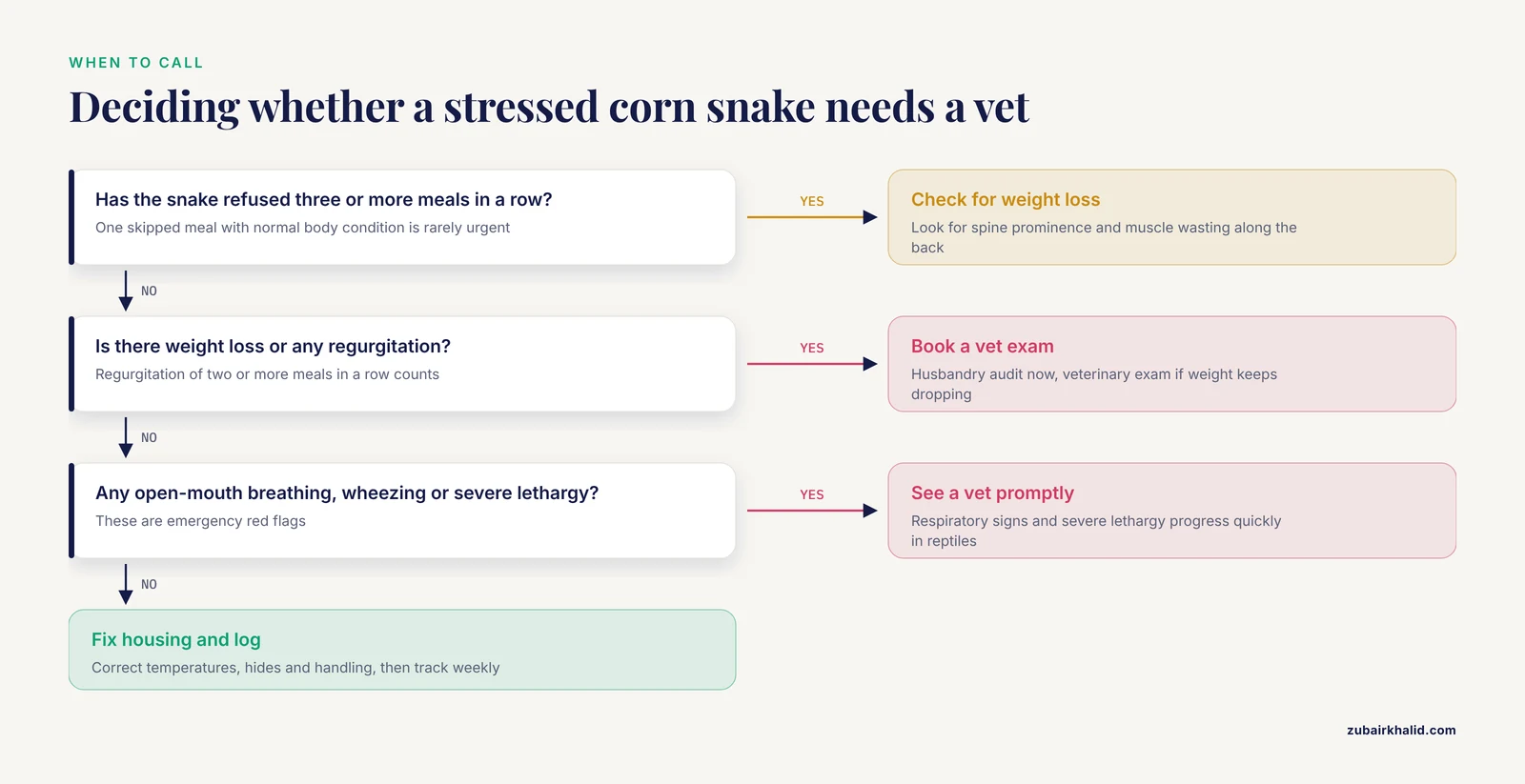
Use this quick guide to decide how urgently to act.
| What you are seeing | Most likely meaning | What to do |
|---|---|---|
| Refusing one meal, otherwise normal | Recent feed, upcoming shed, new environment, seasonal slowdown | Check temperatures, review recent changes, offer food again in 7 days |
| Refusing multiple meals with weight loss | Chronic stress or illness | Husbandry audit now, veterinary exam if weight keeps dropping |
| Hissing, tail rattling, striking when approached | Feeling exposed or insecure, or pain | Evaluate hides, cover, and handling routine, watch for other signs |
| Glass surfing, pacing, pressing against the lid | Encasion too small, too hot, too bare, or too exposed | Review enclosure size, temperature gradient, and clutter |
| Constant hiding, never seen | No secure warm hide, temperatures wrong, or normal cryptic behavior | Verify temperatures, add cover, reduce traffic near the enclosure |
| Rubbing the nose or body along the enclosure | Pre-shed behavior, or enclosure issue if not near a shed | Look for other shedding signs, check enclosure otherwise |
| Open-mouth breathing, wheezing, drooling | Possible respiratory infection, an emergency | Veterinary appointment immediately |
| Regurgitation | Handling too soon after eating, prey too large, temperatures too low, or disease | Stop feeding for a period your veterinarian advises, review feeding and heat, call the vet |
This article is educational and is not a substitute for veterinary diagnosis or treatment.
How Stress Works in a Snake's Body
Stress in reptiles is a physiological event, not just a mood. When a snake perceives a threat it cannot escape, whether that threat is a predator-shaped shadow, a temperature it cannot get away from, or a barren enclosure with nowhere to hide, its endocrine system releases corticosterone, the primary stress hormone in reptiles. Chronically elevated corticosterone suppresses immune function, suppresses appetite, and disrupts normal behavior. A snake living in a constant low-level stress state is a snake that eats irregularly, sheds poorly, and gets sick more easily.
Because snakes do not show stress the way mammals do, researchers have looked for ways to measure it. One practical approach uses shed skins. When a snake sheds, hormones and their metabolites are deposited in the shed skin, so a shed skin can be collected and analyzed for corticosterone without handling or disturbing the animal. A recent study used this non-invasive method to compare corticosterone concentrations in shed skins from three commonly kept snake species, including corn snakes, maintained in two very different housing systems: low-stimulus rack systems and enriched terraria [1].
That research produced two findings that matter directly to corn snake owners. First, corn snakes recorded higher corticosterone concentrations than both boa constrictors and ball pythons in the study, meaning this species shows a pronounced measurable stress signal [1]. Second, housing design affected corn snakes differently from the other species. Corn snakes kept in rack systems showed elevated corticosterone levels, while corn snakes kept in enriched terraria did not [1]. The study also found that the relationship between enclosure volume and corticosterone concentration varied by species, reinforcing that housing needs are not interchangeable across snake species and that corn snakes respond specifically to the environment they are kept in [1].
The practical takeaway is simple. Corn snakes are not ball pythons, and they are not boas. Housing that keeps one species calm can stress another. A corn snake kept in a minimal, featureless setup is carrying a measurable chronic stress load, and that load shows up in the signs described next.
Signs of Stress in Corn Snakes
Stressed corn snake symptoms fall into three clusters: behavior, feeding, and physical condition. No single sign is diagnostic on its own. A corn snake that hides constantly during a two-week shed is behaving normally. A corn snake that refuses food, rattles its tail, and paces the glass for weeks has a problem worth solving.
Behavioral Signs
- Persistent defensive behavior. Hissing, tail rattling against dry substrate, striking, or musking (releasing a foul-smelling secretion) when you open the enclosure or reach in. An occasional startle response is normal. Repeated defensiveness at every interaction means the snake feels chronically unsafe.
- Constant hiding or refusal to emerge. Corn snakes are naturally secretive, especially during the day, but a healthy, comfortable corn snake emerges at dusk and during the warm parts of the day to thermoregulate. A snake that never leaves its hide, even at night, even to eat, is signaling a problem.
- Restless pacing and glass surfing. Repeatedly traveling the perimeter of the enclosure, pressing the nose against the glass, or climbing and pushing at the lid. This is displacement behavior, often driven by an enclosure that is too hot, too small, too exposed, or lacking a secure retreat.
- Excessive soaking or complete avoidance of the water bowl. Spending every hour in the water dish can indicate temperatures are too high, mites are present, or the snake is trying to aid shedding. Avoiding water entirely in a dry environment can signal the opposite problem.
- Nose rubbing against enclosure surfaces. Repeated rubbing along seams, vents, or glass, particularly when it is not associated with an approaching shed, suggests the snake is trying to escape conditions it finds intolerable.
- Freezing or excessive flightiness during handling. A relaxed corn snake moves calmly through your hands. A stressed one either goes rigid, breathes visibly fast, or thrashes to get away.
Feeding-Related Signs
- Food refusal in a snake that previously ate reliably. This is the single most common presenting complaint for stressed corn snakes. One skipped meal with a normal body condition is rarely urgent. Three or more consecutive refusals, especially with weight loss, is a signal to intervene.
- Striking at prey defensively rather than feeding. A stressed snake may strike, coil around the prey item defensively, or ignore it entirely.
- Regurgitation. Bringing back a partially digested meal days after eating is a serious sign. Causes include handling the snake too soon after feeding, prey that is too large, an enclosure too cold to digest, or disease. Regurgitation damages the esophagus and depletes the snake, so repeated episodes need veterinary evaluation.
- Slow, progressive weight loss. A corn snake losing body condition along the spine, with visible muscle wasting, has been off feed or under stress longer than the owner may realize.
Physical Signs
- Incomplete or abnormal sheds. Patchy sheds, retained eyecaps, or shed stuck at the tail tip indicate chronic dehydration, low humidity, or an animal too stressed or too weak to shed properly in one piece.
- Dull, poorly maintained scales outside of the normal pre-shed blue phase.
- Increase in defensive body postures, such as holding the head and neck back in an S-shape, hiding the head under the body, or flattening defensively.
- Visible stress during routine care, such as rapid tongue flicking in a distressed pattern, tense musculature, or rapid breathing when handled.
One important caution. Several of these signs, particularly anorexia, hiding, and dull coloration, overlap with illness and with normal pre-shed behavior. Distinguishing between them is one of the core reasons a physical examination by a reptile veterinarian is valuable when signs persist.
What Causes Stress in Corn Snakes
The causes of stress in corn snakes cluster around five areas. Going through them in order resolves the majority of cases without any medical intervention.
Housing That Fails the Species
Corn snakes are active, semi-arboreal foragers in their native southeastern United States range. They use horizontal space, climb, and explore. Housing that does not give them room to move, places to hide, and visual security produces chronic stress. The shed-skin corticosterone research discussed above found exactly this: corn snakes in minimal rack systems carried higher stress hormone levels than corn snakes in enriched terraria [1]. Enrichment, meaning hides, branches, cover, and substrate depth that lets the snake express natural behavior, is not decorative. It is the variable that separated stressed animals from unstressed ones in that study.
An enclosure that stresses a corn snake typically has some combination of the following problems: too little floor space for the snake to stretch and move, no secure hide on both the warm and cool ends, no cover between hides, a bare glass or plastic interior, or a location in a high-traffic, loud, or brightly lit part of the home.
Thermal Problems
Snakes cannot generate their own body heat. They thermoregulate by moving between warm and cool zones. A corn snake needs a temperature gradient across the enclosure so it can choose. The two classic mistakes both cause stress:
- Too cold overall. Digestion slows or stops, the snake becomes lethargic, food sits undigested, and regurgitation risk rises. This is a common cause of anorexia in winter.
- Too hot, or heat without shade. A heat source that warms the entire enclosure, or a basking spot with no cooler retreat, forces the snake to choose between overheating and staying hungry. Constant soaking in the water bowl is a classic sign of an enclosure running too warm.
Use reliable thermometers to verify actual temperatures at snake level in both zones, not the dial on the heat device. Confirm your target range with an exotics veterinarian, because appropriate values depend on your specific setup and the individual animal.
Handling That Overwhelms the Snake
New corn snakes need time to settle before regular handling begins. Excessive handling, handling right after a meal, handling during the pre-shed phase, and sudden grab-from-above approaches all register as predation events to a snake. Grabbing from above is particularly stressful because overhead approach is how aerial predators attack.
Environmental Intrusion
Corn snakes are prey animals. A enclosure placed in a busy hallway, next to a television, or within sight of a cat or dog creates a constant perceived threat. Cats and dogs staring into a snake enclosure are a direct predator stimulus, and many owners underestimate how much of a snake's day that consumes. Other sources include constant vibration, loud music, nighttime light, and children tapping the glass.
Internal and Medical Causes
Not every stressed-appearing snake is reacting to its environment. Disease causes many of the same signs. Parasites, bacterial infections of the mouth or respiratory tract, mites, impaction, egg retention in females, and organ disease can all present as anorexia, hiding, lethargy, or abnormal posture. Age matters here. Very young snakes are more vulnerable to husbandry errors and dehydrate faster. Older snakes are more likely to have an underlying medical condition driving what looks like behavioral stress. When husbandry is correct and the signs persist, a medical cause moves to the top of the differential list, and that is a veterinary question.
How to Calm a Stressed Corn Snake
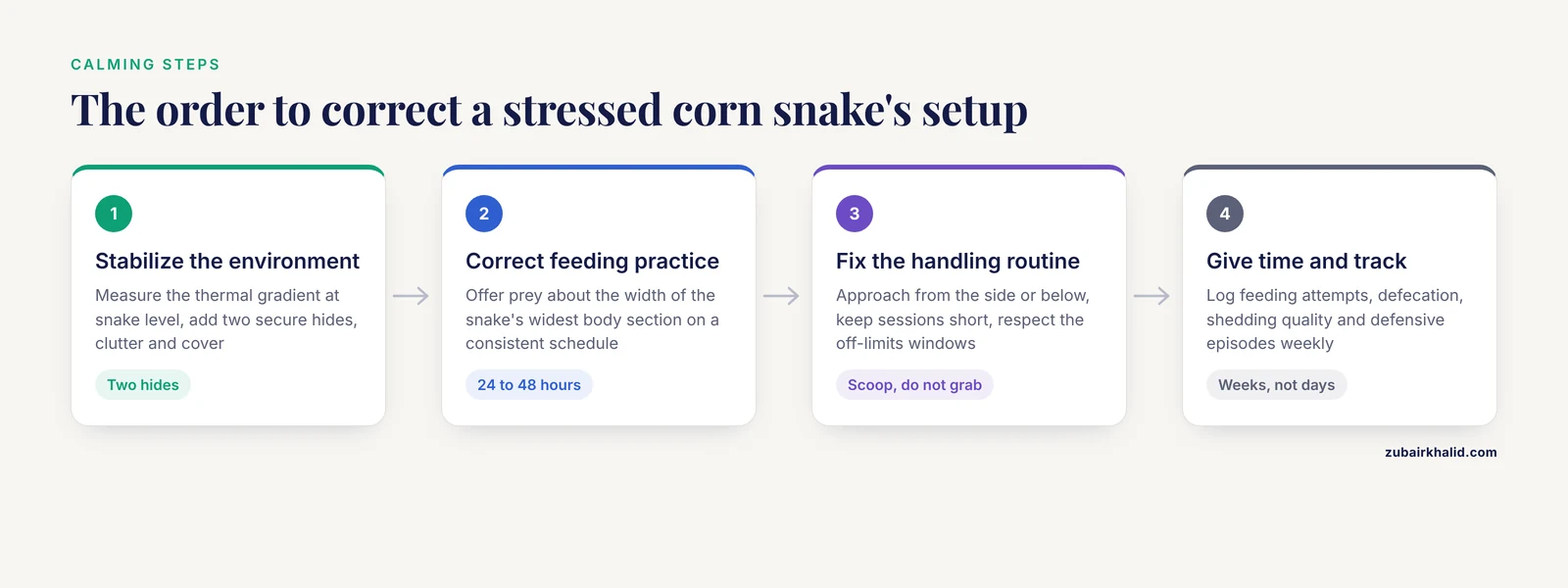
Calming a stressed corn snake means removing the stressor, not treating the symptom. Sedating or distracting the animal while the cause remains in place accomplishes nothing. Work through this sequence.
Step 1: Stabilize the Environment First
- Verify the thermal gradient with actual measurements. Place thermometers at snake level in the warm zone and the cool zone. Adjust the heat source until both zones read in the appropriate range for the species, confirming exact targets with your exotics veterinarian. Under-tank heating or overhead heat designed for reptiles, controlled by a thermostat, is the standard safe approach.
- Provide two secure hides, one on the warm end and one on the cool end. A hide is a snug, enclosed retreat the snake can fully enter. Half-logs sitting in open space do not count. The hide should contact the snake's body on all sides.
- Add clutter and cover. Branches, cork bark, fake foliage, and deep-enough substrate give the snake choices and break up sightlines. This is the enrichment component that research linked to lower stress hormone levels in this species [1].
- Right-size the enclosure. The snake should be able to stretch out fully and move around with purpose. An enclosure that is too small creates the pacing behavior described above. Moving a stressed snake into a larger, well-structured space usually improves matters, provided the new space has abundant hides so the snake does not feel exposed.
- Relocate the enclosure if needed. Move it to a quiet room, out of direct sight of cats and dogs, away from speakers and televisions, and out of constant direct sunlight.
Step 2: Correct Feeding Practice
- Offer appropriately sized prey. A prey item roughly the width of the snake's widest body section is the usual guide. Oversized prey causes regurgitation and meal-associated stress.
- Feed thawed, warmed prey on a consistent schedule, adjusting frequency for the snake's age. Juveniles eat more frequently than adults. Your veterinarian can help you build a schedule matched to your snake's age and body condition.
- Do not handle for at least 24 to 48 hours after a meal, longer for large meals, to allow digestion and prevent regurgitation.
Step 3: Fix the Handling Routine
- Give a new or recently moved snake a settling period. A corn snake adjusting to a new enclosure generally does best with a week or more of minimal contact before regular handling resumes.
- Approach from the side or below, never from directly above. Scoop the snake gently rather than grabbing.
- Keep sessions short and end them calmly. Put the snake back before it shows escalating stress signs, so the experience ends on a neutral note. Handling should be a neutral or mildly positive experience the snake can predict.
- Respect the off-limits windows: the entire pre-shed phase (during the blue-eyed, dull-skinned period), the first 48 hours after eating, and the first days in a new environment.
Step 4: Give It Time and Track Progress
Behavioral improvement in snakes is measured in weeks, not days. Once husbandry is corrected, a useful protocol is to keep a simple log: record feeding attempts, defecation, shedding quality, and any defensive episodes weekly. A snake whose environment is now correct will typically show reduced defensiveness first, followed by renewed interest in food. If the log shows no improvement after a sustained period of correct husbandry, or shows any decline, the case has moved from a behavior problem to a veterinary problem.
Unsafe Home Remedies to Avoid
Well-meaning owners sometimes make stressed snakes worse. Avoid all of the following.
- Force feeding. Never force feed a snake at home. Improper technique causes severe injury, regurgitation, and aspiration. If a snake is not eating, the question of assisted feeding belongs to a veterinarian after a proper exam.
- Prolonged soaking in a sick snake. Short, shallow warm water soaks can help with stuck shed in an otherwise healthy animal, but placing a lethargic or anorectic snake in prolonged soaks causes stress and can worsen underlying disease. Ask your veterinarian before using soaks in a snake showing illness signs.
- Essential oils, incense, or "calming" sprays near the enclosure. Reptile respiratory systems are sensitive, and aromatic compounds can be harmful.
- Heat rocks and unregulated heat sources. Heat rocks cause thermal burns and do not provide a controllable gradient. Any heat source must be thermostatically controlled.
- Over-the-counter medications, dewormers, or supplements dosed by guesswork. Reptile pharmacology is specialized. Incorrect dosing kills.
- Handling the snake more to "socialize" it out of fear. Repeated forced handling deepens the stress response. Confidence comes from security in the environment first, then from short, voluntary, positive interactions.
- Adding live prey and leaving it unattended. A live rodent left with a disinterested snake can seriously injure or kill the snake. Never leave live prey unattended, and prefer thawed prey for routine feeding.
What a Veterinary Examination Involves
When you take a stressed corn snake to a reptile veterinarian, bring three things: your husbandry details (temperatures, enclosure size, substrate, hide placement, feeding records), your weekly log if you kept one, and a fresh fecal sample if possible. Fecal parasite testing is one of the most common and most useful first diagnostics in an anorectic or poorly doing snake.
A typical evaluation includes a full physical examination with body weight and body condition scoring, an oral examination to rule out infection or mouth lesions, palpation, skin inspection for mites, and a review of shedding history. Depending on findings, your veterinarian may recommend a fecal parasite exam, bloodwork, or imaging such as radiographs to evaluate for impaction, organ enlargement, or respiratory disease. Organizations such as the Association of Reptilian and Amphibian Veterinarians (ARAV) maintain owner resources for locating qualified reptile practitioners, and the Merck Veterinary Manual's exotic animal sections provide background reading on common reptile diseases. Neither substitutes for the hands-on exam itself.
The purpose of the exam is to separate the snakes that need treatment from the snakes that need a better enclosure. That distinction cannot be made reliably over the phone or by comparing photos online.
Emergency Red Flags
Go to a reptile veterinarian promptly, the same day when possible, for any of the following:
- Open-mouth breathing, wheezing, clicking sounds, or bubbles and mucus around the mouth or nostrils
- Regurgitation of two or more meals in a row, or regurgitation with blood
- Severe lethargy, the snake not righting itself or not responding to gentle touch
- Prolonged anorexia with visible weight loss or spine prominence
- Burns from heat sources, or any wound
- Visible mites in large numbers, especially around the eyes and Heat pits (corn snakes lack heat pits, so check around the eyes and under scales)
- Straining without production, swelling at the cloaca, or any tissue protruding from the vent
- A shed constricting the tail tip, causing swelling or tissue death beyond it
- Rapid, open-mouth gaping with neck stretching in a warm enclosure, which can indicate overheating or respiratory disease
These findings indicate probable disease or injury rather than husbandry stress, and they progress quickly in reptiles because reptiles often hide illness until it is advanced.
Prevention
Preventing stress in a corn snake costs less than treating the consequences, and the checklist is short.
- Set up the enclosure correctly before the snake arrives, with a working thermal gradient, two secure hides, water, appropriate substrate, and abundant cover.
- Locate the enclosure in a quiet, low-traffic area, out of sight and scent range of cats and dogs.
- Establish a feeding and handling routine, and hold to it.
- Verify temperatures with thermometers on a regular schedule, not once at setup.
- Keep a simple health log so changes in feeding, weight, and shedding are caught early.
- Quarantine and have a fecal exam done for any new snake before it joins a collection, and quarantine new arrivals from existing animals.
The enrichment finding from the shed-skin corticosterone study bears repeating in one sentence here: giving a corn snake a furnished, complex environment rather than a bare minimal one is directly supported as the better welfare choice for this species [1].
Prognosis
For the majority of corn snakes whose stress stems from housing or handling, the prognosis after correct husbandry changes is good. Defensive behavior typically softens first, followed by return of appetite over subsequent weeks. Chronic anorexia with weight loss carries a more guarded outlook, because prolonged fasting depletes a snake's reserves and because the underlying cause may be medical rather than environmental. Cases involving regurgitation, respiratory signs, or advanced weight loss need veterinary treatment before recovery is possible, and the outcome depends on the specific diagnosis. Early intervention, meaning a veterinary exam before the snake has become debilitated, consistently gives the best results.
Limitations and When to Contact a Veterinarian
Every snake is an individual. Husbandry details such as exact temperature targets, enclosure dimensions, and feeding frequency depend on the age, size, and condition of your specific animal, and your exotics veterinarian is the right person to confirm those values for your setup. If your corn snake shows any of the following, contact a reptile veterinarian rather than continuing home management:
- Refusal of three or more consecutive meals, or any refusal combined with weight loss
- Any regurgitation
- Any respiratory sign, including open-mouth breathing or audible breathing
- Defensive behavior that appears suddenly in a previously calm snake, which can indicate pain
- Prolonged hiding combined with lethargy, regardless of how the enclosure looks
- Any condition on the emergency red-flag list above
- Failure to improve after several weeks of verified, corrected husbandry
When in doubt, an examination is the fastest route to an answer. Reptiles compensate for illness for a long time before they look sick, so waiting usually costs more time, money, and snake health than acting early.
Frequently Asked Questions
How do I tell if my corn snake is stressed or just about to shed?
Pre-shed corn snakes go dull and develop cloudy or blue eyes, hide more, eat less, and may rub on enclosure surfaces. This state resolves once the shed is complete, usually within one to two weeks from the start of the blue phase. Stress signs outside a shed window, or signs that continue after a clean shed, point to a husbandry or health issue.
How long does it take a corn snake to settle into a new home?
Most corn snakes need one to two weeks of minimal disturbance to settle, and some take longer. Expect reduced appetite and more hiding during this window. Give the snake hides, cover, correct temperatures, and quiet, and leave handling aside until it is feeding reliably again.
Is it normal for a corn snake to refuse food?
Occasional refusals are common and usually harmless, especially around sheds, after enclosure changes, or during winter slowdowns. Repeated refusals across several weeks, refusal with weight loss, or refusal in a snake with any other sign is not normal and needs investigation, starting with a husbandry audit and moving to a veterinary exam.
Can handling stress my corn snake?
Yes. Handling too soon after arrival, too soon after a meal, during pre-shed, or in a grab-from-above style registers as a predator encounter. Keep early sessions short, approach from the side, respect the off-limits windows, and let the enclosure itself build the snake's confidence first.
Do corn snakes do better in racks or in furnished enclosures?
Research measuring corticosterone in shed skins found that corn snakes kept in minimal rack systems had elevated stress hormone levels compared with corn snakes kept in enriched terraria, a pattern opposite to that seen in ball pythons in the same study [1]. For corn snakes specifically, a furnished, enriched enclosure is the supported welfare choice. Discuss specific setups with your veterinarian.
What does a stressed corn snake look like during shedding?
Some dull coloration, hiding, and reduced appetite are normal during a shed cycle. What is not normal is a shed that comes off in patches, retained eyecaps, a shed stuck on the tail tip, or a snake that seems weak rather than merely reclusive. Those findings suggest dehydration, husbandry problems, or illness, and they warrant a call to your veterinarian.
When should I see a vet for a stressed corn snake?
See a reptile veterinarian when anorexia lasts beyond a few weeks or involves weight loss, when any regurgitation occurs, when respiratory signs appear, when defensive behavior arises suddenly in a previously calm snake, or when corrected husbandry fails to improve the signs over several weeks. Any emergency red flag listed above means the appointment should happen immediately.
Can a stressed corn snake hurt me?
A stressed corn snake may hiss, rattle its tail, musk, or bite, and a strike from an adult corn snake is startling though rarely dangerous. The bite itself is not the concern. The behavior is information. A snake that is defensively escalating is telling you it does not feel secure, and that signal should redirect your attention to the enclosure, the handling routine, or the possibility of pain.