Senior Crested Gecko Care: Aging Signs, Diet, and Comfort
By Dr. Zubair Khalid, DVM, MS, PhD ·

Senior crested gecko care means making three adjustments as your gecko moves past the middle of its life: softer, easier-to-digest feeding with close attention to hydration and calcium, a simplified enclosure with gentle temperatures and low climbing routes, and more frequent health checks so small problems are caught before they become emergencies. Crested geckos commonly live 15 to 20 years in captivity when housed well, which means most of them will spend several years in a senior phase that rewards proactive owners.
This guide explains how old a senior crested gecko usually is, which signs of aging in crested geckos you should watch for, how to shape a senior crested gecko diet, and how to modify the enclosure for comfort. Every recommendation here reflects standard reptile husbandry guidance from veterinary sources, including the Merck Veterinary Manual, VCA Animal Hospitals, the Association of Reptilian and Amphibian Veterinarians, and the evidence-based care guides at ReptiFiles.
This article is educational and is not a substitute for veterinary diagnosis or treatment.
Senior Crested Gecko Care at a Glance
If you only have ten minutes today, here is what matters most. Each item is explained in full below.
| Priority | Action today | Why it matters |
|---|---|---|
| Weigh your gecko | Place the gecko in a container on a gram scale and record the number | Weight trends are the earliest reliable sign of trouble in older geckos |
| Check the diet | Confirm a complete powdered diet is the staple, with insects as a supplement | A balanced complete diet reduces the risk of nutritional disease in aging reptiles |
| Verify temperatures | Confirm the enclosure stays at normal room temperature range with no hot spots above the low 80s Fahrenheit | Overheating is a leading cause of stress and death in crested geckos |
| Add low routes | Add a perch or ledge that runs near the enclosure floor | Older geckos reduce jumping and need safe paths to food and water |
| Schedule a checkup | Book a wellness exam with a reptile veterinarian, ideally one found through ARAV | Baseline exams in the senior years make later illness easier to diagnose |
A five-step checklist for the first week of senior care:
- Record a starting weight, and weigh weekly at the same time of day.
- Photograph your gecko from above and the side for comparison over time.
- Review the diet plan and confirm the powdered staple is being eaten consistently.
- Simplify the enclosure by adding low perches and a floor-level hide.
- Locate a reptile veterinarian near you using the ARAV member directory.
Crested Gecko Lifespan and How Old a Senior Crested Gecko Really Is
The crested gecko lifespan in captivity is long. Evidence-based husbandry guides such as ReptiFiles list a typical captive lifespan of 15 to 20 years, with some individuals living even longer under excellent care. VCA Animal Hospitals also notes that crested geckos are long-lived pets when their basic needs for temperature, humidity, and diet are met.
So how old is a senior crested gecko? There is no single official birthday that turns a gecko into a senior, and no veterinary organization publishes a fixed age cutoff for this species. A practical working definition is to treat your gecko as senior when it reaches roughly the last third of its expected lifespan, which for most healthy captive crested geckos lands somewhere in the early teens. In practice, many owners begin senior-style care around 10 to 12 years of age. The right moment for your individual gecko depends on its weight history, breeding history, and general vigor, and it is a good question to raise with a reptile veterinarian during a routine exam.
Age matters less than trend. A 14-year-old gecko eating well, holding weight, shedding cleanly, and moving normally is aging gracefully. A 9-year-old gecko losing weight and refusing food is already having a problem, regardless of what the calendar says. This is why the single most useful senior care habit is record keeping: regular weights, photos, feeding notes, and shed logs give you and your veterinarian a baseline to measure against.
Two factors influence how a gecko ages:
- Early life care. Geckos raised with proper calcium and vitamin support, appropriate temperatures, and adequate space tend to arrive at old age with fewer structural problems such as metabolic bone disease.
- Reproductive history. Female crested geckos that laid eggs regularly through their lives carry a higher lifetime nutritional and physical cost, and they often need closer weight and calcium monitoring in later years.
Why Senior Care Looks Different for Reptiles
Reptiles age differently from mammals, and the differences shape every recommendation in this article. According to the Merck Veterinary Manual, reptiles are ectotherms, meaning their body temperature and metabolism depend on their environment, and their husbandry must be managed precisely across their entire lives because environmental errors accumulate over years. An old gecko that has spent a decade at slightly wrong humidity or slightly wrong temperatures may show the cumulative effects in kidney, skin, and bone health.
Aging in reptiles commonly shows up as reduced activity, slower digestion, changes in skin quality and shedding, and reduced reserves to compensate for illness. The Merck Veterinary Manual emphasizes that anorexia, or loss of appetite, in a reptile is a sign of underlying disease rather than a disease itself, and that husbandry review is always part of the diagnostic workup. For senior geckos, this means any appetite change deserves attention, even when the gecko otherwise looks fine.
There is also a practical reality specific to arboreal geckos like crested geckos. They live in vertical space, jump between branches, and grip smooth surfaces with lamellae on their toes. Age-related reductions in muscle mass, grip strength, and vision make jumping and climbing riskier. A senior enclosure anticipates this rather than waiting for a fall.
Signs of Aging in Crested Geckos
Signs of aging in crested geckos appear gradually, and the earliest ones are easy to miss unless you are looking for them. Watch for changes across five categories: body condition, skin, movement, appetite, and behavior. Some changes are normal aging, while others signal disease, and the difference is not always obvious. When a change is new, rapid, or paired with weight loss, treat it as a medical question and contact a reptile veterinarian.
Body condition and weight changes
Healthy adult crested geckos are typically well muscled with rounded limbs and a tail that, if present, is plump at the base. In the senior years, watch for:
- Gradual loss of muscle over the limbs and jaw, even when total body weight seems stable
- A more prominent spine or hip bones, which suggests the gecko is drawing down reserves
- Weight gain, which is also a concern because obesity stresses joints and organs
- A waxy or sunken appearance around the eyes, which can reflect dehydration or general decline
Weigh weekly. A gram scale accurate to the gram is inexpensive and is the best early-warning tool you own. A loss of more than a few grams in a short period, or a steady downward drift over several weeks, warrants a veterinary visit even if the gecko still eats.
Skin and shedding
Older skin sheds less cleanly. Senior geckos often need extra humidity support during sheds, particularly around the toes and the tip of the tail, where retained shed constricts circulation. The Merck Veterinary Manual describes dysecdysis, or abnormal shedding, as a common reptile problem that is usually rooted in improper humidity, and notes that retained shed can cut off blood flow to digits if not addressed.
In a senior gecko, also watch for:
- Dry, flaky patches between sheds
- Shed that sticks around the toe tips for more than a day or two after a shed cycle
- Sores or discoloration on the underside, which can indicate a skin infection or a husbandry problem such as a wet, unsanitary substrate
Gentle help with a stuck shed is safe when done correctly. Increase humidity, provide a humid hide, and if a toe tip still holds shed after a humid soak environment has been available, contact your veterinarian rather than pulling at the skin, because the underlying skin is fragile and tears easily.
Movement, grip, and jumping
Normal aging brings quieter movement. An older gecko may:
- Walk or climb more and jump less
- Choose lower perches it used to ignore
- Rest in the open more often, sometimes in slightly odd positions
- Show a weaker grip on smooth glass or plastic surfaces
Weakness is different from slowness. Trembling limbs, an inability to lift the body off the ground, a floppy or kinked tail base, or difficulty closing the jaw are red flags for metabolic bone disease, a disorder of calcium and vitamin D3 metabolism that the Merck Veterinary Manual describes as one of the most common nutritional diseases of reptiles and one that can develop or worsen at any age when dietary calcium and ultraviolet lighting are inadequate. Metabolic bone disease is treatable when caught early, but the bone changes are not always reversible, which is why prevention and early detection matter enormously in senior geckos.
Appetite and digestion
Appetite often becomes more selective with age. Older geckos may eat their powdered staple reliably but lose interest in chasing insects, or they may eat smaller amounts at each feeding. Slower digestion is also normal, so senior geckos may pass stool less frequently than they did as young adults.
What is not normal:
- Complete refusal of all food for more than a week in a gecko that was eating well
- Rapid weight loss while still eating
- Regurgitation, diarrhea, or smearing of stool
- A bloated, hard abdomen
The Merck Veterinary Manual lists anorexia as one of the most common presenting complaints in reptile medicine and stresses that it requires veterinary investigation rather than watchful waiting, especially when combined with weight loss. Extended anorexia in an already old animal depletes reserves quickly.
Behavior and sensory changes
Senior geckos often become more deliberate. They may bask in a favorite spot for longer periods, respond more slowly to movement near the enclosure, and show less interest in exploring during changes to the cage. Reduced activity alone is not disease. Reduced activity plus weight loss, poor shedding, or appetite change is a pattern that needs a veterinary exam.
Crested geckos are nocturnal, so evaluate behavior in the evening hours when the gecko is naturally active. Judging an old gecko as lethargic from its daytime posture leads to wrong conclusions, because resting motionless during the day is normal for this species at every age.
Senior Crested Gecko Diet
A senior crested gecko diet keeps the same foundation as the adult diet but adjusts texture, frequency, and supplementation to match slower metabolism and changing teeth, jaws, and digestion. The goal is to maintain stable weight, support hydration, and prevent the nutritional diseases that become harder to reverse in old age.
The staple: complete powdered diet
Complete powdered meal replacement diets mixed with water remain the correct staple for crested geckos of every age, including seniors. These products are formulated to provide balanced nutrition, which matters even more in older animals because the margin for dietary error narrows with age. Offer fresh mixed diet every one to two days, remove uneaten food promptly, and watch which consistency your senior gecko actually eats.
Consistency is where senior diets diverge from adult diets. Many older geckos prefer a runnier mix. Thinning the powder with extra water does two useful things at once: it makes the food easier to lap and swallow, and it increases water intake, which supports kidney function and helps prevent dehydration, a common problem in aging reptiles. If your gecko only eats very runny food, that is acceptable and often temporary.
Insects: adjust, do not eliminate
Live insects are not mandatory for crested geckos, but they provide enrichment, exercise, and high-quality protein. VCA Animal Hospitals notes that crested geckos accept insects and that gut-loaded, appropriately sized feeder insects are a useful part of the diet when offered alongside a complete staple. In the senior years, adjust insect feeding to match your gecko's abilities and appetite:
- Offer soft-bodied feeders rather than large, hard-shelled insects if chewing seems labored
- Choose feeders that are appropriately small relative to the gecko's head
- Reduce frequency if the gecko shows less interest rather than leaving live prey in the enclosure, where crickets can harass or even bite a slow-moving gecko
- Gut-load feeders before offering them, because the nutritional value of an insect depends on what it has eaten
Some senior geckos stop taking insects entirely and thrive on the powdered staple alone. Others keep chasing insects into old age. Follow your individual gecko, and use the scale and the stool output as your judges rather than a fixed rule.
Hydration is the senior priority
Dehydration is one of the quiet killers of older reptiles. The Merck Veterinary Manual identifies inadequate water access and inappropriate humidity among the most common husbandry-related illness factors in captive reptiles. For senior crested geckos:
- Mist the enclosure regularly so the gecko can drink droplets from leaves and enclosure walls, the way this species drinks naturally
- Maintain a humidity cycle in which the enclosure is moist after misting and dries somewhat before the next misting, since constantly saturated enclosures cause skin and respiratory problems
- Provide a shallow water dish as a backup, cleaned and refilled frequently, even though many crested geckos ignore standing water
- Offer runnier food during warm periods or any time shed skin looks dry
Signs of dehydration include sunken eyes, wrinkled or tented skin that does not flatten quickly when gently pinched, dry urate in the droppings, and lethargy. These findings warrant same-week veterinary contact, and dehydration in a senior gecko often needs professional fluid support rather than home misting alone.
Calcium, vitamin D3, and supplementation
Calcium metabolism is central to reptile health, and the stakes rise with age. The Merck Veterinary Manual explains that nutritional secondary hyperparathyroidism, commonly called metabolic bone disease, results from a dietary calcium to phosphorus imbalance, inadequate vitamin D3, or lack of appropriate ultraviolet light exposure, and that it causes softening and deformation of bones, tremors, and weakness.
For a senior gecko on a complete powdered staple, the diet itself is already balanced, which is a major advantage. Where supplementation enters the picture is with insect feedings. Insects are inherently phosphorus-rich and calcium-poor, so feeders should be gut-loaded and dusted with a calcium supplement according to a plan you discuss with your veterinarian or that follows the product label and current reptile husbandry guidance. Whether your senior gecko needs added vitamin D3 or benefits from ultraviolet lighting is an individual question, and it is one of the best topics for a senior wellness exam, because the answer depends on your lighting setup, your diet, and your gecko's health history.
One caution applies to every senior gecko: more supplementation is not better. Excess supplementation can cause its own problems, so avoid stacking multiple products without a plan.
Feeding schedule adjustments for seniors
A practical senior feeding routine looks like this:
- Offer fresh complete diet in a low, stable dish every evening or every other evening.
- Offer insects once or twice weekly if your gecko still hunts, dusted and gut-loaded as planned with your veterinarian.
- Track how much is eaten at each feeding in a simple log.
- Weigh weekly and compare against the log.
- Remove uneaten food within a day to keep the enclosure sanitary.
If your gecko has trouble reaching an elevated feeding ledge, move the food to a floor-level dish. Many senior geckos stop using high ledges before they stop eating, and a simple dish on the substrate solves the problem.
Comfort and Habitat Adjustments for Older Geckos
Senior crested gecko care is mostly enclosure design. The goal is to preserve normal behavior while removing the risks that an older body cannot tolerate.
Temperature without heat stress
Crested geckos are unusual among pet reptiles because they need no basking spot and no heat lamp in most homes. VCA Animal Hospitals notes that crested geckos do well at ordinary room temperature and that sustained heat is dangerous for them. ReptiFiles similarly emphasizes that temperatures above the low 80s Fahrenheit are harmful and that overheating kills crested geckos more reliably than coolness does.
For seniors, temperature discipline becomes even more important because old animals have less tolerance for thermal stress. Keep the enclosure in the range recommended for the species, avoid placing the cage near windows that receive direct sun, and check that any household heating changes, such as a new space heater or a summer heat wave, are not pushing the enclosure past safe temperatures. A simple digital thermometer placed in the enclosure lets you respond before the gecko suffers.
If your home runs cool in winter, gentle heating that never creates a hot spot is appropriate, and a low-wattage heat source controlled with a thermostat is the standard safe approach for any reptile heating. Discuss specific equipment with your veterinarian or follow a current evidence-based guide rather than improvising.
Humidity and shedding support
Crested geckos need moderate humidity with a wet-dry cycle, and ReptiFiles describes a routine of regular misting that allows the enclosure to dry between sprays as the healthiest pattern for skin and respiratory health. Seniors benefit from:
- Consistent misting on a schedule rather than occasional heavy soaking
- A humid hide, a sheltered box containing damp sphagnum moss, where the gecko can sit during a shed
- Prompt cleaning of any damp, soiled substrate, because wet waste promotes skin and shell-mouth infections
Lower, safer climbing
This is the single most valuable physical modification for an old crested gecko. Rearrange the enclosure so everything the gecko needs is reachable without big jumps:
- Place cork bark, vines, and branches so that gaps between holds are short rather than spanning
- Add a long, gentle ramp or low ledge connecting mid-height perches to the floor
- Position the food dish and any water dish at floor level or on a very low ledge
- Include at least one secure hide at floor level so the gecko never has to climb to rest
- Keep foliage dense enough that a slip ends in leaves rather than a hard landing
Do not remove all vertical space. Climbing is normal behavior and exercise for this species, and an enclosure that is too empty reduces enrichment. The aim is graduated options, from floor to mid-height, with safe routes between them.
Substrate, cleaning, and hygiene
Older geckos spend more time on the floor, so the floor must be safe and clean. ReptiFiles recommends substrates that hold humidity and carry no impaction or chemical risk for this species, such as appropriate bioactive setups or paper-based options. Whatever substrate you use, spot-clean waste promptly and do a deeper clean on a regular schedule, because an older immune system handles environmental bacterial load less well.
Lighting and day-night rhythm
Crested geckos do not require intense basking lamps, but a stable day-night cycle supports normal behavior and appetite. Whether ultraviolet lighting benefits your senior gecko, and if so at what intensity, is a question worth settling with your reptile veterinarian, since the answer interacts with diet and supplementation. Any light chosen must not add unwanted heat, given this species' low heat tolerance.
Stress reduction
Old animals have less reserve for handling stress. Reduce it by:
- Keeping the enclosure in a quiet room away from traffic, televisions, and other pets
- Maintaining a consistent light and dark cycle
- Handling gently, briefly, and low over a soft surface
- Avoiding enclosure redecorations except when they improve senior comfort
- Never housing crested geckos together if they show any aggression, since fighting injuries heal slowly in old geckos
A Practical Weekly Routine for Senior Crested Gecko Care
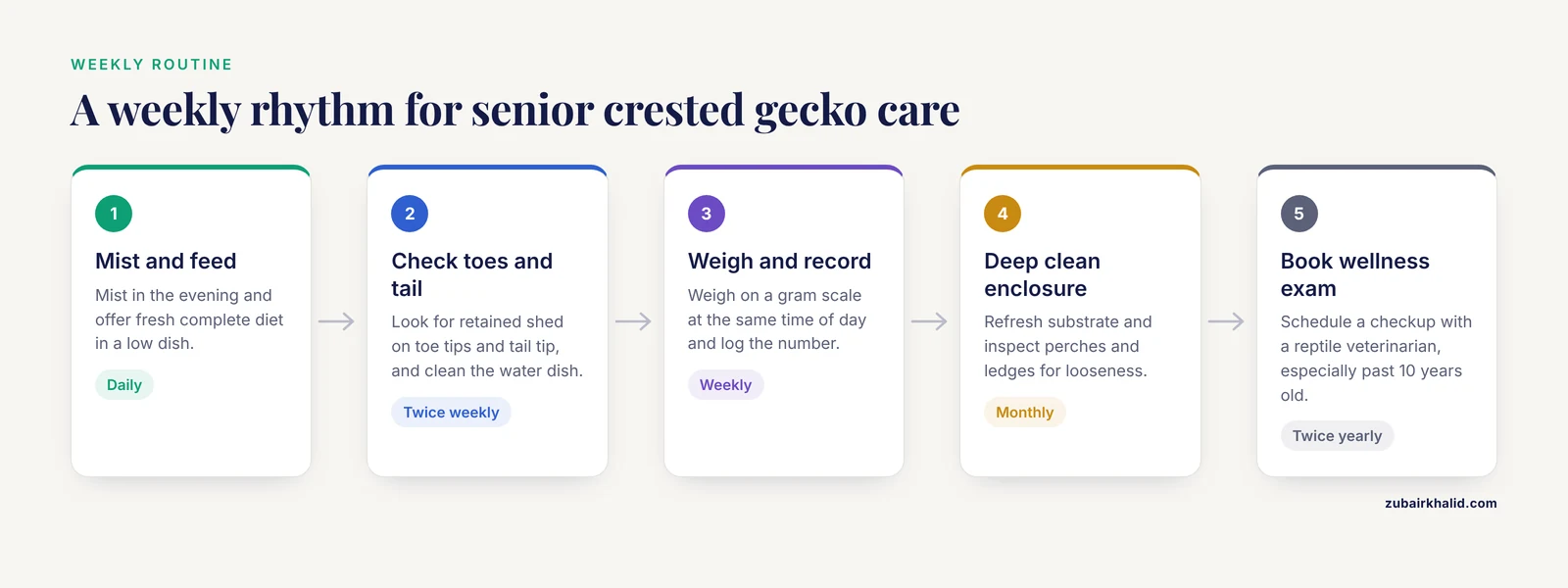
Consistency turns all of the above into a manageable habit. Here is a weekly routine you can start immediately.
Daily:
- Mist in the evening on your established schedule.
- Offer fresh complete diet in a low dish.
- Remove uneaten food the following morning.
- Glance at posture, breathing, and stool.
Twice weekly:
- Offer insects if your gecko still hunts them, gut-loaded and supplemented as planned.
- Check toes and tail tip for retained shed.
- Refill and clean the water dish.
Weekly:
- Weigh and record.
- Photograph from above and the side if you are tracking a change.
- Spot-assess humidity and temperature readings with your digital gauges.
- Check the humid hide and refresh moss as needed.
Monthly:
- Deep-clean the enclosure and replace or refresh substrate as appropriate.
- Inspect perches and ledges for looseness, since a fall from a failed hold is a serious injury risk for an old gecko.
- Review your log for trends in weight, appetite, and stool.
Twice yearly:
- Schedule a wellness exam with a reptile veterinarian, particularly once your gecko is past 10 years old.
Health Problems That Become More Common With Age
Several conditions show up more often in older crested geckos or in geckos whose lifetime husbandry was imperfect. None of them should be treated at home without a diagnosis, and all of them are easier to manage when caught early.
Metabolic bone disease and related bone problems. Caused by dietary calcium imbalance, inadequate vitamin D3, or insufficient ultraviolet exposure, this disease produces soft or deformed bones, tremors, weakness, and difficulty eating. In seniors it can mimic ordinary aging, which is why jaw weakness, limb tremors, or a floppy tail deserve an exam rather than dismissal.
Kidney decline. Chronic dehydration and long-term husbandry errors stress reptile kidneys over years. Weight loss, increased drinking, gout-related swelling, and general decline in an older reptile are among the presentations veterinarians associate with kidney disease, and the Merck Veterinary Manual lists dehydration and improper husbandry among the contributing factors to serious reptile illness. Increased hydration support is your best preventive tool.
Stuck shed and skin infections. Slower, less complete shedding plus a long-lived body makes dysecdysis and secondary skin infections recurring risks in seniors. Humid hides and clean substrate prevent most episodes.
Mouth and jaw problems. Difficulty lapping food, dropping food, or rubbing at the mouth can reflect jaw weakness from metabolic bone disease, mouth infection, or an oral mass. These findings always need a veterinary exam.
Reproductive disease in females. Female crested geckos can produce eggs even without a male, and repeated egg production over a lifetime is a recognized source of calcium drain and reproductive disease in this species. An old female that becomes restless, stops eating, or shows abdominal swelling needs urgent evaluation for egg retention, because this condition is a genuine emergency.
Parasites. Internal parasites can burden a senior gecko more heavily than a young one because reserves are lower. Veterinarians diagnose them through fecal testing, which is one of the simplest and most informative tests a senior reptile can receive.
Working With a Reptile Veterinarian
Not every small animal hospital sees reptiles, and crested geckos deserve a veterinarian with specific exotic animal training. The Association of Reptilian and Amphibian Veterinarians maintains a public member directory precisely for this purpose, and it is the fastest way to find qualified care near you.
A senior wellness exam typically includes a hands-on physical examination, a weight check, a review of your husbandry and diet, and often a fecal parasite screening. Establishing this baseline while your gecko is stable pays off later, because a veterinarian who knows your gecko's normal values can identify disease earlier and treat it more precisely. Ask at the visit about which supplementation plan and lighting approach make sense for your specific setup, and about how often your individual gecko should be seen, since seniors with chronic conditions often benefit from more frequent monitoring.
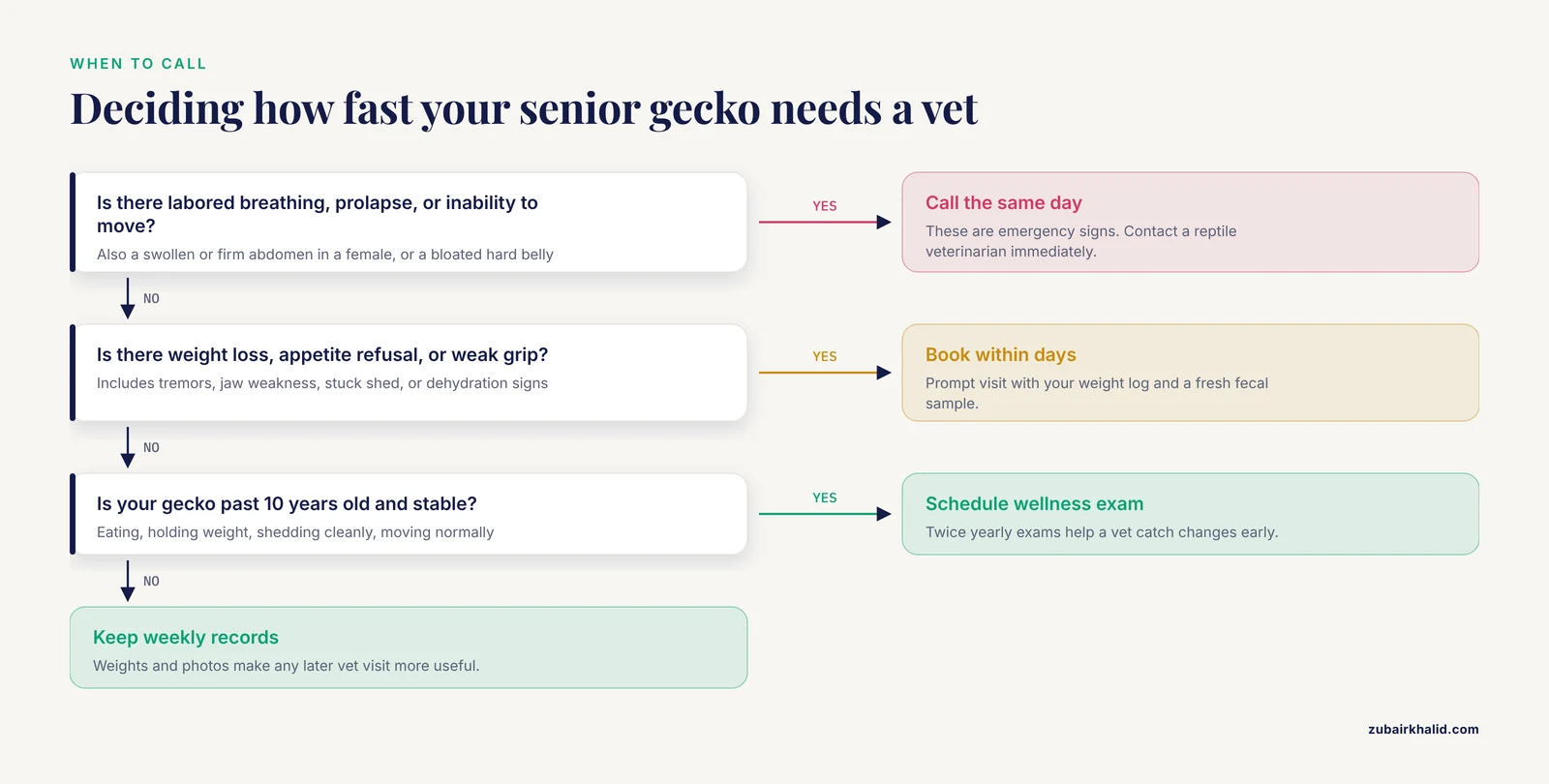
If your gecko shows any emergency sign, such as labored breathing, a swollen abdomen in a female, an inability to move normally, tremors, or complete refusal of food with weight loss, contact a reptile veterinarian immediately rather than waiting for a scheduled appointment.
Common Mistakes in Senior Crested Gecko Care
Avoid these errors, which account for most preventable problems in older geckos:
- Attributing every change to age. Weight loss, appetite loss, and weakness are disease signs until a veterinarian proves otherwise. Age is a context, not a diagnosis.
- Adding heat. Heat lamps and heat mats designed for basking reptiles can overheat and kill a crested gecko, which is adapted to mild temperatures.
- Letting humidity crash during sheds. Skipping misting during a shed week sets up stuck shed and toe injuries.
- Abandoning the balanced staple for a homemade mix. Older geckos have no nutritional margin. A complete powder beats improvised feeding.
- Leaving live crickets in the cage overnight. Crickets bite resting geckos, and an old gecko cannot escape them.
- Pulling stuck shed off by force. Tearing live skin beneath causes wounds and infections. Humidity first, veterinary help second.
- Stopping weight records because nothing seems wrong. Trends are invisible without data. Weekly weighing is the cheapest diagnostic test you own.
- Handling a visibly weak gecko as usual. A gecko with poor grip strength falls easily. Handle low, over soft surfaces, or not at all until it is evaluated.
Troubleshooting Common Senior Gecko Problems
My senior gecko stopped eating its insects but still licks the powder. This is common and usually acceptable. Slower hunting reflexes and reduced interest in live prey are typical aging changes. Keep offering small, soft feeders occasionally, and rely on the complete staple for nutrition. If total food intake drops or weight falls, call your veterinarian.
My gecko will not climb to the feeding ledge anymore. Move the food to floor level today. This is one of the easiest and highest-impact senior modifications, and most geckos resume eating immediately once food is reachable.
Shed keeps sticking on the toes. Increase misting frequency, keep a humid hide available at all times, and check the toe tips after every shed. If skin remains wrapped around a toe after a full humid shed cycle, see your veterinarian, because retained shed constricts the digit and can cause loss of the toe.
My gecko seems wobbly and its grip is weak. Do not wait. Weakness and tremors are classic signs of metabolic bone disease, which requires veterinary diagnosis and prescription-strength treatment. Review your diet and lighting in the meantime, but the exam comes first.
Weight is dropping despite eating. Weight loss while still eating points to conditions such as parasites, dental or jaw problems, kidney disease, or poor nutrient absorption. Bring your weight log and a fresh fecal sample to the appointment.
Handling, Enrichment, and Quality of Life
Old geckos still benefit from gentle interaction and environmental interest. Keep handling sessions short, support the whole body, stay low over a bed or soft surface, and end the session before the gecko shows stress signals such as rapid breathing or frantic movement. Enrichment for seniors can be as simple as rotating safe foliage, offering insects in a shallow dish for supervised foraging, and rearranging a low perch occasionally.
Quality-of-life assessment in a senior gecko comes down to four questions you can answer honestly each month:
- Is it eating its staple reliably?
- Is its weight stable?
- Is it moving, climbing, and exploring within its new normal?
- Is it shedding cleanly and passing normal droppings?
Sustained no across several of these, particularly weight and appetite, means it is time for a veterinary conversation about comfort and next steps.
Limitations and When to Contact a Veterinarian
This article reflects published veterinary guidance for general reptile husbandry and species-specific care, but individual geckos vary widely in health history, body condition, and tolerance for change. Decisions about supplementation schedules, lighting, and treatment of any illness belong with a reptile veterinarian who has examined your animal. When in doubt, call.
Contact a reptile veterinarian promptly, within days, for:
- Any unexplained weight loss of more than a few grams, or a steady downward trend over several weeks
- Refusal of all food for more than about a week in a previously eating gecko
- Limb tremors, jaw weakness, a floppy or kinked tail, or inability to grip normally
- Stuck shed that persists around toes or the tail tip after humidity support
- Sunken eyes, wrinkled skin, dry urates, or other dehydration signs
- Any lump, swelling, wound, or mouth abnormality
Contact a reptile veterinarian immediately, the same day, for:
- Open-mouth breathing, wheezing, or mucus around the nostrils
- A swollen or firm abdomen in a female, which can indicate egg retention
- Inability to move, use the limbs, or right itself
- Regurgitation, blood in the stool, or a bloated, hard belly
- Prolapse of tissue from the vent
- Trauma from a fall or a cage mate fight
Veterinary telehealth can be useful for triage questions, but a physical examination, weight measurement, and fecal or blood testing cannot be done remotely, so in-person care is the standard whenever a senior gecko is visibly unwell.
Frequently Asked Questions
How old is a senior crested gecko?
Most keepers treat crested geckos as senior once they reach roughly the last third of their expected lifespan, commonly around 10 to 12 years of age, since captive lifespans often reach 15 to 20 years. There is no official age cutoff, so use your gecko's weight trend and vigor, and discuss the timing with a reptile veterinarian.
What is the typical crested gecko lifespan in captivity?
Crested geckos commonly live 15 to 20 years in captivity with good husbandry, and some live longer. This makes them a long-term commitment and means most owners will care for a senior gecko for several years.
What are the first signs of aging in crested geckos?
The earliest signs are usually reduced jumping, a preference for lower perches, more selective appetite, slower and less complete sheds, and gradual muscle thinning over the limbs. Weekly weighing catches these changes earlier than visual inspection alone.
What should a senior crested gecko diet include?
A complete powdered meal replacement diet mixed with water should remain the staple, offered every one to two days. Many seniors prefer a runnier mix, which also boosts hydration. Insects can continue as an occasional supplement if they are gut-loaded and appropriately sized.
Should I still feed insects to an older crested gecko?
Yes, if your gecko still shows interest and can handle them. Offer small, soft-bodied, gut-loaded feeders a couple of times per week, and do not leave live crickets unattended in the cage overnight. Some seniors thrive on the powdered staple alone.
How often should I weigh a senior crested gecko?
Weigh weekly at the same time of day using a gram scale, and keep a written log. A steady downward trend or a rapid drop of several grams is one of the most reliable early signs of illness and warrants a veterinary visit.
Do senior crested geckos need heat?
No. Crested geckos do well at ordinary room temperature, and sustained heat above the low 80s Fahrenheit is dangerous for them at any age. Protect the enclosure from direct sun, space heaters, and hot rooms.
When should I take my senior crested gecko to the vet?
Schedule a wellness exam with a reptile veterinarian around the time your gecko enters its senior years, then follow your veterinarian's monitoring plan. Seek care promptly for weight loss, appetite refusal, tremors, weak grip, stuck shed, dehydration signs, or breathing difficulty, and seek same-day emergency care for a swollen abdomen in a female, a prolapse, or inability to move.