Senior Corn Snake Care: Aging Signs, Diet, and Comfort
By Dr. Zubair Khalid, DVM, MS, PhD ·

Senior corn snake care means recognizing when your snake has reached the later third of its expected lifespan, then adjusting feeding, enclosure design, and health monitoring to match a slower metabolism, reduced muscle tone, and a higher risk of chronic disease. A senior corn snake does not need a completely new husbandry plan. It needs the same correct thermal gradient, humidity, and hides it has always needed, delivered with smaller and less frequent meals, easier access to warmth and water, and closer observation for weight loss, shedding problems, and respiratory or neurologic signs.
Corn snakes (Pantherophis guttatus) are among the longest-lived pet snakes, and a well-kept individual frequently outlives the dog or cat in the same household. That longevity is exactly why aging deserves attention. Reptiles decline gradually, and early changes are easy to miss until they become medical problems. This guide walks through how to judge when your snake is senior, which changes are normal aging versus warning signs, how to adapt the diet, and how to set up the enclosure so an older snake can thermoregulate, digest, and move comfortably.
This article is educational and is not a substitute for veterinary diagnosis or treatment.
At a Glance: Senior Corn Snake Care Checklist
| Priority | What to Do | How Often |
|---|---|---|
| Weight and body condition | Record weight and body condition score on the same scale | Monthly |
| Feeding | Offer appropriately sized prey on a reduced schedule, adjust to your snake's body condition | Per your veterinarian's plan, often longer intervals than younger adults |
| Hydration | Refresh the water dish daily, monitor skin folds and shed quality | Daily |
| Thermal gradient | Verify warm and cool zone temperatures with a digital thermometer or temperature gun | Weekly, and after any equipment change |
| Humidity and shedding | Check humidity, inspect sheds for retained eye caps or tail tips | Each shed cycle |
| Physical exam | Annual wellness examination with a reptile veterinarian, more often if problems appear | At least yearly |
| Behavior log | Note activity level, tongue flicking, feeding response, and defecation | Each feeding and handling session |
| Quarantine | Quarantine any new reptile before it shares airspace or equipment with your senior snake | Always, minimum 60 to 90 days per standard reptile practice |
How Old Is a Senior Corn Snake?
The most common question in senior corn snake care is a definition question. How old is a senior corn snake?
There is no single universal cutoff, because snakes age at different rates depending on genetics, husbandry, and reproductive history. In captivity, corn snakes commonly live 15 to 20 years, and documented individuals have exceeded that range under excellent care, according to mainstream reptile husbandry references such as the Merck Veterinary Manual and VCA Animal Hospitals care guides. A widely used practical approach is to consider a corn snake senior at roughly two-thirds of its expected lifespan. For a corn snake with a typical captive lifespan in the mid-to-high teens, that places the senior transition somewhere around 10 to 14 years of age.
Three points help owners use that number sensibly:
- Chronological age is a screening tool, not a diagnosis. A 12-year-old corn snake that feeds aggressively, sheds cleanly, and maintains muscle tone may not need feeding changes yet. A 9-year-old snake with a poor feeding response and weight loss needs a veterinary workup regardless of age.
- Wild-caught vs. captive-bred origin changes the math. If you adopted an adult snake without hatch records, estimate age from size, head width, and history from the previous keeper, then treat the estimate as a minimum and monitor function rather than birthdays.
- Captivity extends lifespan dramatically. Corn snakes in the wild face predators, parasites, and food scarcity. Protected captives routinely live far longer, which is why the senior phase of a pet corn snake is a genuine life stage rather than a brief end-of-life window.
The Association of Reptilian and Amphibian Veterinarians (ARAV) encourages reptile keepers to establish a baseline of normal values for their individual animals, including weight, feeding intervals, and behavior. That baseline is what makes the senior transition detectable. Without records, subtle decline hides in plain sight.
Why Aging Matters Differently in Reptiles
Aging, across species, is the accumulation of molecular and cellular damage that gradually reduces organ reserve and increases the risk of chronic disease [1]. Researchers in geroscience describe aging and age-related disease as a continuum that shares common underlying mechanisms, with individual animals moving along it at different speeds [2]. Those principles apply broadly, but reptiles add a twist that matters enormously for care.
Because snakes are ectotherms, their metabolic rate depends on environmental temperature. A corn snake kept at appropriate temperatures processes food, heals, and fights infection far better than one kept chronically cool. In practical terms, this means two senior corn snakes of identical age can be biologically very different animals. The one with a correct thermal gradient, good hydration, and a stable diet has likely aged more slowly.
Organ-specific decline is also relevant. Studies of age-related changes in liver structure and function show that hepatic reserve diminishes with age even in the absence of overt disease [3]. For a snake, whose liver handles the enormous metabolic load of digesting whole-prey meals, this is one plausible mechanism behind the slower digestion and longer post-feeding recovery many owners observe in older animals. Research in other animals also documents age-related shifts in gut microbiota composition [4], which may influence how efficiently an older snake extracts nutrition from a meal, although reptile-specific data in this area remain limited.
The practical takeaway is straightforward. Aging in a corn snake is not a single event. It is a slow reduction in physiological reserve, and the job of senior care is to reduce unnecessary demands on that reserve while watching closely for the diseases that become more common late in life.
Signs of Aging in Corn Snakes
Signs of aging in corn snakes fall into two groups: expected changes that reflect normal senescence, and red flags that look like aging but signal disease. Confusing the two is the most costly mistake owners make, because several serious conditions in snakes mimic benign slowing.
Expected, gradual changes
- Reduced activity and exploratory behavior. An older snake may spend more time in its hide, move with less urgency, and show less interest in climbing. Muscle mass along the body can subtly decrease, a pattern that in other species is recognized as age-related loss of muscle and functional reserve.
- Longer digestion times. You may notice defecation occurring later after a meal than it used to, reflecting slower metabolic processing.
- Longer intervals between meals without weight loss. A senior snake may voluntarily skip or accept food less eagerly while maintaining body condition.
- Changes in color and pattern. Colors may soften or darken subtly with age. In corn snakes, some morphs also change appearance over their lives independently of aging, so gradual rather than sudden change is the relevant feature.
- Thicker, more irregular scales or rougher skin texture. Very old snakes can develop slightly coarse scale texture, and shedding may become less perfectly complete.
- Cloudiness during sheds that resolves normally. The pre-shed blue phase can look more pronounced, but the shed itself should still come off in one piece if husbandry is correct.
- Reduced breeding behavior. Older males may show less seasonal restlessness, and older females may cycle less reliably or stop producing follicles.
Red flags that are not normal aging
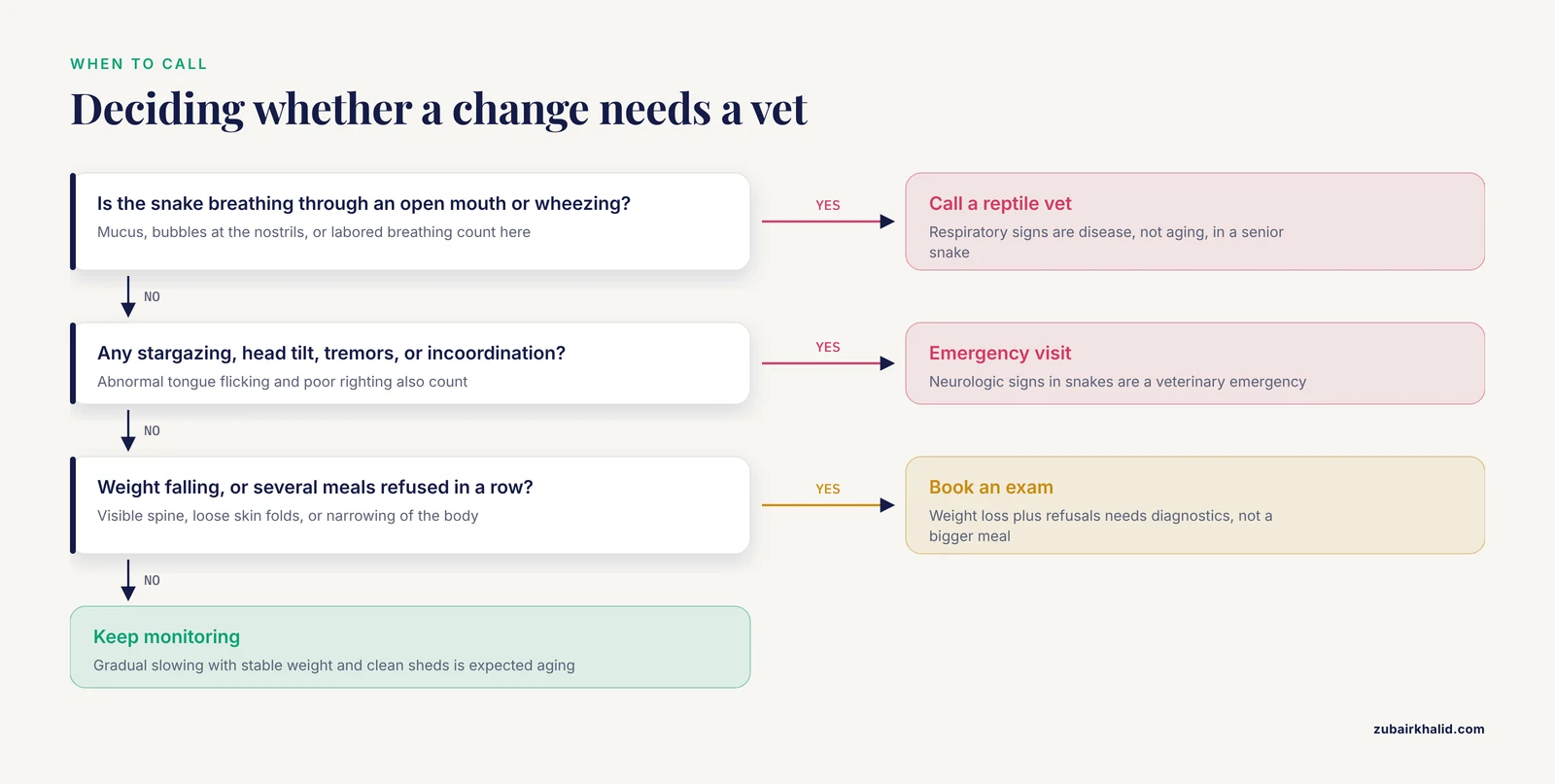
- Rapid or continued weight loss with visible narrowing of the body, prominence of the spine, or loose skin folds. Gradual muscle reduction is expected. Visible emaciation is not.
- Open-mouth breathing, wheezing, excess mucus, or bubbles at the nostrils. These are signs of respiratory disease, not aging.
- Stargazing, incoordination, head tilting, tremors, or abnormal tongue flicking. Neurologic signs are a veterinary emergency in snakes.
- Retained eye caps, retained tail tips, or sheds coming off in fragments despite correct humidity, or dysecdysis accompanied by lethargy.
- Masses, wounds that do not heal, or swelling along the jaw or body.
- Sudden refusal of multiple consecutive meals combined with any of the above.
A single skipped meal in an otherwise normal senior snake is usually not an emergency. A skipped meal plus weight loss, respiratory signs, or neurologic signs is a veterinary appointment, not a wait-and-see situation.
Senior Corn Snake Diet
The senior corn snake diet is less about different food and more about different dosing. Corn snakes remain obligate carnivores eating whole prey their entire lives. What changes with age is meal size, meal frequency, and how carefully you match intake to a slowing metabolism.
Core feeding principles
- Keep prey appropriate in size. The traditional guideline of prey roughly matching the widest part of the snake's body still applies. Overly large meals are harder for an older snake to process and increase the risk of regurgitation and prolonged digestive stress.
- Reduce frequency before reducing size drastically. Many adult corn snakes do well on a meal every 10 to 14 days, and seniors often maintain condition on even longer intervals. The correct schedule is one that holds body condition stable, and your reptile veterinarian can help you set it based on weight trends rather than a calendar.
- Feed thawed frozen prey, warmed appropriately. Live rodents can injure a slower-moving senior snake that fails to strike quickly. This is one of the most underappreciated welfare risks in aging snakes.
- Track body condition, not appetite alone. Weigh your snake monthly. A stable weight on reduced intake is success. A falling weight requires either a feeding adjustment or a veterinary exam, and it can be difficult to tell which without diagnostics.
- Offer food with less competition and stress. Feed in the enclosure or a familiar container, keep handling minimal around meals, and avoid feeding when the snake is in the blue phase of shed or visibly stressed.
Hydration and digestion support
Hydration deserves more attention in seniors because reduced skin elasticity and less efficient renal function make dehydration harder to recover from. Provide a large, shallow water dish the snake can reach easily without climbing. Refresh it daily. If your senior snake begins producing poor sheds, increase humidity modestly and offer a humid hide during the shed cycle before assuming a disease process, then reassess.
Because aging alters digestive physiology and gut microbial populations in animals generally [4], owners should expect that an older snake may take longer to defecate after meals and may process slightly smaller meals more comfortably than large ones. If regurgitation appears, that is never a normal aging sign. Regurgitation warrants a veterinary visit and a review of prey size, feeding interval, and enclosure temperatures.
What not to change
Do not switch a senior snake to novel foods, supplements, or force-feeding routines on your own. Whole prey provides complete nutrition for corn snakes, and unnecessary supplementation of a healthy senior on an appropriate whole-prey diet offers no documented benefit and can cause harm. Any addition to the diet should come from your veterinarian.
Enclosure and Comfort Adjustments for Older Corn Snakes
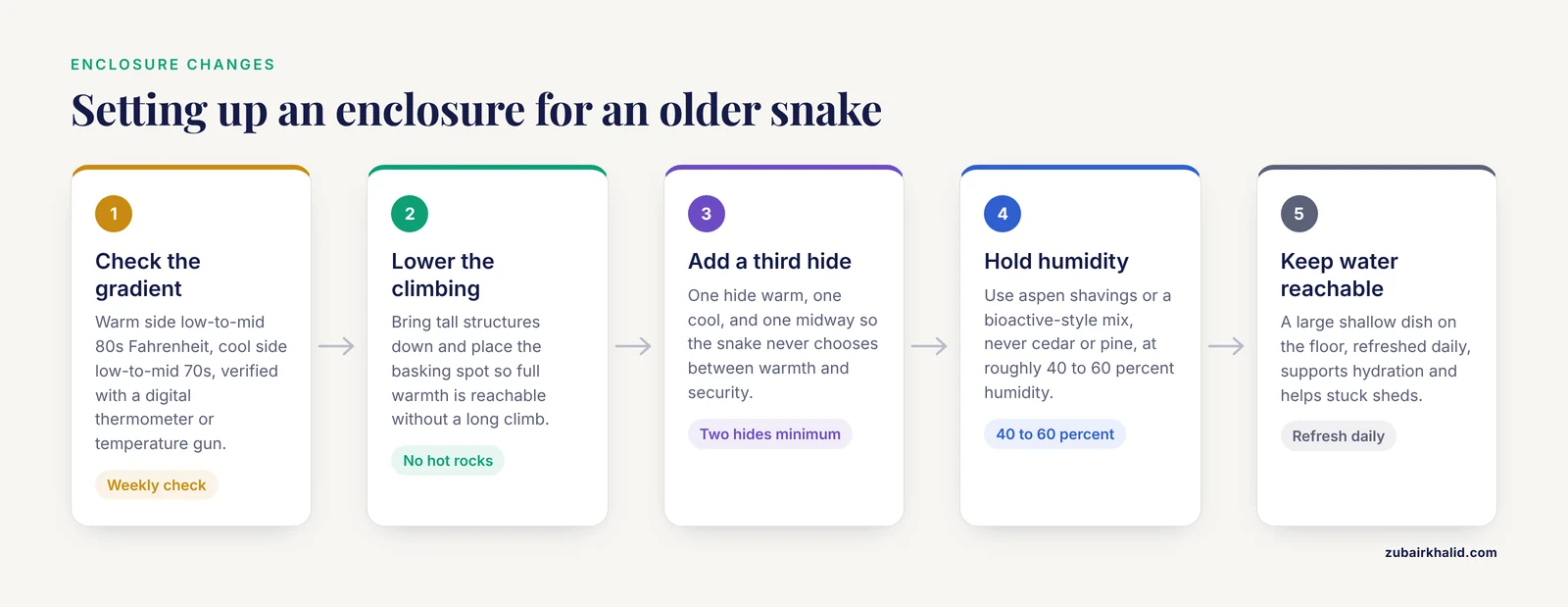
The biggest wins in senior corn snake care are usually environmental, because a well-matched enclosure compensates for reduced mobility, slower thermoregulation, and thinner energy reserves.
Thermal gradient
Maintain a proper thermal gradient so the snake can select its preferred body temperature without traveling far. For corn snakes, mainstream husbandry references describe a warm side in the low-to-mid 80s Fahrenheit with a basking area slightly warmer, and a cool side in the low-to-mid 70s. Verify temperatures with a digital thermometer or infrared temperature gun rather than trusting stick-on dials, which are notoriously inaccurate. In an older snake, position the basking area so the snake can reach full warmth without a long climb, and avoid heat sources the snake must coil directly around, such as hot rocks, which cause burns.
Heat matters more, not less, with age. An older snake with diminished reserve cannot buffer a cold enclosure the way a young adult can, and chronic cool temperatures impair digestion and immune function.
Hides, security, and layout
Provide at least two hides, one on the warm end and one on the cool end, so the snake never has to choose between thermoregulation and security. For seniors, consider adding a third hide midway, lowering the tallest climbing structures, and ensuring the snake can reach water, warmth, and a hide without navigating obstacles. A snug hide reduces stress, and chronic stress suppresses immune function and appetite in reptiles just as it does in other animals.
Substrate and humidity
Choose a substrate that holds some humidity and allows natural burrowing behavior, such as aspen shavings at appropriate depth or a bioactive-style mix appropriate for corn snakes, and avoid cedar or pine, which contain compounds irritating to reptile respiratory tracts. Target humidity in the moderate range suitable for corn snakes, roughly 40 to 60 percent, rising toward the higher end during shed cycles. Spot-clean soiled substrate promptly and do full changes on a schedule that keeps the enclosure dry and odor-free.
Water and soaking
A shallow water dish large enough for the snake to soak supports hydration and helps stuck sheds. Replace water daily and disinfect the dish regularly. If your senior snake soaks constantly, that can be a sign of mites, skin irritation, excessively high temperatures, or discomfort, so constant soaking is a reason to inspect the snake closely and contact your veterinarian if it persists.
Handling
Older snakes tolerate handling, but gentler and shorter sessions are kinder. Support the whole body, keep sessions brief, avoid handling for 48 hours or so after feeding while digestion is underway, and never handle during the blue phase when vision is impaired. Reduced handling also reduces stress hormones, which supports immune function.
Health Risks That Rise With Age and How to Reduce Them
Senior snakes face a narrowing set of likely problems, and knowing the short list sharpens your monitoring.
Infectious respiratory and neurologic disease
Ferlaviruses are significant snake pathogens that cause respiratory and neurologic disease and can produce severe outbreaks in collections [5]. Experimental work in corn snakes compared three genetically distinct ferlavirus genogroups and found clear differences in pathogenicity, with the genogroup B isolate producing the most severe effects, including respiratory and neurologic signs, lung pathology, and mortality in infected animals [5]. This research is directly relevant to senior corn snake care for two reasons.
First, an older snake has less immune reserve, so an infection that a young adult might shake off can overwhelm a senior. Second, ferlaviruses spread within collections, which makes quarantine of any new reptile the single most effective biosecurity step a corn snake owner can take. Keep new arrivals separated with dedicated equipment for a minimum of 60 to 90 days, follow standard reptile quarantine practice, and discuss ferlavirus testing options with a reptile veterinarian if you keep multiple snakes or acquire animals from unknown backgrounds [5].
Signs that overlap with ferlavirus disease, such as open-mouth breathing, excess mucus, abnormal posture, or incoordination, always warrant prompt veterinary attention in a senior snake [5].
Parasites and chronic organ disease
Internal parasites, chronic kidney disease, hepatic disease, and neoplasia all occur in aged snakes. None of these can be diagnosed at home, which is why the annual wellness examination with fecal testing and, where indicated, bloodwork is the backbone of senior preventive care. European geriatric medicine consensus emphasizes preventive action and early detection as the highest-value interventions in aging populations [6], and the same logic applies to reptile practice. The point of a yearly exam is to catch the condition while it is still manageable.
Preventive care schedule
The ARAV recommends that reptile keepers work with a veterinarian experienced in reptile medicine and maintain routine wellness examinations. For a senior corn snake, a sensible schedule is one comprehensive exam per year, including weight trend review, oral examination, body palpation, and fecal parasite testing, escalating to twice-yearly visits if your snake has a chronic condition or unexplained weight trend.
Common Mistakes in Senior Corn Snake Care
- Assuming every change is "just old age." Weight loss, respiratory signs, and neurologic signs are diseases until a veterinarian proves otherwise. The most serious mistakes in senior care come from normalizing red flags.
- Feeding on a young-adult schedule. Continuing large, frequent meals into the senior years promotes obesity and hepatic strain, while also forcing an older digestive system to work harder than necessary.
- Keeping the enclosure too cool. Owners often lower heat in winter or after equipment failure without noticing. In a senior snake, a chronically cool enclosure shows up first as poor digestion and incomplete sheds.
- Feeding live prey to a slow snake. A cornered rodent can seriously injure an older snake that does not strike promptly. Thawed frozen prey eliminates this risk entirely.
- Skipping records. Without a weight log and feeding log, gradual decline is invisible. The single cheapest senior-care tool is a notebook or spreadsheet updated monthly.
- Adding new animals without quarantine. A ferlavirus introduction can devastate a collection, and senior snakes fare worst in an outbreak [5].
- Impacting the snake with bedding or offering prey buried in substrate. Accidental substrate ingestion and impaction risk rises when a slower snake strikes imprecisely. Feeding on a clean, flat surface or in a separate safe container reduces this.
- Waiting too long to involve a veterinarian. Reptiles mask illness until disease is advanced. In a senior animal, the window between "subtle sign" and "crisis" is short.
Troubleshooting Common Senior Corn Snake Problems
Repeated meal refusals with stable weight. Check enclosure temperatures first, confirm the snake is not in blue phase, and review whether anything in the environment changed. Offer prey again at the normal interval. If refusals continue across multiple cycles, schedule a veterinary exam even if weight holds steady.
Weight loss despite eating. This combination suggests insufficient intake for metabolic needs, parasites, dental or oral disease, or organ dysfunction. Escalate to a veterinarian rather than simply increasing meal size, because a bigger meal will not fix a medical cause and may worsen regurgitation risk.
Incomplete sheds. Verify humidity, provide a humid hide during the shed window, and confirm the warm side temperature. If humidity is correct and sheds remain poor across two cycles, discuss the finding with your veterinarian, since retained sheds can also reflect underlying illness or dehydration.
Regurgitation. Stop feeding, verify enclosure temperatures, and contact your reptile veterinarian. Regurgitation in a senior snake is a medical sign, not a husbandry quirk.
Lethargy with poor tongue flicking. Reduced responsiveness, especially combined with any respiratory or neurologic sign, is an urgent presentation. Do not wait for the next scheduled feeding.
Welfare and Safety Points
Senior corn snakes can live comfortable, engaged lives for years with modest adjustments. The welfare priorities are stable thermal conditions, secure hides, appropriate whole-prey nutrition in reduced amounts, consistent hydration, gentle handling, and freedom from live-prey risk. Behavioral enrichment does not stop with age. Offering new scent trails, safe climbing at low heights, and occasional rearrangement of enclosure furniture within a familiar framework keeps an older snake active without imposing physical demands it cannot meet.
Housing a senior snake away from loud room traffic, strong vibrations, and household predators such as cats reduces chronic stress. If children handle the snake, supervise sessions and keep them brief. Finally, plan ahead. Senior snakes can live for many more years, and documenting feeding protocols, weight records, and your veterinarian's contact information makes care consistent if another family member takes over.
Limitations and When to Contact a Veterinarian
Reptile medicine is a specialized field, and individual cases always need a veterinarian. Age estimates, feeding intervals, and enclosure parameters in this article are starting points drawn from general husbandry references, not prescriptions for your specific animal. A reptile veterinarian can weigh your snake, perform an oral and body examination, run fecal and blood diagnostics, and build a plan around your animal's actual condition.
Contact a veterinarian promptly, within days rather than weeks, if your senior corn snake shows any of the following:
- Open-mouth breathing, wheezing, nasal discharge, or mucus bubbles
- Neurologic signs such as stargazing, head tilt, tremors, or incoordination
- Regurgitation of a meal
- Continued weight loss or visible emaciation
- Multiple consecutive meal refusals with any other sign
- Retained eye caps or sheds, or skin lesions that are not healing
- A mass, swelling, or discoloration anywhere on the body
- Prolonged soaking, frantic escape behavior, or a sudden dramatic change in temperament
Seek emergency care for a snake that is unresponsive, cannot right itself, is bleeding, or is openly breathing with its mouth held wide. When in doubt, call a reptile veterinarian and describe the signs. Telephone triage costs nothing and can save days of delay.
Frequently Asked Questions
How old is a senior corn snake?
Most keepers and veterinarians consider a corn snake senior at roughly two-thirds of its expected captive lifespan, which places the transition around 10 to 14 years for a snake with a typical lifespan of 15 to 20 years. Function matters more than the calendar, so a snake showing reduced activity, slower digestion, or declining body condition may warrant senior-level care before that age, while a thriving older snake may not.
What are the first signs of aging in corn snakes?
The earliest signs are usually reduced exploratory activity, longer digestion and defecation intervals, longer gaps between meals with stable weight, subtle changes in color, and slightly rougher skin texture with less perfect sheds. Weight loss, breathing changes, and neurologic signs are not normal aging and require veterinary evaluation.
How often should I feed a senior corn snake?
Feed appropriately sized whole prey on a schedule that keeps body condition stable, which for many seniors means intervals of two weeks or longer rather than the weekly schedule of a young adult. Work with a reptile veterinarian to set the interval based on monthly weight records rather than a fixed calendar.
Do corn snakes slow down as they age?
Yes, most senior corn snakes become less active, spend more time in their hides, climb less, and show less urgency when exploring. Gradual slowing with stable weight and normal shedding is expected. Sudden lethargy or dramatically reduced tongue flicking is a medical sign, not aging.
Should I change the enclosure for an older corn snake?
Keep the correct thermal gradient, humidity, and hides, but make them easier to use. Lower tall climbing structures, add a hide on both the warm and cool ends, keep the water dish on the floor and easy to reach, and avoid heat sources the snake must coil around directly. Verify temperatures with a reliable thermometer rather than stick-on gauges.
When should a senior corn snake see a veterinarian?
Schedule a wellness exam at least once a year with a reptile veterinarian, including a fecal test. Seek care promptly for respiratory signs, neurologic signs, regurgitation, weight loss, retained sheds, masses, or multiple skipped meals. Snakes hide illness well, so subtle changes in a senior deserve faster action than they might in a young animal.
How long do corn snakes live in captivity?
Corn snakes commonly live 15 to 20 years in captivity, and some individuals live longer under excellent husbandry, according to mainstream reptile care references. Protected captive conditions, with proper heating, whole-prey diets, and preventive veterinary care, are the main reasons captive lifespans far exceed those of wild snakes.
Can I still handle my senior corn snake?
Yes, gentle handling remains beneficial, but keep sessions shorter and support the entire body. Avoid handling for about 48 hours after feeding, during the blue phase of shed, and whenever the snake shows respiratory or neurologic signs. If the snake seems stressed or refuses food after handling sessions, reduce their frequency.
Sources
- The emerging role of miRNAs in biological aging and age-related diseases
- The Continuum of Aging and Age-Related Diseases: Common Mechanisms but Different Rates
- Age-related changes in liver structure and function: Implications for disease ?
- Origination, change, and modulation of geriatric disease-related gut microbiota during life
- Three genetically distinct ferlaviruses have varying effects on infected corn snakes (Pantherophis guttatus)
- Silver paper: the future of health promotion and preventive actions, basic research, and clinical aspects of age-related disease--a report of the European Summit on Age-Related Disease.