Safe Toys and Equipment for Turtles: What to Avoid
By Dr. Zubair Khalid, DVM, MS, PhD ·
This article is educational and is not a substitute for veterinary diagnosis or treatment.
Safe toys for turtles share three traits. They are too large to swallow, they are made of inert uncoated materials, and they contain no parts that can break off. The dangerous items are just as specific. Anything small enough to fit in the mouth, anything painted, varnished, scented, or glued, soft rubber that tears into chunks, and strings or fibers that can wrap around a limb all belong outside the enclosure.
The stakes go beyond a ruined toy. Swallowed foreign material is a documented trigger of severe, sometimes fatal intestinal disease in captive turtles [1]. Screening every object that enters the tank is preventive medicine, not decoration.
This guide explains how to choose safe toys for turtles, which toxic materials and designs to avoid, and how to set up turtle cage accessories so that enrichment adds welfare instead of risk.
At a Glance: Safe Versus Unsafe Turtle Toys and Accessories
| Item or practice | Verdict | Why | Safer choice |
|---|---|---|---|
| , - | , - | , - | , - |
| Large, smooth, hard plastic balls | Safe for most turtles | Too big to swallow, easy to disinfect | Rotate with other enrichment |
| Untreated wood, cork bark, smooth stone | Safe when oversized | Inert and uncoated | Choose pieces larger than the turtle's head |
| Painted, varnished, or glued decorations | Avoid | Coatings and adhesives are not made for animal contact | Uncoated, single-piece items only |
| Marbles, beads, coins, small loose particles | Dangerous | Swallowed foreign material is a documented trigger of fatal intestinal disease | Nothing smaller than the turtle's head |
| Soft rubber, latex, and foam toys | Avoid | Tear into swallowable chunks | Hard plastic or natural solids |
| Rope, frayed fabric, wire-core vines | Avoid | Fibers entangle limbs or are swallowed | Solid one-piece items |
| Human snacks used as toy rewards | Avoid | Linked to altered growth and health problems | Species-appropriate foods in small amounts |
| Crowded tank full of accessories | Avoid | Crowding is a recognized stress variable in hatchling care | Few well-spaced, purposeful items |
Why Enrichment Matters for Turtles
Turtles are not passive tank ornaments. Behavioral assessment is considered the most valuable indicator of welfare in sea turtles because it is non-invasive and more cost-effective than physical or nutritional assessments, and higher proportions and longer durations of specific swimming patterns indicate negative welfare [2]. The same logic applies at home. A turtle that uses its space, investigates changes, forages, and basks normally is telling you its environment works. A turtle that changes how it swims or abandons parts of the tank after a new object goes in is telling you something too.
Many owners want to enrich their animals but lack a plan. In a survey of more than 200 reptile owners, 51% expressed concerns about enrichment [3]. Clinical husbandry references make the same point from the other direction. Chelonians often require more space and time than new owners expect, and many people are unaware of what proper care involves [4].
Individuality completes the picture. Zoo-hatched Blanding's turtles displayed distinct personality traits of exploration, boldness, and aggression, and the more exploratory individuals traveled farther and survived at higher rates after release into the wild [5]. In practice, one turtle may investigate a new ball within minutes while a shy tankmate needs days. Plan enrichment for the individual in front of you, not for turtles in general.
How to Choose Safe Toys for Turtles
Use this checklist before anything enters the enclosure.
- Size. The item must be too large to fit in the mouth. When in doubt, size up, because swallowed objects are a documented cause of life-threatening intestinal disease [1].
- Inert material. Hard aquarium-rated plastic, untreated wood, cork bark, and smooth stone are dependable choices. Nothing coated, scented, or chemically treated.
- One-piece construction. No bells, googly eyes, glued seams, or snap-on parts. If a part can detach, assume it eventually will.
- Smooth surfaces. No sharp edges, splinters, or cracked plastic that can cut the mouth, eyes, or shell.
- Cleanability. Anything in a turtle tank develops biofilm. Choose items that survive scrubbing and disinfection, and retire porous items that cannot be cleaned thoroughly.
- Species and life stage. Aquatic species need items that function underwater, terrestrial species need items that function on land. Hatchlings and juveniles are small enough to treat ordinary objects as swallowable, and hatchling research treats even handling frequency and stocking density as variables that shape stress [6].
- Stable placement. Ramps, docks, and climbing structures must not tip, pin, or trap a turtle underwater. Push on every placement before you trust it.
If you cannot determine what an object is made of, treat it as unsafe until a reptile veterinarian says otherwise.
Toxic Materials for Turtles: What to Keep Out of the Enclosure
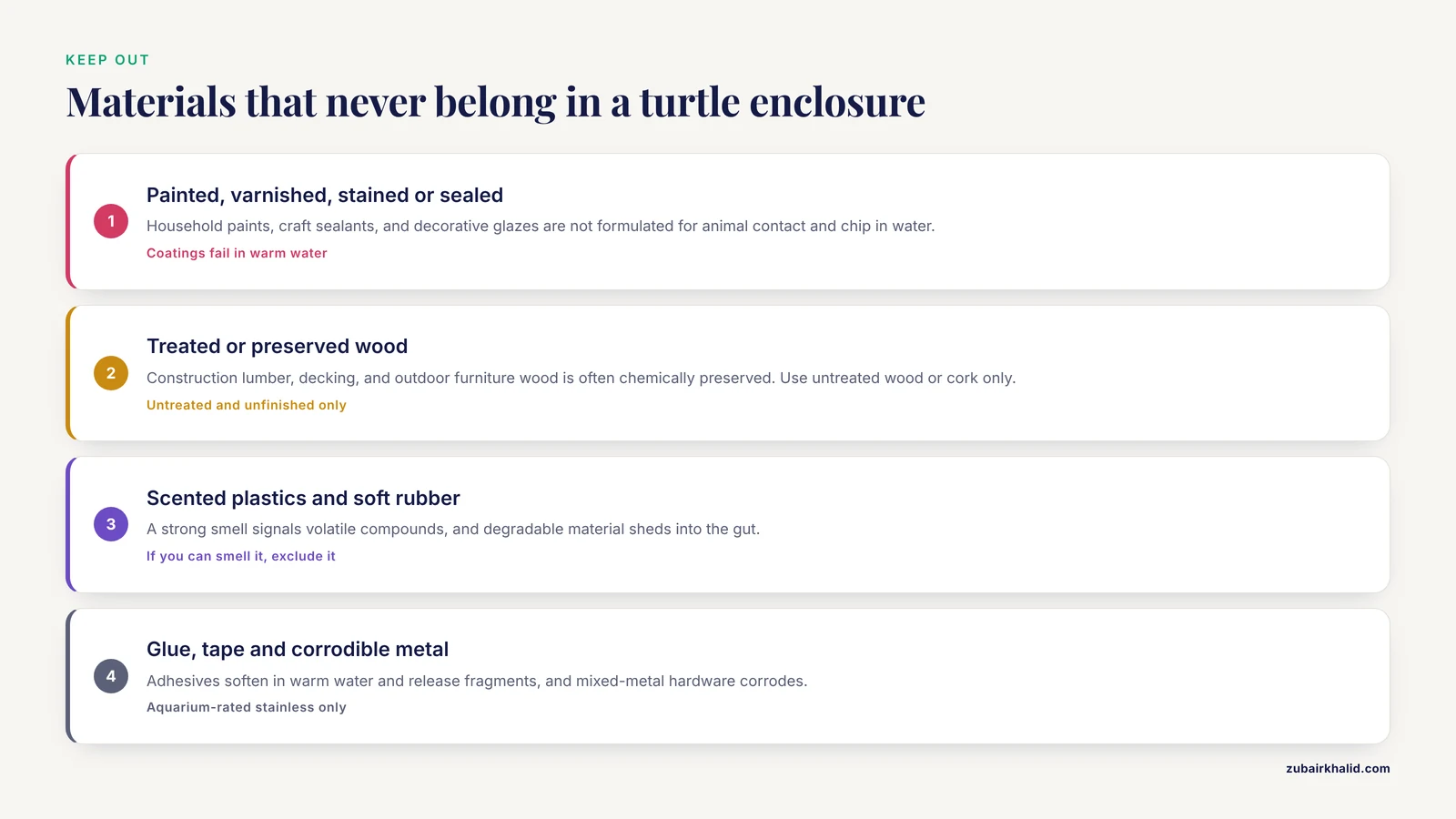
Turtles bite objects, aquatic species gulp water around everything in the tank, and coatings fail over time in warm water. Exclude these categories.
- Painted, varnished, stained, or sealed items. Household paints, craft sealants, and decorative glazes are not formulated for animal contact and chip in water.
- Treated or preserved wood. Construction lumber, decking, and outdoor furniture wood is often chemically preserved. Use only untreated, unfinished wood or cork.
- Scented plastics and rubber. A strong smell signals volatile compounds. If you can smell it, a turtle should not live in a tank with it.
- Soft plastics, vinyl, and foam that shed. Degradable material ends up in the gastrointestinal tract, where indigestible foreign material has caused severe and sometimes fatal intestinal disease [1].
- Anything assembled with glue, tape, or adhesives. Adhesives soften in warm water and can release fragments.
- Corrodible metal parts. Mixed-metal hardware corrodes in warm water. Aquarium-rated stainless fixtures are a different category from random hardware store parts.
- Battery-powered or electronic gadgets. These are not designed to be mouthed, and water plus electronics is its own hazard.
There is no owner-level test for whether a coating is safe. If the composition is unclear, the item stays out. Remember that a chemically inert object can still be dangerous if it is swallowable, so material safety and size safety are separate tests that every item must pass.
Dangerous Toys for Turtles: The Highest-Risk Items
These are the items and patterns behind the most serious toy-related illness in captive turtles.
Swallowable Objects and Foreign Bodies
This is the hazard with the strongest published evidence. In a case series of ten Central American river turtles at a zoological facility, an abrupt diet change or the ingestion of indigestible foreign material preceded illness in the majority of cases [1]. Abnormal buoyancy was the primary clinical sign in nearly all of them. Half of the cases ended in death or euthanasia, and in every fatal case the turtle progressed from abnormal buoyancy to death or euthanasia within one to two days [1]. Small hard objects are not a minor nuisance. They are a documented cause of fatal intestinal disease.
Small Parts and Breakable Decorations
Figurines with glued components, brittle plastic ornaments, and chipped ceramics crack into sharp fragments. A decoration sold for reptile tanks is not automatically safe. Flex the item gently and inspect the seams before it goes in.
Strings, Fibers, and Entanglement Hazards
Rope, frayed fabric, mesh, and artificial vines with wire cores can wrap around a limb or neck and can be swallowed in strips. Choose solid, single-piece items instead.
Soft Rubber, Latex, and Foam
Dog and cat toys are the usual offenders. They are designed for jaws that chew and release, not for mouths that swallow. A turtle that tears off a chunk has manufactured its own foreign body.
Food Used as a Toy, Done Wrong
Food-based enrichment is legitimate, but its failure modes are well documented. At tourist sites in Barbados, green sea turtles provisioned by people with fish plus processed foods such as hot dogs, chicken, and bread showed documented alterations in behavior and growth rates [7]. In the river turtle case series described above, overfeeding of fresh fruit preceded intestinal disease in several cases [1]. Background physiology agrees. Wild and managed care turtles carry different blood fatty acid profiles linked to diet, with wild turtles showing higher percentages of fatty acids including alpha-linolenic acid [8]. The translation is simple. Enrichment foods must be species-appropriate, fed in small amounts, and never an abrupt change to the base diet.
Crowding and Handling Stress
Hatchling loggerhead research measured the stress hormone corticosterone under different handling schedules. Hatchlings handled once a week showed no significant increase in corticosterone, while levels rose significantly under a less frequent schedule, which suggests hatchlings acclimate to a consistent routine. Growth and mortality were similar across handling regimes [6]. The same research program examined stocking density as a stress variable, a reminder that crowding is taken seriously in captive chelonian care [6]. For owners this means two rules. Keep the accessory load modest so the animal retains open swimming space, and keep handling purposeful and consistent rather than constant.
The Best Turtle Toys and Enrichment That Actually Works
Hard, Single-Piece Objects
Tortoise enrichment research gives a usable model. In a Galapagos tortoise study, object enrichment consisted of boomer balls and a free-flowing sprinkler, evaluated for effects on locomotion, species-typical behavior, and enclosure use [9]. For turtles, the same category of item works. A large smooth hard plastic ball, an untreated half log, a cork bark slab, or a smooth stone larger than the head gives a turtle something to push, rub against, and investigate without ingestion risk.
Habitat Features as Enrichment
The best toys are often features of a well-built habitat. Logs, land areas, and varied water depth give a turtle choices, and choice is the core of good enrichment. In the zoo preference study, enclosure feature preferences stayed consistent between winter and summer even though the turtles were housed indoors year round [10].
Interaction-Based Enrichment
The same tortoise study found that all three subjects consistently preferred keeper interactions, specifically shell scrubbing and neck rubbing, over the object enrichment options, and that preference was only a variable predictor of whether enrichment actually changed behavior [9]. At home, supervised out-of-tank time in a secure area, gentle shell cleaning during routine care, and calm predictable routines all count as enrichment. Responses to human presence vary. In a zoo study spanning six reptile species, behavioral responses to visitors ranged widely, with Arrau turtles showing intermediate changes [11]. Watch your turtle, not the calendar.
Food-Based Enrichment Done Right
Use small amounts of species-appropriate foods presented in ways that require a little extra effort rather than handing them from a bowl. Keep the base diet stable, skip processed human foods entirely, and treat fruit and other rich items as rare additions. The documented failure modes are described in the food hazards section above.
Matching Enrichment to the Individual
A bold explorer engages a new object immediately. A shy turtle may ignore it for a week before accepting it. Give new items time, and let the individual's behavior rather than a product description decide what stays in the habitat.
Turtle Cage Accessories Safety: A Practical Checklist
Basking and Land Areas
Docks and ramps should be stable, gently sloped, and easy to climb without abrasion. In the zoo preference study, the amount of time individual turtles spent on land, on logs, and in water varied by individual [10]. Build more than one option so each turtle can choose.
Water and Filtration
Aquatic turtles are messy animals, and water quality underpins their health [4]. Choose filtration appropriate to the tank and the waste load, position intakes away from resting areas, and avoid accessories with crevices that trap debris and develop stagnant pockets.
Lighting and Heating
Provide a thermal gradient and stable temperatures rather than one hot spot. In the river turtle case series, temporary suboptimal environmental temperatures were suspected before the onset of clinical signs in 4 of 10 cases [1]. Preference research also found that zoo-housed aquatic turtles used areas with ambient lighting more than areas under a heat lamp or UV lamp, consistently across seasons [10]. Offer lighting and temperature choices rather than forcing constant exposure to any single fixture.
Substrate
In the 24-hour preference study of five zoo-housed aquatic turtles, the wood turtles and the Blanding's turtle showed clear substrate preferences while the spotted turtles did not [10]. Offer a substrate the turtle can use naturally, and skip loose particles small enough to swallow.
Electrical Safety
Every cord should leave the tank in a way a turtle cannot reach, with a drip loop so water cannot travel along the cord. Heaters should be guarded or positioned where they cannot be bumped or dislodged. Light fixtures belong above the tank, not inside it.
Space and Density
In the owner survey, 21% of respondents were uncertain about appropriate enclosure size [3]. Add equipment only when it earns its space. Open swimming area is itself enrichment for aquatic species, and a crowded tank removes the movement that keeps a turtle in condition.
Common Mistakes Owners Make
- Buying for looks rather than safety. If an item fails the size, material, or construction test, its appearance is irrelevant.
- Assuming a preferred toy is automatically beneficial. A turtle that loves an item is not proof the item is safe. Screen first, then observe.
- Using food as a constant toy. Processed snacks and abrupt diet changes carry documented risks, as described in the food hazards section above.
- Handling constantly during play. Keep handling purposeful and predictable rather than constant.
- Ignoring individual differences. Personality and species shape how a turtle uses enrichment [5], [11].
- Leaving damaged items in the tank. Inspect weekly and remove anything cracked, chipped, or shedding at the first sign of wear.
- Overcrowding the tank. Every accessory takes swimming space. Fewer, better items win.
- Skipping the behavior check. Behavior is your most accessible welfare signal [2]. Watch for several days after every change.
How to Introduce a New Toy Step by Step
- Screen it. Run the item through the selection checklist. Reject anything swallowable, coated, scented, glued, or soft enough to tear.
- Clean it. Rinse and scrub new items before they enter the tank, and skip scented soaps.
- Add one item at a time. Single additions let you attribute behavior changes to a specific object.
- Observe for several days. Look for normal swimming, normal basking, continued appetite, and calm investigation of the new item.
- Remove on red flags. Sudden hiding, refusal to eat or bask, frantic escape attempts, or unusual swimming means the item comes out.
- Rotate rather than accumulate. A small rotation of two or three safe items keeps novelty high without crowding.
- Inspect weekly. Retire items at the first sign of cracks, chips, loose parts, or buildup you cannot scrub off.
Limitations and When to Contact a Veterinarian
This article provides general screening criteria for toys and equipment. Individual cases need a veterinarian, ideally one experienced with reptiles, because even veterinary students report uncertainty about their knowledge of reptile care [12], and turtle anatomy, including the shell and defensive posture, can hinder physical examination [13]. Routine preventive care matters too. In the owner survey, half of respondents reported no regular check-ups despite acknowledging their importance [3].
Contact a reptile veterinarian promptly if your turtle shows any of the following:
- Abnormal buoyancy, tilting, or inability to submerge, which is a documented early sign of severe intestinal disease in captive turtles [1]
- Refusal to eat, especially alongside lethargy
- A sudden drop in activity, hiding, or unusual swimming that persists after a new item is removed
- Straining to defecate, visible swelling, or a known or suspected swallowed object
- Any injury from equipment, such as a cut from broken plastic or entanglement in fibers
Bring the suspected object, or a photo of it, to the appointment. That detail can change both the examination and the plan.
Frequently Asked Questions
What are the safest toys for turtles?
The safest options are large, smooth, single-piece items made of hard plastic, untreated wood, cork, or stone, sized so they cannot fit in the turtle's mouth. They should have no coating, scent, glue, or detachable parts, and they should be easy to scrub clean.
What toys are dangerous for turtles?
Anything swallowable, painted, varnished, scented, glued, soft enough to tear, or built with strings and fibers. Small parts that can break off and brittle decorations that crack into sharp pieces are the most common hazards.
Do turtles really need toys and enrichment?
Yes. Enrichment supports welfare, and both habitat features and owner interaction can work. The most valuable enrichment is matched to the individual turtle rather than bought as a product.
Are plastic plants safe for turtles?
Only sturdy, one-piece, unscented plants that cannot be pulled apart and have no wire stems. Remove any that shed leaves or fragments, because swallowed material is a documented intestinal hazard.
What materials are toxic to turtles?
Avoid painted, varnished, or chemically treated items, treated wood, scented plastics and rubber, adhesives, and corrodible metals. If you cannot confirm what an item is made of, keep it out of the enclosure or ask a reptile veterinarian.
Can I put a ball in my turtle's tank?
Yes, if it is large, smooth, hard, unscented, and too big to swallow. Remove it if it cracks, chips, or develops surfaces you cannot clean.
How do I know if my turtle swallowed something dangerous?
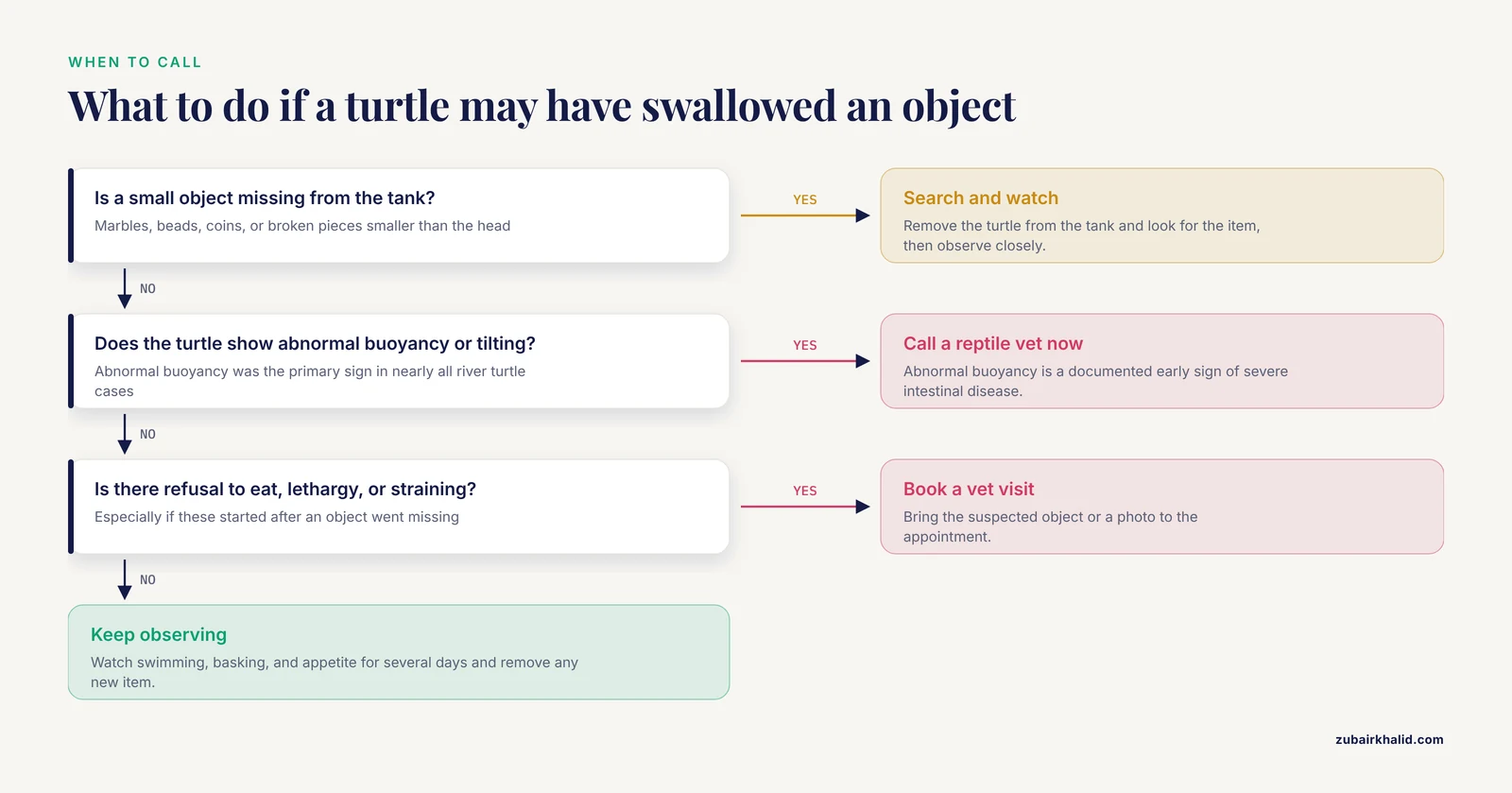
Watch for abnormal buoyancy or tilting, refusal to eat, lethargy, and straining. Contact a reptile veterinarian promptly if any of these appear, especially after an object goes missing from the tank.
How often should I rotate my turtle's toys?
There is no fixed schedule. Rotate a small set of safe items to keep novelty high, inspect them weekly, and retire anything damaged. Let your turtle's behavior guide the pace.
Sources
- INTESTINAL TYMPANY AND VOLVULUS IN CENTRAL AMERICAN RIVER TURTLES (DERMATEMYS MAWII).
- Quantification of sea turtle swimming patterns using a standardized arena to minimize effort in welfare assessment.
- Assessing the Current Landscape of Reptile Pet Ownership in Hong Kong: A Foundation for Improved Animal Welfare and Future Research Directions.
- Turtle care and husbandry.
- Personality in Zoo-Hatched Blanding's Turtles Affects Behavior and Survival After Reintroduction Into the Wild.
- Assessment of captive rearing conditions on loggerhead hatchlings: Effect of handling frequency and stocking density.
- EFFECTS OF "SWIM WITH THE TURTLES" TOURIST ATTRACTIONS ON GREEN SEA TURTLE (CHELONIA MYDAS) HEALTH IN BARBADOS, WEST INDIES.
- ANALYSIS OF FATTY ACID PROFILES FOR EASTERN BOX (TERRAPENE CAROLINA CAROLINA) AND COMMON SNAPPING (CHELYDRA SERPENTINE) TURTLES IN WILD AND MANAGED CARE ENVIRONMENTS.
- Is preference a predictor of enrichment efficacy in Galapagos tortoises (Chelonoidis nigra)?
- Moving Toward Evidence-Based Care: Measuring Preferences in Zoo-Housed Aquatic Turtles Using 24-h Remote Monitoring.
- Behavioral Assessment of Six Reptile Species during a Temporary Zoo Closure and Reopening.
- A Survey Study of Veterinary Student Opinions and Knowledge about Pet Reptiles and Their Welfare.
- Biology and medicine of turtles and tortoises.