Safe Toys and Equipment for Corn Snakes: What to Avoid
By Dr. Zubair Khalid, DVM, MS, PhD ·
The safest toys for corn snakes are simple, inert, easy-to-clean items that let the snake hide, climb, and burrow. Cork bark, smooth untreated hardwood branches, ceramic hides, food-grade plastic tunnels, plain cardboard, and wire-free plastic plants all meet that standard. The dangerous items are just as consistent: aromatic woods such as cedar and pine, anything painted, varnished, or glued together, heat rocks, decor with hidden wire or detachable parts, and loose piles of sand or gravel sold as play material.
Enrichment is not decoration. In a 2026 study published in BMC Veterinary Research, researchers measured corticosterone, a stress hormone, in shed snake skins and found higher concentrations in corn snakes (Pantherophis guttatus) kept in low-stimulus rack systems than in corn snakes kept in enriched, furnished terraria [1]. For this species, a well-furnished enclosure appears to be the lower-stress choice. That same research treats housing design as a key factor in reptile welfare, which places toy and accessory selection in the same category as heating and diet rather than in the category of decoration [1].
This guide explains how to choose safe toys for corn snakes, which materials and products to avoid, how to place and clean cage accessories, and when a problem needs a reptile veterinarian.
This article is educational and is not a substitute for veterinary diagnosis or treatment.
At a Glance: Safe and Unsafe Items for a Corn Snake Enclosure
| Item | Verdict | Why |
|---|---|---|
| , - | , - | , - |
| Cork bark tubes and flats | Safe | Inert, sturdy, works as hide and climb structure |
| Smooth untreated hardwood branches | Safe with prep | Identify the species, clean, then freeze or bake before use |
| Ceramic or resin hides with smooth interiors | Safe | Easy to disinfect, no splinters |
| Heavy stable rocks with smooth surfaces | Safe if anchored | No sharp edges, base rests on the cage floor |
| Wire-free plastic plants, secured | Safe | Visual cover without entanglement risk |
| Plain cardboard tubes and boxes | Safe, disposable | Replace when soiled or damp |
| Converted food-grade plastic containers | Safe if edges smooth | Drill or melt openings, remove every burr |
| Plain PVC pipe tunnels | Safe if food-grade | No glued fittings, smooth cut ends |
| Cedar or pine decor and bedding | Avoid | Aromatic oils irritate reptile skin and airways |
| Heat rocks | Avoid | Uneven hot spots cause contact burns |
| Painted, varnished, or glued craft items | Avoid | Coatings flake, adhesives off-gas |
| Wire-core vines, glitter, beads, googly eyes | Avoid | Wire punctures, small parts can be swallowed |
| Sand, gravel, or walnut shell as play material | Avoid | Particles swallowed during strikes can cause impaction |
| Scented items and air fresheners near the cage | Avoid | Reptile airways are sensitive to airborne irritants |
Do This Today
- Check every item in the cage for loose parts, sharp edges, and hidden wire.
- Confirm a hide sits on both the warm end and the cool end.
- Move plastic and cardboard away from heat fixtures.
- Press and pull each decoration. If it tips or slides, anchor it or remove it.
- Wipe out waste under and inside hides, then spot clean the substrate.
- Put one item on a weekly cleaning rotation so disinfection never piles up.
- Watch your snake for a full evening after any change and note its behavior.
Why Enrichment Matters for Corn Snakes
Corn snakes are active, exploratory animals. Evidence-based husbandry guides such as ReptiFiles describe them as semi-arboreal foragers that use ground level, climbing surfaces, and burrowed tunnels within a single night of activity. A cage with only a water bowl and one hide leaves most of that behavioral range unused.
The stress hormone data support a furnished cage. The BMC Veterinary Research study collected shed skins from privately owned snakes and from a breeder, prepared them under standardized protocols, and compared three popular pet species, Boa imperator, ball pythons (Python regius), and corn snakes, kept either in low-stimulus rack tubs or in enriched terraria [1]. Corticosterone concentrations were higher in corn snakes overall than in the other two species, which suggests this species registers its environment in measurable ways [1]. The housing effect was species-specific. Ball pythons in enriched terraria showed higher corticosterone than ball pythons in racks, while corn snakes showed the opposite pattern, with elevated values in rack systems [1]. Boas showed no clear housing-related difference [1]. Even the relationship between enclosure volume and corticosterone differed by species [1].
The practical takeaway is that enrichment advice does not transfer cleanly between species. A setup that suits a ball python may under-stimulate a corn snake, and for corn snakes the data favor a furnished terrarium over a bare tub. Good enrichment gives a corn snake safe opportunities to hide, climb, press against surfaces, and dig, added without creating new hazards.
What Makes a Toy or Accessory Safe
Material Safety
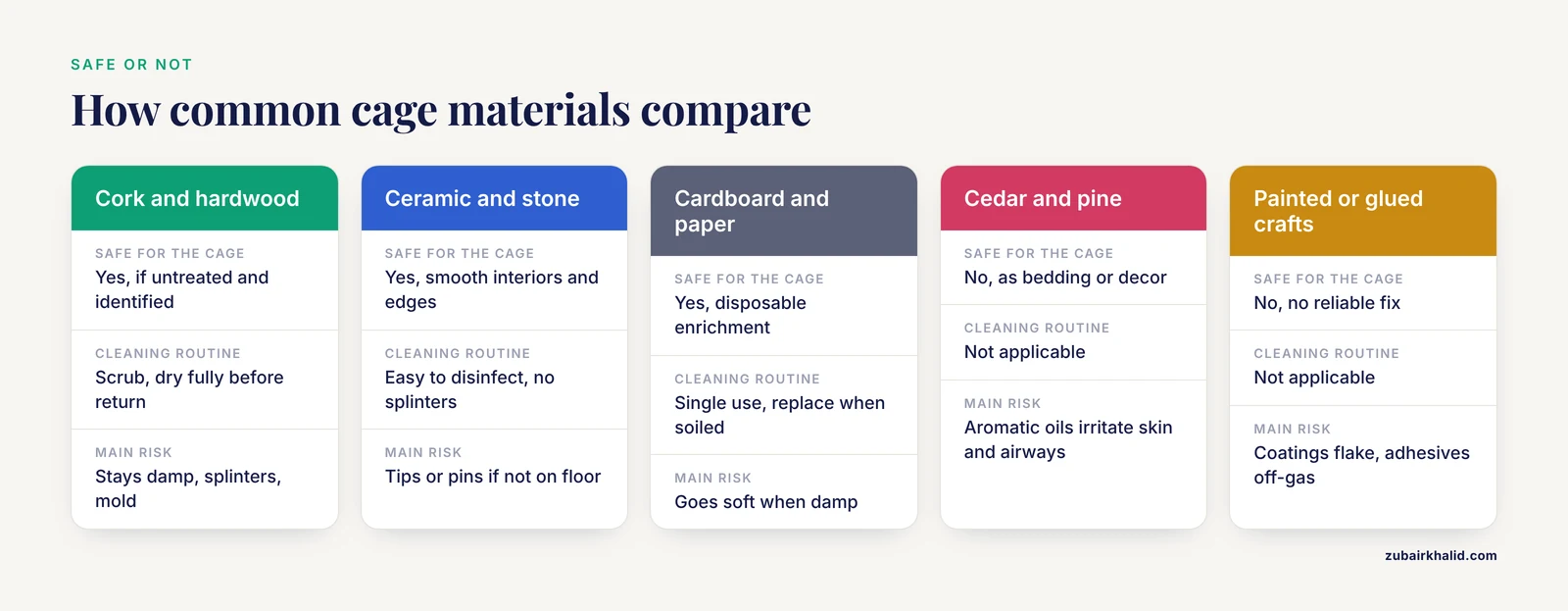
Choose inert materials that do not shed chemicals into a warm, humid environment. Cork, untreated hardwood, ceramic, natural stone, food-grade plastic, plain paper, and cardboard are the workhorses of reptile keeping. Reptile veterinarians consistently advise against aromatic softwoods, pressure-treated lumber, and any item with a paint, varnish, or glue layer, because coatings and adhesives can release fumes in a heated enclosure and can flake into the water bowl or onto food.
Physical Safety
Run your hands over every surface the way your snake will. Look for splinters, burrs from drilled plastic, sharp ceramic edges, and staples. Then ask one question about every gap: can my snake wedge its body in and panic? A crevice narrower than the snake's thickest body section is a trap risk. Heavy items belong on the enclosure floor, not stacked on loose substrate where they can shift and pin the snake. Anything climbable must hold the snake's weight without rocking, and a fall from it should land on substrate, not on glass or another hard object.
Cleanability
Smooth, non-porous items can be scrubbed and disinfected. Wood can be cleaned but holds moisture longer, so it needs full drying before it goes back. Cardboard and paper are single-use, which is a feature rather than a flaw. Fabric traps moisture and odor and is best avoided unless it can be machine washed and dried hot.
Toxic Materials for Corn Snakes
The list of toxic materials for corn snakes is short but absolute. Cedar and pine release volatile aromatic compounds that irritate reptile respiratory tracts and skin, so they are out as bedding and as decor. Pressure-treated wood carries chemical preservatives. Older painted items may contain lead-based paint. Craft adhesives, including hot glue, soften and off-gas with enclosure heat. Essential oils, scented candles, and aerosol fresheners used in the same room can irritate a snake's airways even when they never touch the decor. Galvanized metal can shed zinc. When you cannot confirm what an item is made of or how it was treated, treat it as unsafe.
The Best Corn Snake Toys and Accessories
Hides: The Core Accessory
A hide is a closed or mostly closed shelter the snake can press its body against. Plan for at least two, one on the warm end and one on the cool end, so the snake never has to choose between a safe temperature and a feeling of cover. Snug fits work better than cavernous ones. Extra hides at mid height or along the back wall give a nervous snake more options. Check that entrances are smooth and that the hide cannot tip when the snake pushes against its roof.
Climbing Structures
Cork tubes, sturdy branches, and fixed ledges let a corn snake use vertical space. Anchor branches to a heavy base or wedge them firmly between floor and lid so they cannot pivot. Sand or file cut ends smooth. Position climbing so a slip lands on substrate. Wire-free plastic vines can be wound around branches for cover, but only versions without internal wire, because wire can pierce the coating and the vine can tangle around the snake.
Burrowing and Dig Options
Corn snakes burrow readily. Keep a deep substrate zone on at least one side of the cage, or add a dig box filled with a safe, dry bedding such as aspen shavings or shredded paper. A dig box is one of the cheapest and safest toys available, and it contains the mess better than deep bedding across the whole floor.
Visual Cover and Plants
Open floor space reads as exposure to a prey animal. Plastic plants, cork flats leaned against the glass, and a background on the back and side panels all reduce that exposure. Secure plants so nothing drops onto the snake or into the water bowl.
Feeding-Related Enrichment
Small changes around feeding add interest without risk. Some keepers vary where the prey sits in the enclosure or place it under a light cover so the snake uses its scent-tracking behavior. Keep changes modest, because elaborate feeding games can lead to missed strikes or regurgitation in some snakes. If your snake is a hesitant feeder, discuss feeding enrichment with your reptile veterinarian before changing the routine.
DIY and Budget Options
Plain cardboard boxes with a door cut in one side, toilet paper tubes, paper bags, and converted food-grade plastic containers are all safe when the edges are smooth. Drill or carefully melt openings in plastic and remove every burr. If you need to join or seal plastic, fully cured 100% silicone aquarium sealant is the material most vivarium builders use, and it should be aired out until odorless before the item enters the cage. Skip hot glue, spray paint, and decorated crafts entirely.
Dangerous Toys for Corn Snakes: What to Avoid
Aromatic Woods and Treated Materials
Cedar is the classic hazard. Its aromatic oils, the same compounds that make it smell pleasant in a closet, irritate reptile skin and respiratory tissue. Pine carries related compounds. Pressure-treated lumber, old furniture wood with unknown finish, and pallet wood of unknown origin all fail the treatment-history test. If you cannot identify both the species and the treatment history of a piece of wood, keep it out of the cage.
Heat Rocks and Direct-Contact Heaters
Heat rocks earn their place on the avoid list for a simple reason. They develop uneven hot spots, and a snake resting on a warm surface cannot lift away quickly enough to prevent a burn. Reptile veterinarians regularly see ventral burns caused by unregulated contact heat. Heating belongs on a thermostat, positioned so the snake cannot coil directly on the hottest element for extended periods. Any device that cannot be regulated, including anything marketed as a warm rock, is a dangerous toy rather than an accessory.
Small Parts, Wire, and Entanglement Hazards
Snakes strike, constrict, and drag. Anything with detachable eyes, beads, bells, glitter, or staples can come apart during a strike and be swallowed with the prey item. Wire-core vines are a double hazard, because the wire can pierce the plastic coating and the vine can wrap around the snake's body or jaw. Loose synthetic fibers, cotton batting, and some decorative mosses can tangle around teeth or be ingested. If you can pluck a fiber off with your fingers, your snake can catch it too.
Adhesives, Paints, and Finishes
A heated, humid enclosure accelerates the release of fumes from adhesives and finishes. Hot glue softens near heat fixtures. Spray paints and varnishes continue off-gassing after they feel dry. Older paint layers may contain lead. There is no reliable way to make a coated item safe for a reptile enclosure, so the rule is to buy items colored during safe manufacturing or leave natural materials natural.
Loose Particulate Items Sold as Toys
Colored sand, aquarium gravel, and crushed walnut shell sometimes appear in the toy aisle as play material. In a snake enclosure they are ingestion hazards. A snake striking at prey presses its jaws into the floor, and loose particles can be swallowed, where they can cause impaction. Keep particulate material out of the cage unless it is the substrate itself and your veterinarian or care guide has approved it for your setup.
Live Prey as Entertainment
Live rodents are sometimes offered as a spectacle. They are a hazard. A rodent defending itself can bite and seriously injure a snake, and injuries occur even under supervision. Pre-killed, thawed prey is the standard recommendation in reptile veterinary practice. If your snake refuses thawed prey, work with your veterinarian on feeding strategy rather than leaving live animals in the cage.
Scented and Household Items
Air fresheners, essential oil diffusers, scented cleaning sprays, and smoke of any kind in the snake's room can irritate reptile airways. A snake's respiratory tract has little reserve, so airborne irritants that seem mild to humans can cause real problems. Keep scented products out of the room, and never use fragranced cleaners on anything that goes in the cage.
Corn Snake Cage Accessories Safety: Placement and Setup
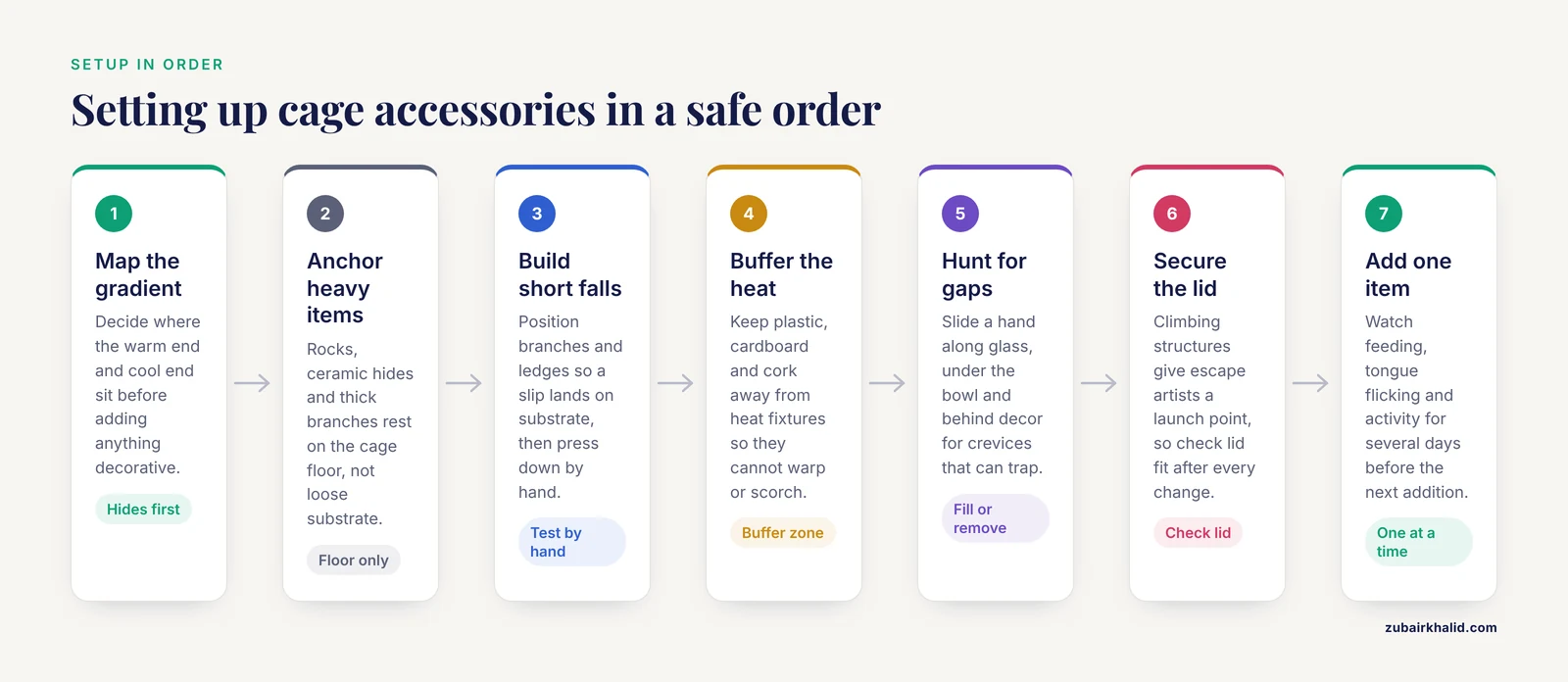
Safety is as much about placement as selection. Work through the setup in this order.
- Map the thermal gradient first. Decide where the warm end and cool end sit, then place a hide at each end before adding anything decorative.
- Anchor heavy items on the enclosure floor. Rocks, ceramic hides, and thick branches should rest on the cage floor, not on loose substrate, so they cannot shift and pin the snake.
- Build climbing with short falls. Position branches and ledges so a slip lands on substrate, then test each structure by pressing down with your hand.
- Keep vulnerable materials away from heat. Plastic, cardboard, and cork degrade, warp, or scorch near heat fixtures, so leave a buffer zone around every heat source.
- Hunt for gaps. Slide a hand along the glass, under the water bowl, and behind decor. Any crevice that can accept the snake's body but not release it needs filling or removal.
- Secure the lid. Corn snakes are persistent escape artists, and a climbing structure gives them a launch point. Check lid fit after every rearrangement.
- Introduce one change at a time. Add a single item, then watch feeding, tongue flicking, and activity for several days before adding another.
Water bowls count as equipment. Choose a heavy, stable bowl that cannot tip, place it in the cool end to limit evaporation into the warm hide, and scrub it daily.
Cleaning and Maintenance
Spot clean daily. Remove feces, shed skin fragments, and wet substrate, and wipe the areas under hides where waste collects unnoticed.
Run a rotating deep clean. Each week, pull one or two items, scrub them, disinfect them with a reptile-safe disinfectant or a dilute unscented bleach solution, rinse completely, and let them dry fully before they go back. Never mix cleaning chemicals, and never return an item while it carries any odor of disinfectant.
Retire items on a schedule. Cardboard goes out when soiled or damp. Wood goes out when it stays damp, grows mold, or splinters. Plastic goes out when it cracks or holds odor. The moist substrate inside a humid hide needs frequent replacement, because warm, damp material grows mold and bacteria faster than anything else in the cage.
Quarantine new purchases. Clean any new item before it enters the cage, and disinfect anything that came from a store bin or a swap meet before your snake touches it. Wash your hands after handling decor or the snake, because reptiles can carry Salmonella and standard hygiene protects everyone in the household.
Common Mistakes
- Overcrowding. A cage packed with decor has no clear thermal gradient and no open travel path.
- Stacking rocks on substrate. Substrate shifts, stacks collapse, snakes get pinned.
- Cleaning with scented products. Fragrance residue sits in a closed box with the snake all day.
- Adding five items at once. You cannot tell which change affected behavior.
- Ignoring wear. Cracked plastic, splintering cork, and fraying vines all start as minor flaws.
- Sharing items between animals without disinfection. Mites and pathogens travel on decor.
- Storing unrelated items in the cage. Paper, fabric, and cardboard in a warm enclosure attract pests.
- Forgetting the lid after rearranging. New climbing routes create new escape routes.
Troubleshooting
The snake ignores new items. Give it time. Snakes investigate at their own pace, often overnight. Place new items along the travel path the snake already uses, usually along the walls.
The snake pushes everything around. Anchor items to a fixed point, add weight to bases, or choose heavier materials. A hide that slides every night is a hide the snake may abandon.
The snake avoids one hide. Check the fit, the temperature under it, and the entrance size. A hide that is too large, too hot, or too tight gets rejected.
The snake rubs its nose on glass or rough decor. Swap rough or abrasive items for smooth ones and add visual cover, since rubbing often reflects escape attempts or stress. Any visible wound or persistent rubbing needs a reptile veterinarian, because rostral injuries can worsen and scar.
Feeding changed after a rearrangement. Revert to the previous layout and reintroduce changes more slowly. Persistent refusal of multiple meals needs veterinary evaluation.
You find mites on decor. Mites live in the whole enclosure, not on one item, so cleaning a single hide will not fix an infestation. Ask your reptile veterinarian about treating the snake and the cage together.
Welfare and Safety Monitoring
You do not need lab equipment to monitor welfare. The practical proxies are behavior and condition: regular feeding, calm tongue flicking, evening exploration, shed skin coming off in one piece, and stable body condition. Warning signs include prolonged hiding, repeated food refusal, open-mouth breathing or wheezing, excess time soaking or complete avoidance of water, and new defensive behavior.
Research is moving toward objective measurement. The shed skin corticosterone method used in recent work gives researchers a non-invasive way to assess chronic stress in snakes, because sampling does not require handling the animal in a way that itself raises stress hormones [1]. That work is why housing design now sits at the center of reptile welfare discussions, and it is a reasonable topic to raise with your veterinarian if you keep multiple snakes or manage a breeding collection.
Limitations and When to Contact a Veterinarian
Every corn snake is an individual, and a reptile veterinarian should tailor housing and enrichment advice to your animal's age, size, health history, and temperament. The guidance here covers safe selection and setup, not individual medical judgment.
Contact a reptile veterinarian promptly for any of the following:
- Any burn, including a suspected burn from a heat source, even if the skin looks intact.
- Mouth breathing, wheezing, or visible effort when breathing.
- A wound on the nose, mouth, or body caused by decor.
- Suspected swallowing of a foreign object or substrate.
- Regurgitation more than once, or refusal of food beyond your snake's normal pattern.
- Lethargy, unusual posture, or a behavioral change that does not resolve within a few days.
- Signs of mites or other parasites on the snake or in the cage.
- Shedding problems that recur rather than occurring once.
The Association of Reptilian and Amphibian Veterinarians maintains a directory that helps owners find a reptile-experienced veterinarian, and references such as the Merck Veterinary Manual's exotic animal section and VCA Animal Hospitals' reptile guides provide reliable background reading between visits.
Frequently Asked Questions
What are the best corn snake toys for a beginner setup?
Start with two closed hides, one at each end of the thermal gradient, plus a cork tube for climbing and hiding, a dig box with safe dry bedding, and two or three wire-free plastic plants. That combination covers hiding, climbing, burrowing, and visual cover at low cost and with no construction skills.
Are cardboard tubes and boxes safe for corn snakes?
Yes. Plain cardboard is one of the safest disposable enrichment materials, because it is inert, dry, and replaceable. Cut a door hole with smooth edges, remove any tape or staples, and discard the item once it is soiled or damp.
Is cedar safe for corn snakes?
No. Cedar releases aromatic compounds that irritate reptile skin and respiratory tracts, and pine carries related compounds. Keep both out of the cage as bedding and as decor, and avoid storing scented cedar products near the enclosure.
Do corn snakes need toys, or are hides enough?
Hides are the foundation, but they are not the whole answer. Corn snakes climb and burrow, and furnished enclosures let them use that full behavioral range. Stress research in this species supports a furnished terrarium over a bare setup.
Can I use toys made for hamsters or birds in my snake cage?
Sometimes, after inspection. Reject anything with cedar, small detachable parts, glued joints, fabric fibers, or a coating you cannot identify. Accept plain, smooth, cleanable items such as undyed untreated wooden pieces or plain ceramic.
How do I disinfect snake toys safely?
Remove the item, scrub off debris, apply a reptile-safe disinfectant or a dilute unscented bleach solution, rinse completely, and dry fully before returning it. Never mix chemicals, never use fragranced products, and never return an item that still smells of disinfectant.
Can I put branches or rocks from my yard in the enclosure?
Yes, with preparation. Use only non-resinous wood you can identify from ground that has not been treated with pesticides, and freeze or bake it using a method from a reputable husbandry guide to kill pests. Scrub rocks, check for sharp edges, and set them on the cage floor. If you cannot confirm a material's history, buy it instead.
How often should I rotate or replace toys?
Rotate a few items every few weeks if your snake seems to ignore its setup, and replace any item immediately when it cracks, splinters, frays, stays damp, or holds odor. Permanent fixtures like hides and branches do not need frequent change, only regular cleaning and inspection.