Safe Toys and Equipment for Ball Pythons: What to Avoid
By Dr. Zubair Khalid, DVM, MS, PhD ·
Safe toys for ball pythons are simple, solid, cleanable items that let the snake hide, climb, and explore without risk of burns, cuts, swallowing, or chemical exposure. The short list looks like this: at least two snug hiding places, securely anchored branches or cork bark for climbing, a water bowl large enough for soaking, plain substrate, and untreated decorations with no small loose parts. The short list of things to avoid is just as clear: hot rocks, exposed heat tape, adhesive-covered items, aromatic softwood products, painted or pressure-treated wood, fragile glass decorations, gravel or small loose objects the snake could swallow, and anything salvaged from the household without being properly cleaned and verified as untreated.
Ball pythons are terrestrial, secretive snakes that spend much of their time in contact with the surfaces of their enclosure. That behavior has a direct consequence for toy and accessory safety. Everything in the cage is effectively a floor, a wall, a chew surface, or a hiding spot, and the snake presses against it for hours at a time. Research on captive housing shows that enclosure design and furnishings influence both behavior and physiological stress in this species, which means the choices you make about toys and equipment are welfare decisions, not decoration decisions [1], [2].
This article walks through what to buy or build, what to leave on the store shelf, why each rule exists, and when a problem calls for your reptile veterinarian.
This article is educational and is not a substitute for veterinary diagnosis or treatment.
At a Glance: Safe vs. Unsafe Items for a Ball Python Enclosure
| Category | Safe choices | Avoid |
|---|---|---|
| , - | , - | , - |
| Hiding places | Commercial reptile hides, half-log cork hides, opaque plastic boxes with an entry hole sized to the snake | Hides with sharp internal edges, flimsy hides that collapse, hides glued with adhesives |
| Climbing | Firmly anchored cork branches, sterilized hardwood branches, commercially sold reptile branches | Loose branches that can fall, resinous softwood limbs, painted or varnished wood |
| Water | Sturdy, shallow, easy-to-clean water basin large enough for soaking | Deep or tippy bowls, porous unglazed items that harbor bacteria |
| Substrate surfaces | Plain approved reptile substrate kept dry and changed routinely | Cedar or other aromatic wood products, dusty fine particles, small pellets or gravel |
| Decor | Smooth sterilized rocks, artificial plants designed for terrariums, untreated live plants | Glass, thin plastic, items with small detachable parts, glued ornaments |
| Heat and light | Thermostat-controlled heating with a guard or safe placement, appropriate overhead lighting | Hot rocks, exposed heat tape, unregulated heat sources, bare bulbs reachable by the snake |
Why Enrichment and Furnishings Matter for This Species
A bare box with a water bowl and a single hide is the minimum a ball python needs to survive. It is not the setup that lets the animal behave like a ball python. A peer-reviewed behavioral study compared ball pythons kept in basic rack-style housing with the same snakes kept in furnished terrariums that included substrate, a hiding place, climbing opportunities, a water basin for bathing, an elevated basking spot, and living plants. The snakes showed a broader spectrum of species-typical behavior in the furnished terrariums, and the authors concluded from an animal welfare perspective that rack housing is no substitute for a furnished enclosure [1].
Commercial practice lags far behind that standard. A welfare assessment of more than 5,000 ball pythons at exotic pet expositions and in online videos found that most vendors and breeders used small, restrictive enclosures that prevented snakes from stretching to their full length, and that most did not provide adequate written husbandry guidance to buyers [3]. That finding matters to you as an owner because the accessories sold alongside many pet-store ball pythons are designed for those minimalist setups. When you upgrade to a larger, furnished enclosure, the equipment list changes, and so does the safety checklist.
Stress physiology adds another layer. Researchers measuring corticosterone, a stress hormone, in shed skins found that the relationship between housing and stress differs by species. In ball pythons specifically, snakes kept in enriched terrariums showed higher shed corticosterone concentrations than those in rack systems, and enclosure volume showed a positive association with corticosterone in this species. The authors interpreted these findings as evidence that responses to housing are species specific and that enrichment must be evaluated carefully rather than assumed to lower stress in every case [2]. Practically, this means you should watch your individual snake after any change, including a positive change like adding climbing structure, and give it time and adequate cover to adjust.
The behavioral evidence, the welfare data, and the stress physiology all point in the same direction for equipment choices. Furnish the enclosure generously, but keep every item simple, solid, cleanable, and chemically inert.
Safe Toys for Ball Pythons, Category by Category
Hiding Places: The Most Important Accessory You Will Buy
Ball pythons are cryptic, nocturnal predators that rely on enclosed spaces for security. A hide that is snug, dark, and appropriately sized is not a toy in the playful sense, but it is the single accessory with the greatest effect on day-to-day welfare. Provide at least two hides, one on the warm end and one on the cool end, so the snake never has to choose between feeling secure and thermoregulating.
Selection criteria:
- Snug fit. The interior should be small enough that the snake contacts the walls when coiled. Oversized caves defeat the purpose.
- Rigid construction. Heavy resin or thick plastic hides will not collapse or tip. Test any commercial hide by pressing on it.
- Smooth interior. Run your fingers around every internal edge. Mold flash on cheap plastic hides can leave sharp ridges that abrade skin.
- No glue. Avoid hides assembled with adhesives, which can fail in heat and humidity or leach chemicals.
- Easy to disinfect. You will lift and clean these items frequently, so weight and shape matter.
A simple opaque plastic storage box with an entry hole cut and sanded smooth is a legitimate, widely used hide. The entry hole should be smooth, since repeated passage over a rough cut edge can injure the snake's rostrum and scales.
Climbing Structures
Although ball pythons are primarily ground dwellers, they do climb when given secure opportunity, and the furnished-terrarium study specifically listed climbing possibilities as part of the behaviorally adequate setup [1]. Good climbing options include:
- Cork bark rounds and flats, which are strong, natural, and easy to anchor.
- Sterilized hardwood branches from non-resinous trees, scrubbed and dried, with all bark removed if you cannot verify the tree's treatment history.
- Commercial reptile branches and ledges sold for the purpose, anchored so they cannot shift under the snake's weight.
Anchoring is the safety rule that gets skipped most often. A ball python is a heavy-bodied snake, and a branch that shifts or falls can injure the animal or pin it against the glass. Every elevated structure should be secured to the enclosure walls or wedged so firmly that you cannot move it with one hand.
Water Basin for Soaking
The furnished-terrarium setup in the behavioral study included a water basin suitable for bathing [1]. Choose a heavy, shallow basin the snake can fully coil in without deep water risk. Weight matters because a light bowl tipped by a burrowing snake becomes a humidity and hygiene problem. Smooth, nonporous surfaces clean best, and the basin should be scrubbed and refilled on a routine schedule.
Substrate-Based Enrichment
Appropriate substrate does double duty as a wellbeing feature, because burrowing and pushing through substrate is normal behavior. The behavioral study included substrate as part of the furnished setup [1]. Keep the layer deep enough for the snake to press into and shift around, and spot-clean soiled areas promptly. Avoid substrates with small, ingestible particles if your snake strikes at food inside the enclosure, since accidental ingestion is a known husbandry hazard discussed further below.
Plants, Live and Artificial
Living plants were part of the behaviorally enriched setup in the published evaluation [1]. If you use live plants, confirm that the species is considered safe for reptile enclosures and that they have not been treated with systemic pesticides, which is common in ornamental horticulture. Wash root balls and foliage thoroughly, or grow plants outside the enclosure first. Artificial plants should be terrarium-rated, have no glitter, wire, or loose flocking, and be anchored so they cannot be dragged into the water bowl.
Selection Criteria for Materials and Equipment
Before any object goes into the enclosure, run it through a short checklist. This is the practical core of ball python cage accessories safety.
- Solid and inert. The material should not crumble, flake, shed fibers, or soften in humidity and heat.
- No small parts. Anything smaller than a piece of the snake's regular prey, or anything that can detach, is a swallowing risk.
- No cavities the snake cannot exit. A decoration with an internal chamber that narrows can trap a snake. If the snake can get in, it must be able to get out without reversing.
- Thermally safe. Nothing flammable, meltable, or heat-trapping near the heat source.
- Cleanable. You must be able to scrub and disinfect it without degrading the surface.
- Chemically clean. No paint, varnish, adhesive, pesticide residue, soap film, or preservative treatment.
- Stable. Push it hard. If it tips, shifts, or rolls, fix it or remove it.
Household items can be repurposed successfully, but only after verification. Reptile husbandry guides, including the evidence-based husbandry resources published by ReptiFiles and the reptile care materials from VCA Animal Hospitals, consistently emphasize that secondhand and salvaged items must be identified, cleaned, and free of treatment chemicals before use. Rocks collected outdoors should be scrubbed and boiled or baked and then inspected for crumbling. Wood from unknown sources should be treated as treated lumber until proven otherwise.
Toxic Materials for Ball Pythons
Because ball pythons live in constant contact with their substrate and decor, and because they breathe at close range from heated, humid air inside an enclosed space, volatile chemicals concentrate where you may not notice them. The main toxic material categories to screen out:
- Aromatic softwoods. Cedar and untreated pine products release aromatic compounds that reptile husbandry authorities, including resources referenced by the Merck Veterinary Manual for exotic animals and ARAV-oriented husbandry guidance, flag as inappropriate for reptile enclosures. Cedar shavings in particular have no place in a snake cage.
- Pressure-treated and painted wood. Preservative salts, paints, stains, and varnishes can leach, especially in warm, humid conditions. Scrap lumber, old furniture parts, and driftwood of unknown origin all fall into this category.
- Adhesives and tapes. Hot glue residue, packing tape, stickers, and foam-backed decor can be ingested during normal tongue-flicking exploration or can fail in heat.
- Soap and chemical residue. Any item washed with detergent must be rinsed completely. Cleaning the enclosure itself should rely on reptile-appropriate disinfection followed by thorough rinsing and drying, following the general disinfection principles described in veterinary exotic animal resources such as the Merck Veterinary Manual.
- Metals and galvanized items. Uncoated galvanized hardware can carry zinc. Stick to stainless steel or plastic hardware inside the enclosure.
- Ornamental plants of unknown treatment. Systemic insecticides are taken up into plant tissue and cannot be washed off.
If you cannot document what an item is made of and how it was treated, it does not belong in the cage. When you are unsure whether a material in your enclosure is toxic, that is a specific question to raise with your reptile veterinarian or with an ARAV-affiliated clinic before the item goes in, not after.
Dangerous Toys for Ball Pythons
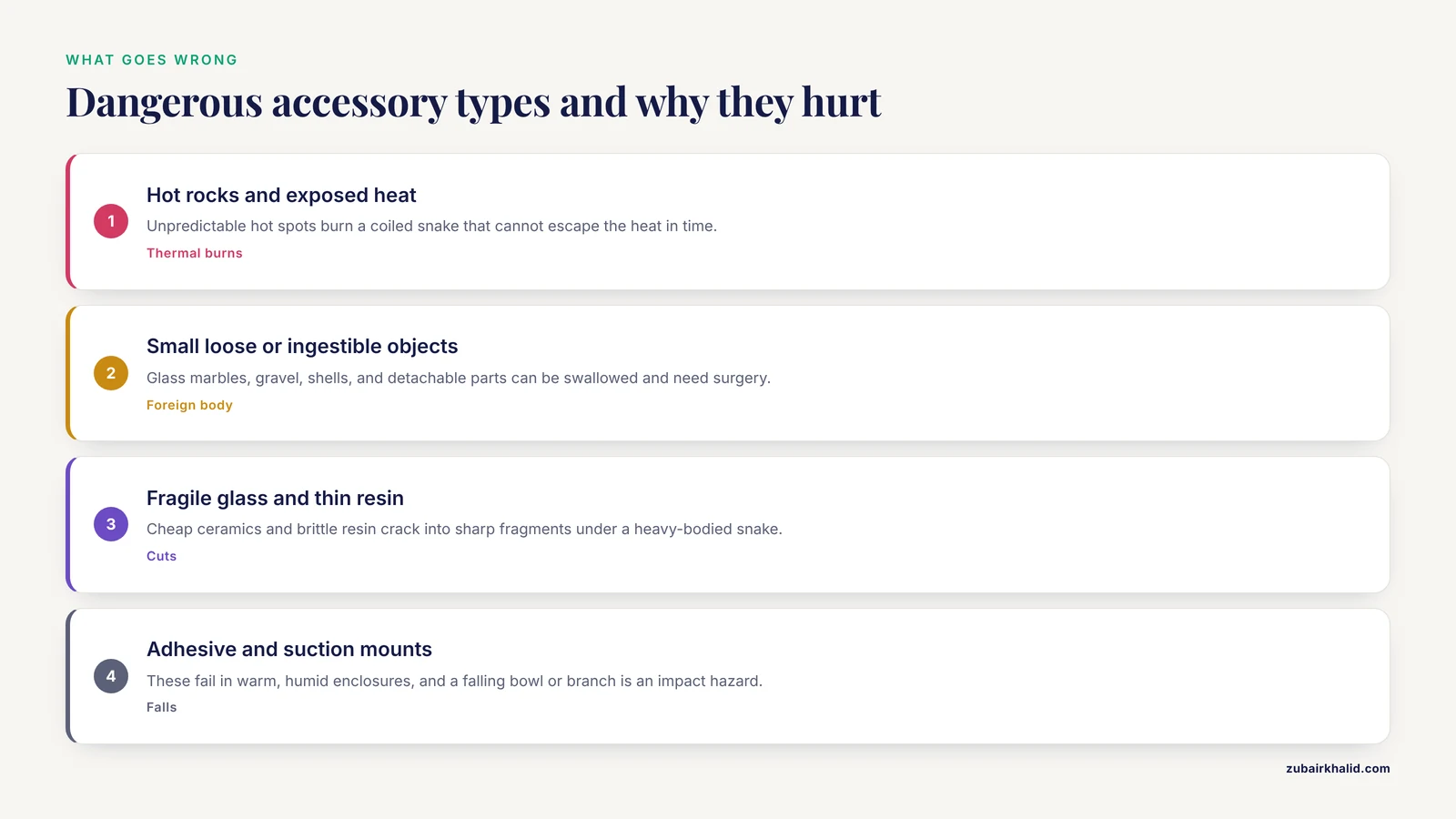
Beyond materials, certain accessory types are dangerous as a category. These are the items most commonly involved in reptile injuries reported in clinical practice, and they are the reason dangerous toys for ball pythons is a list worth memorizing.
Hot rocks. These plug-in stones develop unpredictable surface temperatures and localized hot spots because the snake's body coiled on top of them blocks heat dissipation. Thermal burns from hot rocks are a classic reptile presentation, and reptile veterinarians, including guidance published through VCA Animal Hospitals and ARAV educational materials, recommend against them in favor of thermostat-controlled heating placed so the animal cannot maintain direct prolonged contact with the heat element. A ball python that spends hours pressed against a hot rock cannot escape the heat in time to avoid injury.
Exposed heat elements of any kind. Heat tape, heat cable, and unguarded heat panels can reach burn temperatures at contact points. Every heat source inside or under the enclosure should be regulated by a thermostat and positioned so the snake cannot coil directly on the element itself.
Small, loose, or ingestible objects. Glass marbles, gravel, shells, loose sphagnum chunks in reach of a feeding strike, and decor with detachable parts can be swallowed. Foreign body ingestion in snakes is a surgical problem, so prevention is the entire strategy.
Fragile decorations. Thin glass, brittle resin, and cheap ceramics can crack into sharp fragments under the weight of a heavy-bodied snake. If an item is not rated to hold the animal's weight, keep it out.
Adhesive-hooked and suction-mounted accessories. These fail predictably in warm, humid enclosures. A falling water bowl, branch, or thermometer is an impact and drowning hazard.
Weight-bearing items without support. Any ledge or branch that holds the snake must hold its full adult weight plus the force of a strike or a fall. Test every structure before the snake does.
Enclosures and lids that are not secure. Ball pythons are stronger and more exploratory than their reputation suggests. An unsecured lid is an escape hazard, and escapes end in dehydration, hypothermia, injury, or permanent loss of the animal. Screen lids should be clamped.
Ball Python Cage Accessories Safety: Heat, Light, and Electrical Equipment
Heating and lighting gear causes more preventable injuries than any toy ever will, so it deserves its own safety pass.
Use a thermostat on every heat source. Unregulated under-tank heaters and heat tapes can overheat, and glass-bottom enclosures concentrate that heat against the snake's belly. The thermostat probe belongs where the snake actually rests, not floating in midair, and it should be taped or fixed so the snake cannot dislodge it.
Guard or distance every bulb. Overhead basking lamps and UV lamps can reach skin-burning temperatures at the bulb surface. The furnished-terrarium study used a fluorescent tube and a UV lamp for illumination [1], which reflects standard practice in furnished setups, but the lamp position must keep the bulb out of reach. A snake that climbs into a bulb will burn, and burns on the top of the spine and head are difficult to heal in a humid environment.
Protect cords. Cords that enter the enclosure should pass through cord grommets or be routed so the snake cannot bite or coil on them. Snakes investigate with the tongue and mouth, and a chewed power cord is an electrocution risk.
Verify readings. A cheap digital thermometer and an infrared temperature gun let you confirm that the warm and cool zones match your intended gradient. Equipment safety and thermal safety are the same project, because the correct gradient is what allows the snake to use every accessory you provide.
Check the whole system monthly. Heat sources degrade, thermostats fail, and probes shift. A monthly equipment check takes minutes and prevents most heat-related accidents.
How to Introduce New Toys and Accessories, Step by Step
- Verify the item. Confirm material, treatment, and origin before purchase or before placing anything salvaged.
- Clean and disinfect. Scrub, disinfect using a reptile-appropriate method, rinse completely, and dry.
- Inspect physically. Check for sharp edges, loose parts, cracks, and wobble. Sand or file anything rough.
- Install with stability in mind. Anchor climbing structures, seat heavy items on the substrate floor rather than on top of loose substrate, and secure cords.
- Rearrange conservatively. Add new items without removing established hides. Ball pythons rely on familiar cover, and a full redesign can trigger refusal to eat or prolonged hiding.
- Observe for several days. Watch how the snake uses the item, whether it thermoregulates normally, and whether it eats on schedule. The stress physiology findings in ball pythons indicate that responses to enclosure changes are individual and species specific, so your own snake's behavior is the best monitoring tool you have [2].
- Recheck anchoring after a week. Substrate settles and humidity loosens fittings. Retest every anchor and mount.
Common Mistakes Owners Make
- Buying for the snake the pet store described instead of the adult snake. Ball pythons reach a substantial adult body length, and the welfare assessment of traded ball pythons found that enclosures preventing full body extension were the norm rather than the exception [3]. Accessories bought for a hatchling, especially climbing structures, may be unsafe for an adult's weight.
- Substituting a single hide for a thermal pair. One hide forces the snake to trade security for temperature, which is a chronic stressor.
- Trusting product labels. Items marketed for reptiles can still include hot rocks, glued ornaments, and fragile resin. The category label is not a safety certification.
- Skipping the thermostat. This is the highest-consequence mistake on the list because burns develop silently overnight.
- Overcleaning with harsh chemicals and under-rinsing. Residue in an enclosed, heated space is inhaled and contacted continuously.
- Adding climbing structures without cover below. A nervous snake needs a route along the ground. Open climbing space with no retreat gets ignored, which is another way enrichment fails silently.
- Assuming more enrichment is always better. The corticosterone study found that ball pythons in enriched terraria showed higher shed corticosterone than those in racks [2]. Enrichment must come with adequate hides and the ability to opt out. Structure without cover is exposure, not enrichment.
Troubleshooting Equipment and Behavior Problems
The snake ignores the climbing branch. Anchor it lower, angle it toward a hide, or add cover along the route. Terrestrial snakes use low, sheltered pathways first.
The snake keeps tipping the water bowl. Move to a heavier, wider, lower basin, and seat it into the substrate so it cannot be pushed from below.
The hide feels wrong and the snake perches on top of it. The interior is probably too large or too bright. Downsize or add substrate around the outside to block light gaps.
Condensation and mold appear on new decor. Porous or absorbent items hold moisture. Remove them, dry the enclosure, and switch to nonporous alternatives.
The snake rubs its rostrum along the lid or edges. This can indicate that the enclosure feels exposed or that an edge is rough. Add cover, verify all edges are smooth, and if rubbing persists or you see abrasions, have the snake examined, since rostral injuries can deepen and infect.
Feeding stops after a rearrangement. Restore the previous hide positions, leave everything else stable, and give the snake time. If fasting continues beyond what is normal for your snake's pattern, or if weight loss appears, contact your veterinarian.
Special Situations: Neurologic Morphs and Gravid Females
Two situations change the accessory safety calculus and deserve their own section.
Spider morph ball pythons and wobble syndrome. The spider morph is frequently associated with wobble syndrome, a movement disorder. Advanced imaging research identified structural differences in the inner ear of spider morph ball pythons that were highly likely related to the syndrome [4]. For an owner, the practical takeaway is that a snake with impaired coordination and head tremor needs a simplified, low-risk environment. Eliminate fall hazards, lower climbing structures, avoid deep water features, keep decor minimal, and remove anything the animal could strike hard against during uncontrolled movement. If you own or are considering a spider morph, discuss its neurologic status with your veterinarian before adding any elevated equipment.
Gravid females. Reproductive tracking research in captive female ball pythons documented ovulation mainly between April and August, egg laying from June to November, a median clutch of six eggs, and incubation of approximately 58 days, with follicles of 20 mm or more growing at a median rate of 0.38 mm per day [5]. A female carrying follicles or eggs has shifting space and thermal needs, and a heavy, gravid female is less agile on elevated structures. Before and during the breeding season, keep climbing minimal, ensure the warm hide and water basin are easily accessible without climbing, and coordinate monitoring of follicular development with your reptile veterinarian rather than relying on manual palpation alone, which the same study found had a 25 percent false-negative rate compared with ultrasonography [5].
Limitations and When to Contact a Veterinarian
Every enclosure and every snake is an individual case. The studies summarized here describe populations and group-level patterns, and they cannot predict how your specific animal will respond to a given accessory or change. Decisions about materials, thermal equipment, and any health concern should be confirmed with a reptile veterinarian, ideally one affiliated with ARAV, and the general husbandry frameworks published by organizations such as the AVMA and resources like the Merck Veterinary Manual exotic animal section are useful background reading between visits.
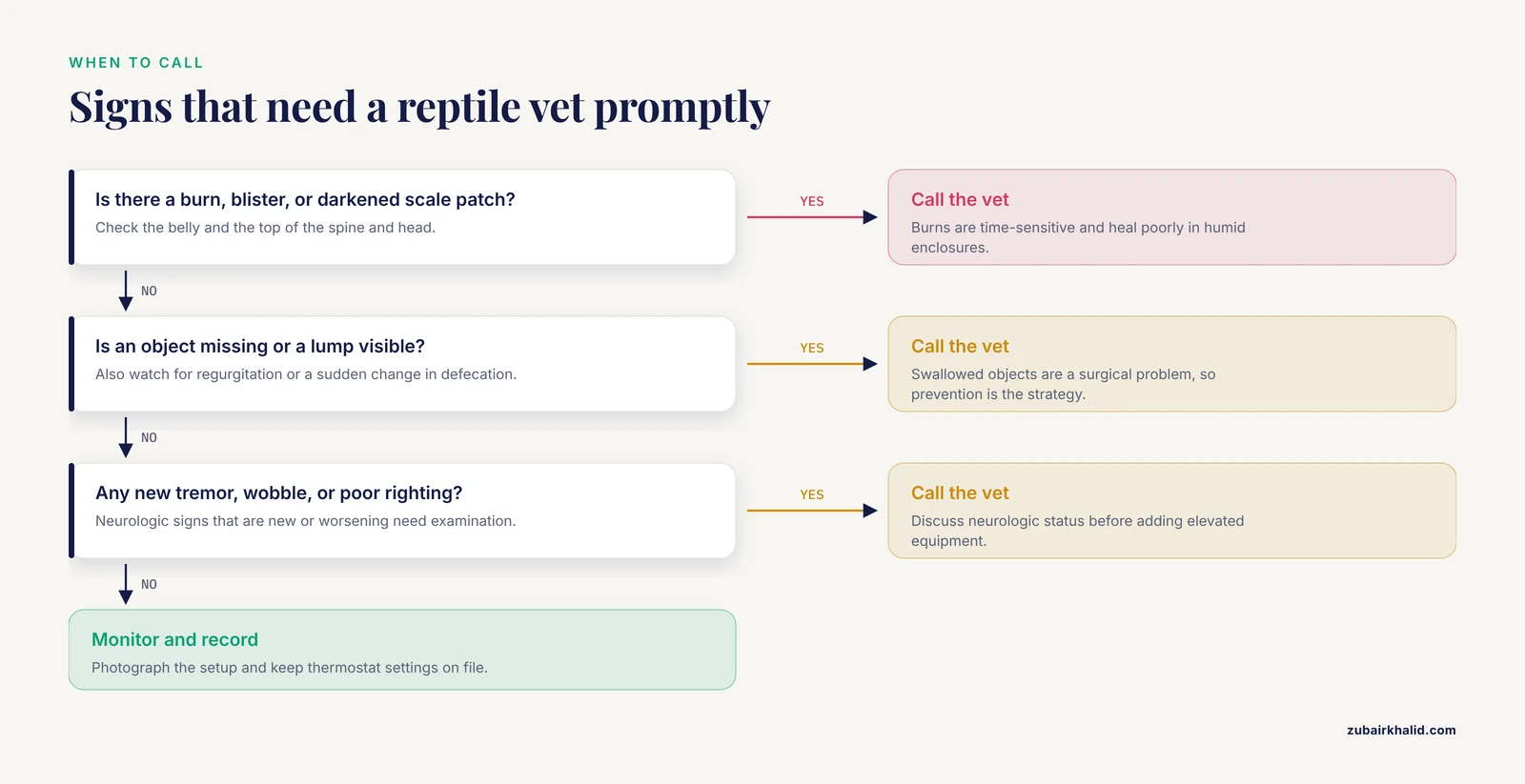
Contact your reptile veterinarian promptly if you observe any of the following:
- Any burn, blister, darkened scale patch, or discoloration, especially along the belly or the top of the spine and head, which suggest contact with an unregulated heat source or a reachable bulb.
- Any suspected swallowed object, including a sudden change in defecation, regurgitation, a visible lump, or a snake that stops eating after an item went missing from the enclosure.
- Rostral or body abrasions that persist or deepen, since chronic rubbing injuries become infected.
- Signs of respiratory disease, such as open-mouth breathing, wheezing, excess mucus, or an abnormally held head posture.
- Prolonged refusal to eat beyond your snake's established pattern, particularly with weight loss.
- Neurologic signs, including tremor, poor righting, incoordination, or head wobble that is new or worsening.
- Injury from a collapsed or fallen accessory, however minor it looks, because reptile skin wounds are evaluated differently than mammalian wounds.
- Before adding any live plant, wood, or substrate you cannot fully identify and verify as untreated.
Keep the manufacturer information for your heating equipment, know your thermostat settings, and photograph your setup before any change, since a record of the enclosure conditions helps your veterinarian evaluate injuries and behavior problems.
Frequently Asked Questions
What are the safest toys for ball pythons?
The safest toys for ball pythons are solid, cleanable, nonporous items with no small parts, no adhesives, and no sharp edges. Snug hides, anchored cork bark, sterilized hardwood branches, a heavy soaking basin, and terrarium-rated plants cover the species' core needs for security, climbing, and bathing. Behavioral research shows that furnished setups with hides, climbing options, a bathing basin, and plants support a broader range of natural behavior than bare housing [1].
What are the most dangerous toys for ball pythons?
The most dangerous toys for ball pythons are hot rocks and any exposed heat element, because they cause thermal burns, followed by fragile glass or thin resin decor, small loose objects that can be swallowed, and accessories mounted with adhesives or suction cups that fail in heat and humidity. Unanchored branches are a close runner-up, since a falling branch can injure a heavy-bodied snake.
Which materials are toxic to ball pythons?
Toxic materials for ball pythons to screen out include aromatic softwoods such as cedar, pressure-treated or painted wood, adhesives and tape residues, galvanized hardware, soap and disinfectant residue, and plants treated with systemic pesticides. Reptile husbandry guidance from sources such as the Merck Veterinary Manual exotic animal resources and ARAV-oriented materials consistently advises keeping enclosure materials chemically inert and untreated. When you cannot document a material's treatment history, treat it as unsafe.
How many hides should a ball python enclosure have?
A ball python enclosure should have at least two hides, one at the warm end and one at the cool end, so the snake can thermoregulate without leaving cover. Hides should be snug, dark, rigid, and smooth inside. A furnished setup with appropriate hiding places is considered part of behaviorally adequate housing for this species [1].
Do ball pythons need climbing toys?
Ball pythons do use climbing structures when they are stable and connected to cover, and published behavioral research included climbing possibilities in the furnished terrariums that supported species-typical behavior [1]. Because the species is primarily terrestrial, climbing should be optional, low, and anchored, never a required route between hides or water.
Are hot rocks safe for ball pythons?
No, hot rocks are not considered safe for ball pythons. They develop unpredictable hot spots, and a snake coiled on one cannot escape the heat before a burn develops. Reptile veterinary guidance, including materials from VCA Animal Hospitals and ARAV educational resources, recommends thermostat-controlled heating positioned so the animal cannot maintain direct prolonged contact with the heat element.
Can I use household items as ball python cage accessories?
Yes, household items can work as ball python cage accessories if they pass a safety check. The item must be identified as untreated, free of paint, varnish, glue, and soap residue, solid enough for an adult snake's weight, free of small parts and trap points, and cleanable. Scrub, disinfect, rinse, and dry anything before it enters the enclosure, and when in doubt about a material, ask your reptile veterinarian first.
When should I call a vet about a toy or accessory injury?
Call a reptile veterinarian for any burn, any suspected swallowed object, any wound that persists or deepens, any new neurologic sign such as tremor or wobble, and any snake that stops eating with weight loss after an enclosure change. Burns and foreign bodies are time-sensitive, and early examination produces better outcomes than watchful waiting.
Sources
- Animal-appropriate housing of ball pythons (Python regius)-Behavior-based evaluation of two types of housing systems.
- Species-specific variations in corticosterone concentrations in captive snake shed skins: implications for housing systems and welfare.
- Dropping the Ball? The Welfare of Ball Pythons Traded in the EU and North America.
- Comparative Assessment of Computed Tomography and Magnetic Resonance Imaging of Spider Morph and Wild Type Ball Pythons (Python regius) for Evaluation of the Morphological Correlate of Wobble Syndrome.
- Follicular Growth Evaluation, Oviposition and Egg Hatching in the Ball Python (Python regius).