Safe Reptile Handling Techniques
By Dr. Zubair Khalid, DVM, MS, PhD ·
Safe reptile handling comes down to three habits. Support the whole body so the animal never feels like it is falling. Watch the reptile's body language before you reach in, and stop at the first sign of stress. Keep every handling session short, calm, and low to the ground so a sudden wriggle never ends in a fall. Reptiles do not enjoy being grabbed the way a dog enjoys a hug, and research on captive reptile welfare shows that handling works best when it is built on good husbandry, gradual habituation, and training that reduces stress for the animal and the person [1].
This guide walks through safe reptile handling techniques step by step, the supplies that make handling safer, the enclosure setup choices that calm a defensive reptile, and the common mistakes that cause most bites, drops, and tail drops.
This article is educational and is not a substitute for veterinary diagnosis or treatment.
Safe Reptile Handling at a Glance
Use this checklist before your next handling session.
| Step | What to do | Why it matters |
|---|---|---|
| , - | , - | , - |
| 1 | Wash your hands before and after | Protects you from bacteria on the reptile and protects the reptile from residues on your skin |
| 2 | Check body language first | Hissing, open mouth, tail whipping, or puffing means wait and try later |
| 3 | Open the enclosure calmly, from the side or top depending on species | Sudden overhead swoops mimic predator attacks and trigger defensive bites |
| 4 | Let the reptile see your hand | Surprised reptiles strike first and investigate second |
| 5 | Scoop from underneath, never grab from above | Under-body support feels like a branch, not a capture |
| 6 | Support the chest or front third and the hindquarters or mid-body | Full support prevents falls, thrashing, and spinal injury |
| 7 | Keep the animal low over a soft surface | A short fall can fracture a reptile's jaw, limbs, or shell |
| 8 | Limit the first sessions to a few minutes | Short positive sessions build tolerance faster than long forced ones |
| 9 | Return the reptile before it escalates | Ending on a calm note makes the next session easier |
| 10 | Wash hands again, and disinfect any handling surface | Standard reptile hygiene protects people and other pets in the home |
Why Safe Handling Matters for Reptiles and Owners
Reptiles are prey animals for most species kept in captivity. Their instincts read a large descending hand as an attack from a bird of prey. A defensive bite, tail whip, or scratch is not aggression in the human sense. It is a survival response, and it happens to inexperienced handlers far more often than it needs to.
The health stakes run in both directions. Improper handling can injure the reptile. Fractured ribs from a squeezing grip, tail injuries from being lifted by the tail, and jaw damage from a fall onto a hard floor are all preventable. Handling also stresses the animal, and chronic stress in captive reptiles is closely tied to husbandry quality. Research on reptile wellness management identifies improper caging, temperature, humidity, and nutrition as leading drivers of stress and disease, and notes that larger, more naturalistic habitats with opportunities for choice and natural behavior reduce that stress and make handling and veterinary care easier [1].
The stakes for people are real too. Reptiles commonly carry bacteria such as Salmonella on their skin and in their droppings, which is why handwashing after contact is a standing recommendation from sources like the Merck Veterinary Manual and the AVMA's pet owner resources. For households with children under five, adults over sixty-five, pregnant people, or immunocompromised members, hygiene around reptiles deserves extra discipline, and those households should discuss reptile ownership with their veterinarian and physician.
Finally, safe handling protects you from the one injury category that deserves respect. A bite from a large monitor, a python, or any venomous species is a medical emergency, not a husbandry problem.
Reading Reptile Body Language Before You Reach In
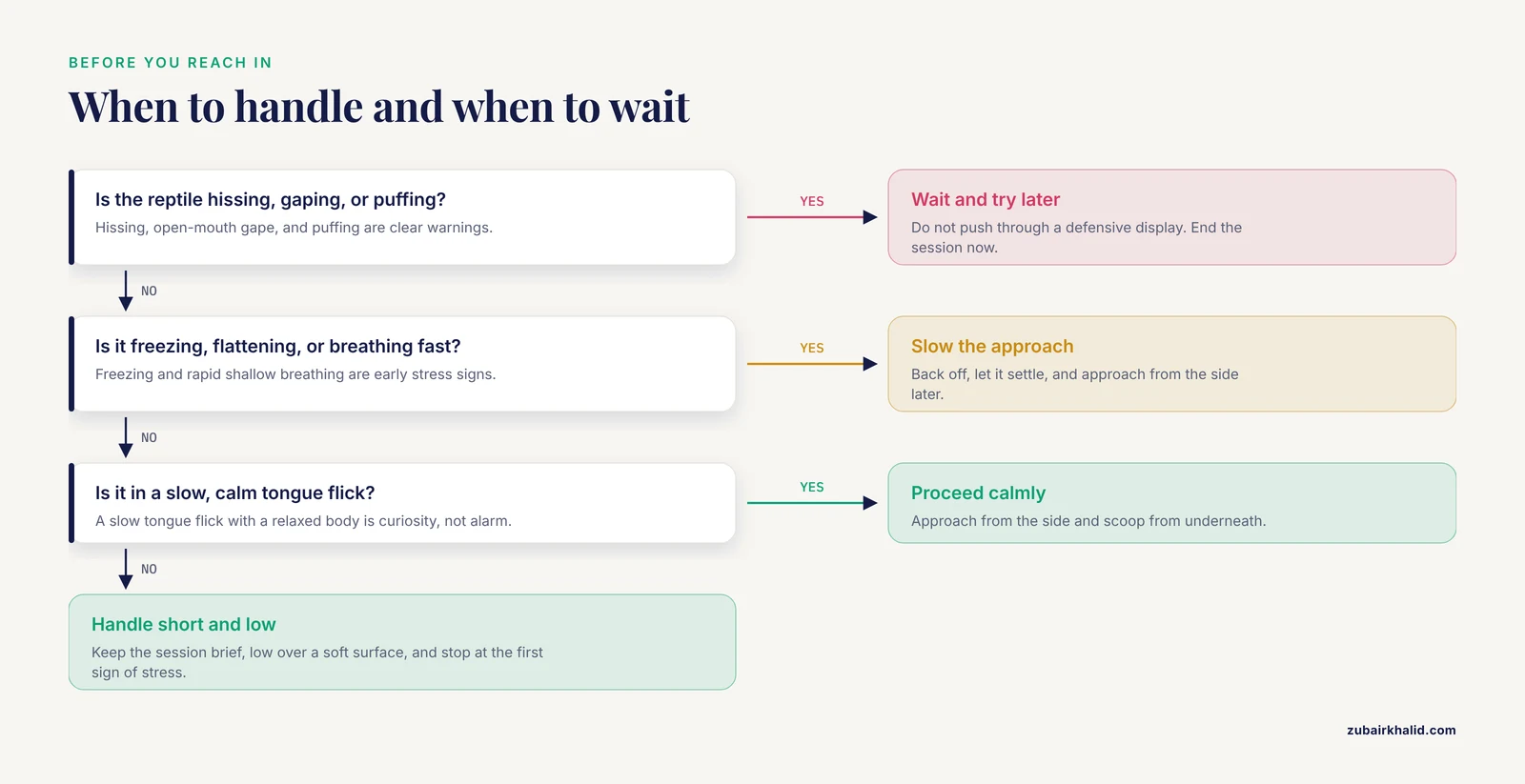
Every safe handling session starts before your hand moves. Reptiles signal stress in species-specific ways, and learning your animal's early warnings is the single most useful handling skill.
Look for these escalating signs of stress or defensiveness.
- Freezing or flattening against the substrate, a common first response in many lizards
- Rapid, shallow breathing or visible throat pulsing
- Hissing, which in nearly every species means back off
- An open-mouth gape, a clear warning in lizards and snakes
- Tail whipping or tail vibrating in snakes and lizards
- Inflation or puffing in bearded dragons, iguanas, and other lizards trying to look larger
- Biting at the air or striking posture in snakes, where the neck pulls into an S shape
- Attempting to flee, burrow, or wedge into a hide
One counterintuitive sign deserves its own note. A calm, slow tongue flick in snakes and many lizards is curiosity, not aggression. A jerky, rapid tongue flick paired with a tense body posture signals alarm. Learning to tell those apart changes how you time every approach.
If you see early warning signs, do not push through them. Ending the session and trying again later, with a slower approach, builds trust. Forcing handling through defensive displays teaches the reptile that being picked up leads to a frightening struggle, which escalates defensiveness over time.
Safe Reptile Handling Techniques Step by Step
The core sequence below applies to most commonly kept lizards and snakes. Species-specific adjustments follow.
The General Handling Sequence
- Prepare the space. Close doors and windows, move other pets out of the room, and clear a handling surface. Have a towel and, for larger animals, a second person ready.
- Wash your hands. Use soap and warm water. Hand sanitizer alone is a weaker option for reptile hygiene.
- Approach from the side, not from above. Open the enclosure calmly. Where the design allows, approach at the animal's eye level or slightly below. A hand descending from directly overhead reads as an aerial predator.
- Let the reptile notice you. Hold a hand still in view for a few seconds. With snakes, many keepers touch the mid-body lightly first so the animal knows contact is coming.
- Scoop from underneath. Slide one hand under the chest or front third of the body and the other under the hindquarters or mid-section.
- Lift with full support and keep it low. Hold the animal a few inches above the enclosure floor or your lap at first. Let the reptile move its head and grip freely. Restraint that fights the animal's movement raises stress for both of you.
- Watch for the exit signals. Escalating hissing, frantic movement, or repeated attempts to leave mean the session is over. Return the animal calmly to the enclosure, rear end first where practical, so it can move away from you.
- Close up, wash up. Secure the enclosure latch. A surprising number of reptile escapes happen because a distracted handler left a lid ajar. Wash your hands and disinfect the handling surface.
Handling Lizards
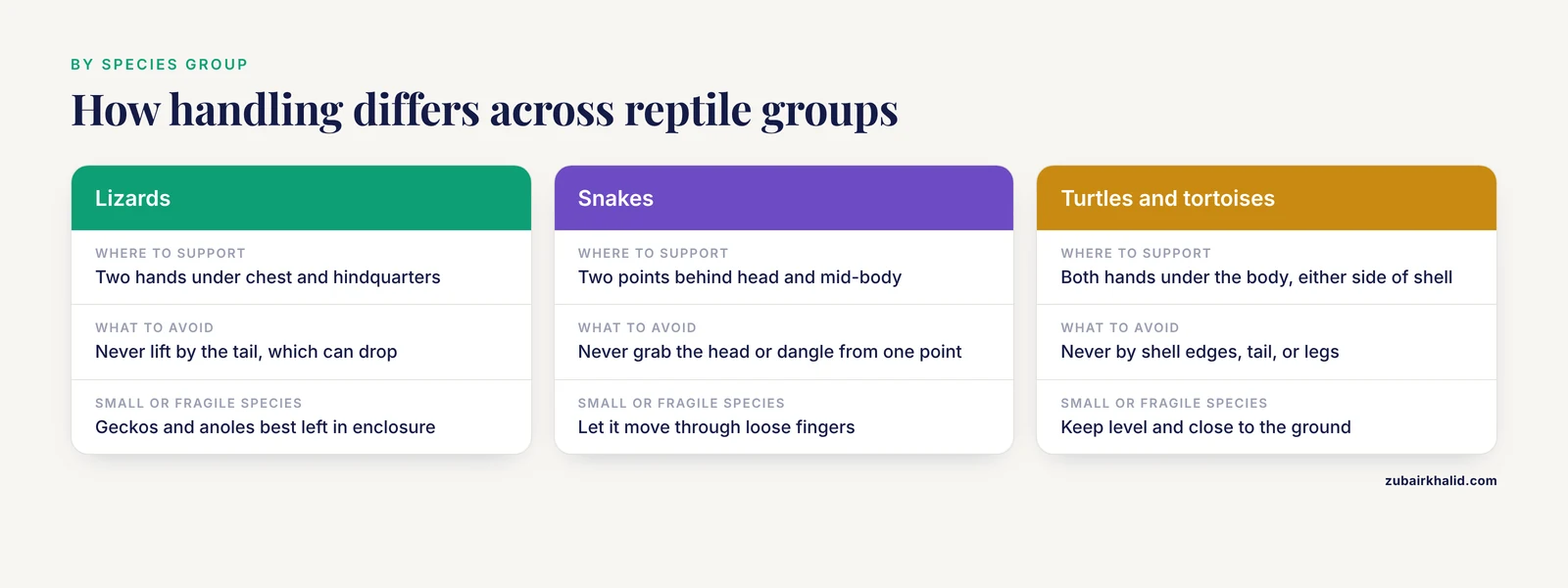
Lizards vary more in handling needs than any other group. Bearded dragons and many other hardy species tolerate two-handed support well. Geckos, day geckos, anoles, and other small, fast species have delicate skin and tails that can drop under stress, so they are often best appreciated in the enclosure rather than handled regularly. For any lizard, never lift by the tail. Some species can drop the tail as an escape response, and in many it regrows imperfectly or not at all.
For large lizards such as iguanas and monitors, use two hands at minimum, support the body along its length, and keep the forelimbs and hind limbs free rather than pinned. A large lizard that thrashes can injure itself and you. If the animal is too strong to support confidently, the honest answer is to handle it less and work on trust at ground level instead.
Handling Snakes
Support a snake at two points, roughly behind the head region and around the mid-body or lower third. Never grab a snake by the head, and never dangle it from one point. Let the snake move through your loose fingers rather than gripping. A snake that feels held down struggles. A snake that feels supported usually settles.
For any snake you cannot identify with certainty, or any snake known to be venomous, the correct handling technique is none at all. Emergency department protocols developed with herpetology consultants emphasize that snakes should be secured, identified by an expert, and contained by trained personnel using a standardized process, because improvised handling of unknown snakes creates serious venom exposure risk for everyone nearby [2]. If a venomous snake escapes or an unknown snake appears on your property, keep people and pets away and call a professional removal service or animal control.
Handling Turtles and Tortoises
Lift a tortoise from underneath, with your hands under the body on both sides of the shell, never by the edges of the carapace alone and never by the tail or legs. A large tortoise is heavier than it looks, and a dropped tortoise can crack its shell. Keep the animal level. Turtles held upside down or tilted sharply can strain and panic. Aquatic turtles have sharp claws and surprising reach, so support the rear of the shell while keeping fingers away from the beak.
Handling Small, Fragile, or Sick Reptiles
Small geckos, hatchlings, newly acquired animals, and reptiles recovering from illness need a gentler protocol. Handling over a soft surface, keeping sessions under a minute or two at first, and using a cup or container as a transport tool rather than bare hands all reduce risk. Sick reptiles deserve the same staged, well-planned approach used for fragile patients in other areas of medicine, where careful preparation, extra support, and limiting each step to what the animal tolerates keep the situation safe for everyone involved [3]. A reptile that is not eating, is lethargic, or is showing respiratory signs should see a reptile veterinarian before any routine handling, because restraint adds physiological stress.
Handling Equipment and Supplies
Good equipment does the work that hands alone cannot, and studies of safe handling in other fields show that assistive devices measurably reduce physical strain compared with unsupported lifting [4]. For reptile keepers, the same principle applies. Choose tools based on the species you keep, not on what looks impressive.
- Snake hooks. Useful for initial assessment of an unfamiliar snake and for redirecting a defensive animal within the enclosure. Hooks are tools for positioning, not for lifting, and they require practice. Ask an experienced keeper or a herpetology professional to demonstrate before you rely on one.
- Clear handling containers or escape-proof tubs. Safer than bare hands for moving small, fast, or nippy species, for transporting a reptile to the veterinarian, and for containing an animal during enclosure cleaning. Ventilate any container and never leave a reptile in one in direct sun or a hot car.
- Soft towels. For gently covering a stressed animal, buffering a wriggling lizard, and drying hands or surfaces. A light towel over the eyes of a nervous lizard often calms it during necessary procedures.
- Cushioned handling surface. A low table with a towel or mat beneath the handling zone turns a wriggle into a non-event instead of a fall.
- Locking enclosure latches and screen clips. Escape prevention is handling safety. Many reptile injuries happen during recapture attempts after an escape.
- Soap, paper towels, and an appropriate reptile-safe disinfectant. Hygiene supplies belong in the handling kit, not across the house.
- A scale. Regular weigh-ins during calm handling sessions give you an early-warning health metric to share at veterinary visits.
Skilled hands remain part of the toolkit. Research on manual handling across industries still values technique and trained hands for tasks that equipment cannot cover [5], and reptile handling is no exception.
Reptile Enclosure Setup That Makes Handling Easier
Handling problems are often enclosure problems in disguise. A reptile that flees from every approach is frequently a reptile whose enclosure gives it nowhere to feel secure, or whose routine teaches it that the only time the lid opens is something unpleasant.
Several setup choices directly improve handling outcomes.
- Provide hides at both ends of the temperature gradient. A reptile that can thermoregulate and hide reliably is a calmer reptile. The current direction in reptile husbandry, reflected in wellness guidance for captive reptiles, favors larger, more naturalistic habitats over sterile spare setups because choice and environmental richness reduce stress and increase natural behavior [1].
- Use front-opening doors where possible. Approaching from the front at eye level is far less threatening than a hand descending from the lid. Front-opening enclosures are one of the highest-impact handling upgrades available.
- Place the enclosure at a good height. An enclosure at chest height lets you handle at a safe, low drop distance. An enclosure on the floor forces you to lift the animal up and down at arm's length, which is where drops happen.
- Add climbing and enrichment. Reptiles benefit from enrichment and can be trained to reduce stress and accept handling and veterinary care more easily [1]. Daily interaction with the enclosure, such as rearranging enrichment or offering food at varied spots, teaches the animal that your hands mean activity and opportunity, not capture.
- Keep the warm side genuinely warm. A reptile handled while cold is sluggish, which is safer, but a reptile living without a proper gradient is chronically stressed. Set up the thermal gradient and humidity to species requirements, which you can confirm with resources from the Merck Veterinary Manual, VCA Animal Hospitals, or an ARAV-recommended reptile veterinarian.
- Quarantine new animals away from your handling area. New arrivals should be housed, fed, and observed separately, with separate handling hygiene, before any shared equipment or close contact with other reptiles in the home.
If you are starting from scratch, the reptile enclosure setup you choose should follow the species first. Research the adult size, the temperature and humidity range, and the behavioral needs of your species before buying the enclosure, because retrofitting a stressed animal into better husbandry takes far longer than setting it up correctly the first time.
The Complete Reptile Care Checklist
Handling is one strand of a larger rope. Use this reptile care checklist monthly and after any change in your animal's routine.
- Enclosure is escape-proof, with functioning locks and no gaps wider than the animal's head.
- Temperature gradient and humidity match the species' documented requirements, verified with calibrated thermometers and a hygrometer.
- Full-spectrum lighting and basking heat are on correct day-night cycles, with bulbs replaced on the manufacturer's schedule even if they still light up.
- Fresh water is available and changed regularly.
- Diet matches the species and life stage, with supplementation discussed with a reptile veterinarian.
- Substrate is species-appropriate and spot-cleaned, with full changes on a set schedule.
- Hides, climbing structures, and enrichment items are present and rotated.
- Feces and urine output look normal and are logged.
- Weight is tracked on a regular schedule.
- Shedding completes cleanly, with no retained eye caps or tail tip bands.
- Handling sessions are short, voluntary where possible, and stopped at early stress signs.
- Hands are washed after every contact, and surfaces are disinfected.
- The name and number of a reptile-experienced veterinarian are posted where you can find them in an emergency.
- New animals complete a quarantine period before any contact with residents.
Safe Reptile Handling Techniques: Common Mistakes
Most handling injuries trace back to a short list of errors. The most common mistakes below are ones veterinarians and experienced keepers see repeatedly.
- Grabbing from above. This triggers the strongest predator response in nearly every species and causes a large share of defensive bites.
- Lifting by the tail, legs, or head. Tail lifts can cause tail drop or spinal injury. Limb grips dislocate joints. Head grabs injure jaws and destroy trust.
- Handling a new reptile on day one. Newly arrived reptiles need days to weeks to settle. Forcing interaction during the adjustment period sets back months of trust.
- Handling right after feeding. A recently fed reptile with a full stomach can regurgitate under stress, and a snake in feeding mode may strike at anything warm that moves. Give the animal time to digest before resuming sessions.
- Handling during shed. The old skin dulls a reptile's vision and handling during this window is uncomfortable for the animal. Wait until the shed is complete.
- Holding too high. The single simplest safety rule is to keep the animal low. Falls onto hard floors fracture jaws, shells, and limbs.
- Squeezing to stop a wriggle. Tighter restraint triggers harder struggle. Loosen your grip, redirect the animal onto your forearm or a surface, and let it choose to settle.
- Ignoring the warning signs. Hisssing and open-mouth displays are the reptile using its words. Skipping the escalation ladder turns a warning into a bite.
- Handling with the smell of prey on your hands. Feeding prey items and then handling a snake with the same unwashed hands is a classic feeding-response bite. Wash hands or use a hook and separate routines for feeding versus handling.
- Treating training as optional. A critical review of handling training programs found that training alone often fails to change real-world practice, and that the surrounding environment and working conditions shape behavior at least as much as instruction [6]. For reptile keepers, the equivalent insight is that a calm routine, a suitable enclosure, and consistent conditions do more for safe handling than any lecture. Train the environment first, then the hands.
Building a Handling Routine That Sticks
Safe handling is a practiced behavior, and research on behavior change offers useful guidance for keepers. In studies of safe handling campaigns, tasks designed to build habit and to heighten perceived risk both produced significant increases in safe handling behavior over a two-week period [7]. A randomized study of safe egg handling behaviors likewise tested structured behavior change techniques as a way to improve everyday handling practices [8]. Translated to reptile care, the practical takeaways are concrete.
Attach handling and hygiene to existing habits. Wash your hands immediately after opening the enclosure, every time, until it is automatic. Schedule short handling sessions at the same point in your daily routine. Pair each session with something the animal values, such as time on a favorite climbing branch or a food reward for species where that fits.
Formal training and demonstration also help. A cross-sectional study of farmers found that those who had attended practical training on safe application were significantly more likely to practice safe handling, and that good knowledge was strongly associated with safer practice [9]. Similar patterns appear in healthcare education, where hands-on training with equipment and practice stations increased both knowledge and confidence in performing safe handling techniques [10] [11]. If a local herpetological society, reptile veterinarian, or experienced breeder offers a handling demonstration, take it. Watching a calm handler support a nervous snake teaches more in ten minutes than ten articles.
Troubleshooting Defensive Behavior and Escapes
My reptile bites every time I open the enclosure. Stop hands-on attempts for a week or more. Sit by the enclosure and let the animal learn your presence. Then begin target-free sessions where your hand enters only to place food or adjust enrichment, and progresses to brief under-body contact without lifting. If aggression persists or escalates, ask a reptile veterinarian to rule out pain, since many previously handleable reptiles turn defensive because something hurts.
My snake strikes at anything warm near the enclosure. That is a feeding response, not handling trouble. Use a hook to touch the snake before reaching in so it associates hook contact with non-food handling, feed in a consistent routine, and never handle after prey-scented hand contact.
My reptile escaped. Contain the room, close gaps, check warm dark spots, and set out water. When you find the animal, do not chase. Approach slowly, cover small lizards and snakes gently with a towel, and support from underneath.
My large lizard is stronger than I am. Do not fight for control. Lower yourself to the ground, allow contact with a stable surface, and recruit a second trained person for any necessary procedure. Handling is voluntary in practice, and a reptile that cannot be safely lifted should still receive enrichment, training, and veterinary care arranged around its strength.
Limitations and When to Contact a Veterinarian
Individual cases vary, and only a veterinarian who examines your animal can assess its health and handling tolerance directly. Find a veterinarian with reptile experience, ideally one associated with the Association of Reptilian and Amphibian Veterinarians, before you need one urgently.
Contact a reptile veterinarian promptly in any of these situations.
- Any bite from a reptile that breaks skin, and any bite from an unknown or venomous snake requires immediate medical care for the person.
- A fall from any height, since reptiles hide fractures and internal injuries well.
- A dropped tail, retained shed, constipation, regurgitation, open-mouth breathing, wheezing, mucus at the nose or mouth, swelling, lumps, or wounds.
- Refusal to eat beyond the species' normal variation, sudden lethargy, or a rapid change in weight.
- Any behavior change in a previously calm animal, because defensiveness can be a pain sign rather than a temperament problem.
- Before breeding, medicating, or any procedure beyond routine handling.
Venomous reptiles are a special category. Ownership is restricted or prohibited in many jurisdictions across the United States, rules vary by state and locality, and no home handling guidance substitutes for professional containment protocols of the kind emergency departments have adopted with herpetology consultants [2]. If you encounter a snake you cannot identify, treat it as venomous and call professionals.
Frequently Asked Questions
How long should I wait after feeding before handling my reptile?
Wait until the meal is clearly digested, which for most snakes means leaving the animal alone for at least the amount of time your species guide or veterinarian recommends, often a day or more. Handling a full reptile risks regurgitation and stress. Ask your reptile veterinarian for a species-specific interval.
Is it safe to let my reptile roam free outside its enclosure?
Supervised floor time in a closed, reptile-proofed room can work for some calm lizards and tortoises, but free roaming adds escape, injury, temperature, and contamination risks. Most keepers do better with structured sessions on a low, prepared surface.
How do I safely handle a venomous or unidentified snake?
Do not. Keep everyone, including pets, well away, and call a professional removal service, animal control, or a herpetologist. Standardized expert protocols for identifying and securely containing snakes exist precisely because improvised handling causes dangerous exposures [2].
Can I handle my reptile during shedding?
It is better to wait. Shedding reptiles have dulled vision and sensitive skin, and handling during this window tends to stress them. Resume normal sessions once the shed is complete and any retained eye caps or tail bands have been addressed by a veterinarian if they persist.
How often should I handle my reptile?
There is no universal schedule. Start with a few short sessions per week for a settled animal, watch stress signs, and let the reptile's response set the pace. Some species tolerate frequent interaction while others are best handled rarely and briefly.
What should I do if my reptile bites me?
Stay calm, support the animal low over a soft surface, and disengage the bite gently rather than yanking, which can injure the reptile's jaw. Wash the wound thoroughly with soap and water, and seek medical care for any bite that breaks skin, causes deep punctures, or comes from an unknown animal.
Do I need to wash my hands after handling my reptile?
Yes, every time. Reptiles can carry bacteria such as Salmonella, and handwashing with soap and water after contact is a standard recommendation from veterinary sources including the Merck Veterinary Manual and the AVMA. This matters most in homes with young children, older adults, pregnant people, or immunocompromised family members.
How do I pick up a tortoise correctly?
Slide both hands underneath the body on either side of the shell, lift with full support, and keep the animal level and close to the ground. Never lift a tortoise by the shell edges, tail, or legs, and get help for large adults, which are heavier and more fragile than they appear.
Sources
- Reptile wellness management.
- Safe Handling of Snakes in an ED Setting.
- Incorporating Safe Patient-Handling Techniques to Mobilize Our Most Complex Patients on Extra Corporeal Membrane Oxygenation
- Effectiveness of Safe Patient Handling Equipment and Techniques: A Review of Biomechanical Studies
- Safe Manual Handling Techniques (objects only)
- Why doesn't training based on safe handling techniques work? A critical review of the literature
- Evaluating the effectiveness of two behaviour change techniques designed to improve safe food-handling among consumers
- Examining the effectiveness of behaviour change techniques for improving safe egg handling behaviours: A randomised prospective experimental study
- Determinants of Safe Pesticide Handling and Application Among Rural Farmers
- A Novel Approach to Safe Patient Handling and Mobility Training in Physical Therapist Education
- P91 Interprofessional bariatric training: - safe manual handling techniques for healthcare students