Reptile Vet vs. Exotic Pet Vet: What's the Difference?
By Dr. Zubair Khalid, DVM, MS, PhD ·
A reptile vet is a veterinarian with advanced training and case volume in snakes, lizards, turtles, and tortoises, while an exotic pet vet treats nontraditional animals generally, including birds, small mammals, amphibians, fish, and reptiles. The practical rule of thumb is simple: any exotics-trained veterinarian is a reasonable starting point for routine care, but a snake, lizard, turtle, or tortoise with a serious, chronic, or surgical problem is best served by a clinic that sees reptiles every week and invests in reptile-specific equipment.
This article explains the reptile vet vs. exotic pet vet distinction in plain terms, shows how the two roles overlap, and walks through the situations where a dedicated reptile veterinarian clearly earns the extra drive time.
The Short Answer: One Species Group Inside a Broader Specialty
"Exotic pet vet" is an umbrella term. In US practice it usually describes a veterinarian whose caseload includes anything beyond dogs and cats, such as rabbits, ferrets, parrots, hedgehogs, frogs, and reptiles. Most exotic animal practitioners develop stronger experience in some groups than others, because the caseload in any given clinic reflects the local pet population.
A "reptile vet" describes focus rather than a completely separate profession. The term typically refers to either an exotic veterinarian who has made reptiles a major share of their practice, or a clinician who has pursued additional reptile-specific training, research, and equipment. The Association of Reptilian and Amphibian Veterinarians (ARAV) serves as the professional home for this community and publishes husbandry and care resources that many general practitioners use as reference material.
So the difference between a reptile vet and an exotic vet is mostly a matter of depth, not kind. Every reptile vet is an exotic pet vet. Not every exotic pet vet is equally comfortable intubating a 12-foot boa, performing a coeliotomy through a chelonian shell opening, or interpreting radiographs of a lizard spine.
What an Exotic Pet Veterinarian Actually Does
An exotic pet veterinarian is trained to work across an unusually wide range of anatomy and physiology. A single day might involve a rabbit dental trim, a parrot wellness exam, a bearded dragon checkup, and a guinea pig skin scraping. This breadth is the specialty's defining feature.
Several realities of exotic animal medicine shape what these veterinarians do:
Species-specific drug sensitivity is a constant concern. Reptiles, birds, amphibians, and small mammals often show heightened sensitivity to common veterinary drugs. Beta-lactam antibiotics, macrolides, aminoglycosides, acetaminophen, ivermectin, and fipronil can cause severe species-specific adverse effects ranging from gastrointestinal dysbiosis to nephrotoxicity, neurotoxicity, and death. Even sedatives and injectable anesthetics can produce respiratory or cardiovascular compromise in the wrong species [1]. An experienced exotic clinician builds dosing decisions around this knowledge, which is one reason owners should never medicate an exotic pet with leftovers from a dog or cat prescription.
Intoxications are hard to diagnose across exotic species. Poison control data collected between 2021 and 2025 show that diagnosing and treating intoxication in exotic pets remains challenging because both owners and clinicians face gaps in species knowledge, toxin information, and reporting resources [2]. A clinic that sees many exotic species learns to recognize these patterns faster.
Zoonotic risk is part of routine counseling. Non-typhoidal Salmonella enterica is one of the most prevalent zoonoses of exotic pets, and reptiles are common asymptomatic carriers. Outbreaks of reptile-associated salmonellosis have occurred yearly in the United States since 2019 [3]. Any exotic pet appointment should include a conversation about hygiene, especially in households with children, elderly family members, or immunocompromised people.
Gastrointestinal disease is one of the most common presenting problems. GI disorders are very common in exotic animals and can be extremely painful, which makes pain recognition and management across species a core clinical skill [4]. Treatment of GI stasis and related conditions centers on fluids, nutrition, and analgesia [5].
A capable exotic pet vet can handle wellness exams, basic diagnostics, husbandry counseling, and many common problems in reptiles. For a healthy adult leopard gecko needing an annual check, this is often all the expertise an owner needs.
What a Reptile Veterinarian Adds on Top
Reptile medicine is not scaled-down dog and cat medicine. Reptiles are ectothermic, their immune function depends on their thermal environment, their metabolism changes with season and temperature, and their anatomy varies enormously between a snake, a chameleon, and a box turtle. A reptile-focused veterinarian builds practice depth in areas that general exotics work touches only occasionally.
Infectious disease surveillance. Reptile infectious disease epidemiology keeps evolving, with a growing list of viruses, bacteria, fungi, and parasites, some of which are true obligate pathogens responsible for mortality events worldwide rather than mere opportunists. The knowledge base on classification, diagnosis, treatment, and management is continually updated, which requires veterinarians working with reptiles to stay vigilant and current [6]. A reptile-heavy clinic is more likely to know which pathogens are circulating in captive collections this year.
Parasitology with species context. Captive reptiles frequently carry gastrointestinal parasites tied to how they are kept and traded. In a 2025 survey of 308 captive reptiles across lizards, snakes, tortoises, and crocodiles, 17.9 percent were infected with coccidia and 3.2 percent carried Cryptosporidium, with single-host life cycle parasites spreading easily through breeding collections, pet trades, and expos. Isospora amphiboluri was the most common parasite of bearded dragons, though it could also infect veiled chameleons, and Choleoeimeria species were most prevalent in snakes [7]. A reptile vet interprets a fecal result knowing which coccidian species matter for which host, and how a recently imported animal's risk profile differs from a captive-bred one.
Reptile surgery. Soft tissue surgery in reptiles requires adapting domestic carnivore principles to radically different anatomy. Preoperative management includes thermoregulation, fasting, fluids, analgesia, and antibiotics, and surgical approaches differ by group, with distinct coeliotomy techniques for saurians, ophidians, chelonians, and crocodilians, plus species-specific procedures for the digestive, urinary, and reproductive tracts [8]. A clinic that performs reptile surgery regularly has the warming equipment, anesthetic monitoring approach, and suture and closure strategies these patients demand.
Reptile oncology and advanced diagnostics. Reptile cancer care has advanced considerably. A recent review of reptile oncology literature from 2016 to 2024 identified diagnostic workups and treatments in 74 patients across lizards, snakes, and chelonians, with integument and gastrointestinal tumors predominating. Clinicians now routinely use radiography, ultrasonography, computed tomography or MRI, endoscopy, and immunohistochemistry or polymerase chain reaction to characterize lesions, and outcomes correlate with complete surgical excision and early presentation [9]. Access to this diagnostic ladder is a meaningful difference between clinics.
Reproductive management. Reproductive problems, from egg retention to sexing monomorphic species, are common in pet reptiles. Current clinical research covers sexing techniques for species without obvious external differences, methods of artificial insemination for endangered species, and hormonal regulation of reproductive activity. For example, GnRH agonist implants may temporarily suppress reproductive hormones in female green iguanas, though they did not change male iguana behavior or testosterone and did not suppress reproduction in female leopard geckos [10]. Reproductive management in reptiles is genuinely species-by-species work.
Physiology-aware monitoring. Even something as basic as blood pressure behaves differently in reptiles. Species-specific variation exists in the renin-angiotensin-aldosterone system, baroreceptor pathways, and hormonal control of vascular tone, and both direct and indirect measurement techniques carry reptile-specific limitations [11]. Anesthetic and critical care decisions in a reptile depend on this kind of physiology-aware monitoring.
Side-by-Side Comparison: Reptile Vet vs. Exotic Pet Vet
| Criterion | Exotic Pet Vet | Reptile Vet (Reptile-Focused) |
|---|---|---|
| Patient range | Birds, small mammals, reptiles, amphibians, fish | Primarily snakes, lizards, turtles, tortoises, crocodilians, amphibians |
| Training base | Veterinary degree plus exotics experience, often mentored | Same base plus concentrated reptile caseload, continuing education, often ARAV involvement |
| Reptile case volume | Varies widely, sometimes a few reptile visits per week | High, often daily reptile appointments |
| Drug knowledge | Strong general exotic formulary awareness | Deep species-by-species reptile dosing and toxicity knowledge [1] |
| Infectious disease currency | General awareness | Tracks evolving reptile pathogen research [6] |
| Parasite interpretation | Reads standard fecal results | Species-level interpretation of coccidia and Cryptosporidium findings [7] |
| Reptile surgery | Varies, often refers complex cases | Regular coeliotomy, shell-adjacent, and species-specific procedures [8] |
| Advanced oncology workup | Refers | Radiography, ultrasound, CT or MRI, endoscopy, immunohistochemistry, PCR [9] |
| Reproductive care | Basic spay and neuter discussion | Sexing, hormonal management, reproductive tracts [10] |
| Anesthetic monitoring | General exotic protocols | Reptile physiology-aware blood pressure and ventilation management [11] |
| Best suited for | Wellness exams, husbandry counseling, minor illness in reptiles | Serious, chronic, surgical, or diagnostically complicated reptile cases |
The Training Ladder Behind the Titles
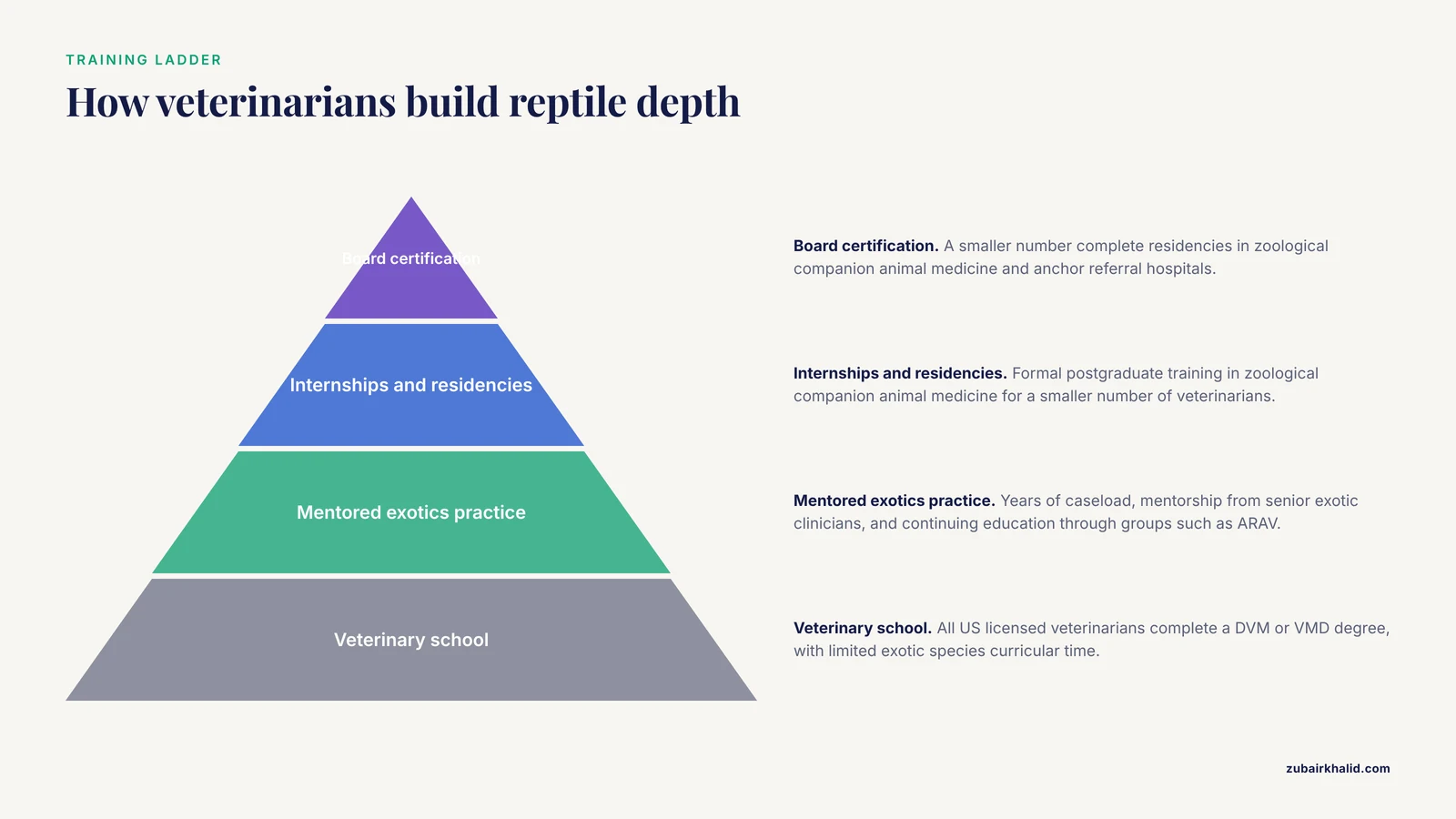
Understanding how veterinarians reach each level helps owners judge a clinic realistically.
Veterinary school. All licensed veterinarians in the United States complete a DVM or VMD degree. Exotic species receive limited curricular time compared with dogs and cats, so real competence comes after graduation.
Mentored exotics practice. Most exotic pet vets build skill through years of caseload, mentorship from senior exotic clinicians, and continuing education through groups such as ARAV and exotic-focused continuing education programs. This is where most competent general reptile care happens.
Internships, residencies, and specialty certification. A smaller number of veterinarians complete formal postgraduate training in zoological companion animal medicine and pursue board certification in specialty colleges. These clinicians anchor referral hospitals and university teaching services, and complex reptile cases often end up on their tables.
What this means when you call a clinic. Titles vary, so the useful questions are practical. How many reptile patients does the clinic see per week. Which reptile species does the primary veterinarian keep current on. Does the clinic hospitalize reptiles with species-appropriate heating. Can they perform coeliotomy or refer to someone who does. A confident clinic answers these directly.
When to Use a Reptile Vet
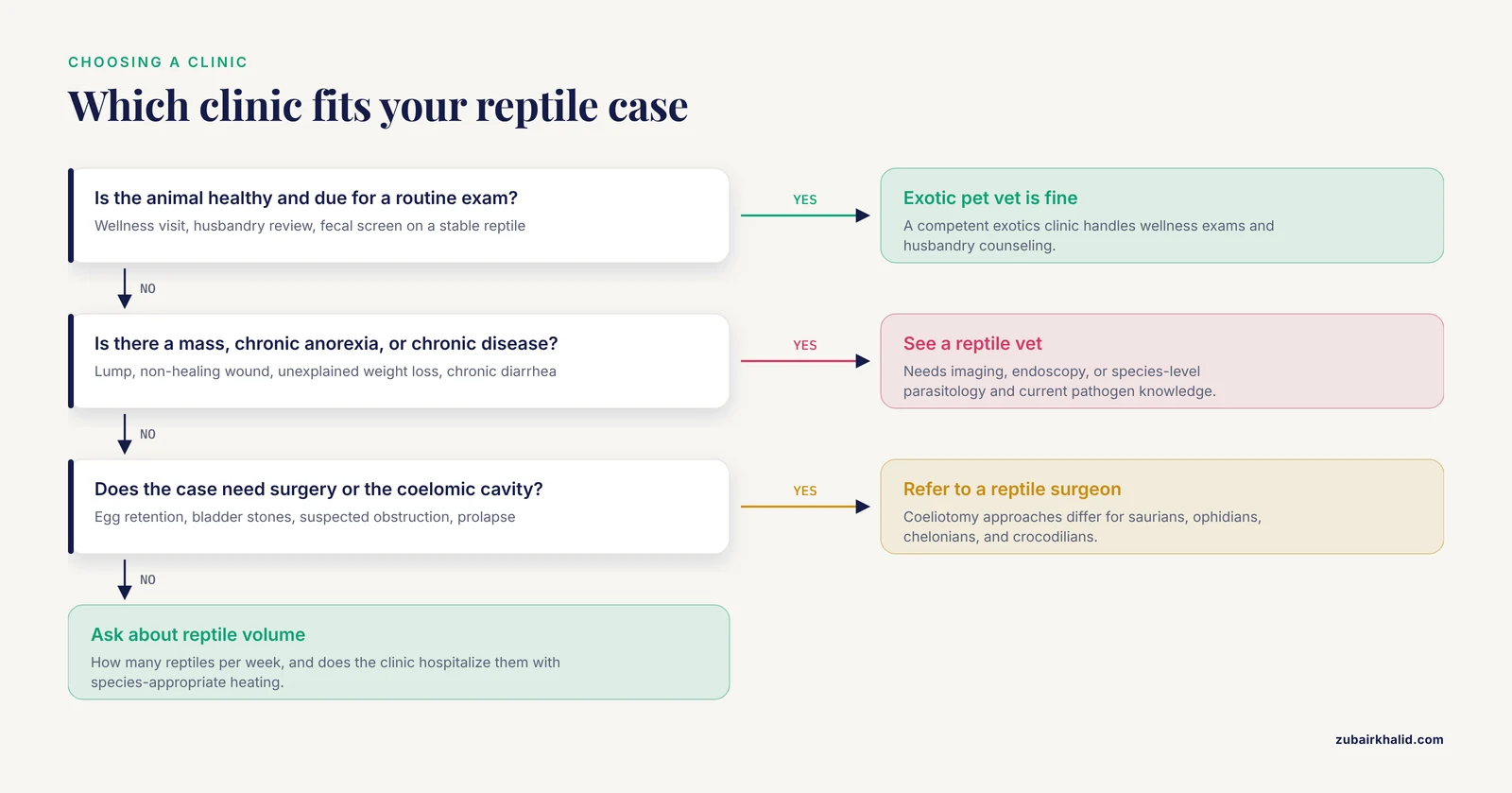
The "when to use reptile vet" question resolves into a few clear situations.
Newly acquired or imported animals. Imported reptiles can arrive with unwanted passengers. In one documented Swedish case, 31 black-breasted leaf turtles illegally imported from Thailand were found infested with Amblyomma geoemydae ticks, an exotic species previously not established there, which prompted surveillance and quarantine measures [12]. Newly imported reptiles can carry ticks and other pathogens not established in your region, so a quarantine period and an early veterinary exam make sense for any reptile with an unclear import history. A reptile veterinarian is the right choice for this first assessment because they know which parasites and ticks to look for by species.
Anything involving surgery or the coelomic cavity. Egg retention, suspected masses, bladder stones, or gastrointestinal obstruction in a reptile demand a surgeon comfortable with reptile anatomy. The surgical literature itself emphasizes how approaches must be adapted for saurians, ophidians, chelonians, and crocodilians [8]. This is a place where the reptile vet vs. exotic pet vet difference becomes concrete.
Cancer suspicion and complicated diagnostics. Because successful outcomes in reptile oncology correlate with complete lesion excision and early presentation, delays in reaching a diagnostically equipped clinic carry real cost [9]. A lump, a non-healing wound, unexplained weight loss, or chronic anorexia warrants a clinic that can move through imaging, endoscopy, and laboratory characterization quickly.
Chronic or collection-level disease. Keepers with multiple reptiles face herd health questions. Given that monoxenous parasites spread easily through breeding collections and can travel with animals to new owners through trades and expos [7], a reptile veterinarian is the appropriate partner for quarantine plans, fecal screening schedules, and treatment decisions across a group of animals.
Reproductive problems and sexing. Determining sex in monomorphic species, managing a gravid female, or suppressing unwanted reproductive activity all fall squarely in reptile veterinary territory [10].
What Happens at a Good Reptile Appointment, and Your Reptile Care Checklist
Whether you choose an exotic pet vet or a reptile specialist, a quality reptile appointment follows a recognizable structure. Knowing it helps you prepare, and it doubles as a reptile care checklist you can run through before any visit.
The husbandry history comes first. Expect detailed questions about your reptile enclosure setup, including temperatures at the basking and cool zones, humidity, UVB lighting type and age, substrate, hide placement, water access, diet and supplementation, and how waste is managed. These questions are not small talk. Captive conditions such as limited space, frequent fecal contact, crowding, and stress directly drive parasitic disease in collections [7], and welfare assessments of exotic animals consistently score environmental and nutritional provision as decisive categories [13]. If your prospective veterinarian asks almost nothing about the enclosure, that is a signal worth weighing.
Practical checklist items to bring or review:
- Enclosure dimensions and a photo of the full setup with lights on
- Exact temperature readings from a thermometer, not assumptions, at both the basking site and the cool end
- Humidity readings and how you measure them
- UVB bulb brand, output type, and replacement age
- Substrate type and cleaning routine
- Full diet list with supplement schedule
- Fecal output description and any photos of abnormal stool
- Shedding history and any retained sheds
- Date of acquisition, source (breeder, expo, rescue, import), and quarantine history
- Any supplements, medications, or home remedies currently in use, because reptiles can react badly to drugs and pesticides safe for other pets [1]
Sample collection and screening. Annual fecal testing is a reasonable topic to raise, given how commonly coccidia and Cryptosporidium appear in captive reptiles even when animals look well [7].
Zoonosis counseling. A responsible clinic discusses Salmonella risk directly, since reptiles commonly carry it without signs [3].
Physical examination adapted to the species. This includes coelomic palpation, oral cavity inspection, skin and scale evaluation, eye and ear assessment in species with external ears, body condition scoring, and in many cases a discussion of whether imaging or bloodwork is indicated.
Comparing the Two on the Criteria That Actually Decide Your Choice
Diagnostic capability. Reptile medicine increasingly relies on imaging and molecular tools. Pancreatic disease illustrates the point, because detecting pancreatic lesions across exotic species now depends on techniques such as ultrasound and CT, and recognizing species-specific pancreatic anatomy is crucial for accurate diagnosis [14]. Ask any prospective clinic what imaging they have in house and what they send out.
Pain management. Reptiles feel pain, but they hide it, and pain mechanisms and manifestations differ across orders and species [4]. A reptile-focused clinician is more practiced at spotting subtle signs such as reduced tongue flicking, altered posture, or anorexia and building an appropriate analgesic plan.
Hospitalization. Reptiles hospitalized in a clinic designed for mammals can become hypothermic overnight. A reptile-capable hospital has heated enclosures, appropriate humidity control, and staff trained to force-feed or tube-feed reluctant patients.
Emergency capability. Exotic intoxication cases present a diagnostic challenge that depends on clinician toxin knowledge and available resources [2]. If your reptile chews a houseplant, licks a pesticide, or escapes into a garage, you want a clinic that has handled these cases before and knows which toxins matter to which species.
Referral networks. Honest generalists refer. A good exotic pet vet who recognizes that your chameleon needs endoscopy or your tortoise needs a coeliotomy will say so and send you to a reptile specialist rather than improvising.
Worked Scenarios
Scenario 1: Healthy adult leopard gecko, annual exam. An exotic pet vet comfortable with reptiles is a sound choice. The visit centers on weight trend, husbandry review, and a fecal screen. Nothing here requires subspecialty depth.
Scenario 2: Bearded dragon with chronic diarrhea. Start with your usual exotics clinic, but expect the workup to lead toward reptile-specific parasitology. Coccidia are common in captive lizards, and Isospora amphiboluri is the most frequently recorded coccidian of bearded dragons, though its host specificity is low enough that it can infect other lizard species too [7]. If the clinic cannot speciate oocysts or manage a refractory case, a reptile vet is the next step.
Scenario 3: Ball python refusing food for two months. Anorexia in a snake sits at the intersection of husbandry, infectious disease, and GI pain. Because GI disorders in exotic animals can be extremely painful and pain expression varies by species [4], and because the reptile infectious disease picture keeps evolving with newly recognized obligate pathogens [6], a snake that refuses multiple meals after a verified husbandry audit deserves a reptile veterinarian with current knowledge and diagnostic tools.
Scenario 4: Red-eared slider with a firm coelomic mass. This is a referral case from the start. Definitive diagnosis may require ultrasound, CT, endoscopy, or biopsy with immunohistochemistry, and treatment hinges on complete surgical excision, with earlier presentation tied to better outcomes [9]. A soft tissue surgical team experienced with chelonians offers the best path [8].
Common Mix-Ups Owners Make
Assuming "we see exotics" means reptile competence. Some clinics list reptiles on their website because they will not turn a patient away. Ask about volume and equipment.
Waiting for a reptile to look sick before seeking a reptile-focused clinic. Reptiles mask disease until disease is advanced, and late presentation is associated with poorer outcomes in conditions such as reptile tumors [9]. Establishing care with a reptile-capable clinic while your animal is healthy buys you a faster workup later.
Using medication intended for dogs, cats, or other pets. Drugs that are routine in mammals, including ivermectin and certain antibiotics, can be toxic to reptiles and other exotic species [1]. Never dose a reptile without veterinary guidance.
Skipping hygiene because the animal looks healthy. Reptiles can shed Salmonella without any signs of illness, and reptile-associated salmonellosis outbreaks occur every year in the United States [3]. Hand washing after handling or cleaning the enclosure is nonnegotiable in every household.
Overlooking a new animal's quarantine. Reptiles bought online or at expos can carry parasites that spread readily in home collections [7], and imported animals can carry ticks or pathogens new to your region [12]. Keep new arrivals separate and have them examined before introducing them to animals you already own.
Limitations and When to Contact a Veterinarian
Individual cases always need an individual veterinarian. The distinctions in this article describe typical patterns in training and caseload, not a guarantee about any specific clinic, and the best exotic pet vet in your area may outperform a distant reptile specialist for a straightforward problem. Travel distance, emergency availability, and continuity of records all matter alongside expertise.
Contact a veterinarian promptly, or an emergency service after hours, if your reptile shows any of the following:
- Complete refusal of food beyond a single normal fasting interval appropriate to the species and season
- Open-mouth breathing, wheezing, or mucus around the nostrils or mouth
- Retained eyecaps or sheds, or visible skin wounds
- Straining without producing stool or urates, or a suspected prolapse of tissue from the cloaca
- Swollen limbs, jaw, or coelomic cavity, or a visible mass anywhere
- Lethargy paired with cold tolerance, meaning the animal cannot warm itself even in a correct thermal gradient
- known or suspected exposure to toxins, pesticides, or medications intended for other species
- Any bite wound, burn, or trauma
- Regurgitation, diarrhea, or blood in the stool
When in doubt, call. Reptile patients tolerate long delays poorly, and an early phone call costs nothing.
This article is educational and is not a substitute for veterinary diagnosis or treatment.
Frequently Asked Questions
Is a reptile vet the same thing as an exotic pet vet?
No, though they overlap heavily. Every reptile vet is an exotic pet vet, since reptiles fall under the exotic animal umbrella, but an exotic pet vet treats all nontraditional pets and may see reptiles only occasionally, while a reptile vet concentrates on snakes, lizards, turtles, and tortoises with deeper species-specific experience.
When should I specifically use a reptile vet instead of a general exotic vet?
Use a reptile vet for surgical problems, masses or suspected cancer, chronic anorexia, infectious disease that does not resolve, reproductive complications, newly imported animals, and any case requiring advanced imaging or endoscopy. Routine wellness exams on a healthy, stable reptile can usually be handled by a competent exotic pet vet.
Do reptile vets cost more than exotic pet vets?
Specialist-level care generally costs more than general practice because it involves more training, more equipment, and longer appointments, and referral hospitals typically charge higher fees than primary clinics. Ask any clinic for an estimate before authorizing diagnostics or treatment.
What should I bring to my reptile's first appointment?
Bring a photo of the complete enclosure with lights on, exact temperature and humidity readings, the UVB bulb brand and age, a diet and supplement list, the animal's acquisition history, and a fresh fecal sample if possible. A written reptile care checklist covering these items saves appointment time and improves the accuracy of husbandry advice.
How often should a healthy reptile see a veterinarian?
An annual wellness exam with a fecal screen is a reasonable baseline for most captive reptiles, since parasites such as coccidia and Cryptosporidium are common even in animals that appear healthy. New acquisitions benefit from an exam and quarantine period regardless of source, and any animal with a change in appetite, shedding, or behavior should be seen sooner. Discuss a schedule matched to your species with your veterinarian.
Can my regular dog and cat vet treat my reptile?
Some can, and some genuinely enjoy it, but competence varies widely because reptile anatomy, drug sensitivity, and husbandry needs differ from mammalian pets, and many drugs safe for dogs and cats are dangerous for reptiles. Ask directly how many reptiles the practice treats per month. If the answer is few, ask which reptile or exotic veterinarian they refer to.
Sources
- Adverse Drug Reactions in the Exotic Animal Patient.
- Common Exotic Pet Intoxications.
- Zoonotic Gastroenteric Diseases of Exotic Animals.
- Pain Management for Gastrointestinal Conditions in Exotic Animals.
- Therapies in Exotic Animal Gastroenterology.
- Updates in Pet Reptile Infectious Diseases.
- Gastrointestinal apicomplexan parasites of captive reptiles: diversity, causes, consequences.
- Soft Tissue Surgery in Reptiles.
- Recent Advances in Reptile Oncology.
- Reproductive Management of Reptiles.
- Under Pressure: The Intricacies of Blood Pressure and Hypertension in Exotic Animals.
- Importation of the exotic tick Amblyomma geoemydae into Sweden via illegally introduced turtles (Geoemyda spengleri) from Thailand.
- Unveiling welfare concerns in Japanese exotic animal cafes.
- Clinical Anatomy, Physiology, and Common Diseases of the Pancreas in Exotic Pets.