Reptile Seasonal Care Adjustments: Step-by-Step Guide
By Dr. Zubair Khalid, DVM, MS, PhD ·
# Reptile Seasonal Care Adjustments: Step-by-Step Guide
Reptile seasonal care adjustments come down to four things you change as the calendar turns: heat gradient management, humidity control, light exposure, and feeding frequency. In spring and summer you stabilize warmth and monitor hydration. In fall you taper feeding and decide whether your animal will brumate. In winter you protect against dry indoor air, heat loss, and short photoperiods that quietly suppress appetite and immune function.
Indoor reptiles do not experience real seasons, but their bodies still respond to light cycles, room temperature drift, and changes in household humidity. That mismatch between biology and environment is where most seasonal problems start. This guide walks through each adjustment in order, gives you a repeatable reptile care checklist, and flags the mistakes that fill exotic animal clinics every fall and winter.
This article is educational and is not a substitute for veterinary diagnosis or treatment.
## Seasonal Adjustments at a Glance
Use this table as your working plan for the year. Species-specific numbers always come from a care sheet for your exact species, reviewed with a reptile veterinarian.
| Season | Heat | Humidity | Light | Food | Watch For |
|---|---|---|---|---|---|
| Spring | Recheck gradients after winter, thermostat recalcibration | Ramp toward breeding-season species norms | Confirm full photoperiod as days lengthen | Resume normal schedule, increase gradually as appetite returns | Breeding behavior, females needing egg-laying substrate |
| Summer | Verify cooling options, prevent overheating near windows | Highest seasonal demand, misting and fogging review | Full daylight cycle | Regular feeding, gut-loaded prey | Heat stress, dehydration, live prey spoilage |
| Fall | Room temperature begins to drop, Insulate cold corners | Start managing drying air | Begin tapering photoperiod only if brumation is planned | Taper frequency as appetite declines naturally | Refusal of food, seeking cooler spots |
| Winter | Protect from drafts, never shut heat off at night | Forced-air heat dries enclosures, add humidity support | Shortest photoperiod of the year | Reduced or paused feeding for brumating species | Lethargy that exceeds normal brumation, weight loss |
## Why Seasons Matter for Reptiles
Reptiles are ectotherms. Their body temperature, digestion rate, immune function, and activity level all track the temperature of their surroundings. Wild reptiles also track seasonal cues beyond temperature. Rainfall patterns change soil moisture, and soil moisture changes how animals behave underground and where they choose to be.
Research on the yellow-spotted monitor (Varanus panoptes) in northern Australia demonstrates how strongly seasonality shapes reptile behavior. Researchers excavated communal nesting warrens across wet seasons with contrasting rainfall and found that female monitors nested significantly deeper in drier years, a plastic response to soil moisture rather than to temperature, because soil temperatures between one and four meters deep barely differ [1]. The study recorded 75 nests across two excavations, 45 after a period of higher wet-season rainfall and 30 after a period of lower rainfall [1]. The lesson for keepers is straightforward. Reptiles read their environment constantly and adjust their behavior to seasonal signals. In a terrarium, you supply those signals deliberately or the animal improvises in ways that can harm it.
Husbandry references such as the Merck Veterinary Manual's exotic animal section, the Association of Reptilian and Amphibian Veterinarians (ARAV), VCA Animal Hospitals reptile guides, and ReptiFiles all converge on the same principle. Seasonal care is not about copying the weather. It is about managing the gradients of heat, moisture, and light your particular species needs as your home's conditions change around the enclosure.
## Step 1: Audit Your Baseline Before the Season Changes
Every seasonal adjustment starts from a known baseline. If you do not know what your enclosure does in a stable week, you cannot tell whether a seasonal change helped or hurt.
1. Record your thermal gradient for seven consecutive days. Place one thermometer at the basking site and one at the cool end. Digital probe thermometers and infrared temperature guns give far more reliable readings than stick-on dials, a point emphasized in nearly every evidence-based husbandry guide, including ReptiFiles and VCA's reptile resources.
2. Record humidity morning and evening with a calibrated digital hygrometer. Analog dial hygrometers are often inaccurate out of the box.
3. Log feeding dates, food types, and whether the animal ate eagerly, hesitantly, or refused.
4. Note your home's seasonal rhythms. When does the furnace or air conditioning run? Does a draft reach the enclosure? Does the tank sit near a window that gets afternoon sun?
Keep these logs. Seasonal care adjustments become easy when you can compare this October to last October.
## Step 2: Adjust Heating and Thermal Gradients
### Spring
Winter heating equipment takes a beating. Recalibrate or replace thermostats, check heat tape and heat cables for wear, and confirm that bulb wattage still holds the correct gradient as room temperatures rise. A thermostat that held a gradient in January may overshoot in May.
### Summer
The seasonal risk inverts. Enclosures near windows can overheat rapidly, and a terrarium in direct sun can reach lethal temperatures even when the room feels comfortable. Move enclosures out of direct sunlight, provide shaded retreats at the cool end, and verify that the animal can always escape the basking area. Overheating kills faster than chilling.
### Fall
As rooms cool, basking sites must work harder. Check that nighttime temperatures do not drop below your species' published minimum. If your home drops sharply at night, add a thermostat-controlled heat source rather than raising daytime temperatures to compensate.
### Winter
Drafts, exterior walls, and power outages are winter hazards. Insulate cold sides of the room, keep the enclosure away from exterior doors, and know your contingency plan for a heating failure. Many keepers keep a backup heat source on hand for winter for the same reason they keep flashlights.
## Step 3: Manage Humidity Through the Year
Humidity is the adjustment owners most often miss, and winter is when it goes wrong. Forced-air and baseboard heating pull moisture out of household air, and an enclosure that held humidity easily in July can become a desert by February.
Practical reptile seasonal care adjustments tips for humidity:
- Seasonal timing matters for species that need high humidity. Raise misting frequency, moisten substrate deeper in the enclosure, or run a fogger on a timer before the dry season arrives, not after you see stuck shed.
- Use a digital hygrometer at animal level, not at the top of a tall enclosure, because humidity stratifies.
- Provide a humidity gradient the same way you provide a temperature gradient. A humid hide lets the animal regulate its own moisture exposure.
- Ventilate deliberately. Stagnant, wet enclosures cause respiratory and skin disease. The goal is the right humidity with airflow, not a sealed swamp.
Seasonal moisture is not a minor variable. The monitor lizard nesting study found that female monitor lizards responded behaviorally to seasonal soil moisture, nesting deeper when nesting seasons were drier, even though temperature at those depths was effectively constant [1]. Wild reptiles actively seek out the moisture conditions they need. Captive reptiles depend on you to provide them.
## Step 4: Adjust Feeding With the Seasons
Appetite in healthy reptiles follows the light and heat calendar. As days shorten and ambient temperatures fall, many species reduce intake naturally. This is normal physiology, not illness, as long as the animal maintains body condition.
The step-by-step approach:
1. In late summer, feed at the normal schedule and confirm the animal is in good body condition before the season turns.
2. In fall, taper feeding frequency as appetite declines rather than forcing food.
3. During a planned brumation, follow your veterinarian's protocol exactly, including the fasting window required before cooling, because undigested food in a cold gut is dangerous.
4. In spring, resume feeding gradually as the animal warms and becomes active. Do not jump straight back to peak frequency in the first week.
If your reptile stops eating in fall and you have not planned brumation, rule out environmental causes first. Verify gradients, verify UVB and visible light output, and check for recent husbandry changes. Prolonged anorexia outside a normal seasonal pattern warrants a veterinary visit, because parasites, dental disease, and infections often surface as appetite loss.
## Step 5: Decide on Brumation Deliberately
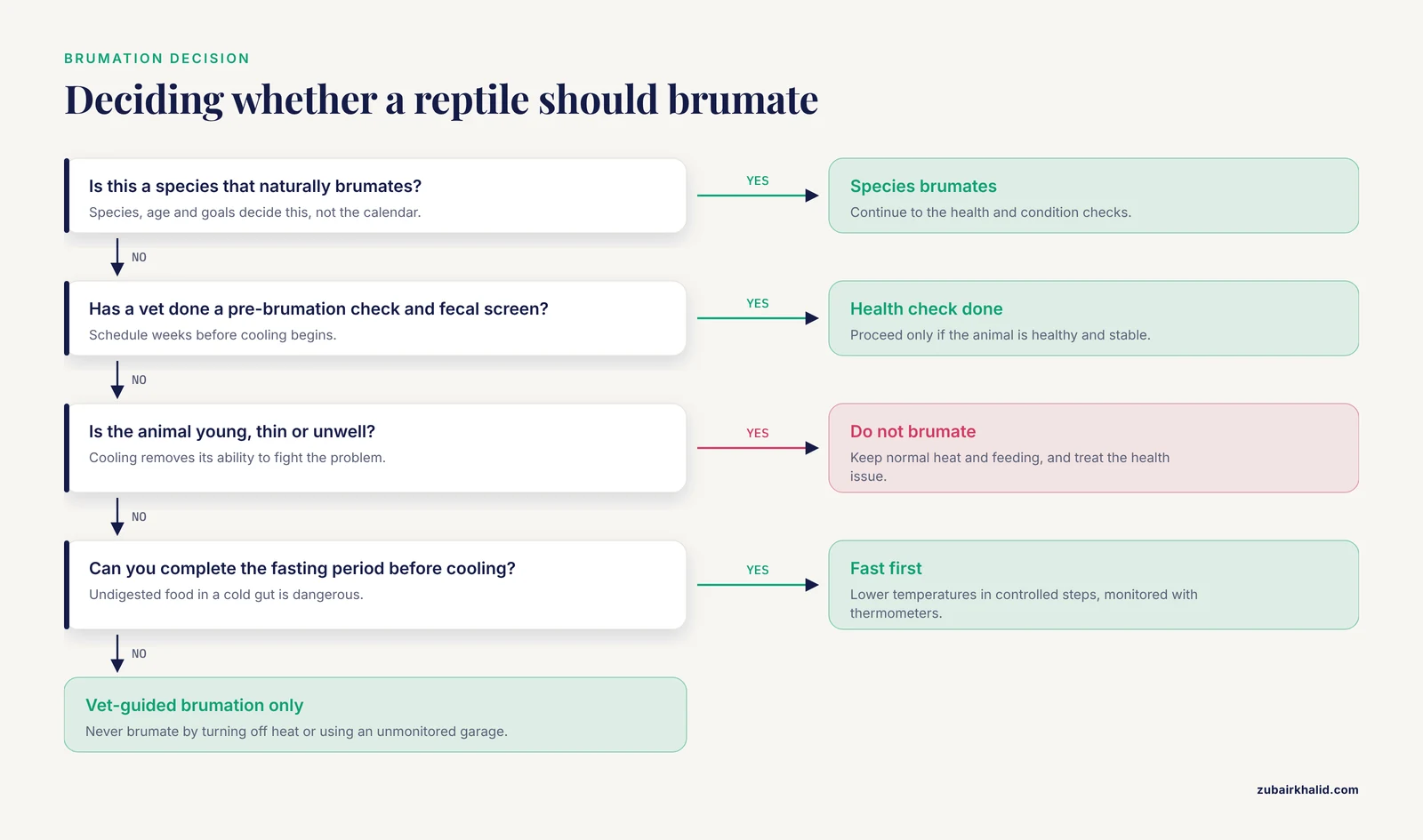
Brumation is the reptile equivalent of winter dormancy. Whether your animal should brumate depends on species, age, health status, and your goals. This is a decision to make with a reptile veterinarian, not a default step.
For healthy adults of species that naturally brumate, a controlled brumation may support long-term wellbeing and is often part of breeding management. For young animals, underweight animals, or animals with any active health problem, brumation is generally inappropriate, and an unwell reptile that is allowed to cool can deteriorate quickly.
If brumation is planned, the safe sequence is:
1. Schedule a pre-brumation veterinary examination, including a fecal parasite screen, weeks before cooling begins.
2. Taper feeding and allow a complete fasting period appropriate to the species and last meal so the gut empties before temperatures drop.
3. Reduce photoperiod gradually.
4. Lower temperatures in controlled steps to the species-appropriate range, monitored with reliable thermometers.
5. Check the animal periodically throughout, and provide water access unless your veterinarian directs otherwise.
6. Reverse the process gradually in spring.
Never brumate a reptile by simply turning off its heat or putting it in an unmonitored garage. The failures veterinarians see most often are animals cooled with food still in the digestive tract and animals whose temperature was never actually measured.
## Step 6: Support Breeding Females and Nesting Behavior
If you keep female reptiles, seasonal care includes reproductive management even when no male is present. Many female reptiles produce follicles or eggs seasonally, and they need somewhere appropriate to lay.
The Varanus panoptes research is directly relevant here. Mothers in that study adjusted nest depth in response to the moisture conditions of the season, demonstrating that the choice of where to deposit eggs is an active, condition-sensitive behavior, not a mechanical routine [1]. A captive female denied suitable nesting substrate may retain eggs, and egg retention is a genuine veterinary emergency.
Seasonal steps for gravid or cycling females:
- Provide a suitable egg-laying substrate box before the breeding season, not after the animal shows restless digging behavior.
- Match substrate depth and moisture to your species' documented nesting preferences. Deep nesting in response to dry conditions, as documented in monitor lizards, shows that some species will dig well below the surface to reach adequate moisture [1].
- Watch for restlessness, refusing food, pacing, and digging at the enclosure walls.
- If a female stops eating, digs persistently, and produces no eggs within the timeframe your veterinarian advises, contact an exotics veterinarian promptly. Dystocia, or egg retention, frequently requires medical or surgical intervention.
## Reptile Enclosure Setup That Handles All Four Seasons
The most reliable reptile enclosure setup is one designed for seasonal flexibility from the start. A cage that only works in June will fail you in January.
Design principles:
- **A thermal gradient, not a single temperature.** Size the enclosure so the animal can move between a warm zone and a cool zone in every season. This is the core recommendation across Merck Veterinary Manual, ARAV, and VCA reptile husbandry materials.
- **Thermostat-controlled heat sources.** Every heat element should run through a thermostat, because seasonal room temperature swings change how hard each element works.
- **Layered humidity options.** Combine a moisture-retaining substrate layer, a humid hide, and adjustable ventilation so you can raise or lower humidity without rebuilding the enclosure.
- **Full-spectrum lighting on timers.** UVB output decays over months, and photoperiod should be controlled by a timer rather than by whenever the lights get switched on. Replacing UVB lamps on the manufacturer's replacement schedule is a standard recommendation across evidence-based husbandry guides.
- **Vertical and horizontal retreats.** Hides at both temperature ends let the animal self-regulate, which is the behavior wild reptiles perform by moving between sun and shade, or by burrowing to modulate moisture exposure as the monitor lizard study illustrates [1].
- **Redundant measurement.** Two thermometers, one hygrometer, and a temperature gun cover the enclosure without guesswork.
## The Year-Round Reptile Care Checklist
Print this reptile care checklist and run it monthly. Seasonal columns are where adjustments plug in.
1. Verify thermal gradient with a temperature gun and probe thermometers.
2. Confirm thermostat function and probe placement.
3. Check hygrometer readings at animal level, morning and evening.
4. Confirm UVB lamp age against its replacement schedule and verify photoperiod timer settings.
5. Inspect substrate for moisture, mold, and pest issues.
6. Confirm fresh water is available and the bowl is clean.
7. Weigh the animal and record body condition.
8. Log feeding response.
9. Inspect skin, eyes, mouth, and vent during normal handling.
10. Review whether the current season calls for a humidity, feeding, or photoperiod adjustment.
## Reptile Seasonal Care Adjustments Common Mistakes
These are the errors that bring reptiles to clinics each season, compiled from the recurring themes in exotic animal veterinary education materials.
- **Assuming indoor means no seasons.** Household air changes dramatically with heating and cooling cycles, and reptiles respond to those changes whether you plan for them or not.
- **Feeding a cooled reptile.** Offering food shortly before or during brumation means food sits undigested in a cold animal. This can be fatal.
- **Brumating a sick or thin animal.** Cooling an animal with parasites or poor body condition removes its ability to fight the problem.
- **Chasing humidity with a sealed enclosure.** Cutting all ventilation to raise humidity produces respiratory disease and mold. Airflow and moisture must both be managed.
- **Trusting stick-on gauges.** Inaccurate thermometers and hygrometers lead keepers to "fix" conditions that were never wrong and miss conditions that were.
- **Letting the basking bulb age through winter.** UVB output declines with use even while the lamp still lights up. Reptiles in short winter photoperiods with declining UVB get a compounded light deficit.
- **Placing the enclosure near a window for "natural light."** Glass blocks the UVB reptiles need, and direct sun through glass can overheat an enclosure rapidly.
- **Ignoring a female's nesting needs.** Waiting until the animal is visibly restless to provide a nest box invites egg retention.
- **Interpreting fall anorexia as illness, or illness as fall anorexia.** The distinction depends on body condition, behavior, and the specific species' normal pattern, which is exactly why a baseline log matters.
## Troubleshooting Seasonal Problems
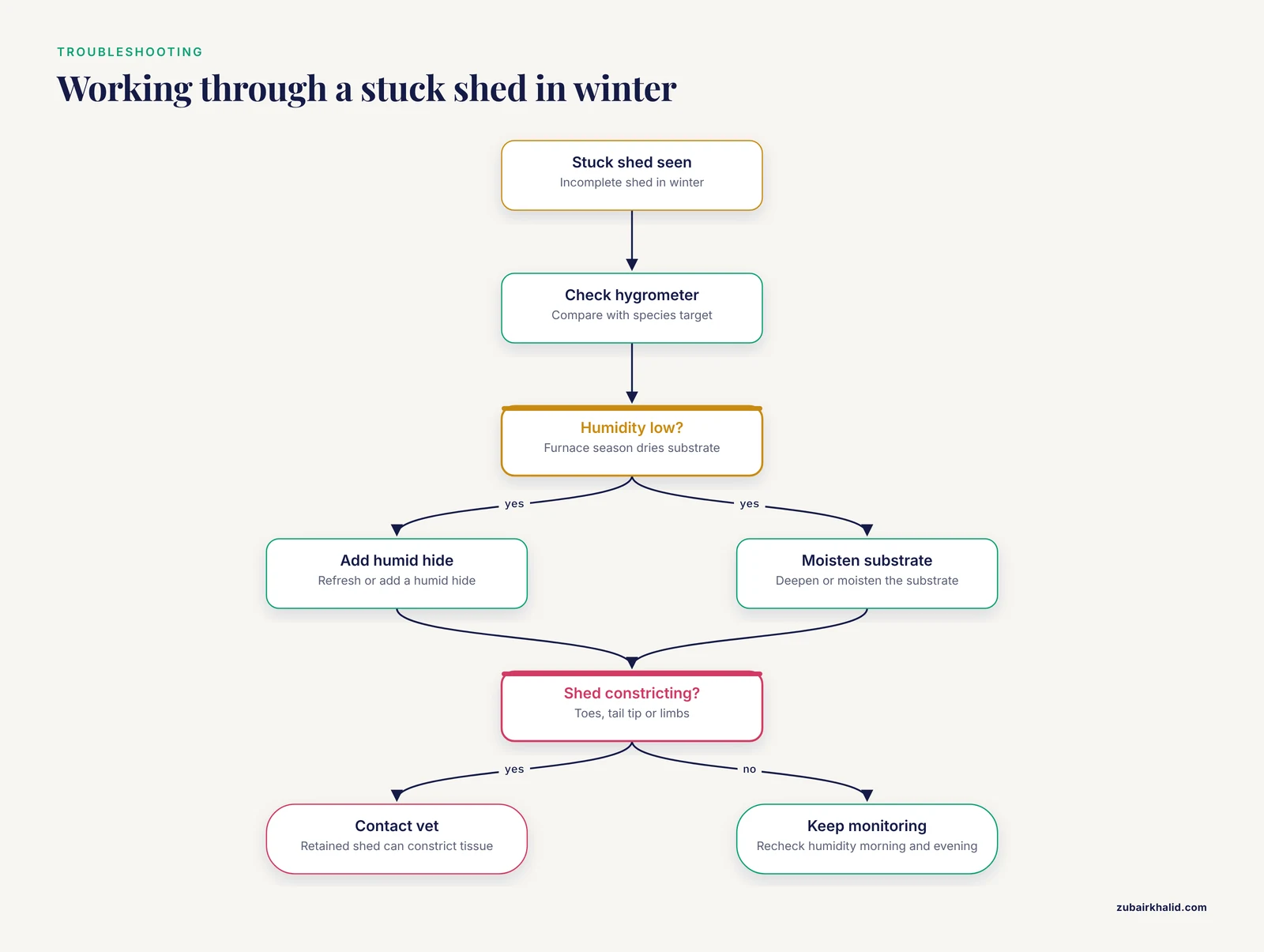
**Stuck shed in winter.** Almost always humidity. Check the hygrometer against your species' target, add or refresh a humid hide, and evaluate whether furnace season dried your substrate faster than usual. Incomplete shed around toes or the tail tip needs attention, because retained shed can constrict tissue.
**Lethargy that seems excessive.** Distinguish normal seasonal slowing from disease. A brumating animal at correct temperatures that rouses and repositions is different from an animal at inadequate temperatures that cannot lift its head. If the enclosure is cold and the animal is motionless, fix the heat first, then reassess. If in doubt, this is a veterinary call.
**Refusing food in fall.** Confirm temperatures first, since digestion depends on warmth. Confirm the animal's body condition is stable. Confirm photoperiod. If all are appropriate for the species and the animal remains bright and stable, seasonal reduction may be normal. Weight loss, lethargy beyond the species' normal pattern, or other signs are not.
**Condensation, mold, or smell.** Humidity without ventilation. Increase airflow, remove wet substrate patches, and spot-clean promptly.
**Reptile escaped from a cool enclosure.** A reptile in a cold house seeks heat, often behind appliances. Check warm spots first and lower the room's escape incentive by keeping the enclosure within the animal's preferred range.
## Welfare and Safety Points
- A reptile's ability to thermoregulate is its primary welfare need. Every seasonal adjustment should preserve or improve the animal's ability to choose its own temperature.
- Never use heat rocks or unregulated heat sources, which cause burns, a point repeated across ARAV client education and Merck Veterinary Manual exotic animal guidance.
- Live prey left in an enclosure with a reptile that is not feeding, which is common in seasonal appetite dips, can injure the reptile. Remove uneaten live prey promptly.
- Wash hands before and after handling, both to protect the animal and to reduce zoonotic risk, a standard hygiene recommendation from veterinary associations including the AVMA.
- Quarantine and vet-screen any new reptile before it enters a collection, especially before any breeding season.
## Limitations and When to Contact a Veterinarian
Every reptile, enclosure, and household is different, and individual cases need a veterinarian, ideally one with reptile experience. The ranges and schedules in any care guide are starting points for a conversation with your exotics vet, not prescriptions.
Contact a veterinarian promptly if you see:
- Weight loss or muscle wasting, at any time of year.
- Anorexia combined with lethargy, sunken eyes, or change in posture.
- Persistent straining, digging, and restlessness in a female that does not produce eggs or that appears bloated.
- Open-mouth breathing, discharge from the nose or mouth, or wheezing.
- Retained shed constricting toes, tail, or limbs.
- Burns from any heat source.
- Trauma, falls, or bites from live prey.
- Any reptile you planned to brumate that has not had a pre-brumation health check.
Find a veterinarian through the Association of Reptilian and Amphibian Veterinarians member directory or by asking your general practice vet for an exotics referral before the season turns, not during an emergency.
## Frequently Asked Questions
### Do indoor reptiles need seasonal care changes at all?
Yes. Indoor reptiles are shielded from real weather, but their physiology still responds to photoperiod, household temperature drift, and humidity changes. Managed seasonal adjustments keep the enclosure matched to the animal's expectations.
### Should my pet reptile brumate?
Only healthy adults of species that naturally brumate, and only under a veterinarian-guided protocol with a pre-brumation health check and a complete fasting period. Young, thin, or ill reptiles should not be cooled.
### Why is my reptile's enclosure so dry in winter?
Forced-air and baseboard heating remove moisture from household air, and the enclosure loses humidity with it. Increase misting frequency, deepen or moisten the substrate, add a humid hide, and verify with a digital hygrometer at animal level.
### Do I need to change UVB lighting with the seasons?
You need to maintain adequate UVB year-round, which matters more in winter when photoperiod is shortest. UVB lamps lose output over months, so follow the manufacturer's replacement schedule and run lights on a timer.
### Is it normal for my reptile to stop eating in the fall?
For many species, reduced appetite as day length and temperature decline is a normal seasonal pattern in a healthy animal with stable body condition. Weight loss, lethargy, or other signs alongside anorexia are not normal and need a veterinary exam.
### Does my female reptile need a nesting box if she has never been with a male?
Many females cycle and can produce follicles or eggs without a male. If your species' females lay seasonally, provide appropriate nesting substrate before the breeding season, because the lack of a nest site is a known risk factor for egg retention, which is an emergency.
### How often should I check thermometers and hygrometers?
Verify readings monthly at minimum and always at the start of each season, when room conditions shift. Use digital probe thermometers and a calibrated digital hygrometer, and spot-check surface temperatures with an infrared gun.
### What seasonal reptile change is an emergency?
Overheating, a reptile cooled with food still in its gut, suspected egg retention, open-mouth breathing, and any rapid decline in behavior or body condition are emergencies. Stabilize the environment you control, heat or cool as directed, and call an exotics veterinarian the same day.
<script type="application/ld+json">
{
"@context": "https://schema.org",
"@type": "FAQPage",
"mainEntity": [
{
"@type": "Question",
"name": "Do indoor reptiles need seasonal care changes at all?",
"acceptedAnswer": {
"@type": "Answer",
"text": "Yes. Indoor reptiles are shielded from real weather, but their physiology still responds to photoperiod, household temperature drift, and humidity changes. Managed seasonal adjustments keep the enclosure matched to the animal's expectations."
}
},
{
"@type": "Question",
"name": "Should my pet reptile brumate?",
"acceptedAnswer": {
"@type": "Answer",
"text": "Only healthy adults of species that naturally brumate, and only under a veterinarian-guided protocol with a pre-brumation health check and a complete fasting period. Young, thin, or ill reptiles should not be cooled."
}
},
{
"@type": "Question",
"name": "Why is my reptile's enclosure so dry in winter?",
"acceptedAnswer": {
"@type": "Answer",
"text": "Forced-air and baseboard heating remove moisture from household air, and the enclosure loses humidity with it. Increase misting frequency, deepen or moisten the substrate, add a humid hide, and verify with a digital hygrometer at animal level."
}
},
{
"@type": "Question",
"name": "Do I need to change UVB lighting with the seasons?",
"acceptedAnswer": {
"@type": "Answer",
"text": "You need to maintain adequate UVB year-round, which matters more in winter when photoperiod is shortest. UVB lamps lose output over months, so follow the manufacturer's replacement schedule and run lights on a timer."
}
},
{
"@type": "Question",
"name": "Is it normal for my reptile to stop eating in the fall?",
"acceptedAnswer": {
"@type": "Answer",
"text": "For many species, reduced appetite as day length and temperature decline is a normal seasonal pattern in a healthy animal with stable body condition. Weight loss, lethargy, or other signs alongside anorexia are not normal and need a veterinary exam."
}
},
{
"@type": "Question",
"name": "Does my female reptile need a nesting box if she has never been with a male?",
"acceptedAnswer": {
"@type": "Answer",
"text": "Many females cycle and can produce follicles or eggs without a male. If your species' females lay seasonally, provide appropriate nesting substrate before the breeding season, because the lack of a nest site is a known risk factor for egg retention, which is an emergency."
}
},
{
"@type": "Question",
"name": "How often should I check thermometers and hygrometers?",
"acceptedAnswer": {
"@type": "Answer",
"text": "Verify readings monthly at minimum and always at the start of each season, when room conditions shift. Use digital probe thermometers and a calibrated digital hygrometer, and spot-check surface temperatures with an infrared gun."
}
},
{
"@type": "Question",
"name": "What seasonal reptile change is an emergency?",
"acceptedAnswer": {
"@type": "Answer",
"text": "Overheating, a reptile cooled with food still in its gut, suspected egg retention, open-mouth breathing, and any rapid decline in behavior or body condition are emergencies. Stabilize the environment you control, heat or cool as directed, and call an exotics veterinarian the same day."
}
}
]
}
</script>
## Sources
1. [Plasticity in nest site choice behavior in response to hydric conditions in a reptile.](https://pubmed.ncbi.nlm.nih.gov/32994522/)