Reptile Preventive Care Schedule
By Dr. Zubair Khalid, DVM, MS, PhD ·
A reptile preventive care schedule is a written plan that assigns every routine task to a fixed interval: daily husbandry checks and feeding, weekly hands-on inspection, monthly weighing and deep cleaning, and at least one veterinary wellness examination per year, typically paired with a fecal parasite screening. The format is simple. You build a table with four columns: the frequency, the task, the value or observation you record, and the finding that triggers a call to your reptile veterinarian. This article gives you a working template, a filled-in example, and the reasoning behind each line so you can adapt it to a bearded dragon, ball python, leopard gecko, tortoise, or any other species you keep.
Most illness in captive reptiles traces back to husbandry, and most husbandry problems are invisible until someone measures for them. A schedule makes measurement routine.
This article is educational and is not a substitute for veterinary diagnosis or treatment.
Why a Written Schedule Matters
Reptiles are prey species that mask clinical signs until disease is advanced. A snake that has not eaten in a month may look outwardly normal. A tortoise with early metabolic bone disease may simply move a little less. Preventive care in this class of animals is therefore less about reacting to visible sickness and more about detecting small deviations from a documented normal. A written schedule replaces guesswork with routine, and routine catches problems while they are still small.
Evidence from human health systems supports the same principle. A national survey of more than 100,000 families in Iran found that the level of routine preventive well-child care was one of the strongest predictors of prompt care seeking when illness actually occurred [1]. Households with an established preventive rhythm sought help earlier during disease episodes. Keepers behave the same way. An owner who weighs monthly and logs every feeding notices a declining weight trend within one or two missed meals. An owner without a schedule often notices only after weeks of anorexia, by which point the disease is harder and more expensive to treat.
Public health research reinforces the value of standardization. Work on preventive care in Italy, where a national decree pushed regions toward uniform, population-centered preventive programs while preserving local adaptation, documented meaningful health improvements once systems moved from ad hoc responses to scheduled interventions [2]. The lesson for a home collection is direct. A consistent, written schedule that you adapt to your species and your situation outperforms occasional bursts of attention.
Modern medicine is also shifting from reactive treatment toward proactive monitoring, a transition driven by continuous data collection and early detection rather than by clinic visits alone [3]. Your husbandry log is the reptile version of that continuous data stream. It turns your terrarium into a monitored environment instead of a black box that you only open when something looks wrong.
Reptile Preventive Care Schedule at a Glance
| Frequency | Core task | What you record | What triggers a vet call |
|---|---|---|---|
| Daily | Observe behavior, appetite, posture, and droppings | Ate or refused, stool and urate present, any unusual behavior | Refusal beyond the species-normal fasting window, abnormal stool, open-mouth breathing |
| Daily | Read thermometers and hygrometer at morning and evening | Temperature gradient readings, humidity reading | Equipment failure, readings drifting outside your species parameters |
| Weekly | Hands-on visual exam, clean and disinfect bowls and fixtures | Skin, eyes, mouth, vent, toes, body condition notes | Retained shed, mouth lesions, swelling, lumps, discharge |
| Monthly | Weigh on a digital scale, deep clean enclosure and decor | Weight in grams, cleaned surfaces and tools used | Weight loss trend, failure to gain in a growing animal |
| Every 6 months | Review your log for trends, check and replace UVB and heat equipment per manufacturer guidance | Equipment replacement dates, trend summary | Declining basking frequency, worsening body condition |
| Annually | Wellness examination with a reptile veterinarian, fecal parasite screening, husbandry review | Vet findings, deworming or treatment plan if prescribed, next exam date | Any abnormal exam finding |
| New animal | Quarantine away from established animals, baseline exam and fecal test | Quarantine start and end dates, test results | Any sign of illness during quarantine |
Print this table, tape it inside the closet door near the enclosure, and tick each line as you complete it.
The Reptile Preventive Care Schedule Format
A workable reptile preventive care schedule format has four elements. Each one exists because a specific failure mode shows up when it is missing.
- Frequency. Fixed intervals remove decision fatigue. You weigh on the first Saturday of the month whether or not the animal "seems fine," because the point is to detect changes you cannot see.
- Task. Concrete and observable. "Check the animal" is too vague to act on. "Examine skin folds for retained shed, check toes for constriction, and inspect the vent for swelling" is something you can actually perform.
- Record. A number or a yes-or-no entry. Weight in grams, highest and lowest temperature readings, shed complete or incomplete, stool present or absent. Numbers allow trends. Descriptions do not.
- Alert threshold. The specific finding that ends routine monitoring and starts a phone call. Writing the threshold down in advance prevents the most common failure in reptile keeping, which is waiting too long because the animal "might just be off its food."
You can keep the schedule in a notebook, a spreadsheet, or a phone app. The tool matters less than the consistency. Structured, scheduled data collection outperforms recall-based recollection, a point demonstrated in occupational health monitoring where census-style routine collection caught patterns that sporadic self-reported surveys missed and badly distorted [4].
Reptile Preventive Care Schedule Template
Copy this blank reptile preventive care schedule template and adapt the rows to your species and life stage. Species-specific parameters such as target temperatures, humidity ranges, and feeding frequency vary widely, so fill in the right-hand values from a species-specific guide from the Association of Reptilian and Amphibian Veterinarians, the Merck Veterinary Manual's reptile resources, VCA Animal Hospitals' reptile care guides, or the evidence-based husbandry guides at ReptiFiles, then confirm them with your veterinarian at the first visit.
| Frequency | Task | Record | Alert threshold (write yours in) |
|---|---|---|---|
| Daily | Count and record feeding response | Ate/refused, number of items | ____ consecutive refusals |
| Daily | Read temp and humidity gauges | Warm-side temp, cool-side temp, humidity | Gauge out of species range or unreadable |
| Daily | Spot clean, refresh water | Feces and urate noted | No droppings for ____ days, diarrhea, blood |
| Weekly | Hands-on visual exam | Skin, eyes, mouth, vent, toes, body condition | Any lesion, swelling, retained shed over ____ days |
| Weekly | Clean and disinfect food and water bowls | Done/not done | N/A |
| Monthly | Weigh | Weight in grams | Loss over ____ g, or no gain in a juvenile |
| Monthly | Deep clean enclosure and decor | Date, disinfectant used | N/A |
| Every 6 months | Test backup equipment, replace UVB per manufacturer schedule | Replacement dates | Any heat source without a thermostat |
| Annually | Vet wellness exam and fecal test | Exam findings, results | Any positive finding |
| Ongoing | Quarantine log for new or sick animals | Start date, separate tools in use | Any clinical sign during quarantine |
A Filled-In Example
Here is a reptile preventive care schedule example for a healthy adult bearded dragon, filled in the way a typical owner would use it. Values such as basking temperature come from the species profile you choose with your veterinarian, not from this article, because they differ between species and depend on your exact equipment.
| Frequency | Task | Record | Alert threshold |
|---|---|---|---|
| Daily | Offer greens and insects per feeding plan | Ate 80 percent or more, partial, refused | 3 consecutive partial refusals |
| Daily | Read digital thermometer and hygrometer | Warm side 100 F, cool side 78 F, humidity 35 percent | Warm side below 95 F or above 110 F |
| Daily | Spot clean, refresh water dish | Stool formed, urate white | No stool for 5 days with normal feeding, runny stool |
| Weekly | Visual exam in the enclosure | Skin intact, eyes clear, no jaw swelling | Any lump, soft jaw, retained toe shed |
| Monthly | Weigh on kitchen scale in a bin | 412 g on the first Saturday | Loss of more than 15 g between monthly weigh-ins |
| Every 6 months | Replace UVB tube, test thermostat probe in water bath | Replaced March and September | Thermostat off by more than 3 F |
| Annually | Wellness exam plus fecal screen in spring | Exam notes filed in folder | Any finding on exam or fecal float |
That is the whole system. One page, one pen, one scale.
Daily and Weekly Tasks: Your Reptile Care Checklist
The daily and weekly portion of a reptile care checklist is where most preventable disease is actually prevented. Nutrition, hydration, thermal burns, and infectious buildup all develop on timeframes shorter than any vet visit interval.
Daily tasks
- Observe the animal for at least a few minutes at the time of day it is most active. Note posture, breathing effort, tongue flicking in snakes and lizards, and willingness to move.
- Record whether food was offered and whether it was eaten, and log any live prey or fresh plant matter that was refused.
- Confirm the water dish is full and clean. Even desert species drink, and many soak.
- Read and log the temperature gradient and humidity. Gauges drift and probes fail, so log the actual numbers rather than trusting the display.
- Spot clean. Remove feces, urates, shed skin, and uneaten fresh food the same day you see them.
Weekly tasks
- Perform a hands-on visual exam if the species and the individual tolerate handling. Work head to tail: eyes and nostrils clear, mouth free of plaque or lesions in species you can safely examine, skin without wounds or retained shed, vent clean, toes free of constricting shed bands, body condition neither hollow-sided nor overly rounded.
- Scrub and disinfect food and water bowls with a reptile-safe disinfectant or diluted bleach solution followed by thorough rinsing and full drying before reuse.
- Verify that heat sources cycle correctly and that thermostat probes sit where your animal actually basks, not where they drifted last week.
- Check live plants, hides, and climbing surfaces for instability, mold, or mites.
Monthly and Quarterly Tasks
- Weigh the animal. Place it in a tared container on a digital kitchen scale, at the same time of day, ideally before feeding. Weight is the single most sensitive indicator of slowly developing disease in reptiles.
- Deep clean the enclosure. Move the animal to a secure temporary container, remove and disinfect substrate surfaces and decor per your disinfectant's contact time, rinse completely, and dry before reassembly.
- Audit equipment. Compare thermometer readings against a known reference, test the thermostat by watching a full heating cycle, and confirm timers still switch at the correct photoperiod for the season.
- Review the log. Look at the weight column specifically. A flat or declining line in an adult, or a flattening growth curve in a juvenile, is the kind of finding that a scheduled review surfaces and that day-to-day observation never does.
The Annual Wellness Examination
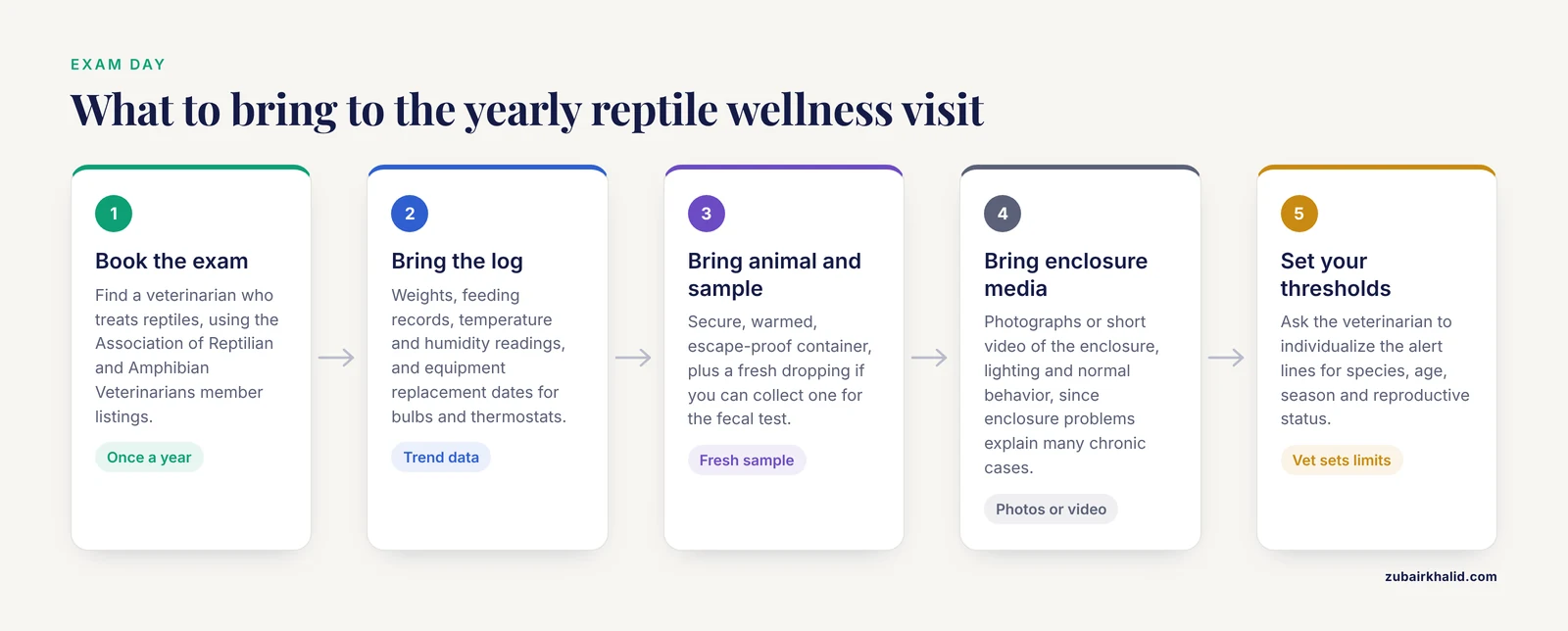
Schedule a wellness examination with a veterinarian who treats reptiles every year, and twice yearly for seniors, animals with chronic conditions, and new acquisitions until they are established. The Association of Reptilian and Amphibian Veterinarians is the primary professional body for this field in the United States, and its member listings are the fastest way to find an experienced clinician near you. Reptile resources from the Merck Veterinary Manual and VCA Animal Hospitals describe the core of these visits consistently: a full physical examination, a discussion of your husbandry parameters backed by your log, weight comparison against previous visits, and a fecal examination for parasites, which is standard because many reptile parasites are present without visible symptoms.
Bring three things to the appointment. Bring the log, because trend data changes what your veterinarian can conclude. Bring photographs or short video of the enclosure, lighting, and normal behavior, because enclosure problems explain a large share of chronic reptile illness. Bring the animal itself in a secure, warmed, escape-proof container with a small sample of a fresh dropping if you can collect one, since a fecal test needs a recent sample and the clinic may not be able to obtain one during the visit.
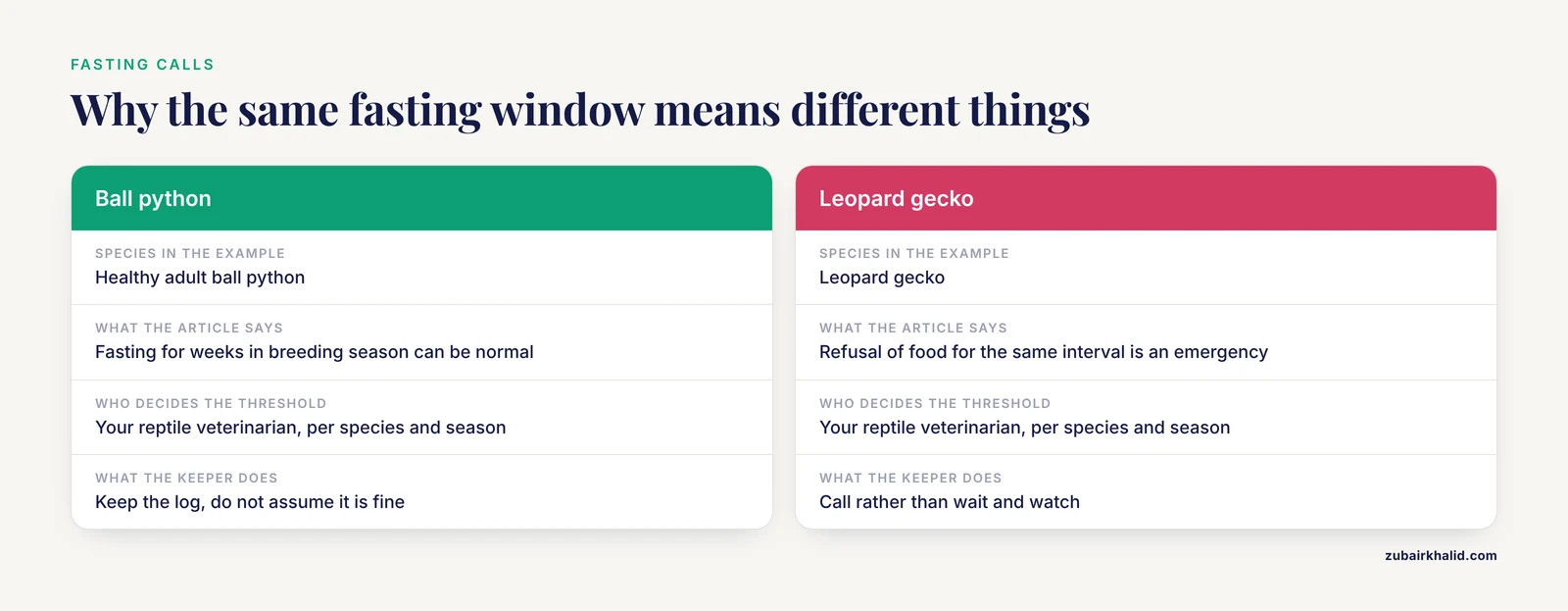
Ask your veterinarian to set the alert thresholds on your template. A healthy adult ball python that fasts for weeks during the breeding season can be normal. A leopard gecko that refuses food for the same interval is an emergency. Species, age, season, and reproductive status all change what "abnormal" means, and your veterinarian is the one who can individualize those lines for your animal.
Reptile Enclosure Setup: The Foundation of Preventive Care
No veterinary schedule can compensate for a deficient enclosure, because chronic husbandry error is the leading driver of the conditions reptile veterinarians treat. Think of reptile enclosure setup as the first tier of preventive medicine and the vet visit as the second. Authoritative husbandry guidance from the Association of Reptilian and Amphibian Veterinarians, the Merck Veterinary Manual's exotic animal resources, VCA Animal Hospitals, and ReptiFiles converges on the same core elements, adjusted for each species.
- Thermal gradient. Provide a warm basking zone and a cooler retreat so the animal can thermoregulate by moving, not by enduring. Control every heat source with a thermostat and measure with at least two digital thermometers or temperature guns, one at the basking surface and one at the cool end. Heat rock devices are widely discouraged because of burn risk.
- UVB lighting where the species requires it. Diurnal basking species generally need appropriate UVB output to synthesize vitamin D and metabolize calcium. Output degrades over time even when the bulb still lights, so follow the manufacturer's replacement interval and log the replacement date on your schedule. Confirm the exact UVB requirement for your species with your veterinarian, because it varies enormously between desert, temperate, and forest species.
- Humidity and hydration. Match humidity to the species using a calibrated hygrometer, provide a humidity hide or moist retreat where the species needs one for proper shedding, and offer fresh water continuously unless your veterinarian advises otherwise for a specific condition.
- Substrate and hides. Choose a substrate that supports the species' natural behavior and is safe if ingested, provide at least one secure hide at each end of the thermal gradient, and avoid loose particulate substrates for species with a documented risk of impaction when fed on them.
- Enclosure size and security. Size the enclosure for the adult animal, not the hatchling, with enough horizontal and vertical space for normal movement and climbing. Locking lids and escape-proof seams protect the animal from the household and the household from the animal.
- Quarantine space. Set up a separate, simpler quarantine enclosure for any new animal, with dedicated tools and hands-on hygiene between animals, for the quarantine interval your veterinarian recommends. Quarantine protects an established collection from parasites and infectious disease that a visually healthy new animal can still carry.
Build these checks into the schedule itself. If the enclosure is the foundation of prevention, then testing its equipment is preventive care, not housekeeping.
Monitoring, Records, and Early Detection
The central insight from current preventive medicine is that continuous, structured monitoring detects disease earlier than episodic assessment. Commentary on connected health platforms argues that clinic-based snapshot evaluations miss the physiologic changes that occur in daily life, and that continuous monitoring tied to actionable data closes that gap [5]. You cannot put a wearable on a bearded dragon, but you can achieve the same architecture at home. The daily observation log is your continuous monitor. The monthly weigh-in is your sensor calibration. The annual exam is your data integration point.
The same literature is honest about the two failure modes of any monitoring program: data accuracy and user compliance [3]. Wearable health reviews repeatedly identify those two problems as the barrier between promising technology and real early detection [6]. Your reptile log faces identical risks. A thermometer that reads wrong produces confident bad decisions, and a schedule that is skipped for three weeks produces blind spots exactly when an animal is getting sick. Both risks have simple fixes. Calibrate or replace gauges on a fixed interval, and anchor the schedule to events you cannot skip, such as trash day or payday.
Records also matter at the veterinary interface. Case evidence from wearable health monitoring in older adults found that people most often brought their trend data to a clinician after noticing changes in sleep or cardiovascular patterns, and that in several instances those trends served as early warning cues that prompted urgent escalation of care [7]. Your log functions the same way in the exam room. "He has lost 40 grams over four months and stopped eating insects two weeks ago" gives your veterinarian a trajectory. "He seems lethargic" does not.
Sticking to the Schedule
Adherence is the weak link in every monitoring program, not knowledge. A hospital physical health monitoring service reviewed more than 1,800 patient records and found that adherence to defined monitoring standards was generally high when the schedule was explicit, the data were audited regularly, and responsibility was assigned clearly [8]. Those three ingredients translate directly to home practice: an explicit written interval, a monthly self-audit where you glance back over the log, and a named person responsible for each task in a multi-person household.
Motivation research points to the same two levers. Interviews with women managing post-pregnancy diabetes risk found that structured routine and external accountability were among the strongest supports for sticking with recommended monitoring [9]. Set your reptile tasks on a repeating calendar with reminders, and tell someone else in the household what the schedule is. Accountability you did not plan for is still accountability.
Common Mistakes
- Guessing temperatures instead of measuring them. Feel is not a thermometer, and the animal cannot tell you the basking surface is 20 degrees too cold.
- Trusting gauge displays indefinitely. Analog dial gauges are notoriously inaccurate, and every sensor drifts. Verify against a reference on your six-month equipment audit.
- Replacing UVB on sight. A bulb that still glows can deliver little usable UVB. Follow the manufacturer's replacement interval and log it.
- Feeding live prey unattended. Rodents and even large insects can injure a reptile. Feed in the enclosure only when you can observe, or use a separate feeding container where appropriate for the species.
- Treating a fasting reptile as normal by default. Seasonal fasting is real in many species, but it is your veterinarian's call, not a default assumption. The alert threshold on your template exists to end that debate with a phone call.
- Skipping quarantine. A new animal that looks healthy can still carry parasites and pathogens into an established collection. Quarantine with dedicated equipment is cheap insurance.
- Weighing inconsistently. A weight taken after a large meal, or on a different scale, or at a different time of day, adds noise that can hide a real trend.
- Cleaning without rinsing or drying. Disinfectant residue is a contact irritant for reptile skin and mucosa. Rinse thoroughly and let surfaces dry fully.
- Upgrading the animal before the enclosure. Adding a second animal, a new diet, or new decor while the thermal gradient or humidity is unverified stacks new variables on an uncontrolled baseline.
Troubleshooting Your Schedule
You keep missing tasks. Shrink the schedule until it is boring. A two-line daily routine done every day beats a ten-line routine done twice a week. Anchor tasks to existing habits, such as reading the gauges while the coffee brews.
Your numbers look wrong. First suspect the equipment, not the animal. Test the thermometer in ice water, which should read near 32 F, and test the hygrometer against a second unit. Replace anything that fails the check and note the replacement date.
The log shows a trend but the animal looks fine. Act on the trend, not the appearance. Reptiles compensate visibly long after they stop compensating physiologically. Call your reptile veterinarian, bring the log, and describe the interval over which the change occurred.
You inherited an animal with no history. Assume nothing about its baseline. Book a new-patient examination and fecal screening promptly, start the log from day one, and treat the first month of data as provisional until a stable pattern emerges.
Welfare and Safety
Every item on the schedule is a welfare measure, not administrative overhead. Temperature control prevents both burns and lethal cold stress. Clean water and correct humidity support proper shedding and renal function. Daily observation is the humane response to keeping an animal whose natural behavior is to conceal suffering. Handle species according to their tolerance, support the body fully, and keep handling sessions short for new or sick animals. Wash hands before and after every contact, both to protect the animal from anything on your hands and to protect your household, since reptiles can carry Salmonella, a recognized zoonotic risk that makes hand hygiene after handling or cleaning non-negotiable in homes with children, older adults, or immunocompromised people.
Limitations and When to Contact a Veterinarian
Every reptile, enclosure, and household differs, and the individual case always needs a veterinarian who has examined your animal. The intervals and thresholds in this article are a framework for organizing that care, not a diagnosis.
Contact a reptile veterinarian promptly for any of the following, regardless of what the schedule says:
- Open-mouth breathing, wheezing, audible breathing sounds, or mucus around the nostrils or mouth
- Refusal of food beyond the alert threshold you set with your veterinarian, especially with visible weight loss
- Prolonged lethargy, weakness, inability to hold the head or limbs in a normal posture, or tremors and twitching
- Softening or swelling of the jaw or limbs, which can indicate metabolic bone disease
- Retained shed, especially constricting shed around toes, tail tip, or eyes, lasting beyond your alert window
- Diarrhea, blood in the stool, markedly foul stool, straining, cloacal swelling or prolapse, or an absence of droppings beyond the expected interval with continued feeding
- Any swelling, lump, wound that is not healing, discharge from the eyes, nose, mouth, or vent, or signs of mouth inflammation
- Regurgitation, repeated soaking combined with appetite loss, or a sudden change in posture such as stargazing
- Any suspected exposure to toxins, including smoke, aerosols, pesticides, or unsuitable substrates ingested with food
- Any illness in a newly acquired animal still in quarantine, which warrants immediate veterinary contact rather than watchful waiting
When in doubt, call. Reptile patients deteriorate quietly, and a phone call that turns out to be unnecessary costs minutes, while a delayed one can cost the animal.
Frequently Asked Questions
How often should a healthy reptile see a veterinarian?
Once a year for a wellness examination with fecal parasite screening is the standard baseline for a healthy adult, with twice-yearly visits for seniors, animals with chronic conditions, and new acquisitions while they settle in. Your reptile veterinarian may adjust this based on species, age, and husbandry history.
What should a reptile preventive care schedule template include?
Four columns: frequency, task, the value you record, and the alert threshold that triggers a vet call. Daily feeding and observation, daily temperature and humidity readings, weekly hands-on exams and bowl disinfection, monthly weighing and deep cleaning, equipment checks every six months, and an annual veterinary visit with fecal testing form the core rows.
Do reptiles really need preventive care if they look healthy?
Yes. Reptiles instinctively hide illness, so a normal-looking animal can still carry parasites or be developing husbandry-related disease. Fecal screening, weight tracking, and physical exams detect those problems before they become emergencies, which is the entire premise of a preventive schedule.
What daily checks belong on a reptile care checklist?
Feeding response, posture and activity, breathing effort, droppings and urates, water availability, and thermometer and hygrometer readings. The whole routine takes a few minutes and produces the trend data that catches disease early.
How does reptile enclosure setup affect preventive care?
It is the foundation, because chronic husbandry error drives many of the conditions reptile veterinarians treat. A correct thermal gradient with a thermostat, species-appropriate UVB and humidity, safe substrate, secure hides, and verified equipment prevent disease, while a testing and replacement schedule keeps the setup honest over time.
How often should I weigh my reptile?
Monthly for most adults, which is frequent enough to reveal a slow decline and infrequent enough to stay practical, with weigh-ins before feeding and on the same scale each time. Growing juveniles and animals under treatment may warrant more frequent weighing on your veterinarian's advice.
What records should I bring to the annual reptile exam?
Bring your log with weights and feeding records, your temperature and humidity readings, the equipment replacement dates for bulbs and thermostats, photos or video of the enclosure, and a fresh fecal sample if you can collect one. Trend data lets your veterinarian distinguish a real change from a stable baseline.
When is a reptile problem an emergency?
Open-mouth or labored breathing, prolapse, severe lethargy, tremors, suspected toxin exposure, trauma, and prolonged anorexia with weight loss all warrant immediate contact with a reptile veterinarian. Anything on your written alert threshold counts as a call-today finding, not a wait-and-see finding.
Sources
- Patterns of Care Seeking During Episodes of Childhood Diarrhea and its Relation to Preventive Care Patterns: National Integrated Monitoring and Evaluation Survey (IMES) of Family Health. Islamic Republic of Iran
- Achieving Health Equity in Decentralized Healthcare: An Innovative Approach to Preventive Care in Southern Italy
- The future of wearable health technology: From monitoring to preventive healthcare
- Sustainability and reliability of methods for monitoring violence in health care
- Automotive Health 2.0: Steering Toward Proactive Preventive Care
- The Impact of Wearable Technology on Health Monitoring
- From Early Warning to Life-Saving Intervention: Case Study Evidence of Persuasive Wearable Health Monitoring in Older Adults and Older Adults With MCI
- Development and evaluation of a physical health monitoring service for people prescribed psychotropic medications
- Views of Women and Health Care Providers Regarding Type 2 Diabetes Screening and Preventive Strategies Post Gestational Diabetes: An Interview Study.