Why Is My Reptile Not Eating? 7 Common Causes and How to Troubleshoot
By Dr. Zubair Khalid, DVM, MS, PhD ·

If your reptile is not eating, the cause is usually environmental before it is medical. Reptiles are ectotherms, which means their body temperature, digestion, immune function, and appetite all run on the conditions you provide in the enclosure. Temperature that is too low, humidity that is wrong for the species, a stressful or insecure enclosure setup, an unsuitable diet, seasonal fasting cycles, contaminated or unsafe substrate, and underlying illness account for the overwhelming majority of feeding problems owners report.
The good news is that most of these causes are fixable at home. The first step in learning how to fix reptile not eating problems is a systematic audit of the enclosure, followed by changes to feeding technique and a short period of observation with weight tracking. This guide walks through the seven most common reptile not eating causes, gives you a practical reptile care checklist you can act on today, and explains exactly when a refusal of food crosses the line into a veterinary emergency.
This article is educational and is not a substitute for veterinary diagnosis or treatment.
At a Glance: Fast Checks You Can Do Today
| Check | What to look for | Immediate action |
|---|---|---|
| Basking zone | Is there a warm spot the animal actually uses, measured with a thermometer at the surface? | Verify temperatures with a digital thermometer or temperature gun rather than guessing |
| Thermal gradient | Can the reptile move between a warm zone and a clearly cooler zone? | Reposition heat sources so the animal can thermoregulate freely |
| Humidity | Is humidity matched to the species' needs, not the room's? | Add or ventilate, provide a humidity hide for shedding species |
| Hides and security | At least one hide on each end of the temperature gradient, out of sight? | Add cover, reduce handling, move the enclosure to a quieter room |
| Diet match | Is the food the correct species, size, and temperature for this animal? | Revisit prey size and presentation, vary items within the species' natural diet |
| Season | Is this the time of year this species normally eats less or brumates? | Confirm the animal is drinking, alert, and maintaining weight, then monitor |
| Substrate | Is bedding clean, dry where it should be, and free of chemicals? | Replace substrate, never use material treated with pesticides or herbicides |
| Records | Do you have a weight trend and a note of last defecation? | Start a simple log with weekly weights on a digital gram scale |
If any check fails and the reptile is also losing weight, lethargic, or showing other signs, skip the troubleshooting and contact a reptile veterinarian.
How Long Is Too Long Without Food?
There is no single answer, because a leopard gecko, a ball python, a bearded dragon, and a green iguana differ enormously in metabolism, adult size, and feeding frequency. A healthy adult snake that skips several weeks can be behaving normally, especially in cooler months. A young, rapidly growing lizard or a small species with high energy demands that refuses several meals in a row is a different situation entirely.
The practical rule most reptile veterinarians use is to judge the fast by three things: the animal's age and body condition, whether it is still drinking and behaving normally, and whether weight is being lost. Juveniles and underweight animals should never be allowed to fast for long. Any reptile that is not eating and is also losing weight, lethargic, or showing respiratory or digestive signs needs an examination rather than more waiting. When you are unsure where your species falls, the Merck Veterinary Manual's exotic animal section and species-specific husbandry guides such as ReptiFiles publish species-by-species feeding intervals that make this judgment much easier.
The 7 Most Common Causes When a Reptile Is Not Eating
1. Temperatures Are Wrong
Temperature is the first and most common reason a reptile stops eating. Digestion in ectotherms is powered by environmental heat. A snake or lizard that cannot reach its preferred body temperature cannot digest prey efficiently, and its appetite shuts down accordingly. This is why a reptile not eating after an enclosure move, a heater failure, a seasonal room temperature drop, or a bulb change so often resolves when the thermal environment is corrected.
Three features matter more than any single number on a dial:
- A proper thermal gradient. The enclosure needs a warm zone, a basking area, and a cooler retreat so the animal can move between them. A uniform warm enclosure is nearly as problematic as a uniformly cold one, because reptiles regulate their body temperature by behavior, not by internal metabolism.
- Heat where the animal can use it. Overhead basking heat that warms the surface the animal rests on is generally more useful than heat that only warms the air. Heat sources the animal can press its body against require a thermostat and careful placement, because contact burns are a well-known husbandry injury.
- Verification, not assumption. Wall thermometers placed incorrectly, or dial gauges read from across the room, routinely misreport conditions. Measure at the basking surface, at the cool end, and at the level where the animal actually spends its time.
Nighttime conditions matter too. Many species tolerate and even benefit from a drop after lights out, but a room that falls too cold overnight can stall digestion in animals fed in the evening. If you feed at night, feeding earlier in the day, when the enclosure is at its warmest, is one of the simplest reptile not eating solutions available.
2. Humidity and Hydration Problems
Dehydration suppresses appetite, and it does so before most owners notice anything wrong. Reptiles lose water through the skin, through respiration, and in the urate portion of their droppings. A reptile in negative water balance often stops eating well before it looks obviously dehydrated.
Humidity problems cut in both directions. Desert-adapted species kept in chronically damp enclosures develop skin and respiratory problems that dull appetite. Tropical and forest species kept in dry household air, especially in winter with central heating, shed poorly, become dehydrated, and eat less. Incomplete sheds around the toes, tail tip, and eye caps are a visible warning that humidity is below the species' needs.
Corrective steps include providing a properly sized water bowl changed daily, misting where appropriate for the species, adding a humidity hide lined with damp sphagnum moss for shedding animals, and adjusting ventilation so the enclosure is humid but not stagnant. Substrate choice interacts with humidity, which is covered in cause six below.
3. Stress From a New or Unsuitable Enclosure Setup
Reptiles are prey animals by evolutionary design, and most of them will not eat while they feel exposed. This is one of the most underappreciated reptile not eating causes, and it explains a large share of new-pet feeding failures.
Common stressors include:
- A new environment. Reptiles freshly arrived from shipping, a breeder, or a store commonly refuse food for days to weeks while they map their surroundings. Here, origin matters. A large analysis of the commercial exotic pet trade found that roughly a third of reptile and amphibian listings over the study period were captive-bred rather than wild-caught, with that share rising over time [1]. Wild-caught animals in particular may need extended acclimation, and a veterinarian should be involved early if they also show weight loss, because parasites and other imported health problems are possible.
- No place to hide. An enclosure with open decor and no secure retreat on both the warm and cool ends keeps the animal in a low-grade state of vigilance. Many keepers find feeding improves dramatically after simply adding two proper hides.
- Excessive handling. Frequent handling, especially in the days after a meal or after arrival, delays feeding in many individuals.
- Chronic visibility. Enclosures in high-traffic rooms, facing other pets such as cats and dogs, or with the animal permanently exposed on all sides, produce the same effect. Visual barriers along the lower glass of front-opening enclosures help many lizards and snakes settle.
- Cohabitation. Housing two reptiles together is a frequent source of chronic stress, competition, and injury, and it is a common reason one or both animals in the pair stop eating.
4. The Diet or the Presentation Is Wrong
Reptile diets are intensely species-specific, and dietary specialization runs deep in this lineage. The fossil record provides striking illustrations. A recently described Cretaceous oviraptorosaur shows skull adaptations for eating soft fruit that parallel those of modern parrots, a reminder that members of the reptile line can become locked into narrow, specialized diets [2]. Living reptiles are no different. A herbivorous tortoise cannot thrive on a carnivore's menu, a snake will often ignore prey that is the wrong size or presented the wrong way, and an insectivore fed a monotonous single invertebrate will gradually develop both nutritional deficiencies and boredom with its food.
When troubleshooting why is my reptile not eating, examine four things:
- Food type. Match the diet to the species' actual natural history, not to what the pet store sells or what an online forum recommends. Herbivorous lizards need appropriate vegetation, insectivores need varied invertebrate prey, and snakes need appropriately sized whole prey.
- Prey size and form. Prey that is too large is refused or regurgitated. Prey that is too small may simply fail to register as a meal for an adult animal.
- Movement and temperature. Many lizards and young snakes key in on movement, and many snakes key in on prey scent and warmth. Frozen-thawed prey warmed appropriately and presented with movement at the front of the hide, or in the evening when crepuscular species wake, often restarts feeding where daytime presentations failed.
- Nutritional completeness. Whole, varied diets matter in ways owners can sometimes see directly. Research on reptile coloration found that riboflavin, vitamin B2, reaches high concentrations in the yellow skin of certain lizards and snakes and must be acquired through the diet, because like carotenoids it cannot be manufactured by the animal [3]. Pigment quality, growth, and immune function all depend on what goes into the animal, which is why long-term single-item diets are a risk factor for both poor color and poor health.
If you suspect the diet is the problem, change one variable at a time and give the animal several feeding opportunities at each step before moving on.
5. Seasonal Fasting, Brumation, and Reproductive Cycles
Not every fast is a problem. Many temperate reptiles reduce or stop eating for part of the year in response to changes in day length, temperature, and light cycle. Brumation, the reptile equivalent of hibernation, is a normal seasonal state in many species, and healthy adults commonly stop eating in the weeks before and during it. Some species also fast during portions of the breeding season, and gravid females frequently refuse food late in pregnancy.
How to tell a seasonal fast from a problem:
- The animal remains alert, drinks normally, maintains body weight, and behaves as expected for the season.
- Weight loss is minimal or absent over weeks of monitoring.
- There are no respiratory, digestive, or behavioral red flags.
Seasonal fasting in an animal that is losing weight, or in a juvenile that needs the calories for growth, is not normal and warrants a veterinary visit. If you plan to allow brumation, have the animal examined and cleared beforehand, because brumating an unwell reptile can be fatal. Your veterinarian can also confirm whether your species brumates at all and discuss whether the practice is necessary for a pet animal.
6. Substrate Problems, Including Chemical Contamination and Swallowed Bedding
Substrate is part of the enclosure setup that owners change least and reptiles interact with most. Two distinct problems appear here.
The first is physical. Loose particulate bedding can be swallowed incidentally during feeding, especially by animals fed on the substrate or by reptiles hunting live invertebrates. In susceptible animals this contributes to impaction, a potentially serious blockage of the digestive tract. Warning signs include straining, absence of droppings, bloating, and a sudden stop in eating. Feeding on a slate tile, a shallow dish, or outside the loose bedding reduces the amount of substrate an animal ingests.
The second is chemical, and the evidence here is more concrete than most owners realize. In a controlled study of a fossorial European reptile, animals housed for three weeks on coconut fiber substrate treated with a glyphosate-based herbicide showed elevated fecal corticosterone metabolites, indicating a heightened stress response, along with altered antipredator behavior compared with animals on clean substrate [4]. In a follow-up choice test, the animals avoided the treated substrate. The practical lesson for keepers is direct. Soil, leaves, or wood collected from outdoors, or any bedding exposed to pesticides, herbicides, or cleaning chemicals, can stress the animal, alter its behavior, and be actively avoided. Because appetite is tightly linked to stress in reptiles, chemically contaminated bedding is a genuine, documented contributor to a reptile not eating. Use purpose-made commercial substrates, replace bedding that has been exposed to aerosolized cleaners or pest sprays in the room, and rinse and dry any natural materials you harvest yourself before they enter the enclosure.
7. Illness, Pain, and Parasites
When the environment checks out and the animal still will not eat, illness moves to the top of the list. Infections, internal and external parasites, mouth problems, injuries, organ disease, and pain from any source all suppress appetite in reptiles. Because reptiles hide illness until it is advanced, a subtle drop in appetite is often the first and only sign.
One physiological detail deserves attention. A meta-analysis across dozens of studies confirmed that behavioral fever, in which an infected ectotherm deliberately selects warmer microhabitats to raise its body temperature and support immune function, is a widespread response in amphibians and reptiles, and that bacterial infections tend to produce stronger fever responses than viral or fungal challenges [5]. For owners, this has two implications. First, a reptile that suddenly basks far more than usual, or parks itself on the heat source around the clock, may be sick rather than comfortable. Second, this defense only works if the enclosure contains a genuine thermal gradient. An animal in a uniformly warm tank, or in a tank that is uniformly too cool, cannot mount the temperature shift its immune system is asking for.
Other signs that move a fast from the husbandry column to the medical column include open-mouth breathing, wheezing, discharge from the nose or mouth, swelling anywhere on the body, retained eyecaps or skin, regurgitation, diarrhea or runny urates, blood in the droppings, tremors, weakness, or a preference for lying flat and unprotected on the enclosure floor.
How to Fix Reptile Not Eating: A Step-by-Step Troubleshooting Plan
Step 1: Audit the Enclosure With a Reptile Care Checklist
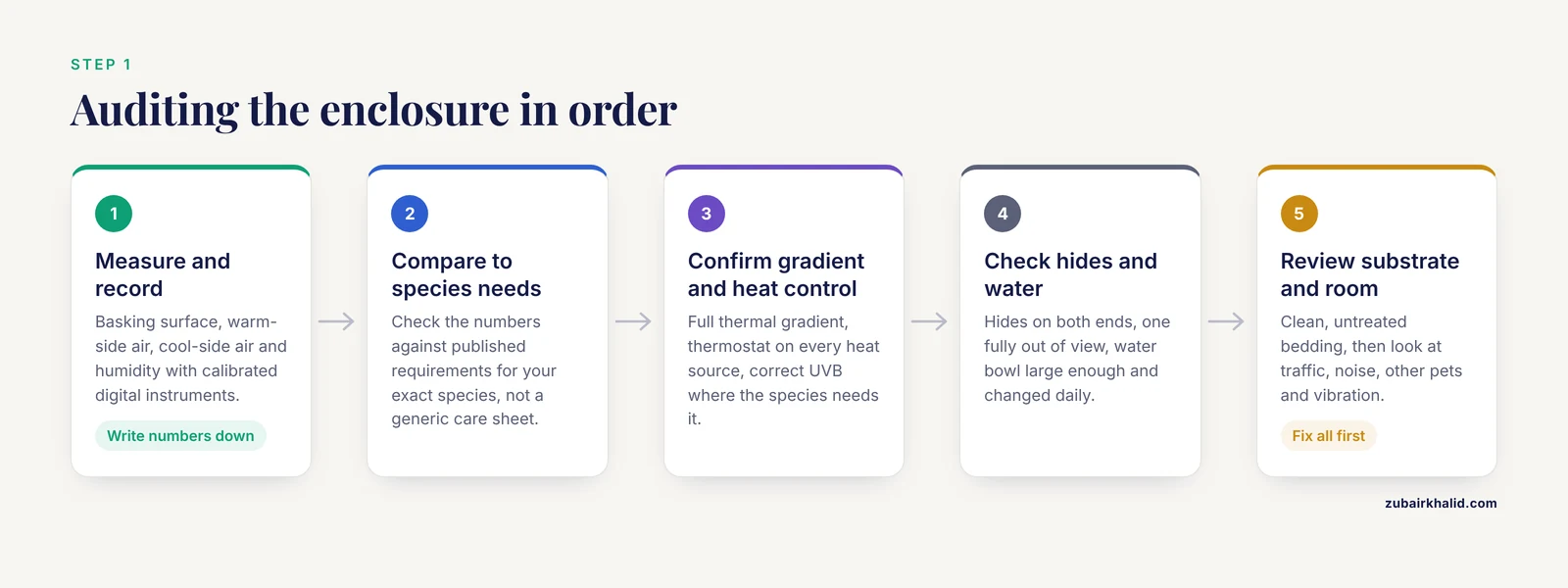
Work through the enclosure setup in one sitting, in this order, because temperature and hydration problems outnumber all other causes combined.
- Measure basking surface temperature, warm-side air temperature, cool-side air temperature, and humidity with calibrated digital instruments, and write the numbers down.
- Compare those numbers against published requirements for your exact species from an evidence-based husbandry guide or your veterinarian, not from a generic care sheet.
- Confirm there is a full thermal gradient, thermostatic control on every heat source, and functional UVB or appropriate full-spectrum lighting of the correct strength and replacement age where the species requires it.
- Confirm hides exist on both ends of the gradient and that the animal can be completely out of view in at least one of them.
- Confirm the water bowl is large enough for the species, changed daily, and positioned where it will not dry out instantly under the basking lamp.
- Check the substrate against cause six above.
- Look at the room, not just the tank. Traffic, noise, other pets, and vibration all register as threats to a prey species.
Fix everything you find before changing anything about food. In many cases appetite returns on its own within days once the environment is right.
Step 2: Revisit Feeding Technique and Safety
If the enclosure passes, look at how food is offered. Offer food at the time of day the species naturally feeds, at the right size, warmed appropriately if frozen-thawed, and with minimal disturbance. For snakes, many keepers have success offering prey partially covered, in low light, at dusk. For lizards, allowing live invertebrates to move visibly in the line of sight triggers feeding responses that a static bowl does not.
Feed in a way that is safe for you as well as the animal. Bites at feeding time are a real and documented hazard. A ten-year review of western hognose snakebite calls to the California Poison Control System found 35 cases in which nearly all victims were bitten by their own pets, almost all bites involved the hands, and the bites occurred typically during feeding, handling, or enclosure cleaning, with local swelling in the large majority of cases [6]. The same review reinforces a point many owners miss with rear-fanged and mildly venomous species, and a separate proteomic study of Bothrops vipers showed that venom composition shifts substantially as snakes mature from neonates to adults, with adult venom showing greater potency in laboratory models [7]. A juvenile snake that was easy to feed barehanded may be a very different animal two years later. Use long feeding tongs or a snake hook, never offer prey with your fingers, wash your hands after handling prey items or other animals so your scent does not read as food, and treat every species' feeding response with respect regardless of its reputation for gentleness.
Step 3: Upgrade Diet Quality and Variety
Once technique is sound, broaden the diet within the species' natural range. Rotate invertebrate species for insectivores, offer a properly balanced variety of greens, vegetables, and appropriate supplements for herbivores as advised by your veterinarian, and keep prey variety appropriate for snakes. Gut-load insects and dust them according to a schedule your reptile veterinarian helps you set for your species and life stage. Reptiles on restricted diets often show improved appetite and color within weeks of a diet upgrade, and the dietary pigments that shape appearance, such as riboflavin in some species, depend entirely on what the animal is fed [3].
Step 4: Reduce Stress and Give It Time
After any husbandry change, back off. Stop nonessential handling for one to two weeks, add cover, move the enclosure if it sits in a busy location, and let the animal investigate its improved setup without interference. Then offer food quietly, without an audience, and leave the enclosure undisturbed afterward. Patience after a correction is one of the most underrated reptile not eating solutions, because many animals need several calm days before appetite returns.
Step 5: Track Weight and Droppings
Buy a digital gram scale and weigh the animal weekly at the same time of day. Record every defecation and urate. A stable weight with a normal dropping pattern in an otherwise alert animal allows a cautious wait-and-see approach. A falling weight, absent droppings, or changes in urate color convert the situation from troubleshooting into a veterinary case.
Common Mistakes Owners Make
- Guessing temperatures instead of measuring them. This is the single most frequent error behind a reptile not eating.
- Treating appetite loss with food variety alone. Offering a dozen new foods does nothing for an animal whose enclosure is too cold.
- Handling more to "check on" the animal. Extra handling during a fast prolongs the stress that caused it.
- Feeding immediately after a habitat change. Give the animal a settling-in period before judging its appetite.
- Assuming a wild-caught animal behaves like a captive-bred one. Captive-bred reptiles make up a growing share of the trade but are still the minority of listings by some measures, and wild-caught animals need longer, quieter acclimation [1].
- Leaving loose substrate under feeding prey. Swallowed bedding is preventable.
- Waiting too long with a juvenile or an underweight animal. Small body reserves run out quickly.
Welfare and Safety Points
Anorexia in reptiles is a welfare issue, not an inconvenience. Ongoing weight loss produces visible muscle wasting along the spine and limbs, and prolonged fasting in a dehydrated animal can lead to gout, kidney damage, and hepatic lipidosis. At the same time, protect yourself. The feeding-time bite data above show that bites cluster on the hands of owners during routine care, so feeding tools, handwashing, and calm, unhurried handling are part of responsible reptile ownership, not optional extras [6].
Limitations and When to Contact a Veterinarian
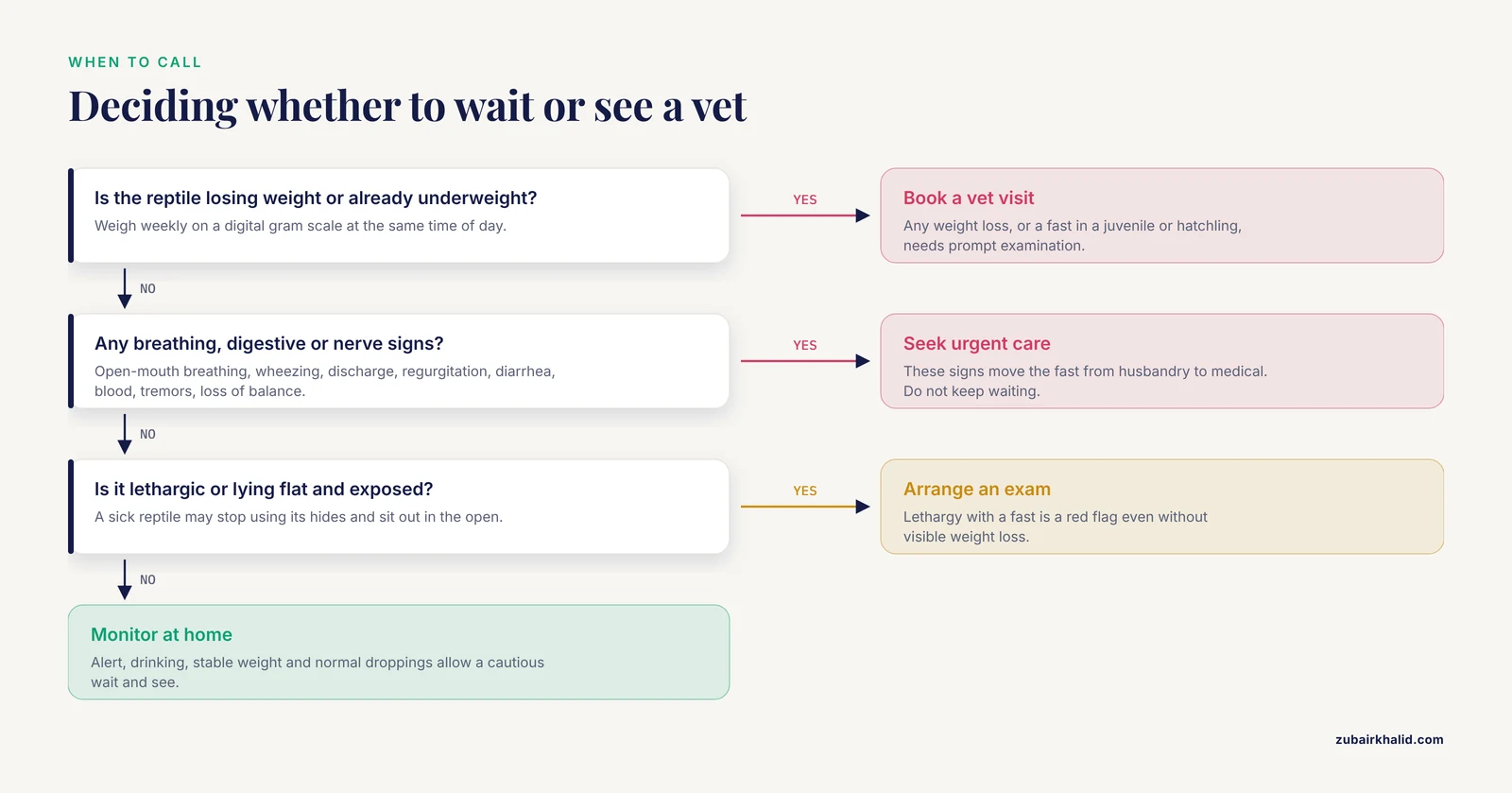
Individual cases vary, and any ongoing feeding problem deserves a conversation with a veterinarian experienced in reptile medicine. The Association of Reptilian and Amphibian Veterinarians maintains a member directory that makes finding a qualified clinician much easier than calling a general small-animal practice and hoping for the best.
Contact a reptile veterinarian promptly, or seek urgent care, if your reptile shows any of the following:
- Any weight loss, or refusal of food in a juvenile, a hatchling, or an animal already underweight
- Not eating combined with lethargy, weakness, or lying flat and exposed rather than using hides
- Open-mouth breathing, wheezing, or discharge from the nose or mouth
- Regurgitation, diarrhea, blood in droppings, no droppings, or visible straining
- Swelling of the mouth or jaw, retained eyecaps, wounds, lumps, or discoloration
- Tremors, loss of balance, or inability to right itself
- Sudden excessive basking or excessive cooling-seeking behavior alongside the fast
- A fast that has already outlasted what is normal for the species and season, or any fast that concerns you
Bring your weight log, your measured temperature and humidity readings, a photograph of the full enclosure setup, a fresh fecal sample, and a description of everything you have already tried. This information shortens the diagnostic process considerably and frequently saves a diagnostic step or two.
Frequently Asked Questions
Why is my reptile not eating but acting normal?
Most commonly the enclosure conditions, especially temperature, have drifted out of the species' range, or the animal is in a normal seasonal fast. Verify temperatures and humidity with instruments, review recent changes, and monitor weight and droppings before assuming anything is medically wrong.
How long is too long for a reptile to go without eating?
It depends entirely on species, age, and body condition. Healthy adults of some species routinely fast for weeks seasonally, while juveniles and small species should never fast long. The safest rule is to seek veterinary advice as soon as weight loss appears or the fast exceeds what is normal for your species.
Will a reptile starve itself on purpose?
Reptiles do not fast out of spite, but chronically unsuitable temperatures, persistent stress, or an unrecognized illness can suppress appetite for extended periods. The animal is responding to its conditions, and the fix is to change the conditions, then have a veterinarian evaluate the animal if appetite still does not return.
Should I handle my reptile while it is not eating?
No, minimize handling until feeding resumes, unless a veterinarian directs otherwise. Handling is a stressor for most reptiles, and added stress during a fast typically prolongs it.
Can stress from a new enclosure stop my reptile from eating?
Yes, and it is one of the most common causes in newly acquired animals. Provide hides on both the warm and cool ends, reduce handling and room traffic, and give the animal quiet time to settle, which may take several weeks.
Does brumation look like illness?
It can. A brumating reptile is inactive and eats little, but it should maintain weight, remain alert when disturbed, and show no respiratory or digestive signs. Illness during brumation can be fatal, so have the animal examined and cleared before allowing a brumation period.
What should I bring to the vet for an appetite problem?
Bring a written weight log, your temperature and humidity measurements, photos of the enclosure from several angles, details of the diet and feeding schedule, a fresh fecal sample, and notes on any recent changes in the home or enclosure.
How do I know if my reptile is dehydrated rather than just picky?
Watch for dull or wrinkled skin, sunken eyes, thick or tacky saliva, incomplete sheds, and dry or pale urates. If you see these signs along with the fast, contact a reptile veterinarian, because dehydration suppresses appetite and needs correction promptly.
Sources
- The commercial trade in exotic pets has had little impact on wild populations of reptiles and amphibians.
- Fruit-eating adaptations in a Late Cretaceous oviraptorosaur (Theropoda).
- Riboflavin: a potentially important skin pigment in reptiles.
- Subterranean but vulnerable: Sub-lethal effects of substrate contamination by a glyphosate-based herbicide on the physiological condition and behavior of a fossorial reptile.
- When cold-bloods heat up: meta-analytical evidence that climatic variability mediates behavioural fever in amphibians and reptiles.
- The secretory life of pets: bites from western hognose snakes reported to the California Poison Control System.
- Ontogenetic Shift in a Snake Venom Proteome Drives Distinct Proteomic Responses in Mouse Renal Mesangial Cells.