Reptile Humidity and Temperature Log
By Dr. Zubair Khalid, DVM, MS, PhD ·
A reptile humidity and temperature log is a dated record of the temperatures and humidity levels inside your reptile's enclosure, taken at fixed points in the habitat at a consistent time each day. The Association of Reptilian and Amphibian Veterinarians identifies proper environmental temperature and humidity as foundational to reptile health, and a written log is the only reliable way to know whether those conditions are actually stable or just look stable on the day you glance at a gauge.
The reason a log matters is simple. Reptiles are ectotherms, meaning they depend entirely on external heat sources to regulate their body temperature, and most species also rely on appropriate ambient humidity for hydration, shedding, and normal respiratory function. The Merck Veterinary Manual notes that improper environmental temperature and humidity are among the most common underlying causes of illness in captive reptiles, including respiratory disease and shedding problems. Because problems develop from patterns over days or weeks, not from a single bad reading, a log catches trouble early.
This article explains what to record, which equipment gives trustworthy numbers, how to build a reptile humidity temperature log template you will actually use, and what the recorded data tells you about your animal's health.
At a Glance: Setting Up Your Log Today
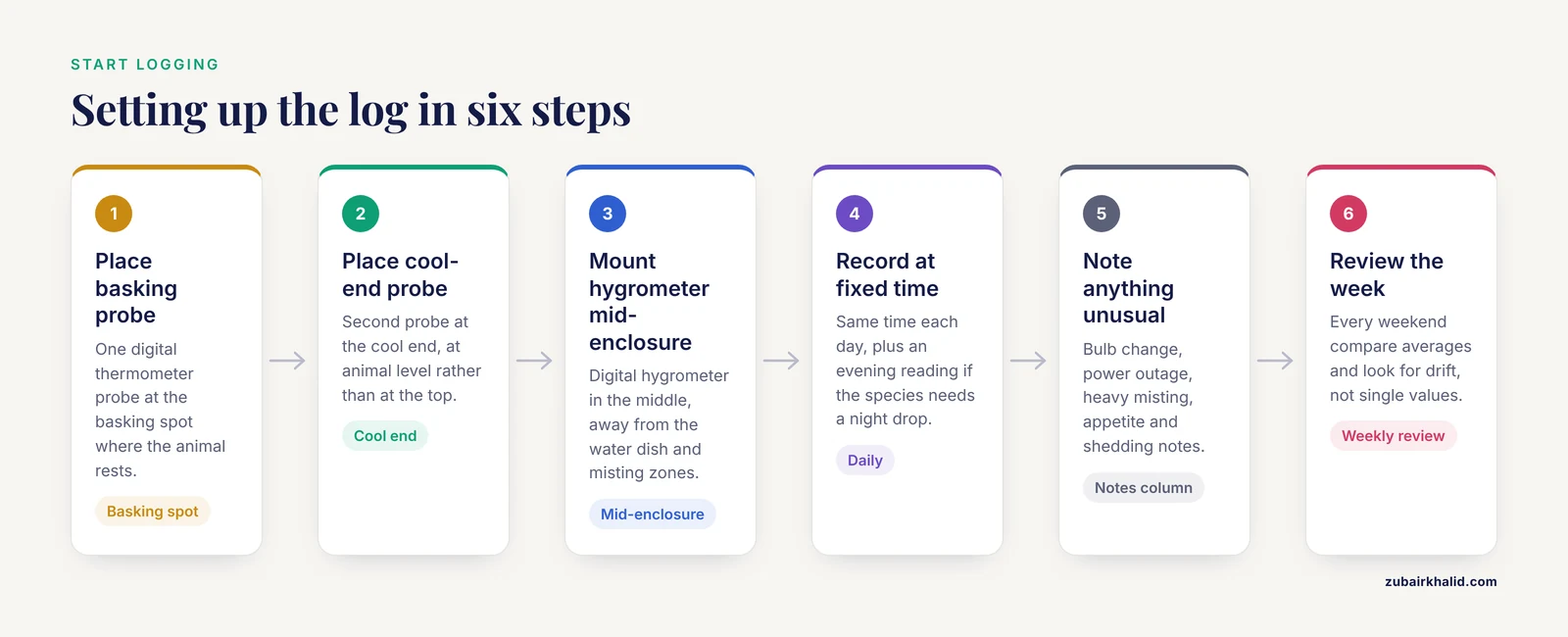
If you want to start logging tonight, follow this sequence:
- Place one digital thermometer probe at the basking spot and one at the cool end of the enclosure.
- Place a digital hygrometer at the level your reptile spends most of its time, ideally mid-enclosure rather than on the glass lid.
- Record both readings at the same time each day, plus one evening reading if your species needs a nighttime temperature drop.
- Write down the readings, the date, the time, and anything unusual (a bulb change, a power outage, a heavy misting).
- Review the full week every weekend and watch for drift, not just single out-of-range values.
- Bring the log to every veterinary appointment. The Association of Reptilian and Amphibian Veterinarians emphasizes that husbandry history is central to a reptile examination.
Why Temperature and Humidity Tracking Matters
Reptiles cannot generate their own body heat the way mammals do. They move between warm and cool zones in their environment to keep their bodies functioning, digest food, and fight off infection. This is why husbandry guidance for captive reptiles centers on a thermal gradient, a deliberately created range of temperatures across the enclosure that lets the animal choose what it needs. If the warm side fails or the cool side never cools, the reptile loses that ability to self-regulate.
Humidity works the same way. A reptile kept in air that is too dry may retain shed skin, especially around the toes and eyes, and may become chronically dehydrated. Air that stays too wet without ventilation encourages bacterial and fungal growth. The Merck Veterinary Manual lists incorrect humidity alongside incorrect temperature as a contributing factor in common captive reptile diseases.
The problem for owners is that enclosure conditions drift. Heat bulbs weaken with age. Ambient room temperature changes with the seasons. Water bowls evaporate faster in winter when heating systems run. A single reading on a random afternoon hides all of that. A reptile humidity and temperature log turns scattered observations into a pattern you and your veterinarian can read.
There is also a diagnostic value. When a reptile becomes lethargic or stops eating, one of the first questions a reptile veterinarian asks is about enclosure temperatures and humidity. Owners who guess answer poorly. Owners with two weeks of logged data answer precisely, which shortens the diagnostic process. VCA Animal Hospitals' reptile care guidance stresses that accurate knowledge of the animal's home environment is part of providing useful information to the treating veterinarian.
Knowing Your Target Ranges
Before you can log anything, you need reference values. These vary enormously across species. A desert species such as a leopard gecko or a bearded dragon needs low humidity and a hot basking zone. A tropical species such as a crested gecko or a ball python needs moderate to high humidity and gentler heat. An aquatic or semi-aquatic species such as a red-eared slider has an entirely different thermal profile because much of its environment is water.
Three principles apply across nearly all species:
- A thermal gradient is required, not optional. The enclosure must offer a warm zone and a cooler zone at the same time, so the animal can move between them. Husbandry guides consistently describe the gradient, including the basking surface temperature and the cool-side temperature, as the core of reptile thermal care.
- Humidity is species-specific. Desert species tolerate and prefer dry air. Tropical and forest species need consistently elevated humidity. The correct value is published for your exact species, not for "reptiles" in general.
- Light-cycle heat differs from constant heat. Many species benefit from a drop in temperature at night that mimics natural conditions, which is why evening readings belong in the log.
Where do you get your numbers? Use a current, evidence-based species guide such as those maintained by ReptiFiles, and confirm the values with a reptile veterinarian at your animal's first wellness exam. Write the target values at the top of your log so every reading has context.
Choosing Equipment That Gives Honest Numbers
The accuracy of your reptile humidity temperature log depends entirely on the instruments feeding it. This is where many setups fail.
Thermometers
Avoid stick-on dial strips placed on the glass. They measure the temperature of the glass surface, not the air where your reptile lives, and they cannot track a gradient. For a usable log you need:
- Two digital thermometers with probes. One probe sits at the basking area, positioned where the animal actually rests. The other sits at the cool end, again at animal level rather than at the top of the enclosure.
- An infrared temperature gun. This measures surface temperature instantly, which is how you verify the actual temperature of the basking surface your reptile touches. Air temperature and surface temperature are different numbers, and both matter.
VCA Animal Hospitals' reptile care resources emphasize measuring at the animal's level and at the specific basking site, because readings taken at the top of a tall enclosure can be many degrees different from conditions at the floor.
Hygrometers
Use a digital hygrometer rather than an analog dial gauge. Dial gauges are widely reported by experienced keepers and husbandry educators to be unreliable, and ReptiFiles' equipment guidance specifically steers keepers toward digital units. Placement matters: a hygrometer pressed directly against a misted wall or water dish reads artificially high. Mount it in the middle of the enclosure where your reptile lives.
Thermostats
Any heat source capable of reaching unsafe temperatures, including heat mats and ceramic heat emitters, should be regulated by a thermostat with its probe correctly positioned. A thermostat is not part of the log itself, but it protects the numbers in your log from sudden dangerous spikes, and thermal burns from unregulated heat sources are a well-recognized presentation in reptile medicine.
Light and UVB Considerations
Many diurnal reptiles require ultraviolet B lighting for vitamin D metabolism and calcium handling, and this lighting is on a timer tied to the day-night cycle. While the log does not measure UVB, recording when bulbs are changed belongs in the notes column, because UVB output declines over time even while the bulb still glows.
Reptile Humidity Temperature Log Format
A good reptile humidity temperature log format is one you can complete in under two minutes. Overbuilt templates get abandoned within a week. The format below captures everything a veterinarian or an experienced keeper would want to see.
Header section (completed once):
| Field | Your Entry |
|---|---|
| Species and age | |
| Enclosure dimensions | |
| Target basking surface temperature | |
| Target cool-side temperature | |
| Target nighttime temperature | |
| Target humidity range | |
| Heat equipment and thermostat setting | |
| UVB bulb type and replacement date |
Daily log section (one row per reading):
| Date | Time | Basking surface temp | Cool-side temp | Night temp (if logged) | Humidity | Notes |
|---|---|---|---|---|---|---|
The notes column does more work than beginners expect. It explains anomalies later. "Day 14: replaced heat bulb" explains why the basking temperature that day differs from the previous week. Without that note, the data looks like equipment failure.
Building the Template
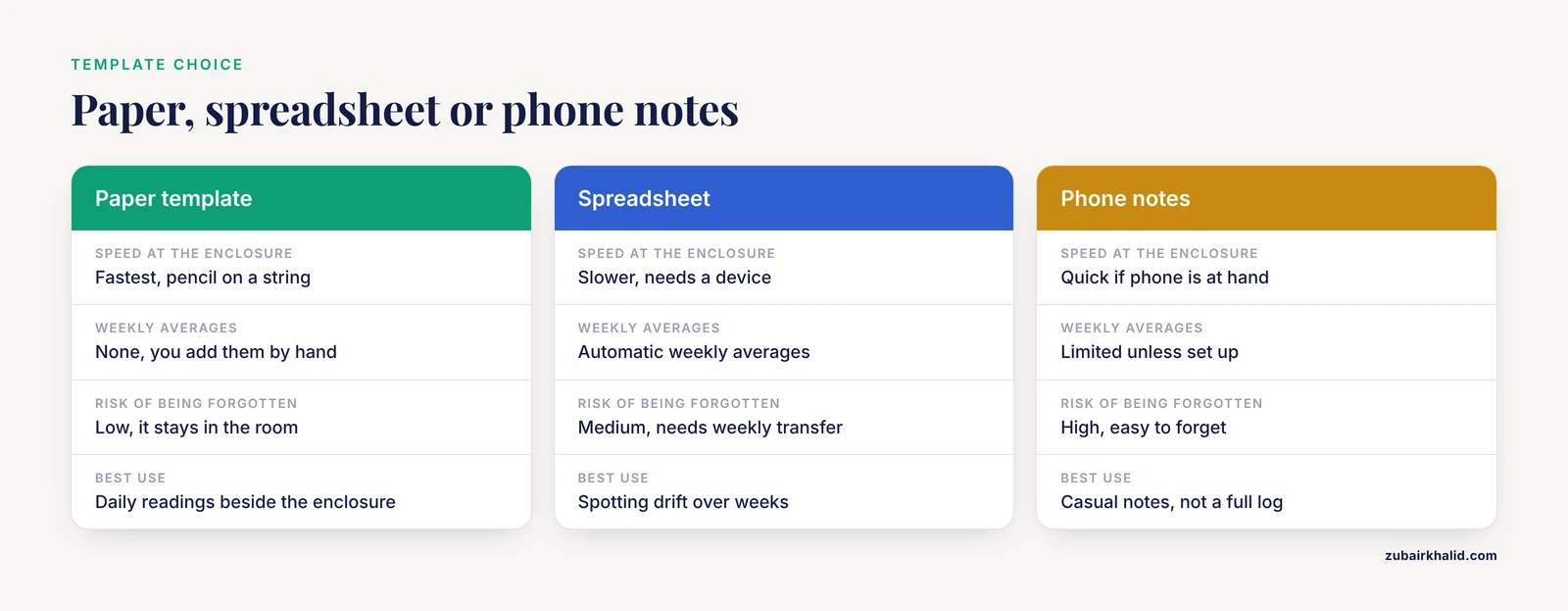
You have three practical options for a reptile humidity temperature log template:
- Paper template. Print or draw the table above and clip it to the side of the enclosure with a pencil on a string. This is the most reliable method because the tool is physically in the room at the moment you need it.
- Spreadsheet. A spreadsheet adds automatic weekly averages and lets you spot drift. Keep a printed blank version next to the enclosure for the daily readings and transfer numbers weekly.
- Phone notes. Acceptable, but easy to forget and harder to see at a glance.
Whatever you choose, keep the template identical week to week so entries remain comparable.
Reptile Humidity Temperature Log Example
The following reptile humidity temperature log example is illustrative only. The target values shown are placeholders for demonstration. Substitute the values published for your exact species from an evidence-based guide and your veterinarian.
Header example:
| Field | Entry |
|---|---|
| Species and age | Ball python, 3 years old |
| Enclosure dimensions | 4 ft x 2 ft x 2 ft |
| Target basking surface temperature | 90 F (illustrative, verify for your species) |
| Target cool-side temperature | 78 F (illustrative) |
| Target humidity range | 65 to 80 percent (illustrative) |
| Heat equipment | Radiant heat panel on thermostat, set to maintain basking target |
| UVB | Linear bulb, replaced per manufacturer guidance, logged date noted |
Daily example entries:
| Date | Time | Basking surface | Cool side | Humidity | Notes |
|---|---|---|---|---|---|
| Mar 3 | 8:00 AM | 90 F | 78 F | 72% | Normal |
| Mar 4 | 8:00 AM | 91 F | 79 F | 68% | Normal |
| Mar 5 | 8:00 AM | 84 F | 73 F | 75% | Bulb dimming, ordered replacement |
| Mar 6 | 8:00 AM | 83 F | 72 F | 76% | New bulb installed, temps recovered |
| Mar 7 | 8:00 AM | 90 F | 78 F | 71% | Normal |
| Mar 7 | 9:00 PM | 82 F | 75 F | 74% | Evening check before night drop |
Notice what this example reveals. A single glance on March 5 would have shown a low basking temperature and prompted a possible overcorrection. The log shows instead that the bulb was aging, the replacement was planned, and conditions were restored within two days. That is the difference between reacting to noise and reading a trend.
Notice also the animal's behavior interleaved with the data. Experienced keepers add behavior notes, such as appetite, defecation, shedding start, and soaking, to the same log. ReptiFiles' husbandry guides recommend observing and recording behavior alongside environmental data because the combination is far more diagnostic than temperature values alone.
How to Use Your Log: Reading Patterns
Collecting data is only half the task. Here is how to interpret what you have recorded.
Watch for drift
Compare this week's averages with last week's. A basking spot that slowly loses three degrees over a month is a failing bulb or a drifting thermostat. Neither produces a dramatic single-day reading, and both are invisible without a log.
Watch for seasonal pressure
Winter room temperatures pull cool-side readings down and dry air pulls humidity down, especially in homes with forced-air heating. Summer does the reverse. Your log shows these seasonal forces early, letting you adjust equipment before the animal is affected.
Separate equipment problems from husbandry problems
If humidity drops every day by late afternoon, the pattern points to evaporation and possibly to ventilation. If humidity drops only on the day you clean, the pattern points to a husbandry step, such as replacing substrate or changing the water dish, that removes moisture. Different causes, different fixes.
Check the gradient, not just the endpoints
The reptile needs usable choices across the enclosure. If your basking target is met but the cool side is also warm, the animal has no way to cool down. Log both ends every time.
Common Mistakes to Avoid
These errors appear repeatedly in reptile medicine cases and in keeper forums alike.
- Trusting a single thermometer placed by the manufacturer. Stock analog dials mounted on glass are the least accurate option and tell you nothing about the gradient.
- Measuring air temperature at the basking spot instead of surface temperature. A reptile's body contacts the surface, and an infrared temperature gun is the correct tool for that measurement.
- Logging only when something seems wrong. The value of a log comes from baseline data collected while everything is normal. Without a baseline, abnormal has no reference point.
- Placing hygrometers near water dishes or misting zones. This produces chronically inflated readings that mask real dryness elsewhere in the enclosure.
- Logging humidity without logging ventilation changes. Foggers and misters can push readings to target while stagnant, oversaturated conditions develop in pockets of the substrate.
- Stopping the log once the animal seems settled. Conditions drift, seasons change, and equipment ages. The Merck Veterinary Manual's reptile husbandry guidance treats environmental monitoring as an ongoing requirement, not a setup task.
- Recording numbers without dates and times. An untyped number is nearly useless in a veterinary history.
Where the Log Fits in Reptile Enclosure Setup
If you are building a new habitat, establish the log during the reptile enclosure setup phase, before the animal arrives. Run the empty enclosure for at least several days with all equipment active and log the readings. This dry-run period exposes equipment problems, dead zones in the thermal gradient, and humidity behavior with nothing inside to be harmed by a mistake.
ReptiFiles' enclosure setup guidance stresses verifying environmental parameters empirically with your own instruments rather than assuming a product label or a wattage calculation predicts real conditions in your home. A bulb that produces a 95 F basking surface in one room may produce a different result two feet from a drafty window or under an air vent.
During setup, your log also validates the gradient across the seasons you have not yet experienced. Keep the early logs. Next winter, they will tell you exactly how much your heating equipment needs help.
A Working Reptile Care Checklist
The log is one part of a broader routine. This reptile care checklist covers the environmental and observation tasks that keep a captive reptile healthy, consistent with husbandry guidance from the Merck Veterinary Manual and reptile veterinary organizations.
Daily:
- Record basking surface, cool-side, and humidity readings in the log.
- Refresh water.
- Observe appetite, posture, activity, and droppings, and note anything unusual in the log.
Weekly:
- Review the week's readings for drift.
- Clean and disinfect items per your established schedule.
- Verify thermostat function and probe placement.
- Check the animal's body condition visually and by feel as appropriate for the species.
Monthly:
- Verify hygrometer and thermometer accuracy against a second instrument.
- Inspect heat equipment for damage, secure mounting, and clearance from the animal.
- Deep-check humidity behavior across a full day, not just at logging time.
Quarterly or per manufacturer schedule:
- Replace UVB bulbs per the manufacturer's output recommendations and note the date in the log.
- Review the full log with your reptile veterinarian at a wellness visit.
Welfare and Safety Points
Several welfare issues connect directly to the data in your log.
Shedding problems. Retained shed, especially around toes, tail tips, and eye caps, is one of the most visible consequences of humidity that is too low for the species. It can constrict tissue and requires careful intervention. A log that shows humidity drifting below target for two weeks before a shed gives you time to correct it, and gives your veterinarian a clear history if dysecdysis occurs.
Respiratory disease. Open-mouth breathing, audible clicking or wheezing, excess mucus at the nostrils or mouth, and a posture with the head and neck held elevated are signs that require veterinary attention. Improper temperature and humidity are recognized contributing factors to respiratory disease in captive reptiles, so your log is directly relevant to diagnosis and treatment.
Thermal injury. Unregulated heat sources cause burns, often severe ones. A thermostat with a correctly placed probe prevents most of these, and log notes about thermostat settings make it possible to detect when a setting has been changed or a probe has slipped.
Avoid free-contact heating hazards. Heat lamps and panels should be guarded so the animal cannot rest directly against them. Log notes about equipment are a good place to record that guards are in place.
Limitations and When to Contact a Veterinarian
This article is educational and is not a substitute for veterinary diagnosis or treatment. Individual animals vary, and a veterinarian who has examined your reptile is the only source of guidance specific to your case.
Contact a reptile veterinarian promptly, ideally within a day, if you observe any of the following:
- Open-mouth breathing, wheezing, clicking sounds, or visible mucus around the nostrils or mouth.
- Complete refusal of food lasting beyond the normal fasting pattern for your species and season, particularly with lethargy.
- Retained shed around the toes, tail, or eyes, or any shed that does not progress normally.
- Any burn, wound, swelling, or discoloration.
- Regurgitation, diarrhea, or a sudden change in dropping appearance.
- Marked lethargy, weakness, or an inability to right itself.
- A log showing environmental values persistently outside your species' target range despite corrections.
- Any suspicion the animal has been exposed to temperatures hot enough to cause distress or cold enough to become sluggish and unresponsive.
Establish care with a veterinarian experienced in reptile medicine before an emergency occurs. The Association of Reptilian and Amphibian Veterinarians maintains resources for locating qualified veterinarians and recommends routine wellness examinations for captive reptiles. Bring your humidity and temperature log, your equipment list, and your feeding history to every appointment.
Frequently Asked Questions
How often should I fill out a reptile humidity and temperature log?
Once daily at a fixed time is the standard for a stable, established enclosure, with an additional evening reading if your species needs a nighttime temperature drop. During a new setup, an illness, or a period of abnormal readings, log two or three times a day until conditions are stable again.
What should a reptile humidity temperature log template include?
At minimum it should include the date, time, basking surface temperature, cool-side temperature, humidity, and a notes column for equipment changes and behavior. Adding target values in the header gives every reading immediate context.
Where should I place thermometers and hygrometers in the enclosure?
Put thermometer probes at animal level, one at the basking spot where the reptile actually rests and one at the cool end. Place the hygrometer mid-enclosure, away from the water dish, misting zones, and ventilation openings where readings distort.
What are the signs that temperature or humidity is wrong in my reptile's enclosure?
Watch the animal, not just the gauges. Open-mouth breathing, wheezing, mucus, retained shed, lethargy, and loss of appetite are recognized signs associated with improper environmental conditions and warrant veterinary attention. Use the log to confirm the trend behind the signs.
Do I need to log temperatures at night?
If your species' care guidance specifies a nighttime temperature drop, yes. Evening or early-morning readings are the only way to confirm the drop is actually happening, and many enclosures hold heat differently after the lights go out.
Are analog dial thermometer and hygrometer gauges accurate enough for a log?
They are the least reliable option and are not recommended for meaningful logging. Digital thermometers with probes and digital hygrometers provide the accuracy the log depends on, and an infrared temperature gun covers surface temperature measurement.
What should I do if humidity spikes or drops suddenly in the enclosure?
First check the equipment. A failed mister, a stuck fogger, a slipped thermostat probe, or an opened lid explains most sudden changes. Correct the cause, log the event and the fix, and monitor closely. If you cannot identify the cause or the animal shows clinical signs, contact your veterinarian.
Can I bring my log to a reptile vet appointment, and will it help?
Yes, bring it. Reptile veterinarians rely heavily on husbandry history, and a dated log with readings, equipment notes, and behavior observations is far more useful than recollection. The Association of Reptilian and Amphibian Veterinarians encourages owners to provide detailed husbandry information as part of routine care.