Why Is My Reptile's Humidity Too High or Too Low?
By Dr. Zubair Khalid, DVM, MS, PhD ·
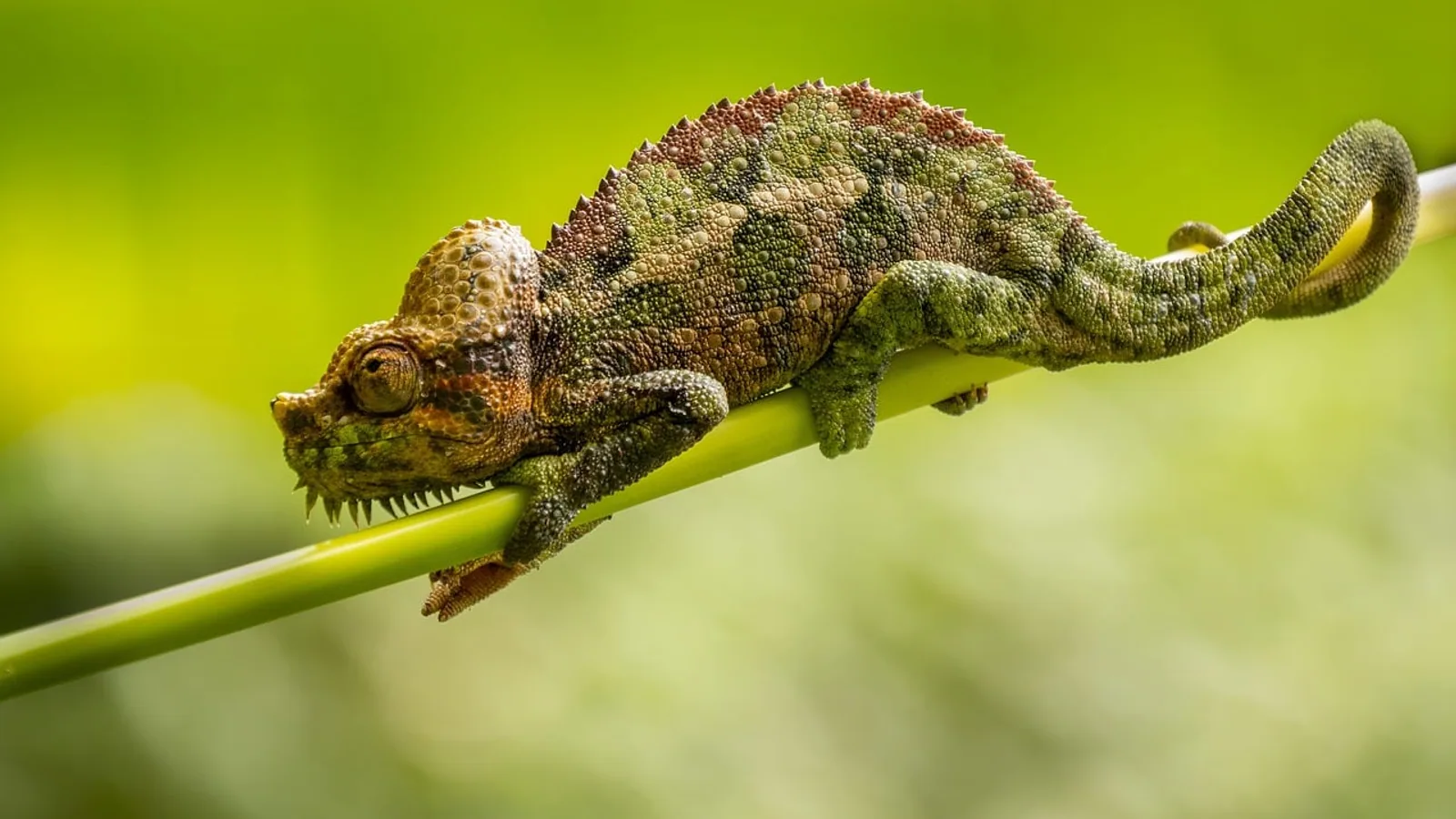
In most cases, reptile humidity problems come from one of four things: a lid or ventilation setup that traps moisture, a heat source that is too weak or too strong, a substrate that holds or sheds water differently than expected, or measuring equipment that is inaccurate or badly placed. Fixing humidity usually means adjusting one or more of those four variables rather than adding more misting or more dry bedding on a guess. Because reptiles are ectotherms whose physiology depends heavily on the quality of their surroundings, humidity is not a cosmetic detail, it is a primary husbandry factor alongside heat, light, food, and water [1].
This guide walks through why humidity matters physiologically, how to tell whether humidity is too high or too low, the specific causes behind each problem, and practical step-by-step solutions you can apply to your enclosure today. A downloadable-style reptile care checklist is included so you can audit your reptile enclosure setup in one pass.
Humidity at a Glance: Your 10-Minute Checklist
| Step | What to check | What a problem looks like |
|---|---|---|
| 1 | Hygrometer placement and accuracy | One sensor, uncalibrated, mounted at basking height for a tropical species |
| 2 | Lid and ventilation | Glass lid with fine mesh over a tropical vivarium, or a fully open top over a rainforest setup |
| 3 | Heat source and gradient | Basking spot too cool, so water never evaporates and the enclosure stagnates |
| 4 | Substrate choice | Aspen or bark chips in a high-humidity species' cage, or sodden coconut fiber in a desert species' cage |
| 5 | Water and misting routine | Daily heavy misting in an already saturated enclosure, or no water source at all |
| 6 | Behavioral signs in the reptile | Glass surfing, gaping, excess soaking, lethargy, or open-mouth breathing [2][3] |
| 7 | Species-appropriate target | A generic number copied from a forum instead of a range matched to the species and its microhabitats |
If any row on that checklist fails, you have likely found the cause of your reptile humidity problem before you spend money on new gear.
Why Humidity Matters So Much for Reptiles
Reptiles depend on their environment to regulate body functions that mammals handle internally. Veterinary reviews of reptile husbandry list ventilation and humidity among the core environmental factors, alongside terrarium construction, light, heat, food, water, and hygiene, that determine whether captive reptiles stay healthy [1]. When any of those factors drifts outside the tolerable range, the animal's physiology has to compensate.
Research on lizards has shown that humidity is not experienced as a single number. What matters physiologically is the interplay between temperature and water vapor in the air, often described as vapor pressure deficit. In acclimation experiments with western fence lizards, cutaneous evaporative water loss changed measurably after just eight days in different hot, cool, dry, or humid climates, with the greatest water loss seen in lizards kept in hot and humid conditions [4]. Two practical lessons come out of that work. First, your reptile's hydration state reflects the combined temperature and humidity profile of the enclosure, not humidity alone. Second, reptiles can plastically adjust their water-loss physiology over days to weeks, which means sudden swings in humidity are stressful even if both the old and new numbers are individually tolerable [4].
Dehydration and water imbalance do not stay cosmetic. Renal disease is one of the most common medical conditions encountered in captive reptiles, its causes are often multifactorial, and clinical signs usually do not appear until the condition is advanced, which is why prevention through correct husbandry is emphasized over treatment [5]. Chronic husbandry errors, including sustained problems with hydration and environmental conditions, are exactly the kind of slow, cumulative stressors that veterinarians implicate in kidney disease [1][5].
How to Tell Whether Humidity Is Too High or Too Low
Signs the enclosure is too dry
- Stuck shed, especially around the toes, tail tip, and eye caps
- Wrinkled or tented skin, sunken eyes, and reduced skin elasticity
- Straining to defecate or dry, hard urates, which can reflect dehydration
- Increased soaking in the water bowl as the animal tries to rehydrate itself
- Lethargy and reduced appetite, which are nonspecific but consistent with suboptimal husbandry [2]
Signs the enclosure is too wet
- A persistent damp or sour smell, which signals substrate that never dries
- Condensation running down the glass for most of the day
- Blistered, waterlogged-looking scale discoloration on the belly or ventrum
- Scale rot or ventral dermatitis patterns, where skin stays in contact with saturated substrate
- Mold or fungal growth on decor, wood, or the substrate surface
- Restless pacing, rub marks on the glass, or other captivity-stress behaviors, which behavioral welfare assessments treat as primary indicators of environmental disturbance [3]
Respiratory warning signs in either direction
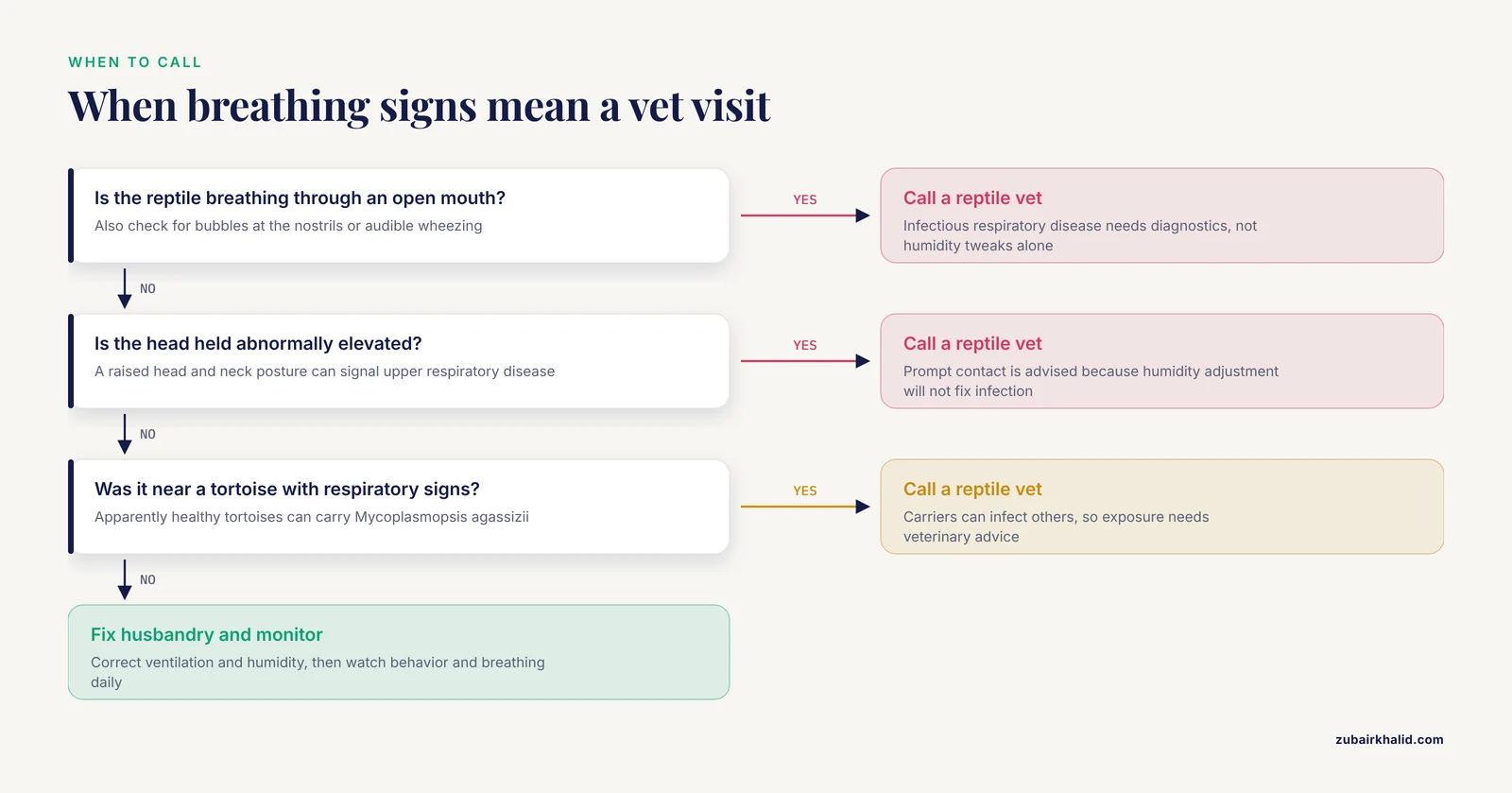
Both extremes can contribute to respiratory disease. Bacteria and other pathogens thrive in stagnant, saturated air, while dry air irritates airways and dries out mucosal defenses. In tortoises, upper respiratory tract disease caused by Mycoplasmopsis agassizii ranges from mild to severe respiratory signs, and importantly, infected animals can become asymptomatic carriers that infect other tortoises [6]. Open-mouth breathing, bubbles at the nostrils, wheezing, or a head held abnormally elevated are reasons to contact a reptile veterinarian promptly, because infectious respiratory disease is not something humidity adjustment alone will fix [6].
Behavior is often the earliest warning system you have. Reviews of reptile welfare note that behavioral change is frequently the primary indicator of disturbance, injury, or disease, and abnormal behavior itself can lead to injury and illness [3]. A reptile that suddenly spends all day pressed against the glass, hides constantly, or refuses food should prompt an immediate audit of temperature, humidity, ventilation, and other husbandry factors, because medical problems and suboptimal husbandry are the first things a veterinarian rules out when behavior changes [2].
Reptile Humidity Problems: Causes of Humidity That Is Too High
Cause 1: Enclosure design that traps moisture
Solid glass or acrylic lids, sealed wooden vivariums built for heat retention, and enclosures with only one small vent all prevent humid air from escaping. Humid air rises, condenses on the coolest surface, and drips back down, creating a saturated loop. Tropical species need humidity, but they also need airflow, and veterinary husbandry reviews treat ventilation as a distinct primary factor, not an optional extra [1].
Cause 2: The basking area is too cool
Humidity only moves if water evaporates, and evaporation is driven by heat. If your basking surface temperature is below your species' requirement, the misted water and damp substrate never dry out, and relative humidity stays pinned near the top of the scale. Many keepers chasing a humidity number turn off or downsize their heat source, which is exactly backwards. Fix the temperature gradient first, and humidity frequently corrects itself.
Cause 3: Substrate that holds water longer than your routine accounts for
Deep coconut fiber, cypress mulch, sphagnum moss, and bioactive soils can hold enormous volumes of water. Pouring water into the substrate, a technique sometimes used deliberately for burrowing species, is easily overdone, and saturated substrate pressed against a reptile's belly is a known route to ventral skin problems.
Cause 4: Over-misting and oversized water features
Automated misting systems are convenient, but they do not know when the enclosure is already saturated. Combined with a large, shallow water dish positioned under the basking lamp, daily fogging can push relative humidity past 100 percent of what the ventilation can shed.
Cause 5: Room-level factors
A basement reptile room, a humid summer climate, or an aquarium in a bathroom can add ambient moisture no enclosure-level fix can fully overcome.
Reptile Humidity Problems: Causes of Humidity That Is Too Low
Cause 1: Screen lids over heated enclosures
Fine mesh over a heat source is essentially an exhaust fan for moisture. This is the single most common cause of low humidity in keepers of tropical species using standard glass terrariums with mesh tops.
Cause 2: Heating that is too strong or too dry
Overhead basking bulbs, ceramic heat emitters, and heat panels raise air temperature, and warm air holds more moisture, so relative humidity readings fall even when the absolute water content of the air has not changed. Desert setups are not immune, since many desert species retreat to humid burrows or rock crevices during the hottest part of the day, meaning their enclosure needs both a dry basking zone and a humid refuge.
Cause 3: Dry substrate and no humid hide
Aspen shavings, paper, and slate cannot buffer humidity. A species that needs a humid retreat but has none must either cope with dry air or soak constantly, and both options carry health risks over time.
Cause 4: Forced-air environments
Reptile rooms with air conditioning, wood stoves, or winter central heating often sit at very low ambient humidity. In winter in much of the United States, indoor air can be extremely dry, and a ventilated enclosure will track that ambient dryness closely.
Cause 5: Wrong equipment or wrong placement
Analog dial hygrometers are notoriously inaccurate, and even digital sensors drift. A sensor placed directly under the heat lamp reads artificially low, while one buried in wet substrate reads artificially high. Neither reading tells you what the animal is actually experiencing at its resting position.
How to Fix Humidity That Is Too High: Step-by-Step
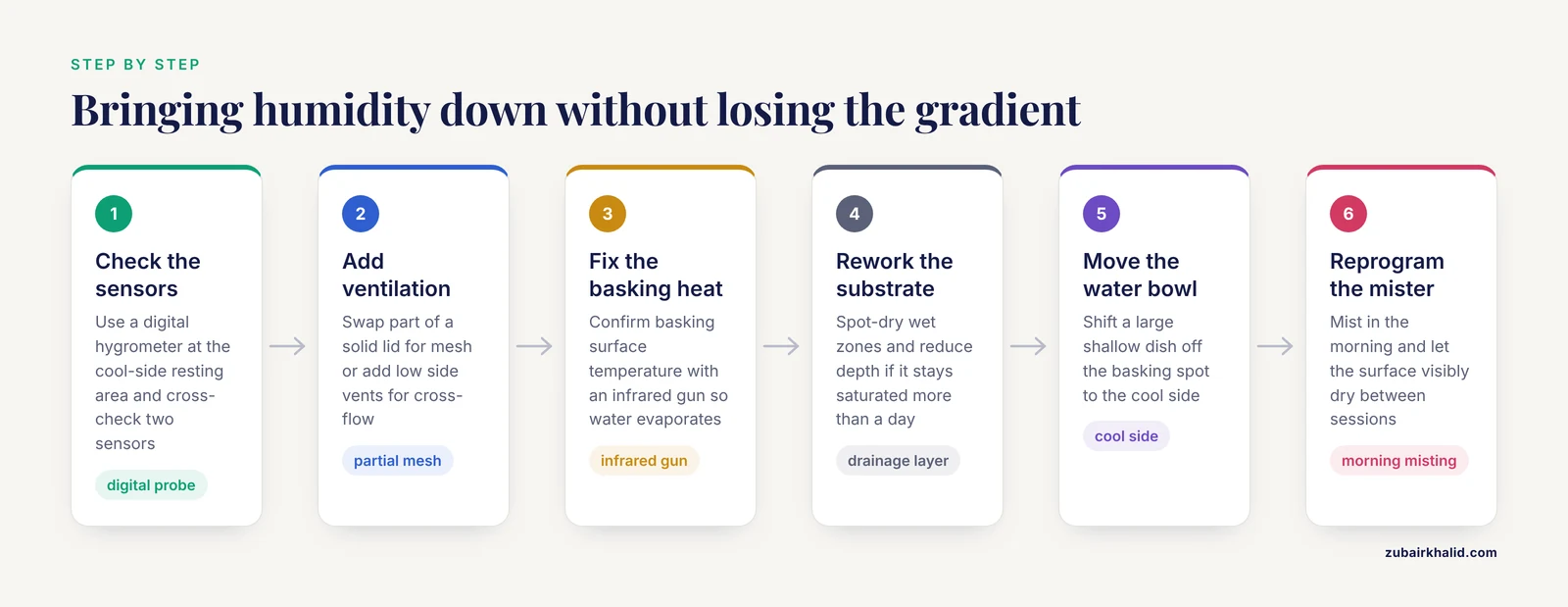
- Verify your readings first. Use a digital hygrometer and place one sensor at the animal's cool-side resting area and, if practical, a second at mid-enclosure height. Cross-check two sensors against each other. If they disagree by more than a small margin, one is wrong.
- Increase ventilation. Replace part of a solid lid with mesh, add low-level side vents, or swap a fully mesh top for partial mesh to create cross-flow. The goal is moisture exchange without eliminating the thermal gradient, since airflow and heat must be balanced together as they are in natural habitats [1].
- Fix the thermal gradient. Confirm your basking surface temperature with an infrared temperature gun and your warm-side and cool-side air temperatures with digital thermometers. Raising the basking temperature into the correct species range usually restores evaporation and drops relative humidity naturally.
- Change the substrate strategy. Spot-dry the wettest zones, remove waterlogged patches, and reduce the depth of moisture-holding substrate if it stays saturated for more than a day. In bioactive setups, improve drainage layers and increase the population of cleanup invertebrates.
- Rethink the water bowl. Move a large shallow dish out from under the basking lamp to the cool side, or downsize it, so it is not functioning as a humidifier.
- Reprogram misting. Mist in the morning so the enclosure has the full warm portion of the day cycle to dry, and let the substrate surface visibly dry between misting sessions rather than running the mister on a fixed timer regardless of conditions.
- Treat any skin or respiratory disease. If you see ventral scale damage, blistering, or any respiratory signs, contact a reptile veterinarian. Husbandry correction prevents recurrence, but established infections need medical treatment.
How to Fix Humidity That Is Too Low: Step-by-Step
- Verify your readings first. The same rule applies in both directions. Confirm sensor accuracy and placement before buying anything.
- Cover part of the mesh lid. A piece of PVC sheet, glass, or foil covering one half to two thirds of a screen top dramatically reduces moisture loss while retaining enough airflow to prevent stagnation. Never seal a lid completely, because ventilation remains a primary husbandry factor for reptile health [1].
- Add a humid hide. A covered hide packed with damp sphagnum moss on the warm side gives the animal a self-regulating microclimate. This mimics the humid retreats many species use in the wild and lets a single enclosure serve a species with both dry and humid microhabitat needs.
- Deepen and mix the substrate. Switch from aspen or paper to a moisture-appropriate mix such as topsoil and coconut fiber for tropical or forest species, and keep it damp enough to hold a clump when squeezed without dripping water.
- Add a large water feature where appropriate. For semi-aquatic and many tropical species, a properly sized water area on the warm side adds evaporative surface area.
- Mist deliberately, not compulsively. Two measured mistings that allow drying cycles between them beat constant light fogging, which raises surface moisture without raising actual humidity and encourages fungal growth.
- Consider the room, not just the cage. Moving the enclosure out of a path of air conditioning vents, or running a room humidifier, fixes the ambient problem that no amount of in-cage misting can fully counteract.
- Expect an acclimation period. Because reptiles adjust their evaporative water loss physiology over days to weeks when hydric conditions change [4], make any humidity correction gradually and watch skin, shedding, appetite, and behavior during the transition [2][3].
Equipment and Supplies: Selection Criteria
- Digital hygrometers with probes. Choose ones with a separate probe on a thin cable so you can position the sensor exactly where the animal rests. Avoid dial-style analog gauges.
- Infrared temperature gun. Humidity and temperature are coupled, so you cannot troubleshoot one without measuring the other at the basking surface, warm side, and cool side.
- Ventilation hardware. Partial-mesh lids, drilled vent panels, or small computer fans on a thermostat-controlled timer can create directed airflow. Position fans to move air across, not directly at, the animal.
- Substrate by function, not appearance. Match substrate water-holding capacity to the species' native microhabitat. ReptiFiles and other evidence-based husbandry guides publish substrate-by-species comparisons that are more reliable than generic pet-store recommendations.
- Humid hide container. A plastic hide with a narrow entrance, filled with moist sphagnum, cleaned and re-mossed weekly to prevent bacterial and fungal buildup, consistent with the emphasis on hygiene in reptile husbandry reviews [1].
- Misting options. Hand sprayers give you feedback and control, pump sprayers suit larger enclosures, and automated systems suit collections, but any automated system should still be checked with a hygrometer daily.
The Merck Veterinary Manual's exotic animal section and the Association of Reptilian and Amphibian Veterinarians (ARAV) both maintain owner-facing and clinician-facing guidance on reptile environmental management, and VCA Animal Hospitals publishes species-specific care sheets that include humidity ranges. Use those named, veterinary-backed resources over forum posts when setting your target numbers.
Common Mistakes That Keep Humidity Broken
- Chasing a single number instead of a gradient. Wild reptiles move between microclimates. A single forced value across the whole cage helps nobody, while a dry basking zone, a mid-gradient, and a humid retreat serve nearly every species.
- Measuring once and never again. Humidity swings with season, room heating, and water bowl evaporation. Weekly spot checks catch drift before it becomes disease.
- Fixing humidity by fixing only humidity. Temperature, ventilation, and humidity interact, and studies of lizard physiology show water balance responds to the combined thermal and hydric environment, not to humidity in isolation [4].
- Ignoring the animal in favor of the gauge. A reptile showing persistent abnormal behaviors is telling you something the hygrometer cannot. Behavioral assessment is a recognized part of welfare evaluation, and abnormal behavior should prompt a husbandry and medical review, not dismissal [3][2].
- Assuming a humid-looking enclosure is a healthy one. Saturated, stagnant air with no airflow is a disease risk even when the number on the gauge looks correct for the species [1].
- Misting the animal instead of the habitat. Direct, constant spraying onto the reptile can interfere with normal behavior and thermoregulation. Shape the environment so the animal can choose its own moisture level.
Troubleshooting Stubborn Cases
Humidity stays too high despite ventilation. Check whether the room itself is humid, whether the heat source has degraded below its rated output, and whether drainage layers in a bioactive setup have failed and turned anaerobic. Rebuild the drainage layer if the bottom third of the substrate smells sour.
Humidity stays too low despite misting. The enclosure is leaking moisture faster than you add it. Cover more of the lid, add a humid hide, deepen the substrate, or address room-level dryness. Verify the thermostat is not forcing your heat source to run continuously at maximum.
Hygrometer readings swing wildly. Two sensors disagree, or one sensor sits in the misting path. Reposition the sensor to the cool-side hide, keep it out of direct spray, and replace sensors older than a year or two, since they drift.
Humidity is correct but the reptile still has stuck shed. Audit hydration and diet alongside surface moisture, and look at whether the animal can physically reach a humid microclimate during its actual shed window. If problems persist across multiple sheds, involve a reptile veterinarian, since nutritional and metabolic disease can affect skin quality and should be ruled out clinically [2][7].
Multiple animals, one problem. If several enclosures in the same room show the same humidity deviation, treat it as a room-level or water-source problem before reworking each cage individually.
A Complete Reptile Care Checklist for Enclosure Setup
Use this list when setting up a new enclosure or auditing an existing one:
- Species-appropriate temperature gradient with a measured basking surface temperature and a defined cool retreat
- Full-spectrum lighting and photoperiod appropriate to the species, with replacement schedules tracked, since light and heat are primary husbandry factors [1]
- Measured humidity gradient with a humid zone and a drier zone where the species' ecology calls for it
- Ventilation that exchanges air without erasing the thermal gradient [1]
- Moisture-appropriate substrate, deep enough for natural burrowing where relevant
- Clean water available at all times, positioned to avoid unintended humidification of the basking zone
- At least one hide on each end of the thermal gradient, plus resting and climbing structures suited to the species [1]
- Hygiene routine for spot cleaning and periodic deep cleaning, because poor hygiene is directly linked to disease problems in reptile husbandry [1]
- Correct grouping or solitary housing, since overcrowding and inappropriate grouping are recognized husbandry stressors [1]
- Digital thermometers and hygrometers, calibrated or cross-checked, at the animal's living height
- Stress minimization, including appropriate visual barriers and handling routines, since stress is a recognized secondary husbandry factor [1]
- A relationship with a reptile-savvy veterinarian before problems appear
Welfare and Safety Points
Humidity management is ultimately a welfare issue, not an equipment hobby. Welfare assessments of captive reptiles identify abnormal behavior as an early and primary indicator of disturbance, injury, or disease, and recognize that captivity stress linked to inadequate environments produces both behavioral and physical signs [3]. Veterinarians working in clinical reptile behavior likewise treat medical problems and suboptimal husbandry as the first differentials to rule out when a reptile presents with behavioral complaints, and they resolve those cases through systematic environmental change and enrichment planning [2].
Do not attempt to medicate a reptile for respiratory signs, skin lesions, or inappetence on your own. Reptile clinical therapeutics is a specialized field, drugs, doses, and routes differ substantially from mammals, and treatment should be directed by a veterinarian experienced with reptiles [7]. What you can and should do at home is fix the environment, document your readings and your animal's behavior, and bring that record to the appointment.
Limitations and When to Contact a Veterinarian
Every reptile is an individual, and target humidity depends on species, age, health status, and the specific microhabitats the species uses, so any individual case ultimately needs interpretation by a veterinarian who can examine your animal. That said, contact a reptile veterinarian promptly, not just after husbandry fixes, if you observe any of the following:
- Open-mouth breathing, nasal discharge, wheezing, or an elevated head and neck posture, which can indicate infectious upper respiratory tract disease requiring diagnostics and treatment [6]
- Bleeding, blistered, discolored, or ulcerated skin, or ventral scale damage consistent with prolonged moisture exposure
- Refusal of food lasting more than a normal inter-meal interval for the species, especially combined with lethargy or weight loss
- Significant dehydration signs such as sunken eyes or tented skin
- Any abrupt, unexplained behavioral change, since behavior change often precedes obvious physical disease in reptiles [3]
- Known or suspected exposure to another reptile with respiratory disease, because pathogens such as Mycoplasmopsis agassizii can be carried by animals that appear healthy [6]
Because renal disease in captive reptiles often produces no signs until it is advanced, and prevention is preferred to treatment [5], periodic wellness examinations with a reptile veterinarian are worthwhile even when your humidity numbers look perfect.
This article is educational and is not a substitute for veterinary diagnosis or treatment.
Frequently Asked Questions
What humidity should my reptile's enclosure be?
There is no single correct number. Target ranges are species-specific and best set from veterinary-backed resources such as the Merck Veterinary Manual exotic animal section, ARAV, VCA Animal Hospitals care sheets, or ReptiFiles species guides. Aim for a gradient with both a drier and a humid zone rather than one forced value.
Can high humidity make my reptile sick?
Yes. Stagnant, saturated air promotes bacterial and fungal growth, contributes to skin infections, and is associated with respiratory disease. Ventilation and humidity are both recognized primary husbandry factors in reptile health, and poor environmental conditions are a common root cause of medical problems in captive reptiles [1].
Can low humidity make my reptile sick?
Yes. Chronic dryness contributes to dehydration, incomplete sheds, retained eye caps, and straining during defecation. Sustained husbandry errors that affect hydration are among the factors implicated in serious chronic conditions such as renal disease, where prevention through correct husbandry is strongly preferred over treatment [5].
How do I raise humidity without making the cage soggy?
Cover part of the mesh lid, add a humid hide filled with damp sphagnum, deepen moisture-holding substrate, and mist in measured cycles that allow the surface to dry between applications. The goal is humid air and a drying cycle, not permanently wet surfaces.
How do I lower humidity without drying out my reptile?
Improve cross-ventilation, confirm your basking temperature is in range so evaporation works properly, relocate the water bowl to the cool side, and let the substrate surface dry between mistings. Keep a humid hide available so the animal retains access to moisture when it needs it.
Where should I place my hygrometer?
Place a digital hygrometer probe at the animal's cool-side resting level, out of the direct misting path, and ideally use a second sensor at mid-enclosure height. Avoid placing a sensor under the heat lamp or inside wet substrate, because both positions produce misleading readings.
How long does it take for a reptile to adjust to new humidity levels?
Research on lizards shows measurable changes in evaporative water loss physiology after about eight days of acclimation to new hydric conditions [4]. Change humidity gradually over one to two weeks and monitor behavior, skin, appetite, and shedding throughout the transition [2][3].
Should I mist my reptile directly?
Mist the habitat rather than the animal. Reptiles regulate their own moisture exposure by moving between microclimates, and giving them a humid retreat lets them self-regulate. Direct constant spraying onto the animal is not a substitute for a correct humidity gradient and can stress the animal.
Sources
- Assessment of the husbandry problems of reptiles on the basis of pathophysiological findings: a review.
- Clinical Reptile Behavior.
- Assessing reptile welfare using behavioural criteria
- Hydration and evaporative water loss of lizards change in response to temperature and humidity acclimation.
- Clinical Management of Reptile Renal Disease.
- Detection and Identification of Mycoplasmopsis agassizii in Captive Tortoises with Different Clinical Signs in Italy
- ADVANCES IN REPTILE CLINICAL THERAPEUTICS