Reptile Humidity Calculator: How to Use It
By Dr. Zubair Khalid, DVM, MS, PhD ·
A reptile humidity calculator converts the two numbers you can actually measure inside an enclosure, air temperature and moisture content, into relative humidity, the number your husbandry guide gives you as a target. You enter the temperature and either a dew point, a wet bulb reading, or a second hygrometer reading from another part of the cage, and the calculator returns the relative humidity at that spot. You then compare that number with the target range for your species and adjust ventilation, substrate, water, or misting until the measured value sits inside the range.
This article walks you through the formula behind the calculator, gives you fully worked examples, shows you how to place sensors so the numbers mean something, and explains what humidity errors do to reptile health from the veterinary literature.
At a Glance: Your Humidity Action Checklist
| Step | Action | Tool |
|---|---|---|
| 1 | Identify your species' target humidity range from a reputable species guide | ReptiFiles, VCA Animal Hospitals reptile guides, or your veterinarian |
| 2 | Place one digital hygrometer on the cool side and one on the warm side | Two digital hygrometers |
| 3 | Record temperature and humidity at each probe | Notebook or phone log |
| 4 | Run the numbers through the calculator formula below | Calculator or spreadsheet |
| 5 | Compare each zone against the target range | Your species guide |
| 6 | Adjust one variable at a time (ventilation, substrate, water bowl, misting) | Enclosure hardware |
| 7 | Recheck after 24 hours and log again | Same log |
| 8 | Watch the animal, not just the gauge, for shedding, appetite, and breathing | Your eyes |
What a Reptile Humidity Calculator Actually Does
Relative humidity is a ratio, not an amount. It compares the water vapor actually present in the air with the maximum amount of water vapor that air can hold at its current temperature. Because that maximum rises steeply as air warms, the same amount of moisture reads as a completely different relative humidity at different temperatures.
That single fact is why a reptile humidity calculator is more than a convenience. A ball of air holding a fixed amount of water might read 70 percent relative humidity at one temperature and only about 55 percent a few degrees warmer. In a reptile enclosure with a thermal gradient, this means one hygrometer on the wall cannot describe the whole cage. The calculator lets you translate between the temperatures your heat sources create and the humidity your animal actually experiences in each zone.
Reptile enclosure setup guides have long listed relative humidity among the primary design concerns, alongside enclosure size, substrates, landscaping, heating, and lighting [1]. Husbandry reviews place ventilation and humidity among the key environmental factors that determine normal reptile functioning in captivity [2]. The calculator is simply the tool that turns those design intentions into measurable numbers.
Why Humidity Is a Medical Issue, Not a Comfort Issue
Improper humidity is one of the most common and most damaging husbandry errors in captive reptiles. The veterinary literature is consistent on this point, and the consequences touch nearly every body system.
Skin and shedding. The leading cause of dermatological disease in reptiles is inadequate management, especially species-inappropriate temperature and humidity, with dysecdysis (abnormal shedding) among the most frequent non-infectious skin problems seen in practice [3]. Shedding itself is a humidity-sensitive process. The outer epidermal layers are shed periodically to restore functions including water regulation, gas exchange, growth, and protection against infection and injury, and the timing of the first postnatal shed in snakes is logically influenced by the aerial environment the newborn enters [4]. An animal kept in air that is too dry sheds poorly, and retained shed constricts digits and tail tips and creates entry points for infection.
Kidneys and hydration. Renal disease accounts for considerable morbidity and mortality in reptiles, in part because of inadequate temperature, humidity, and access to water. Inappropriate husbandry can produce subclinical dehydration that directly harms the renal system, which depends on vascular perfusion to function [5]. A chronically dry enclosure is a slow kidney injury you cannot see.
Fungal and bacterial disease. Fungal infections of the skin, respiratory tract, and gastrointestinal tract occur in many captive reptiles, and affected animals are commonly immunocompromised and kept in suboptimal conditions. Treatment requires correcting inappropriate environmental conditions such as poor hygiene, and temperature and humidity that are too high or too low [6]. Bacterial, fungal, and parasitic diseases in reptiles are often the result of immunocompromising conditions such as inappropriate temperatures, humidity, or hygiene, and treatment usually requires fixing the predisposing husbandry deficiency [7]. Skin disease in general follows the same pattern, with infectious dermatopathies frequently driven by management errors [3].
Respiratory disease. Respiratory tract disease in snakes has a complex pathogenesis, but the pattern is clear. When captive conditions fall far below what the animal would encounter in nature, the animal enters a battle with infectious agents that it has a hard time winning [8].
Hibernation and brumation. Owners who brumate temperate species need to pay special attention. Viperid snakes placed into hibernation should be clinically healthy, well hydrated, and maintained in an environment with sufficient humidity and access to water, because post-hibernation deaths from visceral gout have occurred in dehydrated animals [9].
The calculator is your early warning system for all of these conditions. Measuring accurately costs minutes. Treating dysecdysis, renal disease, or a fungal dermatitis costs months.
The Reptile Humidity Calculator Formula
The Core Equation
Relative humidity is defined as:
RH (%) = 100 × (e ÷ es)
Where:
- e is the actual (partial) vapor pressure of water in the air
- es is the saturation vapor pressure, the maximum vapor pressure air can hold at its current temperature
To use this formula, you need a way to find both pressures from things you can measure. The saturation vapor pressure comes from temperature alone. The actual vapor pressure comes from a dew point reading or from a hygrometer reading combined with temperature.
The Saturation Vapor Pressure Formula
The standard approximation used by meteorologists and by virtually every online humidity calculator is the Magnus formula:
es(T) = 6.112 × exp[(17.62 × T) ÷ (243.12 + T)]
Where T is the air temperature in degrees Celsius and es comes out in hectopascals (hPa, identical to millibars). If you have a dew point reading instead of a vapor pressure, plug the dew point into the same formula to get e.
e(Td) = 6.112 × exp[(17.62 × Td) ÷ (243.12 + Td)]
Where Td is the dew point in degrees Celsius.
The Reverse Calculation
A good humidity calculator also works backward. If you know the target relative humidity and the enclosure temperature, you can solve for the dew point you need to maintain:
Td = (243.12 × ln(e ÷ 6.112)) ÷ (17.62 - ln(e ÷ 6.112))
Where e = (RH ÷ 100) × es(T). This tells you how much moisture, expressed as dew point, the enclosure air must contain at a given temperature to hit your target.
Reptile Humidity Calculator Worked Example
Here is a complete worked example using realistic enclosure numbers.
Worked Example 1: Calculating Humidity in the Cool Zone
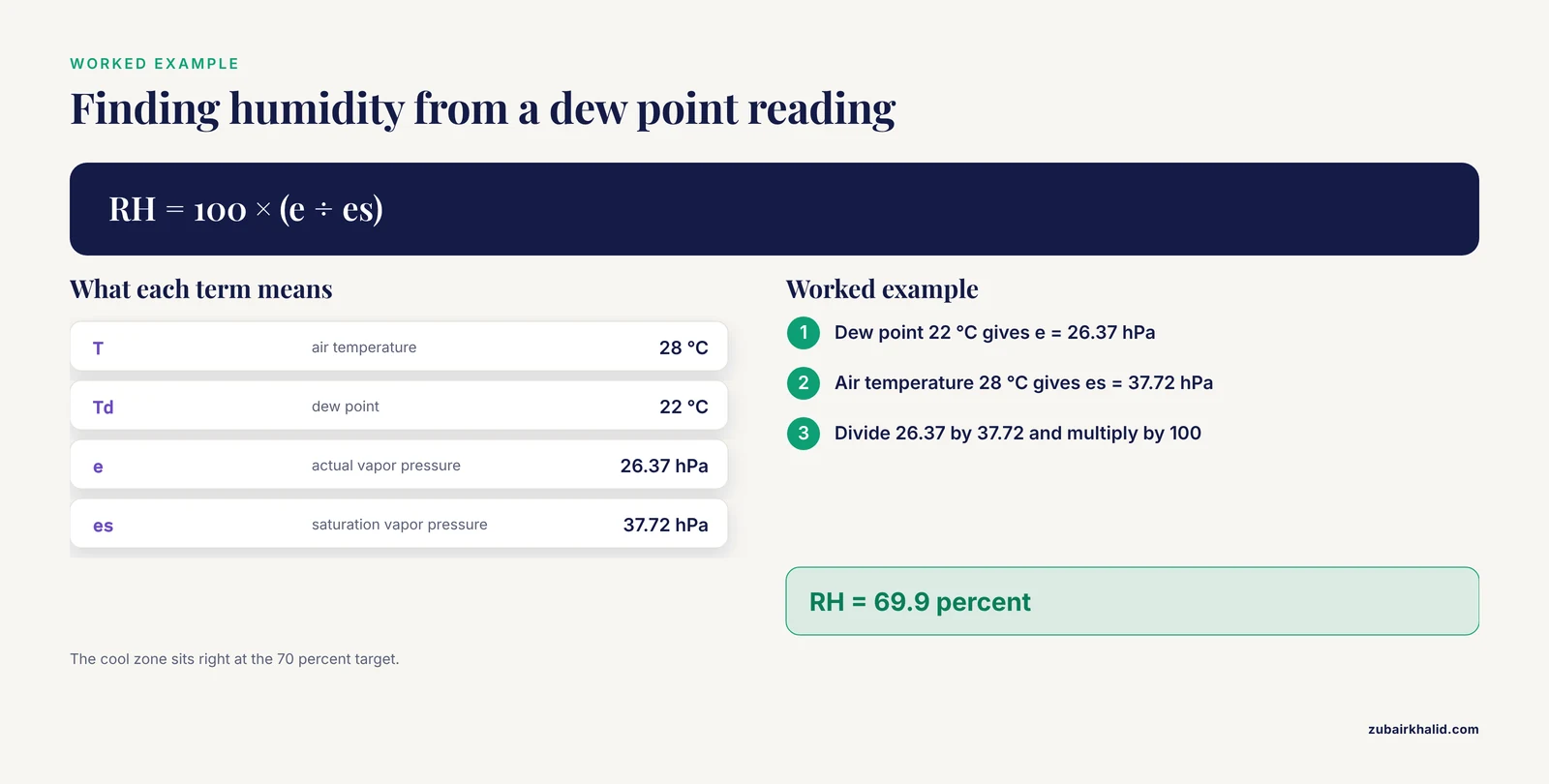
Suppose your hygrometer pair reads a cool-side temperature of 28 °C with a dew point of 22 °C, and your species target range is centered on 70 percent relative humidity.
Step 1. Find the actual vapor pressure from the dew point.
e = 6.112 × exp[(17.62 × 22) ÷ (243.12 + 22)]
e = 6.112 × exp(387.64 ÷ 265.12) = 6.112 × exp(1.4621) = 6.112 × 4.315 = 26.37 hPa
Step 2. Find the saturation vapor pressure at the air temperature.
es = 6.112 × exp[(17.62 × 28) ÷ (243.12 + 28)]
es = 6.112 × exp(493.36 ÷ 271.12) = 6.112 × exp(1.8197) = 6.112 × 6.172 = 37.72 hPa
Step 3. Divide and multiply by 100.
RH = 100 × (26.37 ÷ 37.72) = 69.9 percent
The cool zone sits right at 70 percent, inside the hypothetical target.
Worked Example 2: Why the Warm Zone Reads Lower
Now take the same air, holding the same 26.37 hPa of vapor, and follow it across the thermal gradient to a basking-side air temperature of 32 °C.
es(32) = 6.112 × exp[(17.62 × 32) ÷ (243.12 + 32)]
es(32) = 6.112 × exp(563.84 ÷ 275.12) = 6.112 × exp(2.0495) = 6.112 × 7.866 = 48.08 hPa
RH = 100 × (26.37 ÷ 48.08) = 54.8 percent
Nothing was removed from the air. The warm zone simply reads drier because warm air has a higher saturation ceiling. This is the single most common source of confusion in reptile humidity management. Owners see one reading, assume the whole cage matches, and the basking zone is actually 15 points drier than the gauge suggests.
Worked Example 3: Working Backward From a Target
Suppose you want to hold 70 percent relative humidity at a controlled incubator or humidity-chamber temperature of 28 °C, and you want to know what dew point the air inside must have.
Step 1. Saturation pressure at 28 °C is 37.72 hPa, from Example 1.
Step 2. Convert the target to an actual vapor pressure.
e = 0.70 × 37.72 = 26.40 hPa
Step 3. Invert the Magnus formula.
ln(26.40 ÷ 6.112) = ln(4.319) = 1.4635
Td = (243.12 × 1.4635) ÷ (17.62 - 1.4635) = 355.8 ÷ 16.16 = 22.0 °C
To hold 70 percent at 28 °C, the air in that chamber must maintain a dew point of about 22 °C. If your room air has a dew point below that, you will need added moisture, such as damp substrate in a closed chamber, to reach the target. If your room air already sits above it, you need ventilation rather than misting.
How to Calculate Reptile Humidity With a Calculator, Step by Step
- Confirm your species' target. Look up the target humidity range in an evidence-based species guide such as those published by ReptiFiles, the VCA Animal Hospitals reptile care library, or resources from the Association of Reptilian and Amphibian Veterinarians. Write the range down.
- Measure temperature at the point of interest. Use a digital thermometer with the probe placed where the animal actually rests, not at the top of the cage.
- Measure moisture content. The cleanest input is dew point, which some digital sensors report directly. If yours does not, use the relative humidity reading plus temperature as your inputs and let the calculator handle the conversion.
- Run the formula. Enter temperature and dew point into the Magnus-based equations above, or enter temperature and RH and let the calculator solve for the vapor pressures.
- Repeat for every microclimate. Run the calculation separately for the basking zone, the ambient warm side, the cool side, and any humid hide.
- Compare and adjust. If a zone reads below target, add moisture or reduce ventilation in that zone. If it reads above target, increase ventilation or reduce free water surface area.
- Recheck after 24 hours. Enclosure humidity responds to changes slowly, especially in glass tanks with screen tops. Log the new readings before adjusting again.
Reptile Enclosure Setup for Humidity Control
The calculator tells you where you are. The enclosure design determines where you can get to. Building the enclosure around the humidity target is far easier than fighting a poorly suited setup with daily misting.
Build Zones, Not One Number
A quality reptile enclosure setup provides a thermal gradient, and the gradient necessarily creates a humidity gradient, because warmer air holds more moisture at the same relative humidity. Design for this deliberately. Place the water bowl and the most moisture-retentive substrate on the cool side, where evaporation is slowest, and keep the basking zone drier and well ventilated.
Provide a Humid Micro Refuge
A humid hide is a small enclosed retreat filled with damp sphagnum moss or similar substrate that traps locally high humidity. In a controlled zoo study, 18 snakes across two families were exposed to four enrichment types, and the humid hide was one of the items tested, with behavioral responses recorded to evaluate welfare value [10]. A humid hide gives the animal a high-humidity microclimate it can use on demand, which matters during the pre-shed period and for species from mesic habitats kept in typically dry homes. This is the practical application of a principle ecologists use at landscape scale. Artificial snake hibernacula studied in the field buffered internal temperature and humidity against external conditions, showing that enclosed structures can maintain a stable internal microclimate even when conditions outside swing widely [11]. Your humid hide does the same job on a small scale.
Match the Habitat, Not a Universal Number
Species from arid habitats and species from humid habitats respond to dry air differently, and this has been measured directly. In a study of 12 squamate species from mesic and xeric Israeli habitats, evaporative water loss was higher in dry air for all species, but the effect was stronger in mesic species, and small-bodied mesic species showed increased resting metabolic rate under unnaturally dry conditions, a sign of physiological stress [12]. Among two syntopic lacertid lizards, the species from forested, humid environments preferred lower temperatures than its more widespread relative, and both species showed similar total evaporative water loss despite different daily patterns, suggesting active control of water loss in the humid-habitat species [13]. The practical lesson is that a jungle-dwelling species in a dry enclosure is under measurable physiological stress, while a desert species in a soaking-wet enclosure faces fungal and bacterial risk [6]. Set the calculator target from the species' native habitat, not from a general reptile chart.
Some species exploit humidity in remarkable ways. The desert thread snake, a fossorial species weighing about one gram, showed low water loss at 70 percent relative humidity and apparent water absorption from air at 97 percent relative humidity, confirmed by both respirometry and body mass gains [14]. Extreme high humidity is, for certain fossorial species, a water source rather than a hazard. Knowing which category your species falls into is why the species-specific target comes first.
Ventilation Is Part of the Formula
Husbandry reviews list ventilation and humidity together among the factors influencing normal reptile function [2], and enclosure design guidance treats relative humidity as a primary design concern that interacts with heating and landscaping choices [1]. Stagnant, saturated air grows mold and opportunistic pathogens. Moving air at the correct humidity does not. Screen-top-only enclosures typically ventilate too much for tropical species, while sealed enclosures ventilate too little for everything. Cross-ventilation through vents at different heights, low on the cool humid side and higher on the warm side, gives you control.
Substrate Is Your Moisture Battery
Substrate choice determines how much water the enclosure floor can hold and release. Moisture-retentive materials such as coco fiber and cypress mulch buffer humidity between mistings, while aspen and paper products do not. For breeding projects, substrate moisture has direct reproductive consequences. A meta-analysis of 37 studies across 28 reptile species found that wetter substrate conditions produced longer and heavier hatchlings, and that substrate moisture significantly affected body size, with effects on hatching success moderated by temperature [15]. Egg-laying keepers should treat incubation substrate moisture as carefully as incubation temperature.
Your Reptile Care Checklist for Humidity
Use this recurring checklist alongside your calculator readings.
Daily
- Read and log temperature and humidity in each zone
- Refresh the water bowl with clean water
- Spot-mist if the species target calls for daily misting
- Observe shedding condition, breathing, and posture
Weekly
- Verify the hygrometer against a second sensor or a fresh reading in the same spot to catch sensor drift
- Wipe condensation from glass only if it signals chronic oversaturation, and investigate the cause rather than just wiping
- Check the humid hide substrate moisture and re-dampen as needed
- Inspect for mold, mildew, or damp substrate odors
Monthly
- Deep-check substrate for saturation and replace where compacted or soiled
- Test the water bowl location and whether the animal actually drinks from it
- Review your log for trends rather than single readings
Seasonal and special situations
- Before brumation, confirm the animal is well hydrated and plan a hibernation environment with sufficient humidity and access to water [9]
- For gravid females and clutches, set incubation substrate moisture deliberately, since it measurably affects hatchling size [15]
Common Mistakes When Using a Humidity Calculator
Trusting one gauge for the whole cage. As the worked example shows, a 4-degree temperature spread moves the relative humidity reading by roughly 15 points with no change in actual moisture. One sensor cannot represent a gradient.
Relying on analog dial hygrometers. Cheap dial gauges are often inaccurate and drift over time. A digital capacitive sensor with a documented accuracy specification is the standard for reptile keeping, and ReptiFiles husbandry guides consistently recommend digital sensors placed at animal level.
Chasing a single number. Humidity fluctuates naturally through the day and with misting, basking, and ventilation. Judge the enclosure by its range across 24 hours, not by one midday snapshot.
Confusing wet substrate with humid air. Soaked substrate raises surface moisture, encourages bacterial and fungal growth, and can raise humidity only weakly if the cage ventilates freely. Damp, not dripping, substrate plus correct ventilation produces stable humidity [2].
Misting the animal instead of the environment. Misting raises humidity temporarily and then collapses. Structural changes, such as partial screen coverage, deeper substrate, a larger water bowl, and a humid hide, hold humidity between mistings.
Ignoring hydration during brumation. Dehydrated animals entering hibernation are at risk of serious post-hibernation problems, including visceral gout in viperids [9].
Troubleshooting Table
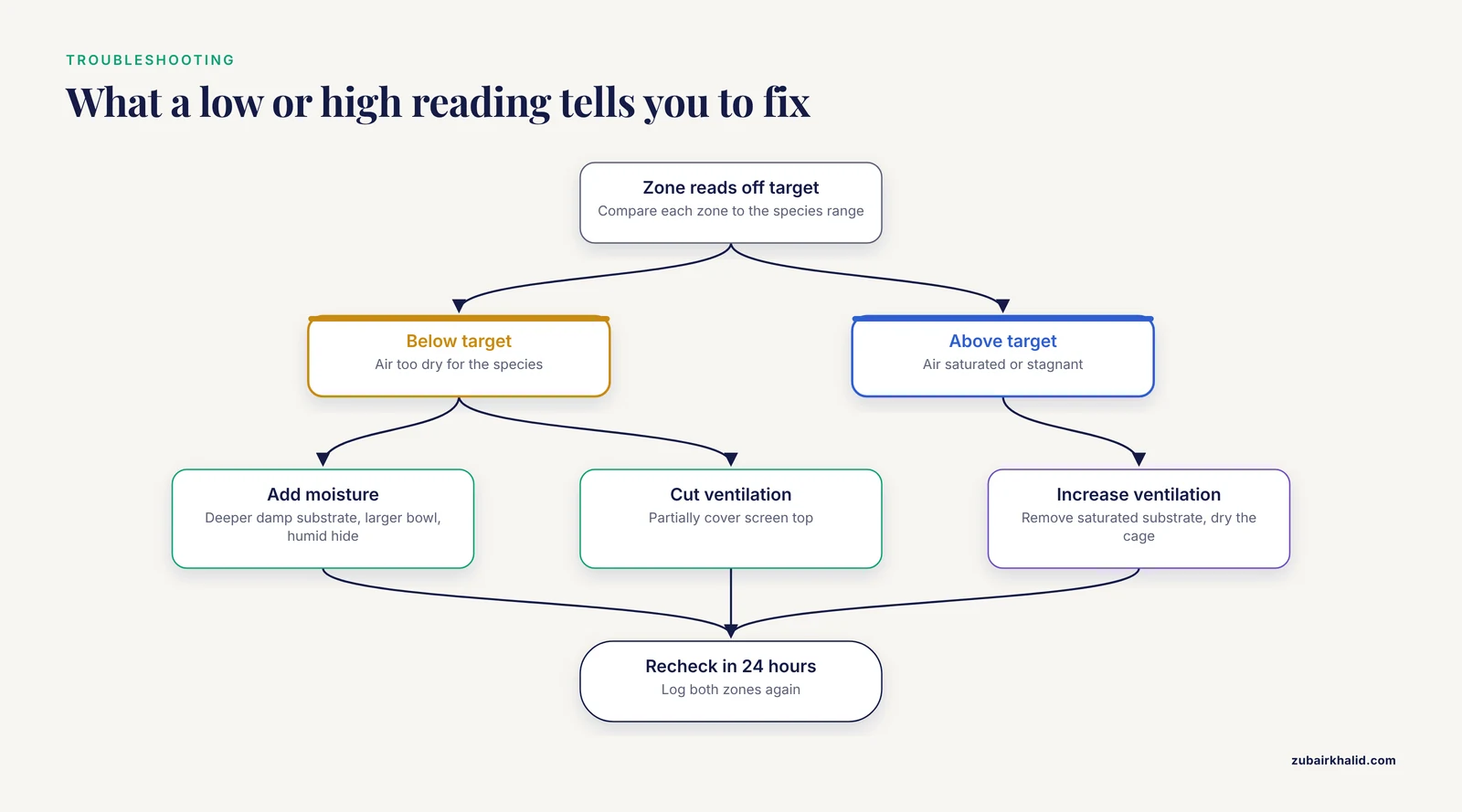
| Problem | Likely Cause | Calculator-Informed Fix |
|---|---|---|
| Humidity far below target everywhere | Too much ventilation, dry room air, water-repellent substrate | Reduce screen ventilation, add moisture-retentive substrate, enlarge the water bowl, add a humid hide |
| Cool zone on target, basking zone far below | Expected physics, warmer air reads lower | Accept a gradient or add a localized humid microclimate, do not try to equalize the whole cage |
| Humidity spikes after misting then collapses | Free water evaporating faster than the enclosure can hold it | Increase substrate depth and dampness, reduce ventilation briefly, mist less but more thoroughly |
| Condensation on all glass daily | Air saturated at the coolest surface, usually over-ventilated enclosure in a cool room or oversaturated substrate | Reduce free water, improve air circulation with a small fan in the room, check for water leaks under the enclosure |
| Musty smell or visible mold | Chronic saturation with stagnant air | Increase ventilation, remove saturated substrate, clean and dry the enclosure, consult a veterinarian if the animal shows skin or respiratory signs, since immunocompromised reptiles in suboptimal conditions develop opportunistic fungal and mixed infections [6] |
| Dysecdysis (stuck shed) | Chronic low humidity, especially during the shed cycle | Correct enclosure humidity using the calculator for each zone, provide a humid hide, contact a veterinarian if shed remains after environmental correction [3] |
| Reading keeps drifting upward over weeks | Sensor contamination or battery failure | Recalibrate or replace the sensor, verify against a second device |
Welfare and Safety Points
Humidity management is a welfare intervention, not an aesthetic one. Modern reptile care has moved away from sterile, spartan enclosures toward larger, more naturalistic habitats that provide choices, higher activity levels, reduced stress, and opportunities for natural behavior, and improper humidity along with improper nutrition, caging, lighting, substrate, and temperature can lead to stress and disease [16]. A correctly calculated humidity gradient with a usable humid hide gives your animal behavioral control over its own moisture exposure, which is exactly what enrichment-based husbandry aims for [10].
Safety cuts both ways. Too little humidity dehydrates, impairs shedding, and stresses the kidneys [5],. Too much, especially with poor hygiene and stagnant air, promotes opportunistic fungal and bacterial disease [6], [7]. The goal is the species' target range with air movement, not extremes in either direction.
Limitations and When to Contact a Veterinarian
Every enclosure is different, every individual animal is different, and the numbers in this article are worked examples rather than prescriptions for your species. Individual cases need a veterinarian, ideally one with reptile experience. The Association of Reptilian and Amphibian Veterinarians maintains a member directory for finding a qualified clinician.
Contact a veterinarian if you observe any of the following:
- Retained eyecaps or shed that has not cleared after environmental correction, since dysecdysis signals husbandry or health problems
- Open-mouth breathing, wheezing, excess mucus, or lethargy, which can indicate respiratory disease that flourishes when husbandry falls below natural standards [8]
- Discolored, blistered, or softening scales, or any skin lesion, which may represent bacterial, fungal, or mixed opportunistic infection tied to husbandry deficiency [6], [7]
- Reduced drinking, reduced urination, weight loss, or lethargy, which can reflect dehydration affecting renal function [5]
- Any animal that appears stressed or anorexic in an enclosure whose measured humidity you cannot bring into the target range after systematic correction
Frequently Asked Questions
What is a reptile humidity calculator?
It is a tool, usually a web form or spreadsheet, that converts enclosure temperature and moisture measurements into relative humidity so you can compare the result against your species' target range. It works in both directions, from readings to humidity and from a humidity target to the moisture level you need to maintain.
What formula does a reptile humidity calculator use?
The standard formula is RH = 100 × (e ÷ es), where e is the actual vapor pressure and es is the saturation vapor pressure at the air temperature. Both pressures are typically computed with the Magnus approximation, es = 6.112 × exp[(17.62 × T) ÷ (243.12 + T)], with temperature in degrees Celsius and pressure in hectopascals.
Where should I place the hygrometer in the enclosure?
Place one digital sensor at animal level in the cool zone and a second at animal level in the warm zone, and calculate each zone separately. A single reading cannot describe a thermal gradient, because the same air reads drier wherever it is warmer.
Can I trust a cheap dial hygrometer?
No. Analog dial gauges are commonly inaccurate and drift with age, and decisions built on their readings can be wrong by a wide margin. Use digital capacitive sensors, verify them periodically against a second device, and replace any sensor you cannot verify.
How do I raise humidity without soaking the whole cage?
Add moisture-retentive substrate, enlarge the water bowl on the cool side, partially cover screen ventilation, and provide a humid hide filled with damp moss. The humid hide gives your animal access to high humidity on demand while the rest of the cage stays in the target band.
Is high humidity dangerous for reptiles?
It can be. Stagnant, saturated air with poor hygiene predisposes reptiles to opportunistic fungal and bacterial infections of the skin and respiratory tract, and treatment of those infections requires correcting the environmental conditions along with medical therapy. Target the species' range with ventilation, not maximum moisture.
How does humidity affect shedding?
Shedding is a moisture-dependent process, and reptile skin disease references identify dysecdysis, or abnormal shedding, as one of the most common non-infectious skin problems caused by species-inappropriate humidity. During the pre-shed period, provide reliable access to a humid microclimate and confirm each zone with the calculator.
How often should I measure and calculate humidity?
Read both zones daily and log the results, verify sensor accuracy weekly, and review trends monthly. Readings matter most during shedding cycles, for gravid females and incubating clutches, and before and during any brumation period.
This article is educational and is not a substitute for veterinary diagnosis or treatment.
Sources
- Designing environments for captive amphibians and reptiles.
- Assessment of the husbandry problems of reptiles on the basis of pathophysiological findings: a review.
- [[Dermatological diseases in reptiles].](https://pubmed.ncbi.nlm.nih.gov/20235013/)
- Complexity in the timing of the first postnatal ecdysis in snakes.
- Diseases of the Reptile Renal System.
- Fungal diseases of reptiles.
- Selected infectious diseases of reptiles.
- Respiratory diseases, diagnostics, and therapy in snakes.
- A comparison between pre- and posthibernation morphometry, hematology, and blood chemistry in viperid snakes.
- THE EFFECT OF VARIED ENRICHMENT TYPES ON SNAKE BEHAVIOR.
- Artificial snake hibernacula provide suitable microclimate but are not immediately adopted.
- An Overlooked Habitat-Dependent Link Between Metabolism and Water Loss in Reptiles.
- Comparing Preferred Temperatures and Evaporative Water Loss Rates in Two Syntopic Populations of Lacertid Lizard Species.
- Water Uptake from Air in a Desert Thread Snake, Myriopholis macrorhyncha.
- The effect of moisture during development on phenotypes of egg-laying reptiles: a systematic review and meta-analysis.
- Reptile wellness management.