Reptile Humidity and Hydration Checklist
By Dr. Zubair Khalid, DVM, MS, PhD ·
A working reptile humidity and hydration checklist comes down to five daily and weekly actions: measure humidity with a calibrated digital hygrometer at animal level, keep a humidity gradient from a moist hide to a drier basking zone, provide fresh drinking water every day, mist or fog on a schedule matched to your species, and log body weight so you catch dehydration early. Reptiles lose water through their skin and breath in ways that depend directly on the temperature and moisture of the air around them, so hydration management and enclosure climate control are the same job [1][2].
This guide gives you the reason behind each check, a ready-to-use checklist template, a sample filled-in routine, setup steps for a proper reptile enclosure setup, common mistakes, and the specific situations that mean you should call a reptile veterinarian.
This article is educational and is not a substitute for veterinary diagnosis or treatment.
At a Glance: The Core Checklist
| Frequency | Task | Pass Standard |
|---|---|---|
| Daily | Read the hygrometer at animal level | Reading matches your species target range |
| Daily | Check drinking water bowl | Clean, full, positioned in a cool zone |
| Daily | Quick behavior scan | Normal activity, normal posture, no gaping or lethargy |
| Daily | Mist or fog per your species plan | Substrate and hides reach target moisture without pooling water |
| Weekly | Weigh your reptile | Stable weight, no steady downward trend |
| Weekly | Inspect the moist hide and substrate | Damp but not soured, no mold, no pests |
| Weekly | Ventilation check | Air exchange working, no condensation running down the glass all day |
| Monthly | Calibrate or replace the hygrometer | Reading within a point or two of a salt-test or reference reading |
| Monthly | Deep clean and substrate refresh | Fresh substrate at correct moisture, hides dried and returned |
| Seasonal | Adjust for shedding cycles, breeding, and brumation | Species-appropriate moisture and hydration before and during any dormant period |
Print this table, tape it to the enclosure, and initial each row. A checklist only works if it gets used the same way every time.
Why Humidity and Hydration Matter So Much for Reptiles
Reptiles are ectotherms whose body water balance is governed largely by the environment they sit in. Research on squamates shows that evaporative water loss rises sharply in dry air, and the effect is strongest for species adapted to humid, mesic habitats. In a study of 12 Israeli lizard and snake species, evaporative water loss was higher in dry air than in humid air, and the increase was stronger in mesic species than in xeric species. Small-bodied mesic species under 5 grams even showed a metabolic stress response when exposed to unnaturally dry conditions [2].
Hydration status is not fixed. Lizards acclimated for just 8 days to hot, humid conditions showed a measurable increase in cutaneous evaporative water loss, meaning the skin's water-permeability responds plastically to the climate the animal lives in [1]. For keepers, this means a reptile held for weeks in the wrong humidity is not simply uncomfortable. Its physiology has shifted, and moving it abruptly back to correct conditions also requires a transition period.
Humidity even affects how reptiles physically interact with their world. Tokay gecko setae soften and adhere more strongly as relative humidity rises, an effect driven by changes in the material properties of beta-keratin rather than by capillary water films [3]. A gecko kept at the wrong humidity may grip differently on branches and glass, which is one more reason the hygrometer reading is a husbandry vital sign.
Water balance also interacts with temperature regulation. In the common lizard (Zootoca vivipara), short-term restriction of free-standing water and daytime air humidity measurably shifted thermal preferences, though the effects were modest. Dehydration can trade off against behavioral thermoregulation [4]. A dehydrated reptile may bask differently, and a reptile that cannot reach its preferred body temperature may process water differently. The two variables move together, which is why a complete reptile care checklist tracks temperature and humidity side by side.
Reptile Humidity and Hydration Checklist Template
Use the following checklist format as your master template. Copy it, adapt the targets to your species, and review it monthly. Each line has a specific observable standard so that two different household members would score the enclosure the same way.
Daily Items
- Hygrometer reading recorded. Log the reading at animal level in the enclosure center, not at the top near the lamp.
- Humidity gradient confirmed. One measured point in the humid zone and one in the dry zone. A single average number hides the gradient your animal actually uses.
- Fresh water available. Bowl rinsed and refilled. Reptiles defecate and soak in water bowls, so a soiled bowl is a hydration failure and a hygiene failure at once.
- Misting or fogging completed per schedule. Note the time. Consistency matters more than volume.
- Condensation assessment. Brief morning condensation on glass can be normal. Condensation that persists all day signals over-wetness or poor ventilation.
- Behavior noted. Activity level, time spent in the humid hide versus the basking spot, tongue flicking and exploration in species that use them.
Weekly Items
- Body weight recorded on a digital gram scale. Weight is one of the most practical hydration proxies an owner can track. Researchers evaluating hydration use body mass, plasma osmolality, and hematocrit together, and body mass is the one you can measure at home [1].
- Substrate moisture checked by hand. The humid hide substrate should feel damp through the middle without free water pooling when you press it.
- Mold and pest inspection. Check the corners of the moist hide, under the water bowl, and along the warm side.
- Water bowl sanitation deep-cleaned. Scrub biofilm, not just rinse.
- Equipment check. Misting nozzle not clogged, fogger reservoir clean, hygrometer probe intact and positioned correctly.
Monthly Items
- Hygrometer verification. Compare your device against a second reference or a saturation salt test. Cheap analog dial gauges are often wildly inaccurate and should not be trusted for medical decisions.
- Substrate replaced or refreshed. Full change or targeted change depending on your setup.
- Ventilation reviewed. Adjust vents seasonally. Summer and winter room humidity differ, so the enclosure needs re-tuning.
- Checklist reviewed. Update targets if your animal moved life stages, is gravid, or is entering a dormant season.
Seasonal and Life-Stage Items
- Pre-shedding moisture increase. Raise humidity slightly and add rough surfaces when the skin dulls before a shed.
- Gravid female support. Females ready to lay need a suitable laying box with controlled substrate moisture, a practice used even in professional conservation breeding programs for endangered Canarian giant lizards, where eggs were moved into incubators with controlled temperature and humidity for hatching [5].
- Egg incubation moisture. Substrate moisture during development affects hatchling outcomes. A meta-analysis of 37 studies across 28 reptile species found that wetter substrate conditions produced longer and heavier hatchlings, and that the effect of moisture on hatching success interacted with incubation temperature, with higher temperatures reducing success [6]. If you incubate eggs, treat moisture as a managed variable, not an afterthought.
- Brumation preparation. Before any cooling period, the animal must be clinically healthy, well hydrated, and in good body condition. A study of 31 hibernating viperid snakes found that dehydration during hibernation carried serious consequences, including markedly elevated plasma uric acid after arousal, with visceral gout and death in two individuals and recovery in one treated with fluid therapy. The authors recommend sufficient humidity and access to water throughout, plus a blood uric acid check on arousal [7].
- Dormancy microclimate check. Whether you brumate in a dedicated cooler or an artificial hibernaculum-style setup, verify that the structure actually buffers external temperature and humidity swings. Field research on artificial snake hibernacula showed the constructs buffered outside conditions well and maintained stable internal microclimates, but snakes were slow to adopt them, which tells owners that the structure matters less than whether the animal actually uses the microclimate you built [8].
Worked Example: A Filled-In Daily Routine
To show the checklist example in practice, here is how one day looks for a keepers' log entry for a mid-sized, humidity-loving lizard species:
- 8:00 AM hygrometer reading: humid hide 88 percent, basking-side air 45 percent. Both within target.
- 8:05 AM water bowl rinsed and refilled with dechlorinated water.
- 9:00 AM lights on, misting run for the scheduled duration, substrate in humid hide re-dampened.
- 6:00 PM behavior note: animal used humid hide twice overnight, basked 3 hours midday, feeding normally.
- Evening: no persistent condensation on glass, so no ventilation change needed.
- Weekly weight (Saturday): 412 g, unchanged from last week.
This is the entire daily burden once the setup is right. Five minutes in the morning and a one-line evening note.
Reptile Enclosure Setup: Building Humidity Control Into the Habitat
Humidity is much easier to manage when the enclosure is designed for it. Retrofitting moisture control into a poorly set up tank is the root cause of most chronic hydration problems. Work through these steps in order.
Step 1: Choose the Enclosure for Airflow, Not Just Size
Glass tanks with full mesh tops vent humidity rapidly. The right setup depends on your species' native climate. Tropical species need moderate airflow with high moisture retention. Arid species need high airflow with dry air, and their risk profile is the opposite, since trapped humidity in a desert species' enclosure creates its own problems. Identify your species' native habitat type first and design airflow second.
Step 2: Establish a Humidity Gradient, Not a Single Number
The single most useful structural feature is a moisture gradient. One end or one chamber stays humid, the other stays drier, and the animal moves between them as its physiology demands. In nature, reptiles do exactly this. Desert thread snakes survive aridity by retreating underground where humidity is high, and researchers found that Myriopholis macrorhyncha actually absorbed water from air held at 97 percent relative humidity, gaining body mass, while losing water rapidly in dry air [9]. That study is a clear argument for the humid retreat: for some species, a properly saturated micro-refuge is not a luxury, it is a functional drinking mechanism.
Build the gradient with:
- A sealed or partially sealed humid hide containing moisture-holding substrate on the cool side.
- A dry basking zone with well-ventilated air on the warm side.
- Substrate depth sufficient to hold a moisture layer without saturating the whole enclosure floor.
Step 3: Instrument It Correctly
Buy at least two digital hygrometers, not dial gauges. Place one probe at animal level in the humid zone and one in the dry zone. Calibrate monthly. Log readings, because a written number on paper reveals drift that a glance at the display never will. The Merck Veterinary Manual's exotic animal resources emphasize accurate environmental monitoring as a foundation of reptile husbandry, and every experienced reptile veterinarian will ask you for your actual readings, not your impression of them.
Step 4: Choose the Delivery Method
Common humidity delivery tools and their selection criteria:
- Hand pump or pressure sprayer. Inexpensive, precise, labor-dependent. Best for one or two enclosures.
- Automatic misting systems. Consistent schedules, good for multi-enclosure collections. Check nozzles weekly for clogs.
- Ultrasonic foggers. Raise visible humidity quickly but can soak substrate and drive respiratory-tract moisture issues if run constantly in a sealed box. Use on timers.
- Humid hide box. The highest-value tool per dollar. A covered container with damp substrate gives the animal self-service humidity regardless of room conditions.
- Water bowl placement. A large bowl on the warm side raises ambient humidity through evaporation and doubles as a soak site for species that use them.
Step 5: Match the Hydration Plan to the Species' Drinking Mode
Reptiles drink in species-specific ways. Some drink from standing water, some respond to water droplets on leaves and surfaces from misting, some take water from food, and a few, like the fossorial thread snake described above, can extract water directly from near-saturated air [9]. Learn your species' documented drinking mode and deliver water in that form. A chameleon that will not recognize a water bowl is not being stubborn. It is waiting for droplets.
Common Mistakes That Undermine Hydration
- Trusting a dial hygrometer. Analog dial gauges frequently read far from true humidity. If your medical and husbandry decisions rest on one, your decisions rest on nothing.
- Chasing a single enclosure-wide number. A uniform 70 percent everywhere is often worse than a 40 to 95 percent gradient, because the animal needs choice. Gradients let the animal manage its own evaporative water loss the way wild reptiles do [2].
- Misting the glass, not the substrate. Water on glass evaporates into the room through the vents. Water absorbed into substrate holds humidity where the animal lives.
- Ignoring room seasonality. Winter heating and summer air conditioning change baseline room humidity substantially. A setting that worked in July fails in January. Re-verify monthly.
- Sudden correction of long-standing errors. Because skin water loss acclimates to the conditions the animal has been living in, shifting a chronically dry-kept animal into saturated conditions overnight is a shock to its adjusted physiology [1]. Move conditions toward target over days to weeks.
- Dry brumation. Cooling a reptile for the winter without humidity and water access is the pattern associated with post-hibernation hyperuricemia and visceral gout in viperid snakes [7]. Any brumation plan must include moisture.
- Confusing wetness with humidity. A soupy enclosure is not a humid one. Saturated substrate grows mold, feeds pests, and can macerate skin, while contributing little to air humidity compared with proper ventilation management.
Troubleshooting Guide
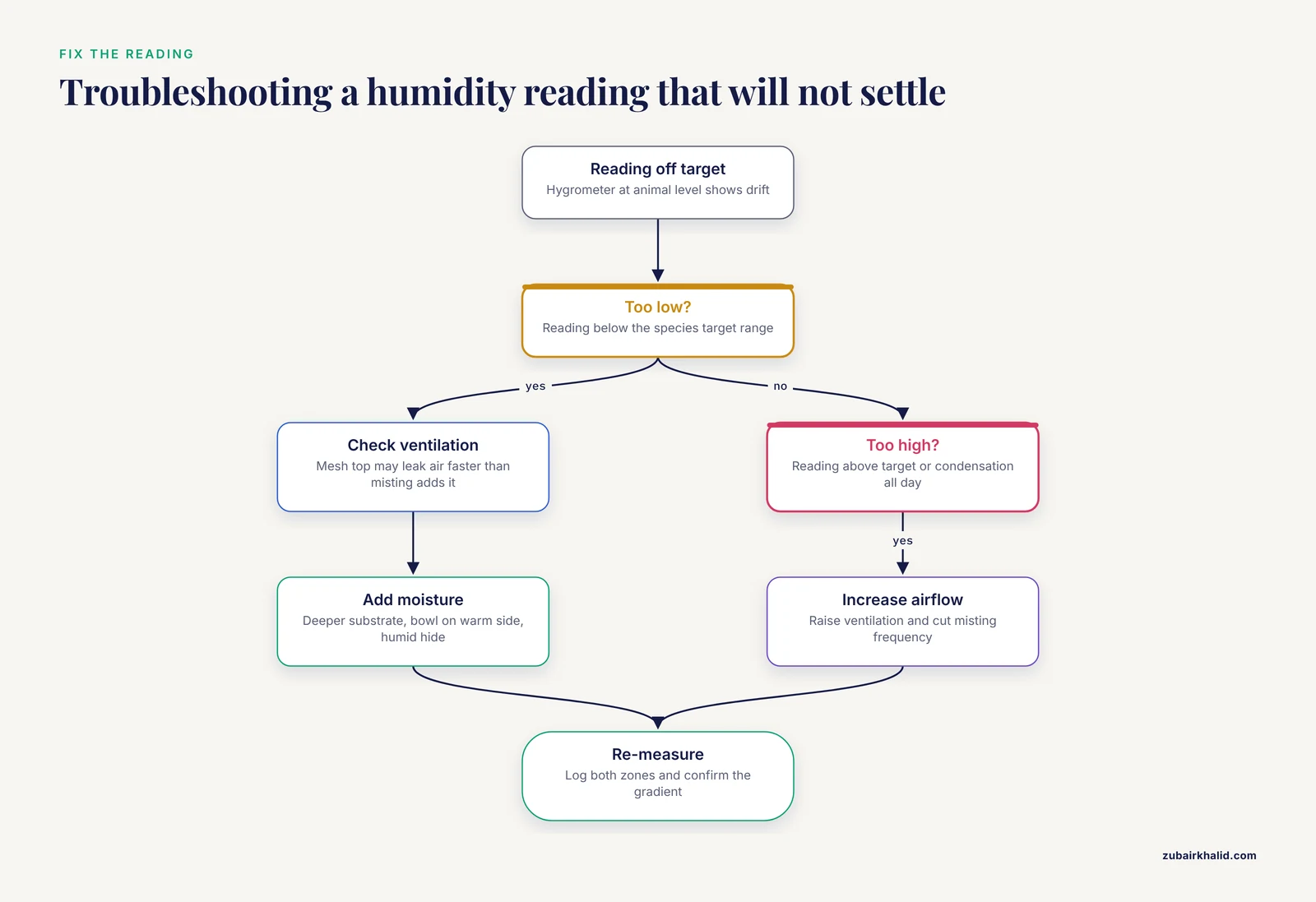
Reading too low despite misting. Check ventilation first. A mesh top leaking air faster than you can add moisture is the usual culprit. Partially cover the mesh, add deeper moisture-retaining substrate, move the water bowl to the warm side, and re-measure. Add a humid hide as an insurance policy.
Reading too high or condensation persisting. Increase ventilation, reduce misting frequency, and confirm the water bowl is not oversized for the enclosure. Watch the animal. Constant time in the humid hide or constant avoidance of it both signal that the gradient needs adjustment.
Reptile not drinking visibly. Confirm the drinking mode matches the delivery method. Then weigh the animal weekly. Stable weight with normal urate output generally indicates adequate intake even when you never see drinking, which is common in many nocturnal species. Weight loss with reduced feeding is a reason to call a veterinarian rather than guess.
Shed problems. Increase humidity and offer a rough, damp surface during the shed window. Retained shed around toes, the tail tip, or the eye caps warrants a veterinary visit rather than repeated home soaking attempts.
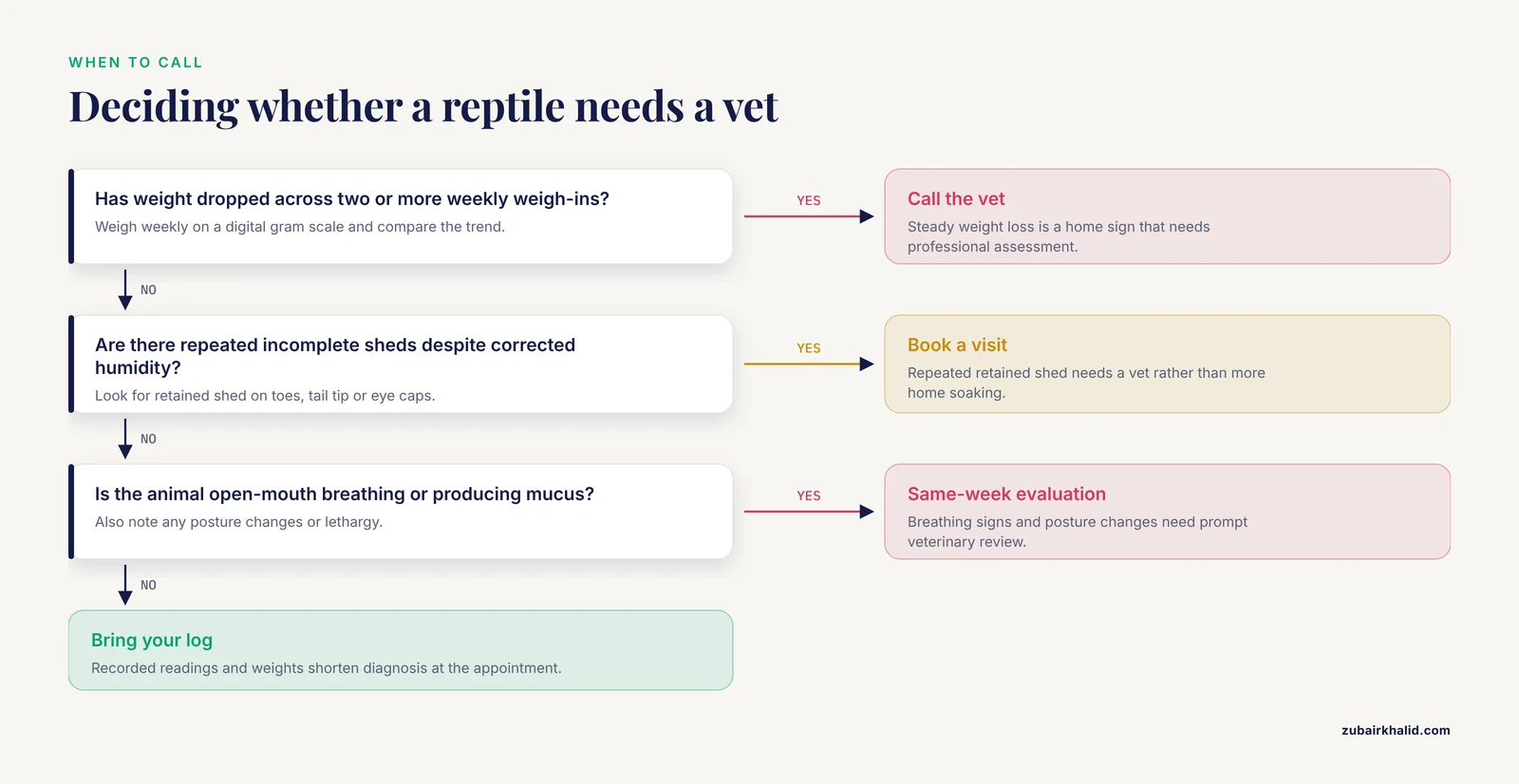
Multiple unexplained problems at once. Poor shedding, low activity, and drifting weight together suggest the environment has been off longer than you noticed. Re-run this entire checklist from step one, and bring your log to the vet appointment. Recorded data shortens diagnosis.
Signs That Warrant Veterinary Attention
Owners monitor weight and behavior. Veterinarians go further. Clinical assessment of reptile hydration draws on the same markers researchers use, including plasma osmolality, hematocrit, and body mass trends [1], and bloodwork can reveal consequences of chronic dehydration such as elevated plasma uric acid, the abnormality associated with fatal visceral gout in the hibernating viperid snake study [7].
Contact a reptile veterinarian when you see any of the following:
- Steady weight loss across two or more weekly weigh-ins.
- A reptile that stops eating alongside any change in stool or urate output.
- Repeated incomplete sheds despite corrected humidity.
- Any animal emerging from brumation with reduced condition, since the viperid study recommends blood uric acid testing on arousal precisely because problems are not always visible externally [7].
- Open-mouth breathing, excess mucus, or posture changes, which need same-week evaluation.
- Lethargy combined with a hygrometer reading far outside target for more than a day or two.
Professional resources such as the Association of Reptilian and Amphibian Veterinarians (ARAV) maintain client education materials and veterinarian directories, and the Merck Veterinary Manual's exotic animal section covers reptile husbandry fundamentals that align with this checklist. VCA Animal Hospitals also publishes species-level reptile care guides that pair well with the template above.
Limitations and When to Contact a Veterinarian
This reptile humidity and hydration checklist gives you a monitoring framework, not a diagnosis. Every species, and every individual within a species, has its own target ranges shaped by native climate, age, health status, and acclimation history. Research clearly shows that even within one species, individuals respond differently to the same humidity conditions, and that mesic and xeric species diverge sharply in their responses to dry air [1][2]. Set your numbers from species-specific evidence-based husbandry guides such as those compiled by ReptiFiles, from your breeder's records, and from your veterinarian's advice, in that order of specificity.
Contact a veterinarian promptly for weight loss, refusal of food beyond your species' normal interval, shed retention, respiratory signs, or any animal that seems dehydrated and is not improving within a day of corrected conditions. Individual cases need professional evaluation, and a checklist is the tool that makes those evaluations faster and more accurate.
Frequently Asked Questions
What humidity level should my reptile's enclosure be?
There is no universal number. Your species' native climate determines the target, with tropical species needing consistently high humidity, arid species needing low humidity with an optional humid retreat, and temperate species sitting between. Get the target range from a species-specific evidence-based care guide or your reptile veterinarian, then maintain a gradient within it rather than one uniform reading.
How do I measure humidity accurately?
Use a calibrated digital hygrometer with the probe placed at animal level, one in the humid zone and one in the dry zone. Avoid analog dial gauges, which are often inaccurate. Verify your device monthly against a second reference and log the readings so you notice drift.
How often should I mist my reptile's enclosure?
As often as needed to keep the humid zone and substrate within your species' target range, which may be once or twice daily for tropical species and rarely or never for arid species. Consistency matters more than volume. Adjust frequency seasonally as room conditions change and verify with your hygrometers, not by eye.
Can reptiles actually absorb water from humid air?
Some can. The desert thread snake Myriopholis macrorhyncha gained body mass and showed apparent water uptake when held at 97 percent relative humidity, while losing water quickly in dry air. This is why a near-saturated humid retreat is a genuine hydration tool for species that use microclimates this way, not just a comfort feature.
How can I tell if my reptile is dehydrated at home?
Track body weight weekly on a gram scale, since declining weight is the most practical home indicator, and watch for reduced activity, appetite changes, and poor sheds. Definitive assessment uses plasma osmolality and hematocrit, which only a veterinarian can measure. Any steady weight loss deserves a call.
Does humidity matter for reptile eggs?
Yes. A meta-analysis of 37 studies across 28 species found that wetter substrate conditions produced longer and heavier hatchlings and that moisture interacts with incubation temperature in determining hatching success. Incubation substrate moisture should be controlled deliberately, as it is in professional breeding programs.
Can humidity be too high?
Yes. Chronically saturated enclosures promote mold, pests, and skin problems, and constantly damp conditions can contribute to respiratory disease risk in many species. Persistent all-day condensation, soured substrate, or an animal that never leaves the humid hide are signals to increase ventilation and rebalance the setup.
Do reptiles need hydration during brumation or hibernation?
Yes. Snakes entering hibernation should be clinically healthy, well hydrated, and in good body condition, and they should be maintained with sufficient humidity and access to water throughout. Dehydration during dormancy is linked to sharply elevated plasma uric acid after arousal, which can be fatal, so hydration support before and during the dormant period is part of safe brumation practice.
Sources
- Hydration and evaporative water loss of lizards change in response to temperature and humidity acclimation.
- An Overlooked Habitat-Dependent Link Between Metabolism and Water Loss in Reptiles.
- Changes in materials properties explain the effects of humidity on gecko adhesion.
- Short-term changes in air humidity and water availability weakly constrain thermoregulation in a dry-skinned ectotherm.
- Long-Term Conservation Management of the Endangered Canarian Lizards Gallotia simonyi and G. bravoana (Fam. Lacertidae) (2006-2024).
- The effect of moisture during development on phenotypes of egg-laying reptiles: a systematic review and meta-analysis.
- A comparison between pre- and posthibernation morphometry, hematology, and blood chemistry in viperid snakes.
- Artificial snake hibernacula provide suitable microclimate but are not immediately adopted.
- Water Uptake from Air in a Desert Thread Snake, Myriopholis macrorhyncha.