Reptile Hides and Climbing Decor: Complete Guide
By Dr. Zubair Khalid, DVM, MS, PhD ·
Every reptile enclosure needs two things beyond heat, light, and water: secure places to hide and safe places to climb. A hide is any enclosed spot where the animal can get its entire body out of view. Climbing decor includes branches, cork, vines, ledges, and platforms that let a reptile use the vertical space in its enclosure instead of only the floor. Set up well, these items lower stress, encourage natural movement, and help prevent many of the husbandry-driven health problems veterinarians diagnose in pet reptiles.
A veterinary review of reptile husbandry lists sites for resting and hiding, the structure of rocks, and branches for climbing activities among the factors that determine whether a captive reptile functions normally, alongside heat, light, food, water, ventilation, humidity, and hygiene [1]. Behavior research points the same direction. Ball pythons moved from bare racks into furnished terrariums with a hiding place, climbing possibilities, a bathing basin, an elevated basking spot, and living plants showed a different behavior spectrum than the same snakes kept with only a hide and a water bowl [2]. Leopard geckos offered enrichment items that enabled hiding and climbing used them readily [3]. Snakes exposed to humid hides, climbing structures, and suspended hides responded with more climbing and tongue flicking, changes the study authors considered potentially clinically meaningful [4].
Treat this as the ultimate guide to hides and climbing structures, from selection through placement, cleaning, troubleshooting, and the point where a veterinarian needs to step in.
This article is educational and is not a substitute for veterinary diagnosis or treatment.
At a Glance: Hide and Climbing Setup Checklist
| Item | Purpose | Placement | Final check |
|---|---|---|---|
| Warm-side hide | Security while thermoregulating | Warm end, over or beside the heat source | Snug fit, entrance faces away from room traffic |
| Cool-side hide | Security without forced warmth | Opposite end | Same snug fit, out of any draft |
| Humid hide | Safer, more complete sheds | Middle or warm end | Damp filling, secure lid, opens easily for cleaning |
| Climbing branch or vine | Vertical movement and exercise | Anchored at two or more points | No wobble under the animal's weight |
| Elevated perch or platform | Height near the basking light | Under the light, stable base | No hard objects directly below a long fall |
| Cover plants, real or fake | Broken sightlines so movement feels safe | Along walls and between zones | No loose pieces that could be swallowed |
| Water bowl or basin | Drinking, and soaking where the species does this | Cool end for most setups | Stable base, easy exit |
Why Hides and Climbing Structures Are Core Husbandry, Not Accessories
Reptiles are ectotherms, which means their physiological functioning depends largely on the quality of their surroundings [1]. The husbandry review cited above frames the enclosure itself as part of the medical picture. Construction of the terrarium, arrangement of heating elements, humidity, hygiene, hiding sites, and climbing branches all influence normal function, and many reptile health problems trace back to these management factors rather than to infection or genetics [1].
Behavioral studies fill in the picture from the animal's side:
- In the ball python housing study, furnished terrariums contained substrate, a hiding place, possibilities for climbing, a water basin for bathing, an elevated basking spot, and living plants. The snakes showed a different behavior spectrum in these enclosures than they had in conventional racks [2].
- In the leopard gecko study, every gecko showed interest in enrichment items that enabled hiding and climbing. Geckos kept in sparse rack boxes approached enrichment items faster and interacted with them more often than geckos in planted terrariums, although total interaction time was similar between the two settings [3].
- In the snake enrichment study, eighteen snakes of multiple species were exposed to four enrichment types: a humid hide, an olfactory item, a climbing structure, and a suspended hide. Climbing and tongue flicking increased after each item was introduced. The changes were not statistically significant, but the authors judged the increases potentially clinically important [4].
The takeaway for owners is direct. Hides and climbing structures are not decoration. They are the parts of the enclosure that let a reptile thermoregulate without exposure, exercise, shed cleanly, and express the behaviors its body is built for.
Match Decor to Your Reptile's Natural History
Terrestrial and burrowing species
Ball pythons, leopard geckos, many skinks, and similar ground dwellers prioritize floor-level security. Give them snug caves at ground level on both the warm and cool ends, with low, broad climbing pieces as optional extras. The gecko study used dry hides and wet hides as core enrichment items, and the geckos used them [3]. The ball python study still provided climbing possibilities in a terrestrial species' furnished enclosure, and the animals used the full setup [2].
Arboreal species
Crested geckos, chameleons, vine snakes, and many rat snakes live in the vertical plane. Vine snakes of the genus Oxybelis range across habitats from North to South America, and molecular work shows the brown vine snake actually represents a complex of species rather than one wide-ranging snake [5]. For a keeper, the natural history is the point. A snake built like a vine needs vine-like decor: slender perches at several heights, foliage to press against, and cover up high rather than only on the floor. Suspended hides, tested in the snake enrichment work, suit these species well [4].
Heavy-bodied climbers
Boas and many pythons fall between the two groups. They need thick, firmly anchored branches rated for their weight, plus roomy ground-level hides. Never assume a heavy snake will not climb. Given a stable route, many do.
Types of Hides and What Each One Does
Warm-side and cool-side hides
Reptiles move between warm and cool zones to hold their body temperature in the right range, and heat is one of the primary husbandry factors identified in the veterinary review [1]. Two hides, one at each end, let the animal choose temperature without giving up security. With only one hide, a reptile must either sit exposed in the correct zone or hide in the wrong one. Both choices create chronic stress.
Humid hides
A humid hide is a closed container with damp sphagnum moss, paper, or similar filling and a single entry hole. The humid hide was one of the four enrichment types tested in snakes [4], and wet hides were among the items every leopard gecko in the gecko study chose to use [3]. Species that shed regularly benefit from access to a damp microclimate, which supports cleaner sheds. Check the filling daily, keep it damp rather than soaked, and clean the container often, because hygiene is directly tied to husbandry disease [1].
Elevated and suspended hides
Suspended hides hang from branches or attach to the walls and give arboreal animals a secure resting spot off the ground [4]. Mount them into structural anchor points, never into thin decor, and test every attachment under the animal's full weight.
What separates a good hide from a bad one
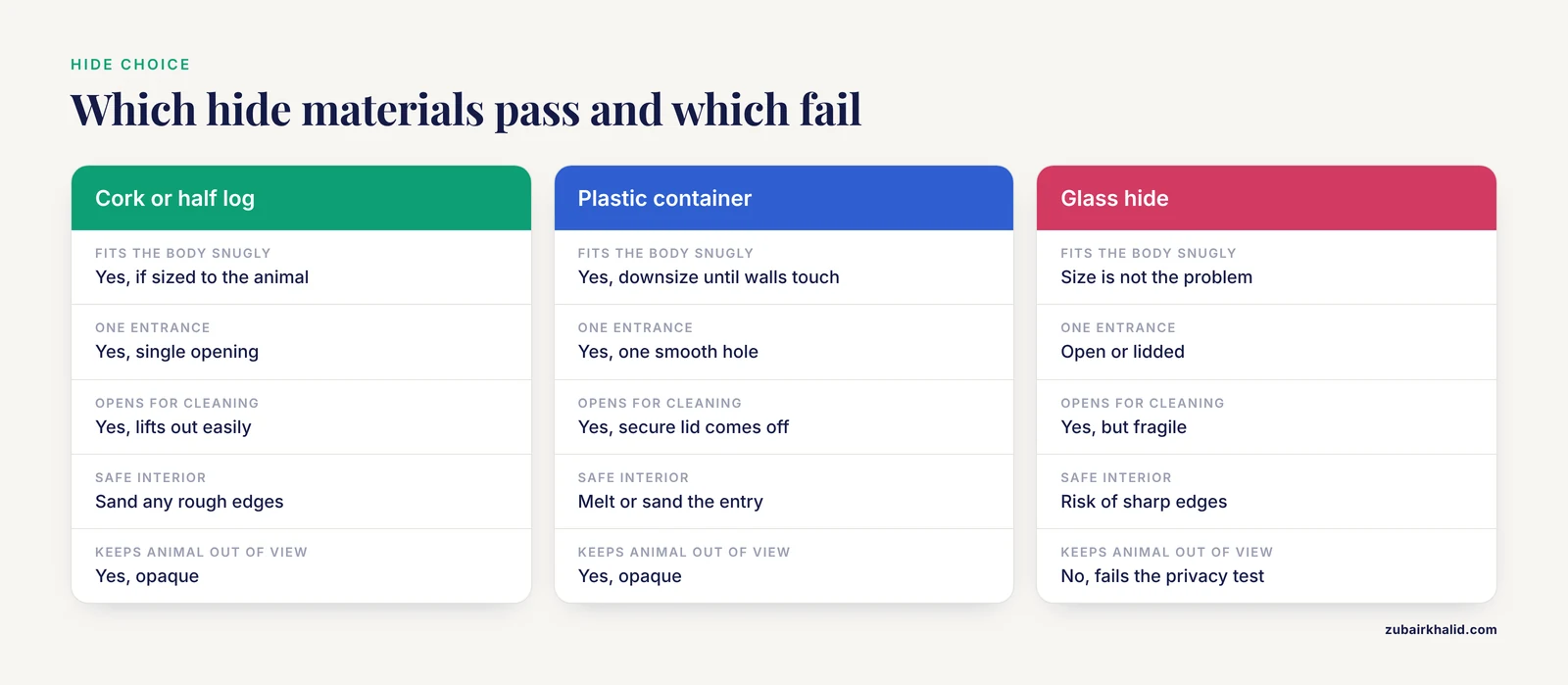
A good hide has three properties. It fits, meaning the roof and walls contact the animal's body so it feels enclosed. It has one entrance the animal can enter and leave without turning around in a tight space. And it opens for you, so cleaning and health checks do not require dismantling the enclosure. Suitable materials include commercial reptile caves, cork rounds, half logs, and opaque plastic containers with smooth, melted or sanded entry edges. Glass hides fail the privacy test, and anything with sharp interior edges or splinters fails the safety test.
Choosing and Placing Climbing Decor
Selection criteria
Work through this list for every branch, vine, ledge, and platform before it goes in the enclosure:
- Diameter matches the species. Arboreal snakes and small lizards grip slender perches best, while heavy-bodied species need thick branches that will not flex.
- Load and stability. Anchor each piece at two or more points, wedge it firmly between walls, or seat it in a branch rest. Press down hard with your hand. Any movement means the animal can fall.
- Texture. Cork bark and natural wood give grip. Slick plastic tubes are poor climbing surfaces.
- Cleanability. Non-porous pieces or replaceable natural pieces both work. Porous wood that stays damp and soiled should be retired.
- Safety. No sharp points, no splinters, no loose hardware, no wire that can snag a toe or tail.
- Source. Wood sold for reptile habitats is the low-risk choice. Collected wood carries unknown exposure to pesticides, mold, and pests, so discuss preparation with your reptile veterinarian before using it.
Placement and anchoring
The arrangement of heating elements is a recognized husbandry factor, which means decor that blocks heat or light changes the environment you built [1]. Keep the basking area open, keep light sources unobstructed, and build the climbing route around the gradient rather than through it. Create a continuous path from the floor to the highest perch with multiple exits, so a nervous animal is never trapped on one branch. Place an elevated platform or sturdy perch under or near the basking light for species that use height, mirroring the elevated basking spot used in the ball python terrariums [2]. Leave open floor space for terrestrial species, and keep heavy decor away from the tank glass so nothing strikes it if a piece shifts.
Reptile Hides and Climbing Decor Step by Step

Follow this sequence when setting up a new enclosure or rebuilding an existing one:
- Map heat and light first. Place the heat source at one end so the enclosure runs from warm to cool. Decor comes after the gradient exists, not before.
- Set the warm-side hide. Position it over or beside the heat source, with the entrance facing away from the room.
- Set the cool-side hide. Same snug fit, opposite end, out of any draft.
- Add the humid hide. Fill it with damp moss or paper, place it in the middle or on the warm end, and plan to check it daily.
- Install climbing structures. Match diameter to the species, anchor at two points, and run the hand-press test on every piece.
- Layer in cover. Add plants, cork flats, or vines along the walls and between zones so the animal can move without being seen.
- Place water. A stable bowl for drinking, and a basin for bathing where the species uses one, as the ball python enclosures did [2].
- Observe and adjust for one to two weeks. Note which hides get used, whether climbing happens, and whether the animal paces at the glass. Change one variable at a time so you can tell what worked.
Reptile Hides and Climbing Decor Tips That Make Setup Easier
- Buy two of each hide so one can be cleaned while the other stays in service.
- In group housing, provide more hides than there are animals so no one monopolizes cover.
- Photograph the layout before every deep clean so you can rebuild it exactly.
- Introduce new decor one item at a time and give the animal a day to settle before judging its response.
- Re-run the stability test after cleaning, after moves, and every few months, because anchored branches loosen over time.
- Keep a short behavior log. Two lines a day on hide choice and climbing activity will show you problems long before they become medical ones.
- For a shy or newly arrived animal, add cover before adding open space. Security first, scenery second.
Common Mistakes in Reptile Hides and Climbing Decor
- Only one hide. The animal must choose between the right temperature and feeling safe. Fix it with a hide at each end.
- Hides that are too large or too open. A hide the animal can stand up in with room to spare is a shelf, not a refuge. Downsize until the walls brush its body.
- Decor that moves under load. A branch that holds a perch test but shifts under a climbing animal causes falls and mouth injuries. Anchor everything twice.
- Blocking heat or light. Stacked decor under a lamp or across a heat gradient flattens the temperatures the animal depends on [1].
- Wrong perch diameter. Thin branches under heavy snakes flex and dump them. Fat branches under small climbers give nothing to grip.
- No humid hide. Animals without a damp retreat often shed in incomplete pieces, especially around the toes and eyecaps.
- Overcrowding. Decor that fills the enclosure leaves no thermal gradient, no open floor, and no clear travel routes. Fewer, better-placed pieces win.
- Uncleaned wild wood. Collected branches can carry pesticides, mold, and pests. Clean and dry them thoroughly and confirm preparation with your reptile veterinarian.
- Bare tubs treated as finished housing. Behavior-based evaluation of ball python housing found that rack systems are no welfare-equivalent alternative to furnished terrariums [2]. A container with a single hide and a water bowl is a starting point, not a complete setup.
Troubleshooting Behavior and Shedding Problems
- Glass surfing or nose rubbing. Repeated interaction with the transparent walls was classified as an undesirable behavior in the snake enrichment study [4]. In home enclosures it usually signals too little cover, a missing hide on one end, or a flattened temperature gradient. Add hides and sightline breaks before changing anything else.
- The animal never leaves its hide. Check whether the warm hide sits at the wrong temperature, whether the hide is too large, or whether the room around the enclosure is too busy. A reptile that also stops eating needs a veterinary exam rather than more decor.
- The animal never climbs. Recheck branch diameter, stability, and placement. Some individuals simply prefer the floor, and forcing the issue helps no one.
- Incomplete sheds. Confirm the humid hide stays damp and the animal can reach it from both zones. Retained shed around the toes, tail tip, or eyecaps needs careful home attention or a veterinary visit if it does not release.
- Sudden disuse of a favorite branch or hide. A change in position preference can be the first sign of pain or illness. Ask your reptile veterinarian rather than assuming a preference shift.
Cleaning and Maintenance
Hygiene is directly related to husbandry problems in reptiles, which makes cleaning part of the medical plan, not an afterthought [1]. Spot clean waste and damp spots daily. Wash hides and hard decor weekly with warm water and a reptile-safe cleaner, rinse completely, and dry before returning them. Disinfect during deep cleans and between animals, following the product label, and never return a damp hide to the enclosure. Retire porous wood that stays soiled or grows mold rather than trying to salvage it. Inspect anchors and branch seats at every cleaning, because a branch that was stable last month may not be stable today.
Reptile Care Checklist: Full Enclosure Setup
Use this list to audit any reptile enclosure setup, whether you are starting fresh or reviewing an established one:
- Thermal gradient from a warm zone to a cool zone, with heat placement verified.
- At least two snug hides, one per zone.
- A humid hide with damp, regularly changed filling.
- Species-matched climbing structures, anchored and load-tested.
- Elevated basking or perching access where the species uses height [2].
- Cover plants or cork along the walls for broken sightlines.
- A stable water bowl, plus a bathing basin where the species soaks.
- Substrate suited to the species and easy to spot clean.
- Species-appropriate lighting, kept unobstructed by decor.
- Cleaning supplies on hand and a simple behavior log in use.
Limitations and When to Contact a Veterinarian
Reptile enrichment research is young. The authors of the snake enrichment study note that reptilian enrichment has received far less attention than enrichment for mammals and birds, and that behavioral recording is needed to judge whether any given item helps [4]. Individual animals also differ widely, so a reptile veterinarian who has seen your animal and your enclosure should tailor any setup advice to the species, age, and health status in front of them.
Contact a reptile veterinarian promptly if any of the following occur:
- Rubbing injuries on the nose or face, or raw patches from glass contact.
- A fall from climbing decor followed by swelling, reluctance to move, or abnormal posture.
- Retained shed that does not release with a humid hide, especially around the eyes, toes, or tail tip.
- A burn from contact with a heat source under or inside decor.
- Refusal to eat beyond the species' normal fasting pattern, or regurgitation after climbing.
- Lethargy, open-mouth breathing, or wheezing at any time.
- Suspected pests or mold exposure from collected wood.
Frequently Asked Questions
How many hides does a reptile enclosure need?
At least two. One hide belongs on the warm end and one on the cool end so the animal never has to trade security for the right body temperature. Most species also benefit from a humid hide, and group housing needs more hides than there are animals.
Where should hides be placed in the enclosure?
Put the warm hide over or beside the heat source and the cool hide at the opposite end. Face entrances away from room traffic and check that neither hide blocks heat or light from reaching the rest of the enclosure.
What can I use as a reptile hide?
Commercial reptile caves, cork rounds, half logs, and opaque plastic containers with a smooth entry hole all work. The hide should contact the animal's back and sides, have one entrance, and open easily for cleaning. Avoid glass and anything with sharp interior edges.
Do snakes need climbing branches?
It depends on the species. Arboreal snakes need slender, well-anchored perches, while heavy-bodied ground species still use and benefit from climbing structures in furnished enclosures. Offer climbing options and let the snake's behavior tell you how much to build out.
How do I make climbing branches safe and stable?
Match the branch diameter to the species, anchor it at two or more points, and press down firmly with your hand to test for movement. Remove sharp ends, avoid chemically treated wood, and recheck stability after every cleaning.
What is a humid hide and does my reptile need one?
A humid hide is a closed container filled with damp moss or paper that the animal can enter to support shedding and hydration. Most species benefit from one, especially during shed cycles. Keep the filling damp rather than soaked and clean the container often.
How often should hides and climbing decor be cleaned?
Spot clean waste daily, wash hides and hard decor weekly, and disinfect during deep cleans or between animals. Replace porous items that stay soiled or develop mold.
Why is my snake rubbing its nose on the glass?
Nose rubbing usually points to too little cover, an incomplete temperature gradient, or an enclosure that feels too exposed. Add hides and sightline breaks, verify heat placement, and have a reptile veterinarian examine the nose if the skin is broken.
Sources
- Assessment of the husbandry problems of reptiles on the basis of pathophysiological findings: a review.
- Animal-appropriate housing of ball pythons (Python regius)-Behavior-based evaluation of two types of housing systems.
- The Effect of Enrichment on Leopard Geckos (Eublepharis macularius) Housed in Two Different Maintenance Systems (Rack System vs. Terrarium).
- THE EFFECT OF VARIED ENRICHMENT TYPES ON SNAKE BEHAVIOR.
- Hiding in the lianas of the tree of life: Molecular phylogenetics and species delimitation reveal considerable cryptic diversity of New World Vine Snakes.