Reptile Feeding Schedule Template: How to Create a Routine That Works
By Dr. Zubair Khalid, DVM, MS, PhD ·

A reptile feeding schedule template that works has five parts: a feeding frequency matched to your species and life stage, a portion defined relative to body weight, a fixed feeding day or time, a written log of every meal and every weigh-in, and a review point where you adjust based on growth, body condition, and appetite. Write all five down. A written routine removes guesswork, prevents overfeeding, and gives your veterinarian exactly the information needed to interpret health problems correctly.
This guide shows you why a schedule matters, what feeding research actually demonstrates, how to build your own template step by step, and how to troubleshoot the most common feeding problems reptile owners run into.
At a Glance: Build Your Feeding Routine Today
Complete these steps in order. Most owners can finish in one evening.
| Step | Action | Tools Needed |
|---|---|---|
| 1 | Identify your reptile's feeding category and current life stage | Species records, breeder or rescue notes |
| 2 | Confirm target feeding frequency with your reptile veterinarian | First vet visit or wellness exam |
| 3 | Get a baseline body weight | Digital kitchen or parcel scale |
| 4 | Choose fixed feeding days and times | Calendar or phone reminders |
| 5 | Set up a written log (paper or spreadsheet) | See the template format below |
| 6 | Feed, weigh, and record on schedule | Prey or food items, scale |
| 7 | Review the log monthly and adjust | Body condition notes, vet guidance |
Every step feeds into the next. The log you start in step 5 becomes the record your veterinarian reads in step 7 and at every future checkup.
Why a Feeding Schedule Matters for Reptile Health
Reptile metabolism runs slower than mammal metabolism, and digestion is a long, physiologically demanding process. What happens inside your reptile after a meal is not trivial. In a study of gopher snakes and black rat snakes fed mice, plasma uric acid concentrations rose after eating and gradually returned to baseline as the meal was digested, and snakes that ate two mice had higher uric acid values than snakes that ate only one [1].
This has a practical consequence that many owners never hear about. When a veterinarian runs bloodwork, the results change depending on when the reptile last ate. The same study concluded that interpretation of uric acid concentrations should always be based on information about the feeding schedule [1]. If you cannot tell your veterinarian when your snake last ate, a normal post-meal rise in uric acid could complicate the interpretation of a test meant to check for conditions such as gout.
A written feeding schedule solves this. It also solves a subtler problem. Much traditional herpetoculture advice rests on habit, anecdote, or inherited practice rather than measured outcomes. Researchers studying juvenile Boa constrictor growth noted that many husbandry routines in zoo herpetology are based on tradition, authoritarianism, anecdote, or speculation, with relatively few empirical studies behind common practices [2]. Your own routine deserves better foundations, and the research gives you a place to start.
What Feeding Research Actually Shows
Frequency changes growth outcomes
The boa constrictor study is one of the most directly useful feeding experiments available to owners. Researchers raised littermates under two regimes that were identical in total food mass but different in schedule. One group ate 10 percent of their body mass once per week. The other ate 20 percent of their body mass every two weeks. Snakes on the weekly regimen grew to a larger size and at a faster rate than snakes on the biweekly regimen, despite eating the same total amount of food over time [2].
The takeaway is straightforward. How you spread meals across the week matters, not just how much you feed in total. Smaller, more frequent meals outperformed larger, less frequent ones for growth in this species. For an owner, this argues against the old habit of offering one very large prey item at long intervals and against free-form feeding without any plan at all.
Meals change blood values, so timing is data
The snake uric acid study reinforces the same principle from a diagnostic angle. Because plasma uric acid rises after eating and scales with meal size, the interval between the last meal and a blood draw is part of the result itself [1]. Feeding records are not just husbandry housekeeping. They are medical data.
Food abundance matters most during reproduction
Feeding schedules interact with reproduction. In a study of the southern grass skink, a placentotrophic lizard, females were fed four different diets combining high or low food amounts with constant or variable schedules. Low food availability during gestation reduced developmental success, placental nutrient transport, offspring size, and maternal growth and body condition, and females deprived of food were more likely to cannibalize their offspring. Interestingly, the schedule of feeding did not affect offspring or mothers in this species. What mattered was whether food was abundant [3].
For owners of breeding females, the message is to prioritize consistent food availability during gestation over agonizing over exact feeding days. If you breed lizards, discuss a gestation feeding plan with your reptile veterinarian before the breeding season starts.
How to Create Your Reptile Feeding Schedule Template
Step 1: Identify Feeding Category and Life Stage
Sort your reptile into one of three broad feeding categories: animals that eat vertebrate or invertebrate prey, animals that eat insects, and animals that eat plant matter. Then record life stage. Juveniles, adults, seniors, and breeding females have different nutritional demands. If you acquired your reptile from a breeder or rescue, ask for the feeding history in writing. If you do not know the species' natural feeding pattern, that is a specific question to bring to your first veterinary visit rather than something to guess at.
Step 2: Confirm Frequency With Your Veterinarian
General frequency charts circulate widely online, but the boa study shows why species-specific, evidence-based guidance matters. Because growth rate differed measurably between weekly and biweekly feeding in that species [2], the correct interval is a real clinical decision, not a preference. Ask your reptile veterinarian, ideally one affiliated with the Association of Reptilian and Amphibian Veterinarians (ARAV), to confirm a target interval for your species and life stage. Resources such as the Merck Veterinary Manual's exotic animal section and VCA Animal Hospitals' reptile care guides can help you prepare questions, but the interval itself should be matched to your individual animal.
Step 3: Define Portions Relative to Body Weight
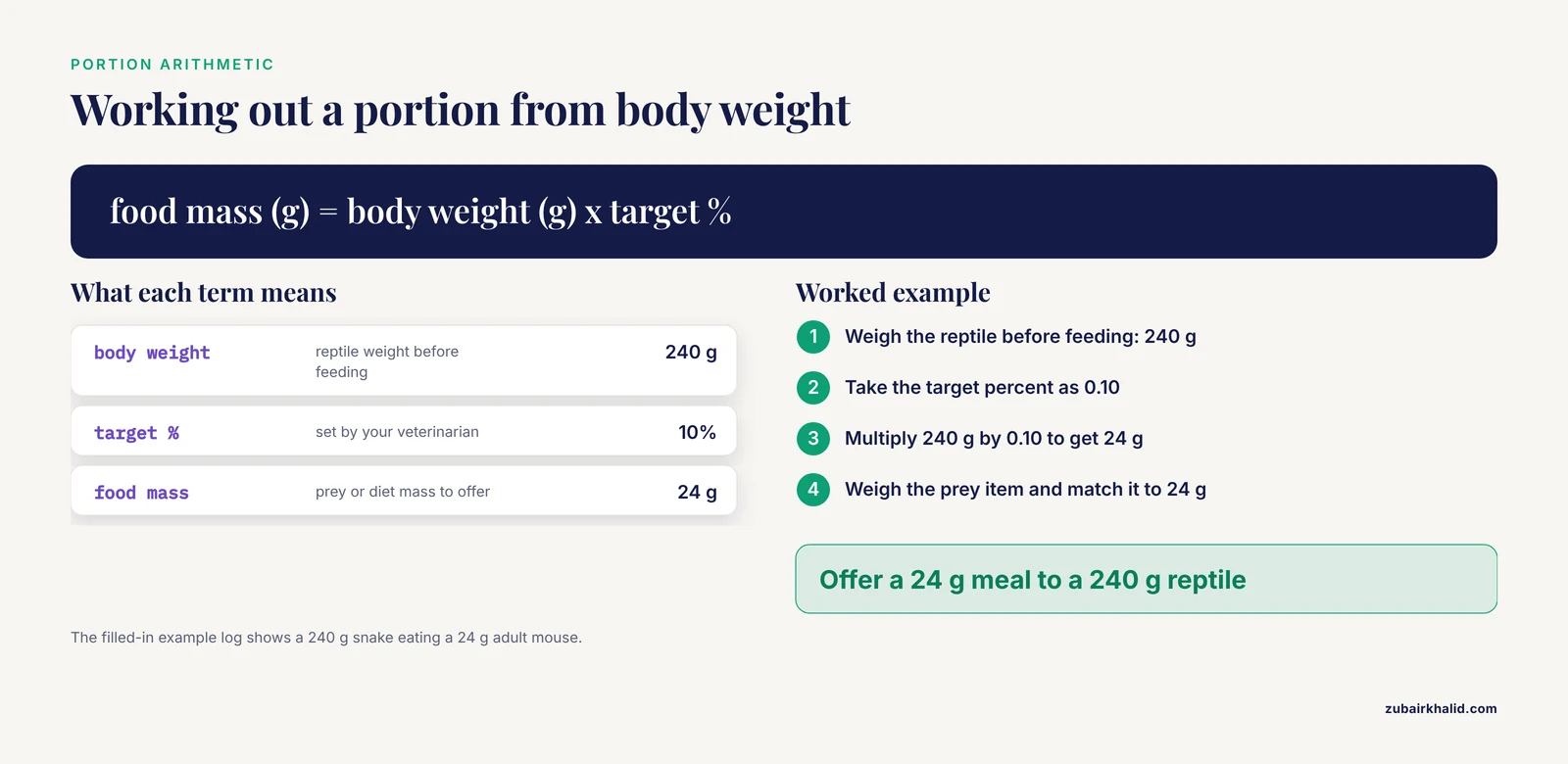
The cleanest way to define a portion is as a percentage of body mass, which is exactly how the boa researchers designed their feeding regimes [2]. This requires a scale. Weigh your reptile on the same scale, at the same time of day, before feeding, and record the number. Your veterinarian can help you set a target percentage for your species. From that point, portion size is arithmetic. If your animal gains or loses weight, the target prey or food mass changes with it.
Step 4: Anchor Meals to Fixed Days and Times
Pick specific days. Write them into a calendar or set recurring phone reminders. Reptiles, like most animals, do better with predictable routines, and predictable routines make it far easier to notice when something changes. A missed feeding is also information. If your reptile refuses a scheduled meal, that refusal goes in the log and becomes part of the health record.
Step 5: Build the Log
A useful log captures five data points per feeding: date, food item offered, food mass in grams, reptile body weight, and a notes column. Add a column for refusal or partial eating. Paper, a spreadsheet, or a notes app all work. What matters is that the record is consistent and travels with your reptile to vet appointments.
Step 6: Feed, Weigh, and Record
Follow the schedule without improvising for at least one full review cycle, usually a month. Consistency for a defined period is what makes the data interpretable. Random adjustments make it impossible to tell whether a change in weight or appetite came from the schedule, the diet, the environment, or the animal itself.
Step 7: Review and Adjust Monthly
Once a month, look at the log. Three questions drive the review:
- Is body weight trending up, down, or stable, and does that match expectations for the life stage?
- Are there refusals, and do they cluster around sheds, enclosure changes, or seasonal shifts?
- Does anything in the log change what you would tell your veterinarian?
Adjust one variable at a time. Change frequency or portion, not both in the same cycle, so you can attribute the outcome.
Reptile Feeding Schedule Template Format and Example
Here is a reptile feeding schedule template format you can copy directly into a spreadsheet or notebook.
Blank Template
| Date | Life Stage Target | Food Item | Food Mass (g) | Reptile Body Weight (g) | Eaten / Refused / Partial | Notes |
|---|---|---|---|---|---|---|
Add a header row above the table with your reptile's name, species, date of birth or acquisition date, target feeding frequency from your veterinarian, and target percent-of-body-mass portion if your veterinarian has given you one.
A Filled-In Example
This reptile feeding schedule template example shows how three weeks of records look in practice. The entries are illustrative, not a recommendation for any specific animal.
| Date | Food Item | Food Mass (g) | Body Weight (g) | Outcome | Notes |
|---|---|---|---|---|---|
| Mar 3 | Adult mouse | 24 | 240 | Eaten | Scheduled feed, ate promptly |
| Mar 10 | Adult mouse | 25 | 243 | Eaten | Normal strike response |
| Mar 17 | Adult mouse | 24 | 245 | Refused | Entering shed, eyes cloudy, skipped and logged |
Notice what the refusal entry does. Three weeks later, when the animal finishes shedding and eats normally, the pattern is documented rather than forgotten. If refusals instead clustered over consecutive scheduled feeds with no shed in progress, that log becomes the reason to call the veterinarian.
Finding a Free Reptile Feeding Schedule Template
If you prefer not to build a spreadsheet from scratch, search for a free reptile feeding schedule template that includes the columns above. Before you print one, check that it captures food mass and body weight, not just dates and food items. A template without weights cannot support percent-of-body-mass portioning, which is the approach with the strongest published support. Any template can be customized, so treat a downloaded version as a starting point and add the columns you need.
Adjusting the Schedule for Life Stage and Breeding
Growth stages generally demand more frequent feeding than maintenance stages, and the boa data illustrates why juvenile feeding decisions carry long-term consequences. The differences in size and growth rate between the weekly and biweekly groups emerged during the juvenile period, when the animals were actively growing [2].
For adult animals, your veterinarian will help you define a maintenance schedule aimed at stable weight rather than maximal growth. For gravid females, the lizard gestation study shifts the priority. There, food amount, not feeding schedule, determined developmental outcomes, offspring size, and maternal condition [3]. An owner of a breeding female should focus on making food reliably available throughout gestation and should treat any sign of poor maternal condition as a reason for immediate veterinary contact.
The Reptile Care Checklist: Feeding Within the Bigger Picture
A feeding schedule only works inside a complete husbandry system. Use this reptile care checklist to audit your setup. Each item either directly supports feeding or supports the physiology that makes digestion possible.
Feeding items
- Written feeding schedule with confirmed frequency from your veterinarian
- Digital scale for both food items and the reptile
- Feeding log with food mass and body weight columns
- Appropriate prey or diet items stored correctly
- Separate feeding enclosure or feeding tool if recommended for your species
Enclosure and physiology items
- Temperature gradient appropriate for the species, verified with thermometers rather than guesswork
- Heat sources controlled by thermostat
- Hiding places on both the warm and cool ends
- Clean water available at all times unless your veterinarian advises otherwise
- Appropriate humidity measured with a hygrometer
- Full-spectrum lighting or UVB provision as advised for your species
Record-keeping items
- Baseline body weight recorded at acquisition
- Monthly weight trend reviewed
- Shed dates and refusal events logged
- Veterinary contact information and last exam date noted
The enclosure items are not decoration. Reptiles rely on external heat sources to digest, and a feeding schedule imposed on an enclosure with a poor thermal gradient can produce meals that sit undigested and animals that stop eating. If you are unsure whether your gradient supports your species' digestive needs, that is a specific question for your reptile veterinarian, ideally with photos or readings from your enclosure. Detailed, species-specific guidance on thermal gradients is also available from evidence-based husbandry resources such as ReptiFiles and the Merck Veterinary Manual's exotic animal materials.
How Reptile Enclosure Setup Affects Feeding Success
Reptile enclosure setup and feeding are a single system. A reptile that eats but cannot reach and maintain the temperatures needed for digestion is a reptile at risk, because an undigested meal in a cold animal is a veterinary emergency in many species. Before you finalize any feeding schedule, verify three things about the enclosure.
- The warm end reaches the species-appropriate basking range and holds it after feeding. Meals often coincide with the reptile seeking the warm end. Confirm with a thermometer at the basking surface, not the air.
- The cool end provides a genuine retreat. Reptiles thermoregulate by moving between zones. Without a functional cool zone, the animal cannot manage its own post-meal physiology.
- Hides and cover exist near both temperature zones. A reptile that feels exposed may delay feeding or refuse it, and stress-related anorexia is one of the most common problems reptile veterinarians see.
If any of the three is missing, fix the enclosure before you judge the feeding schedule. Many apparent feeding problems are actually enclosure problems.
Common Mistakes in Reptile Feeding Routines
Feeding by tradition instead of evidence. The most damaging habit in reptile keeping is continuing a practice because it is what everyone does. The boa researchers made this point explicitly, noting how much standard practice rests on tradition and anecdote rather than measurement [2]. When you adopt a routine, ask what evidence supports it.
Assuming total food quantity is all that matters. The boa littermates ate identical total food mass and still grew at different rates because the schedule differed [2]. Splitting the same food budget into smaller, more frequent meals produced measurably better growth in that study.
Feeding huge meals at long intervals. Oversized, infrequent meals are the pattern the weekly group beat in the boa research [2], and larger meals also produced larger post-feeding uric acid rises in the snake study [1]. Big infrequent meals are doubly unattractive on the evidence.
Feeding right before a vet visit. Because plasma uric acid rises after a meal and stays elevated through digestion [1], a recent large meal can muddy bloodwork. If your reptile has a scheduled health exam, ask your veterinarian in advance whether and when to feed beforehand.
Keeping no records. Without a log, refusals blur together, weight trends go unnoticed, and your veterinarian loses the feeding-schedule context that bloodwork interpretation requires [1].
Changing multiple variables at once. If you alter frequency, portion size, and diet item in the same week, no one, including your veterinarian, can say what caused the result.
Troubleshooting Appetite and Growth Problems
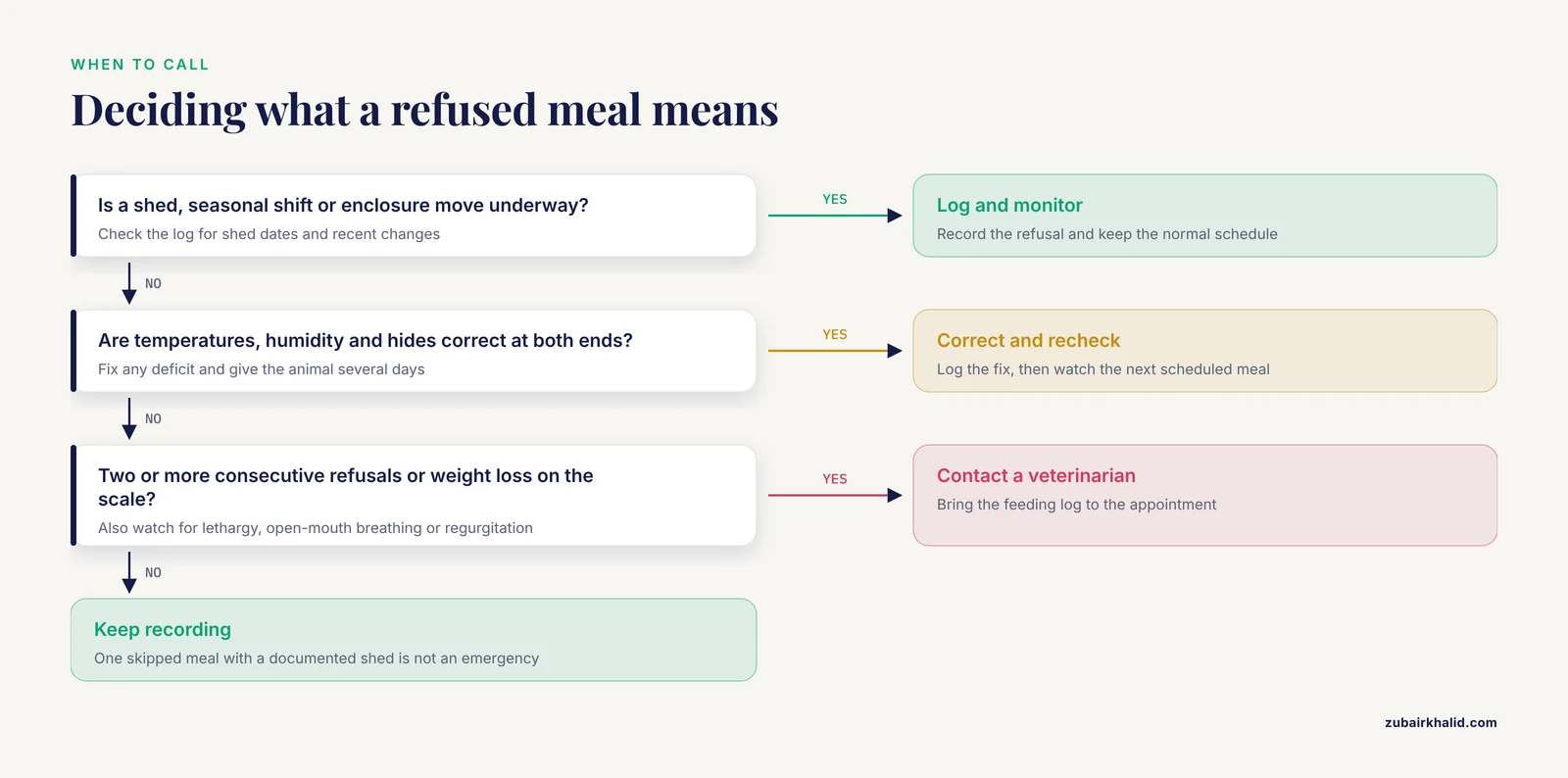
Work through this sequence before assuming the animal is sick or the schedule is wrong.
Step 1. Check the log first. When did the last successful meal occur, and how does the current interval compare with the confirmed schedule? Many owners misjudge elapsed time, especially with less frequent feeding intervals.
Step 2. Check the enclosure. Verify temperatures at both ends, humidity, and hide availability. Correct any deficit and give the animal several days before drawing conclusions.
Step 3. Check for normal causes. Shedding cycles, seasonal changes, and recent enclosure moves or new animals in the home can all suppress appetite temporarily. Log the event and monitor.
Step 4. Check the trend, not the day. One skipped meal in a healthy animal with a documented shed is different from three consecutive refusals with weight loss on the scale. The scale reading is why you weigh before every feeding.
Step 5. Escalate on defined criteria. If refusals extend beyond what your veterinarian has told you is normal for the species, if weight loss appears in the log, or if the animal shows lethargy, abnormal posture, open-mouth breathing, or regurgitation, contact a reptile veterinarian. Do not wait out multiple missed feeds in an animal that is also losing weight.
Welfare and Safety Points
- Never leave live prey unattended with a reptile, since prey animals can injure a reptile that is not interested in feeding. Use pre-killed or frozen-thawed items where your veterinarian recommends them.
- Weigh food items and the reptile on a dedicated scale. Handling food for a reptile, especially frozen-thawed prey, carries hygiene considerations, so wash hands and surfaces after preparation.
- Quarantine and veterinary screening for new arrivals is standard advice from organizations including the AVMA's pet-owner resources and reptile specialist groups. Ask your veterinarian about a wellness exam and any screening before a new reptile joins an existing collection.
- Record every deviation from the schedule, including refusals. The record protects the animal by making patterns visible early.
Limitations and When to Contact a Veterinarian
Individual cases need a veterinarian, and the research summarized here covers specific species under specific experimental conditions, not every reptile in every home. The boa findings apply directly to boa constrictors and inform, but do not prescribe, feeding plans for other species. The uric acid findings come from two snake species under study conditions. Use these findings as a framework for asking better questions, not as a substitute for species-specific veterinary guidance.
Contact a reptile veterinarian promptly if any of the following occur:
- Two or more consecutive refused scheduled meals, or any refusal pattern that your veterinarian has told you exceeds normal for the species
- Measurable weight loss between scheduled weigh-ins
- Regurgitation, swelling, difficulty breathing, lethargy, or abnormal posture
- A gravid female that stops eating, loses body condition, or shows distress
- Bloodwork is planned, so that feeding timing can be coordinated with the draw
- Any suspected injury from live prey
For routine confirmation of your schedule, a wellness exam with a reptile-experienced veterinarian, ideally an ARAV member, is the right starting point. Bring your feeding log. Veterinarians consistently get more from an appointment when the owner arrives with written records.
Frequently Asked Questions
How often should I feed my reptile?
Feeding frequency depends on species, age, and reproductive status, and should be confirmed with a reptile veterinarian rather than copied from a generic chart. Research in juvenile boas showed that feeding interval alone changed growth outcomes, so the correct interval is a real clinical decision for your specific animal.
Where can I find a free reptile feeding schedule template?
Search for a free reptile feeding schedule template that includes columns for date, food item, food mass, reptile body weight, and outcome. If the template you find lacks weight columns, add them yourself, because portioning by percent of body mass and tracking growth both require recorded weights.
What is the best reptile feeding schedule template format?
The best format is a table with one row per feeding event and columns for date, food item, food mass in grams, body weight in grams, whether the meal was eaten or refused, and notes. Keep it in whatever medium you will actually maintain, whether paper, spreadsheet, or app.
Can feeding timing affect my reptile's blood test results?
Yes. Plasma uric acid in snakes rises after eating and returns to baseline as digestion proceeds, so veterinarians interpret uric acid values in light of the feeding schedule. Tell your veterinarian when your reptile last ate before any blood draw.
How do I decide portion size?
Use a percent-of-body-mass approach, weighing both the food item and the reptile, and ask your veterinarian to set the target percentage for your species and life stage. In published boa research, portions were defined as a percentage of body mass, which made the feeding regimes directly comparable and adjustable.
What should I do if my reptile refuses a scheduled meal?
Log the refusal, check enclosure temperatures and humidity, look for an impending shed or recent change in the home, and monitor. Escalate to a reptile veterinarian if refusals continue beyond the normal window for your species or if weight loss appears on the scale.
Do I need to change the schedule if my lizard is gravid?
Discuss a gestation feeding plan with your reptile veterinarian before breeding season. Research in a placentotrophic skink found that food abundance during gestation, rather than feeding schedule, drove developmental success and offspring size, so reliable food availability is the priority for breeding females.
Should I feed my reptile during the day or at night?
Match feeding time to your species' natural activity pattern, and confirm the specifics with your reptile veterinarian, since activity timing varies widely among species. Whatever time you choose, keep it consistent so that deviations are easy to spot in the log.
This article is educational and is not a substitute for veterinary diagnosis or treatment.