Reptile Equipment Maintenance Checklist
By Dr. Zubair Khalid, DVM, MS, PhD ·
Run a short equipment check every day, a deeper check every week, and a full inspection of heating, lighting, thermostats, humidity tools, and the enclosure itself every month. Reptiles depend entirely on the equipment you provide to regulate their body temperature, metabolize calcium, shed properly, and stay hydrated. When a heat bulb fails, a thermostat drifts, or a UVB lamp burns out while still glowing, the animal inside the cage often shows no complaint until disease is advanced. That is why regular reptile equipment checks are one of the highest-value habits in reptile keeping, and why sources such as the Association of Reptilian and Amphibian Veterinarians emphasize correct captive husbandry as the foundation of reptile health.
This guide gives you a practical reptile equipment maintenance checklist you can act on today, a step-by-step method for checking each piece of gear, the most common mistakes owners make, troubleshooting advice, and clear signs that it is time to call a reptile veterinarian.
This article is educational and is not a substitute for veterinary diagnosis or treatment.
At a Glance: Reptile Care Checklist by Frequency
| Frequency | Task |
|---|---|
| Every day | Read thermometer and hygrometer at basking and cool zones. Confirm lights and heat turn on. Watch behavior, appetite, and droppings. Spot-clean waste. Refresh water. |
| Every week | Verify thermostat probe placement and readings. Check heat and UVB equipment for damage, flicker, or unusual noise. Wipe glass and surfaces. Check hides, branches, and water dishes for wear. |
| Every month | Test thermostats against a separate thermometer. Deep clean and disinfect the enclosure and accessories. Inspect seals, locks, screen lids, and cables. Review temperature gradient across the full enclosure. |
| Every quarter | Replace UVB bulbs according to their replacement schedule, even if they still light up. Recalibrate or replace hygrometers as needed. Inspect and replace worn substrate. |
| Every year | Replace aging heat bulbs and heat mats proactively. Review the full reptile enclosure setup against current species guidance. Schedule a wellness check with a reptile veterinarian. |
Why Regular Reptile Equipment Checks Matter
Reptiles are ectotherms. They do not generate their own stable body heat the way mammals and birds do. They move between warm and cool zones to regulate their body temperature, and they rely on ultraviolet B light to synthesize vitamin D3, which allows them to absorb dietary calcium. The Merck Veterinary Manual notes that improper environmental temperature and inadequate ultraviolet lighting are among the most common underlying causes of illness in captive reptiles, contributing to problems such as poor digestion, immune suppression, metabolic bone disease, and abnormal shedding.
That biology is exactly why equipment failure is a medical event in this group of animals. A heat mat that slips out from under a hide, a thermostat probe that falls into a water dish, or a UVB tube that has passed its useful life can set off a chain that ends in anorexia, constipation, softening of the jaw or shell, or a stuck shed that constricts toes and tail tips. Veterinarians who work with reptiles routinely trace these presentations back to husbandry equipment that looked fine from outside the cage.
Equipment checks also protect you. Reptiles and amphibians can carry Salmonella organisms that do not make the animal itself visibly ill but can infect humans. The Merck Veterinary Manual identifies reptiles as a recognized source of Salmonella infection in people, and stresses hygiene around reptile enclosures. Cracked glass, frayed cords, and damp electrical connections near water features add electrical and injury risk on top of the disease risk.
Step-by-Step Reptile Equipment Checks
Use this step-by-step routine as your recurring reptile care checklist. Each step takes a few minutes once you know your setup.
Step 1: Establish a Baseline for Your Specific Species
Before you can spot equipment problems, you need to know what correct looks like. Basking temperatures, cool-zone temperatures, humidity ranges, and UVB requirements differ widely between a desert-dwelling bearded dragon, a tropical gecko, and an aquatic turtle. Evidence-based husbandry guides such as ReptiFiles provide species-specific target ranges, and the VCA Animal Hospitals reptile care guides reinforce setting up species-appropriate temperature and lighting before an animal comes home.
Write your species targets on a card taped near the enclosure. Every later check consists of comparing the real numbers against that card.
Step 2: Read and Record Temperatures at Both Ends
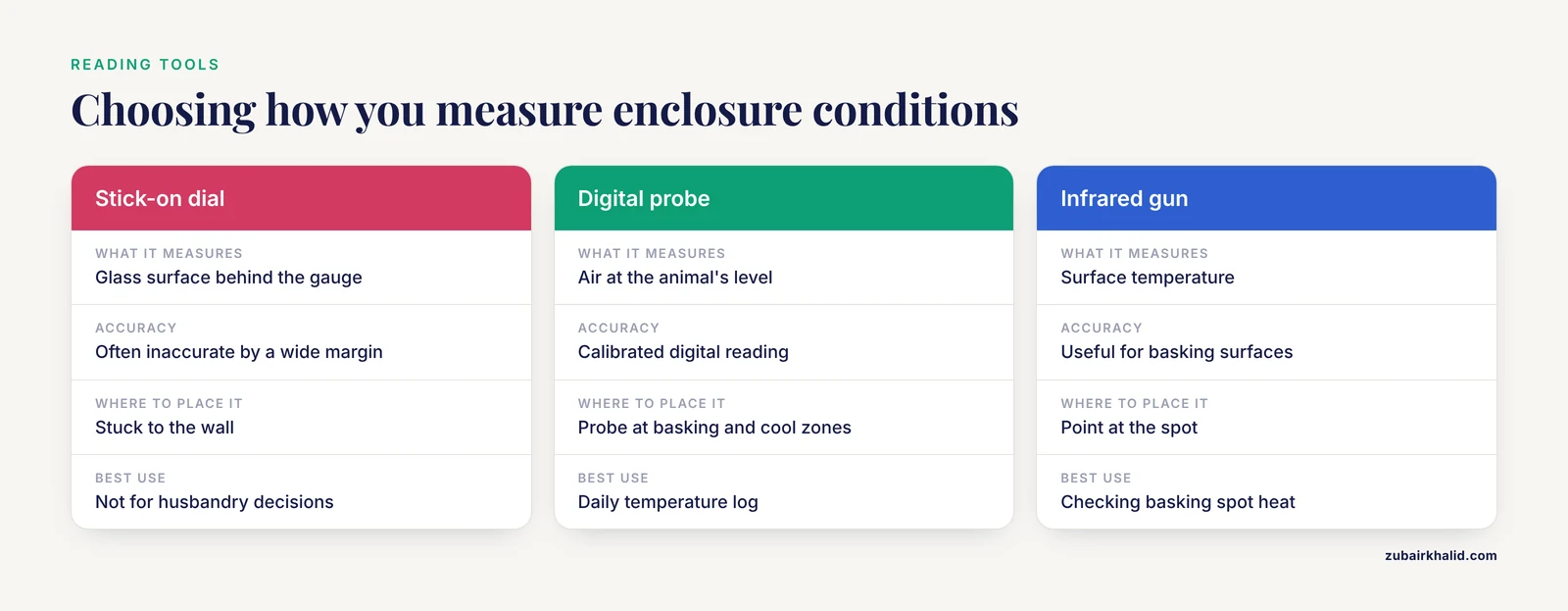
Measure the basking spot and the cool end at the level where your reptile actually sits, not at the glass wall. Digital probe thermometers and infrared temperature guns give more useful readings than the stick-on dial gauges often sold with starter kits, which the Merck Veterinary Manual and reptile veterinary resources treat as too inaccurate to base husbandry decisions on.
Record the numbers daily. A trend is easier to interpret than a single reading. A basking surface that has drifted five degrees cooler than last month tells you a bulb is aging long before your reptile stops eating.
Step 3: Verify Thermostats and Dimmers
Any heat source strong enough to injure a reptile, including heat mats, ceramic heat emitters, and high-wattage basking bulbs, should be controlled by a thermostat. During your check:
- Confirm the probe sits where it belongs, at the animal's level, secure against movement, and out of water dishes and misting paths.
- Compare the thermostat's displayed temperature against a separate calibrated thermometer at the same spot.
- Watch one full heat cycle. The heat source should shut off at the set point and restart when temperature falls.
- Check the bulb, mat, and cord for hot spots, discoloration, swelling, or a burnt smell.
A thermostat that reads correctly but fails to cycle the heat source is a fire and burn hazard and should be replaced, not adjusted.
Step 4: Check Heat Sources Physically
Heat mats should be attached to the side or back wall of the enclosure or otherwise set up so the animal cannot sit directly on an unregulated surface, because direct contact with overheated mats is a recognized cause of thermal burns in reptiles. Under-tank heaters used without thermostat control are among the equipment items reptile veterinarians most often implicate in burn injuries.
For heat bulbs and ceramic heat emitters, inspect the fixture for corrosion, check that the bulb is the correct wattage for the fixture rating, and confirm the lamp is positioned so the animal cannot touch it. Heat rocks deserve a special mention: electrically heated rocks are widely associated with severe contact burns and are generally advised against in favor of thermostat-controlled heating.
Step 5: Test UVB Output and Replacement Schedule
UVB lamps do not announce the end of their useful life. A bulb can emit plenty of visible light while producing little or no usable UVB, because the phosphor coating degrades before the filament fails. ReptiFiles recommends replacing UVB lamps on a fixed schedule based on the manufacturer's stated output life, commonly in the range of every 6 to 12 months depending on the bulb type, and sooner if the lamp has been switched on and off frequently.
During your checks:
- Confirm the lamp is the correct output strength for your species and mounted at the distance the manufacturer specifies, because UVB delivery falls off rapidly with distance and filtration through glass or plastic.
- Look for flicker, buzzing, darkened ends, or visible coating damage.
- Log the install date with a permanent marker on the lamp housing so replacement is not left to memory.
Step 6: Validate Humidity Readings
Check the hygrometer against known conditions when possible, or replace inexpensive analog units that no longer track your species' target range. Confirm misting systems, foggers, and humidifiers are working, filling correctly, and not soaking the substrate beyond what the species needs, since persistently wet bedding contributes to skin and respiratory infections in reptiles.
Step 7: Inspect Water, Filtration, and Soaking Equipment
Aquatic and semi-aquatic turtles, water dragons, and many other species depend on clean water. Check filters daily for flow, clean or replace media on the manufacturer's schedule, and perform partial water changes as needed to keep ammonia and waste accumulation down. The Merck Veterinary Manual emphasizes water quality management as a core component of aquatic reptile husbandry and notes that poor water conditions predispose reptiles to skin, shell, and eye infections.
Step 8: Examine the Enclosure Structure Itself
Walk the full reptile enclosure setup:
- Test every lid, latch, and lock. Reptiles are escape artists and an unsecured screen top is the most common escape route.
- Run your hands along interior surfaces looking for sharp edges, chipped glass, splinters, or exposed staples.
- Check cables and cords for chewing damage, and route them where the animal and any cage mates cannot reach them.
- Confirm furniture, branches, and stacked rocks are stable so they cannot shift and pin or crush the animal.
Step 9: Deep Clean and Disinfect on Schedule
On your monthly cycle, move the animal to a secure temporary container, remove all decor, and clean with an appropriate disinfectant, following the product's contact time and rinsing thoroughly. The Merck Veterinary Manual provides guidance on cleaning and disinfection of reptile housing and stresses rinsing away chemical residues, because reptiles are sensitive to lingering disinfectants on surfaces. Wash your hands before and after handling the animal or its equipment, a habit the VCA reptile care guides highlight because of the Salmonella risk reptiles can carry.
Step 10: Watch the Animal, Not Just the Machines
End every check by observing your reptile for a few minutes. Posture, activity, breathing, tongue flicking, response to food, and dropping quality are living sensors for equipment problems you may have missed. A reptile that suddenly spends all its time pressed against the heat source, or avoids the basking area entirely, is telling you the gradient is wrong even if the thermometers look normal.
Equipment Selection Criteria
When replacing gear, select items against these criteria rather than by brand:
- Thermostats with proven safety features, including an indicator light or alarm for sensor failure. Every heat source in the enclosure should pass through a thermostat.
- Digital probe thermometers and infrared thermometers in place of stick-on dials, so you can measure both surface and air temperatures at the animal's level.
- UVB lamps sized and rated for your species and mounting distance, with a documented replacement schedule you can log.
- Fixtures rated above the wattage of the bulb you install, positioned so the animal cannot contact the heat surface.
- Durable, cleanable enclosures with secure locking lids, and enough footprint to create a real thermal gradient. The Merck Veterinary Manual stresses adequate space and environmental gradients as baseline requirements for captive reptiles.
- Substrate and decor that can be cleaned or replaced without harboring moisture or parasites.
Practical Reptile Equipment Checks Tips
- Keep a maintenance log inside the lid of the enclosure. Write bulb install dates, thermostat readings, and cleaning days in one place.
- Buy replacement bulbs ahead of time. Waiting until a bulb burns out means your animal may go weeks without adequate UVB while a replacement ships.
- Keep spare fuses, spare thermostats, or a backup heat source on hand for power failures and cold snaps, especially for tropical species.
- Label cords by plug and fixture. During a deep clean it is easy to unplug the wrong thing and leave a heat source off overnight.
- Photograph your setup when everything is correct. Comparing against the photo makes drift obvious.
- Bundle your monthly deep clean with a review of your species care sheet, since husbandry standards are updated as evidence improves, a point ReptiFiles makes in maintaining its evidence-based guides.
Common Mistakes in Reptile Equipment Checks
These are the errors reptile veterinarians encounter most often:
- Running heat sources without thermostats. Unregulated heat mats and bulbs cause burns and fires. Thermostat control is considered standard practice in modern reptile keeping.
- Trusting stick-on dial thermometers. These gauges are often inaccurate by a wide margin and hide dangerous temperature extremes.
- Leaving UVB bulbs in place until they burn out. Because UVB output fails before visible light does, a bulb that looks fine can leave the animal unable to use dietary calcium, setting up metabolic bone disease.
- Placing the thermostat probe in the wrong location. A probe on the glass wall or dangling in midair does not measure the surface your animal actually contacts.
- Using heat rocks. Contact burns from heated rocks are a classic and largely preventable injury in pet reptiles.
- Filtering UVB through glass or plastic. Standard glass and many acrylics block the wavelengths reptiles need, so a lamp behind glass may deliver almost no usable UVB.
- Cleaning with residues left behind. Disinfectants that are not fully rinsed can irritate skin, eyes, and respiratory tissue in reptiles.
- Ignoring the cool end. Without an escape from heat, a reptile cannot thermoregulate and may develop overheating signs even when the basking spot is correct.
- Skipping checks during winter and summer extremes. Ambient room temperature shifts change enclosure conditions, so the seasons when you assume everything is fine are the seasons most likely to drift.
- Treating the equipment as set-and-forget after a new reptile enclosure setup. Hardware ages, animals grow, and setups need periodic reevaluation.
Troubleshooting Common Equipment Problems
Enclosure runs too cold even at max output. Check the bulb wattage against the fixture and enclosure size, confirm the room temperature is reasonable, and verify the thermostat is not cycling early because the probe sits in a cool airstream. Increase ambient room warmth safely or add an appropriate secondary heat source controlled by its own thermostat.
Enclosure runs too hot. Confirm the thermostat probe placement first. A probe resting on glass reads differently from one at animal level. Reduce bulb wattage, raise the fixture, or add a dimming thermostat.
Hygrometer and thermometer disagree. Trust the calibrated digital instrument and replace the cheap one. Keeping two independent instruments on the same zone is the fastest way to catch a failing sensor.
Reptile avoids the basking area. The surface may be hotter than the air reading suggests, the lamp may be too intense or too close, or the animal may be ill. Measure the actual surface temperature at the basking spot and consult a reptile veterinarian if avoidance continues despite correct readings.
Reptile sits pressed against the glass over the heat source. This posture usually means the animal cannot get warm enough elsewhere. Verify the gradient and the overnight temperature rather than assuming the animal is simply enjoying the heat.
Persistent low humidity despite misting. Check the enclosure for excessive ventilation, use a deeper water area or humid hide for species that need it, and confirm the substrate holds moisture appropriately for the species rather than staying sodden.
Escape despite a closed lid. Inspect corners, cable cutouts, and the gap between sliding glass doors. Reptiles exploit gaps far smaller than owners expect.
Welfare and Safety Points
Equipment maintenance is animal welfare work. Reptiles feel pain and distress, and chronic environmental errors, temperatures that are always slightly wrong, lighting that is always slightly inadequate, produce slow-developing disease rather than sudden emergencies. The AVMA's general guidance on responsible pet ownership frames the provision of appropriate environment and preventive care as core owner obligations, and reptile-specific veterinary organizations reinforce that principle through their husbandry-focused resources.
Handle hygiene carefully for your own household. Because reptiles can shed Salmonella even while appearing healthy, wash hands after any contact with the animal, its water, or its enclosure, keep reptiles out of kitchens and food preparation areas, and supervise interactions between reptiles and young children, older adults, or immunocompromised household members, following the precautions described in the Merck Veterinary Manual and VCA reptile care guides.
Never release a pet reptile outdoors, and never discard live cultures, substrates, or water from aquatic setups into natural waterways. Responsible disposal protects both your local ecosystem and native reptile populations.
Limitations and When to Contact a Veterinarian
Individual cases need a veterinarian. Temperature and lighting targets vary by species, by local climate, and by the individual animal's health, so use this checklist to gather accurate data and bring those numbers to a reptile veterinarian when something is wrong.
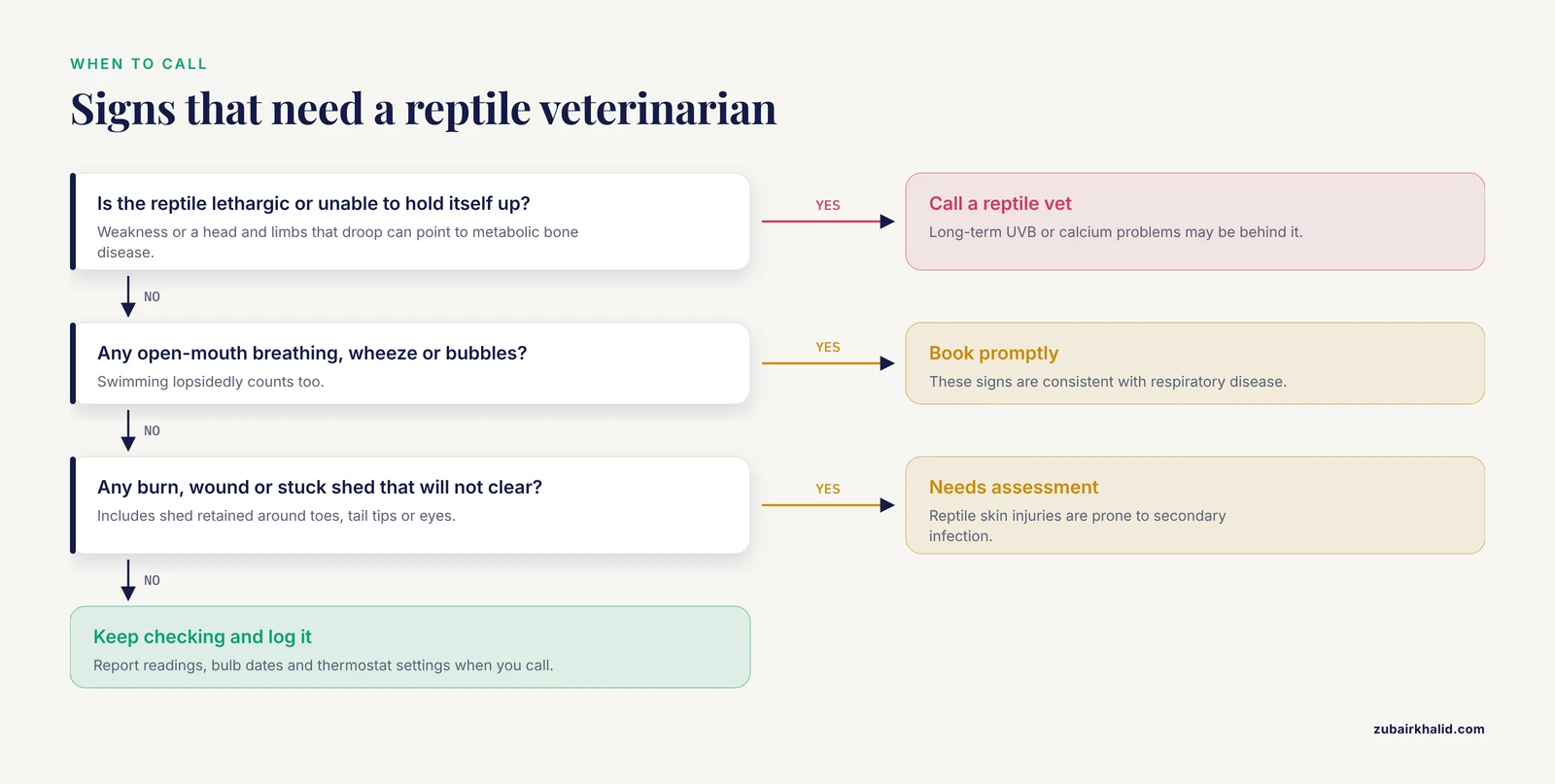
Contact a veterinarian experienced with reptiles promptly if you notice any of the following:
- Lethargy, weakness, or an animal that cannot hold its head or limbs up normally, which can indicate metabolic bone disease related to long-term UVB or calcium problems.
- Open-mouth breathing, wheezing, bubbles at the nostrils, or swimming lopsidedly, signs consistent with respiratory disease.
- Refusal to eat beyond what is normal for the species and season, especially when paired with weight loss.
- Softening of the jaw, limb tremors, fractures after minor falls, or a soft, pliable shell in turtles and tortoises.
- A stuck shed that does not resolve with appropriate humidity, particularly shed retained around toes, tail tips, or eyes.
- Any burn, wound, or injury from heating equipment, which needs professional assessment because reptile skin injuries are prone to secondary infection.
- Swelling, discoloration, or foul odor in the mouth, which may indicate infectious stomatitis.
- Diarrhea, consistently abnormal droppings, or visible parasites in waste.
When you call, report your equipment readings, bulb replacement dates, thermostat settings, and the results of your recent checks. That log often shortens the diagnostic process considerably. If you do not have a reptile veterinarian, the Association of Reptilian and Amphibian Veterinarians maintains a client resource for locating qualified exotic animal veterinarians.
Frequently Asked Questions
How often should I check my reptile's heating equipment?
Read temperatures every day, verify the thermostat and heat sources weekly, and test the whole heating system against a separate thermometer monthly. Replace aging bulbs and heat mats proactively rather than waiting for failure.
How often do UVB bulbs need to be replaced?
Replace UVB lamps on the manufacturer's replacement schedule, commonly every 6 to 12 months depending on bulb type, even if the bulb still lights up, because UVB output declines long before visible light does.
Can I use a heat rock for my reptile?
No. Heat rocks are a well-recognized cause of severe contact burns in reptiles because they concentrate heat in one spot that the animal cannot escape. Use thermostat-controlled heating such as a regulated heat mat or overhead heat source instead.
What temperature and humidity should my reptile's enclosure have?
Targets depend entirely on species, and a desert species, a tropical species, and an aquatic species have very different needs. Follow a species-specific care guide such as those published by ReptiFiles or VCA Animal Hospitals, write the targets near the cage, and confirm your equipment achieves them.
Are stick-on dial thermometers good enough?
No. Stick-on gauges are widely reported to be inaccurate and measure only the glass surface behind them. Use digital probe thermometers and an infrared temperature gun to measure the surfaces and air at the level where your reptile actually lives.
Do reptiles really carry Salmonella?
Yes, many healthy reptiles carry Salmonella organisms without looking ill, and the bacteria can infect people through contact with the animal, its water, or its enclosure. Wash your hands after handling, keep enclosures out of kitchens, and supervise contact between reptiles and children or immunocompromised people.
How do I disinfect the enclosure safely?
Remove the animal to a secure container, clean away organic debris, apply an appropriate disinfectant for its full contact time, and rinse thoroughly so no chemical residue remains on surfaces the animal touches, following the cleaning and disinfection guidance in the Merck Veterinary Manual.
When should I take my reptile to a veterinarian?
See a reptile veterinarian for lethargy, anorexia, open-mouth breathing, tremors or a soft jaw, retained shed around toes or eyes, any burn from heating equipment, mouth swelling or discharge, or abnormal droppings, and schedule annual wellness exams with an exotics-trained clinician.