Bringing Home a New Tortoise: First Week Guide
By Dr. Zubair Khalid, DVM, MS, PhD ·
Most tortoises need somewhere between a few days and two weeks to settle into a new home, and some take longer. The goal of the new tortoise first week is simple: keep the environment stable, keep handling to a minimum, and let the animal orient itself before you add anything new to its life. Tortoises are long-lived reptiles that rely heavily on familiar surroundings and routine, so the calmest possible start protects both their welfare and their health [1].
This guide walks you through the setup that should be finished before pickup, what to do on day one, a daily routine for the rest of the week, how to read settling-in behavior, and when to book the first vet visit for a tortoise. Every tortoise is an individual, and your reptile veterinarian is the right person to confirm the details for your specific species and age.
At a Glance: Your First Week Plan
| Day | Main goal | Key actions |
|---|---|---|
| , - | , - | , - |
| Before pickup | Habitat ready | Enclosure cycled and heated, temperatures verified, food and water stations set, reptile veterinarian identified |
| Day 1 | Low-stress arrival | Quiet transport, place tortoise directly in the enclosure, no handling, offer water and food, normal light schedule |
| Days 2 to 4 | Observe, don't interfere | Feed and refresh water, record eating, basking, urination, and droppings, keep household traffic low |
| Days 5 to 7 | Establish routine | First weight record, gentle brief handling only if the tortoise is settled, book or attend the first veterinary visit |
Your New Tortoise Checklist
Have everything running before the animal arrives. A new enclosure that is still being adjusted on day one adds stress to an already stressful transition. Work through this new tortoise checklist in advance.
- Enclosure. Choose an enclosure sized for the adult size of your species, not just the hatchling in front of you. Tortoises need room to walk, thermoregulate, and dig. Undercrowding matters as much as overcrowding, and captive studies of tortoises kept in tight, high-constraint spaces document chronic stress behaviors and serious health risks [2]. If you plan to keep more than one tortoise, discuss space requirements with your veterinarian first.
- Heat sources with control. Provide a thermal gradient so the tortoise can move between warmer and cooler zones. Use a thermostat on any heat source and place thermometers so you verify actual temperatures where the tortoise rests, not just what the dial claims. Exact target temperatures vary widely by species, so get the specific numbers for your species from a reptile veterinarian or a species-specific, evidence-based care guide such as the Merck Veterinary Manual exotic animal resources, VCA Animal Hospitals reptile care guides, or ReptiFiles.
- UVB and basking lighting. Most commonly kept species need appropriate ultraviolet B exposure and a defined day-night light cycle to support shell and bone health. Confirm the correct lighting type, placement, and replacement interval for your species with your veterinarian, because these details vary by species and bulb.
- Substrate. Offer a substrate deep enough for natural digging and burrowing behavior, chosen for your species' humidity needs. Avoid dusty, mold-prone, or ingestible small-particle beddings that a veterinarian would flag as impaction risks.
- Hides and visual barriers. A new tortoise needs at least one sheltered hide at each end of the temperature gradient. Hiding is normal settling behavior, not a problem to fix.
- Water dish. Provide a shallow dish the tortoise can enter and exit easily without risk of tipping or trapping.
- Food prepared in advance. Know what the seller or breeder was feeding and buy the same items before pickup so you can match the diet from day one.
- Gram scale. A digital kitchen scale accurate to the gram lets you track weight, which is one of the most practical health measures an owner can keep. In long-term tortoise projects, regular weight monitoring alongside health checks was central to confirming that animals were thriving after major moves [1].
- Veterinarian identified. Find a reptile-experienced veterinarian before you need one. The Association of Reptilian and Amphibian Veterinarians (ARAV) maintains a find-a-vet resource, and your regular small animal clinic can usually refer you if they do not see exotics.
Bringing Home a Tortoise: Day One
The first day sets the tone for the whole transition. Plan it around one principle: change arrives once, and then nothing changes for a while.
Transport calmly. Move the tortoise in a secure, ventilated container lined with padding, kept at a reasonable temperature and out of direct sun. Chelonian handling is stressful for the animal even when it looks calm, and their anatomy means they cannot signal distress the way a mammal does [3]. Keep car noise and handling brief.
Place, then leave alone. Set the tortoise directly into the prepared enclosure and step back. Resist the urge to hold it, photograph it with family members, or rearrange the habitat around it. Reptiles show measurable, individual behavioral responses to novel environments and stimuli, and giving a new arrival time and space is the most reliable way to reduce that load [4]. Research on captive chelonians also shows that handling frequency affects stress hormone levels, and that animals can acclimate to a consistent handling routine over time [5]. Day one of a new home is the wrong time to start that acclimation.
Offer water and food, then expect little. Fill the water dish and place a small amount of the familiar food where the tortoise can find it without searching. Many new tortoises will not eat on day one. That alone is not an emergency, but it should improve over the following days.
Run the normal light schedule. Turn lights on and off on the schedule you intend to keep permanently. Consistency from the first evening onward helps the tortoise build a rhythm.
The First Week Routine, Days 2 Through 7
Once the tortoise is home, your job shifts from setup to observation. Keep your footprint small and your records detailed.
Daily tasks.
- Refresh water and spot-clean any waste.
- Offer food at a consistent time each day in a consistent place.
- Verify temperatures and humidity at tortoise level with your own instruments.
- Observe from a distance: basking posture, time spent walking, time in the hide, breathing sounds, eye clarity, nasal area, and shell condition.
- Log eating, drinking, urination, and droppings in a simple notebook or phone note.
Weekly tasks.
- Weigh the tortoise on the gram scale and record the number. Sustained weight maintenance or gain is one of the clearest signals that a tortoise is adjusting well, which is exactly why long-term tortoise monitoring programs lean on weight trends [1].
- Review your log for trends rather than reacting to single off days.
Handling rule for week one. Keep handling to weighing and, if needed, short health checks. If your tortoise arrives settled and eating by midweek, brief, calm sessions can begin, but the first priority is letting the animal establish a map of its new territory on its own terms.
How Long for a Tortoise to Settle In
There is no single number, but a useful pattern is this: a healthy tortoise in a correct environment typically starts exploring, basking openly, and eating within a few days to about a week. Shyer individuals and some species take two weeks or more. The honest answer to how long for a tortoise to settle in is that settling is a process you confirm with data, not a date on a calendar. Long-term relocation studies of tortoises show that adaptation, survival, weight trends, and eventually breeding unfold over months and years even in successful cases, so early patience is justified [1].
Signs your tortoise is settling in.
- Active walking and exploring, especially at expected times of day
- Basking in the open rather than wedged behind furniture
- Eager, consistent eating
- Regular urination and droppings
- Normal alertness when you approach the enclosure
Signs the adjustment is not going well.
- Refusing food well past the first several days
- Remaining hidden almost constantly, even at basking times
- Repetitive pacing along the enclosure walls. In a captive study of spur-thighed tortoises kept in a high-constraint space, stereotypic pacing consumed a large share of the animals' time budget and was read as a marker of chronic stress [2]
- Lethargy, straining to urinate, abnormal droppings, nasal or ocular discharge, or soft or discolored shell areas
Individual behavior counts for more than any general rule. Studies comparing individual reptiles under identical conditions repeatedly find that responses differ animal by animal [4], and even within a species, one tortoise may relish attention while a sibling avoids it entirely [6].
Handling and Visitors During the First Week
Keep handling minimal and purposeful. The goal of early handling is not bonding, it is acclimation. Chelonian research shows that stress physiology responds to how often animals are handled, with animals tolerating a consistent routine better than erratic contact [5]. Start with very short, low, supported handling near the ground, always after the tortoise is eating reliably.
Control household traffic. Everyone in the family will want to see the new arrival. Explain that watching quietly is the visit, and that touching, tapping the shell, or lifting sets the settling-in clock back. Keep dogs, cats, and small children away from the enclosure this week.
Do not treat interaction as automatic enrichment. Preference studies with giant tortoises found that some individuals strongly preferred human interaction over object enrichment, while others showed no interest in people at all and preferred food instead [6]. Related work with Galapagos tortoises found that individual preference did not consistently predict which enrichment actually improved species-typical behavior and activity [7]. Translation: your tortoise, not your expectations, decides what counts as positive contact. Give it a quiet week to show you.
Give a new tortoise distance from existing pets and other tortoises. Visitor presence and crowding measurably alter tortoise behavior, including activity and aggression, in managed settings [8]. New arrivals should also be quarantined from any reptiles you already own, and your veterinarian can advise on an appropriate quarantine period and testing before any introduction.
Feeding in the First Week
Diet is one of the most common places new owners go wrong, and the consequences accumulate slowly.
Match first, vary later. Feed what the seller was feeding for the first days, then transition gradually toward the diet your veterinarian confirms for your species. Abrupt diet change on top of an environment change stacks two stressors into one week.
Aim for variety and a correct calcium to phosphorus balance. Tortoises with a generalist, varied diet tend to adapt and thrive better than animals on narrow rations, a point highlighted in successful tortoise relocation projects [1]. The inverse also holds. Captive tortoises kept on a monotonous, human-derived diet showed a disrupted calcium to phosphorus ratio and elevated risk of metabolic bone disease [2]. Ask your reptile veterinarian to review your specific plant list and any supplementation plan for your species.
Build choice into the bowl over time. Once eating is established, simple variety is a legitimate welfare tool. Yellow-footed tortoises offered foods in different colors showed clear preferences and used them to make choices, and researchers note that the element of choice itself benefits captive animal welfare [9]. Rotating safe greens, weeds, and flowers appropriate to your species adds both nutrition and decision-making.
Do not force food. A tortoise that ignores food on day one or two is usually still mapping its world. A tortoise that has never eaten by the end of the first week needs a veterinary conversation, and sooner if other signs appear.
The First Vet Visit for a Tortoise
Book the first vet visit for a tortoise within the first week, ideally while the animal is still new to you. Early exams establish a baseline while the animal is usually still healthy, and they catch problems acquired before purchase, which are common in commercially sourced reptiles.
What the visit typically includes. Chelonians present unique challenges in clinic because their shells and defensive postures complicate examination, which is why veterinarians with specific reptile training add the most value here [3]. Expect a hands-on physical examination, shell and beak assessment, weight measurement, a review of your husbandry details, and discussion of parasites and screening based on your tortoise's source. Routine preventive care, illness recognition, and safe handling for sampling are core parts of published chelonian veterinary guidance [10].
What to bring.
- A fresh fecal sample collected that morning, in a sealed clean container
- Purchase or adoption records, including any health guarantees
- Photos or short video of the full enclosure, plus your thermometer and hygrometer readings at tortoise level
- Your feeding log and first weight record
- Notes on anything you have observed, including the settling behaviors described above
Questions worth asking. Confirm target temperatures, humidity, lighting replacement schedules, and the species-appropriate diet and supplementation plan in writing. Ask how the veterinarian prefers to be contacted if the tortoise stops eating or shows respiratory signs, and when they want the first recheck.
Common First Week Mistakes
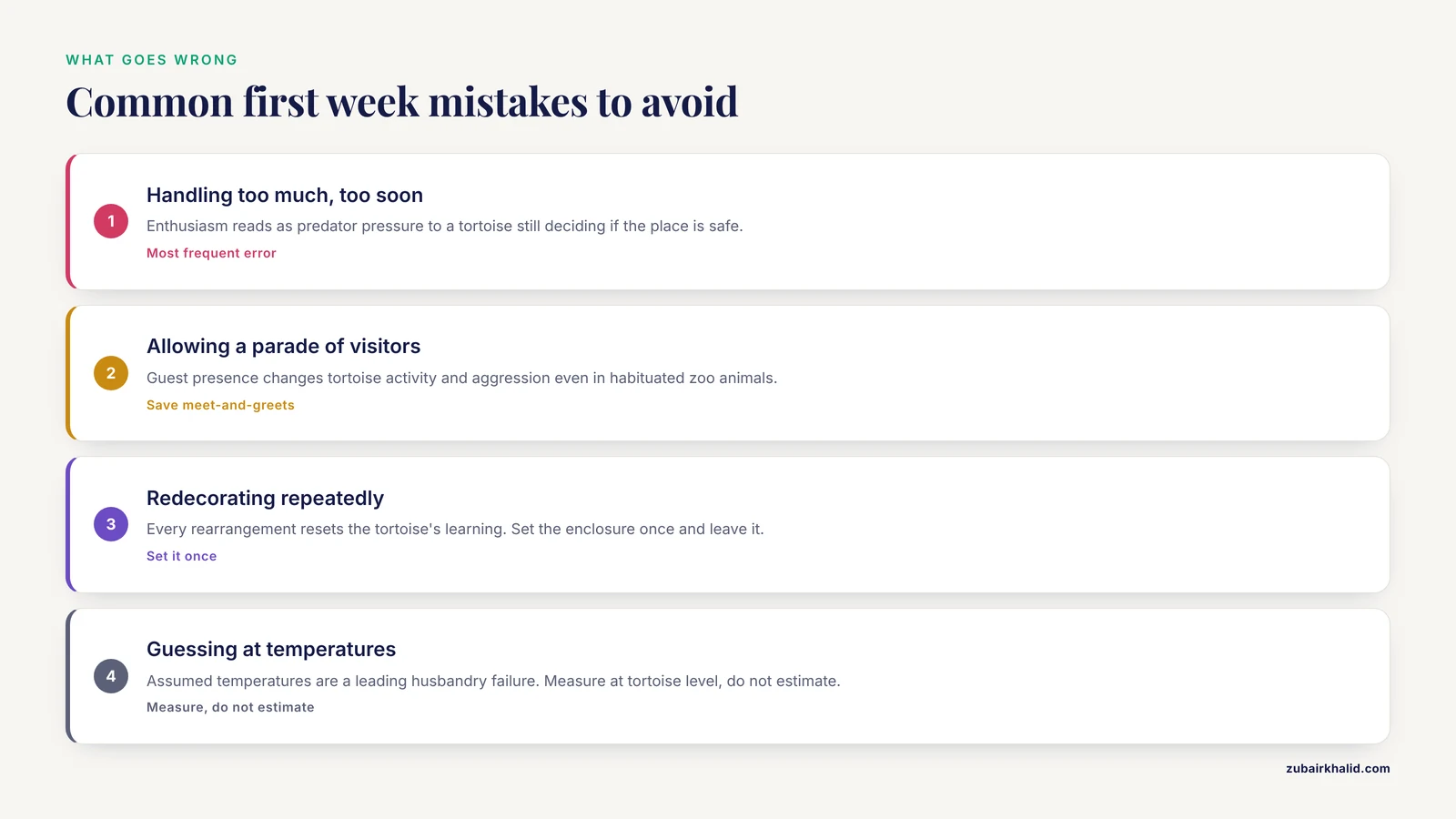
- Handling too much, too soon. This is the most frequent error. Enthusiasm reads as predator pressure to a tortoise that is still deciding whether the new place is safe.
- Allowing a parade of visitors. Guest presence changes tortoise behavior even in habituated zoo animals [8]. Save meet-and-greets for after the settling window.
- Redecorating repeatedly. Every rearrangement resets the tortoise's learning. Set the enclosure once and leave it.
- Guessing at temperatures. Assumed temperatures are a leading husbandry failure in chelonians, and inadequate husbandry is a recognized driver of the illnesses veterinarians see in these animals [10]. Measure, do not estimate.
- Changing the diet immediately. Match the previous diet first, transition later.
- Housing the new arrival with existing reptiles. Quarantine protects your current animals from pathogens the newcomer may carry silently. This applies even when both animals look completely healthy.
- Ignoring small signs. Tortoises hide illness until it is advanced, and their defensive anatomy can delay obvious symptoms [3]. Early vet input costs far less than late treatment.
Troubleshooting the First Week
My tortoise only hides. Normal for the first days, especially for shy individuals. Confirm temperatures are correct and the hide is appropriate, then give it time. Constant hiding that persists past the first week alongside refusal to eat is a veterinary conversation.
My tortoise is pacing the walls. Occasional boundary walking during early exploration is common. Repetitive pacing that dominates the day is different, and research links this pattern to chronic stress in constrained captive environments [2]. Reassess space, cover, and visual barriers, and loop in your veterinarian.
My tortoise ate on day two, then stopped. Brief dips happen. Watch weight, hydration signs, and droppings. Persistent refusal needs a call to your reptile vet.
My tortoise is active but has not passed droppings. Note the date, confirm hydration and warmth, and mention it at the first visit. Straining, swelling, or distress is an urgent same-day problem.
My tortoise seems fine, should I still see a vet? Yes. Reptiles mask disease well, and an early baseline exam with a fecal screen is the single most useful appointment you can make in the first month.
Limitations and When to Contact a Veterinarian
This article is educational and is not a substitute for veterinary diagnosis or treatment. Every tortoise, species, and household differs, and individual cases need a veterinarian, ideally one experienced with reptiles.
Contact a reptile veterinarian promptly, or seek emergency care, if you see any of the following:
- Refusal to eat extending beyond the first week, or paired with weight loss
- Any nasal discharge, bubbly breathing, open-mouth breathing, or wheezing
- Swollen or closed eyes
- Soft spots, lumps, discoloration, or foul odor on the shell
- Lethargy, weakness, or inability to right itself
- Straining to urinate or defecate, or absence of droppings with distress
- Diarrhea or strikingly abnormal droppings
- Any injury, fall, bite from another animal, or suspected ingestion of foreign material
- Signs you simply cannot classify, because with reptiles, waiting is rarely the safe choice
Your veterinarian can also confirm species-specific parameters, such as exact temperatures, humidity, lighting schedules, and diet composition, which general guides deliberately avoid prescribing across all tortoise species.
Frequently Asked Questions
How long does it take a tortoise to settle in?
Most tortoises begin eating and exploring normally within a few days to a week, and some individuals need two weeks or longer. Judge settling by behavior and weight trends rather than a fixed date, and give a shy tortoise extra quiet time before judging the transition a failure.
Should I handle my new tortoise during the first week?
Keep handling to weighing and necessary health checks only. Handling raises stress hormones in chelonians, though animals can acclimate to a consistent gentle routine over time, so build that routine after your tortoise is eating well.
What should I do if my new tortoise is not eating?
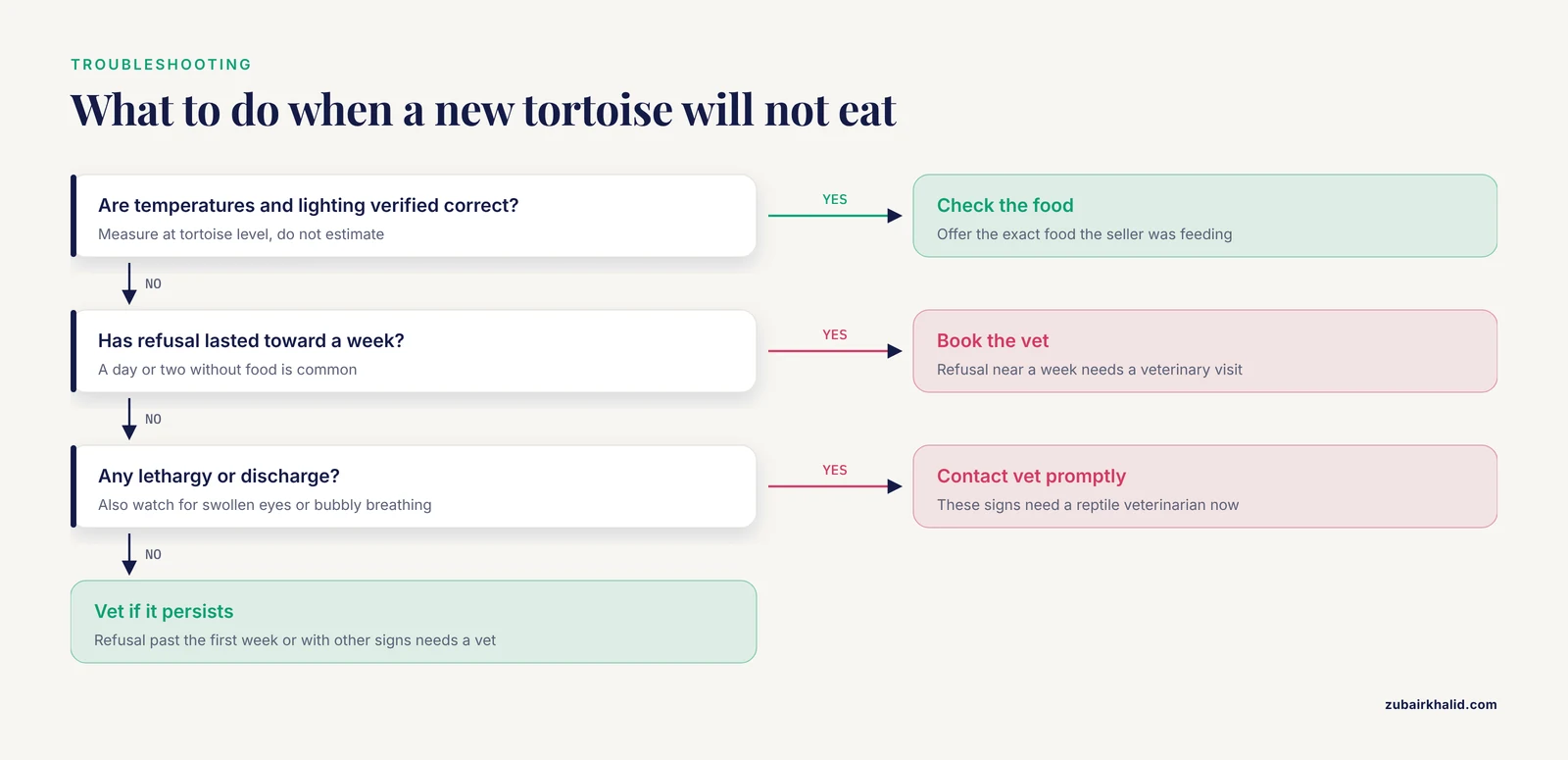
Confirm temperatures and lighting are correct, offer the exact food it was eating before, and reduce all disturbance. A day or two without food is common. Refusal that extends toward a week, or refusal with lethargy or discharge, needs a veterinary visit.
When should the first vet visit happen?
Book it within the first week of bringing your tortoise home. An early exam establishes a baseline weight and health record, screens for pre-existing parasite loads, and lets you confirm species-specific husbandry numbers with a professional.
What supplies do I need before bringing home a tortoise?
An adult-sized enclosure with a working thermal gradient, UVB and basking lighting, deep suitable substrate, hides at both temperature ends, a shallow water dish, the familiar food, thermometers and a hygrometer, a gram scale, and the contact details of a reptile veterinarian.
Can my new tortoise share an enclosure with a tortoise I already own?
Not during the first weeks. New arrivals need quarantine to protect your existing animal from pathogens the newcomer may carry without symptoms, and crowding or forced proximity is itself linked to chronic stress and aggression in tortoises. Ask your veterinarian about quarantine length and any testing before an introduction.
What does normal first week behavior look like?
Expect plenty of hiding, cautious exploration, possibly skipped meals early on, and gradually increasing basking and eating by midweek. Regular droppings, steady weight, alert eyes, and quiet breathing are the markers that the adjustment is on track.
Should friends and family be allowed to interact with the new tortoise?
Wait until after the settling window. Visitor presence measurably changes tortoise activity and aggression even in animals used to people, and a parade of new faces during week one works against the calm environment you are trying to build.
Sources
- The welfare implications of using exotic tortoises as ecological replacements.
- Ecological and Ethological Assessment of Captive Testudo graeca in an Urban Bazaar: A Case of High-Constraint Wildlife Tourism in Kastamonu, Northern Anatolia.
- Biology and medicine of turtles and tortoises.
- Behavioral Assessment of Six Reptile Species during a Temporary Zoo Closure and Reopening.
- Assessment of captive rearing conditions on loggerhead hatchlings: Effect of handling frequency and stocking density.
- Assessing preferences of two zoo-housed Aldabran giant tortoises (Aldabrachelys gigantea) for three stimuli using a novel preference test.
- Is preference a predictor of enrichment efficacy in Galapagos tortoises (Chelonoidis nigra)?
- Documenting Aggression, Dominance and the Impacts of Visitor Interaction on Galápagos Tortoises (Chelonoidis nigra) in a Zoo Setting.
- Enriching tortoises: assessing color preference.
- Turtle care and husbandry.