Bringing Home a New Leopard Gecko: First Week Guide
By Dr. Zubair Khalid, DVM, MS, PhD ·
Most leopard geckos need roughly one to two weeks to settle into a new home, and the first seven days set the tone for everything that follows. During this period your job is narrow and deliberate. You set up a correct thermal environment, you provide food and water, and then you mostly leave the gecko alone. Handling, cleaning beyond spot care, and rearranging the enclosure all wait until the animal is eating reliably and moving with confidence.
This guide walks through the settling-in timeline, a practical new leopard gecko checklist, feeding, hygiene, warning signs, and how to plan a first vet visit for a leopard gecko. The goal is a calm first week that prevents the most common problems new owners create for themselves.
At a Glance: Your First Week Checklist
| Day | Priority | Action |
|---|---|---|
| Before pickup | Setup complete | Enclosure running with heat established for at least 24 to 48 hours, all three hides in place, water dish filled |
| Day 1 | Arrival and quiet | Place the gecko in the enclosure, offer water, do not handle, do not feed if the animal arrived stressed, lights low, room quiet |
| Day 2 to 3 | Observation only | Check from a distance, spot clean if needed, offer a small first meal in the evening, remove uneaten insects |
| Day 4 to 5 | Feeding rhythm | Continue small evening feedings, confirm the gecko is using the warm and cool sides, verify temperatures with a thermometer |
| Day 6 to 7 | Health baseline | Weigh the gecko if you have a scale, photograph the skin and toes, note bowel movements, contact a reptile veterinarian if appetite or droppings are abnormal |
| Week 2 onward | Routine begins | Begin very short handling sessions only if the gecko is eating and shedding normally, schedule a wellness exam and fecal screening |
Print this table, tape it near the enclosure, and treat it as your script for the week. Resist the urge to improvise in the first days. Predictability is what a new leopard gecko needs most.
How Long for a Leopard Geico to Settle In
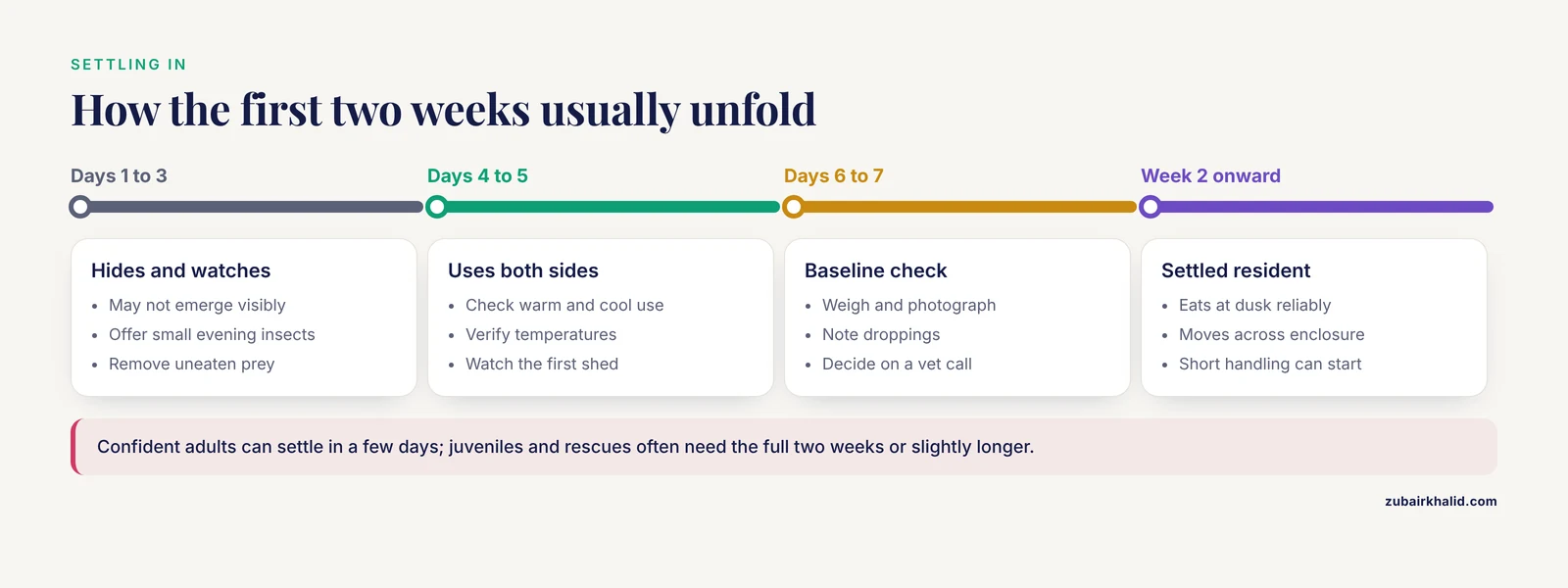
Expect most leopard geckos to need one to two weeks before they behave like residents rather than new arrivals. Some confident adults settle within a few days. Juveniles, rescues, and geckos that traveled a long distance often need the full two weeks or slightly longer.
Settling in means specific, observable things. Your gecko is settled when it:
- Eats insects offered in the evening without prolonged hesitation
- Emerges from hides at dusk and moves through the full enclosure
- Produces regular, formed droppings with a white urate portion
- Stops darting away or flattening against the floor when you approach the glass
- Sheds its skin in complete pieces rather than leaving fragments stuck to toes or the tail
The settling window matters clinically, not just behaviorally. A large UK survey of 214 leopard geckos presented to veterinary practices between 2019 and 2023 found that the most commonly reported problems were non-specific signs such as reduced appetite, weight loss, and lethargy, and that skin, gastrointestinal, and ophthalmic systems were the most affected body systems [1]. A quiet first week gives you a clean baseline. If your gecko then stops eating or becomes lethargic after settling in, you know something has changed, and that information makes your veterinarian's job far easier.
Do not interpret hiding as a problem. Leopard geckos are crepuscular and naturally spend daylight hours in shelters. A gecko that hides all day but feeds well at night is usually doing exactly what a healthy leopard gecko does.
New Leopard Gecko Checklist: Before You Bring the Animal Home
The single best thing you can do for a new leopard gecko is to have the enclosure finished and running before the animal arrives. A heat gradient that has been stable for two days tells you far more than one you are still adjusting while a stressed gecko watches.
Enclosure and Furniture
- A secure, ventilated terrarium sized for adult life. An adult leopard gecko needs floor space to establish a warm side and a cool side. Set the enclosure up for the adult size from day one so the gecko never needs a stressful move.
- Three hides minimum. One hide on the warm side, one on the cool side, and one humid hide filled with damp sphagnum moss or similar substrate. The humid hide is not optional. Incomplete shedding, called dysecdysis, was the single most common diagnosis in the UK survey of pet leopard geckos, affecting nearly 30 percent of the 214 geckos reviewed [1]. A functioning humid hide is your primary prevention tool.
- Substrate you can monitor. For the first weeks, paper towel or similar plain lining lets you see droppings clearly, track appetite indirectly, and spot problems fast. Whatever substrate you choose long term, discuss impaction and hygiene risks with your reptile veterinarian, since gastrointestinal disorders were nearly as common as skin disorders in the survey population [1].
- A shallow water dish that cannot tip, refreshed daily.
- Climbing and texture enrichment, such as cork bark, branches, and rocks, arranged so the gecko can move between hides without constant exposure.
Heating and Lighting
- A heat source creating a gradient. The gecko must be able to move between a warm digestion zone and a cooler retreat. Use a thermostat on any heat source so the surface cannot overheat.
- Two thermometers, one on each side, so you verify the gradient rather than guessing. Hygrometer readings on both sides are equally useful.
- A light cycle that matches the room. If you keep the enclosure in a room with natural day and night cycles, that is usually sufficient. Leopard geckos are most active at dusk and dawn, so expect them to ignore your daytime schedule.
Supplies on Hand
- Live insects appropriate to the gecko's size, ordered before pickup
- A shallow feeding dish and calcium dish if your breeder or veterinarian recommends one
- A small digital kitchen scale for weekly weight tracking
- Disposable gloves and a disinfectant safe for reptile enclosures
- A record book or phone note for weights, feeding dates, sheds, and droppings
One Caution About Online Advice
Artificial intelligence chatbots have become a common first stop for new reptile owners, and a 2025 study comparing two leading chatbots on leopard gecko husbandry questions found that while both gave generally accurate answers without dangerous errors, their completeness varied substantially and both showed biases, such as omitting commercial diets or recommending only larger-than-standard enclosures [2]. The study's own conclusion is the right lesson for a new owner: chatbots can be a starting point, but they do not replace an exotics veterinarian or an evidence-based written care guide. When a chatbot answer and your reptile veterinarian disagree, side with the veterinarian.
Day-by-Day: The First Week Plan
Day 1: Arrival Without Fanfare
Bring the gecko home in a secure escape-proof container, place the container inside the prepared enclosure, open it, and step back. Offer fresh water. Do not handle the gecko, do not feed heavily on this first night, and keep household traffic and noise low. Many geckos will hide immediately and may not emerge visibly for two or three days. This is normal. Check with a flashlight from a distance rather than lifting hides, which floods the animal with the exact stress you are trying to avoid.
Days 2 to 3: Observation and First Meal
Offer a small number of appropriately sized insects in the evening, when leopard geckos are naturally inclined to feed. If the gecko does not eat the first offering, remove the insects and try again the next evening. Skipping meals for several days after arrival is common and rarely an emergency in an animal with good body condition, provided it is drinking and behaving normally otherwise.
A note on insect size comes from an unexpected direction. A 2023 study on improving leopard gecko welfare found that feeding very small insects, rather than large ones, created more varied and lasting foraging activity, and that after eleven months of this approach the geckos' behavioral frequencies had almost doubled, an accepted indicator of improved well-being [3]. For a new owner, this is an easy win. Small prey items spread across the enclosure floor turn mealtime into natural foraging behavior and give your new gecko something to do besides hide.
Days 4 to 5: Confirm the Environment
By midweek, verify that the gecko is using both sides of the enclosure. If it never leaves the cool side, the warm side may be wrong. If it never leaves the warm side or rests with its mouth open, the enclosure may be too hot overall. Adjust the thermostat gradually and recheck readings. Watch the first shed. Young geckos shed frequently, and a first shed in your home tells you whether the humid hide is working.
Days 6 to 7: Baseline and Decision Point
By the end of the first week you should have enough information to make a judgment:
- Has the gecko eaten at least once or twice?
- Are droppings present and normally formed?
- Is body condition stable, with a plump tail?
- Is movement smooth, with no trembling or weakness?
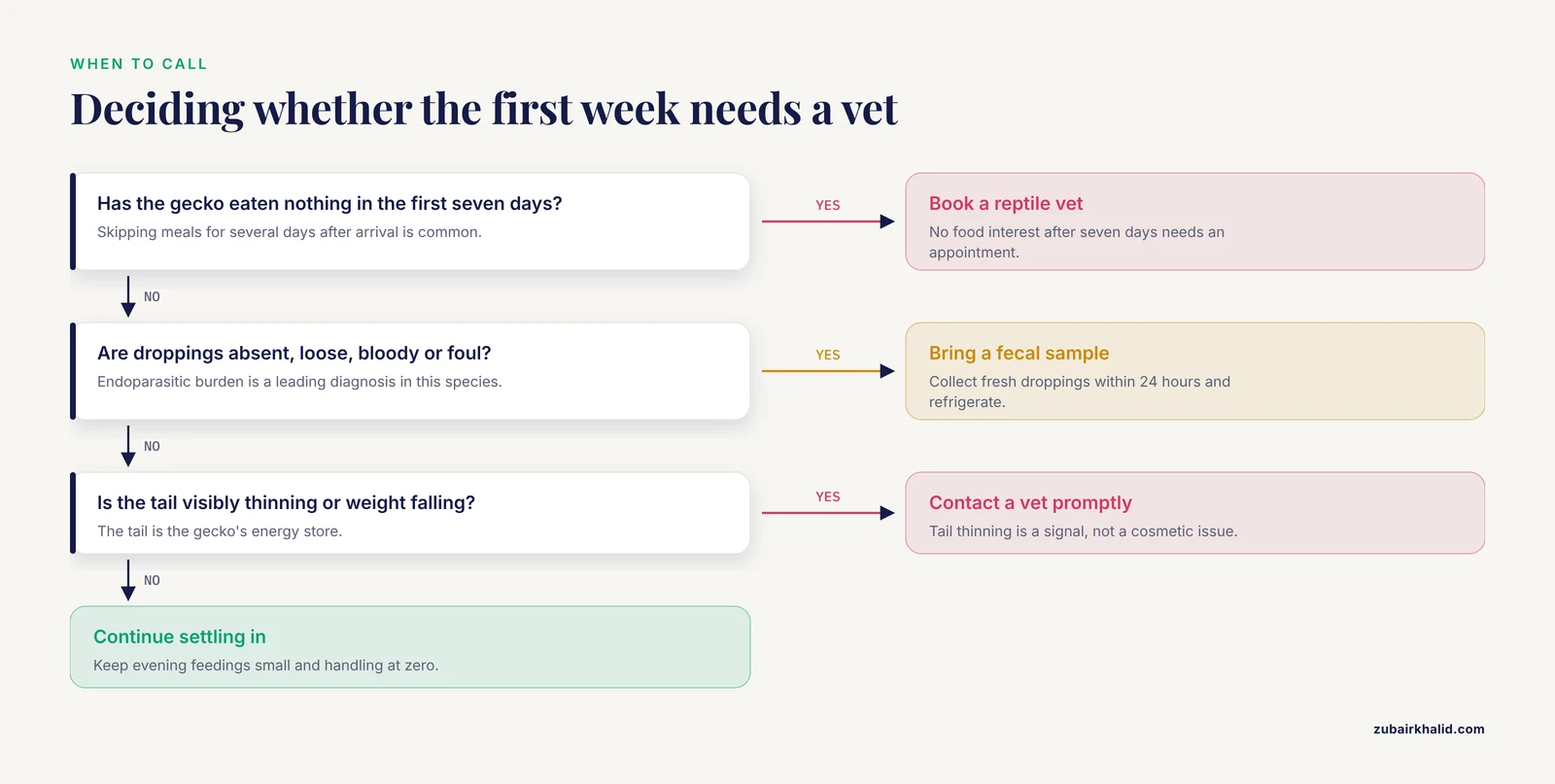
If most answers are yes, continue the settling-in plan. If the gecko has eaten nothing in the first week, has no droppings, or is visibly losing tail mass, that is your cue to book a reptile veterinary appointment rather than waiting longer.
Hygiene and Household Safety
Leopard geckos can carry bacteria that matter to human health, and the first week, with its unavoidable contact during transport and setup, is when most handling happens. A Portuguese study sampling the mouths and cloacas of healthy pet leopard geckos and bearded dragons found third-generation cephalosporin-resistant Enterobacterales in 17.9 percent of sampled reptiles, including organisms such as Citrobacter freundii and Klebsiella aerogenes carrying resistance genes [4]. Healthy-looking animals can carry resistant bacteria. This finding has three practical consequences for your household:
- Wash hands with soap and water after every contact with the gecko, its enclosure, or its equipment, and supervise any child's handwashing.
- Keep the enclosure out of kitchens and food preparation areas, and never clean equipment in sinks used for dishes.
- Do not wash enclosure items in the bathtub your family uses. Use a dedicated bucket or basin.
This is standard reptile hygiene, consistent with the general zoonotic guidance that organizations such as the AVMA provide for reptile-owning households, and it applies from day one, not only when an animal looks ill.
Health Watch List for the First Week
Knowing what commonly goes wrong in leopard geckos tells you what to watch for. The UK veterinary record survey of 214 leopard geckos identified the three most common diagnoses as dysecdysis at 29.96 percent, endoparasitic burden at 10.75 percent, and presumptive hypovitaminosis A at 9.88 percent, and it found that husbandry factors were significantly associated with several reported disorders [1]. A companion review of common conditions in the species similarly emphasizes skin, digestive, and eye disease as the core problems keepers encounter [5]. Translated into first-week observations:
- Stuck shed on toes, tail tip, or around the eyes. Check the toes and eyelids closely. Retained shed constricts digits and can damage the eye area. Increase humidity in the humid hide and seek help if shed remains after a soak-assisted attempt you and your veterinarian agree on.
- Abnormal droppings. Loose, foul-smelling, or bloody droppings in a newly arrived gecko raise the possibility of endoparasites. Bring a fresh fecal sample to your first veterinary visit, since parasitic burdens are a leading diagnosis in this species and a fecal examination is a routine part of new-reptile screening.
- Eye changes. Swollen eyelids, ribbon-like or squinting appearance, or debris around the eyes warrant a prompt call. Ophthalmic disease affected more than a fifth of geckos in the survey population [1], and eye problems in this species are strongly tied to husbandry and nutrition, which is why your veterinarian will ask detailed questions about diet and supplements.
- Tail condition. The tail is the gecko's energy store. A tail that visibly thins during the first week is a signal to contact a veterinarian, not a cosmetic issue.
- Mouth and jaw. Reluctance to close the mouth or grab insects can reflect nutritional disease or oral infection and should be evaluated.
Photograph anything abnormal on day 6 or 7. A dated photo showing progression or improvement is genuinely useful at an appointment.
First Vet Visit for a Leopard Gecko
Plan the first veterinary visit within the first two to four weeks, rather than waiting for illness. The purpose of this visit is to establish a baseline and catch the conditions this species commonly carries before they cause obvious signs.
What to Ask For
- A wellness examination by a veterinarian comfortable with reptiles. The Association of Reptilian and Amphibian Veterinarians maintains a find-a-vet resource that is the fastest way to locate an exotics-experienced clinician near you.
- A fecal examination for parasites. Given that endoparasitic burden was among the three most common diagnoses in pet leopard geckos presenting to UK practices [1], fecal screening is a reasonable standard part of establishing a new animal, and your veterinarian may recommend repeat testing or treatment based on results.
- Weight recorded in grams so future visits have a comparison point.
- A diet and supplement review. Presumptive hypovitaminosis A appeared in nearly 10 percent of surveyed geckos [1], and vitamin A status in this species is tied to what and how often the animal is fed. Bring your exact feeding plan, including supplement products, so the veterinarian can evaluate it rather than guessing.
What to Bring
- The gecko in a secure, ventilated carrier with a paper towel lining
- A fresh fecal sample, collected within the previous 24 hours and refrigerated if needed
- Photographs of the full enclosure, the thermostat and thermometer readings, and your humid hide
- A written list of feedings, what was offered, and what was eaten during the first week
- Any records from the breeder, store, or previous owner, including dates of purchase and prior treatment
Common Mistakes in the First Week
Handling too soon. The most frequent error is picking the gecko up on day one or two to show family members. Every premature grab teaches the animal that hands mean danger and lengthens the settling period.
Rearranging the enclosure repeatedly. Cleaning decorations, moving hides, and redecorating all reset the gecko's mental map of its territory. Establish a layout before arrival and leave it alone.
Feeding oversized insects. Large prey can intimidate a new gecko and may go uneaten. As the welfare research above shows, small insects actually create more activity and engagement [3], so there is no advantage to oversized prey during settling in.
Ignoring the humid hide. Because dysecdysis is the most common diagnosis in pet leopard geckos [1], a dry or unused humid hide is one of the highest-impact husbandry failures in the species. Check it daily for the first week and keep the substrate damp, not soaked.
Skipping the veterinary baseline. Many owners wait until a gecko is off food to find a reptile veterinarian. Locating one in week one, while the animal is healthy, is far easier than searching during an emergency.
Trusting a single source of advice. Whether the advice comes from a chatbot, a pet store employee, or a forum post, verify anything consequential against an exotics veterinarian [2]. Contradictory advice is the norm in reptile keeping, and your own veterinarian can resolve contradictions for your specific animal.
Limitations and When to Contact a Veterinarian
This article is educational and is not a substitute for veterinary diagnosis or treatment. Individual animals vary in temperament, age, body condition, and history, and the right pace for handling or feeding your specific gecko is a question for an in-person examination by a reptile veterinarian.
Contact a reptile veterinarian promptly, within days rather than weeks, if your new gecko shows any of the following:
- No food interest at all after the first seven days, especially with visible tail thinning
- Weight loss confirmed on a scale
- Lack of droppings for an extended period or straining to defecate
- Loose, bloody, or unusually foul droppings
- Retained shed around toes, tail tip, or eyes that does not resolve with improved humidity
- Swollen or closed eyelids, or discharge from the eyes or nose
- Trembling, weakness, reluctance to move, or difficulty righting itself
- Mouth that does not close properly or refusal to grab prey items
- Regurgitation or visible swelling of the abdomen
If you cannot reach a reptile-experienced veterinarian locally, ask a general practice clinic for a referral, or use the Association of Reptilian and Amphibian Veterinarians directory. Do not delay care hoping that appetite will return on its own once several of these signs are present together.
Frequently Asked Questions
How long for a leopard gecko to settle in?
Most leopard geckos settle in within one to two weeks. Settling in means eating reliably at dusk, moving across the whole enclosure, producing regular droppings, and no longer fleeing when you approach. Confident adults can adjust in a few days, while juveniles and rescues may need longer, and a longer adjustment alone is not a sign of illness if the animal is drinking and in good body condition.
Should I handle a new leopard gecko during the first week?
No. Wait until the gecko is eating consistently and moving with confidence, usually in the second week, then begin with very short sessions. Early handling is the most common first-week mistake and directly prolongs the stress response you are trying to avoid.
What if my new leopard gecko is not eating?
Offer small, appropriately sized insects in the evening and remove anything uneaten. Skipping meals for the first several days after arrival is common. If the gecko eats nothing during the entire first week, or shows tail thinning or lethargy, book a reptile veterinary appointment rather than waiting another week.
Does a healthy-looking new gecko still need a first vet visit?
Yes. A wellness exam with fecal screening within the first two to four weeks establishes a baseline and screens for parasitic burdens and nutritional issues that are common in this species even in animals that appear healthy. Healthy reptiles can also carry bacteria of concern to people, so baseline care protects your household as well as the gecko.
What temperature does the enclosure need?
Provide a thermal gradient with a warm digestion area and a cooler retreat, controlled by a thermostat and verified with a thermometer on each side. Confirm species-appropriate target temperatures with your reptile veterinarian or a current evidence-based husbandry guide, and never rely on a single thermometer reading or an unregulated heat source.
Can a leopard gecko carry bacteria that affect people?
Yes. Studies have found antimicrobial-resistant bacteria, including resistant Enterobacterales, in healthy pet leopard geckos. Wash your hands after every contact with the gecko or its enclosure, keep equipment out of kitchens and family bathrooms, and supervise children's handwashing after handling.
What should I feed during the first week?
Offer small live insects in the evening, sized to the gecko, and remove uneaten prey. Small insects are preferable to large ones because they encourage natural foraging behavior and have been shown to substantially increase activity and behavioral variety over time. Discuss a complete long-term diet, including any supplementation, at your first veterinary visit.
What are the warning signs during the first week?
Call a reptile veterinarian for refusal to eat past the first week, tail thinning, absent or abnormal droppings, stuck shed on toes or eyes, swollen eyelids, trembling or weakness, or a mouth that will not close properly. Multiple signs appearing together always justify an examination, not further observation.
Sources
- Husbandry factors are associated with skin, gastrointestinal and ophthalmic disorders in leopard geckos (Eublepharis macularius).
- Accuracy and Completeness of AI Chatbot Responses for Leopard Gecko (Eublepharis macularius) Husbandry: An Exploratory Comparison of ChatGPT-4o and Gemini 2.5 Pro
- Sensory Stimulation as a Means of Sustained Enhancement of Well-Being in Leopard Geckos, Eublepharis macularius (Eublepharidae, Squamata)
- ESBL/pAmpC-producing Enterobacterales in common leopard geckos (Eublepharis macularius) and central bearded dragons (Pogona vitticeps) from Portugal.
- Common conditions in leopard geckos (Eublepharis macularius)