Bringing Home a New Corn Snake: First Week Guide
By Dr. Zubair Khalid, DVM, MS, PhD ·
Bringing home a corn snake is mostly a exercise in restraint. Your job in the new corn snake first week is to provide warmth, water, hides, and quiet, and then leave the snake alone. Most corn snakes need several days to about two weeks to settle into a new enclosure. Expect hiding, refusals to eat, and defensive behavior early on. These are normal responses to a new environment, not signs of illness by themselves.
Research on captive snakes shows that housing design measurably affects chronic stress. In one study measuring corticosterone, a stress hormone, in shed skins of three pet snake species, corn snakes (Pantherophis guttatus) kept in enriched terraria had lower stress hormone levels than corn snakes kept in low-stimulus rack systems [1]. That finding matters for your first week because it points to the same conclusion experienced keepers reach: a properly furnished enclosure with places to hide and natural stimuli helps a new corn snake settle faster and cope better.
This guide walks you through the new corn snake checklist, a day-by-day plan for the first seven days, feeding and handling decisions, and the signs that mean you should contact a reptile veterinarian.
At a Glance: Your First Week Plan
Use this checklist before pickup day and during the week that follows.
| Step | When | What to Do |
|---|---|---|
| Set up the enclosure | 2 to 3 days before pickup | Assemble the vivarium, heating, hides, water bowl, and substrate. Confirm temperatures are stable before the snake arrives. |
| Find a reptile veterinarian | Before pickup | Locate an exotics or reptile veterinarian near you. The Association of Reptilian and Amphibian Veterinarians (ARAV) maintains a public veterinarian search. |
| Get feeding records | At pickup | Ask the breeder or seller for the last feeding date, prey size, and what the snake has been eating. |
| Quiet transport home | Pickup day | Transport the snake in a secure, ventilated container with no loose items. Keep the car warm and the drive calm. |
| Settle in, no handling | Day 1 to 2 | Place the snake in the enclosure, offer fresh water, and leave it alone. |
| Observe only | Day 3 to 4 | Check temperature gradients, water, and behavior from a distance. Do not handle. |
| First feeding offer | Day 5 to 7, or per breeder guidance | Offer an appropriately sized meal in the evening, when corn snakes are naturally active. |
| Gentle handling decision | Day 6 to 7 and after | Only begin short handling sessions once the snake has eaten and shows relaxed behavior. |
| Schedule a health check | Within the first weeks | Book a wellness examination with your reptile veterinarian, ideally with a fresh fecal sample. |
How Long for a Corn Snake to Settle In
There is no single timetable, but a reasonable expectation is 3 to 7 days for a young corn snake to stop acting defensive, and up to 2 to 4 weeks before it feeds confidently and explores normally. Hatchlings and newly imported or recently shipped animals usually take longer than established juveniles and adults from a reputable breeder.
Signs your corn snake is settling in:
- It comes out of the hide at dusk and moves around the enclosure.
- It flicks its tongue normally when you approach rather than striking or rattling its tail.
- It accepts a meal.
- It rests in different spots along the temperature gradient rather than pressing into one corner constantly.
Signs that settling is not going well:
- Refusing multiple meals offered over several weeks.
- Constant hiding even at night, or frantic escape behavior when you approach.
- Open-mouth breathing, wheezing, or bubbly discharge around the mouth or nostrils.
- Regurgitation after eating.
- Skin that fails to shed in one complete piece, or retained eyecaps.
Stress physiology is measurable in snakes, and the shed-skin corticosterone study found species-specific responses to housing, with corn snakes showing elevated stress markers when kept in rack systems compared with enriched terraria [1]. In practical terms, a snake that never settles may be telling you something about its environment. Review the enclosure before you assume the snake itself is the problem.
The New Corn Snake Checklist
Gather everything before the snake comes home. A warm, furnished, stable enclosure on day one is the single biggest factor in a smooth first week.
The Enclosure
Choose an escape-proof vivarium with secure, lockable lid clips. Corn snakes are active and are known escape artists. A terrarium with more floor area and some vertical climbing space supports natural behavior. The shed-skin study discussed above found that housing design affects stress in corn snakes, and that snakes of this species maintained in enriched terraria had lower corticosterone concentrations than those in rack systems [1]. If you use a rack system for practical reasons, compensate with generous tub size, hides, substrate depth, and some environmental variation.
Selection criteria for the enclosure:
- Escape-proof lid with clips, no gaps larger than a pencil.
- Enough floor space for the snake to stretch out fully, plus room for a warm side and a cool side.
- At least two identical hides, one on the warm end and one on the cool end, so the snake never has to choose between feeling safe and thermoregulating.
- A water bowl large enough for the snake to soak in, kept on the cooler side to slow evaporation.
- Ventilation that allows air movement without dropping humidity excessively.
Heating
Corn snakes need a thermal gradient, meaning a warm zone and a cooler zone within the same enclosure, so the snake can move between them. Heat mat heat alone is outdated for this species. A thermostatically controlled heat source, typically an over-tank heat mat plus or instead of a low-wattage basking lamp, is the modern standard. Every heating device must be connected to a quality thermostat with the probe placed where the snake actually rests.
Do not guess at settings. Reliable husbandry references, including the reptile sections of the Merck Veterinary Manual, publish species-appropriate temperature ranges. Write those target ranges down, set your thermostat, and verify with at least one thermometer on the warm side and one on the cool side. A temperature gun is useful for checking surface temperatures on the basking spot.
Lighting
A day and night cycle supports normal activity. Corn snakes are crepuscular, meaning most active at dawn and dusk, so a simple LED day light on a timer is sufficient for a visible light cycle. Keepers and veterinarians increasingly provide low-output ultraviolet B lighting for diurnal and crepuscular snake species as part of modern husbandry. Discuss UVB use and positioning with your reptile veterinarian or an evidence-based husbandry resource such as ReptiFiles, which publishes detailed, cited corn snake care guides.
Substrate and Furnishings
- Aspen bedding or a suitable paper-based substrate several inches deep allows natural burrowing behavior.
- Cork bark, branches, and sturdy fake plants add cover and climbing opportunities.
- Clutter is good. The enriched terraria in the corticosterone study were precisely this kind of complex environment, and corn snakes in those conditions showed the lowest stress readings of the housing types compared [1].
- Avoid pine and cedar products, which contain aromatic compounds unsuitable for reptile enclosures.
Feeding and Handling Supplies
- Prey items matched to what the snake was already eating, confirmed with the seller.
- Feeding tongs, a separate container or feeding tub if you prefer feeding outside the enclosure, and a thermometer or temperature gun.
- A lockable lid or door and a hand sanitizer station near the enclosure.
Setting Up Before You Bring Your Corn Snake Home
Assemble and run the enclosure two to three days before pickup. New heating equipment needs time to prove itself, and you want to catch any thermostat faults while there is no animal inside.
Step by step:
- Place the enclosure away from direct sun, drafts, speakers, and household traffic.
- Install the thermostat and heat sources. Set the thermostat and let everything run for a full day.
- Verify the gradient with thermometers on both ends. Adjust until the warm and cool zones hold steady.
- Add substrate, then place the water bowl on the cool side.
- Place two identical hides at opposite ends of the temperature gradient.
- Add branches, cork, and cover so the snake can move across the enclosure without being fully exposed.
- Fill and condition the water bowl. Provide fresh, dechlorinated water.
- Record your readings. Photograph the thermometer displays so you have a baseline for comparison during the week.
Bringing Home a Corn Snake: Day by Day
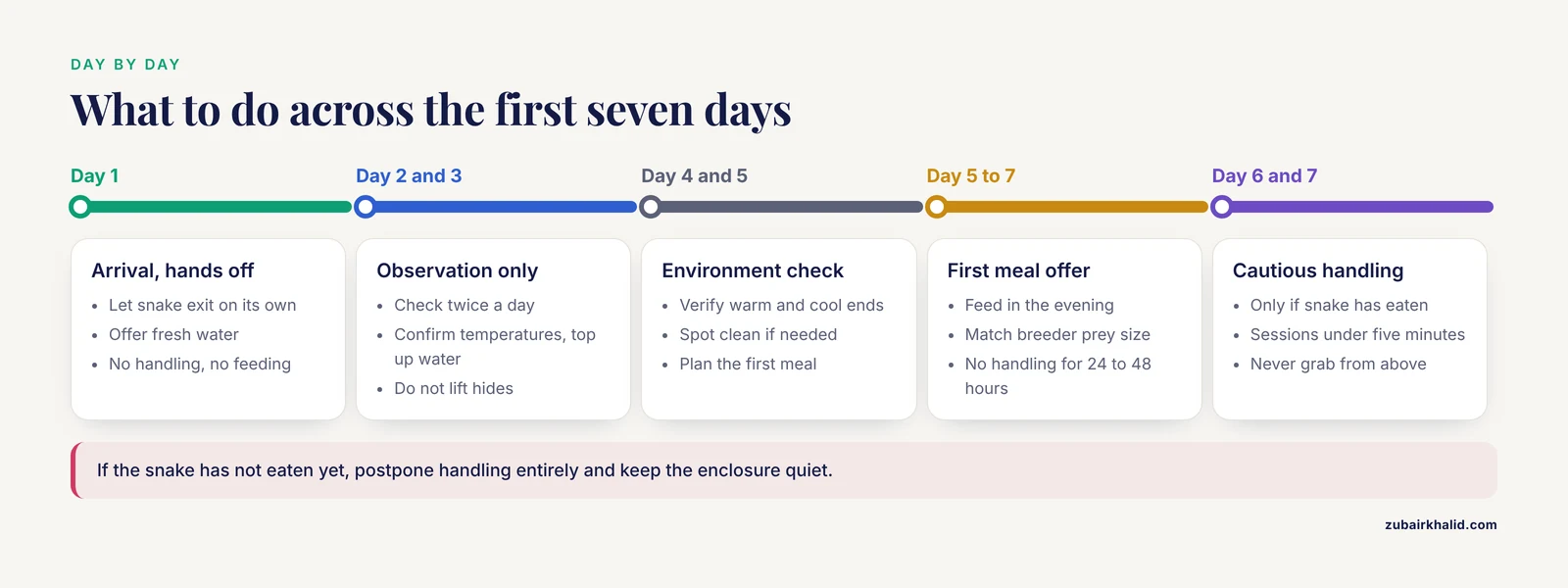
Day 1: Arrival and Hands-Off Time
Transport the snake home in a ventilated plastic container or cloth bag inside an insulated carrier. Do not transport it loose in the car. Keep the vehicle comfortably warm.
When you arrive:
- Open the enclosure, place the container inside, open the container lid, and let the snake exit on its own. If it does not move after several minutes, gently guide it out without grabbing.
- Offer fresh water.
- Close the enclosure, dim the lights, and leave the room quiet.
- No handling, no feeding, no photographing with flash. Day one is about reducing stimulation.
Do not bathe the snake on arrival. Do not treat it for mites prophylactically unless your veterinarian has advised a specific protocol.
Day 2 and Day 3: Observation Only
Check the enclosure twice a day with the lights on, ideally at dusk when the snake may be more visible. Confirm temperatures, top up water, and look for droppings. Do not lift hides or disturb the snake to see it. A corn snake that stays hidden for days is behaving normally.
Wash your hands before and after any contact with the enclosure or water bowl. This protects the snake from residues on your hands and protects your household from Salmonella, which reptiles can carry. The AVMA provides reptile owner guidance on hygiene and safe handling that applies here.
Day 4 and Day 5: Environment Check and First Meal Decision
By now the snake should be moving at dusk and evening. Verify the warm end and cool end temperatures once more, and spot clean if needed.
Offer the first meal around day 5 to 7, or follow the breeder's schedule if the snake was fed recently. Ask at pickup when the snake last ate. Offering food too soon after transport often wastes a prey item and adds disturbance. When you do feed:
- Feed in the evening.
- Match the prey type and size to the breeder's records.
- For frozen-thawed prey, warm it thoroughly and never microwave it. Use warm water to thaw and a hair dryer or warm water to bring the prey to a mouse-like warmth at the head.
- Offer with tongs, slowly, and leave the room if the snake strikes and constricts.
- Do not handle for at least 24 to 48 hours after the snake has eaten, since handling too soon can contribute to regurgitation.
Day 6 and Day 7: First Handling, Cautiously
If the snake has eaten and shows relaxed, tongue-flicking behavior in the evening, you can begin very short handling sessions. Keep the first sessions under five minutes, support the body, never grab from above, and always return the snake before it gets cold or stressed. Avoid handling for roughly a day after any meal. If the snake has not yet eaten, postpone handling entirely.
Feeding Your New Corn Snake
Corn snakes are rodent eaters, and most captive-bred animals eat frozen-thawed mice. Match prey size to the snake. A practical rule many keepers and breeders use is prey no wider than the widest part of the snake's body. Confirm the exact size and schedule with your seller, because growth stage changes what is appropriate.
Common first-week feeding problems and responses:
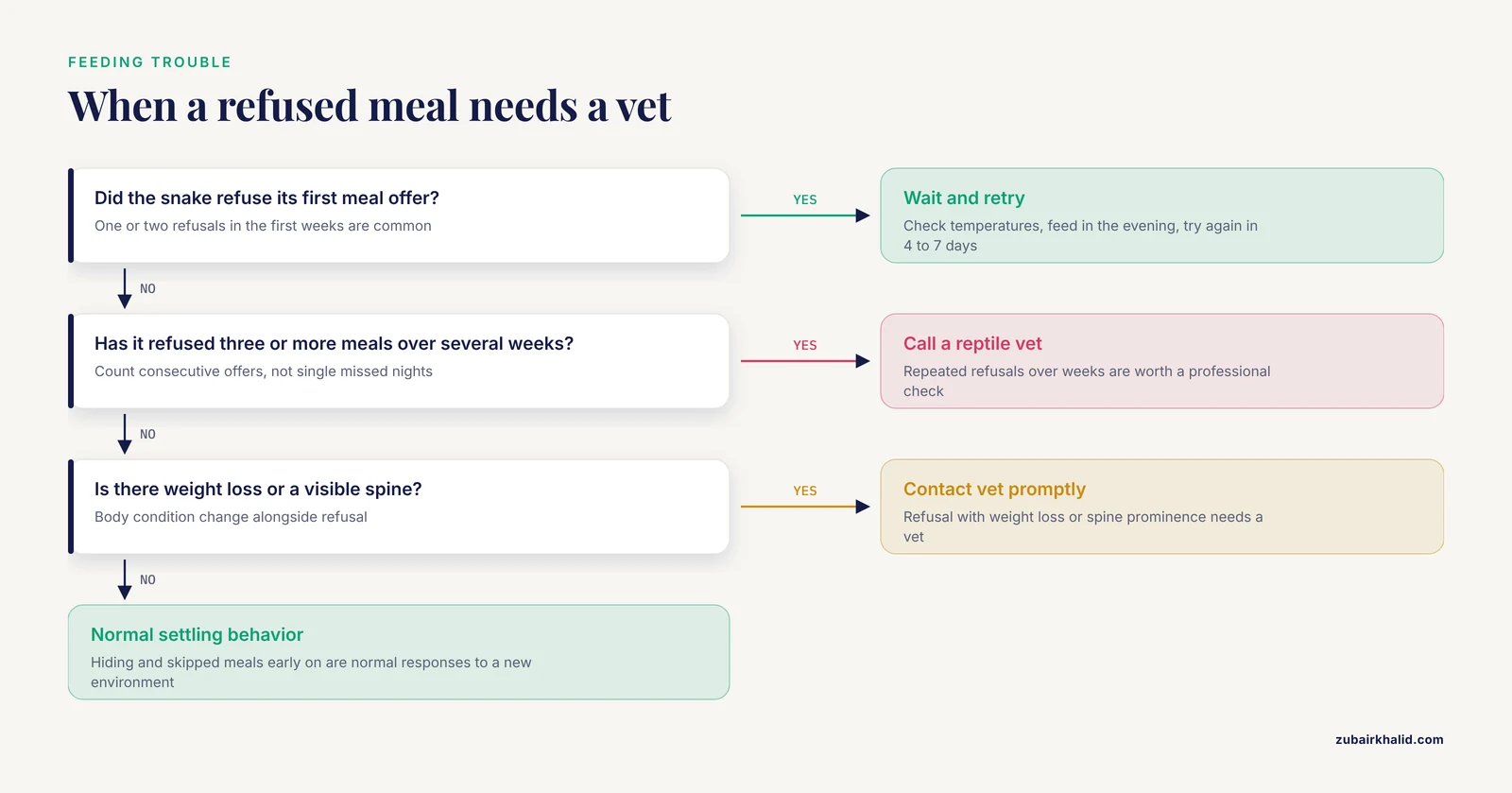
- Refusal at the first offer. Wait 4 to 7 days and try again. One or two refusals in the first weeks are common and rarely urgent in a healthy animal with good body condition.
- Strikes but does not eat. Try feeding in the evening, in a darker and quieter setting, or leave the prey item in the enclosure overnight if your substrate allows safe removal of an uneaten item the next morning.
- Only eats live. A snake established on live prey may need a gradual transition to frozen-thawed. Ask the seller what the snake has actually been eating before you buy a freezer stockpile.
- Regurgitation. Stop all handling, review temperatures at the digestion zone, wait roughly two weeks before offering a smaller meal, and contact your reptile veterinarian if it happens more than once.
Stress, Housing, and What the Science Says
Corticosterone is the primary stress hormone in reptiles, and researchers can measure it non-invasively from shed skins, which makes it a practical welfare marker for pet snakes. The study by Zieliński and colleagues compared corn snakes, rosy boas (Boa imperator), and ball pythons (Python regius) housed in either low-stimulus rack systems or enriched terraria [1]. Two findings matter directly to a new corn snake owner.
First, corn snakes in that study showed higher corticosterone concentrations overall than the boa and python species measured [1]. Corn snakes are active, curious animals, and their welfare appears especially sensitive to how stimulating their housing is.
Second, the housing effect ran in opposite directions for different species. Ball pythons in enriched terraria had higher corticosterone than ball pythons in racks, while corn snakes showed the reverse pattern, with elevated corticosterone in rack-housed animals [1]. There is no universal best housing system across snake species. For a corn snake specifically, an enriched terrarium with hides, deep substrate, climbing structure, and cover is well supported by this evidence.
Enrichment is not decoration. In a newly arrived snake, cover and complexity reduce the perceived exposure of moving around the enclosure, which is one reason the day-by-day plan above emphasizes hides on both temperature gradients and clutter across the floor.
Common First Week Mistakes
- Handling too soon. The most frequent error. Handling on day one or two prolongs settling and increases defensive behavior.
- Feeding on day one. A stressed snake often refuses, and the wasted prey item plus the disturbance set you back further.
- One hide instead of two. A single hide forces the snake to pick between safety and correct temperature, and the snake will usually pick safety and sit at the wrong temperature.
- No thermostat, or a probe in the wrong place. Unregulated heat sources cause burns and overheating deaths. The probe must sit at the snake's level where the animal rests.
- Redecorating daily. Every change resets the settling clock. Set the enclosure up well, then leave it alone for the first week.
- Bathing on arrival. Unnecessary, stressful, and it delays settling.
- Cohousing. Never house corn snakes together, regardless of age or size. Snakes are solitary, and cohousing risks feeding accidents, stress, and disease transmission.
- Skipping the quarantine period. If you own other reptiles, keep the new arrival in a separate room with separate tools and handwashing for a quarantine period, typically 60 to 90 days, a length your veterinarian can tailor to your collection.
The First Vet Visit for a Corn Snake
Book a wellness examination with a reptile-experienced veterinarian within the first weeks, before any problem appears. ARAV is the primary professional organization for reptile medicine in the United States and offers a public tool for finding a qualified veterinarian. Not all companion animal clinics see reptiles, so confirm experience with snakes specifically.
What a typical first visit includes:
- A full physical examination, including weighing the snake, checking body condition, examining the mouth, eyes, skin, and vent, and palpating the body.
- A discussion of husbandry, ideally with your enclosure temperatures, prey records, and shedding history documented.
- A fecal examination for parasites. Bring a fresh dropping in a sealed bag if your snake has defecated, or collect one during the first week and refrigerate it briefly, within the window your clinic recommends.
- Baseline advice on quarantine, feeding progression, and shedding support.
New acquisitions are where most preventable reptile illness is caught early. A snake that looks fine can still carry parasites, which is why a fecal test on a clinically healthy new pet is standard practice in reptile medicine. If the seller or breeder has recent veterinary records, bring them.
Limitations and When to Contact a Veterinarian
Every corn snake is an individual, and this guide cannot replace an examination by a veterinarian who has seen your animal. Individual cases need a veterinarian, especially when the snake is a hatchling, was recently shipped, or came from an unclear background.
Contact a reptile veterinarian promptly, within 24 to 48 hours, if you see any of the following in the first week or shortly after:
- Open-mouth breathing, audible wheezing, or discharge from the nostrils or mouth.
- Regurgitation, especially more than once.
- Refusal of three or more consecutive meals offered over several weeks, or any refusal combined with visible weight loss or spine prominence.
- Lethargy outside normal hiding, such as a snake lying flat, limp, or upside down.
- Blisters, discoloration, sores, or any suspected mites, which appear as tiny moving specks around the eyes, heat pits, or vent.
- A shed that comes off in patches, retained eyecaps, or a stuck tail tip.
- Visible swelling, a mass, or a kinked or painful section of the body.
- Any bite wound, escape injury, or encounter with another pet.
Go to an emergency or urgent care reptile facility for a snake that is unresponsive, bleeding, actively regurgitating, or showing severe respiratory distress.
This article is educational and is not a substitute for veterinary diagnosis or treatment.
Frequently Asked Questions
How long for a corn snake to settle in?
Most corn snakes settle within 3 to 7 days and feed confidently within 2 to 4 weeks. Hatchlings and recently shipped animals can take longer. Judge settling by behavior, not the calendar, and keep handling off until the snake eats and moves normally at dusk.
Should I handle my new corn snake during the first week?
No. Wait until the snake has accepted at least one meal and moves calmly in the evening. Then begin with sessions under five minutes and avoid handling for a day after any meal.
When should I feed my corn snake for the first time?
Most keepers offer the first meal around day 5 to 7 after arrival, or sooner if the breeder's records show the snake is due. Ask for the last feeding date at pickup and follow that schedule.
What if my new corn snake refuses to eat?
One or two refusals in the early weeks are usually normal settling behavior. Check temperatures, feed in the evening, and try again 4 to 7 days later. Contact a reptile veterinarian if refusals continue over several weeks or if the snake is losing body condition.
Does a corn snake need a first vet visit even if it looks healthy?
Yes. A wellness examination with a fecal parasite test is standard for new reptiles, because a snake can look healthy while carrying parasites. Book the visit within the first weeks and bring your husbandry records and a fresh dropping if available.
Should my corn snake live in a rack system or a terrarium?
Research measuring stress hormones in shed skins found that corn snakes showed higher stress levels in rack systems than in enriched terraria, the opposite pattern seen in ball pythons [1]. An enriched terrarium is the better-supported choice for this species, though a well-furnished, appropriately sized rack tub can be made to work.
Is it normal for a new corn snake to hide all day?
Yes. Corn snakes are crepuscular and a newly arrived snake will often stay hidden for days. Constant hiding, even at night, combined with refusing food, frantic escape attempts, or other signs on the escalation list above, warrants a veterinary call.
Can I put my new corn snake in with my other snake?
No. House corn snakes singly at all times. New arrivals also need a quarantine period away from your existing reptiles, typically 60 to 90 days, with separate equipment and handwashing, and your veterinarian can adjust that timeline for your situation.