How to Set Up a Reptile Fogger: Step-by-Step Guide
By Dr. Zubair Khalid, DVM, MS, PhD ·
Setting up a reptile fogger correctly takes about thirty minutes of planning and involves five decisions that determine whether the device helps or harms your animal. You need to confirm that fogging actually suits your species, mount the unit outside the enclosure with the fog line entering above the water level, fill the reservoir with demineralized water, connect the fogger to a calibrated hygrometer and timer rather than running it continuously, and establish a cleaning schedule before the first use.
A fogger is one tool within a complete humidity strategy. Reptile wellness frameworks consistently identify environmental management, including temperature and humidity, as the foundation of preventive health in captive reptiles [1]. Research on lizards shows that humidity is not cosmetic either. Evaporative water loss in lizards changes measurably after just over a week of exposure to a new humidity regime, which means the moisture environment you build shapes your animal's physiology, not just its appearance [2].
This guide walks through the full setup process, the physiology behind each decision, the mistakes that send keepers to the veterinarian, and the warning signs that mean humidity problems have already become medical ones.
At a Glance: Fogger Setup Checklist
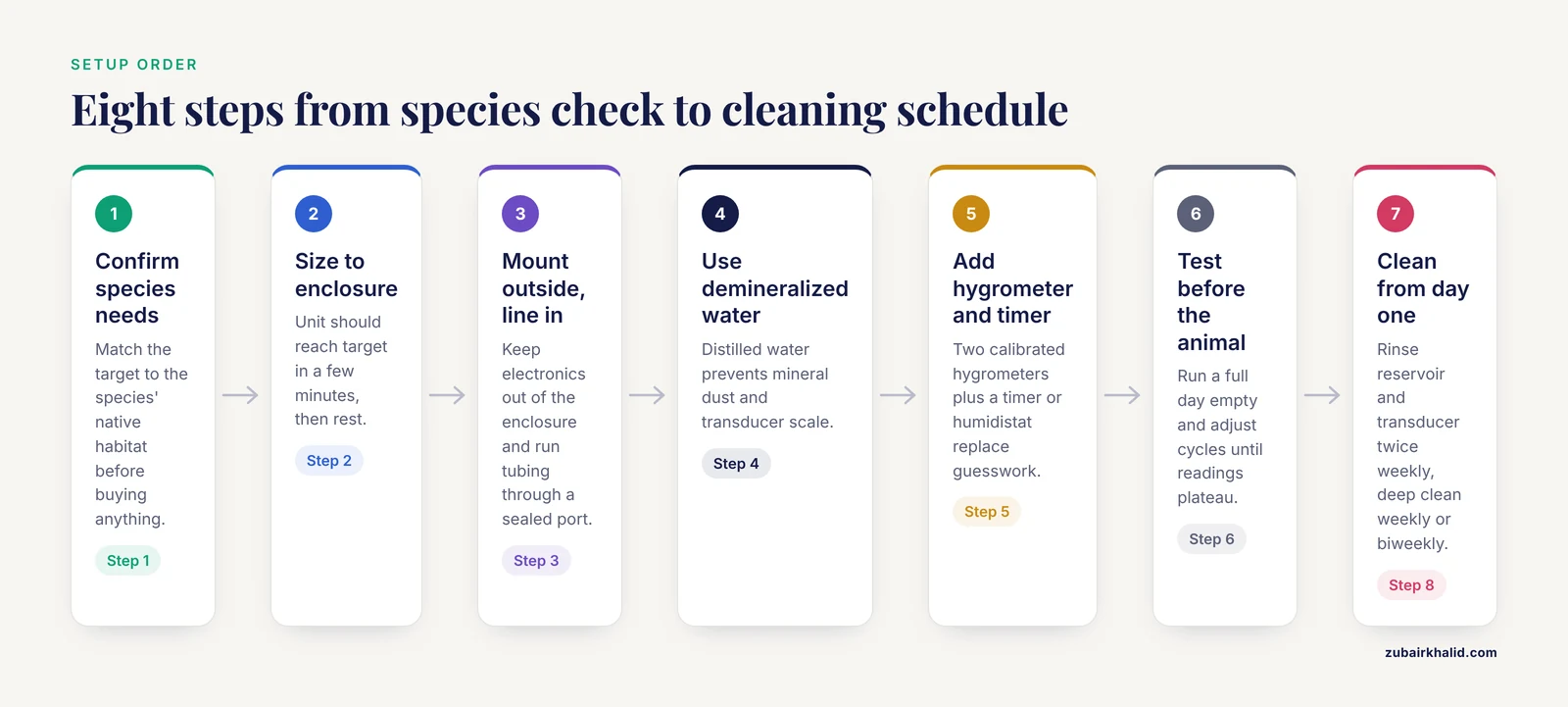
| Step | Action | Why It Matters |
|---|---|---|
| 1 | Confirm your species needs fogging | Arid-adapted species can be harmed by chronic dampness |
| 2 | Size the fogger to the enclosure volume | Undersized units run constantly, oversized units flood the air |
| 3 | Mount the unit outside, run the line in | Protects electronics from condensation and the animal from equipment |
| 4 | Use demineralized water | Prevents mineral dust and residue buildup |
| 5 | Position the nozzle above substrate, away from the animal | Fog should humidify air and surface layers, not soak one spot |
| 6 | Pair with a calibrated hygrometer and timer | Measured control beats guesswork in any humidified environment [3] |
| 7 | Test on a dry day and adjust cycle length | Establishes your baseline before you rely on automation |
| 8 | Set a cleaning and descaling schedule | Stagnant reservoirs and mineral deposits degrade output and hygiene |
Complete all eight steps before you introduce or return an animal to the enclosure. A fogger installed mid-problem tends to mask husbandry errors rather than fix them.
Why Humidity Equipment Matters for Reptile Health
Reptiles are ectotherms whose water balance is tightly coupled to their surroundings. Unlike mammals, most reptiles excrete nitrogen as semi-solid urates, an adaptation that conserves water but depends on the animal staying adequately hydrated in the first place. Recent work characterizing urate excretions across twenty-one reptile species, including the ball python, shows that these excretions are complex crystalline materials that also sequester salts and even ammonia, and their composition varies with the animal's physiology [4]. In practical terms, a dehydrated reptile cannot manage waste the way its body is designed to, and the urates you see in the enclosure are one of the few visible windows into hydration status.
The humidity you maintain in the air and substrate directly drives water exchange across the skin and lungs. In controlled acclimation experiments, Western fence lizards shifted their cutaneous evaporative water loss in response to whether they were kept in dry or humid conditions, with animals in hot, humid conditions showing the greatest changes [2]. This plasticity cuts both ways. A reptile maintained in an enclosure that is too dry may chronically lose water across its skin and respiratory surfaces, while one held in saturated air with poor ventilation loses the ability to dry out at all.
Drier air also stresses the respiratory tract itself. Reviews of airway physiology describe how low-humidity conditions disrupt the thin liquid layer that lines the airway surface, impairing mucociliary clearance and increasing susceptibility to inflammation and infection [5]. The same principle applies to any vertebrate breathing continuously dry or continuously saturated air. Reptiles with chronic respiratory disease are among the patients veterinarians most often see after well-intentioned humidity equipment is misconfigured.
Species from semi-arid habitats illustrate why one setting never fits all. Field studies of Brazilian Caatinga lizards found that soil temperature and humidity significantly influenced body condition and water uptake across three species, and that the rocky-dwelling species absorbed less water when offered it, suggesting better baseline hydration from its microhabitat [6]. Your animal's enclosure needs to reproduce its native microhabitat gradients, not a single uniform fog-soaked climate.
Where a Fogger Fits in Your Reptile Enclosure Setup
A fogger is an ultrasonic device that vibrates water into a cold visible mist and pushes it through a tube into the enclosure. It differs from two related devices that keepers often confuse.
- Fogger: produces fine suspended mist. Best for raising ambient humidity quickly and for creating a humidity pulse, such as an evening fog in a tropical vivarium.
- Mister or pump sprayer: produces larger droplets that wet surfaces. Best for species that drink water droplets off leaves and glass.
- Humidifier (room type): raises humidity in the whole room. Useful indirectly, rarely sufficient alone for a glass enclosure.
Most keepers combining these tools get better results than with a fogger alone, because a fogger raises air humidity but does little to wet the deep substrate layers where burrowing species retreat. Reptile enclosure setup for a humidity-loving species typically includes moisture-retentive substrate depth, live or artificial foliage for cover, a full-body water dish, and a partially enclosed humid hide, with the fogger as the automated top-up rather than the primary source.
Resources such as the Merck Veterinary Manual's exotic animal section, VCA Animal Hospitals' reptile care guides, ARAV (the Association of Reptilian and Amphibian Veterinarians), and the evidence-based husbandry guides at ReptiFiles all converge on the same principle: identify the species' natural history first, then choose equipment. A fogger belongs in the plan for cloud forest geckos, many salamander-adjacent amphibian setups, and tropical snakes. It usually has little or no role for desert species kept properly with a dry gradient and localized humid hides.
How to Set Up a Reptile Fogger Step by Step
Step 1: Confirm Your Species Actually Needs Fogging
Before you buy or unbox anything, write down your species' native habitat type and match your target to it. The physiological literature reinforces how different these targets are. Lizards acclimated to hot, humid conditions changed their water loss physiology within days [2], while semi-arid species rely on specific soil and air conditions to maintain hydration [6]. A fogger set up for a desert species' enclosure can create constant dampness the animal's skin and respiratory system were never designed to handle.
If you are unsure where your species falls, this is a specific question to bring to an exotics veterinarian or to verify against the husbandry literature for that exact species and locale. Regional variants of the same species can differ.
Step 2: Size the Fogger to the Enclosure Volume
Foggers are rated by tank capacity and output rate. Match the unit to your enclosure rather than buying the largest available. A small terrarium with an oversized fogger will saturate in minutes, then swing back down between cycles, creating humidity spikes rather than a stable plateau. A large custom enclosure with an undersized unit will run nearly continuously, which shortens the life of the transducer and keeps the reservoir warm, encouraging microbial growth.
As a planning rule, the unit should be able to raise your enclosure from baseline to target within a few minutes of output and then rest. If it cannot, you either need a larger unit or, more often, better humidity retention in the enclosure itself through covered screen tops, deeper substrate, and sealed seams.
Step 3: Mount the Unit Outside the Enclosure With the Line Running In
Place the fogger on a stable surface beside or below the terrarium, never inside it. Ultrasonic units generate heat at the transducer and house electronics that condensation can damage. Run the supplied tubing through a sealed port in the enclosure wall or up over the back rim, and secure the nozzle end inside.
Two placement rules inside the enclosure:
- Keep the nozzle above the substrate surface and above the water dish line. Fog pushed directly into standing water or saturated substrate condenses immediately and wastes output.
- Aim the nozzle so mist disperses across foliage rather than settling on one basking surface or the animal's preferred resting spot. A cold mist falling directly on a reptile for extended periods creates a localized chill zone the animal cannot escape.
Step 4: Choose and Handle Water Correctly
Use distilled or demineralized water in the reservoir. Tap water, especially hard tap water, carries dissolved minerals that ultrasonic agitation throws into the air as a fine powder that settles on enclosure surfaces and foliage, and that scales the transducer over time. Some units include a demineralization cartridge. If yours does, replace it on the manufacturer's schedule rather than waiting for visible output decline.
Never add anything to the reservoir. No substrate additives, no antimicrobial drops marketed for humidifiers, nothing beyond the water the manufacturer specifies. Additives in ultrasonic units become aerosols your animal inhales.
Step 5: Connect a Calibrated Hygrometer and a Timer or Humidistat
This step separates working systems from guesswork. The one rigorously documented humidified-environment study in the veterinary literature made its point through measurement. Researchers converting an entire room into a functional incubator for premature low-birth-weight neonates mounted a hygrometer directly beside the subjects and actively maintained the room between 70 and 80 percent relative humidity, adjusting conditions against that measured reading rather than assuming them [3]. The lesson transfers directly: a humidity number you are not measuring is a humidity number you do not have.
Install at least two digital hygrometers, one at basking height and one inside the humid hide or at substrate level, and calibrate them against a known reference salt method or against each other. Connect the fogger to a timer for scheduled pulses, or, better, to a humidistat probe that switches the unit off at your target reading. Continuous fogging is almost never correct. Nighttime pulse cycles timed to your species' natural humidity rhythm generally outperform constant output because they mimic the natural dew point drop and give the enclosure a daily drying period.
Step 6: Run and Calibrate Before the Animal Depends on It
Run the system for a full day with the enclosure empty or occupied only by plants, checking both hygrometers hourly if you are home. Adjust cycle length and frequency until the readings plateau in your species' target range with the fogger off for meaningful portions of the day. Note where fog pools, where it never reaches, and whether the screen top bleeds humidity faster than the unit can supply it. Fix those enclosure-level problems now, because a fogger running constantly against a leaky lid is a failing system wearing the costume of a working one.
Step 7: Fold the Fogger Into a Full Reptile Care Checklist
A fogger only functions as part of a husbandry system. Professional reptile wellness management is organized around exactly this kind of integrated environmental and preventive care planning [1]. Build your written reptile care checklist around the fogger so every element supports it:
- Thermal gradient with measured basking and cool-zone temperatures, since humidity readings are meaningless without the temperature context that defines vapor pressure
- Moisture-retentive substrate at a depth appropriate for the species, changed on schedule
- A humid hide containing damp sphagnum or similar, used during sheds
- Fresh water available at all times, since drinking remains a primary hydration route regardless of air humidity
- Daily visual checks of urate quality, shed completeness, appetite, and activity
- Weekly hygrometer checks and fogger reservoir cleaning
- A logbook or app note of daily high and low humidity readings
That last pair matters because urates are a real-time hydration readout. The same crystal chemistry that lets reptiles conserve water also produces visible changes when the system is stressed, and reviewing waste quality as part of routine care turns your daily observation into physiological monitoring [4].
Step 8: Establish the Cleaning Schedule From Day One
Clean the reservoir and rinse the transducer at least twice weekly, and deep clean the entire unit per the manufacturer's instructions on a fixed weekly or biweekly schedule. Ultrasonic reservoirs are warm, still-water environments where biofilm develops quickly, and any device that aerosolizes water can aerosolize what grows in that water. Drain the reservoir fully between uses if the manufacturer permits it. Replace tubing and nozzle components on the schedule the manufacturer states, since internal surfaces you cannot see or scrub accumulate film.
Reptile Fogger Tips That Improve Results
These tips address the gaps most often left after a technically correct installation.
Target the substrate, not the ceiling. Fog that drifts up and out of an open screen top accomplishes nothing. Direct the nozzle downward and outward through foliage so mist loses momentum, cools, and settles into the lower half of the enclosure where the animal actually lives.
Create a pulse, not a fog bank. One longer evening cycle typically outperforms short bursts all day. The daily drying window is not a failure of the system. It is part of the design, and it prevents the constant saturation that favors bacterial and fungal growth on skin and in substrate.
Watch the animal, not only the gauge. Hygrometers measure air. Reptiles respond to the whole thermal and hydric environment. The acclimation research shows plasma osmolality and body condition respond differently to temperature and humidity manipulations, and that individual animals within the same treatment varied considerably [2]. Two animals in the same enclosure can need different microhabitats, which is exactly why a proper enclosure offers a humidity gradient alongside the temperature gradient.
Match fogging schedule to activity pattern. Nocturnal and crepuscular tropical species typically benefit from evening fog that mirrors natural nighttime humidity rise. Diurnal desert-adjacent species that need only a humid hide rarely benefit from enclosure-wide fogging at any hour.
Quarantine new equipment smells. New plastic units can off-gas. Run any new fogger outside the animal's room for a full reservoir cycle first, and confirm no odor remains before installing the line.
Reptile Fogger Common Mistakes
These are the errors that turn a helpful device into a veterinary problem.
1. Running the fogger continuously. Constant saturation without a drying period promotes bacterial and fungal growth on the animal's skin, in the substrate, and inside the device. Stable humidity is the goal, and stability includes a measured dry phase.
2. Skipping the hygrometer. Setting a fogger by feel and by the visible plume is the most common single failure. Humidified environments require direct measurement and active adjustment against that measurement, as the incubator-room model demonstrated [3]. Cheap hygrometers drift, so verify calibration periodically.
3. Using tap water in hard-water regions. Mineral aerosol coats every surface, clogs foliage, and scales the transducer until output collapses. The fix costs pennies compared to the replacement and cleaning burden.
4. Placing the nozzle over the water dish or heat source. Fog condensing into a dish fouls the water, and fog meeting a hot basking surface behaves unpredictably, locally spiking humidity and heat interaction in ways that stress the animal.
5. Treating the fogger as the whole humidity plan. No fogger substitutes for correct substrate depth, a humid hide, adequate cover, and ventilation design. Keepers who lean on the device instead of the enclosure usually discover the problem when an animal spends a complete shed cycle stuck in dry air anyway.
6. Ignoring the dry-side warning signs. Overcorrection happens. A keeper worried about dryness can push humidity so high that condensation runs down the glass and the animal sits perpetually damp. Respiratory disease risk rises in poorly ventilated, saturated enclosures, and the airway physiology literature explains why continuously unfavorable air conditions degrade mucosal defenses [5].
7. Pointing fog at the animal for long durations. A reptile parked under a cold mist column loses heat through evaporative and convective cooling it may be unable to escape, particularly for tropical species already maintained near the cool end of their thermal gradient.
8. Forgetting that temperature and humidity interact. The physiology research is explicit that temperature dominates several hydration measures, with humidity effects layered on top [2]. A fogger cannot compensate for a basking spot that is wrong. Correct the thermal gradient first, then tune humidity.
Troubleshooting a Fogger That Is Not Performing
Output has dropped. Scale on the transducer is the usual cause. Clean it per the manufacturer's instructions with the specified solution, and check whether your demineralization cartridge is exhausted.
Humidity spikes then collapses. Your enclosure is losing moisture faster than the unit supplies it. Add substrate depth, cover part of the screen top, or add a humid hide rather than extending fog time indefinitely.
Water is pooling on the glass or floor. The nozzle is placed too low, aimed too directly, or cycle length is excessive. Raise and redirect the nozzle and shorten cycles.
Two hygrometers disagree wildly. One is misreading. Calibrate both against the same reference and replace the one that will not agree.
Condensation inside the tubing and unit. This is normal in small amounts. Persistent water backing into the unit means the line runs uphill from the enclosure into the device, which over time can force condensate into the electronics. Re-route the line with a downward slope toward the enclosure.
A musty smell from the enclosure after fogging began. Stop the fogger, inspect the substrate for sour or moldy zones, replace affected substrate, and shorten cycles. Resume only after the enclosure smells clean and the animal is observed normal.
Welfare and Safety Points
Electrical safety comes first. Keep the power supply, connections, and the unit body away from any surface where condensation or spilled reservoir water can reach them, use a drip loop in every cord, and connect the device through a quality surge protector. Never operate a fogger with a cracked reservoir.
Welfare considerations follow from the physiology covered above. Reptiles managed under sound wellness programs receive environmental care that matches species needs, and environmental quality, including humidity, is treated as preventive medicine rather than decoration [1]. Your fogger should give the animal a choice: a humid zone and a drier zone within the same enclosure, so the animal can behaviorally regulate as it would in nature. The Caatinga field work showing species-specific water uptake tied to microhabitat structure makes the case that animals in different microclimates within the same landscape maintained different hydration states [6]. Offer gradients, not uniformity.
Handle the animal normally through the setup process. Do not relocate a reptile for days of fogger tinkering unless the enclosure must be emptied for the work. Reptiles tolerate established routines far better than repeated disruption, and enclosure changes are best made while the animal is observed and eating normally.
Limitations and When to Contact a Veterinarian
Humidity equipment supports health but does not treat disease, and individual cases vary by species, age, prior history, and coexisting conditions. Everything in this article is general husbandry practice, and any animal with a medical problem needs examination by a veterinarian experienced with reptiles, ideally a member of ARAV or a clinic that sees exotic patients regularly.
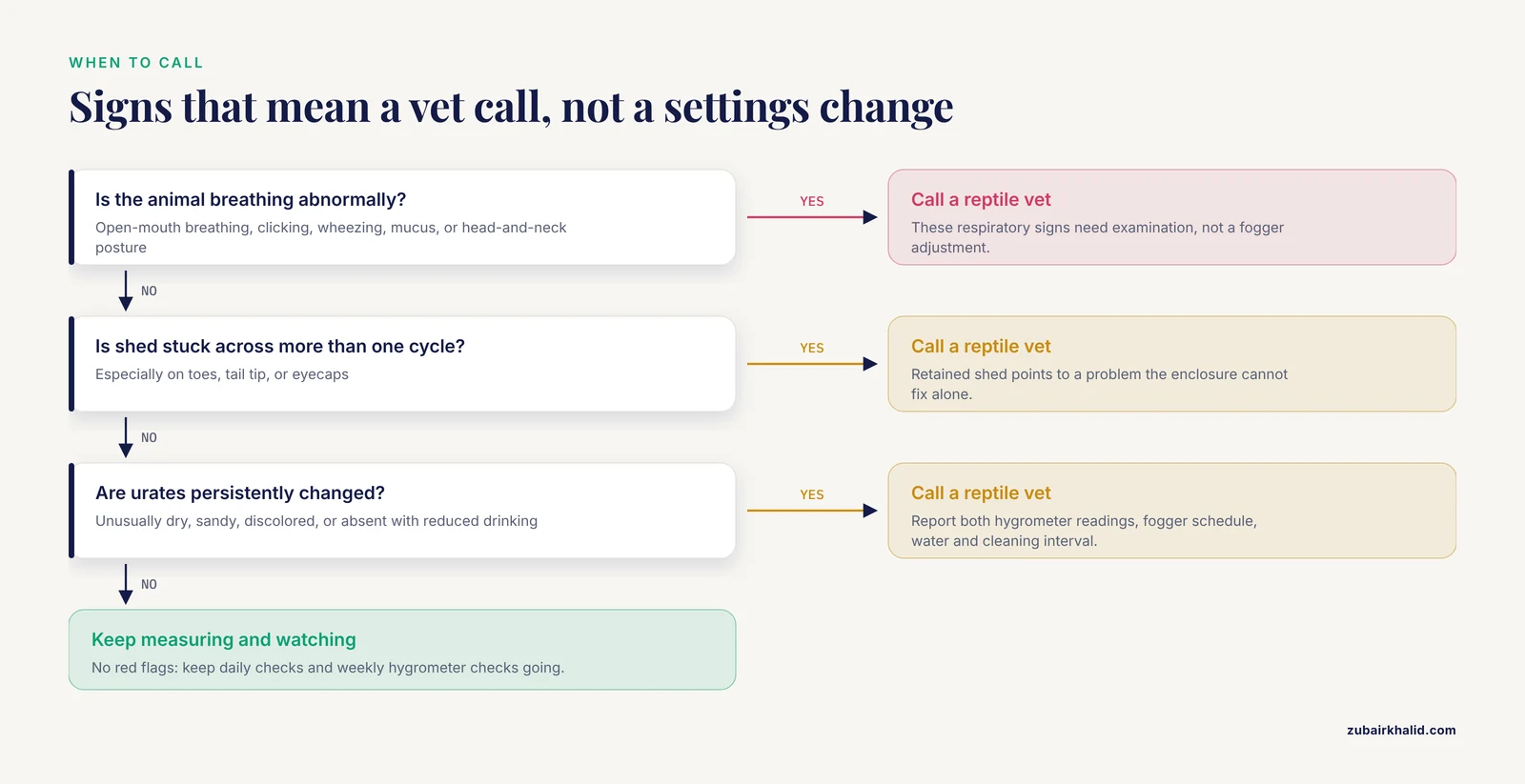
Contact a reptile veterinarian promptly if you observe any of the following, because these signs indicate problems a fogger adjustment cannot solve:
- Open-mouth breathing, audible clicking or wheezing, visible mucus at the nostrils or mouth, or a head-and-neck posture suggesting respiratory effort
- Incomplete shed retained across more than one cycle, especially shed stuck on the toes, tail tip, or eyecaps
- Urates that change character persistently, becoming unusually dry, sandy, discolored, or absent alongside reduced drinking
- Lethargy, loss of appetite lasting beyond a normal species-specific fasting window, or sudden weight loss
- Blisters, discolored patches, or softening of the skin or shell in species with shells
- Any animal that has been housed in a visibly saturated, poorly ventilated enclosure for more than a few days, even if it currently appears well, since early respiratory disease can be subtle
When you call, report your humidity and temperature readings from both hygrometers, your fogger schedule, water source, and cleaning interval. Those details let the veterinary team distinguish an environmental cause from a medical one far faster.
This article is educational and is not a substitute for veterinary diagnosis or treatment.
Frequently Asked Questions
Can I leave a reptile fogger on all night?
You can run it overnight on a timer or humidistat if your species is nocturnal and its natural habitat humidifies at night, but continuous uncontrolled fogging is rarely correct. Set pulses, keep one hygrometer as a fail-safe shutoff, and confirm the enclosure still gets a daily drying period.
Do I need distilled water in a reptile fogger?
Demineralized or distilled water is strongly recommended because ultrasonic units aerosolize dissolved minerals as fine dust and mineral scale degrades the transducer. If your unit includes a demineralization cartridge, replace it on the manufacturer's schedule.
Where should the fogger nozzle go in the enclosure?
Place the nozzle above the substrate and above the water line, aimed through foliage so mist disperses across the lower enclosure instead of falling directly on the animal or pooling on one surface. The unit body itself stays outside the enclosure.
Will a fogger alone keep my humidity in range?
Usually not. Foggers raise air humidity but do little for deep substrate moisture, and open screen tops bleed humidity faster than most foggers replace it. Combine the fogger with moisture-retentive substrate, a humid hide, and partial lid coverage.
How often should I clean a reptile fogger?
Rinse the reservoir and transducer at least twice weekly and deep clean the full unit weekly or biweekly per the manufacturer's instructions. Stagnant reservoirs develop biofilm quickly, and anything in the water becomes airborne.
What humidity level should I set for my reptile?
There is no single number that applies across reptiles, and the correct target depends on your exact species and locale. Identify the native habitat type, verify against species-specific husbandry literature, discuss the target with an exotics veterinarian if uncertain, and measure with calibrated hygrometers rather than estimating.
What is the difference between a fogger, a mister, and a humidifier?
A fogger makes fine suspended mist for raising air humidity in pulses, a mister wets surfaces with larger droplets for species that drink off foliage, and a room humidifier changes whole-room conditions. Many species do best with a combination rather than any single device.
What signs suggest humidity problems are affecting my reptile's health?
Watch for incomplete or stuck sheds, respiratory signs such as open-mouth breathing or clicking, persistent changes in urate quality, lethargy, and appetite loss. Any of these warrants a call to a reptile veterinarian, because they indicate physiological strain rather than a settings problem.
Sources
- Reptile wellness management.
- Hydration and evaporative water loss of lizards change in response to temperature and humidity acclimation.
- The Role of Humidity in the Management of Premature Neonates in a Rural Incubator
- Uric Acid Monohydrate Nanocrystals: An Adaptable Platform for Nitrogen and Salt Management in Reptiles
- Extreme temperature and airway dehydration: current understanding and integrative insights into respiratory vulnerability
- Exploring induced hydration in semi-arid lizards