How to Set Up a Temperature Gradient for Your Reptile
By Dr. Zubair Khalid, DVM, MS, PhD ·
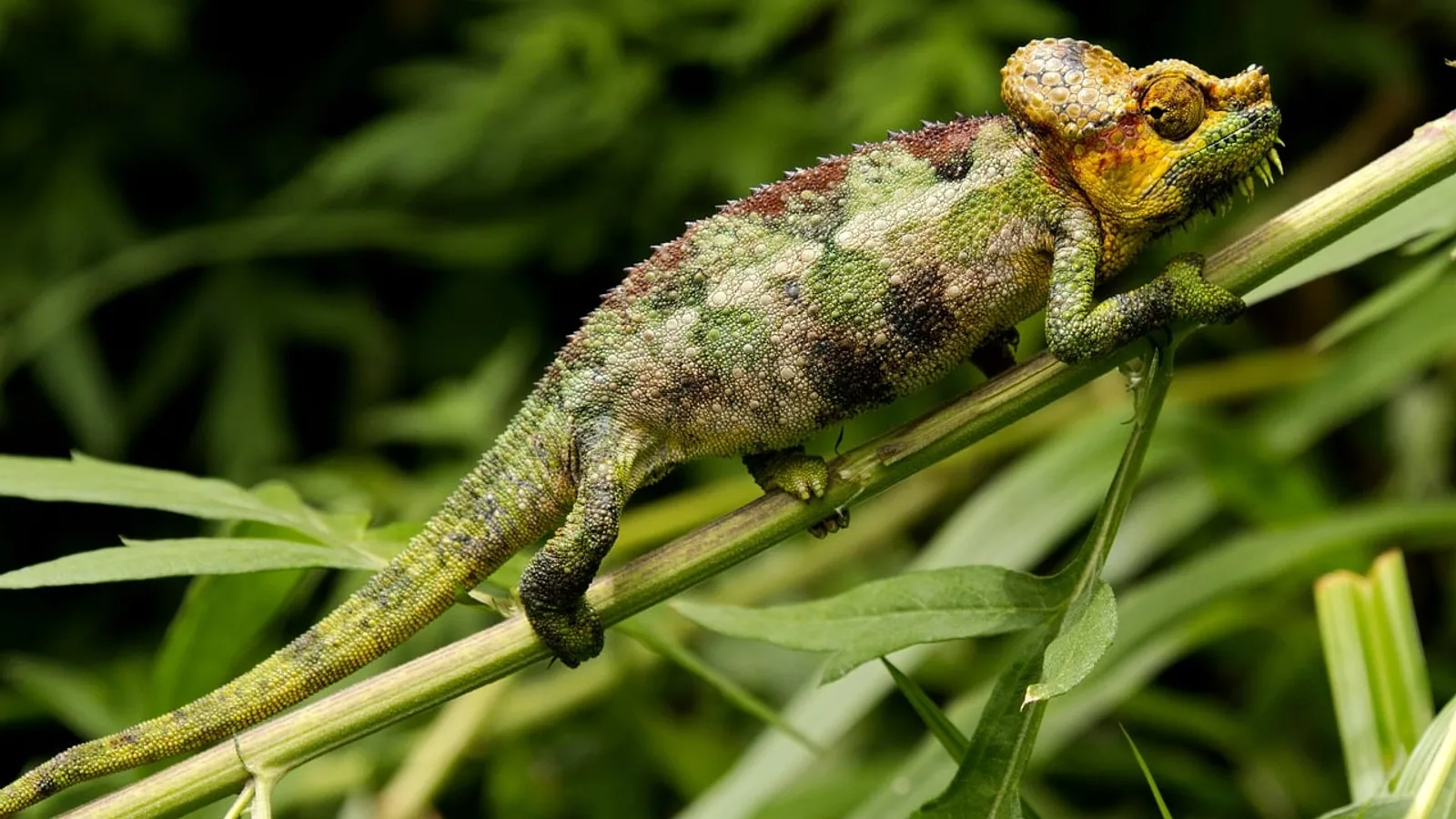
A temperature gradient means one end of the enclosure is warm, the other end is cooler, and everything in between falls somewhere in between. You create it by placing heat at one side of the cage, never in the center, and measuring the temperatures at several points until the warm zone, the cool zone, and the middle all fall inside the range published for your species. Reptiles are ectotherms. They cannot make their own body heat, so they move between warmer and cooler areas to manage their body temperature, digestion, immune function, and activity level. A cage that is uniformly warm, or uniformly cool, removes the animal's ability to thermoregulate at all.
This guide walks through how to set up a temperature gradient for reptiles step by step, including equipment choices, thermometer placement, calibration, common mistakes, and a practical reptile care checklist you can use the day you set up the enclosure.
This article is educational and is not a substitute for veterinary diagnosis or treatment.
At a Glance: Gradient Setup Checklist
| Step | Action | How You Know It Is Done |
|---|---|---|
| 1 | Confirm the adult target temperatures for your species from a current species-specific guide (ARAV, the Merck Veterinary Manual, or VCA Animal Hospitals publish reptile care guidance) | You have written down a warm-side and cool-side target |
| 2 | Choose an enclosure long enough for two distinct zones | The cage is at least roughly twice as long as the intended basking zone |
| 3 | Mount a heat source over or at one end, controlled by a thermostat or dimmer | The fixture cannot be touched by the animal and cannot fall |
| 4 | Place thermometers at the basking surface, mid-cage, and cool side | Three or more independent readings, not one dial on the glass |
| 5 | Run the setup for several days before the animal arrives | Readings hold steady across morning, afternoon, and night |
| 6 | Adjust equipment until every zone hits target | Measured numbers match your species guide, not guesses |
| 7 | Watch the animal's behavior for a week and fine-tune | The reptile uses both zones and feeds and defecates normally |
Why Reptiles Need a Gradient, Not a Single Temperature
In the wild, a reptile never experiences one uniform temperature. It basks in sun, retreats under a rock, burrows into soil, and shuttles between microhabitats that differ by many degrees. Researchers studying animal communities along natural thermal gradients, such as the elevational zones of Mount Kilimanjaro, have shown that temperature strongly shapes where animals live, how active they are, and how they use their environment [1]. A captive enclosure is a tiny landscape, and the gradient is what turns it from a box into a habitat.
The physiological stakes are real. Environmental temperature is not just a comfort issue. In a randomized cross-over trial in human volunteers, even short-term stays under different sustained air temperature profiles produced measurable changes in metabolic and stress hormones, including leptin and cortisol [2]. Reptiles, whose entire metabolism runs on external heat, are far more directly governed by the temperatures around them. A reptile held at one temperature constantly cannot properly digest food, cannot mount a full immune response, and cannot express normal basking and hiding behavior.
A well-built gradient also creates a humidity gradient as a side effect, and that is a feature rather than a flaw. Under a temperature gradient, evaporation is favored on the warm side and condensation on the cool side [3]. Moisture also migrates through soil and substrate along thermal gradients [4]. In practice this means the warm end of a properly built enclosure dries faster while the cool end holds moisture longer, which gives your animal a choice of microclimates just as it would have in nature. Species from arid habitats use this to find dry retreats, and tropical species use the cooler, moister end to stay hydrated.
Finally, a gradient gives you and your veterinarian diagnostic information. Sick reptiles often camp at one extreme. A bearded dragon that stops basking, or a snake that stops using its warm hide, is telling you something before other symptoms appear.
The Science of Measuring a Gradient Correctly
Before the step-by-step section, one principle from thermal science is worth borrowing directly. When geothermal researchers measured temperature gradients in boreholes, they found that a conventional single-pass temperature log gives only a snapshot, while continuous stationary measurements from several fixed sensors over periods of one to four days were needed to detect instability caused by moving fluids [5]. Their thermometers resolved differences of one hundredth of a degree, and with that sensitivity they could separate stable gradients from disturbed ones across their wells [5].
Your vivarium is a much smaller system, but the lesson transfers exactly. One thermometer reading, taken once, tells you almost nothing. Temperatures inside an enclosure drift with room temperature, bulb age, and air currents, and a reading taken at 2 p.m. on a Sunday may not describe Tuesday night at all. Plan to measure at multiple fixed points and to keep measuring for days, not minutes.
There is also a spatial lesson. Hydrologists now use long fiber-optic cables that sense temperature continuously along their whole length to map gradients in riverbed aquifers, because point measurements miss how much the gradient varies from one spot to the next and how it shifts after disturbances [6]. In a reptile cage, the equivalent disturbance is a bulb change, a relocated hide, a seasonal room temperature swing, or a new draft. Those events silently move your gradient, which is why re-measuring after any change is part of routine reptile enclosure setup, not an optional extra.
How to Set Up a Temperature Gradient for Reptiles Step by Step
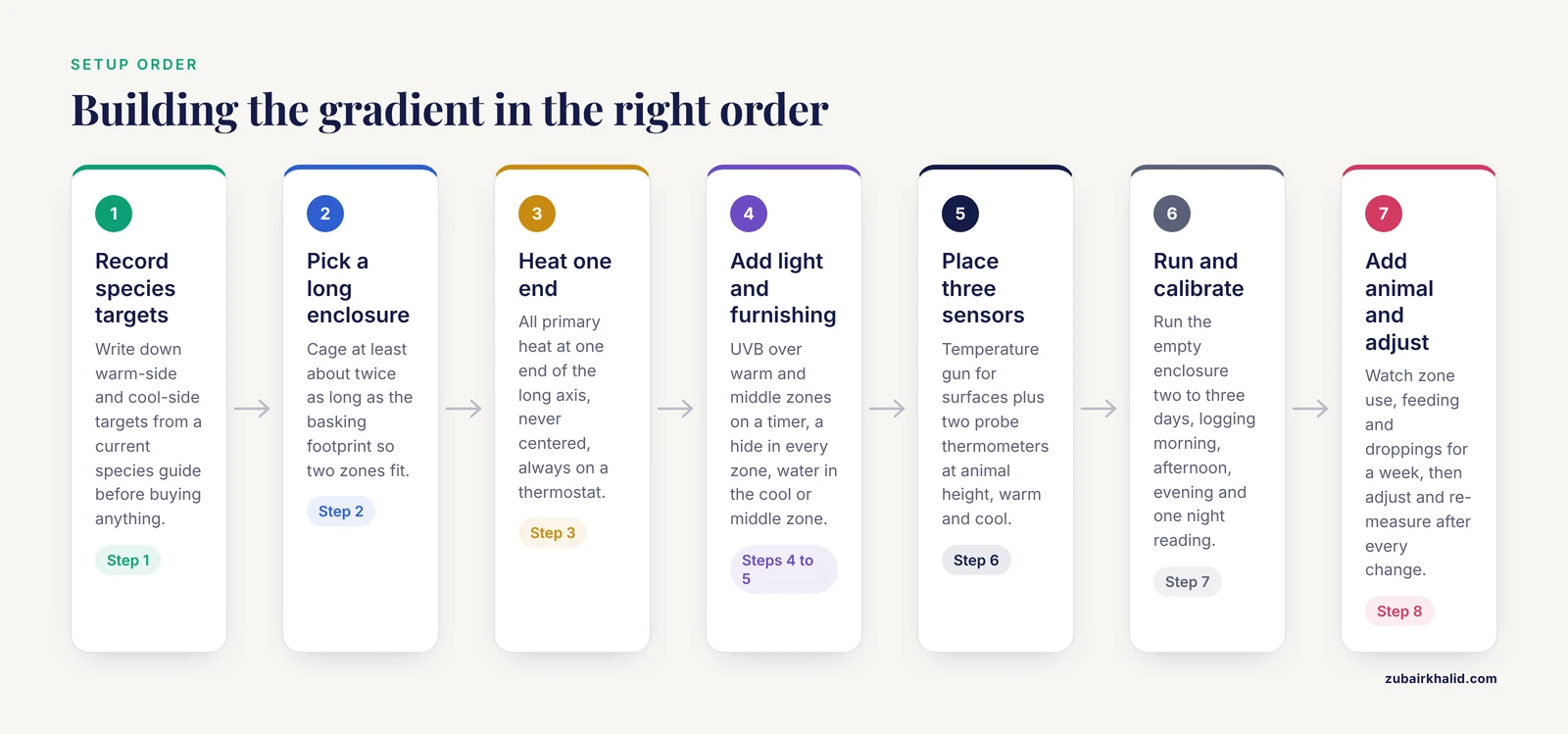
Step 1: Write Down Your Species Targets First
Every species, and to a degree every life stage, has published target ranges for basking surface temperature, warm ambient temperature, and cool ambient temperature. The Association of Reptilian and Amphibian Veterinarians, the Merck Veterinary Manual's exotic animal section, VCA Animal Hospitals' reptile care guides, and ReptiFiles' evidence-based husbandry guides all publish species-specific temperature recommendations, and these are the numbers you should build to.
As orientation only, a few commonly published adult targets illustrate how widely species differ. Bearded dragons typically need a basking surface around 100 to 110 degrees Fahrenheit with a cool side in the mid 70s to mid 80s. Leopard geckos need a warm hide in the high 80s to low 90s with a cool retreat in the 70s. Ball pythons need a warm side near 88 to 92 degrees and a cool side in the upper 70s. Crested geckos, in contrast, often need no basking spot at all and thrive at ordinary room temperatures in the low to mid 70s. Verify the exact numbers for your individual animal with your exotics veterinarian and a current care sheet, because juveniles, gravid females, and brumating animals have different requirements.
Two more definitions before you buy equipment. Ambient temperature is the air temperature in the zone. Surface temperature is the temperature of the actual rock, branch, or substrate the animal presses its body against. Basking species regulate against surfaces, so basking targets are surface targets, and you need a temperature gun or a probe pinned to the surface to measure them honestly.
Step 2: Choose an Enclosure Long Enough to Hold Two Zones
Gradient setup begins with the cage, not the heater. A tall, narrow enclosure cannot hold a meaningful horizontal gradient, and a small tank cannot hold a warm zone and a cool zone that differ enough to matter. As a working rule for a gradient, the enclosure should be at least about twice as long as the footprint of the basking area, and for most terrestrial lizards and snakes that means a long, low enclosure rather than a tall one. If your current cage cannot fit two distinct zones plus a hide in each zone, upgrade the enclosure first, because no heater can create a gradient inside a box that is too small.
Front-opening enclosures make the measurement and adjustment work in the later steps far easier, and they reduce stress compared with reaching in from above, which many prey-species reptiles interpret as a predator attack.
Step 3: Put All Primary Heat at One End
The defining move of a gradient is asymmetry. All primary heat goes at one end, typically one end of the long axis, and the opposite end gets none. Never center a heat lamp over the middle of the cage. A centered heat source produces a warm bullseye with cool edges, which forces the animal to choose between overheating and underheating with nothing in between.
For most species, overhead radiant heat is the default and best option. Heat that comes from above, like sunlight, warms the animal's back and the basking surface below it. Suitable fixtures include incandescent basking bulbs and halogen flood lamps in a dome fixture rated for the bulb's wattage. For species that need heat at night without light, a ceramic heat emitter or a deep heat projector provides radiant heat with no visible glow. Under-tank heaters are appropriate only for a small set of species that seek belly heat, such as leopard geckos, and even then only as a secondary source beneath the warm hide, always on a thermostat and never under loose substrate that can trap heat against the glass.
Whatever the source, a thermostat is not optional. A thermostat with its sensor placed at the animal's level in the warm zone caps the temperature and prevents burns and overheating if a bulb fails on, if ambient room temperature spikes, or if the bulb wattage is wrong. Thermostats are the single most important safety device in reptile enclosure setup.
Step 4: Layer in Light and Photoperiod
Most day-active lizards need bright, white light at the basking spot, and most also need ultraviolet B lighting for vitamin D3 synthesis unless their diet supplies it. UVB should run along the warm and middle zones so the animal can bask in both heat and UVB together, which mirrors natural behavior. Follow the UVB manufacturer's distance and replacement-interval guidance, because UVB output declines long before the bulb burns out. Nocturnal species generally do not need bright basking light, and their heat should come from non-light-emitting sources so their day-night cycle stays intact.
Set the lights on a timer. A consistent photoperiod of roughly 10 to 14 hours of light depending on species and season stabilizes behavior and feeding, and it keeps the heat cycle predictable.
Step 5: Furnish Both Zones Properly
A gradient is only usable if the animal can exploit it. Each zone needs a hide or retreat so the animal never has to choose between correct temperature and security. The warm zone needs an appropriate basking surface, such as a flat rock, slate, or branch placed at the right distance under the heat fixture. The cool zone needs a humid or shaded retreat for many species. Add climbing structure for arboreal animals at several heights, because vertical gradients matter for them too, with warmer air near the top of the warm side and cooler air lower down.
Water placement follows the humidity logic of gradients. Because evaporation dominates the warm side and condensation dominates the cool side of any temperature gradient [3], water bowls generally belong in the cool or middle zone for most species so the water stays cooler and evaporates more slowly. The exception is species encouraged to soak, where your veterinarian or care guide may advise a warm-side soak area.
Step 6: Place Thermometers Like a Scientist
This is the step most owners rush, and it is the one that separates a working gradient from a guess. Mirror the multi-point approach used in the borehole study and place at least three independent sensors [5]:
- An infrared temperature gun for spot-reading surface temperatures, especially the basking surface.
- A probe digital thermometer with its probe at the animal's level on the warm side, ideally inside or beside the warm hide.
- A second probe digital thermometer at the animal's level on the cool side.
Optional additions include a hygrometer in each zone, since humidity and temperature interact, and a data-logging thermometer if you want overnight records. Cheap stick-on dial thermometers that adhere to the glass are not adequate. They read the glass, not the air, and their error can be enormous.
Position sensors at animal height, not at the top of the cage. Heat stratifies, and air near the top of a warm enclosure can be dramatically hotter than the air where the animal actually lives.
Step 7: Run and Calibrate for Several Days Before Adding the Animal
Turn everything on and let the empty, furnished enclosure run for at least two to three days, and ideally longer. The borehole researchers needed continuous measurement over periods ranging from 16 hours to 4 days to declare a temperature field stable, and their equipment resolved changes of 0.01 degrees [5]. You do not need that precision, but you do need their patience. Record warm-side, middle, and cool-side readings at consistent times each morning, afternoon, and evening, including one night reading.
Adjust during this window. If the basking surface is too cool, raise the bulb wattage or lower the fixture within safe distance limits. If the cool side is too warm, increase the enclosure length, add a taller barrier or denser cover on the cool end, reduce wattage, or improve ventilation. If the whole cage runs hot because the room is warm, that is a room problem, and a thermostat plus lower wattage is the fix. If the gradient is too flat, meaning almost no difference between the ends, add more wattage at one end and increase cool-side shading.
Note how the walls participate in all of this. Building-science studies of temperature gradients across masonry walls show that wall temperatures lag behind air temperature under transient conditions, so the thermal mass of a glass or wooden enclosure stores heat and releases it slowly [7]. A thick wooden vivarium will hold its gradient more steadily than thin glass, but it also changes temperature slowly, which is why every adjustment needs hours to show its full effect. Wait after each change before judging it.
Step 8: Introduce the Animal and Fine-Tune From Behavior
Once the numbers hold, add the animal and watch how it uses the gradient for the first week. Reptiles voted with their bodies are the most accurate thermometers you own. A reptile that constantly gapes with its mouth open on the warm side, flattens itself under the heat for hours, or hides from the basking spot is too hot. A reptile that never leaves the warm hide, or perches directly under the lamp all day, may need more ambient warmth. A reptile using both zones, feeding normally, and passing normal droppings is telling you the gradient works.
Then keep measuring. As the distributed-sensing study in a braided river aquifer showed, gradients are not static, and they shift after disturbance events and settle into new patterns over time [6]. Recheck all sensors after every bulb change, deep clean, seasonal room temperature shift, and HVAC change in your home.
Equipment and Supplies: Selection Criteria
You do not need exotic gear, but you do need the right categories, and quality matters more than brand.
Primary heat. Choose an overhead radiant source appropriate to your species, either a basking bulb or halogen flood for day heat, a ceramic heat emitter or deep heat projector for night heat, and match the wattage to the fixture rating. Selection criteria are the beam width covering the whole basking surface, the fixture's heat rating, and compatibility with a thermostat or dimmer.
Thermostat or dimmer. A proportional or pulse-proportional thermostat gives smoother control than a simple on-off thermostat and extends bulb life. The sensor must sit where the animal lives, not at the fixture.
Thermometers. One infrared temperature gun for surfaces plus at least two probe digital thermometers for air temperatures is the working minimum. This mirrors the fixed multi-sensor method that thermal researchers use to distinguish stable gradients from unstable ones [5]. A data logger is a worthwhile upgrade for anyone keeping heat-sensitive species.
UVB and visible light. Select a UVB output level and fixture length appropriate for your species, place it over the warm and middle zones, and follow the manufacturer's replacement schedule.
Substrate and cover. Choose substrate that supports your species' humidity needs and burrowing behavior, and provide enough hides, branches, and plants that every temperature zone includes a place to feel safe. Because soil moisture redistributes along thermal gradients [4], substrate choice and misting interact with your gradient, so evaluate humidity readings together with temperature readings.
Safety hardware. Fixture brackets or clamps, cord clips, a screen or guard between bulbs and the animal, and a surge protector. Burns from unguarded heat lamps and failed thermostats are among the most preventable injuries seen by reptile veterinarians.
Tips That Make the Difference
These are the field-tested refinements that separate an average setup from an excellent one.
- Build the gradient on the long axis. Horizontal distance is what creates a usable gradient, not vertical stacking.
- Target surfaces, not just air. Basking animals care about the surface under the lamp. Measure it with the temperature gun at the exact spot the animal sits.
- Use wattage and distance together. Moving a bulb closer intensifies the basking spot, and raising wattage raises the whole warm zone. Adjust one variable at a time and wait several hours between adjustments, because enclosure walls buffer change.
- Protect the gradient from drafts. Just as engineers deliberately protect a solar pond's gradient layer from wind-driven mixing so it stays stable [8], keep your enclosure away from air conditioning vents, open windows, and doorways that repeatedly scrub the cool side with cold air.
- Log readings. A phone note with date, time, and three readings turns gradient maintenance from memory into data, and it gives your veterinarian a record if your animal ever presents ill.
- Match nighttime to species. Desert species often tolerate and benefit from a nighttime drop. Tropical species need less of a drop. Confirm the nighttime floor temperature for your species and use a non-light-emitting heat source if the room falls below it.
- Think of your enclosure as an experiment. Scientists studying organism responses deliberately construct controlled temperature gradients so subjects can choose their preferred conditions, and they measure effects across the whole gradient rather than at one point [9]. Your pet is the subject, and its behavior is the result.
Common Mistakes and How to Fix Them
Learning how to set up a temperature gradient for reptiles includes learning the failure modes. These are the mistakes that show up again and again.
Heating the whole cage evenly. Two low-wattage bulbs, one at each end, flatten the gradient and destroy the animal's ability to thermoregulate. Put primary heat at one end only.
Trusting the dial on the glass. Stick-on dial thermometers are inaccurate and read the wrong surface. Replace them with probe digitals and a temperature gun.
Measuring once and never again. A single reading is a snapshot. The borehole study that motivated multi-point stationary measurement found that snapshots alone miss instability caused by moving air and fluid [5]. Log for days after setup and re-check after every change.
No thermostat. An unregulated heat source is a burn and fire risk and will cook the enclosure on a warm day. Every heat source gets a thermostat with the sensor in the animal's zone.
Heat rocks and heat pads inside the cage. Rigid in-cage heaters create severe contact burns and provide heat from below that many species cannot escape. Overhead radiant heat with a thermostat is safer and more natural for the overwhelming majority of species.
Too small an enclosure. If the warm hide and the cool hide are within one body length of each other, there is no gradient. Upgrade the enclosure before adding more heat.
Ignoring the cool side. Some owners obsess over the basking spot and let the cool side drift upward until the whole cage is warm. The cool zone is half the therapy. It is where the animal retreats to cool down, and it must genuinely be cool.
Overnight chaos. Turning everything off at night can drop a tropical enclosure below its safe floor, and leaving intense light on 24 hours a day destroys the photoperiod. Use timers and a thermostated night heat source where needed.
Placing the heat lamp in the center. A centered lamp gives a hot bullseye and cold corners. Move it to the end of the long axis.
Guessing at species targets. Husbandry advice evolves, and internet forums often repeat outdated numbers. Pull current targets from ARAV resources, the Merck Veterinary Manual, VCA Animal Hospitals, or ReptiFiles, and confirm anything ambiguous with an exotics veterinarian.
Troubleshooting Guide
| Problem | Likely Cause | Fix |
|---|---|---|
| Basking spot will not reach target | Bulb too dim, fixture too high, or reflective cage glass losing heat | Increase wattage within fixture limits, lower the fixture to a safe distance, or partially screen the basking area |
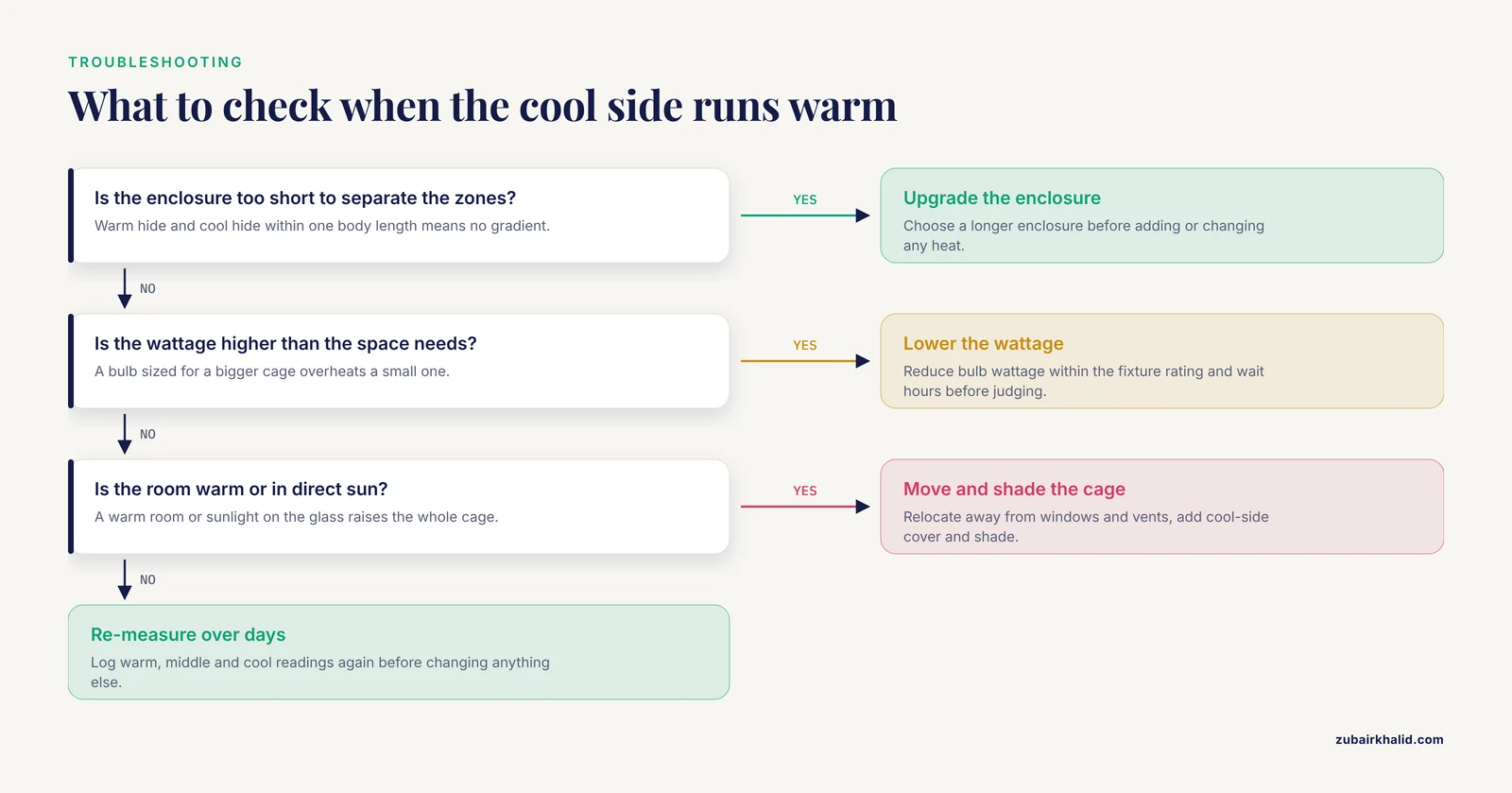
| Cool side too warm | Cage too short, wattage too high, or warm room | Longer enclosure, lower wattage, more cool-side cover and shade, or relocate the cage |
| Gradient too flat | Two heat sources or a very uniform room | Consolidate heat at one end, insulate or shade the cool end |
| Gradient unstable day to night | Room temperature swings or thin glass walls | Thermostat the heat, consider a more insulating enclosure, add a night heat source, log readings over several days before adjusting [5] |
| Whole cage overheated | Failed thermostat, oversized bulb, heat wave | Verify thermostat function immediately, replace with correct wattage, and move the enclosure out of direct sun |
| Reptile never uses the cool side | Gradient too narrow or cool side unappealing | Widen the difference, add a secure cool hide |
| Reptile never basks | Basking surface wrong temperature or texture, or the animal feels exposed | Re-measure the surface, adjust, and add cover approaches to the basking spot |
| Condensation and soggy cool side | Excess water combined with the cool-end condensation effect [3] | Reduce misting volume, improve ventilation, and reposition the water bowl |
Welfare and Safety Points
Thermostats and guarded fixtures prevent burns. Place nothing the animal can climb into contact with inside the effective range of any heat lamp. Check bulb fixtures weekly for loose clamps and frayed cords. Keep water and electricity separated, and route cords so the animal cannot reach them.
The gradient itself is a welfare tool. An animal that can choose its own body temperature can digests its meals properly, mount immune responses, and exhibit natural behavior, which is the foundation of good reptile medicine. Organizations including the AVMA and ARAV emphasize that environment-driven disease, including thermal stress, is among the most common preventable problems in pet reptiles, and correcting the thermal environment is often the first step in treating those conditions.
Your Reptile Care Checklist for Gradient Setup
Use this consolidated reptile care checklist the day you build or overhaul an enclosure.
- Species targets written down from a current, reputable care guide and confirmed with your exotics veterinarian.
- Enclosure long enough for two full zones, front-opening where possible.
- Primary heat at one end only, mounted securely and guarded.
- Thermostat installed, sensor at animal height in the warm zone, tested before the animal arrives.
- UVB and visible light on a timer, placed over the warm and middle zones.
- A hide in every zone, plus basking surface, climbing structure, and water placed appropriately.
- Temperature gun plus two or more probe digital thermometers at animal height.
- Two to four days of logged readings across morning, afternoon, and night before introducing the animal.
- Behavior review after one week of occupancy, with adjustments based on where the animal spends its time.
- Scheduled re-measurement after every bulb change, cleaning, or room-temperature change.
Limitations and When to Contact a Veterinarian
Every species, every enclosure, and every home is different, and the ranges in this article are general orientation rather than a prescription for your individual animal. Individual cases need a veterinarian, ideally one with reptile experience, and species-specific targets should always be confirmed against a current care guide and your own animal's signalment.
Contact an exotics veterinarian promptly if any of the following occur:
- Your reptile stops feeding for longer than is normal for its age and species, or an adult skips multiple consecutive meals.
- Your reptile permanently abandons either end of the gradient, especially a desert species that stops basking.
- You observe open-mouth breathing, wheezing, mucus at the mouth or nose, lethargy, or a drooping posture.
- You see a burn of any size from any heat source, since even small thermal burns in reptiles can become infected and need prescription care.
- Your reptile is constipated, has diarrhea, has urate changes, or has not defecated when it normally does.
- Temperatures swing wildly despite a functioning thermostat and correct wattage, which suggests equipment failure or an underlying husbandry problem you cannot resolve alone.
- Your animal shows tremors, weakness, soft jaw, or reluctance to move, which can reflect metabolic bone disease related to long-term UVB and temperature management.
Bring your temperature log to the appointment. Veterinarians can act on measured data far more effectively than on recollection.
Frequently Asked Questions
How long does it take to establish a stable temperature gradient?
Plan on two to four days of running the empty, furnished enclosure and logging readings before you introduce the animal. Thermal researchers monitoring gradients continuously found that stability judgments require extended measurement windows rather than a single session, and your enclosure needs the same patience [5].
Where should the thermostat probe go?
Place the thermostat probe at the animal's level in the warm zone, near the basking area or inside the warm hide, not at the lamp itself. A probe at the fixture reads fixture heat and will shut the lamp off long before the basking surface reaches target.
Can I use a heat mat as my only heat source?
For most species, no. Overhead radiant heat is the primary source for the great majority of reptiles because it mimics sunlight and warms the whole warm zone. Heat mats suit only certain ground-dwelling species, such as leopard geckos, and even then work best as a secondary source under the warm hide, always on a thermostat.
Do I need a temperature gradient at night?
You need the same asymmetry, but the absolute temperatures drop for most species, and some desert species benefit from a nighttime fall. Confirm the safe nighttime floor temperature for your species and maintain it with a thermostat-controlled, non-light-emitting heat source if the room gets colder than that.
Why is my cool side too warm even with a good basking spot?
The most common causes are an enclosure too short to separate the zones, wattage higher than the space needs, a warm room, or direct sunlight hitting the cage. Lengthen the enclosure, reduce wattage, add shading and cover on the cool end, and move the cage away from windows and vents.
How do I measure the basking spot temperature correctly?
Use an infrared temperature gun pointed at the exact surface where the animal rests, measured from the animal's typical position. Basking targets are surface temperatures, not air temperatures, and a probe hanging in the air will under-read the surface the reptile actually presses against.
What is the single biggest mistake owners make?
Relying on one cheap thermometer, taking one reading, and assuming the job is done. Gradients drift with room temperature, bulb aging, and changes in the cage, which is why fixed multi-point sensors and repeated measurements over days are the reliable approach [5].
When should I talk to my vet about temperatures?
Talk to your exotics veterinarian before setup if your species has special requirements, such as brumation or a species that does not bask, and contact them promptly if your reptile stops using either zone, stops eating, shows any sign of a burn, or if temperatures swing despite working equipment. A log of your readings will make that conversation far more productive.
Sources
- Plant and animal functional diversity drive mutualistic network assembly across an elevational gradient
- Contrasting short-term temperature effects on the profiling of metabolic and stress hormones in non-obese healthy adults: A randomized cross-over trial.
- Evaporation condensation-induced bubble motion after temperature gradient set-up
- Circulation of Water in Soil under a Temperature Gradient
- Temperature Gradient Measurements in Hydrothermal Areas of Georgia
- Quantifying Interannual Variations in Groundwater Fluxes Within a Braidplain Aquifer Using Active-Distributed Temperature Sensing
- Temperature Gradient across Masonry Walls under Transient Conditions: Case Studies from a Warm Humid Climate
- An experimental study to establish a salt gradient solar pond (SGSP)
- Multiple stressors and benthic harmful algal blooms (BHABs): Potential effects of temperature rise and nutrient enrichment.