How to Quarantine a New Ball Python: Steps and Timeline
By Dr. Zubair Khalid, DVM, MS, PhD ·
Quarantine a new ball python in a separate room, in a simple and easy-to-disinfect enclosure, for a minimum of 60 to 90 days before it shares any space, equipment, or air with your established snakes. During that ball python quarantine period, you feed it last in your care routine, handle it after all other animals, clean its waste daily, and watch closely for signs of illness. Quarantine protects the snakes you already own from parasites, mites, and infectious diseases that a new snake can carry without showing symptoms. This guide walks you through the full setup, the daily routine, the observation checklist, and the timeline from the day your snake arrives to the day you consider introducing new ball pythons safely to the rest of your collection.
Quarantine at a Glance
Use this checklist to get started today.
| Step | What to do | When |
|---|---|---|
| , - | , - | , - |
| 1 | Set up a dedicated quarantine enclosure in a separate room, away from your other reptiles | Before the snake arrives |
| 2 | Dedicate equipment. Separate hooks, bowls, tongs, sponges, and spray bottles that never leave the quarantine room | Before the snake arrives |
| 3 | Book a wellness examination with a reptile veterinarian | First week |
| 4 | Feed and handle the quarantine snake last, after all other animals | Every day |
| 5 | Remove and disinfect waste daily. Wash hands and change clothes after every quarantine session | Every day |
| 6 | Record weight, feeding, shedding, urates, and behavior in a log | Every week at minimum |
| 7 | Discuss screening and testing options with your veterinarian | Early in quarantine |
| 8 | Treat any illness, mites, or abnormal findings found during quarantine and restart the clock if your veterinarian advises | As needed |
| 9 | End quarantine only after the full period passes with a clean bill of health | 60 to 90 days at minimum |
| 10 | Begin introducing new ball pythons safely only after your veterinarian agrees the snake is healthy | After quarantine |
Why Quarantine Matters for Ball Pythons
Ball pythons are one of the most commonly traded reptiles in the world, and the commercial trade moves thousands of them through breeder racks, expos, pet stores, and shipping boxes every year. Research on the welfare of ball pythons traded in Europe and North America found that most vendors used small and restrictive enclosures, and that the majority provided little or no written husbandry guidance to buyers [1]. The same study observed that most consumers could not recognize housing that failed to meet minimum welfare standards [1]. A snake that arrives at your home may therefore come from crowded conditions where disease can spread easily between animals, and the seller may not have disclosed health problems.
New snakes can look perfectly healthy while carrying infectious organisms. Many reptile pathogens cause no outward signs for weeks or months. A quarantine period gives hidden problems time to become visible, gives you time to establish a baseline of normal behavior for your individual snake, and prevents a single new arrival from exposing an entire collection. Veterinarians who specialize in reptiles, including members of the Association of Reptilian and Amphibian Veterinarians, consistently describe quarantine as the single most effective biosecurity step a keeper can take.
Quarantine also protects the new snake itself. Relocation is stressful, and a stressed snake diverts energy away from immune function. A quiet, simple, warm quarantine room lets the animal settle, eat, and recover from the journey before it faces any additional challenges.
Diseases Spread by New Ball Pythons
New arrivals can carry a range of conditions that spread to other snakes through direct contact, shared equipment, mites, and contaminated hands or surfaces. Conditions reptile veterinarians routinely discuss in the context of quarantine include:
- Snake mites. Blood-feeding parasites that crawl between enclosures and on clothing and hands. Mites are among the most common and most frustrating problems introduced by new snakes.
- Internal parasites. Roundworms, tapeworms, and protozoal organisms that live in the digestive tract and shed eggs in feces. Other snakes in the home can ingest these eggs from contaminated surfaces or water.
- Bacterial infections. Mouth rot, abscesses, and respiratory infections caused by bacteria that flourish in stressed animals kept in poor conditions.
- Viral diseases. Reptile veterinarians recognize viral infections of pythons that can cause respiratory disease and neurologic signs. Some of these viruses can be carried and shed by snakes that appear healthy, which is precisely why a visual inspection alone is not enough to clear a new snake.
- Fungal infections. Skin and respiratory fungal disease that can develop in damp, unclean enclosures and spread on shared equipment.
Because some of these pathogens spread through the air, on dander, or on your hands and clothing, physical separation in another room offers far better protection than simply placing a new snake in a different enclosure across the same shelf. Ask your veterinarian which pathogens are of greatest concern in your region and which screening tests they recommend for new ball pythons.
Building the Quarantine Setup for Ball Pythons
A quarantine enclosure should be simple, escape-proof, and easy to disinfect. Comfort matters, but the priority is preventing pathogen buildup and making daily cleaning fast.
Enclosure choice
A plastic tub or a simple glass or PVC enclosure works well. Choose a size that lets the snake stretch out along at least part of its body length and thermal gradient. Research on ball python housing has compared simple rack tubs with furnished terrariums, and the furnished terrariums in that study included substrate, a hiding place, possibilities for climbing, a water basin for bathing, an elevated basking spot, and living plants. The study reported that the furnished terrariums supported a broader range of species-typical behaviors than the basic rack setup [2]. Within quarantine, aim for the middle ground: simple enough to disinfect thoroughly, but still providing a secure hide on both the warm and cool ends, a water bowl large enough for drinking, and substrate deep enough for the snake to feel secure.
Heating and lighting
Ball pythons need a thermal gradient, meaning a warm area at one end and a cooler retreat at the other, so the snake can choose its own body temperature. Use a thermostat-controlled heat source and verify temperatures with a thermometer at snake level. Automatic temperature control was a feature of the housing systems evaluated in the published ball python housing research, and it remains the safest way to prevent burns and dangerous fluctuations [2]. Provide a normal day and night light cycle in the room. UV lighting is part of fully furnished long-term housing described in the housing research [2], and you can discuss with your veterinarian whether to include low-level UV during quarantine or add it when the snake moves to its permanent enclosure.
Humidity and ventilation
Ball pythons do best with moderate to relatively high humidity and good air movement. Stale, saturated air encourages respiratory and fungal disease, while air that is too dry causes incomplete sheds. A humidity gauge at snake level, a properly sized water bowl, and light misting when needed will keep you in the right range. Watch each shed closely, because a stuck eyecap or retained shed on the tail tip is an early sign that humidity is wrong.
Substrate and furnishings
Use paper towel, newspaper, or another plain, disposable substrate during quarantine. Loose decorative substrates hide mites, trap moisture, and make it hard to examine feces. Furnishings should be limited to two hides, a water bowl, and perhaps one simple climbable branch that can be disinfected or discarded. Everything in the quarantine enclosure should either be disposable or survive bleach disinfection.
Equipment checklist
- Lockable plastic tub or simple enclosure with a secure lid
- Thermostat and heat source plus two thermometers and a hygrometer
- Two hides, one on the warm end and one on the cool end
- Water bowl that can be scrubbed and boiled or disinfected
- Disposable substrate such as paper towel
- Dedicated feeding tongs, snake hook, and spray bottle that stay in the quarantine room
- Food-grade disinfectant or diluted bleach solution for cleaning, plus a separate bucket
- Digital kitchen scale for weekly weight checks
- A notebook or spreadsheet for your quarantine log
Keep every item on this list out of your main reptile room for the entire quarantine period. Cross-contamination through shared equipment defeats the whole purpose of quarantine.
The Daily and Weekly Routine
Order of care
Always work with your established animals first and your quarantine snake last. After every quarantine session, wash your hands and forearms thoroughly and change your shirt. If you can, keep dedicated clothing or a smock for the quarantine room. These habits take seconds and prevent you from carrying pathogens between rooms on your hands, sleeves, and shoes.
Cleaning
Spot clean feces and urates as soon as you see them, and replace soiled substrate promptly. Once a week, remove the snake to a secure temporary container, replace all substrate, and disinfect the enclosure, hides, and water bowl. Rinse thoroughly and allow surfaces to dry before returning the snake, because residue from disinfectants irritates reptile skin and airways.
Feeding
Feed the quarantine snake separately, using prey items from a reliable source, and do not move food or bowls between rooms. Offer food on a schedule suited to the snake's age and size. Young snakes eat more frequently than adults. Expect some feeding hesitation during the first weeks after arrival. Many ball pythons skip a meal or two while settling into new surroundings, and a single missed meal in an otherwise healthy snake is usually not an emergency. Record every feed, strike, and refusal in your log so you can show your veterinarian a pattern rather than a single data point.
Monitoring and record keeping
Weigh the snake weekly on the same day, at the same time relative to feeding. Record weight in grams, date and outcome of every feeding, every shed, the appearance of feces and urates, and any behavior you notice. Photograph anything unusual. A quarantine log turns vague worry into usable clinical information, and your veterinarian will rely on it heavily if the snake ever becomes ill.
What to Watch For During Quarantine
Your quarantine period doubles as an extended health observation window. Review this checklist during every session.
- Body condition. The spine should not ridge sharply above the body, and the snake should not feel hollow behind the head.
- Skin. Look for mites around the eyes, heat pits, and chin grooves, and for blisters, scabs, or discolored patches.
- Respiration. Watch for open-mouth breathing, wheezing, clicking sounds, bubbles at the nostrils, or holding the head upward in an exaggerated posture.
- Mouth. Look for excessive saliva, redness, or cheesy material inside the mouth, which can indicate infectious stomatitis.
- Feces. Normal droppings combine a dark solid portion with pale urates. Persistent diarrhea, green discoloration, visible worms, or a lack of droppings after several meals all warrant a veterinary call.
- Behavior. Note whether the snake uses its enclosure, strikes at food, and moves with normal coordination.
- Shedding. Complete sheds in one piece suggest good hydration and husbandry. Fragmented sheds suggest husbandry problems or skin disease.
One observation deserves special mention. Some popular ball python morphs carry inherited neurologic problems. The spider morph, for example, is frequently associated with wobble syndrome, and imaging research has identified structural differences in the inner ear of spider ball pythons that likely explain the condition [3]. A wobble is not contagious, so quarantine will not prevent it, but your quarantine log is the right place to record any head tremor, wobbling, or difficulty striking at food. If you have purchased a spider or a related morph, document these signs early and discuss them with your veterinarian, because they affect long-term welfare and feeding management.
The Quarantine Timeline, Step by Step
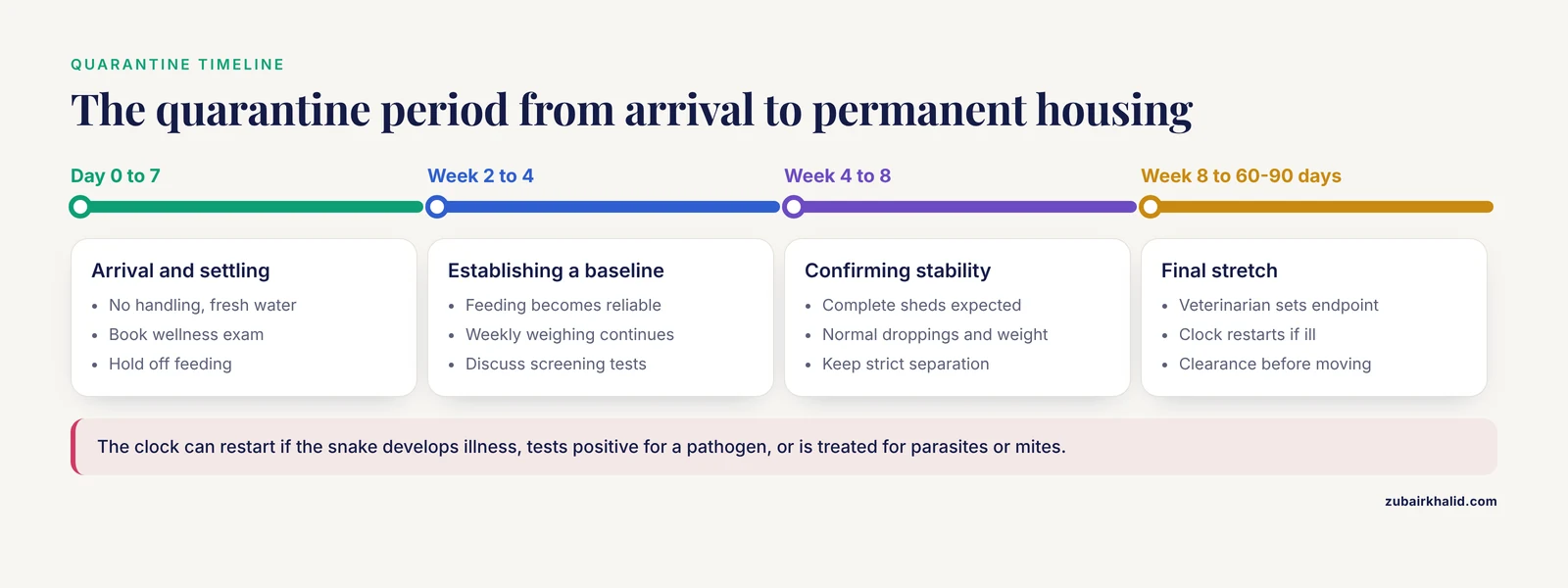
Day 0 to Day 7: Arrival and settling in
Set up the quarantine room before the snake arrives. When the snake comes home, place it in the enclosure without handling it, provide fresh water, and leave it alone. Do not feed for the first several days, or follow the feeding schedule your seller used, because a freshly shipped snake digesting a meal in transit faces unnecessary stress. During this first week, book a wellness examination with a reptile veterinarian if you have not already. Bring your log, any seller health records, and a fresh fecal sample if your veterinarian requests one.
Week 2 to Week 4: Establishing a baseline
By the second week, most ball pythons begin feeding reliably. Establish your regular feeding interval, continue weekly weighing, and watch for the first shed. This is the window in which early problems usually surface, so review the observation checklist deliberately at every visit. Discuss your veterinarian's recommended screening tests now, because results take time to return and any positive finding extends your timeline.
Week 4 to Week 8: Confirming stability
A snake that eats consistently, sheds completely, passes normal droppings, maintains or gains weight, and behaves normally is tracking well. Continue the strict separation routine without shortcuts. Keepers commonly relax during this middle stretch, and cross-contamination most often happens here, when the snake looks healthy and the routine feels tedious.
Week 8 to the end of the quarantine period
Many reptile veterinarians recommend a quarantine period of at least 60 to 90 days, and some recommend longer for snakes whose origin or screening results raise concern. Ask your veterinarian to help you set the exact endpoint for your snake. The clock can restart if the snake develops illness, tests positive for a pathogen, or is treated for parasites or mites, so a clean, uneventful run matters more than the calendar.
After quarantine: permanent housing
When your veterinarian agrees the snake is healthy, move it to its permanent enclosure. Base that enclosure on the welfare principles published in the ball python housing research, which found that furnished terrariums with substrate, climbing opportunities, a water basin, an elevated basking spot, and appropriate lighting supported a wider range of natural behaviors than sparse rack housing [2]. Transition the snake to its permanent setup gradually and give it another settling-in period before any introduction to other snakes.
Introducing New Ball Pythons Safely After Quarantine
Never house a ball python with other snakes on the basis of a short quarantine alone, and never co-house ball pythons for convenience. Snakes are solitary animals, and co-housing creates stress, feeding accidents, and disease transmission risk even between healthy-looking animals. Once quarantine ends and your veterinarian confirms the new snake is healthy, follow this sequence.
- Confirm the full quarantine period passed without illness, parasites, or mites, and that any screening your veterinarian recommended came back clear.
- Move the new snake to its permanent enclosure in your main reptile room and observe it there for a few additional weeks before considering any physical proximity to other snakes.
- Disinfect or retire all quarantine equipment, or keep it strictly dedicated to quarantine for future arrivals.
- If breeding is your goal, remember that reproduction has its own timeline. Published research on female ball pythons documented follicular development, ovulation occurring mainly between April and August, and egg laying from June to November, with median clutch sizes of six eggs and incubation of roughly 58 days [4]. A newly acquired female needs time to settle, establish condition, and receive a veterinary clearance before any breeding plans, and a veterinarian can use ultrasonography to assess reproductive status when the time comes [4].
- When you do place enclosures near each other, maintain solid visual barriers and never share water bowls or furnishings between enclosures.
Common Quarantine Mistakes
- Skipping quarantine for a snake that "looks healthy." Healthy appearance does not rule out parasites or viruses. Visual inspection is the weakest screening tool available.
- Quarantining in the same room. Shared air, dander, mites, and foot traffic across the same shelf undermine separation. A different room, even a bathroom or spare closet, is far safer.
- Sharing equipment "just once." One borrowed hide or water bowl can transport mites or parasite eggs between rooms. Duplicates are cheaper than treating your whole collection.
- Handling the new snake first. Hand-washing is necessary but not sufficient. Reorder your care routine so the new snake comes last, every day.
- Cutting the period short. Some pathogens take weeks to become detectable. Ending quarantine early because the snake ate well for a month exposes your collection to the hardest problems to detect.
- Forgetting to disinfect between quarantine cycles. Every quarantine enclosure must be fully stripped, disinfected, and dried before the next arrival.
- Treating quarantine as a punishment. A bare, cold, or dry tub is not quarantine, it is neglect. Quarantine means separation plus good husbandry.
- Ignoring the log. Without records, you cannot tell your veterinarian whether the skipped meal was the first or the third, or whether weight loss is trending or a one-time fluctuation.
Stress, Welfare, and the Quarantine Environment
Quarantine should reduce risk without reducing welfare. A landmark study of ball python housing measured behavior in snakes kept first in conventional racks and then in furnished terrariums, and found that the furnished setups supported a broader behavior spectrum [2]. Elements worth including even in a simple quarantine enclosure are a hide at each end, substrate the snake can press against, and clean water at all times [2].
Stress physiology research adds a nuance worth knowing. A study measuring corticosterone, a stress hormone, in shed skins of captive snakes found that in ball pythons, individuals kept in enriched terraria showed higher corticosterone concentrations than those kept in rack systems, a pattern opposite to the one seen in corn snakes in the same study [5]. The same research identified species-specific relationships between enclosure volume and stress hormone levels [5]. The practical lesson is that responses to housing are species-specific, so watch your individual ball python's behavior and feeding rather than assuming that more space and stimulation always means less stress. Some newly imported ball pythons settle faster in a smaller, dim, quiet quarantine tub with one hide than in a large, brightly lit display enclosure. Adjust the environment based on feeding response, use of space, and body condition, and discuss any persistent anorexia with your veterinarian.
Finally, remember where your snake likely came from. Research across exotic pet expositions and seller videos documented widespread substandard housing and minimal husbandry guidance in the ball python trade [1]. Assume your new snake experienced crowding, temperature extremes, or irregular feeding before it reached you, and give it extra patience during its first weeks.
Limitations and When to Contact a Veterinarian
Every ball python is an individual, and the timeline and checklist in this article are general guidance rather than a diagnosis. A reptile veterinarian should examine any snake with clinical signs, and only your veterinarian can interpret screening tests, set your exact quarantine endpoint, and clear a snake for introduction to your collection. Individual cases always need professional evaluation.
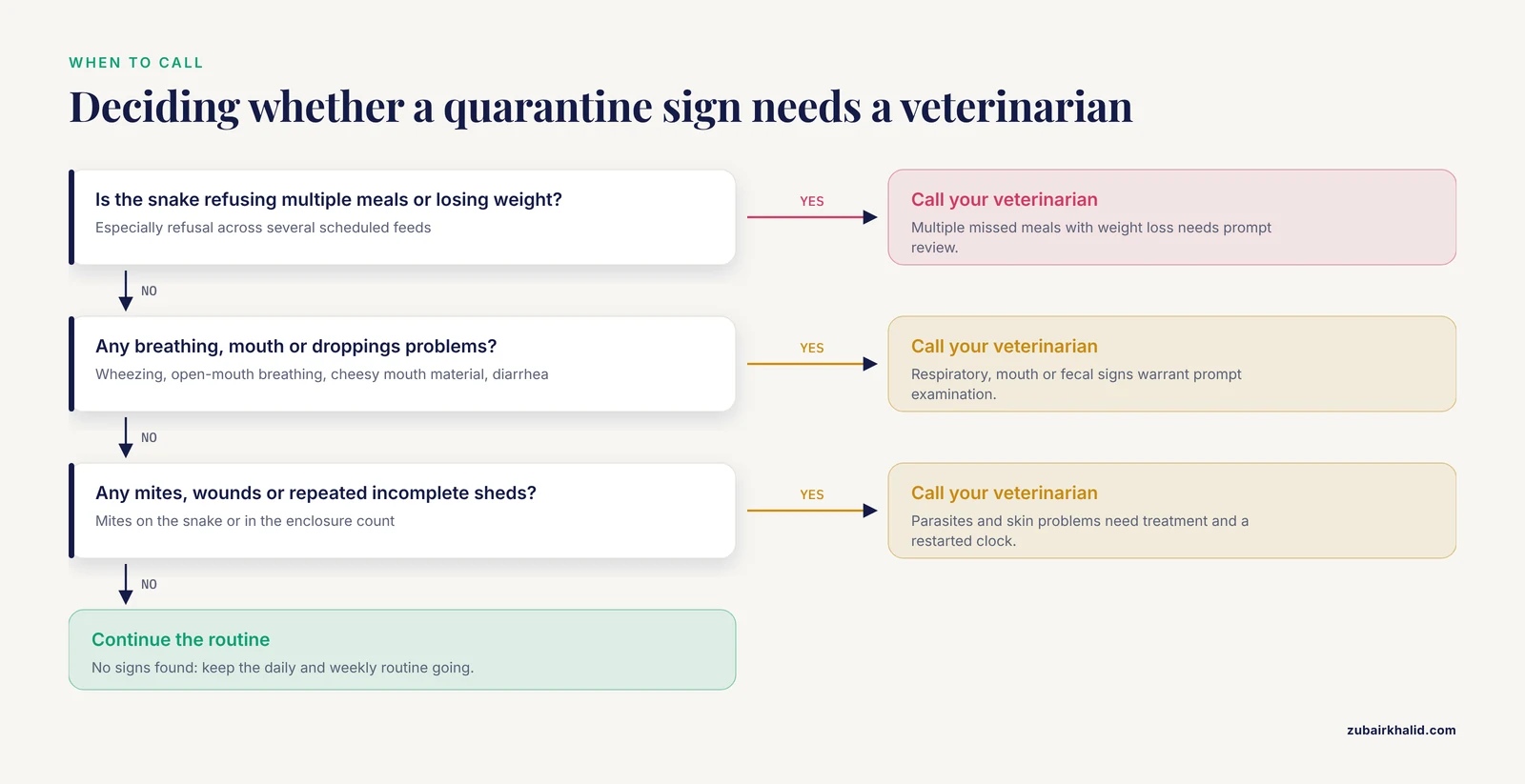
Contact a reptile veterinarian promptly if you observe any of the following during quarantine:
- Refusal to eat that extends across multiple scheduled meals, especially with weight loss
- Open-mouth breathing, wheezing, clicking, nasal discharge, or an abnormal head posture
- Visible mites or ticks on the snake or in the enclosure
- Diarrhea, unusually foul-smelling or discolored droppings, regurgitation, or no droppings across several meals
- Mouth redness, excessive saliva, or cheesy material in the mouth
- Blisters, wounds, discolored scales, or incomplete sheds across more than one cycle
- Head tremors, wobbling, righting difficulty, or uncoordinated striking
- Sudden lethargy, failure to thermoregulate, or a snake that stays out in the open constantly
- Rapid or unexplained weight loss between weekly weigh-ins
If you keep a collection and one animal shows signs of contagious disease, call your veterinarian before handling any other snake, and describe your quarantine setup so they can advise on protecting the rest of your animals. In the United States, there is no general federal requirement to quarantine privately owned pet ball pythons, but state and local rules can apply to certain situations, and your veterinarian or state animal health officials can confirm anything relevant to your circumstances.
Frequently Asked Questions
How long should a ball python quarantine period last?
Most reptile veterinarians recommend at least 60 to 90 days, and some recommend longer when a snake's origin or test results raise concern. Ask your veterinarian to set the endpoint for your specific snake, and restart the clock if illness, parasites, or mites appear during the period.
What diseases can a new ball python spread to my other snakes?
New ball pythons can carry snake mites, internal parasites, bacterial infections such as mouth rot and respiratory disease, viral infections, and fungal disease. Some of these can be carried by snakes that look healthy, which is why quarantine and veterinary screening matter more than appearance.
Can I keep my new ball python in the same room as my other snakes?
No. Separate rooms provide the protection quarantine depends on, because mites, shed skin particles, and contaminated hands and clothing travel easily within one room. A spare room, bathroom, or closet works well for a quarantine setup for ball pythons.
What do I need for a quarantine setup for ball pythons?
You need a simple lockable enclosure, a thermostat-controlled heat source, two hides, a water bowl, disposable substrate, thermometers and a hygrometer, and a dedicated set of cleaning tools that never leave the quarantine room. Keep the setup easy to disinfect so daily cleaning takes minutes.
Do I need to take my new ball python to a veterinarian during quarantine?
Yes. Schedule a wellness examination in the first week. Your veterinarian will establish a baseline, discuss which screening tests make sense for your snake, and answer husbandry questions before small problems become large ones.
How do I disinfect quarantine equipment safely?
Remove organic debris first, then scrub and disinfect with an appropriate reptile-safe disinfectant or diluted bleach solution, rinse completely, and let everything dry before reuse. Porous items such as cork and wood are hard to disinfect, so discard them or keep them permanently in quarantine.
Should I handle my ball python during quarantine?
Keep handling minimal and always last in your daily order of care. Brief sessions to weigh the snake, spot clean, and check body condition are enough. Limiting contact reduces stress for the snake and reduces the chance you carry anything between rooms.
When can I safely put my new ball python with my other snakes?
Only after the full quarantine period passes without illness, your veterinarian confirms the snake is healthy, and any recommended screening is complete. Even then, house ball pythons individually, because co-housing creates stress, feeding risks, and disease transmission danger regardless of quarantine status.
This article is educational and is not a substitute for veterinary diagnosis or treatment.
Sources
- Dropping the Ball? The Welfare of Ball Pythons Traded in the EU and North America.
- Animal-appropriate housing of ball pythons (Python regius)-Behavior-based evaluation of two types of housing systems.
- Comparative Assessment of Computed Tomography and Magnetic Resonance Imaging of Spider Morph and Wild Type Ball Pythons (Python regius) for Evaluation of the Morphological Correlate of Wobble Syndrome.
- Follicular Growth Evaluation, Oviposition and Egg Hatching in the Ball Python (Python regius).
- Species-specific variations in corticosterone concentrations in captive snake shed skins: implications for housing systems and welfare.