How to Measure Temperature and UVB Levels in Your Reptile Enclosure
By Dr. Zubair Khalid, DVM, MS, PhD ·
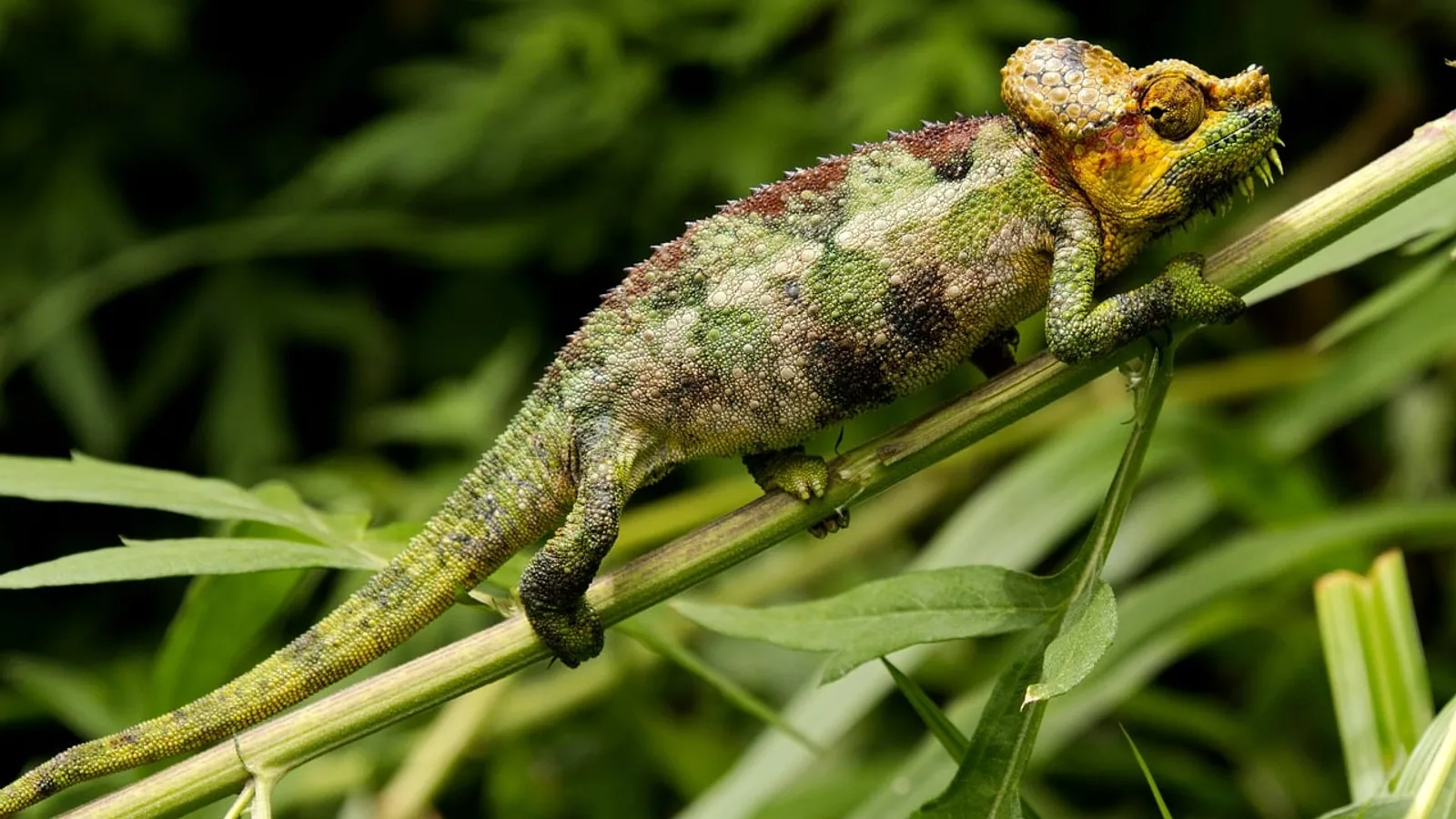
Measure temperature with a digital thermometer or infrared temperature gun placed at your reptile's level, and measure UVB with a dedicated UV index meter held where your rept actually basks. Guessing from the color of a bulb, the feel of the glass, or the reading on a stick-on dial tells you almost nothing about what your animal actually experiences. Because heating, lighting, and humidity are among the primary areas of concern when designing a captive reptile environment, verifying them with real measurements is one of the highest-value habits in reptile care [1].
This guide walks through the why, the exact step-by-step method, the equipment worth owning, the mistakes keepers make most often, and the points at which a veterinarian should take over.
At a Glance: Your Measurement Routine
| Task | Tool | Where to Measure | How Often |
|---|---|---|---|
| Basking surface temperature | Infrared temperature gun | Surface of the basking spot, at animal level | At setup, then weekly |
| Warm-side and cool-side air temperature | Digital thermometer with probe | Shade, at the height your reptile rests | At setup, then weekly |
| Humidity | Digital hygrometer | Mid-enclosure, away from the water bowl | At setup, then weekly |
| UVB output at the basking zone | UV index meter built for reptile lighting | Directly under the lamp, at basking height | At setup, then every 1 to 3 months |
| UVB bulb replacement check | Manufacturer's rated lifespan plus meter readings | Same spot each time | Per the manufacturer's schedule |
Keep a simple log. A dated note card taped inside the stand works as well as a spreadsheet.
Why Measuring Beats Guessing
Reptiles are ectotherms. They do not generate their own body heat the way mammals do, so they move through their environment to warm up, cool down, and, through basking, support processes like digestion and vitamin D metabolism. The environment is not decoration. It is physiology. Veterinarians evaluating disease in captive reptiles routinely look first at the design of the vivarium, because enclosure size, heating, lighting, and relative humidity are the areas where problems most often begin [1].
Two broad husbandry philosophies exist. One is a simpler, laboratory-animal-style setup. The other is a naturalistic vivarium that tries to recreate essential features of the animal's wild habitat. Both can work, but both depend on the same fundamentals, and those fundamentals are only verifiable if you measure them. A naturalistic planted tank with beautiful lighting can still deliver zero usable UVB at the basking ledge if a mesh screen sits between the lamp and the animal.
The practical consequence is simple. If your temperatures and UVB output are wrong, your reptile may eat less, digest poorly, hide constantly, or, over months to years, develop metabolic bone disease from inadequate UVB exposure. None of those outcomes announce themselves on day one. A thermometer and a UV meter turn invisible problems into numbers you can act on.
Understand What You Are Actually Measuring
Before buying equipment, get clear on three distinct measurements that keepers often confuse.
Air temperature versus surface temperature
Air temperature is what a thermometer probe senses in open air. Surface temperature is what your reptile's skin actually contacts when it lies on a rock, branch, or basking platform. Under a basking lamp, a rock surface can be far hotter than the surrounding air. Since a basking reptile touches the surface, surface temperature is usually the more meaningful number at the basking spot. Air temperature matters more for the overall warm and cool zones.
UVB output versus visible light
A UVB bulb that still glows brightly may be producing only a fraction of its original ultraviolet output. Visible brightness tells you almost nothing about UVB. Human eyes cannot see ultraviolet light at all. This is why bulb appearance is not a substitute for either a meter or a strict replacement schedule.
The gradient, not a single number
A healthy enclosure offers a thermal gradient, a range from a warm basking zone to a cooler retreat, so the animal can choose. A single temperature reading anywhere in the enclosure cannot confirm a gradient exists. You need at least two readings, one at each end, plus the basking surface.
Equipment Worth Owning
You do not need laboratory gear. You need four inexpensive tools and the discipline to use them at the same spot each time.
- Digital thermometer with a probe. Choose one with a wired probe you can position at animal level and a display you can read from outside the enclosure. These cost little and are far more accurate than the round stick-on dials sold in the reptile aisle.
- Infrared temperature gun. This lets you point and read the temperature of any surface instantly. It is the right tool for basking rocks, branches, and the substrate under a heat mat.
- Digital hygrometer. Relative humidity is one of the primary design concerns in vivaria, and it interacts with temperature because warm air holds more moisture [1]. A small digital hygrometer placed mid-enclosure tracks it continuously.
- UV index meter built for reptile lighting. Ordinary UV sensors and phone apps are not reliable for this purpose. A dedicated meter reads the ultraviolet index at your reptile's basking position. They cost more than thermometers, which is why many keepers buy one meter and share it with a local reptile club or borrow one periodically rather than metering every lamp monthly.
For species-specific target values, consult the species guides published by the Merck Veterinary Manual, VCA Animal Hospitals, ReptiFiles, and the Association of Reptilian and Amphibian Veterinarians. Those sources publish the temperature ranges and UV index targets that apply to your particular animal, and your reptile's veterinarian can confirm them at a wellness visit.
How to Measure UVB Levels in a Reptile Enclosure, Step by Step
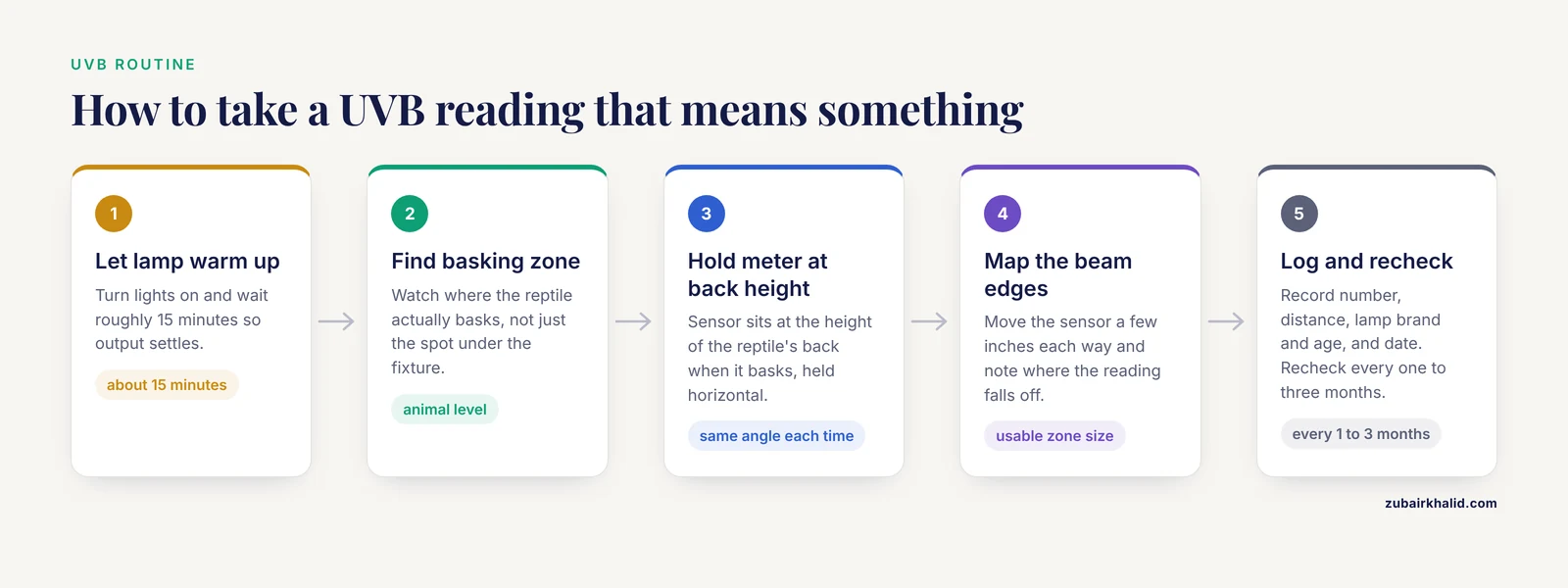
This is the core of measuring UVB properly, and the sequence matters because distance and obstructions change the numbers dramatically.
- Let the lamp warm up. Many UVB lamps need several minutes to reach stable output. Turn the lights on, wait roughly 15 minutes, and do other chores while the lamp settles. Read your lamp's instructions for its specific warm-up recommendation.
- Identify the basking zone. Watch where your reptile actually positions itself to bask, or where it would bask based on the layout. The relevant measurement point is the spot the animal occupies, not the spot directly under the fixture if the animal never goes there.
- Set the meter at animal level. Hold or mount the UV index meter so its sensor sits at the height of the reptile's back when it basks. Measuring at the lamp face instead overstates the dose the animal receives. In a tall arboreal enclosure, you may need to stand on a step stool and hold the sensor at the top platform where the animal rests.
- Take a direct reading. Hold the sensor horizontal, directly under the lamp at the basking point, and record the number.
- Map the beam edges. Move the sensor a few inches in each direction from center and record where the reading falls off. This tells you the real size of the usable basking zone. Many keepers discover their usable zone is much smaller than they assumed.
- Repeat with the screen closed. If a mesh lid sits between lamp and animal, take readings with the mesh in place as it normally is. Fine metal mesh can block a meaningful share of UVB output. Compare the open and closed readings once so you know the size of the difference, then always measure with the lid in its normal position.
- Log the number, the distance, the lamp brand and age, and the date. Consistency makes trends visible. A reading of the same spot with the same lamp orientation is comparable month to month. A reading from a different height or angle is not.
- Recheck on a schedule. UVB output declines with age even while the lamp still lights. Recheck every one to three months, and always recheck after changing a bulb, moving a fixture, or rearranging the enclosure.
Interpreting the readings
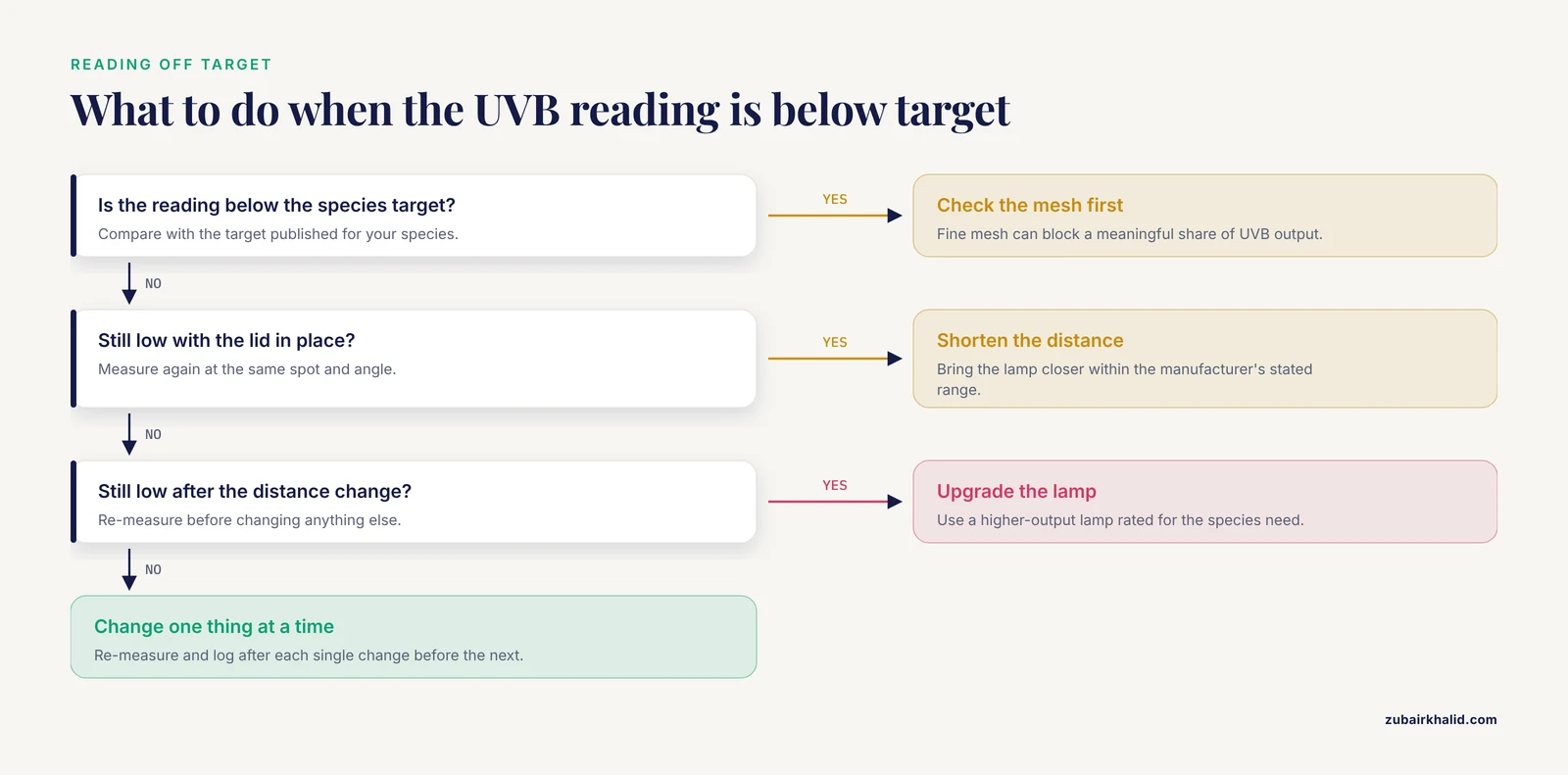
Match your reading to the target published for your species in the guides named above. Desert-adapted basking species and shade-dwelling forest species sit at very different points on the UV spectrum, and arboreal animals that live close to the canopy sun often need different access than ground-dwelling species that use light patches. If your reading sits below the species target at the basking zone, the usual fixes are a shorter lamp-to-animal distance, removing or opening the mesh barrier, or a higher-output lamp rated for the purpose. Make one change at a time and re-measure before changing anything else.
Checking lamp aging
Put a dated tag on each UVB lamp when you install it. Track its rated lifespan from the manufacturer's packaging. Even a meter cannot tell you a lamp is about to fail suddenly, but paired with a replacement schedule, meter readings catch the slow decline that otherwise goes unnoticed.
How to Measure Temperature, Step by Step
- Place a digital probe at the warm end, positioned in shade so the sensor reads air temperature rather than direct beam, at the height where your reptile usually rests.
- Place a second probe at the cool end, again at animal level.
- Use the infrared gun on the basking surface. Point it at the exact spot where the animal sits, from the direction the animal approaches. Take three readings across the surface and note the center value.
- Check the substrate over any heat mat with the infrared gun. Heat mats can warm surfaces well above their thermostat setting if unregulated, and burns on the underside of a reptile are a recognized consequence of unregulated heat sources. If you use under-tank heating, connect it to a thermostat and verify the surface temperature with the gun.
- Read the numbers at the same times of day for at least the first two weeks after any change. Rooms swing with the seasons, and a setup that held steady in winter can overheat in summer.
- Log all readings. Warm-side, cool-side, basking surface, humidity. Four numbers, one line, once a week.
Reptile Enclosure Setup: Where Measurement Fits
Measurement is the verification step in a larger setup process. When planning or auditing a reptile enclosure, work through the elements that vivarium design treats as primary: enclosure size, substrate, landscaping, heating, lighting, and humidity [1]. A compact reptile care checklist that puts measurement in context:
- Enclosure large enough for a full thermal gradient and normal movement
- Substrate appropriate to the species and easy to keep clean
- Hides and landscaping on both the warm and cool sides so the animal never has to choose between comfort and security
- Heat sources controlled by thermostats, never left unregulated
- UVB lamp positioned over the basking zone, with mesh obstruction accounted for
- Digital thermometer probes at both ends, a hygrometer mid-enclosure
- A written log of temperature, humidity, and UVB readings
- Replacement dates written on every lamp and bulb
- Fresh water and a plan for seasonal adjustment
A naturalistic vivarium adds plants, live microclimates, and aesthetics to this framework, which is exactly why measurement matters more in those setups, not less. The richer the habitat, the more microclimates exist, and the easier it is to assume the animal is using a zone it actually avoids [1].
Tips That Make Measurements Meaningful
Measure at animal level, every time. A probe taped to the glass six inches above the substrate, or a meter held at the lamp, reads a different animal than the one you own.
Standardize the sensor orientation. UV meters read differently depending on the angle of the sensor. Pick a method, hold the sensor the same way each time, and note it in your log.
Measure at the same time of day. Lamps cycle, room temperature swings, and sunlight through a window can inflate readings. Noon readings compared with morning readings are not comparable numbers.
Use the log to spot drift, not just absolutes. A basking surface that held steady for months and then crept upward often signals a thermostat or bulb problem before the animal shows any signs.
Verify after every change. New bulb, new fixture, new mesh, new room, new season. Any change to the physical setup invalidates your old numbers until you re-measure.
Meter borrowed instead of owned. If a dedicated UV meter is out of budget, ask your exotics veterinarian, a local herpetological society, or a reptile-focused store whether they meter lamps for keepers. Many do. The key is that someone with the right instrument verifies your actual basking zone periodically rather than nobody ever doing it.
Common Mistakes to Avoid
Relying on stick-on dial thermometers. These dials often read the temperature of the glass they are stuck to, which is not the air or the animal. They are the most common source of false confidence in reptile keeping.
Measuring UVB with the mesh removed and then leaving the mesh in place. If your working numbers came from an open-lid reading, your animal may be living under a fraction of the dose you documented.
Trusting a bright bulb. A UVB lamp that still lights can have lost most of its useful ultraviolet output. Visible light and UVB output are independent.
Measuring only the basking spot. Without a cool-side reading, you cannot confirm a gradient exists. An enclosure that is uniformly warm is as much a welfare problem as one that is uniformly cold.
Assuming one reading fits the whole year. Ambient room temperature changes with the seasons, and your heating equipment's effective output changes with it. A setup verified in January may need re-verification in July.
Placing the thermometer probe in direct light. A probe in the basking beam reads the beam, not the zone the animal rests in for most of the day.
Changing several variables at once. If you raise the lamp, swap the bulb, and add a second hide in the same weekend, you will never know which change produced the result. Change one thing, measure, log, then decide.
Troubleshooting: What to Do When Numbers Are Off
Basking surface too hot. Raise the lamp, add a dimming thermostat, or reduce lamp wattage. Re-measure the surface after each adjustment. Never let an animal sit under a heat source you have not verified with a surface reading.
Warm side never reaches target. Check the bulb's rated wattage against your enclosure size, confirm the thermostat probe placement near the basking zone, and consider whether the room itself is too cold for the equipment to keep up.
Too little difference between warm and cool sides. Increase the power or height of the warm-side heat source, or improve cooling on the other end. A flat thermal profile removes the animal's ability to thermoregulate.
UVB reading below target at the basking zone. Shorten the lamp-to-animal distance within the manufacturer's stated range, address mesh obstruction, or upgrade to a lamp rated for the output your species needs. Re-measure after each change.
UVB reading fine at setup but low six months later. This is normal lamp aging. Replace the lamp on schedule, note the date, and re-measure the new lamp from the first day so you know its baseline.
Humidity far from target. Adjust ventilation, add or reduce a water feature, or change misting frequency, then confirm with the hygrometer. Remember that temperature changes shift relative humidity readings, so evaluate humidity alongside your temperature numbers rather than in isolation [1].
Welfare and Safety Points
A reptile's long-term health rests on the environment it lives in, which is why husbandry review is a standard part of exotic animal veterinary practice [1]. Beyond the numbers, protect welfare with a few habits:
- Every heat source should be controlled by a quality thermostat. Unregulated heat mats and ceramic emitters are the leading cause of thermal burns in captive reptiles.
- Position lamps so the animal cannot touch them. Guards or mounting distance prevent contact burns.
- Provide hides on both the warm and cool ends so thermoregulation never forces the animal into the open.
- Maintain a consistent photoperiod appropriate to your species, and ask your veterinarian or a species guide about seasonal variation for your animal.
- Keep the log where anyone caring for the animal can find it. A pet sitter who cannot see the targets cannot maintain them.
Limitations and When to Contact a Veterinarian
This article is educational and is not a substitute for veterinary diagnosis or treatment. Individual cases need a veterinarian, especially an exotics or reptile-focused practitioner, and species-specific target values should come from current species guides or your vet rather than from generalized advice.
Contact a veterinarian promptly if you notice any of the following, and bring your temperature, humidity, and UVB logs to the appointment:
- Reluctance to eat lasting more than a few days in an animal that normally feeds reliably
- Lethargy, spending all its time on the cool side or hidden
- Signs of metabolic bone disease, including soft or rubbery jaw or shell, limping, tremors, or a bowed spine or limbs, which can follow chronic inadequate UVB exposure or dietary imbalance
- Any burn, blister, or discolored scale patch on the underside or basking-contact surfaces
- Open-mouth breathing, wheezing, or mucus around the nostrils
- Abnormal stool, diarrhea, or visible parasites in waste
- Rapid weight loss or visible spine and hip prominence
- Any animal that has escaped its thermal gradient, been exposed to extreme heat or cold, or been housed with incompatible tankmates
Because veterinarians evaluate causes of disease partly through the lens of enclosure design, your measurement log is clinical data. A week of readings often shortens the diagnostic conversation considerably.
Frequently Asked Questions
How often should I measure temperature and UVB in my reptile enclosure?
Check temperatures weekly and UVB every one to three months, with extra checks after any change to bulbs, fixtures, mesh, or room conditions. New setups deserve daily checks for the first two weeks while the equipment settles.
Can I use a smartphone app to measure UVB levels?
No. Phone cameras and consumer sensors are not designed or calibrated for the ultraviolet range relevant to reptile lighting, and their readings are not reliable. Use a dedicated UV index meter built for reptile lamps.
Do UVB bulbs stop producing UVB before they burn out?
Yes. Most UVB lamps lose ultraviolet output gradually while still emitting visible light normally, which is why bulb appearance is not a valid test and why meters or strict replacement schedules are necessary.
Where exactly should I place my thermometer probes?
One probe in shade at animal level on the warm side, one in shade at animal level on the cool side. Use an infrared gun for the basking surface and for any substrate over a heat mat.
What is the difference between air temperature and surface temperature, and which matters more?
Air temperature describes the surrounding air, while surface temperature is what the animal contacts when basking. For the basking spot itself, surface temperature matters more, and for the general warm and cool zones, air temperature matters more. Measure both.
How do I measure UVB in a tall enclosure or for an arboreal reptile?
Measure at the height where the animal actually rests, not at the floor or the lamp. That usually means holding the meter at the top platform level, with the lid in its normal closed position.
Should I take UVB readings with the mesh lid on or off?
Take them with the lid exactly as it normally sits during the day. Fine mesh can block a meaningful share of UVB, so a reading taken with the lid removed overstates what your animal receives.
How many hours a day should reptile lights stay on?
Photoperiod depends on your species and its natural seasonal pattern. Follow the guidance in a species-specific source such as the Merck Veterinary Manual, VCA Animal Hospitals, or ReptiFiles, and discuss tropical versus temperate seasonal lighting with your reptile's veterinarian.