How to Measure Humidity in a Reptile Enclosure
By Dr. Zubair Khalid, DVM, MS, PhD ·
To measure humidity in a reptile enclosure, place a calibrated digital hygrometer probe inside the enclosure at the height and location where your reptile actually spends time, record the reading at consistent times of day on both the warm and cool sides, and log the results daily for at least the first few weeks after any change to the setup. A single dial on the glass wall does not tell you what your animal is experiencing. Research on western fence lizards showed that the hydration physiology of lizards shifts in response to the humidity of their environment and that the relationship between humidity and water loss is best described by vapor pressure deficit, a measure that combines temperature and moisture in the air [1]. In practical terms, your hygrometer reading only means something when you interpret it alongside the temperature at the same spot.
This guide walks through the physics you need, the step-by-step measurement process, equipment selection, placement tips, the common mistakes that skew readings, troubleshooting, and how to fold humidity checks into a broader reptile care checklist.
At a Glance: Humidity Measurement Checklist
| Step | Action | When |
|---|---|---|
| 1 | Buy at least two digital hygrometer probes | Before setup |
| 2 | Calibrate each probe with the salt slurry method | Before first use, then every 6 to 12 months |
| 3 | Place one probe on the cool side, one on the warm side, both at animal height | Setup day |
| 4 | Record readings at the same two times each day | Daily |
| 5 | Note readings before and after misting or fogging separately | Each session |
| 6 | Check the humidity inside any humid hide separately | 2 to 3 times weekly |
| 7 | Review the log weekly and adjust ventilation, water sources, or substrate | Weekly |
| 8 | Recheck readings after any change to heating, lighting, or substrate | Whenever you change the setup |
Keep this table printed or saved on your phone. It doubles as the humidity section of a full reptile care checklist, and it works for a new reptile enclosure setup as well as an established one.
Why Measuring Humidity Correctly Matters
Reptiles lose water across their skin continuously, a process called cutaneous evaporative water loss. The rate of that loss depends heavily on the moisture gradient between the animal and the surrounding air. When researchers acclimated western fence lizards to four combinations of temperature and humidity for eight days, the lizards' evaporative water loss changed in response to the climate they lived in, and animals kept in hot, humid conditions showed the greatest change in water loss rate [1]. The direction of that change tracked the water vapor pressure of the air and the vapor pressure deficit, which is the gap between how much moisture the air actually holds and how much it could hold at that temperature [1].
Two lessons follow for a pet owner measuring humidity at home.
First, the number on the hygrometer is not just about the animal. It describes an environment the animal will physiologically adjust to over a matter of days. In the same study, measurable shifts in water loss appeared after about a week of exposure to a new hydric regime [1]. If you change your enclosure's humidity, expect your reptile's physiology to follow within days, and expect that adjustment to carry real metabolic cost. Chronic guesswork about humidity, drifting week to week, forces repeated physiological adjustment.
Second, temperature and humidity interact. In the acclimation study, the same lizards' plasma osmolality, hematocrit, and body mass responded more strongly to temperature than to humidity [1]. For a keeper, that means a hygrometer reading taken in a cool corner means something different from the same reading taken under a basking lamp, even if the digits are identical. Warm air holds moisture differently, and your animal experiences the combination, not the two numbers in isolation. This is why a serious measurement routine always pairs a hygrometer probe with a thermometer probe at the same location.
Relative Humidity Versus Vapor Pressure Deficit
Most consumer hygrometers report relative humidity (RH), the percentage of moisture saturation in the air at the current temperature. RH is the number species care guides and veterinarians quote, and it is the number you will log. It is not, however, the whole physiological picture.
Vapor pressure deficit (VPD) describes the drying power of the air. Research in lizards found that changes in evaporative water loss across individuals were negatively related to the vapor pressure deficit of their treatment conditions and positively related to the water vapor pressure itself [1]. In plain terms, lizards in air with a large gap between actual and potential moisture lost water faster, and lizards in moisture-rich air lost water slower. The same relative humidity value can carry very different drying power at different temperatures.
You do not need to abandon your hygrometer. You need to interpret RH in context:
- Read RH and temperature at the same spot, at the same time, as a pair.
- Understand that 60 percent RH at 78 degrees Fahrenheit is a different drying environment from 60 percent RH at 92 degrees Fahrenheit.
- When a husbandry guide gives you an RH target range, treat it as a reference point tied to the temperature ranges the guide also provides. Species-specific husbandry resources, including the evidence-based guides published by ReptiFiles and the reptile care sheets maintained by VCA Animal Hospitals, present these targets alongside temperature gradients for exactly this reason.
Equipment: Choosing a Hygrometer
Digital probe hygrometers
A small digital unit with a remote probe on a thin wire is the workhorse tool. The display sits outside the enclosure, the probe sits inside where the air your reptile breathes actually circulates, and you can move the probe during setup experiments without disturbing the animal. Buy at least two. One probe can only describe one microclimate, and most enclosures have at least two meaningful microclimates, warm and cool.
Selection criteria to apply:
- A detachable or long-reach probe so the display can stay outside the glass.
- Readout resolution of at least 1 percent RH.
- A minimum and maximum memory function, which lets you see overnight lows and highs you cannot watch in person.
- Replaceable batteries.
- A temperature readout on the same unit, so each humidity reading comes with its paired temperature.
Analog dial hygrometers
Analog dials are inexpensive and widely sold with starter kits. Treat them with skepticism. Many ship with calibration errors large enough to make the reading useless, and they cannot be probe-positioned. If you already own one, calibrate it with the salt test described below and, even then, prefer a digital probe for the readings you actually log.
Combination temperature-humidity data loggers
A logger records readings at set intervals over hours or days. This matters because humidity in an enclosed vivarium swings with lighting cycles, misting, and room conditions. A logger answers questions a spot check cannot, such as how quickly humidity crashes after the heat lamps turn on or how long a humid hide holds its moisture overnight.
Psychrometers and smart sensors
Enthusiast-grade sensors that report dew point and calculate vapor pressure deficit exist and are worth considering for large or bioactive setups. For most owners, a well-calibrated digital probe paired with a notebook or a spreadsheet achieves the same husbandry outcome.
How to Measure Humidity in a Reptile Enclosure Step by Step
Follow this sequence from day one of a new setup or from tomorrow with an existing one.
Step 1: Gather and calibrate your probes
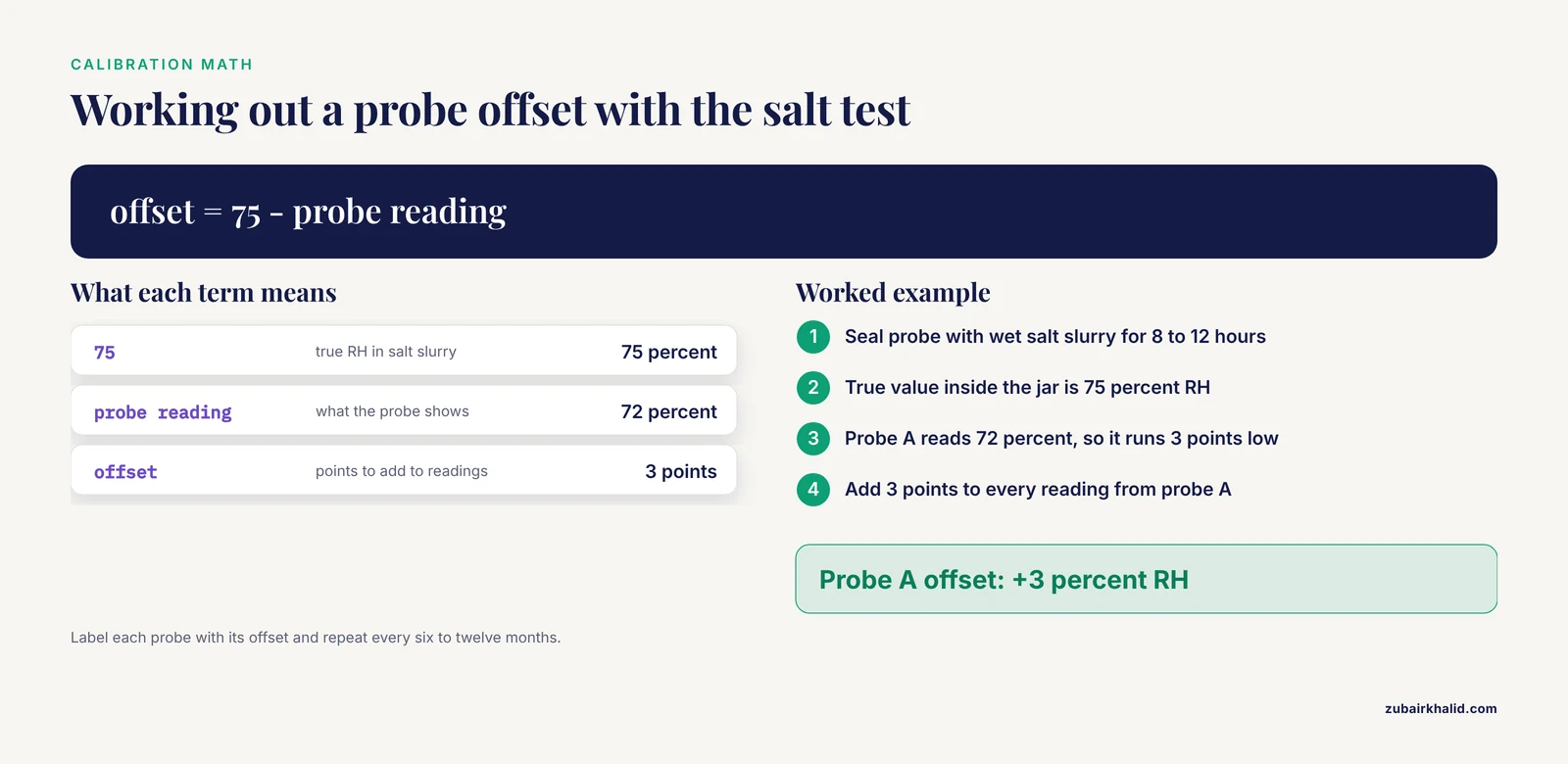
Before any probe goes into the enclosure, calibrate it. The widely used field method is the salt slurry test:
- Fill a small airtight container, such as a zip-top food container, with a shallow layer of table salt.
- Add a few drops of water, drop by drop, until the salt is the texture of wet sand with no standing water.
- Place the probe and its sensor inside the sealed container alongside the salt, not touching the salt.
- Wait 8 to 12 hours with the container sealed at a stable room temperature.
- The true reading inside a saturated sodium chloride slurry at stable room temperature is 75 percent RH. Adjust or note the offset of each probe.
Label your probes with their offsets. If probe A reads 72 percent in the jar, you know it runs 3 points low and you can correct mentally or in your log. Repeat the calibration every six to twelve months and whenever a probe has been dropped, soaked, or has behaved strangely.
Step 2: Identify the microclimates in your enclosure
Most enclosures contain at least three measurable zones:
- The warm side, under or near the primary heat source.
- The cool side, at the opposite end.
- Any specialized microclimate, such as a humid hide, a planted drainage layer, or a rock crevice where the animal retreats.
Sketch your enclosure on paper and mark these zones. You are about to assign a probe to each one that matters.
Step 3: Place the probes at animal height
Mount or position each probe where the reptile's body actually sits, not at the top of the enclosure. Warm, moist air stratifies. A probe zip-tied to the upper screen lid reads the air leaving the cage, not the air your animal lives in. Practical placement rules:
- Cool side probe: mid-height on the cool end, near the surface of the substrate but not touching it, shielded from direct water spray.
- Warm side probe: equivalent position on the warm end, protected from radiant heat sources by the natural distance the animal keeps from the lamp. Never let a probe sit where it will be baked, which shortens its life and skews readings.
- Humid hide probe: inside the hide cavity itself, since the whole point of the hide is that its microclimate differs from the rest of the cage.
Keep sensors off the glass. Glass temperatures track the room as much as the enclosure interior, and a sensor against the glass can read condensation and cold-biased numbers that misrepresent the air.
Step 4: Establish a reading schedule
Measure at two fixed times daily, for example one hour after lights turn on and one hour before lights turn off. Consistency converts scattered numbers into a trend. Log four values at each session:
- Cool side RH and cool side temperature.
- Warm side RH and warm side temperature.
A notebook, a phone note, or a simple spreadsheet works. Over two weeks you will see the true range of each zone, which is far more useful than any single reading.
Step 5: Measure around husbandry events, separately
Misting, fogging, and adding water to a drainage layer spike humidity within minutes. Do not treat those spikes as the enclosure's baseline humidity. Record a reading immediately before misting, immediately after, and again an hour later. The recovery slope tells you how quickly your setup dries out, which guides how often you need to re-mist and how well your ventilation and substrate hold moisture.
Step 6: Verify with behavior and physical observations
Numbers first, then confirmation. Watch how your reptile uses the enclosure. An animal that crowds its water dish, soaks excessively, or presses into the humid hide for the entire day may be responding to air that is too dry. An animal that avoids the warm side entirely may be telling you the warm side is both hot and humid, a combination that produces the highest evaporative water loss in the lizard acclimation work [1]. Behavior is not a hygrometer, but it is a check on one.
Step 7: Review weekly and adjust one variable at a time
Each week, scan your log for drift. If humidity is creeping down, consider substrate drying out, reduced water area, or seasonal room changes. If it is climbing, consider reduced ventilation or an overactive fogger. Change one variable, then measure for several days before changing another. Single-variable adjustment is the only way to know what actually moved the number.
Humidity Measurement Within Your Reptile Enclosure Setup
If you are planning a new reptile enclosure setup, build measurement into the design rather than bolting it on afterward. The layout decisions that make humidity stable and measurable are the same decisions that make the enclosure easy to keep.
Design for at least two measurable zones
A thermal and humidity gradient is the foundation of good reptile husbandry, and organizations such as the Association of Reptilian and Amphibian Veterinarians emphasize that reptiles need the opportunity to move among microclimates and self-regulate. To provide that gradient, you need to be able to measure it. Plan the enclosure so the warm and cool zones each have open air space at animal height where a probe can hang naturally.
Choose substrate partly for how it holds moisture
Substrate type determines how humidity behaves between mistings. Deep moisture-holding layers buffer swings and produce gentler curves on your log. Thin, quickly drying substrates produce sharp spikes and crashes. Whichever substrate your species guide calls for, expect it to shape your humidity data, and give a new substrate two full weeks of logging before judging it.
Plan ventilation deliberately
Ventilation is the control you have over humidity baseline. Cross ventilation, with intake low on one side and exhaust high on the other, moves moist air out predictably. Screen tops vent aggressively and suit arid species. Partially covered tops retain moisture for tropical species. Whatever you choose, your probes will quantify the result, and a probe placed near the exhaust opening will tell you how much moisture is actually leaving.
Water sources and their measurement footprints
A large water bowl, live plants, a drainage layer, and moss boxes each add moisture in a pattern your log will reveal. Measure after adding any new water feature so you know its true footprint rather than guessing.
Tips That Improve Measurement Quality
These practical tips separate useful data from noise.
- Calibrate every probe, including new ones. Factory calibration on consumer hygrometers varies widely. The salt test costs pennies and takes one overnight.
- Log temperature with every humidity reading. The physiology work in lizards demonstrates that temperature drives moisture-related physiological responses as strongly or more strongly than humidity itself in some measures [1]. A humidity log without paired temperatures cannot be interpreted reliably.
- Measure the humid hide separately. A humid hide exists precisely because its interior microclimate differs from the rest of the cage. Probing it directly is the only way to confirm it delivers what it is designed to deliver.
- Give the probe time to equilibrate. After moving a probe between zones, wait 20 to 30 minutes before recording, since sensors need time to settle to the new air mass.
- Keep sensors clean and dry of direct contact. Water droplets on a sensor distort readings until the sensor dries. Shield probes from direct misting spray while still exposing them to the air.
- Watch the overnight minimum. Many enclosures dry out overnight under constant ventilation. The minimum memory function on a digital unit captures the low point without you waking up to check.
- Re-verify after every change. New bulb, new substrate, moved enclosure to a different room, seasonal furnace use. Each one can shift the humidity baseline, and your log should capture the before and after.
Common Mistakes in Measuring Reptile Enclosure Humidity
These are the errors seen most often, and each one has a straightforward fix.
Relying on one probe for the whole enclosure
A single reading describes a single point. Enclosures are gradients. Two calibrated probes, warm and cool, are the minimum for honest measurement.
Trusting an uncalibrated dial
Analog dials frequently ship tens of percentage points off. An owner who believes they are providing 70 percent RH while the true value is 45 percent is not keeping the animal they think they are. Calibrate or replace.
Reading right after misting
A post-mist reading of 90 percent RH tells you about the misting, not the enclosure. Baseline readings taken well before and well after husbandry events are the numbers that matter.
Mounting the sensor at the top of the cage or on the glass
Both placements describe the container, not the habitat. Move sensors to animal height in open air.
Ignoring the temperature pairing
Because the same RH value carries different drying power at different temperatures, and because physiological measures in lizards respond to temperature as much as to humidity in some respects [1], a humidity number recorded without its temperature is half a data point.
Treating a species target as a single fixed number
Humidity guidance for a species is a range tied to a time of day and often to a thermal zone. Owners who chase one magic number end up over-misting and creating constantly saturated conditions, which brings its own problems with substrate and skin. Measure your actual range, compare it to the species range, and correct the gap rather than the digit.
Logging for three days and stopping
A three-day log is a snapshot. Seasonal changes, drifting equipment, and aging substrate all shift conditions over months. An ongoing weekly check, even if it is just two readings, keeps the baseline visible. ReptiFiles and other evidence-based husbandry resources consistently frame monitoring as ongoing rather than a one-time setup task.
Troubleshooting Humidity Problems
Once you can measure reliably, correcting problems becomes systematic.
Humidity too low
Work through likely causes in order. Check whether substrate has dried beyond its intended depth and add moisture to it. Enlarge or add a water bowl on the warm side, where evaporation is fastest. Add live plants or a moss box. Reduce cross ventilation slightly by partially covering a screen section. Misting more frequently addresses the symptom, and a log of the recovery slope after each misting tells you whether the underlying buffer, the substrate, needs attention instead.
Humidity too high and staying high
Persistent saturation usually means too little ventilation or too much un-evaporated standing water. Increase cross ventilation. Check the drainage layer, if you have one, for water levels above the intended line. Confirm the fogger or mister timer against your log, since timers drift and a session that used to run briefly may now be flooding the cage. Constantly saturated substrate and damp surfaces raise concerns for skin and shell condition in many species, so a prolonged high reading is worth correcting quickly.
Wild swings between readings
Swings point to thin substrate, aggressive ventilation, or a heat source that runs in hard on-off cycles. Deepening the substrate and moderating ventilation smooths the curve. A data logger will show you the daily cycle in detail if the swings are hard to pin down.
Probes that disagree
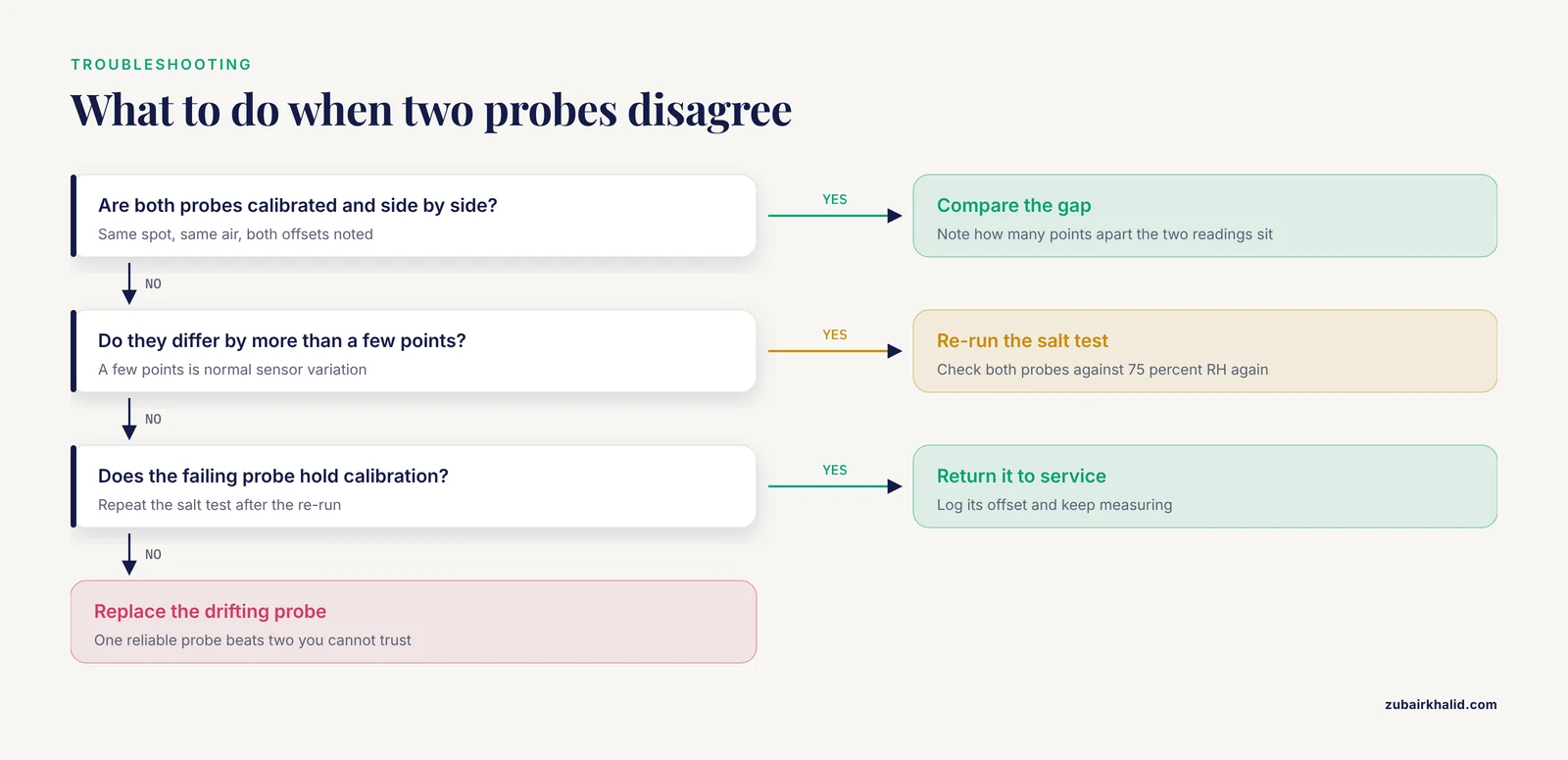
If two calibrated probes placed side by side differ by more than a few points, one is failing. Re-run the salt test on both. Retire any probe that cannot hold its calibration.
Welfare and Safety Considerations
Humidity is a welfare parameter, not a decoration. The acclimation research in western fence lizards demonstrated that animals physiologically reorganize around the moisture conditions they live in within about a week, with measurable effects on cutaneous evaporative water loss [1]. An enclosure whose humidity swings unpredictably asks the animal to repeat that adjustment indefinitely. Stable, species-appropriate conditions, verified by measurement, are the welfare goal.
Pair humidity management with these safety points:
- Never let a probe, its wire, or its mounting hardware become an entanglement or ingestion hazard. Route wires outside the enclosure through cable ports or secure them along the frame.
- Keep electrical displays and connections away from mist zones.
- Watch for the physical signs that husbandry discussions with a reptile veterinarian should address, including retained shed, changes in skin condition, or persistent lethargy, and report your humidity log to the veterinarian when you seek care. A two-week log is one of the most useful documents you can bring to an exotics appointment.
Veterinarians affiliated with the Association of Reptilian and Amphibian Veterinarians and resources such as the Merck Veterinary Manual's exotic animal content consistently frame environmental parameters, including humidity, as part of the clinical assessment of a sick reptile. Your measurements become part of the medical record.
Building Humidity Into a Full Reptile Care Checklist
Humidity measurement belongs inside a broader routine. A practical weekly reptile care checklist looks like this:
- Log humidity and temperature on both zones at two fixed times on at least two days.
- Verify the humid hide microclimate.
- Clean and refill the water bowl, and note whether bowl size still fits the humidity baseline.
- Spot-check substrate moisture at depth, not just the surface.
- Inspect the shed and skin condition of the animal during routine handling.
- Confirm misting and fogging timers against the log.
- Re-run probe calibration every six to twelve months.
Folding measurement into this routine takes under ten minutes a week and converts humidity from a guessing game into a managed parameter.
Limitations and When to Contact a Veterinarian
Every enclosure is a specific case, and individual animals vary. The guidance in this article describes measurement and husbandry practice, and it does not replace evaluation of your particular animal by a reptile veterinarian. Species-appropriate humidity target ranges should come from a source specific to your species, ideally your exotics veterinarian or a current, evidence-based species guide.
Contact a reptile veterinarian promptly if you observe any of the following:
- Retained shed across multiple shed cycles, especially around the toes, eyes, or tail tip.
- Changes in skin condition, including unusual dryness, cracking, discoloration, or lesions in damp or soiled substrate areas.
- Persistent soaking behavior, water dish crowding, or open-mouth breathing.
- Lethargy, loss of appetite, or significant weight change that persists beyond a few days.
- Any situation where your humidity log shows conditions far outside the species range for more than a week despite your correction attempts.
When you call, describe the readings from your log, the paired temperatures, and what you have already adjusted. That history lets the veterinarian separate an environmental problem from a medical one faster.
Frequently Asked Questions
How often should I measure humidity in my reptile enclosure?
Measure at two fixed times daily during the first weeks after setup or any change, then at least twice weekly once your log shows the enclosure is stable. Keep the twice-weekly rhythm indefinitely, since seasonal and equipment drift shows up gradually.
Where should I place the hygrometer probe?
Place the probe in open air at the height where your reptile's body sits, on both the warm and cool sides, away from direct mist spray and away from the glass and any heat lamp. A probe at the cage top or on the glass reads the wrong air.
Do I need a separate hygrometer for the warm and cool sides?
Yes. Warm and cool zones hold different moisture conditions, and a single probe can only describe the point where it sits. Two calibrated digital probes are the practical minimum for a standard enclosure.
Are cheap analog dial hygrometers accurate enough?
Often not out of the box, and many cannot be calibrated to fix the gap. Use the salt slurry test to check any dial you already own, and prefer a digital probe unit for the readings you actually log.
How do I calibrate a hygrometer at home?
Seal the sensor in an airtight container with a saturated salt slurry, table salt wetted to a sandy texture with a few drops of water, for 8 to 12 hours at stable room temperature, then compare the reading to the known value of 75 percent RH and note or adjust the offset.
Why does my humidity reading spike after misting?
Misting adds liquid water that evaporates into the air, so the reading rises sharply and then falls as the enclosure dries. Log the before, immediately after, and one-hour-after values separately so the spike does not contaminate your baseline numbers.
Is relative humidity enough, or should I also track vapor pressure deficit?
Relative humidity is the practical standard for home keeping, but it should always be logged with its paired temperature, because the same RH value describes different drying conditions at different temperatures. Research in lizards shows that evaporative water loss tracks vapor pressure deficit and water vapor pressure [1], so owners of large or advanced setups may benefit from sensors that report both.
What humidity level does my species need?
Species ranges differ widely, and the correct target range for your animal should come from a current species-specific husbandry guide or your reptile veterinarian rather than a general number. Once you have that range, the measurement method in this article tells you whether your enclosure actually delivers it.
This article is educational and is not a substitute for veterinary diagnosis or treatment.