How to Increase Humidity in a Reptile Enclosure Without a Fogger
By Dr. Zubair Khalid, DVM, MS, PhD ·
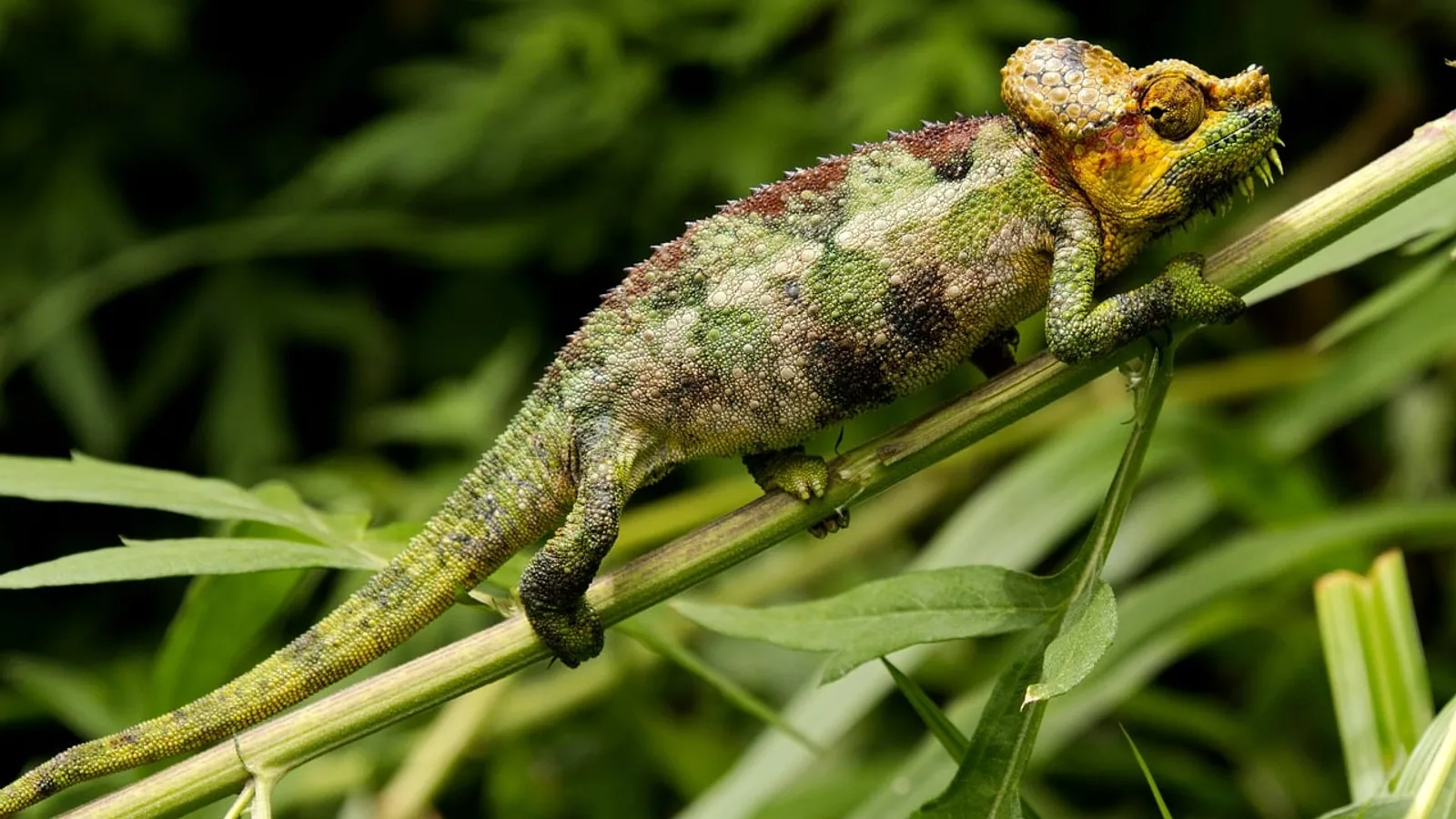
You can raise humidity in a reptile enclosure without a fogger by combining four passive methods: a moisture-retaining substrate, a large or warm water source, reduced and redirected ventilation, and periodic hand misting or a planted, live-moss layout. Measured with a calibrated digital hygrometer at the animal's level, these methods hold relative humidity in a stable band for most tropical and forest-dwelling species without the equipment cost, noise, or saturated airflow that foggers sometimes create.
This guide walks through the physiology behind why humidity matters, a step-by-step method you can apply today, the enclosure setup choices that keep humidity from leaking away, the mistakes owners make most often, and a working reptile care checklist you can print and tape to the enclosure door.
This article is educational and is not a substitute for veterinary diagnosis or treatment.
At a Glance: Raising Humidity Without a Fogger
| Method | What you do | Typical effect | Maintenance |
|---|---|---|---|
| , - | , - | , - | , - |
| Moisture-retaining substrate | Switch to coco fiber, cypress mulch, sphagnum moss blends, or bioactive soil at adequate depth | Raises and stabilizes baseline humidity | Spot clean daily, replace on schedule |
| Water features | Add a large, shallow water dish on the warm side, or a soak area for semi-aquatic species | Adds constant evaporation | Change water daily |
| Ventilation control | Partially cover screen lids with PVC, acrylic, or foil panels, keeping cross-flow at one end | Prevents constant moisture loss | Inspect weekly for condensation pooling |
| Hand misting | Spray warm, dechlorinated water onto substrate and decor once or twice daily | Creates humidity spikes that mimic natural cycles | Test with a hygrometer after each change |
| Humidity hide or moss box | Offer a sealed container lined with damp sphagnum moss | Gives the animal a microclimate it can enter voluntarily | Re-moisten every 1 to 2 days |
| Live plants and moss | Plant hardy tropical species in the substrate | Continuous evapotranspiration | Water and prune as part of routine care |
Why Humidity Matters for Reptile Health
Humidity is not a comfort detail. It is a physiological variable that changes how a reptile's body actually works. Research on western fence lizards found that cutaneous evaporative water loss changes plastically when animals are acclimated to different hydric regimes, meaning the body's water-loss profile shifts in response to the humidity the animal lives in, and that humidity interacts with temperature rather than acting independently [1]. A lizard kept in the wrong hydric environment is not merely uncomfortable. Its skin, plasma osmolality, and hydration status are all responding to conditions that may be far from what the species evolved for [1].
Different species need very different humidity bands. Desert species tolerate dry air. Forest and streamside species do not. The Chinese big-headed turtle, an endangered aquatic species maintained at the Wildlife Conservation Society's Prospect Park Zoo, was kept with carefully managed water and ambient conditions, and the zoo's egg incubation protocol ran at 90 to 95 percent humidity [2]. That professional program illustrates a useful point for home keepers. High humidity was not decorative. It was a deliberate, monitored part of reproducing a rare species, achieved through enclosure design and environmental management rather than gadgets alone [2].
Professional sources reinforce the same principle. The Merck Veterinary Manual's exotic animal resources identify improper environmental humidity as a recurring driver of illness in captive reptiles, including shedding problems and respiratory disease. VCA Animal Hospitals' reptile care guides and the Association of Reptilian and Amphibian Veterinarians both direct owners to control the enclosure environment as a whole, with heat, light, water, and humidity treated as one integrated system. ReptiFiles, an evidence-based husbandry resource, organizes its species guides around the same idea: measure the microclimates, do not guess at them.
How to Increase Humidity in a Reptile Enclosure Step by Step
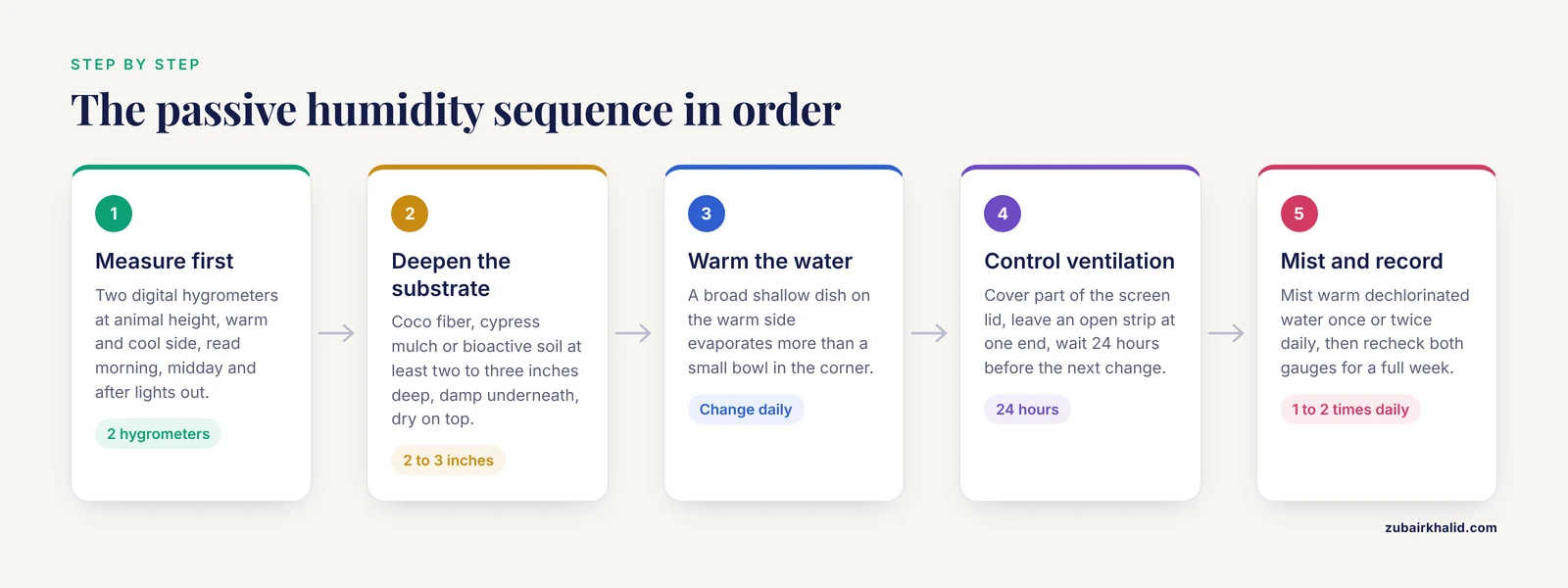
If you need higher humidity today, follow this sequence. Each step builds on the last, and the final step is verification.
Step 1. Measure Before You Change Anything
Buy or borrow two digital hygrometers. Place one on the basking side and one on the cool side, at the height where your reptile spends most of its time. Analog dial gauges are often inaccurate and should not guide your decisions. Write down the current readings at three points in the day: morning, midday, and after lights out. Reptiles respond to the humidity they actually experience over a full cycle, not to a single snapshot, so baseline data before changes matters [1].
Step 2. Upgrade the Substrate
Substrate is the single largest humidity reservoir in most enclosures. Replace dry bedding such as aspen shavings with a mix of coco fiber, cypress mulch, or a bioactive soil blend. Deepen it to at least two to three inches for most terrestrial species, deeper for burrowers. Dampen the lower layers with warm water until the substrate clumps lightly in your fist without dripping. Dry top layers over damp bottom layers create a gradient, so the animal can move to the moisture level it needs.
Step 3. Enlarge or Warm the Water Source
A broad, shallow water dish on the warm side of the enclosure evaporates far more water than a small bowl in the corner. For semi-aquatic species, a soaking area is standard practice. The Prospect Park Zoo program for Chinese big-headed turtles kept this species with water features and fluctuating ambient conditions as a core part of the habitat, not as an accessory [2]. Change the water daily so it does not become a bacterial reservoir.
Step 4. Restrict and Redirect Ventilation
Screen lids vent moisture continuously. Cover part of the screen with a solid panel, leaving an open strip at one end so warm, humid air can cycle rather than stagnate. The goal is controlled cross-flow, not a sealed box. Sealed enclosures promote mold, bacterial growth, and ammonia buildup. After each adjustment, wait 24 hours and re-read both hygrometers before changing anything else.
Step 5. Add a Misting Routine
Fill a clean spray bottle with warm, dechlorinated water and mist the enclosure once or twice daily, targeting substrate, plants, and decor rather than spraying the animal directly. Morning misting mimics natural dew. The goal is a humidity pulse that rises after misting and falls slowly, which mirrors how moisture behaves in real habitats. Test the readings after each misting session and adjust volume and frequency based on the numbers, not on how wet the glass looks.
Step 6. Offer a Humidity Hide
Line a closed container with an entrance hole using damp sphagnum moss and place it on the cool side. A humidity hide gives the animal access to near-saturated microclimate air even when overall enclosure humidity is imperfect. This is especially valuable for snakes during shed cycles and for amphibian-adjacent species. Refresh the moss every one to two days so it stays damp but not soupy.
Step 7. Verify and Record
Recheck both hygrometers at the same three time points for a full week. Record the numbers. A stable daily pattern is the goal. If readings swing wildly, your ventilation or substrate retention needs adjustment. If readings plateau below target, add another method rather than intensifying one method to extremes.
Reptile Enclosure Setup Choices That Lock In Humidity
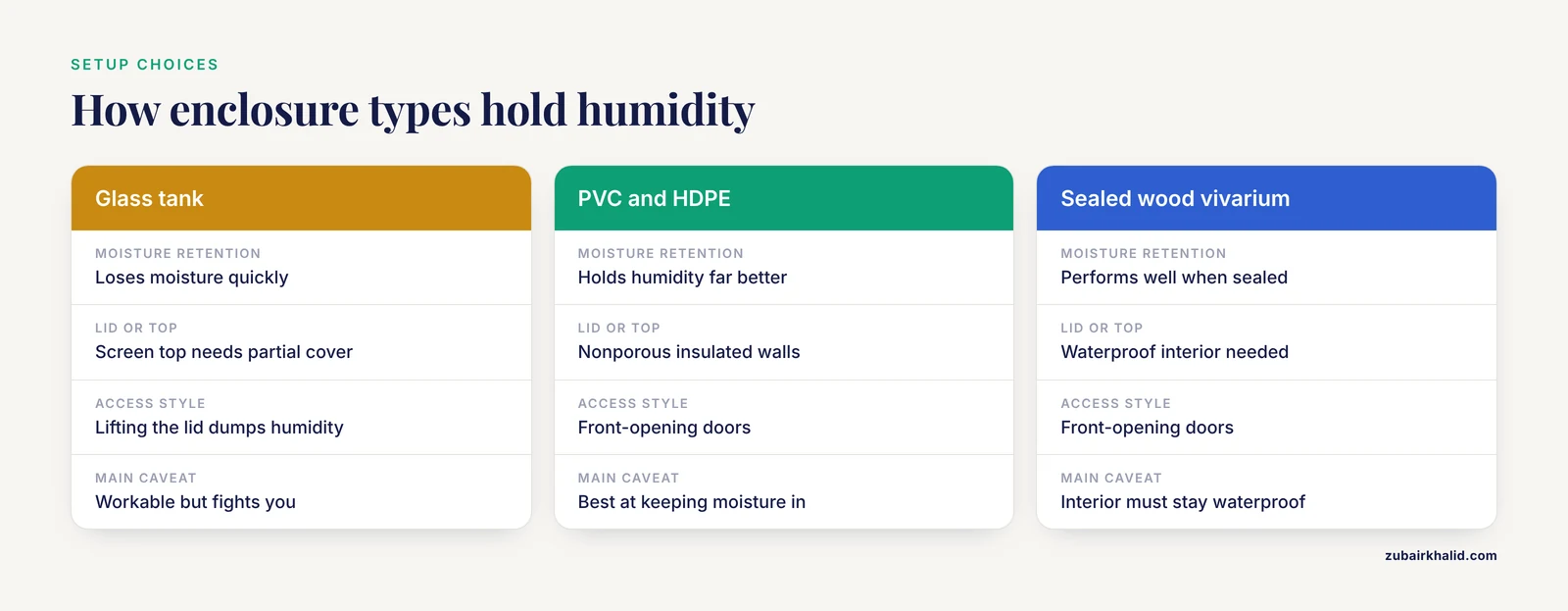
Some enclosures fight you from day one. If you are still planning your reptile enclosure setup, choosing the right container saves months of frustration.
Glass tanks with screen tops lose moisture quickly but are workable with partial lid coverage. PVC and HDPE enclosures hold humidity far better because the walls are nonporous and insulated. Wooden vivaria with sealed, waterproof interiors also perform well. Front-opening doors reduce the massive humidity loss that happens every time you lift a glass lid off the top.
Enclosure volume matters too. A tall enclosure with a deep substrate bed and a planted background traps a vertical humidity gradient, which lets the animal thermoregulate and hydrate across the same space. Zoo husbandry programs manage large, complex aquatic and terrestrial environments by manipulating both water conditions and ambient conditions together, adjusting them deliberately across seasons rather than holding everything constant [2]. Home keepers can copy the principle at small scale: treat humidity, temperature, and airflow as a single adjustable system.
Supplies and Selection Criteria
You do not need specialized equipment to do this well. You need the right basic supplies, chosen on sensible criteria.
| Supply | Selection criteria | Notes |
|---|---|---|
| , - | , - | , - |
| Digital hygrometers | Readable display, small probe or body, two units for gradient reading | Calibrate or cross-check against a second unit |
| Spray bottle | Adjustable nozzle, clean and dedicated to the enclosure | Never reuse bottles that held chemicals |
| Substrate | Species-appropriate, holds moisture without molding, no aromatic woods | Cypress and coco fiber are reliable bases |
| Sphagnum moss | Long-fiber, clean, reptile-safe | Use in humidity hides and on the substrate surface |
| Lid panels | Rigid PVC, acrylic, or cut foil sheet, sized to partial coverage | Leave cross-flow at one end |
| Live plants | Hardy tropical species that tolerate enclosure light and heat | Drain and inspect for pesticides before planting |
| Water dishes | Wide, shallow, heavy enough to resist tipping, warm-side placement | Scrub and refill daily |
No brand endorsement is needed here. Any product meeting these criteria works. If you are unsure whether a substrate or plant is safe for your specific species, ask an exotics veterinarian or consult a species-specific guide such as those published by ReptiFiles or the care sheets distributed by the Association of Reptilian and Amphibian Veterinarians.
Tips That Make Passive Humidity Methods Work Better
Once the basic setup is running, these tips squeeze more performance out of the same methods.
- Warm the water, not just the air. Water on the warm side evaporates faster than water on the cool side. Moving a dish six inches can change the readings measurably.
- Layer, do not saturate. Damp substrate at the bottom with a dry surface layer prevents scale rot while still feeding humidity into the air.
- Use evaporation timing. Mist at the time your lights come on. The heat cycle then drives evaporation through the day, which produces a natural humidity curve.
- **Add rough surface area. Cork bark, branches, and rock piles hold micro-droplets after misting and release them slowly, extending the humidity pulse.
- Cross-check with the animal's behavior. A reptile soaking constantly in its water dish may be signaling that ambient humidity is too low, or that something else is wrong. Behavioral change deserves a conversation with a reptile veterinarian.
These are practical refinements, and the physiology behind them is straightforward. Because evaporative water loss in reptiles responds directly to the vapor pressure conditions of the surrounding air, small changes in surface moisture and airflow translate into real changes in what the animal experiences [1].
Common Mistakes When Raising Humidity
The common mistakes are predictable and avoidable.
Misting the animal instead of the habitat. Spraying a reptile directly provides brief local wetting but does not fix enclosure humidity, and constant handling stress works against the animal.
Sealing the enclosure completely. Removing all airflow drops humidity readings but raises the risk of mold, bacterial overgrowth, and respiratory irritation. Controlled cross-flow is the correct target.
Trusting a single analog gauge. Dial hygrometers can be badly off. Two digital units at animal height give you the gradient that matters.
Chasing a single number. A humidity target is a range across a daily cycle, not one constant value. Zoo protocols adjust humidity and temperature across seasons on purpose [2]. Stability within a species-appropriate band beats a flat, forced reading.
Soaking the substrate. Waterlogged substrate causes skin and shell problems and breeds fungus. The substrate should feel like a wrung-out sponge, not a swamp, unless the species genuinely requires aquatic conditions.
Ignoring condensation on glass. Persistent heavy condensation on the cool glass means the enclosure is too wet and under-ventilated. Add airflow before you add more moisture.
Changing everything at once. Adjust one variable, wait, measure, then decide. Multi-variable changes leave you unable to tell which change helped.
Forgetting the temperature link. Humidity cannot be managed separately from temperature. Research on acclimating lizards to combined temperature and humidity treatments showed that physiological responses differed depending on whether conditions were hot or cool as well as dry or humid, and that some measures responded more strongly to temperature than to humidity itself [1]. If your temperatures are wrong for the species, no humidity fix will produce a healthy animal.
Troubleshooting Humidity Problems
| Problem | Likely cause | Fix |
|---|---|---|
| , - | , - | , - |
| Humidity spikes then crashes within hours | Too much open ventilation | Reduce screen coverage further, deepen substrate |
| Humidity fine on cool side, low on warm side | Heat source drying the warm end | Add a warm-side water dish, mist warm side more heavily |
| Substrate stays soaked on the surface | Over-misting or poor drainage | Reduce mist volume, add a drainage layer or dry top layer |
| Mold on substrate or decor | Stagnant air and saturation | Increase cross-flow, remove moldy material, replace substrate |
| Animal soaks constantly | Ambient humidity too low, or illness | Raise ambient humidity, and consult a reptile veterinarian if soaking persists |
| Readings vary wildly between hygrometers | Unit error or placement difference | Cross-check both units side by side, replace the inaccurate one |
| Humidity good but animal still has shed problems | Possible underlying health issue or wrong temperatures | Veterinary examination plus a full temperature review |
Reptile Care Checklist for Humidity Management
Use this reptile care checklist weekly. It takes about ten minutes.
- [ ] Two digital hygrometers read and recorded at three time points
- [ ] Water dish full, clean, positioned on the warm side
- [ ] Substrate damp in lower layers, dry on the surface layer, no standing water
- [ ] Humidity hide moss refreshed and damp, not dripping
- [ ] Ventilation panels in place, cross-flow present, no stagnant corners
- [ ] Misting performed on schedule, volume adjusted to recorded readings
- [ ] No mold visible on substrate, wood, or plants
- [ ] No persistent condensation pooling on cool glass
- [ ] Temperatures verified with a separate thermometer at basking and cool spots
- [ ] Animal's behavior reviewed: normal activity, normal appetite, normal shedding, no constant soaking
Safety, Welfare, and Monitoring
Passive humidity management is safe when it is measured and moderate. Two welfare risks deserve explicit attention.
The first is the opposite extreme. Excess humidity combined with poor ventilation and cool surfaces produces chronic damp conditions associated with bacterial and fungal skin disease and respiratory infections in captive reptiles. Professional sources, including the Merck Veterinary Manual's exotic animal materials, treat environmental management as a first-line factor in preventing these conditions. Your hygrometer readings, substrate moisture checks, and weekly checklist exist precisely to catch drift toward that extreme.
The second risk is dehydration that hides behind humidity fixes. Acclimation research demonstrates that a reptile's hydration status, measured through plasma osmolality and body mass, responds to the hydric conditions it lives in [1]. An animal kept chronically below its species-appropriate humidity band is quietly losing water across its skin every day, even if it appears normal. If you have corrected the enclosure and the animal still shows poor shedding, sunken eyes, lethargy, or reduced appetite, that is a veterinary problem, not a husbandry problem.
Limitations and When to Contact a Veterinarian
This article gives general husbandry guidance. Individual cases need a veterinarian, because the correct humidity band, substrate, and enclosure design depend on the species, the animal's age, and its health status. A veterinarian with reptile experience, ideally one affiliated with the Association of Reptilian and Amphibian Veterinarians, can pin those parameters down for your specific animal.
Contact a reptile veterinarian promptly if you observe any of the following:
- Open-mouth breathing, wheezing, bubbly nasal discharge, or labored breathing
- Discolored, blistered, or ulcerated skin, or soft or discolored shell areas in turtles and tortoises
- Incomplete or stuck sheds occurring repeatedly despite corrected humidity
- Persistent lethargy, loss of appetite, or weight loss
- Constant soaking, gaping, or abnormal posture that persists after environmental correction
- Any sign of illness in a hatchling or a debilitated animal, where decline can be fast
Frequently Asked Questions
What is the fastest way to increase humidity without a fogger?
Deepen and dampen a moisture-retaining substrate, add a large warm-side water dish, and partially cover the screen lid. These three changes together usually move readings within a day.
How do I measure humidity accurately in a reptile enclosure?
Use two digital hygrometers placed at the animal's level, one on the warm side and one on the cool side. Analog dial gauges are often unreliable and should not guide husbandry decisions.
Does a bigger water bowl raise humidity enough on its own?
A large warm-side water dish adds meaningful evaporation, but in most enclosures it works only as one part of a system that also includes substrate, ventilation control, and misting.
How often should I mist a reptile enclosure?
Once or twice daily is a common starting point for tropical species, with volume adjusted to your hygrometer readings. Measure after each change rather than misting on a fixed schedule regardless of results.
Can too much humidity make my reptile sick?
Yes. Chronic damp conditions with poor ventilation promote bacterial and fungal skin disease and respiratory infections. The goal is a stable species-appropriate range with cross-flow, not maximum humidity.
What substrate holds the most humidity?
Coco fiber, cypress mulch, sphagnum blends, and bioactive soil hold moisture well. Match the substrate to the species, because burrowers, forest-floor species, and arid species have different needs.
Should I cover the screen lid of my reptile enclosure?
Partially, yes. Covering most of the screen with a solid panel retains moisture, while leaving a strip open at one end maintains the cross-flow needed to prevent stagnation and mold.
Is a humidity hide a good substitute for whole-enclosure humidity?
A humidity hide is a valuable supplement that gives the animal a voluntary wet microclimate, especially during shedding, but it does not replace proper ambient humidity across the whole enclosure.