How Often to Clean a Tortoise Habitat: Cleaning Schedule
By Dr. Zubair Khalid, DVM, MS, PhD ·
Clean the enclosure daily by removing feces, urates, and leftover food, do a partial clean with dish washing and surface wiping every week, and perform a full deep clean with complete substrate replacement every month to every three months depending on enclosure size, substrate type, and how many tortoises share the space. This layered tortoise cage cleaning schedule keeps waste loads low without stripping the enclosure so often that the animal experiences constant disruption.
Husbandry quality is the single biggest driver of captive tortoise health. Veterinary reviews of first-opinion tortoise practice describe husbandry deficiencies as a common factor in the development of clinical disease, which is exactly why a written cleaning routine matters more for tortoises than for many other pets [1]. This article gives you a practical schedule, the reasoning behind it, a step-by-step deep cleaning method, guidance on safe cleaning products for tortoises, and the warning signs that mean it is time to call a reptile veterinarian.
This article is educational and is not a substitute for veterinary diagnosis or treatment.
At a Glance: Tortoise Cleaning Schedule
| Task | Frequency | Key Points |
|---|---|---|
| Remove feces, urates, and uneaten food | Daily | Use gloves or a dedicated scoop, wash hands after |
| Refresh drinking and soaking water | Daily | Scrub the dish at least twice weekly or whenever soiled |
| Wipe basking surfaces, glass, and hides | Weekly | Damp cloth with warm water, no residue left behind |
| Disinfect food and water dishes | Weekly | Rinse completely and air dry before returning them |
| Replace damp or heavily soiled substrate patches | Weekly or as needed | Damp spots breed bacteria and mold |
| Full substrate change and disinfection of all surfaces | Monthly to quarterly | More often for small enclosures or multiple tortoises |
| Wash and disinfect cleaning tools and hands | Every cleaning session | Keep tortoise tools separate from household items |
| Fecal parasite screening discussion with your veterinarian | At wellness visits and if diarrhea appears | Ask your veterinarian about an appropriate interval |
Why Tortoise Habitat Hygiene Matters
A tortoise lives in contact with its own waste every day. Unlike a mammal, it cannot walk away from a fouled enclosure, and in a closed indoor habitat there is no natural dilution of waste, bacteria, or parasites. Tortoise husbandry guides written for veterinary clinics emphasize that enclosure management is a core part of preventive care, and that species-specific requirements determine how a given enclosure should be run [1]. The same principle appears across livestock medicine, where studies of farm hygiene consistently link sanitation programs and waste removal to lower disease risk.
Hygiene failures in tortoise enclosures tend to produce predictable problems:
- Bacterial and fungal overgrowth in damp, fouled substrate, which can contribute to shell rot and skin infections.
- Parasite accumulation. Fecal matter in enclosures allows parasite eggs to concentrate where the tortoise feeds and drinks. In a survey of captive Aldabra giant tortoises across three zoological facilities in Zanzibar, oxyurid-type nematode eggs were found in samples from one facility while samples from the other two were negative, and the authors concluded that management and husbandry factors may influence parasite occurrence [2]. Routine cleaning plus periodic fecal testing is the practical response to that risk.
- Ammonia and odor buildup from decomposing waste, which signals that the cleaning interval is too long.
- Pest attraction. Decaying food and waste draw flies, mites, and rodents into both indoor and outdoor habitats.
Hygiene is not only about the animal. Reptile keepers share a household with the enclosure, so the same principles that drive water, sanitation, and hygiene programs in livestock settings, meaning safe feces handling and clean surfaces, protect the humans doing the cleaning [3]. Hand hygiene after every contact with waste, substrate, or tank water is the simplest and most effective protective measure for the whole family.
Your Tortoise Cage Cleaning Schedule in Detail
The schedule below assumes a typical indoor tortoise table or vivarium housing one healthy adult or juvenile tortoise. Adjust upward for larger collections and downward slightly for very small enclosures, which foul faster.
Daily Tasks (5 to 10 Minutes)
- Spot clean all feces and urates. Tortoise droppings and the white, chalky urate deposits should be lifted out with a scoop or paper towel as soon as you see them. Daily removal keeps parasite eggs and bacteria from cycling back into the enclosure.
- Remove uneaten food. Leafy greens wilt within hours and rot quickly in warm, humid conditions. Pull leftovers before they decompose.
- Check and refresh the water dish. Tortoises drink and often soak and defecate in their water, so the dish can turn filthy within a day. Dump, rinse, and refill it daily.
- Do a quick health scan. Cleaning time is the natural moment to observe your tortoise's appetite, posture, breathing, eyes, nose, and shell. Early observation is how most husbandry-related disease gets caught before it becomes an emergency.
- Verify the thermal gradient and humidity readings while you are at the enclosure, because equipment drifts and bulbs burn out.
Weekly Tasks (20 to 30 Minutes)
- Scrub the food and water dishes with a dedicated brush, then disinfect them and rinse thoroughly. Porous dishes such as unglazed clay hold biofilm more than glazed ceramic or plastic, so scrub them more carefully.
- Wipe hard surfaces. Clean the enclosure walls, basking platform, and the outside of the habitat with warm water and, if needed, a small amount of fragrance-free dish soap. Rinse or wipe away all soap residue.
- Replace wet substrate patches. Areas around the water dish, the soak zone, and favorite defecation spots degrade fastest. Swap them for fresh, dry substrate so moisture never settles in for a week at a time.
- Clean hides and decorations that look soiled rather than waiting for the monthly deep clean.
- Check for pests. Look for mites, fungus gnats, or fly larvae around the food dish and damp corners.
Monthly to Quarterly Deep Clean
A full deep cleaning of a tortoise enclosure is warranted monthly for small or crowded enclosures, and can stretch to every two or three months for a large tortoise table on a good depth of clean substrate that is being spot cleaned diligently. Signs that you are waiting too long include persistent odor, discoloration of the substrate, a humid sour smell under the basking lamp, or visible mold.
The concept behind a deep clean is the same one veterinary hygiene frameworks describe for any animal housing system: remove organic material first, then clean, then disinfect, then dry, in that order [4]. Disinfectants lose potency against organic debris, so scrubbing before disinfecting is not optional.
Deep Cleaning a Tortoise Enclosure: Step by Step
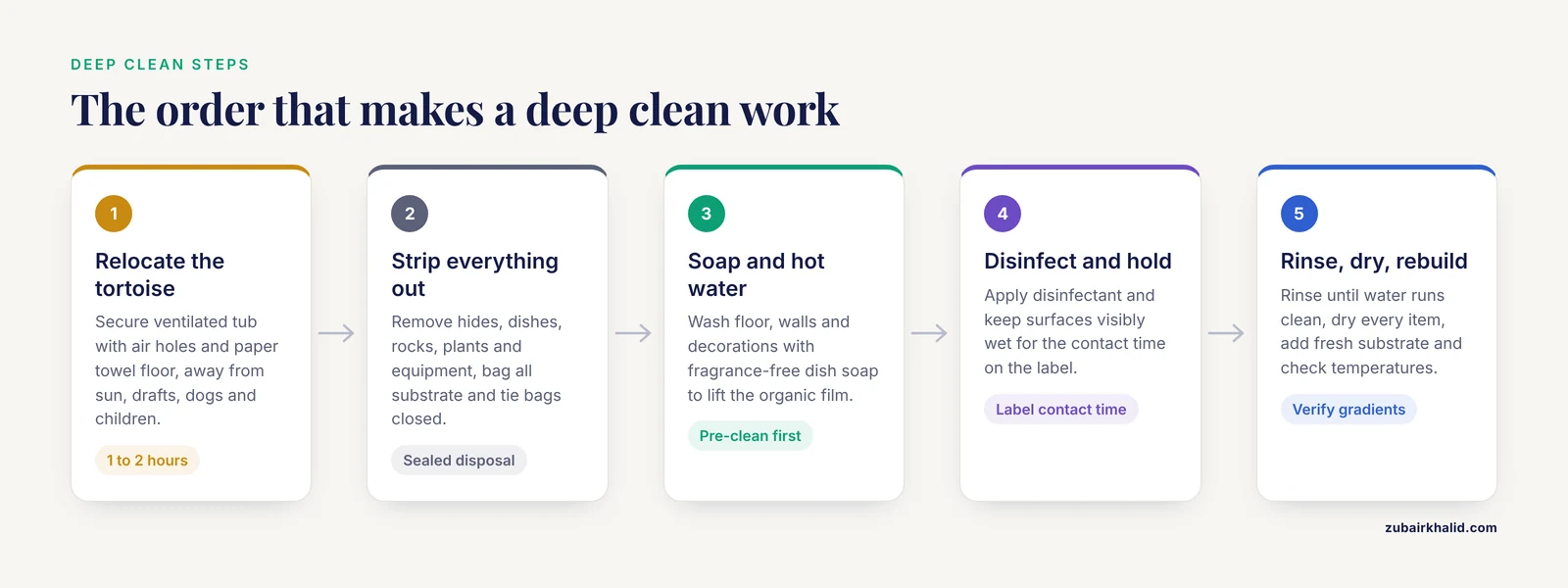
Set aside an hour or two. Gather gloves, a substrate scoop, paper towels, a dedicated scrub brush and sponge, fragrance-free dish soap, your chosen disinfectant, a spray bottle, garbage bags, and fresh substrate stored at room temperature.
- Relocate the tortoise. Place your tortoise in a secure, ventilated temporary container, such as a plastic tub with air holes and a paper towel floor, kept at a comfortable temperature away from direct sun, drafts, dogs, and children.
- Remove everything. Take out hides, dishes, rocks, plants, and equipment. Discard all substrate into garbage bags and tie them closed. Composting tortoise waste is fine in many areas, but sealed disposal is the default that keeps parasite eggs out of the household and garden paths.
- Pre-clean with soap and hot water. Wash the empty enclosure floor and walls and all decorations with fragrance-free dish soap and hot water. This removes the organic film that would otherwise shield bacteria from any disinfectant.
- Rinse completely. Soap residue irritates skin and mucosa, so rinse every surface until the water runs clean.
- Disinfect. Apply your disinfectant of choice to the enclosure, hides, dishes, and nonporous decorations. Keep surfaces visibly wet for the contact time stated on the product label. Ask your reptile veterinarian if you are unsure which product suits your setup, particularly for hatchlings or an animal recovering from illness.
- Rinse again. After the contact time, rinse all surfaces thoroughly with clean water. This step is critical, because residual disinfectant on the floor of an enclosure contacts the shell, mouth, and eyes of a low-slung animal all day.
- Dry completely. Air dry or towel dry every item before reassembly. Reassembling on damp surfaces recreates the humid microclimates you just eliminated.
- Rebuild the habitat. Add fresh substrate at the appropriate depth for your species, reinstall the hides, dishes, and gradients, and verify temperatures with your thermometer before the tortoise returns.
- Return the tortoise and wash up. Wash your hands and forearms, and launder or disinfect your cleaning tools. Keeping reptile cleaning gear separate from kitchen gear is standard advice in public health guidance for reptile-owning households, and it is the habit most often skipped.
- Log the date. A simple note on your phone or calendar keeps your tortoise cage cleaning schedule honest and reveals patterns, such as enclosures that foul faster in summer.
Safe Cleaning Products for Tortoises
Tortoises breathe enclosure air constantly, drink from dishes that sit on treated surfaces, and contact the floor with their mouths, beaks, and shells. Product choice and rinsing discipline therefore matter more than they would in a dog crate or cat litter box.
Reasonable options and their limits:
- Plain hot water and mechanical scrubbing. Sufficient for weekly surface wiping and for dishes between disinfections. Friction does most of the microbial work on visible soil.
- Fragrance-free dish soap. Effective for the pre-clean stage. Always rinse until no suds remain.
- Diluted household bleach (sodium hypochlorite). A widely used, inexpensive disinfectant in veterinary settings, including for reptile housing. Use an unscented product mixed fresh, apply to a pre-cleaned surface, allow the labeled contact time, then rinse thoroughly and dry. Never mix bleach with ammonia or acidic cleaners, because the combination releases hazardous gases.
- Chlorhexidine-based disinfectants. Common in veterinary hospitals and frequently recommended by reptile veterinarians for enclosure surfaces and dishes. Rinse per the product directions.
- Commercial reptile-safe cleaners. These exist and are convenient, but evaluate them the same way as any disinfectant, meaning check the label for the intended contact time and whether rinsing is required.
Products and practices to avoid:
- Scented soaps, pine and citrus oil cleaners, and strongly perfumed multipurpose sprays, which leave volatile residues in a mostly closed airspace.
- Ammonia-based glass cleaners inside the enclosure.
- Any chemical mixture not intended for use around animals.
- Cleaning with the tortoise inside the enclosure or in a container right beside the fumes.
One caution about disinfectant strength: a stronger mix is not a safer clean. Overly concentrated disinfectant leaves more residue and adds risk, while proper dilution with adequate contact time and thorough rinsing does the actual job. If you are unsure, your reptile veterinarian can recommend a specific product and dilution for your species and life stage.
Water, Soaking, and Dish Hygiene
Water dishes deserve special attention because they double as drinking vessels and soaking tubs and are the fastest-fouling item in the habitat. Dump and refill daily, scrub at least twice weekly, and disinfect weekly. If your tortoise habitually defecates in the water, which many do, replace the water immediately afterward rather than waiting for the scheduled change.
Hydration is also a health issue in its own right. Urolithiasis, the formation of urinary calculi, is a recognized disease of captive tortoises seen regularly at veterinary hospitals, and a survey of 101 affected tortoises in Japan found that husbandry and dietary factors around calculi formation were still not fully clarified, which is one reason veterinarians encourage consistent, well-managed basic husbandry including dependable access to fresh water [5]. Keeping the water dish clean and full is the low-effort foundation of that.
Substrate, Waste Management, and Biosecurity
Substrate strategy determines how fast your enclosure degrades between deep cleans. Loose substrates such as topsoil and coco fiber mixtures can be spot cleaned efficiently but eventually accumulate waste deep below the surface, which is why full replacement on a schedule matters even when the top layer looks clean. Solid liner systems allow faster deep cleaning but need more frequent wiping. Whichever system you choose, remove feces daily and commit to the full substrate change interval.
Waste disposal is a small biosecurity exercise. Feces management in livestock settings is treated as a core sanitation task precisely because waste is the vehicle that keeps pathogens and parasites circulating in an animal's environment [3]. Treat your tortoise's droppings the same way: bag them, close the bag, remove them from the living space, and wash your hands. If you keep multiple reptiles, do not share dishes, hides, or cleaning tools between enclosures without disinfecting them first, and clean the youngest animals' enclosures last or with separate tools. This simple traffic control mirrors the segregation practices that animal health authorities consider basic biosecurity on any premises holding animals [6].
If your tortoise has been treated for parasites, discuss enclosure disinfection and recheck fecal testing with your veterinarian, because reinfection from a contaminated environment is a well-recognized pattern when waste removal lags behind treatment [2].
Outdoor Tortoise Enclosures and Seasonal Adjustments
Outdoor pens follow the same hygiene logic with a few additions. Remove droppings daily, keep the water source clean, and manage drainage so no area stays muddy for days, because chronically wet ground concentrates waste and supports bacterial and fungal growth. Where tortoises graze a planted pen, rotating access or raking the area periodically prevents waste from accumulating in the zones the animal uses most.
Welfare monitoring programs for managed tortoise populations track survival, growth, and body condition over years as the measure of whether management is working [7]. Pet owners can apply a scaled-down version of the same idea by recording weight and appearance at cleaning time, since a stable, growing animal on a consistent cleaning schedule is the most visible evidence that your tortoise habitat hygiene routine is adequate.
Seasonal matters to adjust:
- Warm months. Waste decomposes faster, so shorten the interval between full cleans and watch for flies.
- Rain. Outdoor pens may need substrate top-ups and drainage fixes after heavy weather.
- Hibernation periods. For species that hibernate indoors, deep clean and disinfect the enclosure before hibernation and again before spring wake-up, so the animal enters and exits the cycle in a clean environment. Your veterinarian can advise on hibernation suitability for the individual animal [1].
Common Mistakes in Tortoise Habitat Cleaning
- Cleaning only when it smells. Odor means the schedule has already failed. Smell is a lagging indicator, not a trigger.
- Deep cleaning too rarely. A large enclosure that looks clean can still harbor parasite eggs in substrate. The Zanzibar tortoise survey showed that facility-level management differences were associated with parasite presence even in animals showing no clinical signs [2].
- Skipping the pre-clean. Disinfecting over visible dirt wastes the product and the effort, since organic debris neutralizes most disinfectants [4].
- Insufficient rinsing. Residue from soap or disinfectant sits exactly where your tortoise eats, drinks, and walks.
- Replacing all substrate far too often. Stripping the enclosure weekly stresses some tortoises and resets the microfauna keepers work to establish in planted or bioactive setups. Frequent spot cleaning plus a sensible deep clean interval is the better balance.
- Using the kitchen sink or bathtub for enclosure items without disinfecting them afterward. Use a utility tub or bucket system instead.
- Forgetting the tools. A contaminated scoop or brush reintroduces what you removed. Wash tools and hands every session.
- Ignoring the water dish schedule. This is the highest-traffic, highest-risk item in the habitat and the one most often neglected between deep cleans.
- Cleaning while sick animals share the space. If one tortoise is under treatment, isolate cleaning tools and consult your veterinarian about the correct disinfection protocol before returning recovered animals to the enclosure.
Monitoring Health Signals During Cleaning
Cleaning sessions double as structured health checks. At each session, observe and, where practical, record:
- Appetite and what food was actually eaten, not just offered.
- Feces volume, color, and consistency, plus the presence and amount of urates.
- Activity level and posture, including whether the animal uses its basking area normally.
- Eyes, nostrils, and mouth for discharge or swelling.
- Shell condition, looking for soft spots, discoloration, foul smell, or flaking areas.
- Weight, checked on the same scale at regular intervals.
Persistent changes in any of these are the point where a cleaning article stops being sufficient and a veterinary article takes over. Husbandry reviews for first-opinion practice stress that tortoise disease is frequently the visible end point of an earlier husbandry gap, so noticing a problem at cleaning time and acting on it quickly is the most valuable thing a cleaning routine can do for your animal [1]. Young tortoises appear particularly vulnerable to the cumulative effects of environmental and husbandry shortfalls, as suggested by case series of degenerative cardiac disease in young giant tortoises and sulcatas in human care, where inappropriate environmental parameters and husbandry were flagged for investigation as contributing factors [8].
Limitations and When to Contact a Veterinarian
Every tortoise, enclosure, climate, and household differs, so treat the intervals in this article as starting points rather than fixed rules, and discuss your specific setup with a reptile veterinarian, particularly for hatchlings, multiple-animal households, animals with a history of illness, and species with specialized needs [1].
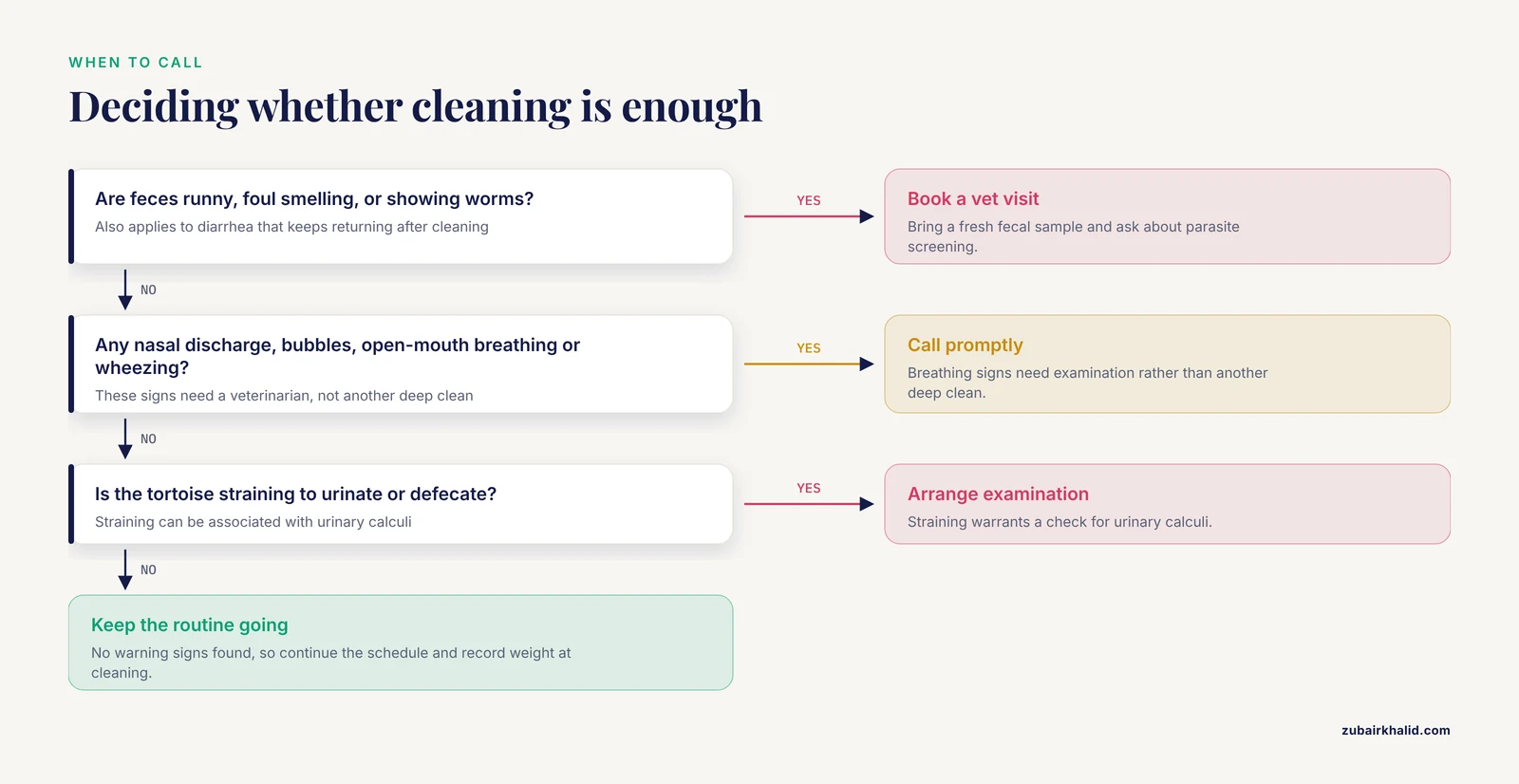
Contact a reptile veterinarian promptly if you observe any of the following:
- Diarrhea, persistently runny or malodorous feces, or visible worms or worm segments.
- Inappetence lasting more than a few days, or refusal of favorite foods.
- Lethargy, spending all day hidden, or an inability to right itself if tipped.
- Nasal discharge, bubbles at the nostrils, open-mouth breathing, or wheezing.
- Swelling of the eyes, ears, limbs, or neck, or any soft or foul-smelling area on the shell.
- Straining to urinate or defecate, which in tortoises can be associated with urinary calculi and warrants examination [5].
- Weight loss or failure to grow in a young tortoise.
- Any sign of illness in a tortoise that shares an enclosure with or recently lived near another animal, because shared housing raises the possibility of contagious or parasitic disease that needs diagnosis rather than more cleaning [2].
Frequently Asked Questions
How often should I clean a tortoise habitat?
Spot clean feces, urates, and uneaten food daily, do a weekly clean of dishes and hard surfaces, and deep clean with full substrate replacement monthly to every three months. Smaller enclosures and multi-tortoise setups need the shorter interval.
Can I clean the enclosure while my tortoise is still inside?
For daily spot cleaning, careful work around the animal is fine. For any deep clean involving disinfectant, water, or chemical fumes, move the tortoise to a secure, ventilated temporary container first.
Can I use bleach to clean a tortoise enclosure?
Diluted unscented household bleach is a standard veterinary disinfectant for animal housing when used correctly. Apply it to a pre-cleaned surface, allow the labeled contact time, rinse thoroughly, and dry completely before the tortoise returns. Never mix bleach with other cleaners.
Is vinegar safe for cleaning tortoise enclosures?
Plain diluted white vinegar can dissolve mineral deposits on glass and dishes and is low risk when rinsed away, but it is a weak disinfectant. Use it for mineral scale, and rely on an appropriate disinfectant for the sanitizing step.
How often should I change tortoise substrate?
Replace damp or fouled patches weekly and do a complete substrate change at every deep clean. Between changes, daily feces removal keeps the deeper layers serviceable.
How do I clean a tortoise habitat without stressing the animal?
Keep spot cleaning quick and calm, work from the same routine each day, avoid lifting the tortoise unnecessarily, and reserve full substrate strip-outs for the scheduled deep clean. Many tortoises tolerate established routines well and learn to anticipate feeding after cleaning.
What should I do after a sick tortoise recovers?
Ask your reptile veterinarian about a disinfection protocol for the enclosure and equipment before the animal returns, and whether follow-up fecal testing is advised. Clean the recovering animal's enclosure last in your rotation and keep its tools separate.
Do I need to wash my hands after cleaning the enclosure even if I wore gloves?
Yes. Wash your hands and forearms after every cleaning session and after handling the tortoise itself, since hand hygiene is the main barrier between enclosure waste and the rest of the household.
Sources
- Tortoise health. Part 1: husbandry and husbandry-related conditions
- Occurrence of Oxyurid-Type Nematode Eggs in Aldabra Giant Tortoises (Aldabrachelys gigantea) from Zoological Collections in Zanzibar, Tanzania
- Knowledge, attitudes, and practices of women related to human and animal feces management in Ethiopia: Evidence for strengthening water, sanitation, and hygiene (WaSH) initiatives
- Construction of Veterinary Hygiene System for Healthy Husbandry
- Survey of tortoises with urolithiasis in Japan
- Husbandry Practices, Biosecurity Measures of Pig Farmers and Their Awareness of Transmissible Gastroenteritis in Kwara and Oyo States, Nigeria
- The welfare implications of using exotic tortoises as ecological replacements.
- DEGENERATIVE CARDIAC DISEASE IN TWO SPECIES OF TORTOISE (CHELONOIDIS NIGRA COMPLEX, CENTROCHELYS SULCATA)