How Often to Clean a Bearded Dragon Habitat: Cleaning Schedule
By Dr. Zubair Khalid, DVM, MS, PhD ·

Spot clean your bearded dragon's enclosure every day, do a light clean of dishes and surfaces once a week, and perform a full deep clean of the entire habitat about once a month. Add an extra deep clean any time there is a spill, a loose stool, a pest problem, or an odor that persists after routine cleaning.
This schedule is the standard framework reptile veterinarians recommend for pet bearded dragons (Pogona vitticeps). The exact rhythm can shift with your setup. A large naturalistic enclosure with a bioactive clean-up crew needs different maintenance than a spare tank with paper towel substrate. This guide gives you a workable bearded dragon cage cleaning schedule, explains the reasoning behind each task, walks through deep cleaning a bearded dragon enclosure step by step, and covers safe cleaning products for bearded dragons so you are not guessing at the pet store shelf.
This article is educational and is not a substitute for veterinary diagnosis or treatment.
At a Glance: Bearded Dragon Cleaning Schedule
| Frequency | Task | Typical Time |
|---|---|---|
| Daily (1 to 2 times) | Remove feces, urates, shed skin, uneaten insects, and leftover greens. Wipe any spilled water. Check the water dish. | 2 to 5 minutes |
| Daily (quick check) | Scan for odor, damp spots under decor, and mites on the dragon or in the woodwork. | Under 1 minute |
| Weekly (20 to 30 minutes) | Wash and disinfect food and water dishes. Wipe basking surfaces, rocks, and glass. Stir or spot-replace loose substrate. Remove and replace cage liner or paper substrate as needed. | 20 to 30 minutes |
| Monthly (1 to 2 hours) | Full deep clean. Move the dragon to a temporary secure container. Remove all decor and substrate. Scrub, disinfect, rinse, and dry the enclosure and every item inside it. Replace substrate completely. | 1 to 2 hours |
| As needed | Immediate deep clean after a spill, diarrhea, regurgitation, a suspected parasite problem, a mite sighting, or before introducing a new animal to the household. | Varies |
Put this table where you feed your dragon. A bearded dragon habitat hygiene routine holds up far better when it is tied to an existing habit like morning feeding.
Why Cleaning Frequency Matters
Bearded dragons live in close contact with their own waste. They defecate in the enclosure, often in a favored corner, and they walk through it, dig in it, and occasionally taste it. Fecal material breaks down quickly under a basking lamp, and warm, moist substrate becomes a growth medium for bacteria, mold, and parasites within days.
The hygiene case for regular cleaning goes beyond the dragon itself. Reptiles can carry significant bacteria in their digestive tracts while appearing completely healthy. A study of pet central bearded dragons and leopard geckos in Portugal found that 17.9 percent of the healthy reptiles sampled carried third-generation cephalosporin-resistant Enterobacterales, including species such as Citrobacter freundii and Klebsiella aerogenes, and that some isolates carried extended-spectrum beta-lactamase genes [1]. These are bacteria of genuine public health concern. The authors of that study emphasized the zoonotic risk of close human-animal contact with pet reptiles [1]. Every time you reach into the enclosure, handle your dragon, or touch a dish it has eaten from, you are handling surfaces that contact that bacterial reservoir. Routine cleaning plus handwashing after every encounter is the practical defense.
There is also a comfort and welfare dimension. Bearded dragons spend much of their day in one or two preferred zones of the enclosure, especially the basking area [2]. That concentration of activity means waste, shed, and food debris accumulate in predictable places. Targeted daily attention to those zones keeps the habitat livable with minimal effort, and it lets you notice changes in your dragon's droppings, posture, and appetite at the earliest possible stage. Fecal output is one of the most useful daily health signals an owner has, and you can only read it if you find it fresh.
The Daily Routine: Spot Cleaning
Spot cleaning is the backbone of the schedule. Done consistently, it keeps the monthly deep clean short and keeps odor nearly nonexistent.
Follow this short checklist once or twice a day, ideally after the morning lights come on and again after the evening feeding:
- Pick out all feces and urates with a paper towel or a dedicated scoop. Bearded dragons often defecate in the same spot every day, so check that corner first. This localized use of the enclosure is well documented, with captive lizards concentrating their activity in one area [2].
- Remove uneaten feeder insects. Live crickets and roaches left overnight can bite a sleeping dragon and will die and rot in warm substrate.
- Lift out wilted greens and fallen vegetables before they mold.
- Wipe any water that has splashed or spilled, especially under and around the water dish. Persistent dampness under a hide or rock is a mold risk.
- Check the water dish, dump it, and refill with fresh water. Dragons often defecate in their water dish, which is one more reason it needs daily attention.
- Give the dragon and the decor a quick visual scan for mites, which appear as tiny moving specks around the eyes, in the skin folds, or in the woodwork.
Wash your hands with soap and warm water after every spot clean, even if you wore gloves. Hand hygiene after reptile contact is a core zoonotic disease prevention measure highlighted in the veterinary literature [1].
The Weekly Routine
Once a week, go beyond picking out waste and clean the surfaces and supplies the dragon touches constantly.
Weekly task list:
- Dishes. Food and water dishes go to the sink for a wash with hot water and dish soap, followed by disinfection and a thorough rinse. If you use porous dishes such as unsealed terra cotta, inspect them for cracks and replace them when they become stained or pitted.
- Basking surfaces and hardscape. Wipe down smooth rocks, branches the dragon climbs, the basking platform, and the glass with warm soapy water, then rinse-wipe with clean water. Fecal smears on the basking rock are common because many dragons relieve themselves while warmed up.
- Substrate refresh. Stir and aerate loose substrate, remove clumped or soiled patches, and top up as needed. Replace cage liners or paper-based substrate entirely on a weekly or twice-weekly cadence depending on how messy your individual dragon is.
- Glass and ventilation. Wipe the inside glass and check ventilation grilles for dust and debris. Clear airflow matters for respiratory health, so a blocked or grimy vent cover is worth two minutes of attention.
- Equipment check. Confirm the basking and ambient temperatures and the UVB output schedule while you are already handling the habitat. Cleaning day is the natural time to catch a burned-out bulb.
Keep a small caddy with paper towels, a scoop, dish soap, a spray bottle of your chosen disinfectant, and a separate rinse bottle. A dedicated caddy that never leaves the reptile room prevents cross-contamination with items used in human food areas.
Deep Cleaning a Bearded Dragon Enclosure: The Monthly Reset
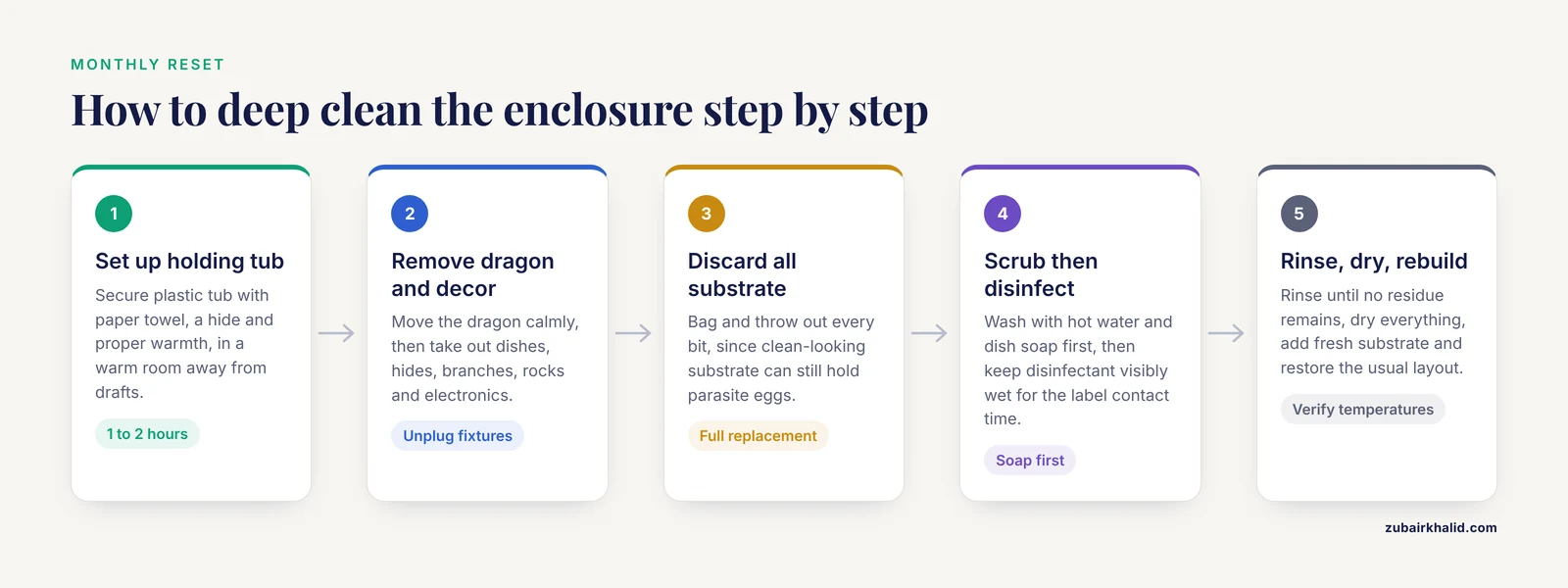
Deep cleaning a bearded dragon enclosure means emptying it, disinfecting every surface, and rebuilding it from the ground up. Once a month is the standard interval. Some keepers stretch to every six weeks with a very dry, sparse setup, while a humid or heavily planted enclosure may need it more often. Watch for the signals: any lingering odor after weekly cleans, visible substrate staining, or calcium and hard-water crust on the glass all mean the interval is too long for your setup.
Step-by-step deep clean:
- Set up a temporary holding container. Prepare a secure plastic tub or spare enclosure with paper towel substrate, a hide, and appropriate warmth. A bearded dragon should not sit in a cold dark box for hours, so plan the deep clean for a warm part of the day and keep the holding setup within the proper temperature range.
- Remove the dragon. Handle calmly and support the whole body. Place the dragon in the holding container in a warm room away from drafts, direct sun through glass, dogs, cats, and children.
- Remove everything else. Take out all decor, dishes, hides, branches, rocks, and electronics. Unplug and remove heat and light fixtures. Brush loose debris off the fixtures with a dry cloth rather than wetting electrical components.
- Remove all substrate. Bag it and discard it. Even substrate that looks clean can harbor parasite eggs and bacterial reservoirs, so a monthly deep clean means full replacement, not spot refreshment.
- Scrub with soap and water first. Wash the empty enclosure and every decor item with hot water and dish soap to strip organic matter. Disinfectants are significantly less effective on surfaces that still carry visible grime, so this step is not optional.
- Disinfect. Apply your chosen disinfectant to the enclosure interior and to each decor item. Keep surfaces visibly wet for the full contact time stated on the product label, which for many disinfectants means leaving them wet for several minutes rather than wiping immediately. Pay attention to silicone seams in glass tanks, corners, and the underside of hides, where organic material hides.
- Rinse thoroughly. Rinse every surface and item with clean water until no disinfectant residue remains. Residue left behind can irritate skin and eyes and can be ingested when the dragon licks surfaces.
- Dry completely. Air dry or towel dry the tank and all items. Disinfectant residue and moisture both need to be gone before reassembly.
- Rebuild. Add fresh substrate, then reposition hides, basking surfaces, and climbing structures. Reinstall equipment, verify temperatures with your thermometer, and confirm UVB placement before the dragon goes back in.
- Return the dragon and clean up after yourself. Disinfect the holding tub, the caddy, and any sinks or tubs you used, and wash your hands and forearms well.
One caution on rebuilding. Enclosure design affects how bearded dragons use their space and how they thermoregulate. Naturalistic enclosures provide better thermal heterogeneity than simple standard setups, though research on overall welfare benefits has been mixed, with lizards in one study spending most of the day inactive in a single zone regardless of enclosure style [2]. In practical terms, keep the core layout stable from month to month. Your dragon has learned where the warm rock is and where the hides sit. Restore that geography during deep cleans and save rearranging for deliberate upgrades.
Safe Cleaning Products for Bearded Dragons
The safest effective toolkit is simple, and most of it is already in your laundry room.
Products that work well:
- Dish soap and hot water. The first cleaner for every surface. Soap lifts organic debris so the disinfectant step can actually work.
- Unscented household bleach, properly diluted. A dilute bleach solution is one of the most reliable, inexpensive disinfectants for reptile enclosures and is widely recommended in reptile veterinary resources, including guidance published by the Merck Veterinary Manual. Use a fresh dilution each cleaning session, apply it to a cleaned surface, keep the surface wet for the labeled contact time, then rinse repeatedly and dry. Never use bleach at full strength inside the enclosure.
- Commercial reptile-safe disinfectants. Several products sold for terrarium use are formulated to be safe after rinsing. Read the label for reptile use, follow the contact time, and rinse as directed.
- Plain white vinegar. Useful for hard water spots, mineral crust from calcium and vitamin dusting spills, and glass polishing. It is a cleaner, not a true disinfectant, so use it alongside rather than instead of a disinfectant.
- A dedicated scrub brush and scraper. Label them for reptile use only and retire them if they become worn or cracked.
Products and practices to avoid:
- Scented cleaners, pine and citrus oil products, and strong ammonia-based cleaners. Fragrant residues and volatile compounds linger in a small enclosed space that the dragon breathes continuously.
- Mixing chemicals. Never combine bleach with ammonia or with vinegar. Mixing bleach and ammonia produces toxic chloramine gas. Mixing bleach and acid produces chlorine gas. Use one product, rinse completely, then move to the next.
- Spraying disinfectant near the dragon. Always clean with the animal out of the room. Aerosolized cleaners and even water mist from a spray bottle are unnecessary exposures.
- Fragrance plug-ins or aerosol fresheners near the enclosure. A clean reptile room should smell like nothing.
Whatever product you use, the full cycle matters more than the brand: clean off organic matter first, disinfect with the correct contact time, rinse until residue is gone, and dry fully. Skipping the rinse or the dry step is where most disinfectant problems begin.
Substrate, Decor, and How They Change the Schedule
Your substrate choice determines how much of the weekly and monthly workload you carry.
Paper towel and newspaper. Fastest to maintain. Replace soiled sections daily and the whole floor at least weekly. Ideal for quarantine and for a dragon recovering from illness, because nothing hides waste or parasites.
Slate, ceramic tile, and sealed hard surfaces. Wipeable, inexpensive over time, and easy to disinfect during a deep clean. Grout lines need a scrub brush.
Reptile carpet. Washable, but buy at least two pieces so one can be washed and fully dried while the other is in use. Inspect carpet for loose threads that can catch toes and claws.
Loose substrates. Soil and soil-sand mixes look natural and support digging behavior, but they hold moisture and waste. They require diligent daily spot cleaning, frequent stirring, and full monthly replacement.
Bioactive setups. A bioactive enclosure with a drainage layer, live plants, and a clean-up crew of invertebrates processes some waste biologically, which reduces routine workload over time. Bearded dragon keepers increasingly favor these naturalistic designs. Research on naturalistic housing in this species found genuine benefits for thermal variety but equivocal evidence on behavior and stress markers, so bioactive is not automatically superior on welfare grounds, and it still demands monitoring, plant care, and periodic attention to the areas the dragon uses most [2].
Wood, cork, and porous rock. These are the hardest items to truly disinfect because bacteria and parasite eggs settle into pores and cracks. Scrub them, disinfect them, rinse them, and dry them in the sun if possible. Replace any piece that stays damp, grows mold, or cannot be fully cleaned after a heavy contamination event.
One morph-specific note worth mentioning. Silkback and leatherback bearded dragons lose water through the skin at substantially higher rates than wild-type dragons, with scaleless animals losing roughly twice as much evaporatively in one comparison of captive-bred phenotypes [3]. If you keep one of these smooth-scaled morphs, expect more moisture around the water dish and more frequent drying duties, since their enclosures lose water to the air faster than a standard dragon's.
Habitat Hygiene and Bearded Dragon Welfare
Cleaning is not separate from welfare. It is part of it.
Research on this species has shown that housing conditions leave measurable traces in the animals themselves. In a study that housed captive-bred bearded dragons in standard or enriched enclosures for four weeks, lizards in the standard enclosures showed significantly greater use of the left eye during basking, a pattern associated with negative emotional states, while the enriched-housed lizards did not [4]. The study's authors proposed lateralized eye use as a promising non-invasive welfare indicator in this species [4]. What that means for a cleaning routine is straightforward. The enclosure is not just a container, it is the environment your dragon's nervous system responds to every day. Hygiene, thermal quality, and structural richness all feed into the same welfare budget.
A clean habitat also preserves the features that make an enclosure work. Waste films on basking rocks change grip, spilled water creates damp zones that alter the thermal gradient, and dirty glass diffuses UVB and visible light. The same body of research that documented better thermal heterogeneity in naturalistic enclosures also showed how much these lizards rely on a small number of preferred microclimates [2]. When you deep clean, restore those microclimates exactly. A dragon that suddenly cannot find its usual warm spot is a stressed dragon, and stress shows up in feeding, activity, and even the lateralized-eye signals described above.
Common Cleaning Mistakes
- Cleaning only the visible glass. The tank walls are the least contaminated surface. The work is under the hide, in the corner, and in the seams.
- Disinfecting without washing first. Disinfectant on organic debris does little. Soap first, disinfect second.
- Skipping the rinse. Residual disinfectant is a contact irritant and an ingestion risk.
- Returning the dragon to a damp enclosure. Chronic dampness promotes skin and respiratory problems. Dry everything before reassembly.
- Wiping droppings instead of lifting them. Smearing waste across a surface spreads it and leaves residue. Pick it up.
- Using the kitchen sink and sponges for enclosure items. Keep reptile cleaning tools separate from human food preparation. This separation matters even more given the resistant bacteria documented in apparently healthy pet reptiles [1].
- Rearranging the entire enclosure at every deep clean. Stability helps a territorial, routine-driven lizard. Clean deeply, redecorate rarely.
- Letting live feeders free-roam overnight. Loose crickets chew on sleeping dragons and die in inaccessible spots, which creates a hidden rot problem that defeats a clean schedule.
- Ignoring the equipment. Dust on fixture covers, calcium splatter on the mesh screen, and dead insects behind the light fixture all belong in the monthly clean.
Troubleshooting Common Problems
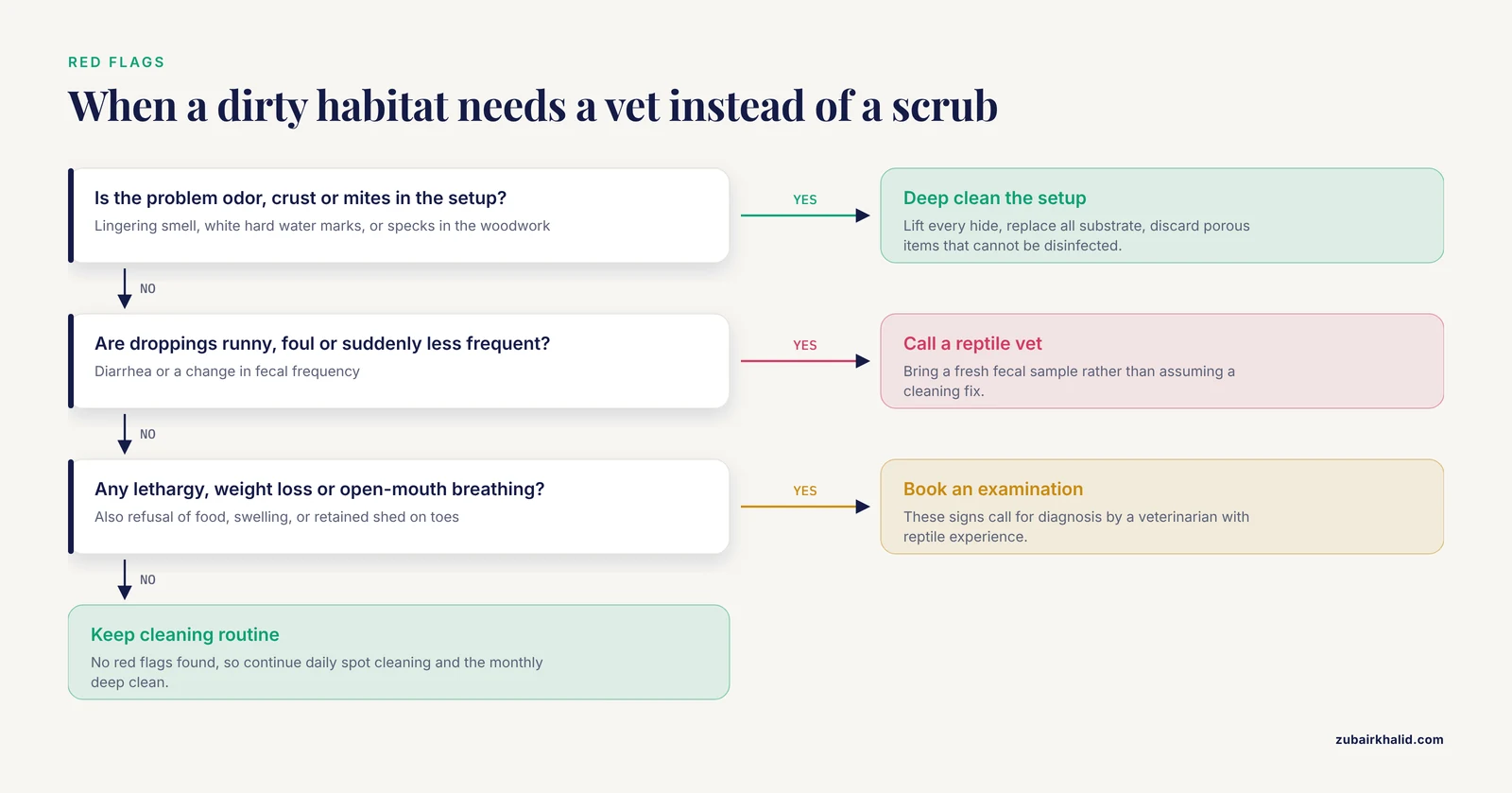
Persistent odor despite weekly cleaning. Lift every hide and check the substrate underneath. A single soaked patch under a water bowl or a decomposing feeder insect behind decor can carry a surprising amount of smell. If a full deep clean does not resolve the odor, look for a wet stool pattern or diarrhea and call your reptile veterinarian, since abnormal droppings often have a medical cause rather than a cleaning cause.
Rec staining and hard water marks. White crust on glass and dishes is usually calcium dust and mineral deposits. Soak with plain white vinegar, scrub, rinse, and dry. Reposition the water dish away from the basking light to reduce evaporation rings.
Mites. Tiny mobile specks on the dragon, around the eyes, or in the enclosure woodwork indicate a mite problem that household cleaning alone will not solve. Deep clean the entire setup, discard porous items that cannot be disinfected, and contact a reptile veterinarian for a treatment plan for the dragon itself.
A dragon that defecates only in the water dish. This is common and not a problem in itself, but it makes daily dish duty non-negotiable. Some keepers add a second shallow dish and adjust placement to steer the habit toward the easiest spot to clean.
Frequent loose stools. Hygiene responds to husbandry and to medicine in parallel. Substrate ingestion, diet imbalance, and parasites all cause abnormal droppings. Bring a fresh fecal sample to your veterinarian rather than assuming a cleaning fix.
Limitations and When to Contact a Veterinarian
Cleaning schedules are general husbandry guidance, and individual animals vary in messiness, health status, and enclosure needs. Any specific health question about your dragon needs an examination by a veterinarian with reptile experience.
Contact a reptile veterinarian promptly if you notice any of the following, because these signs call for diagnosis rather than more cleaning:
- Diarrhea, runny or unusually foul droppings, or a sudden change in fecal frequency
- Regurgitation or refusal of food lasting more than a day or two in an otherwise healthy adult, or any food refusal in a juvenile
- Lethargy, prolonged hiding, or failure to thermoregulate normally
- Weight loss, a prominent spine or hip outline, or a soft or rubbery jaw
- Visible mites, wound openings, blistering, discolored patches, or retained shed around toes and the tail tip
- Open-mouth breathing, wheezing, excess mucus at the mouth, or head tilting
- Any swelling of the limbs, jaw, or eyes
Also talk with a veterinarian or physician about zoonotic risk before a reptile joins a household that includes infants, elderly family members, pregnant people, or anyone who is immunocompromised. The finding that a meaningful share of healthy pet bearded dragons carry antimicrobial-resistant Enterobacterales in their oral and cloacal cavities [1] is a reason for consistent handwashing and sensible boundaries around the enclosure, not a reason to give up the animal.
Frequently Asked Questions
How often should I clean a bearded dragon enclosure?
Spot clean daily, clean dishes and key surfaces weekly, and deep clean the whole enclosure monthly. Add an unscheduled deep clean after diarrhea, a spill, a mite sighting, or any contamination event.
Can I use bleach to clean a bearded dragon tank?
Yes, dilute unscented bleach is a standard and effective choice when used correctly. Clean surfaces with soap first, keep the bleach solution in contact with the surface for the labeled time, rinse until no smell or residue remains, and dry completely before the dragon returns.
Is vinegar safe for cleaning bearded dragon enclosures?
Yes, plain white vinegar is safe for cutting mineral deposits and hard water spots as long as you rinse and dry afterward. It is a cleaner rather than a disinfectant, so pair it with a proper disinfectant during deep cleans.
Do bearded dragons carry bacteria that can make people sick?
They can. Healthy pet bearded dragons have been documented carrying antimicrobial-resistant Enterobacterales in their mouths and vents [1]. Wash your hands with soap after every contact with the dragon, the substrate, or the dishes, and keep enclosure cleaning tools out of the kitchen.
How do I deep clean an enclosure with live plants or a bioactive setup?
Remove the dragon, spot-clean waste and replace top dressing, prune and inspect plants, let the clean-up crew and microfauna do their work, and avoid disinfecting the planted substrate itself. Disinfect hard items like dishes and glass separately, and monitor whether odor or fly pests are building up, which signals a need for a more thorough intervention.
Can I clean the enclosure while my bearded dragon is inside?
Light spot cleaning is fine, but a deep clean should always happen with the dragon in a separate warm holding container. Sprays, moved furniture, scrubbing, and disinfectant fumes are all unnecessary stress and exposure for an animal inside the tank.
How long should disinfectant sit on surfaces before I rinse?
Follow the contact time on the product label. Many disinfectants need to stay visibly wet for several minutes to work, so saturate the surface, wait out the full contact time, then rinse thoroughly and dry. Wiping a surface dry immediately after spraying defeats the product.
How often should I replace the substrate completely?
During the monthly deep clean, replace all substrate even if it looks clean. Between deep cleans, remove soiled patches daily and refresh loose substrate weekly. Replace immediately after any diarrhea, spill, or pest problem regardless of the calendar.
Sources
- ESBL/pAmpC-producing Enterobacterales in common leopard geckos (Eublepharis macularius) and central bearded dragons (Pogona vitticeps) from Portugal.
- Influence of enclosure design on the behaviour and welfare of Pogona vitticeps.
- Bearded dragons (Pogona vitticeps) with reduced scalation lose water faster but do not have substantially different thermal preferences.
- Visual lateralization as an indicator of animal welfare.