Healthy vs Unhealthy Crested Gecko Poop: What Droppings Tell You
By Dr. Zubair Khalid, DVM, MS, PhD ·
Crested gecko poop is one of the most reliable daily health signals an owner has. A healthy crested gecko passes small, formed, brown droppings, each finished with a soft white or cream urate, at a pace that follows its feeding schedule. Reptiles hide illness until disease is well advanced, so droppings are often the first outward clue that something is wrong inside the gut, the kidneys, or the husbandry itself. Learning your gecko's normal pattern, and the changes that actually matter, puts you ahead of most problems that bring crested geckos to a reptile veterinarian.
Owner triage summary
- Normal: brown, formed feces, a white to cream urate, a mild smell, and a frequency that tracks meals.
- Watch and adjust: one soft stool after a diet change, a temporary color tint after a colorful meal, or a dropping that arrives slightly later than usual.
- Call a reptile veterinarian: diarrhea lasting more than a day or two, red streaks or black tarry stool, undigested food in the dropping, a strongly foul smell, yellow or chalky urates, or no stool at all alongside bloating, straining, or lethargy.
This article is educational and is not a substitute for veterinary diagnosis or treatment.
At a Glance: Healthy vs Unhealthy Crested Gecko Droppings
| Feature | Healthy | Concerning |
|---|---|---|
| , - | , - | , - |
| Frequency | Follows the feeding schedule, from daily in growing juveniles to every few days in adults | A sudden break from your gecko's own baseline |
| Fecal color | Brown to dark brown, with harmless meal-related tints | Red streaks, black and tarry texture, or green that persists across droppings |
| Fecal texture | Formed, holds its shape, moist but not wet | Watery, coated in mucus, or containing undigested insects or diet |
| Urate | White to pale cream, soft paste to lightly firm | Yellow, orange, chalky and gritty, or rock hard |
| Odor | Mild, faintly earthy, gone once cleaned | Strongly foul or suddenly much worse |
| The gecko itself | Eating, alert, stable weight | Refusing food, lethargy, or weight loss alongside any stool change |
A single odd dropping rarely means disease. Patterns over several droppings, especially when paired with appetite or behavior changes, are what separate harmless variation from a reason to book an exam. When in doubt, bring a fresh sample and your notes to a reptile veterinarian rather than waiting to see if the next dropping looks better.
What Crested Gecko Poop Is Made Of
Reptiles handle waste very differently from mammals, and that difference explains what a normal crested gecko dropping looks like. The digestive, urinary, and reproductive tracts all empty into one shared chamber called the cloaca, so feces and urinary waste leave the body together through a single opening. Instead of producing liquid urine loaded with urea the way mammals do, crested geckos convert most of their nitrogen waste into uric acid, which is excreted as a semi-solid white paste known as urates. This water-saving adaptation suits an animal that evolved on the islands of New Caledonia, where moisture arrives in pulses rather than a steady supply.
The Three Parts of a Normal Dropping
- Feces: the brown portion, made of digested food and bile pigments. In an omnivore that eats a powdered complete diet, fruit, and insects, the exact shade shifts with meals.
- Urates: the white or cream portion, the reptile equivalent of urine, passed as a soft paste or a small firm cap.
- Urine: a clear liquid component, sometimes visible as a wet ring or damp spot around the dropping. At other times the cloaca reabsorbs most of that water and you see little to none of it.
All three exit through the vent, the external opening on the underside at the base of the tail. That location matters during health checks, since stuck shed around the vent, swelling, or pink tissue protruding from the opening can interfere with defecation and needs veterinary attention.
Why Temperature Shapes Digestion
Crested geckos are ectotherms, meaning they rely on environmental heat to run their metabolism, including the muscular activity of the gut. When enclosure temperatures sit in the correct range, food moves through at a normal pace and droppings appear on a predictable rhythm. When the room or enclosure runs cold, digestion slows, droppings become less frequent, and partially digested food can show up in the stool. Sustained heat above the species' comfort zone is equally dangerous, because crested geckos tolerate heat poorly and can decline rapidly in overheated enclosures. This is why any investigation of abnormal poop starts with a thermometer, not a medication.
How Often Does a Crested Gecko Poop?

There is no single correct number, because frequency follows food, heat, and hydration. The useful frame is frequency relative to meals.
- Hatchlings and juveniles eat more often, sometimes daily, and typically pass droppings daily to every other day.
- Adults are usually fed a few times a week and commonly pass droppings every few days, with some adults stretching to about a week between droppings.
- Cooler seasons slow everything down. Many crested geckos eat less and defecate less during winter months even indoors, as room temperature and light cycles shift.
- Hydration matters. A gecko kept at proper humidity with regular misting digests and eliminates more predictably than one kept too dry.
Many crested geckos also favor one corner of the enclosure as a latrine, which makes monitoring easier. The most valuable habit you can build is recording the date each time you clean droppings. After a few weeks you will know your individual's rhythm, and any genuine change will stand out immediately instead of blending into a vague memory.
What Healthy Crested Gecko Poop Looks Like
Healthy crested gecko poop has a consistent profile:
- Color: medium to dark brown feces. Meals heavy in insects darken the stool, while fruit or flavored powdered diets can add orange, pink, or rust tones.
- Texture: formed and cohesive, holding its shape when lifted with a tissue. It should be moist, not crumbly dry and not runny.
- Urate: white to pale cream, soft like toothpaste or slightly firmer. A small amount of clear liquid around it is normal.
- Size: proportional to recent meals. A dropping after a large insect dinner is bigger and darker than one following a powdered diet.
- Smell: mild and quickly forgotten once the dropping is removed. Reptile droppings should never dominate a room.
Normal variation is real. A gecko that just ate a mango-flavored diet may produce an orange-tinged dropping that looks alarming in a photo without the meal history. This is why the color chart below pairs each appearance with its most likely cause and a clear action, rather than treating every color as a diagnosis.
Crested Gecko Poop Color Chart
| Appearance | Most likely meaning | What to do |
|---|---|---|
| , - | , - | , - |
| Brown, formed feces with a soft white or cream urate | Normal dropping | Nothing, keep records |
| Very dark brown to near black after an insect meal | Insect pigments and chitin | Normal if it matches a recent insect feeding |
| Orange, pink, or rust tint | Pigments from fruit or flavored powdered diet | Fine if it follows a colorful meal, call the vet if it persists across several droppings |
| Green feces | Fast gut transit, diet pigments, or early illness | Fine once after a large fruit meal, call the vet if repeated or paired with soft stool |
| Red streaks or drops of fresh blood | Bleeding from the lower intestine, vent injury, or heavy parasite irritation | Veterinary visit promptly |
| Black, tarry, sticky feces | Blood digested higher in the gut | Veterinary visit promptly |
| Watery, shapeless droppings | Diarrhea from diet change, parasites, or infection | Vet if it lasts more than a day or two or comes with appetite loss |
| Undigested insects or diet visible | Maldigestion, temperatures too low, or parasites | Veterinary fecal exam |
| Mucus coating | Intestinal irritation | Vet if repeated |
| White, chalky, gritty urates | Possible excess calcium intake or dehydration | Vet check and a review of supplementation |
| Yellow or mustard urates | Dehydration, or less often liver or bile problems | Vet check |
| Hard, dry, scant droppings | Dehydration or early constipation | Review hydration and heat, vet if no stool passes |
| Sudden strong foul odor | Parasites, bacterial overgrowth, or spoiled diet | Veterinary fecal exam |
Two rules make this chart work in practice. First, match the appearance to what your gecko actually ate over the last day or two. Second, judge trends rather than single droppings, since one unusual stool in an otherwise bright, eating gecko is rarely an emergency.
Unhealthy Crested Gecko Poop: Causes and Differentials
Crested Gecko Diarrhea
True crested gecko diarrhea means droppings that lose all form, arrive watery or mushy, and often stain a wide area of the enclosure. The common causes are:
- Diet changes: a sudden switch in powdered diet brand or flavor, a very large fruit meal, or overfeeding can speed gut transit for a day or two.
- Parasites: protozoa and worms irritate the intestinal lining and are a leading cause of persistent loose stool in reptiles.
- Bacterial and other infections: the reptile gut carries a bacterial population that can shift toward disease after stress, poor hygiene, or improper temperatures.
- Stress and environment: a new enclosure, co-housing, heavy handling, or temperatures outside the correct range can all soften stool.
- Spoiled food: mixed powdered diet left sitting in the enclosure grows bacteria and yeast that upset the gut.
A single soft stool after a diet change usually resolves on its own once the diet settles and husbandry is confirmed correct. Diarrhea that persists beyond a day or two, recurs across several droppings, or arrives with a dropped appetite needs a fecal exam rather than a wait-and-see approach.
Parasites That Show Up in Droppings
Internal parasites are among the most common findings when a reptile veterinarian runs a fecal test. The usual suspects include:
- Nematodes (roundworms), including pinworms, which are widespread in reptiles and usually detected by finding characteristic eggs on fecal flotation.
- Coccidia, single-celled protozoa that damage the intestinal lining and cause diarrhea and weight loss.
- Flagellates and other protozoa, which can bloom under stress and crowding and produce foul, loose droppings.
- Cryptosporidium, a protozoal parasite that in lizards is associated with weight loss, regurgitation, and wasting, and is notoriously difficult to clear.
Parasite burdens connect to droppings in a predictable way. Heavy loads produce diarrhea, mucus, undigested food, a strong smell, and weight loss despite a normal appetite. Wild-caught or recently imported animals carry the highest risk, though captive-bred geckos can also harbor parasites, which is why screening rather than assumption is the standard.
Undigested Food and Maldigestion
Finding recognizable insect parts or powdered diet in a dropping is a specific warning sign. The two leading explanations are enclosure temperatures too low for normal digestion and an intestinal problem such as parasites. Either way, food is passing through without doing its job, and the gecko is losing nutrition it needs. This finding deserves a fecal exam and a full husbandry review.
Blood in Crested Gecko Poop
Blood appears in two forms, and the difference tells a veterinarian where the problem sits. Fresh red streaks or drops usually indicate bleeding low in the intestine or at the vent, from heavy parasite irritation, a scratch, or tissue that has slipped out of the vent. Black, tarry, sticky feces indicate blood that was digested higher up, which points to more significant gut disease. Both are reasons to book a veterinary visit promptly, and the tarry form is the more urgent of the two.
No Poop: Constipation, Impaction, and Blockage
A gecko that stops producing droppings may simply be eating less, especially in cooler months. Concern grows when absent stool is paired with other signs. Dehydration dries the stool and slows the gut. Low temperatures slow it further. Loose particle substrate, if swallowed during feeding or exploration, can accumulate and cause impaction, particularly in an animal that is already dry. In females, eggs pressing on the digestive tract can reduce defecation, and a gravid female that strains without passing stool or eggs needs urgent help. A visibly swollen or firm belly, straining, repeated restless posture changes, or lethargy with no droppings is a veterinary case, not a home project.
Urate Changes and What They Mean
Urates act as a hydration and metabolism report card. Soft white to cream urates are the goal. Yellow or mustard urates suggest dehydration, or less often a liver or bile problem that a veterinarian should evaluate. Chalky, gritty, or unusually thick urates can reflect heavy calcium supplementation, since excess calcium leaves the body through the same route. Rock hard urates point to chronic dehydration. Any of these changes, especially when paired with reduced appetite, justifies a checkup and a review of your supplement routine with your veterinarian.
Odor Changes
Reptile droppings have a mild smell. A sudden, strong, lingering odor usually means intestinal parasites, bacterial overgrowth, or food that spoiled inside the enclosure. Smell is subjective, but owners reliably notice the difference, and it is a finding worth mentioning at the exam even if the droppings otherwise look normal.
Risk Factors for Abnormal Droppings
Certain situations raise the odds of stool problems:
- Young age. Hatchlings and juveniles dehydrate and decline faster than adults, and parasite burdens hit them harder.
- Origin. Wild-caught or recently imported animals carry more parasites than established captive-bred geckos.
- New arrivals without quarantine. A new gecko added directly to a collection can pass parasites and infections to the animals already there.
- Co-housing. Crested geckos are best kept individually, and shared enclosures add stress, competition, and disease transfer.
- Loose particle substrate. Swallowed particles are an impaction risk, particularly in a dehydrated animal.
- Temperature and humidity errors. Chronic cold slows the gut, chronic dryness dehydrates it, and overheating can be quickly fatal in this species.
- Supplement mistakes. Heavy-handed calcium dosing shows up in the urates, while insufficient calcium and vitamin D3 undermine overall health and appetite.
- Unreliable feeder insects. Insects raised on unknown or contaminated material can introduce problems into an otherwise clean setup.
Veterinary Examination and Diagnostics
When droppings look wrong for more than a day or two, or any red flag appears, a reptile veterinarian is the right next step. The Association of Reptilian and Amphibian Veterinarians maintains resources for locating a veterinarian experienced with reptiles, and recommends that new reptiles receive an initial wellness exam that includes a fecal parasite screening.
A typical workup includes:
- History and husbandry review. Expect questions about temperatures, humidity, diet, supplements, substrate, cleaning routine, and any new animals. Many stool problems are solved at this step alone.
- Physical examination. Weight, body condition, hydration status, the vent, the abdomen, and the mouth. VCA Animal Hospitals notes that reptiles often mask illness until disease is advanced, so a hands-on exam catches problems owners miss.
- Fecal testing. A fresh dropping is examined by direct smear and fecal flotation to find protozoa and worm eggs, with acid-fast staining or PCR testing added when coccidia or Cryptosporidium is suspected.
- Imaging. Radiographs or ultrasound help when impaction, retained eggs, or organ disease are suspected.
- Bloodwork. Recommended when systemic illness, organ disease, or significant dehydration complicates the picture.
Bring a fresh dropping to the appointment if you can, kept cool but not frozen, or ask the clinic whether they can collect a sample during the visit. Bring your dropping log and a photo of anything you found unusual. Owners who arrive with records give their veterinarian a head start that often shortens the diagnostic process.
Treatment and Evidence-Based Management
Treatment targets the cause found on testing and corrects the husbandry that allowed the problem to develop.
- Antiparasitic therapy. When parasites are identified, veterinarians prescribe antiparasitic drugs such as fenbendazole, metronidazole, or toltrazuril, which are used in reptiles under veterinary direction. Dosing in reptiles differs sharply from mammals and depends on the species, the weight of the animal, and the specific parasite, so prescriptions are set by the treating veterinarian. Treatment is commonly repeated, and follow-up fecal exams confirm that the parasite is actually cleared rather than assumed gone.
- Environmental hygiene. Many parasites shed infective stages in droppings, so prompt feces removal, disinfection of surfaces and decor, and replacement of substrate during treatment prevent reinfection.
- Hydration support. Correct humidity and misting, and fluids administered by the clinic when a gecko is genuinely dehydrated, restore normal gut function.
- Nutritional support. A gecko that has stopped eating may need assisted feeding with a recovery product under veterinary guidance, since reptiles can decline quickly without food.
- Husbandry correction. Temperatures, humidity, and diet are adjusted to the species baseline, because no medication works well in an enclosure running cold or dry.
- Isolation. Affected geckos are kept separately from others during treatment, with dedicated tools and careful hand hygiene, to stop spread through a collection.
Recheck timing is set by the treating veterinarian and depends on the diagnosis. The consistent theme across parasitic disease in reptiles is that a single treatment without a confirming fecal exam leaves the job unfinished.
Home Remedies That Put Crested Geckos at Risk
Some popular fixes for abnormal droppings cause more harm than the original problem:
- Dewormers made for dogs, cats, or birds. Reptile dosing is completely different, and guesswork doses can cause serious toxicity in a small lizard.
- Leftover antibiotics from another pet. Wrong drug, wrong dose, and no diagnosis behind the decision.
- Herbal dewormers, essential oils, garlic, or apple cider vinegar. None have proven effect against reptile parasites, and some are irritating to a small animal's skin and airways.
- Mineral oil or laxatives for constipation. These can be aspirated or worsen a blockage, and belong only in a veterinarian's hands.
- Drastic heat increases to speed digestion. Crested geckos tolerate heat poorly, and pushing temperatures above their safe range can be fatal.
- Forced feeding without instruction. Incorrect technique can injure the jaw or send food into the lungs.
The pattern behind all of these is the same. Reptile medicine is species- and dose-specific, and the margin for error in a gecko that weighs a few dozen grams is small.
Prevention: Keeping Droppings Normal
- Quarantine every new gecko. House new arrivals separately, in a separate room where possible, with dedicated tools and supplies, before they join a collection.
- Screen feces at the first vet visit. A baseline fecal test catches parasites before they cause disease, and periodic screening is a reasonable habit for any collection.
- Wash your hands. Reptiles, including geckos, can carry and shed Salmonella without ever looking sick, so handwashing after handling or cleaning protects your household. Keep geckos and their equipment out of kitchens, and supervise any contact between reptiles and young children.
- Hold the husbandry baseline. Daytime temperatures in the low to mid 70s Fahrenheit, average humidity around 50 to 70 percent with misting spikes, and a varied omnivorous diet keep the gut working as designed.
- Clean promptly. Remove droppings as they appear, disinfect decor between deep cleans, and never leave mixed powdered diet sitting in the enclosure long enough to spoil.
- Feed responsibly. Use commercially raised feeder insects and fresh, properly stored diet.
- Keep a dropping log. Dates, appearance, and photos make real changes obvious and give your veterinarian useful history.
Prognosis for Abnormal Droppings
Outcomes depend on the cause and how early it is caught. Stool changes driven by husbandry usually normalize within days of correcting temperatures, humidity, or diet. Parasite infections identified on fecal testing typically respond to prescribed treatment, with rechecks confirming clearance. The outlook is more guarded for Cryptosporidium infections, which are difficult to clear even with veterinary care, and for any gecko that reaches the veterinarian after marked weight loss. Early action is the single biggest factor an owner controls.
When to Worry About Crested Gecko Poop: Emergency Red Flags
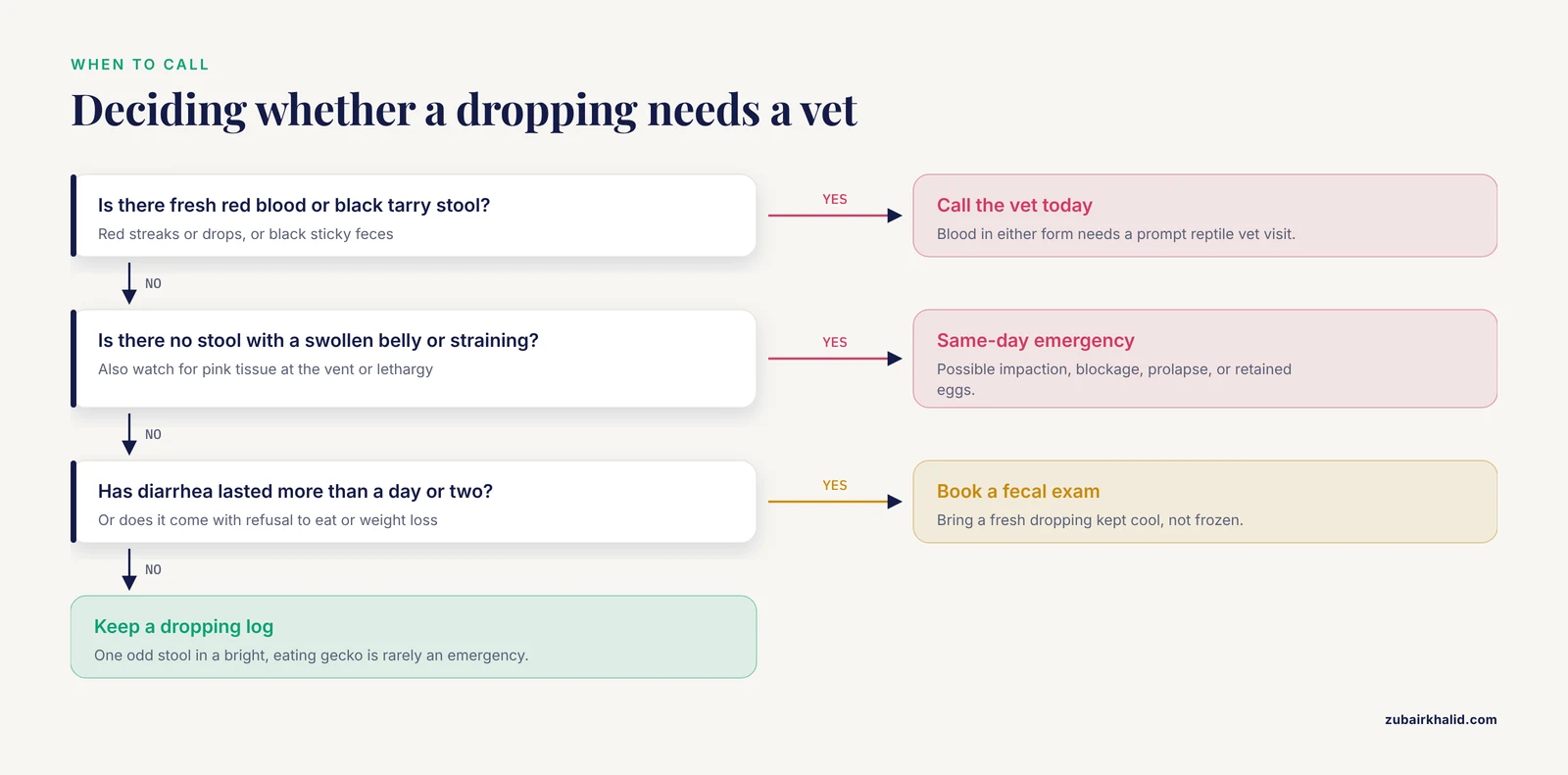
Contact a reptile veterinarian the same day, or an emergency exotics service after hours, for any of the following:
- Fresh red blood or black, tarry stool
- Pink or red tissue protruding from the vent, which is a prolapse
- No droppings with a swollen or firm belly, straining, or lethargy
- Diarrhea alongside refusal to eat or visible weight loss
- Regurgitation with progressive weight loss
- Yellow urates in a gecko that is also lethargic or not eating
- A gravid female straining without passing stool or eggs
- Sudden collapse, open-mouth breathing, or a gecko found on the enclosure floor unable to grip or climb
Limitations and When to Contact a Veterinarian
Every crested gecko is an individual, and droppings can only be interpreted alongside the animal's history, husbandry, and hands-on exam findings, so a reptile veterinarian should evaluate any case that concerns you. Escalate beyond routine monitoring when:
- Any red flag from the list above appears
- Diarrhea lasts more than a day or two or keeps returning
- Dropping frequency breaks from your gecko's recorded pattern and does not return, especially in an adult that continues eating while producing nothing
- Appetite drops over several consecutive meals, or weight loss becomes visible along the tail and body
- Behavior changes, such as constant hiding, spending all day at the bottom of the enclosure, or refusing food it normally takes eagerly
- You simply feel something is off, because owners who know their animal's baseline are frequently right
If you do not yet have a reptile veterinarian, the Association of Reptilian and Amphibian Veterinarians provides a public directory to help you find one in your area.
Frequently Asked Questions
How often should a healthy crested gecko poop?
It depends on age and feeding. Juveniles eating daily often pass droppings every day to every other day, while adults eating a few times a week commonly go every few days, sometimes up to about a week. Your own gecko's recorded pattern matters more than any universal number.
What does healthy crested gecko poop look like?
Healthy droppings have brown, formed feces with a soft white to cream urate, sometimes a clear liquid ring, a mild smell, and a size that matches recent meals. Anything persistently watery, tarry, bloody, or foul-smelling falls outside normal.
Why is my crested gecko's poop white?
The white portion is the urate, the reptile equivalent of urine, excreted as semi-solid uric acid to conserve water. A white or cream urate is normal. Chalky, gritty, or yellow urates are changes worth discussing with a veterinarian.
Can crested gecko diarrhea go away on its own?
A single soft stool after a diet change often resolves once the diet settles and husbandry is correct. Diarrhea lasting more than a day or two, or paired with appetite loss, needs a fecal exam and veterinary treatment rather than waiting.
Do crested geckos carry Salmonella?
Reptiles, including geckos, can carry and shed Salmonella while looking completely healthy. Wash your hands after handling or cleaning, keep the gecko and its supplies out of kitchens, and supervise any contact with young children.
How does a vet test crested gecko poop?
A fresh dropping is examined with a direct smear and fecal flotation, and acid-fast staining or PCR testing is added when coccidia or Cryptosporidium is suspected. Follow-up fecal exams after treatment confirm that parasites are truly cleared.
Why does my crested gecko's poop smell so bad?
A sudden strong odor usually points to intestinal parasites, bacterial overgrowth, or diet that spoiled inside the enclosure. A fecal exam identifies the cause and guides treatment.
Can diet change the color of crested gecko poop?
Yes. Insect meals darken droppings, while fruit and flavored powdered diets can tint them orange, pink, or rust. Meal-related tints fade within a dropping or two, and persistent odd colors deserve a veterinary check.