Crested Gecko Healthy Weight: Body Condition and Charts
By Dr. Zubair Khalid, DVM, MS, PhD ·
A healthy adult crested gecko usually weighs between about 35 and 55 grams, but the number on the scale matters less than the trend over time and the shape of the gecko itself. A gecko at a "normal" weight can still carry too much fat, and a gecko slightly under the chart average can be perfectly healthy. Veterinarians who work with reptiles, including members of the Association of Reptilian and Amphibian Veterinarians, emphasize body condition, growth trend, and husbandry review over any single weight reading.
This guide explains how much a crested gecko should weigh at each life stage, how to judge body condition with your hands and eyes, how to weigh your gecko accurately at home, and what to do if you conclude your gecko is overweight.
At a Glance: Crested Gecko Weight Checklist
| Action | What to do | How often |
|---|---|---|
| Weigh | Use a digital gram scale, weigh before feeding, record the number | Weekly for young geckos, every 2 to 4 weeks for adults |
| Photograph | Top view and side view photos for comparison over months | Monthly |
| Palpate | Feel the spine, hip bones, and tail base with a gentle fingertip | Every weigh-in |
| Review diet | Check how much prepared diet and how many insects are offered | Monthly |
| Compare | Look at the weight trend, not one single reading | Every weigh-in |
| Call a reptile veterinarian | Unplanned weight loss, no appetite, lethargy, kinked tail or jaw | Immediately when these appear |
How Much Should a Crested Gecko Weigh?
Crested geckos grow quickly in their first year and reach adult size between roughly 12 and 24 months of age. Individual growth rates vary with genetics, feeding, and enclosure temperature, so any chart should be treated as a reference point rather than a target. Husbandry references such as ReptiFiles publish weight ranges that many keepers use as rough checkpoints, and reptile veterinarians commonly use the same life-stage framing during wellness visits.
Typical weights for crested geckos, by life stage:
| Life stage | Approximate age | Typical weight range |
|---|---|---|
| Hatchling | Birth to 2 months | 1 to 3 g |
| Juvenile | 2 to 6 months | 3 to 10 g |
| Sub-adult | 6 to 12 months | 10 to 25 g |
| Young adult | 12 to 18 months | 25 to 35 g |
| Mature adult | 18 months and older | 35 to 55 g |
| Gravid female | Adult, carrying eggs | Often above her own baseline |
A few practical points about these numbers:
- Females generally reach a heavier, broader adult build than males, and a breeding female carrying eggs can temporarily weigh well above her usual baseline.
- Large, line-bred adults can exceed 55 g in good condition, while naturally small adults may sit in the low 30s for life. Neither is automatically wrong.
- The single most useful number is not today's weight but the change over weeks and months. Rapid gain in an already mature adult usually means fat gain. Unplanned loss of more than a few grams in a short period is a reason to contact a reptile veterinarian.
Because there are no formal breed-standard or peer-reviewed weight tables for this species, treat the chart as a screening tool. Your gecko's own trend line, plus a hands-on body condition check, tells you far more than the chart alone.
Why Weight Alone Does Not Define a Healthy Crested Gecko
Reptile medicine treats obesity as a real and underrecognized problem in captive reptiles, and the Merck Veterinary Manual notes that excess body fat and overfeeding contribute to serious disease in reptiles, including hepatic lipidosis, a dangerous accumulation of fat in the liver. A crested gecko can look plump and "well fed" while quietly storing fat around its internal organs.
At the same time, two geckos of the same length can differ by several grams in perfectly healthy ways because of muscle mass, hydration, gut fill, and whether a female is gravid. This is why reptile veterinarians pair every weight reading with a body condition assessment. The combination answers two separate questions:
- Is the gecko gaining, losing, or holding steady over time?
- Is the tissue being added or lost lean and structural, or is it fat?
Crested Gecko Body Condition Score: A Hands-On Guide
A body condition score, or BCS, is a simple system for describing fat cover and muscle. Small-animal veterinarians use scored systems routinely, and the same logic transfers to reptiles with species-specific landmarks. For crested geckos, the landmarks are the spine along the back, the hip bones on either side of the pelvis, and the fat storage area at the base and along the length of the tail.
Use a simple five-point scale for home tracking:
| Score | Spine and hips | Tail | Overall impression |
|---|---|---|---|
| 1, emaciated | Bones sharply prominent, deep hollows | Tail thin, skin loose | Weak, bony, often with other health problems |
| 2, underweight | Spine easily felt and visible | Tail narrow, lacking fullness | Flat or gaunt body outline |
| 3, ideal | Spine felt with light pressure, not visible | Tail full and rounded, gentle taper | Smooth oval outline from above |
| 4, overweight | Spine hard to find even with pressure | Tail thickened, base bulging | Rounded, heavy body, fat pads visible |
| 5, obese | Spine and hips not palpable | Tail swollen with fat, lobes bulging | Fat deposits along sides and tail base, reduced activity |
How to Perform the Check in Five Steps
- Support the gecko fully in one hand or let it walk across your open palms at table height. Never restrain by the tail, and never work over a hard floor.
- Run one fingertip lightly down the spine from neck to pelvis. At a healthy score you should feel the vertebrae under slight pressure without seeing them stand out.
- Feel the pelvis. Place a fingertip on each hip bone. In a lean gecko they are distinct. In an overweight gecko they disappear under fat.
- Look at and gently feel the tail base. This is where crested geckos store most of their fat. A healthy tail is full but tapers smoothly. Fat lobes that bulge at the base or along the tail suggest score 4 or higher.
- View from directly above and from the side. Take dated photos. Compare month to month rather than day to day.
Score 3 is the goal. A gecko at score 4 needs a gradual adjustment plan. A gecko at score 5, or any gecko showing rapid change in either direction, needs a veterinary examination before you make significant diet changes.
Is My Crested Gecko Overweight?
Signs that a crested gecko is carrying excess fat include:
- A tail base that looks bulbous or develops distinct fat lobes rather than a smooth taper
- Fat pads along the sides of the body or behind the head
- Loss of the visible waist and muscle definition when viewed from above
- A gecko that clings to the same low perch, moves clumsily, or slips during climbing that was previously easy
- Weight still climbing after the gecko has reached adult size and stopped growing
- Reluctance to climb and jump, with preference for staying near the bottom of the enclosure
Excess weight in a reptile is not cosmetic. The Merck Veterinary Manual identifies overnutrition as a direct risk factor for hepatic lipidosis in reptiles, a potentially fatal condition, and lists obesity among the most common nutritional problems seen in captive herptiles. Carrying fat also reduces the space available for a female to form and pass eggs, which raises the risk of egg retention, a veterinary emergency.
If you are asking whether your gecko is overweight, the most reliable answer comes from combining the scale, the body condition score, and the trend line. A single heavy weigh-in after a large meal is not evidence. A steady climb across three months with a tail base that keeps filling out is.
How to Weigh Your Crested Gecko Accurately
Consistent technique matters more than expensive equipment.
Equipment You Need
- A digital gram scale with at least 1 g resolution. A 0.1 g jewelry or kitchen scale is even better for juveniles. Choose one with a stable, flat platform and a tare function.
- A small container or plastic tub to place the gecko in on the scale, so wriggling does not tip the reading. Weigh the empty container first and use the tare function, or subtract the container weight.
- A simple log, notebook or spreadsheet, with date, weight, and one-line notes on feeding and shedding.
Technique
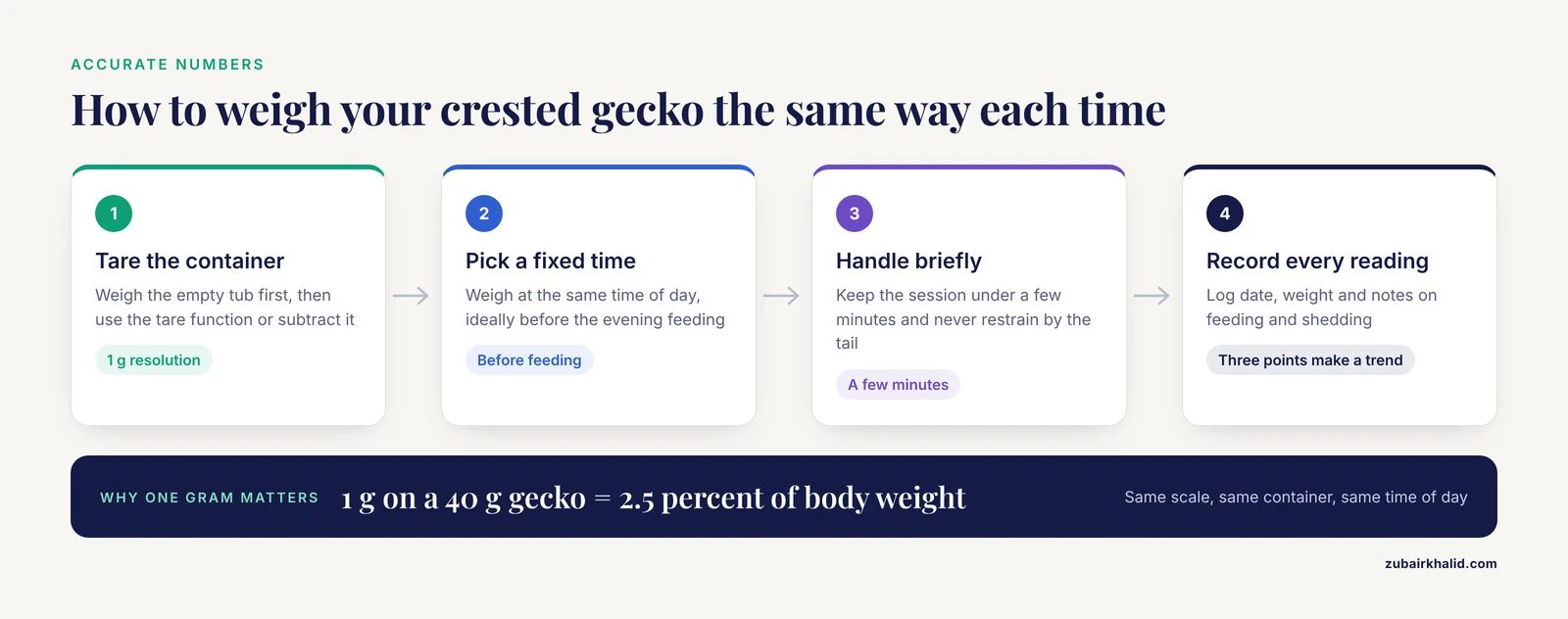
- Weigh at the same time of day, ideally before the evening feeding, so gut fill is similar each time.
- Do not weigh for two or three days after a large meal if you want a consistent body-weight trend, or note that the reading includes food.
- Handle gently and keep the session under a few minutes. Crested geckos tolerate brief handling well when they are used to it, and routine weighing doubles as calm, low-stress handling.
- Record every reading. Three points make a trend, and trends are what you act on.
Reptile owners are often surprised by how much a small error matters. One gram on a 40 g gecko is 2.5 percent of body weight, which is why the same scale, same container, and same time of day should be used every time.
How to Help a Crested Gecko Lose Weight
Weight loss in a crested gecko must be slow. Rapid food restriction in a small reptile risks nutritional deficits and stress, and sudden changes can trigger food refusal. The goal is a gradual return to score 3 over weeks to months, guided by the weekly or biweekly weigh-in.
Step 1: Audit the Diet
Most pet crested geckos eat a commercially prepared powder diet mixed with water, often supplemented with live insects. The two most common overfeeding patterns are:
- Leaving a full cup of prepared diet in the enclosure permanently, so the gecko grazes without limit. Offer a measured amount and remove it after a set period, for example 24 to 48 hours, so intake is controlled.
- Offering insects on top of an unrestricted prepared diet. Insects are calorie-dense and are best treated as a measured supplement rather than an unlimited addition.
A practical adult feeding pattern many keepers follow, consistent with published husbandry guidance, is prepared diet on a set schedule several evenings per week in a measured portion, with insects offered a smaller number of times per week rather than daily. If your gecko is overweight, reduce the frequency or portion size by a modest amount, never by half overnight.
Step 2: Fix the Enclosure Environment First
Appetite and fat metabolism depend on correct temperature. Crested geckos are a temperate-zone species that does not tolerate heat well, and chronic overheating causes stress, appetite loss, and illness rather than fat burning. Review these basics before touching the diet:
- Provide a thermal gradient within the species-appropriate range, with a warm area and a cooler area so the gecko can thermoregulate. Confirm temperatures with a digital thermometer at gecko level, not a stick-on dial.
- Confirm humidity and hydration. Dehydrated reptiles misbehave around food and can show misleading weight changes.
- Check that the enclosure is tall, well planted, and vertically structured. Crested geckos are arboreal and need climbing structures, foliage, and hiding spots to express natural behavior.
Step 3: Increase Activity Through Enrichment
You cannot walk a gecko on a leash, so exercise has to come from the enclosure itself:
- Add more branches, vines, cork tubes, and ledges so the gecko travels the full height of the enclosure.
- Rearrange safe climbing structures periodically. Novel layouts encourage exploration.
- Feed in different locations on different evenings so the gecko must travel to eat.
- Keep live insect feeding, when offered, as an activity. Chasing prey engages natural hunting behavior.
Step 4: Track, Adjust, and Be Patient
- Weigh every one to two weeks and record the number.
- A slow, steady decline toward score 3 is the goal. If weight stalls, make one small change, such as trimming the prepared diet portion, then observe for another few weeks.
- Do not skip meals as a shortcut. Consistency protects the digestive system and keeps the gecko calm.
- Re-score body condition monthly by hand. The tail base is the first place you will see progress.
What Not to Do
- Do not fast an overweight gecko for days at a time. Reptiles can appear hardy, but prolonged food refusal in a crested gecko is a red flag, not a weight-loss tool.
- Do not cut calcium and vitamin supplementation along with calories. Calcium and vitamin D3 status remains essential, and the Merck Veterinary Manual identifies calcium deficiency as a leading nutritional disease of captive reptiles.
- Do not judge progress by daily weigh-ins. Normal hydration and gut fill swing the number by grams.
The Other Direction: When Weight Loss Is the Problem
Because crested geckos store fat in the tail, a thin tail is one of the clearest visible signs of an underweight gecko. Other warning signs include a prominent spine and hips, lethargy, sunken eyes, and loss of appetite. Possible causes span husbandry and medicine, including temperatures outside the correct range, parasite burden, mouth problems, and metabolic bone disease, which the Merck Veterinary Manual describes as a common and serious nutritional disorder of captive reptiles, often linked to inadequate calcium, vitamin D3, or UVB exposure.
Unplanned weight loss always warrants a call to a reptile veterinarian before you simply increase food, because force-feeding an ill reptile without diagnosing the underlying problem delays proper care.
Common Mistakes Owners Make
- Judging by looks alone. Roundness reads as "healthy" to human eyes, but in a crested gecko it often reads as fat storage.
- Free-feeding prepared diet indefinitely. Controlled portions are the single easiest lever for weight management.
- Weighing at different times of day with different containers, then misreading normal variation as a trend.
- Panicking over one gram. A gecko that ate a large insect dinner and is well hydrated will weigh more today than yesterday for harmless reasons.
- Ignoring the male and female difference. Expecting a female to weigh the same as her clutchmate brother sets an arbitrary target that fits neither animal.
- Cutting calcium supplementation when cutting calories. These are separate decisions, and calcium needs do not fall with body weight.
Welfare and Safety Points
- Gentle, brief, regular handling for weighing is enriching for captive reptiles and builds tolerance for veterinary examinations.
- Never grab a crested gecko by the tail. Crested geckos can drop their tails when frightened, and unlike some species, a dropped tail does not regenerate, which permanently changes the animal and removes the main fat-storage site.
- Any weight-loss plan should preserve environmental quality first. A cold, dry, barren enclosure harms welfare faster than a few extra grams of fat.
- Every diet change should keep calcium and vitamin supplementation intact unless a veterinarian directs otherwise.
Limitations and When to Contact a Veterinarian
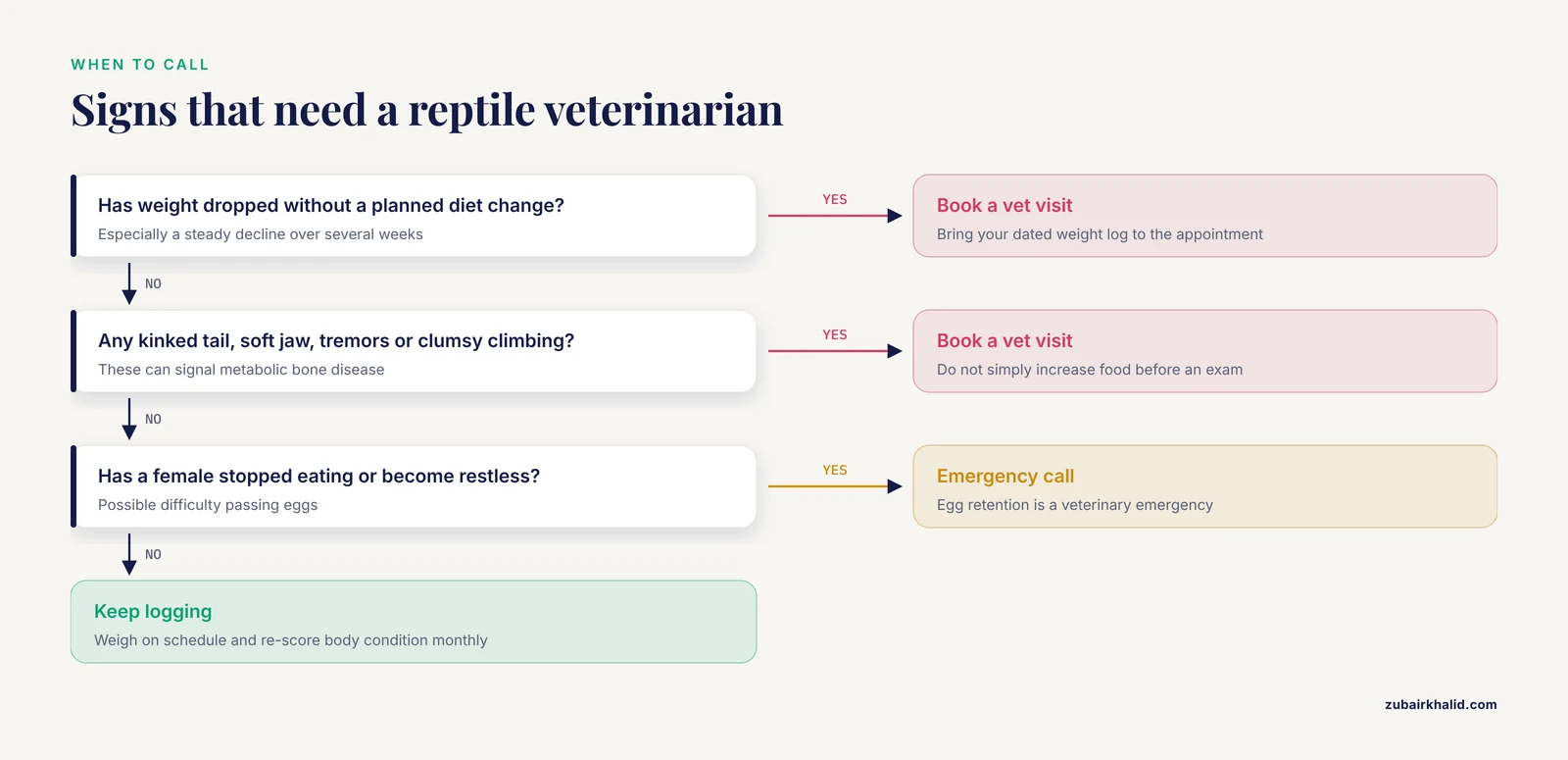
Individual cases differ, and only a veterinarian who can examine your gecko can diagnose a weight or body condition problem. Contact a reptile veterinarian, ideally one experienced with exotics or a member of the Association of Reptilian and Amphibian Veterinarians, if you see any of the following:
- Unplanned weight loss between routine weigh-ins, especially a steady decline over several weeks
- Complete refusal of food for more than a few days in an adult, or any prolonged refusal in a juvenile
- Kinks in the tail, a soft or rubbery lower jaw, tremors, or difficulty climbing, which can signal metabolic bone disease
- Lethargy, sunken eyes, stuck shed around toes or tail tip, or abnormal droppings
- A female that stops eating, becomes restless, or strains, which can indicate difficulty passing eggs and is an emergency
- Body condition score of 5, or rapid unexplained gain, where a veterinarian can rule out other causes and help build a safe plan
- Any sudden change in behavior after a husbandry change, new enclosure, or new feeder insect
Bring your weight log to the appointment. A dated record of weights, feeding notes, enclosure temperatures, and humidity readings shortens the diagnostic process and gives your veterinarian exactly what they need.
Frequently Asked Questions
How much should an adult crested gecko weigh?
Most healthy adult crested geckos weigh between about 35 and 55 grams, with females often on the heavier end and individual variation well outside that range in both directions. Your gecko's own weight trend and body condition score matter more than the chart average.
How often should I weigh my crested gecko?
Weigh growing juveniles weekly and adults every two to four weeks, always with the same scale and at the same time of day. Consistency in technique matters more than frequency.
Can a crested gecko be overweight even if its weight is in the normal range?
Yes. Fat storage at the tail base and around the organs does not always show on the scale. A gecko at an average weight with bulging tail fat and no palpable spine is overweight, which is why body condition scoring is essential.
What does a healthy crested gecko body condition look like?
At a healthy score, the spine and hip bones are easy to feel with light pressure but not visible, the tail is full and tapers smoothly from the base, and the gecko has a smooth oval outline when viewed from above with an obvious ability to climb energetically.
How fast can a crested gecko safely lose weight?
Weight loss should be gradual, measured in small increments over weeks to months rather than days. Aim for small, steady reductions through modest portion control and more climbing enrichment, and consult a reptile veterinarian before starting if your gecko is severely overweight or unwell.
Do male and female crested geckos weigh different amounts?
Yes. Adult females typically reach a heavier, broader build than males, and a gravid female can weigh well above her usual baseline while carrying eggs. Compare each gecko to its own history, not to a cage mate of the other sex.
Why is my crested gecko losing weight even though it is eating?
Continued appetite with weight loss can reflect incorrect enclosure temperatures, parasites, dental or mouth problems, poor nutrient absorption, or other illness. This pattern warrants a veterinary examination rather than simply offering more food.
What equipment do I need to track my crested gecko's weight?
A digital gram scale with 1 g resolution or finer, a small container to hold the gecko on the platform, and a log for dates and weights. Add a monthly top-view and side-view photo to compare shape over time.
This article is educational and is not a substitute for veterinary diagnosis or treatment.
Association of Reptilian and Amphibian Veterinarians, reptile health and wellness resources, arav.org Merck Veterinary Manual, Exotic and Laboratory Animals, merckvetmanual.com VCA Animal Hospitals, reptile care guides, vcahospitals.com ReptiFiles, evidence-based crested gecko husbandry guides, reptifiles.com