Corn Snake Healthy Weight: Body Condition and Weight Charts
By Dr. Zubair Khalid, DVM, MS, PhD ·
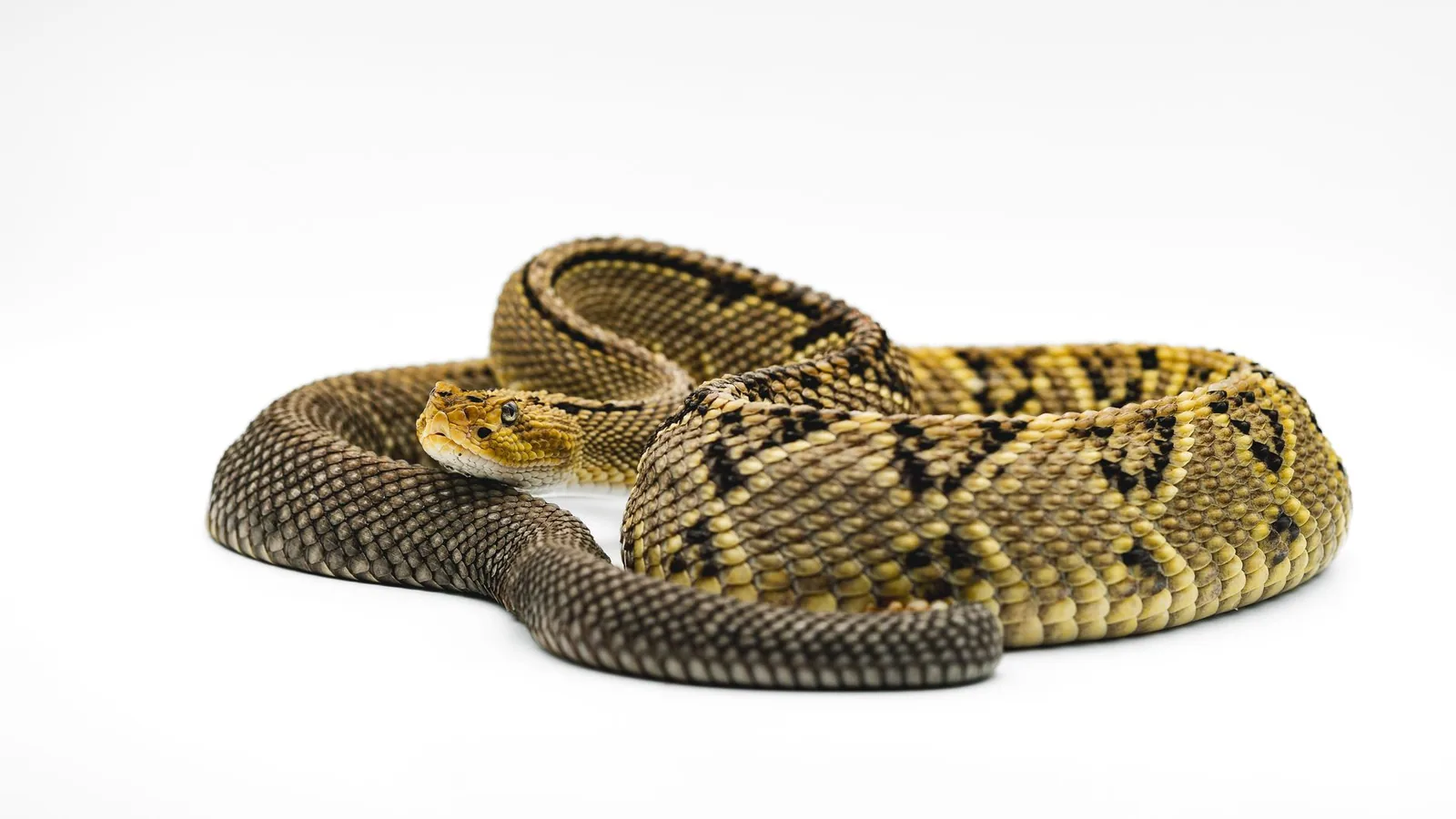
A healthy corn snake weight is not a single number on a scale. Two adult corn snakes of the same age can differ by hundreds of grams and both be perfectly healthy, because weight depends on sex, length, genetics, and feeding history. The most reliable way to answer "how much should a corn snake weigh" is to combine two tools: a repeatable weight trend measured on a gram scale, and a hands-on body condition score based on palpating the snake's spine, ribs, and muscle contours. Veterinary researchers have validated exactly this kind of scoring system for corn snakes, using a 5-point scale in which 2.5 is considered the ideal body condition [1].
This guide walks you through both tools, explains what an overweight or underweight corn snake looks and feels like, and gives you a practical plan for helping an overweight snake return to a healthy condition without crash dieting.
This article is educational and is not a substitute for veterinary diagnosis or treatment. Any snake that is losing weight rapidly, refusing food for an extended period, or showing visible spine and ribs needs an in-person examination by a reptile veterinarian.
At a Glance: Assessing Your Corn Snake Today
| Step | What to do | What healthy looks like |
|---|---|---|
| 1. Weigh | Place the snake in a container on a digital gram scale, same day of the feeding cycle each time | Weight is stable in adults, steadily rising in growing juveniles |
| 2. Measure | Record snout-vent length and total length monthly | Length grows before bulk in young snakes |
| 3. Palpate | Run fingers along the spine, the area between the vertebral processes, the ribs, and the neck | Gentle, rounded muscle ridge over the spine, no sharp bone edges, no soft fat rolls |
| 4. Score | Assign a body condition score on a 5-point scale in 0.5 steps | 2.5 is the validated ideal [1] |
| 5. Look | View the snake from above and from the side | Smooth, slightly rounded body contours, no pinched or concave muscle ridges |
| 6. Log | Record weight, length, score, and feeding date in one place | A clear trend line you can show your veterinarian |
How Much Should a Corn Snake Weigh?
This is the question every owner asks, and the honest answer is that published research has not established a single healthy weight target for pet corn snakes. What the peer-reviewed literature does establish is a method. In a study of corn snakes at a reptile rescue center, researchers measured body weight, snout-vent length, snout-to-tail-tip length, and mid-body circumference, and paired those measurements with hands-on palpation performed by three veterinarians [1]. The goal was to give practitioners a repeatable way to separate a snake carrying healthy fat and muscle from one that is obese or emaciated.
Because body composition, not body weight alone, defines health, your own snake's trend line matters far more than a chart built from other people's snakes. A practical approach:
- Establish a baseline. Weigh your snake on the same schedule for several weeks and record the number to the nearest gram.
- Track direction, not just value. A growing juvenile should gain steadily. A mature adult should hold roughly steady, with small fluctuations around defecation and shedding.
- Interpret weight alongside length. Researchers studying body condition in snakes calculate it as the relationship between body mass and body length, which is why measuring both gives you far more information than weight alone [1].
- Interpret weight alongside feeding and temperature. Experimental work on corn snakes shows that both food supply and thermal conditions measurably change body condition indices, meaning an under-heated enclosure or an inconsistent feeding schedule can distort what the scale tells you [2].
A Weight Tracking Table You Can Copy
| Date | Weight (g) | Snout-vent length (cm) | Body condition score | Fed? | Notes |
|---|---|---|---|---|---|
Fill this in after every weigh-in. Bring it to veterinary appointments. A veterinarian can then compare your records against the measurements used in clinical assessment, including body weight, snout-vent length, and mid-body circumference [1].
Corn Snake Body Condition Score: The Hands-On Check
The corn snake body condition score is a subjective, tactile method of evaluating body fat and muscle mass, adapted from the scoring systems veterinarians use in mammals [1]. The validated system for corn snakes uses five points, allows half-point steps, and places the ideal at 2.5 [1]. You do not need a veterinary degree to apply the principles at home. You need clean hands, a calm snake, and a few minutes.
What to Palpate
In the published method, examiners palpate four regions on each snake [1]:
- The spine itself, running a fingertip along the vertebral column
- The area between the vertebral spinous and transverse processes, the bony landmarks on either side of the spine
- The ribs along the body wall
- The neck region
How to Perform the Check
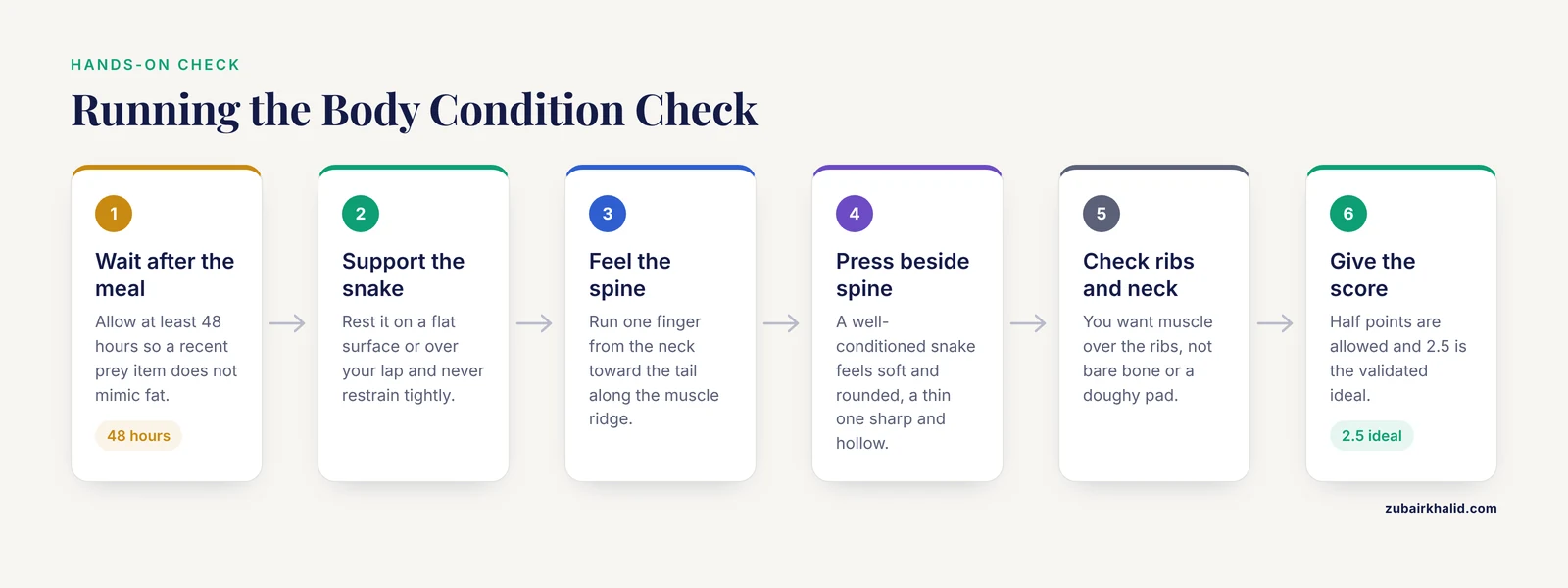
- Wait at least 48 hours after a meal so a recent prey item does not mimic fat or distort the body wall.
- Support the snake on a flat surface or over your lap. Never restrain tightly.
- Starting behind the head, run one finger gently down the spine from the neck toward the tail. Feel for the ridge of muscle that sits on either side of the vertebrae.
- Press the pad of your finger lightly into the groove beside the spine. In a well-conditioned snake you feel a soft, rounded fill. In a thin snake the groove feels sharp and hollow.
- Slide your fingers down the rib line on the side of the body. You should feel muscle over the ribs, not bare bone, and not a thick, doughy pad.
- Assess the neck, one of the regions specifically included in the clinical scoring protocol [1].
- Assign a score. Half points are allowed, and 2.5 is ideal.
Reading the Scale
| Score region | What you feel | Interpretation |
|---|---|---|
| Very low end of the scale | Spine and ribs sharply prominent, muscle ridge concave, bones feel bare | Emaciation. Veterinary attention needed promptly |
| Below 2.5 | Muscle ridge flattening, spine easily felt everywhere | Under-conditioned. Review feeding, temperature, and parasite status with a veterinarian |
| 2.5 | Rounded muscle over the spine and ribs, gentle oval cross-section, no fat rolls | Ideal, the validated target [1] |
| Above 2.5 | Soft, thick padding, spine hard to find, rounded or sagging contours | Over-conditioned. Begin a weight management plan |
| Very high end of the scale | Spine barely or not palpable, heavy fat deposits, bulging body wall | Obese. Structured weight loss plan under veterinary guidance |
Visual Confirmation
Palpation is the core of the score, but your eyes help. A snake in poor body condition shows concave muscle contours, the same finding recorded on physical examination in a clinical case report of a corn snake with serious systemic illness [3]. An overweight snake shows the opposite: exaggerated rounding, sometimes with visible creases or folds where the body wall bulges. Photograph your snake from above and from the side at each weigh-in. Side-by-side photos over months reveal trends that daily observation hides.
Is My Corn Snake Overweight?
Ask this question with your hands, not just your eyes. Signs that your corn snake is carrying excess condition include:
- The spine is difficult or impossible to feel along much of the body
- The body cross-section looks round or segmented rather than a soft oval, sometimes with visible creases
- Fat pads feel doughy rather than taut
- The snake tires quickly during handling and sprawls rather than moving actively
- Weight continues climbing after the snake reaches adult size
Context matters. Obesity in reptiles is a recognized clinical concern, and recognizing it, along with the opposite problem of emaciation, is part of why researchers developed a formal scoring system for this species [1]. Overweight snakes also face practical risks inside their own enclosures, including reduced mobility and difficulty climbing, which further reduces the activity that would help burn energy.
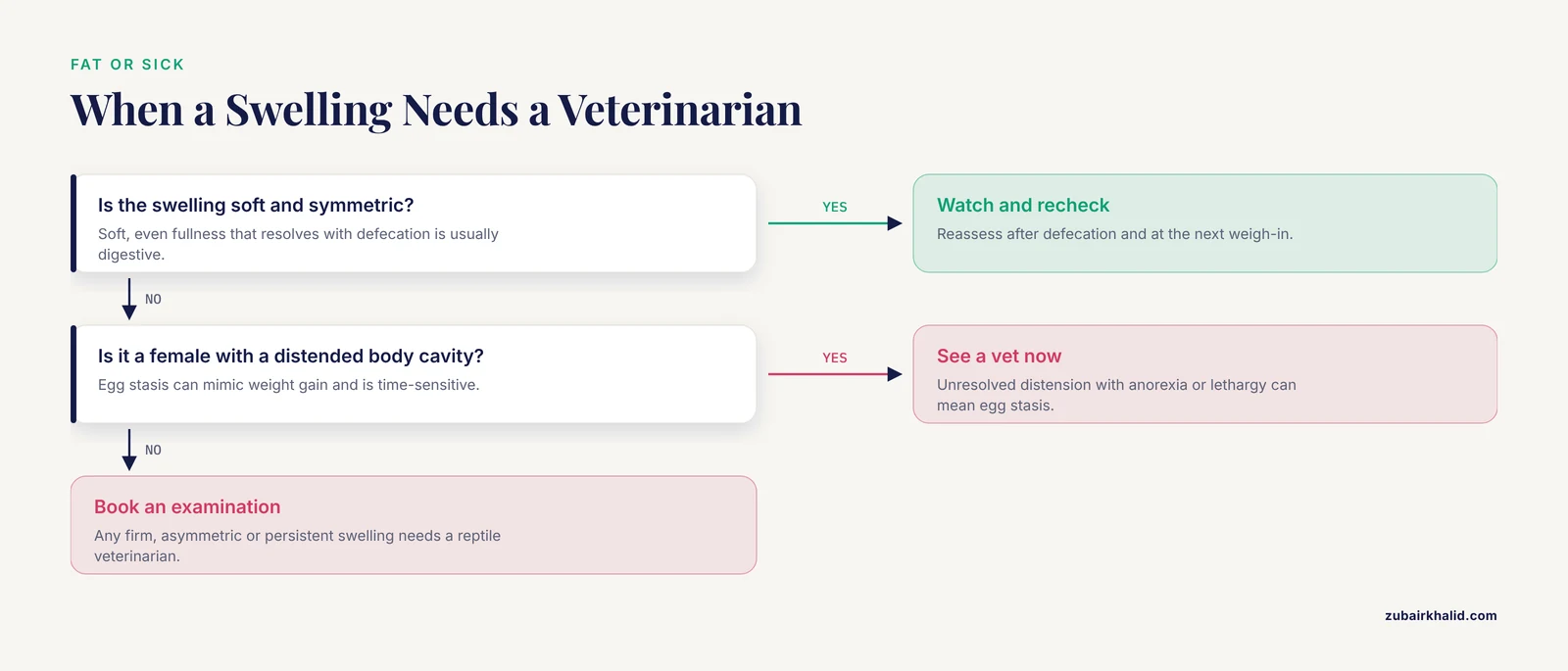
One caution: a distended or asymmetric body is not always fat. Swellings along the spine, firm lumps, or localized bulges can signal disease rather than condition. A published case report describes a corn snake whose presenting sign was a firm, nodular mass along the dorsal body region, initially a swelling an owner might have misread as weight gain or a full stomach [3]. Any fixed lump, asymmetric swelling, or progressive thickening of one body region needs veterinary examination, not a diet.
Why Corn Snakes Gain Weight
Most captive corn snakes become overweight for a combination of predictable reasons, and each one is fixable.
Feeding Too Often or Prey Too Large
Corn snakes are ambush predators that in captivity burn far fewer calories than they would hunting wild prey. When owners feed on a juvenile schedule into adulthood, or offer prey items at the maximum end of the size range every time, surplus energy is stored as fat. Feeding and thermal regime studies confirm that food availability directly shifts body condition indices in this species [2], so the feeding calendar is the single most powerful lever you control.
An Enclosure That Is Too Small
Movement requires room. In a controlled study, corn snakes housed in enclosures longer than their own body length were measurably more active and spent time fully stretched out, a posture that was physically impossible in smaller enclosures [4]. Snakes given a choice between small and large enclosures preferred the larger one while active [4]. A snake that cannot stretch fully cannot swim through its environment, climb, or perform the muscle-working behaviors that keep body condition in the ideal range. The same research group found that corn snakes in small enclosures showed reduced activity overall, supporting the conclusion that insufficient space limits natural behavior [5].
Missing Enrichment
An empty tub gives a snake nothing to do but sit. When researchers added environmental complexity to corn snake enclosures, the snakes used the enrichment, their general behavior shifted in ways consistent with improved welfare, and they strongly preferred the enriched enclosure when given a choice [6]. Climbing branches, hides at multiple heights and temperatures, and deep substrate for burrowing all convert floor space into usable, energy-burning territory.
Thermal Problems
Corn snakes are ectotherms. Digestion, metabolism, and fat storage all depend on the thermal gradient in the enclosure. Research on this species shows that thermal regime alone changes body condition indices [2]. A gradient that is too cool slows digestion and activity. A gradient without variation prevents the snake from behaviorally regulating its own metabolism. Review your heat sources and measure surface temperatures at both ends of the enclosure before blaming the diet.
How to Help a Corn Snake Lose Weight
Weight loss in a snake must be slow, deliberate, and monitored. Reptiles tolerate long intervals between meals, but they do not tolerate rapid, unexplained loss of body mass. Use the following sequence.
Step 1: Rule Out Medical Causes First
Before cutting calories, have a reptile veterinarian confirm the snake is genuinely over-conditioned and not instead hiding disease. Unexplained weight change in either direction warrants examination. This single visit also gives you a documented baseline weight, length, and professional body condition score to measure your progress against.
Step 2: Build a Feeding Plan and Stick to It
Work with your veterinarian to set an adult feeding interval appropriate to your snake's size, age, and score. The key principles supported by the evidence:
- Food availability drives body condition in this species [2], so schedule is the primary tool
- Change one variable at a time so you can attribute weight change to the change you made
- Do not skip meals erratically or fast an obese snake indefinitely without veterinary guidance. Consistency beats crash diets
Step 3: Right-Size the Prey
Prey that is persistently large delivers persistently surplus energy. Discuss appropriate prey sizing with your veterinarian or a reputable breeder, and match prey to the snake's current body condition rather than to its maximum potential size.
Step 4: Expand the Enclosure and Add Complexity
If your snake lives in an enclosure shorter than its own body, it cannot fully stretch, and research shows it will be less active as a result. Upgrade to an enclosure that allows full extension, then add climbing branches, multiple hides, and varied substrate. Enriched enclosures produce behavior consistent with improved welfare and are actively preferred by the snakes themselves [6]. More territory plus more complexity equals more voluntary exercise, which supports fat loss without starving the animal.
Step 5: Weigh on a Schedule and Adjust Slowly
Weigh every two to four weeks at the same point in the feeding cycle. Log the numbers. If weight is not trending down over months, revisit feeding interval and prey size with your veterinarian. Expect the process to take months. A body condition score that took years to build takes months to reverse, and that pace is appropriate and safe.
Step 6: Reduce Stress While You Do It
Physiologic stress can complicate feeding and metabolism. In a study measuring corticosterone, a stress hormone, in shed skins, corn snakes housed in low-stimulus rack systems showed elevated corticosterone compared with those in enriched terraria, a pattern opposite to that seen in another commonly kept species [7]. The lesson for weight management is that the environment you slim the snake down in should be enriched and stimulating, not barren. A stressed, anorexic snake is not a dieting snake, it is a sick one.
Special Case: Female Corn Snakes and Reproductive Body Changes
Owners of female corn snakes need one extra layer of vigilance. A female that has been bred, or even an unbred female in reproductive condition, can develop a distended coelomic cavity that mimics weight gain. Post-ovulatory egg stasis, or dystocia, occurs when a female cannot expel her eggs, and a published clinical case describes exactly this presentation: a distended body cavity with firm, smooth contents palpable on physical examination and radiopaque egg formations visible on radiographs [8]. That case was resolved surgically with salpingotomy, followed by improvement over days and suture removal at the two-week shed [8], but the lesson for owners is preventive. If a female's midsection swells and does not resolve with defecation or a normal shed, or if she becomes anorexic and lethargic alongside the swelling, seek veterinary care immediately. Dystocia is time-sensitive.
Record reproductive history in your weight log. A female's weight will normally rise with follicle development and egg production, and knowing the calendar prevents you from misreading reproductive changes as obesity or disease.
Weighing Equipment and Technique
- A digital scale reading in grams. Kitchen scales work well for adults. Choose one that covers your snake's current weight with headroom, and check that it reads zero with the empty container on it.
- A secure container. A plastic tub with a lid keeps the snake calm and contains movement so the reading is stable. Tare the container first.
- A soft tape measure or length of string. For snout-vent length, measure from the tip of the snout to the vent. Researchers include both snout-vent length and total snout-to-tail-tip length in formal body condition assessment [1], so whichever you choose, choose one and stay consistent.
- A logbook or spreadsheet. Trend data is the product. A single number means nothing without its history.
Weigh at the same point relative to feeding, ideally a day or two before the next scheduled meal, when the digestive tract is empty. Post-meal weigh-ins artificially inflate the number by the mass of the prey item.
Common Mistakes That Distort Weight Assessment
- Weighing right after feeding. The prey mass adds grams that look like growth.
- Judging by eye alone. Snakes hide condition well, and a round snake photographed in a coil can look either fat or normal. Palpate.
- Comparing your snake to charts built from unknown populations. Sex, lineage, and length make cross-snake comparisons unreliable. Trend within your own animal.
- Ignoring the thermal gradient. Body condition responds to temperature, not just food [2].
- Confusing a full or swollen body with a fat one. Impaction, eggs, and masses can all enlarge the body. Firm, asymmetric, or progressive swellings need a veterinarian, as documented in clinical case reports of both neoplasia [3] and egg stasis [8].
- Dieting without diagnosis. Cutting food from a snake that is actually ill accelerates decline.
- Assessing during a shed cycle or pre-defecation. Both change weight and appearance. Wait, then reassess.
Welfare Notes: Condition Is a Welfare Issue
Body condition sits inside a bigger welfare picture. Larger enclosures increase activity and allow natural postures [4], enrichment is actively chosen by corn snakes and improves their behavior [6], and housing design measurably affects chronic stress physiology in this species [7]. A snake kept in a stimulating, spacious, thermally correct environment is easier to keep in ideal body condition, because the drivers of both overeating from boredom and inactivity from confinement are removed at the source.
Limitations and When to Contact a Veterinarian
The validated body condition scoring system for corn snakes comes from a study of 22 snakes at a single rescue center, scored by three veterinarians [1]. It is a clinical tool, not a home diagnosis, and individual snakes vary. Every case of abnormal weight, in either direction, ultimately needs a veterinarian to interpret.
Contact a reptile veterinarian promptly if any of the following occur:
- Unexplained weight loss between weigh-ins, or a dropping body condition score
- The spine or ribs become prominent or the muscle ridge feels concave [3]
- Refusal of food beyond your veterinarian's guidance for the snake's age and season
- A firm, nodular, or progressive swelling anywhere along the body [3]
- A distended coelomic cavity in a female that does not resolve, especially with anorexia or lethargy, which can indicate egg stasis [8]
- Lethargy, ataxia, or abnormal posture alongside any change in weight or condition [3]
- Regurgitation, diarrhea, or changes in defecation accompanying weight change
- A body condition score at the extreme high end, where a structured veterinary weight loss plan is safest
Frequently Asked Questions
How much should a corn snake weigh?
There is no single healthy number, because weight varies with sex, length, age, and individual build. Judge a corn snake healthy weight by its own weight trend over time combined with a hands-on body condition score, on which 2.5 out of 5 is the validated ideal [1].
Is my corn snake overweight?
Palpate the spine, ribs, and neck. If the spine is difficult to feel, the body wall feels soft and doughy, and the contours look rounded or creased from above, the snake is likely over-conditioned. Assign a body condition score above 2.5 to confirm [1], and have a veterinarian rule out swelling caused by disease before starting a diet.
What is a corn snake body condition score?
It is a tactile, five-point scoring system, using 0.5-point steps, in which a veterinarian palpates the spine, the area between the vertebral processes, the ribs, and the neck to assess fat and muscle mass. The system was developed specifically for corn snakes, with 2.5 defined as ideal [1].
How often should I weigh my corn snake?
Every two to four weeks for adults, at the same point in the feeding cycle, on a tared digital gram scale. Juveniles can be weighed more frequently to confirm steady growth. The value of weighing lies in the trend line, not any single reading.
How do I help a corn snake lose weight?
Confirm the diagnosis with a veterinarian first, then adjust the feeding schedule and prey size, upgrade to an enclosure long enough for the snake to fully stretch and climb, add enrichment that encourages activity [4],, and weigh on a regular schedule. Expect gradual progress over months rather than weeks.
Can enclosure size really affect my corn snake's weight?
Yes. Corn snakes housed in enclosures longer than their own bodies were more active, spent time fully stretched out, and preferred those enclosures when active, while snakes in smaller enclosures showed less activity [4]. More usable space means more voluntary exercise, which supports healthy body condition.
My corn snake looks bloated. Is it fat or sick?
It depends on the character of the swelling. Symmetric, soft fullness that resolves with defecation is usually digestive. A firm, smooth, persistent distension in a female can indicate egg stasis [8], and a firm nodular mass along the back can indicate serious disease [3]. Any firm, asymmetric, or persistent swelling needs veterinary examination.
Does stress affect my corn snake's weight and appetite?
Housing design affects chronic stress in corn snakes, with elevated corticosterone measured in snakes kept in low-stimulus rack systems compared with enriched terraria [7]. A chronically stressed snake may eat inconsistently or behave abnormally, so review the enclosure, enrichment, and thermal gradient alongside any feeding or weight problem.
Sources
- Body condition scoring (BCS) in corn snakes (Pantherophis guttatus) and comparison to pre-existing body condition index (BCI) for snakes.
- Effects of food and thermal regimes on body condition indices and skin colouration in corn snakes
- Malignant paravertebral sarcoma with concurrent hepatic metastases in a corn snake (Pantherophis guttatus)
- Does enclosure size influence the behaviour & welfare of captive snakes (Pantherophis guttatus)?
- Does enclosure size influence the behaviour & welfare of captive corn snakes (Pantherophis guttatus)?
- Does the provision of environmental enrichment affect the behaviour and welfare of captive snakes?
- Species-specific variations in corticosterone concentrations in captive snake shed skins: implications for housing systems and welfare
- Surgery Management Post Ovulatory Egg Stasis in Corn Snake (Pantherophis guttatus)