How to Create a Bioactive Enrichment Setup for Reptiles
By Dr. Zubair Khalid, DVM, MS, PhD ·
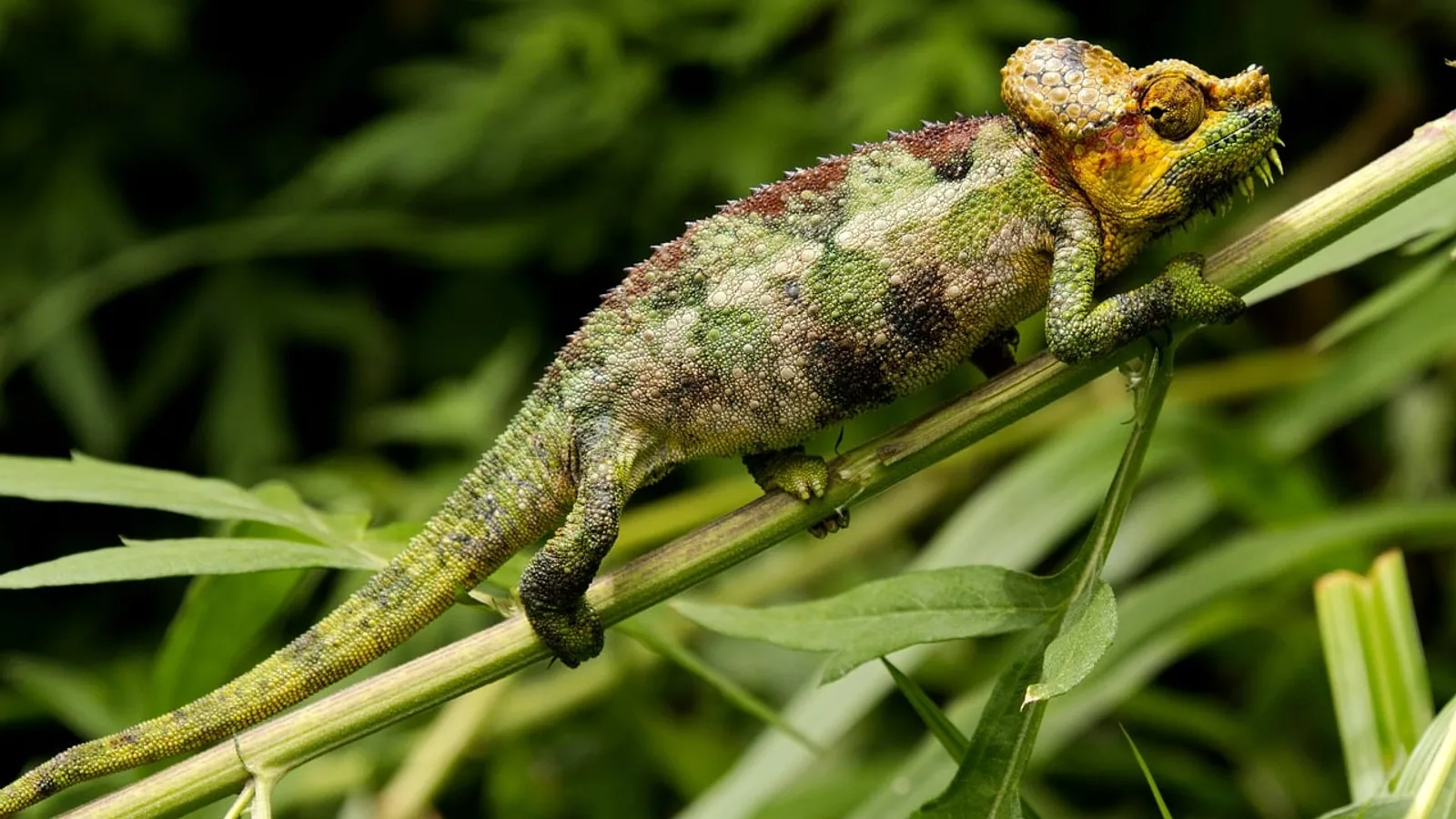
A bioactive enrichment setup is a living enclosure that combines a functioning substrate ecosystem, live plants, a cleanup crew of beneficial invertebrates, and species-appropriate enrichment features such as hides, climbing structures, and scent opportunities. You build it in layers, from drainage at the bottom to plants and behavioral features on top, and you maintain it with small, regular tasks instead of full substrate changes. Done well, it gives your reptile choices, cover, and stimulation, which are the three things enrichment research consistently links to better welfare in captive reptiles [1][2][3][4].
This guide walks through the why, the full step-by-step build, practical tips, common mistakes, troubleshooting, and the point at which a veterinarian should take over.
This article is educational and is not a substitute for veterinary diagnosis or treatment.
At a Glance: Bioactive Enrichment Setup Checklist
| Task | Key detail | Done? |
|---|---|---|
| Research your species | Natural habitat, activity pattern, moisture needs, climbing or burrowing tendency | ☐ |
| Choose and size the enclosure | Secure, ventilated, large enough for a thermal gradient and multiple zones | ☐ |
| Install a drainage layer | Gravel or clay ball layer at the bottom to manage moisture | ☐ |
| Add a bioactive substrate mix | Soil-based mix deep enough for the species' natural behavior | ☐ |
| Plant the enclosure | Reptile-safe live plants matched to light and humidity | ☐ |
| Introduce a cleanup crew | Springtails and isopods to break down waste and mold | ☐ |
| Provide multiple hides | At least a warm hide, a cool hide, and a humid hide [2] | ☐ |
| Add structural enrichment | Branches, ledges, cork, rocks for climbing species [2] | ☐ |
| Plan sensory enrichment | Rotate scent opportunities and safe novel objects [2][3] | ☐ |
| Install lighting and heating | Species-appropriate photoperiod and thermal gradient | ☐ |
| Monitor with gauges | Thermometers and hygrometers in more than one zone | ☐ |
| Quarantine new animals | Health check and observation period before adding to an established setup | ☐ |
| Observe behavior weekly | Record activity, hide use, feeding, and abnormal behaviors [1][2][5] | ☐ |
Why Enrichment Matters for Reptile Welfare
Reptiles were long assumed to be simple captives that needed little beyond heat, water, and food. The evidence says otherwise. Reptile behavior specialists note that common reasons reptiles are presented to veterinarians for behavior problems include hyperactivity, self-mutilation, biting, repetitive behaviors, and postural abnormalities, and that medical problems and suboptimal husbandry must be ruled out before any behavioral diagnosis is made [5]. The enclosure itself is part of the prescription. When a veterinarian addresses a behavior case, environmental changes including enrichment are among the first interventions recommended [5].
Specific studies back this up with data. In a study of captive corn snakes, adding a simple hide box to otherwise bare enclosures significantly decreased locomotion, digging, and soaking, all of which are behaviors that can indicate stress or restlessness in a barren environment. The snakes used the hide box frequently and were observed tightly coiled inside it for about a quarter of the observation time [1]. Notably, the study began because snakes sold at exhibitions were often housed without any hide at all, leaving them exposed and at risk of inappropriate handling by customers [1].
Enrichment works across reptile groups. Leopard geckos responded to five different types of environmental enrichment in a controlled study, confirming that even small, terrestrial lizards discriminate between and benefit from varied enrichment options [4]. In snakes of two families kept at a zoological institution, exposure to four enrichment types (a humid hide, olfactory enrichment, climbing structures, and a suspended hide) produced changes in climbing and tongue-flicking behavior after each item was introduced, changes the researchers considered potentially clinically meaningful even where statistical significance was not reached [2].
Aquatic and semi-aquatic reptiles benefit as well. A case study on captive freshwater turtles found that introducing colored object enrichment reduced escape behavior, meaning interaction with the glass walls of the tank, and increased exploration and random swimming on enrichment days. Objects scented with fish attracted significantly more interest than unscented objects [3]. Historical work on a captive Nile soft-shelled turtle documented genuine play behavior in response to environmental enrichment, helping establish that even reptiles long considered sedentary can show curiosity and play-like activity when the environment invites it.
The takeaway is simple. An empty enclosure is an under-stimulating environment, and under-stimulation shows up as repetitive behavior, constant pacing, glass surfing, or excessive soaking. A bioactive enrichment setup addresses this at the habitat level rather than relying on occasional novel objects alone.
What a Bioactive Enrichment Setup Includes
A bioactive enclosure is a miniature ecosystem. Its core components are:
- A drainage layer, usually clay balls or coarse gravel, that collects excess water at the bottom of the enclosure.
- A living substrate, a soil-based mix that supports plant roots, microbial life, and burrowing behavior.
- Live plants matched to the species' light and humidity needs, which provide cover, climbing surfaces, and visual complexity.
- A cleanup crew, typically springtails and isopods, that consumes waste, shed skin, and mold.
- Functional enrichment features, including multiple hides, climbing and basking structures, and sensory items.
The bioactive foundation is what separates this approach from drop-in enrichment. Because the substrate and plants are alive, the setup gives the animal a dynamic environment that changes over time, which is itself a form of stimulation. The enrichment features layered on top then target specific behaviors, such as hiding, climbing, tongue flicking, and exploring, that researchers use to measure reptile welfare [1][2].
Bioactive Enrichment Setup Step by Step
Step 1: Research Your Species Before Buying Anything
Every design decision follows from the species. A crepuscular, burrow-oriented leopard gecko, an arboreal climbing snake, and a swimming, basking turtle need completely different enclosure setups. Before you purchase equipment, answer these questions for your species:
- What is the natural habitat, arid, temperate, or tropical?
- Is the animal terrestrial, fossorial, arboreal, or aquatic?
- What thermal gradient and humidity range does it need?
- Does it burrow, climb, dig, soak, or hide for long periods?
- What does the evidence say it responds to? Snakes, for example, responded to humid hides, climbing structures, suspended hides, and scent items in a zoo study [2], while leopard geckos responded to five distinct enrichment types [4].
ReptiFiles' evidence-based husbandry guides and the species care resources from VCA Animal Hospitals are useful starting points for these baseline parameters, and the Association of Reptilian and Amphibian Veterinarians (ARAV) provides husbandry resources aimed at reptile health.
Step 2: Build the Substrate Profile
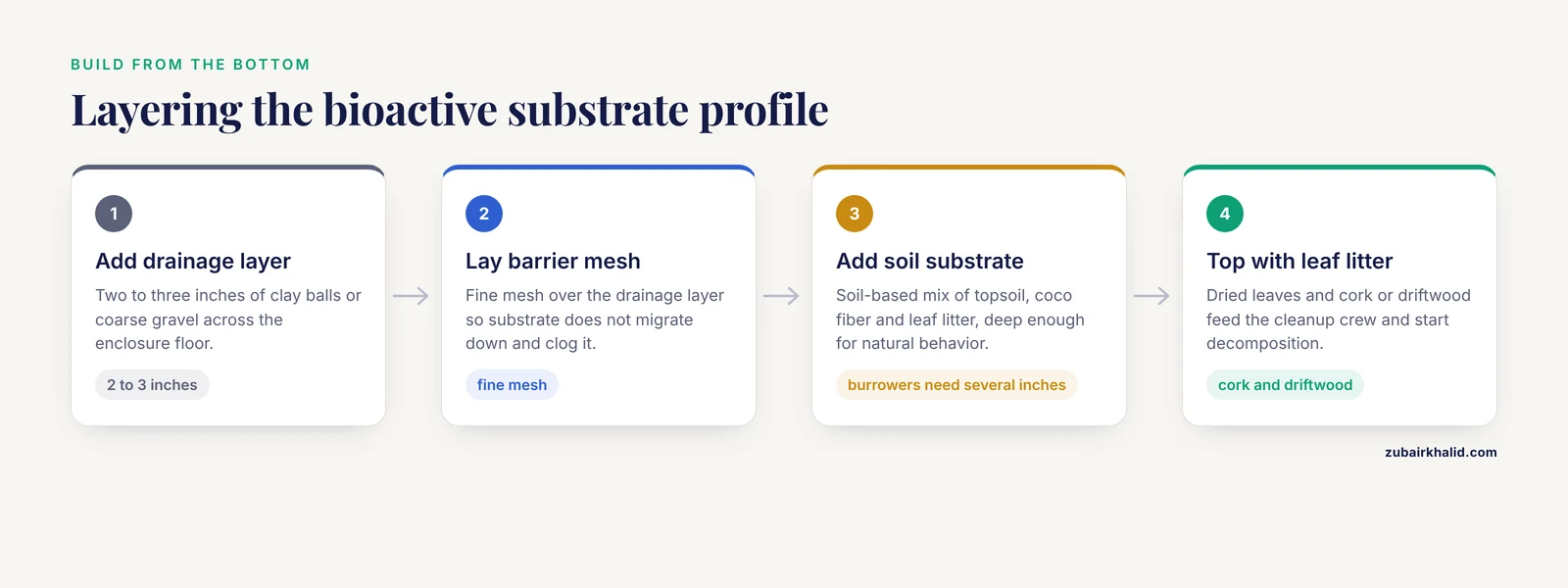
A bioactive enrichment setup step by step always begins at the bottom.
- Drainage layer. Add a two to three inch layer of clay balls or coarse gravel across the enclosure floor. In damp setups this catches percolating water so the substrate above stays moist but not waterlogged. In arid setups a thinner drainage layer still helps you manage targeted humid zones.
- Barrier mesh. Lay a fine mesh over the drainage layer so substrate does not migrate down and clog it.
- Substrate. Add a soil-based bioactive mix, often a blend of topsoil, coco fiber, and leaf litter, deep enough to allow the species' natural behavior. Burrowing species need several inches at minimum. Snakes dig in response to barren conditions, and one goal of a good setup is that digging decreases because the environment no longer frustrates the animal [1].
- Leaf litter and wood. Top the substrate with dried leaf litter and pieces of cork or driftwood. This gives the cleanup crew food and habitat, gives small reptiles cover, and starts the decomposition cycle.
Let the substrate settle and stabilize with plants and cleanup crew in place before introducing the animal.
Step 3: Plant the Enclosure
Choose live plants based on three criteria: they are non-toxic to your species, they tolerate the light and humidity of the enclosure, and they are sturdy enough to withstand the animal's weight and activity. Hardy choices commonly used in bioactive setups include pothos, snake plant, ficus, and various bromeliads for tropical setups, and hardy succulents and grasses for arid ones. Verify every species against a reputable reptile-safe plant list before planting.
Position plants to create visual barriers and dead-ends. Reptiles use cover to feel secure, and the corn snake study shows what happens without it, snakes in bare enclosures paced, dug, and soaked significantly more than snakes given a hide [1]. Plants that break sightlines across the enclosure serve the same function as hides.
Step 4: Establish the Cleanup Crew
Springtails and isopods are the standard cleanup crew for bioactive reptile enclosures. Springtails are tiny detritivores that control mold. Isopods consume waste, shed skin, and decaying plant matter, and some species also aerate the substrate. Order a starter culture, add it to the moist zones of the substrate, and give it a few weeks to establish before the animal moves in. Feed the crew occasionally with leaf litter or a small amount of vegetable matter so the population persists.
Two practical warnings. First, the cleanup crew is sensitive to desiccation, so arid setups need at least one reliably moist refugia zone, often under a water dish or cork slab, where springtails and isopods can survive. Second, avoid harsh chemical cleaners anywhere in a bioactive enclosure, because they will kill the crew and the soil microorganisms along with the pests.
Step 5: Layer Functional Enrichment on Top
This is where the enrichment in bioactive enrichment setup earns its name. Structure the enclosure so the animal can make meaningful choices.
Hides. Provide at least one hide on the warm side, one on the cool side, and a humid hide. The zoo snake study tested a humid hide as one of its four enrichment types and identified hiding as a natural, desirable behavior in the snakes' baseline repertoire [2]. The corn snake study demonstrates that even a single hide box measurably changes behavior for the better [1]. Give more than one so the animal never has to choose between thermoregulation and security.
Climbing structures. For arboreal and semi-arboreal species, add branches, ledges, and cork tubes at multiple heights. Climbing was one of the four enrichment types tested in snakes, and introduction of climbing enrichment produced increases in climbing and tongue-flicking behavior that the researchers viewed as clinically meaningful [2].
Suspended and elevated features. A suspended hide, an elevated platform under a heat or light source, gives arboreal animals a secure resting spot off the ground [2].
Sensory and olfactory enrichment. Scent is underused in reptile keeping. The snake study used olfactory enrichment as a category, and the turtle study found that objects scented with fish attracted significantly more interest than plain objects, and that scent-topped enrichment days reduced escape behavior at the group level [3][2]. Safe scent options include items from the animal's environment such as leaf litter, substrate from a different terrarium zone, or, for aquatic feeders, food-related scents used sparingly.
Novel objects. Colored objects placed in the turtle tank changed behavior on the days they were introduced [3]. Rotating safe, novel items keeps the environment responsive rather than static.
Step 6: Establish Light, Heat, and Monitoring
Install species-appropriate heating to create a thermal gradient, with a warm zone and a cool zone connected by the hides and structures you have placed. Provide lighting on a consistent photoperiod, and UVB lighting where the species requires it. Place thermometers and hygrometers so you can verify conditions in more than one zone, because a gradient you cannot measure is a gradient you cannot maintain.
The Merck Veterinary Manual's exotic animal resources and ARAV husbandry materials both stress that thermal and lighting parameters are husbandry fundamentals for reptile health, so confirm the exact target range for your species from a species-specific source rather than guessing.
Step 7: Introduce and Acclimate the Animal
Quarantine any new reptile in a simple, easily disinfected hospital-style enclosure for an observation period before moving it into the bioactive setup. This protects the established ecosystem from pathogens and parasites and gives you a clean baseline for the animal's behavior and appetite. Once the animal moves in, expect a settling period. Give it time to discover the hides and structures before judging the setup. Do not handle during the first days beyond what is medically necessary.
Step 8: Monitor Behavior and Maintain the System
Bioactive setups are maintained, not rebuilt. Your routine looks like this:
- Spot clean visible waste, though the cleanup crew handles much of it.
- Prune plants and remove dead leaves before they mold.
- Top up leaf litter and feed the cleanup crew as needed.
- Refresh water dishes daily.
- Check temperatures and humidity at both ends of the gradient.
- Wipe glass viewing panels, since glass surfaces invite escape behavior in turtles and snakes [2][3].
Add a behavioral observation habit. The research on reptile enrichment relies on systematic observation, and you can use a simplified version. Once a week, watch your reptile for a fixed period and note where it is, what it is doing, and whether you see any repetitive or unusual behavior. Comparing notes across weeks tells you whether an enrichment change worked. Researchers in the snake study recorded behaviors every five minutes over repeated observation sessions, and that is essentially the method scaled down for a home [2].
Reptile Enclosure Setup: Equipment and Selection Criteria
| Item | Selection criteria |
|---|---|
| Enclosure | Escape-proof, front-opening preferred for access, ventilated to match species humidity needs, sized for adult body length |
| Drainage media | Inert, washable clay balls or gravel, no crushed limestone in humid setups that need pH control of soil |
| Substrate | Soil-based, free of perlite-heavy potting mixes, deep enough for burrowing if the species burrows |
| Live plants | Confirmed non-toxic, matched to enclosure light and moisture, sturdy against the animal |
| Cleanup crew | Springtails plus a hardy isopod species suited to the enclosure's humidity |
| Hides | Multiple, sized so the animal contacts the walls, including one humid hide [2] |
| Climbing structures | Load-bearing branches and cork, anchored, positioned to create vertical travel routes [2] |
| Water features | Species-appropriate dish or pool, large enough for soaking species without flooding the biozone |
| Heating and lighting | Thermostat-controlled heat source, full-spectrum lighting on a timer, UVB where indicated for the species |
| Instruments | At least two thermometers and one hygrometer placed at animal level in different zones |
No single brand is required for any of these. Buy to the criteria, not the label.
Bioactive Enrichment Setup Tips
Start with hiding opportunities. If you change only one thing, add appropriate hides. The strongest single result in the corn snake research was the drop in restless behavior after a hide box was introduced [1], and hiding appeared as a core natural behavior in the zoo snake ethogram [2]. Hides are cheap, and their effect is measurable within weeks.
Use variety, not volume. Leopard geckos responded to five different enrichment types, which suggests the value comes from the diversity of opportunities rather than from any single item [4]. Rotate among hiding, climbing, olfactory, and object-based enrichment rather than piling in more of one kind.
Watch individual responses. The turtle study found large differences between individual animals in how they responded to the same enrichment, with some individuals increasing escape behavior while others decreased it [3]. Your animal is the final judge. An item that one turtle ignored, another may use constantly.
Use scent deliberately. Fish-scented objects outperformed plain objects in the turtle study, and olfactory enrichment was a distinct category in the snake study [3][2]. For most keepers this is the easiest high-impact addition, because a scent change costs nothing.
Keep handling short. In the corn snake study, snakes were more active after a five-minute handling session than after a ten-minute one, and the longer handling produced more inactivity afterward [1]. In zoo snakes, short staff-led handling did not increase active or abnormal behavior, though inactivity rose and out-of-sight behavior fell after handling sessions, and abnormal behavior was actually lower on handling days overall [6]. The pattern supports brief, predictable handling sessions rather than long ones, and always with a hide available afterward so the snake can decompress [1][6].
Record before you rotate. Note behavior for a week before introducing something new, then note it again after. Without the before-and-after picture you cannot tell whether a change helped.
Common Mistakes in Bioactive Enrichment Setups
Bare enclosures with no hide. This is the mistake the corn snake study was designed around, snakes displayed at exhibitions were kept without hide boxes, which increased restless behavior and exposure-related stress [1]. Every reptile enclosure needs at least one secure hide, and most benefit from several [2].
Treating the bioactive substrate as the whole plan. Living soil supports the animal's body, not its mind. A bioactive tank with no hides, no climbing structure, and no scent variation is still a barren behavioral environment. The enrichment layer is separate and mandatory.
Ignoring individual variation. Keepers often read that an enrichment type worked in a study and assume it will work identically for their animal. The turtle research showed that the same enrichment produced increases in escape behavior in some individuals and decreases in others, with large differences in activity budgets between animals [3]. Expect to experiment and discard items your animal ignores.
Overcleaning. Scrubbing a bioactive substrate with disinfectant, or replacing the substrate monthly, destroys the microbial and invertebrate community the setup depends on. Spot clean and prune instead.
Waterlogging or desiccating the substrate. Without a functioning drainage layer and measured humidity, the cleanup crew dies, mold blooms, and plant roots rot. In arid setups the opposite failure occurs, springtails perish and waste accumulates. Both problems trace back to skipping the monitoring step.
One static setup forever. Enrichment effects in the studies were measured right after items were introduced, and novel objects had their strongest effect on the days they appeared [3]. Leaving the identical environment in place for a year wastes the principle. Rotate scent items and novel objects on a schedule, even if the structure stays fixed.
Too much open floor, too little cover. Escape behavior and pacing in turtles and snakes is associated with interaction with transparent boundaries, which rises in exposed, featureless enclosures [2][3]. Dense cover and broken sightlines reduce it.
Assuming behavior change is always enrichment-related. Repetitive behaviors, hyperactivity, self-mutilation, biting, and postural abnormalities in reptiles can be caused by medical problems or suboptimal husbandry rather than boredom, and a veterinarian should rule those out before you treat the setup as the cure [5].
Troubleshooting Your Bioactive Setup
Mold blooms. Common in new setups before the cleanup crew establishes. Increase ventilation slightly, prune dead plant matter, and verify the springtail population. Mold on a single piece of wood can be spot-treated by removing and rinsing the item.
Cleanup crew die-off. Check for a dry substrate surface, recent chemical use, or absence of moist refugia. Add leaf litter, mist the refugia zone, and re-seed the culture if needed.
Plants dying. Diagnose by symptom. Leggy growth means insufficient light. Rotting crowns mean waterlogged substrate. Crisped leaves in an arid setup usually mean the plant was not matched to the humidity in the first place. Replace with species matched to the enclosure rather than fighting the conditions.
Persistent odor. A balanced bioactive enclosure should smell earthy, not sour. Persistent odor points to an overloaded cleanup crew, standing water in the drainage layer, or a waste load exceeding the system's capacity, often from overfeeding. Reduce feeding frequency, verify drainage, and add isopods.
Glass surfing or boundary interaction. Repeated interaction with transparent boundaries is classified as an undesirable behavior in reptile behavioral research [2], and it decreased on enrichment days in the turtle study [3]. Review cover density, hide placement, and visual barriers first, then add scent or object enrichment.
The animal ignores everything. Give it time, then check the placement. An item placed in the wrong thermal zone or in an exposed position often goes unused until it is moved. Then try a different enrichment category, since individuals differ in what they use [3].
Handling and Daily Interaction Within a Bioactive Setup
Handling is part of the enrichment conversation because it changes behavior in measurable ways. Zoo research on three python species found that short, staff-led handling did not significantly change active or abnormal behavior before versus after sessions, and that abnormal behavior was lower on handling days than non-handling days [6]. However, inactivity increased after handling, and the animals spent less time out of sight, suggesting handling leaves snakes in a more withdrawn state for some period afterward [6]. The corn snake data point the same direction from the other side, snakes were more active after five-minute handling sessions than after ten-minute sessions [1].
Put together, the evidence favors short, consistent, low-drama handling sessions, with the animal returned to a secure hide afterward. For a new or reclusive animal, let the bioactive enclosure do the work first. A snake or lizard that has secure hiding options tolerates interaction better, because it always has somewhere to retreat.
Limitations and When to Contact a Veterinarian
Most enrichment research in reptiles involves small sample sizes and single-institution case studies, so treat the findings as directionally strong rather than guaranteeing an identical result for your animal. Individual variation in response to the same enrichment is well documented [3][4]. What works for your animal is determined by observation over time, supported by your veterinarian.
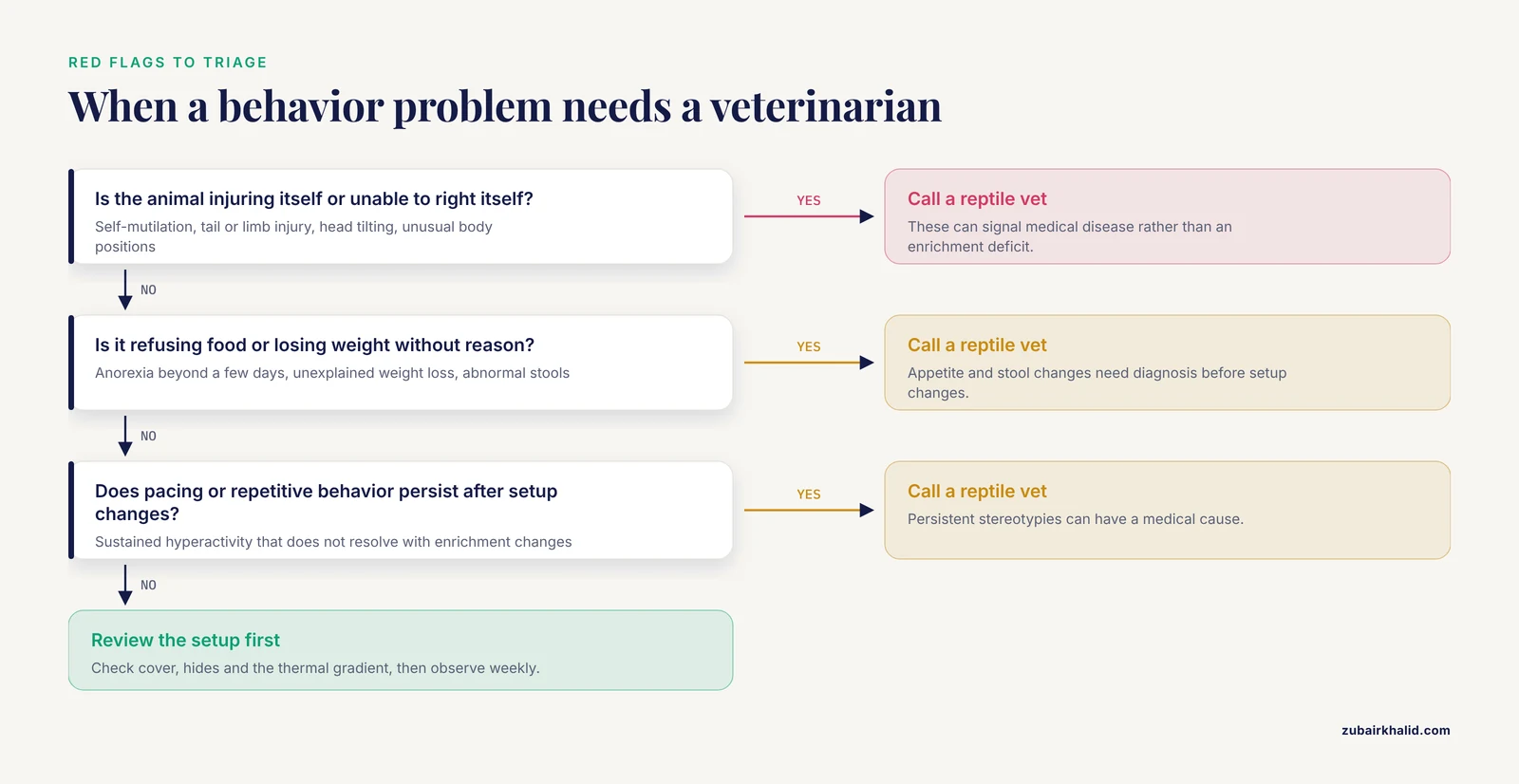
Contact a veterinarian experienced with reptiles promptly if you observe any of the following, because these can signal medical disease rather than an enrichment deficit [5]:
- Self-mutilation, including tail or limb injury the animal inflicts on itself.
- Sustained hyperactivity, such as relentless pacing that does not resolve with enrichment changes.
- Repetitive behaviors or stereotypies that persist across days and settings.
- Postural abnormalities, including unusual body positions, head tilting, or failure to right itself.
- Unprovoked biting from an animal that was previously tractable, which can reflect pain.
- Anorexia lasting more than a few days, unexplained weight loss, or abnormal stools.
- Prolonged soaking or refusal to use hides, after you have verified the thermal gradient is correct.
The Merck Veterinary Manual and ARAV both recommend establishing a relationship with a reptile-savvy veterinarian before problems arise, since reptile illness often presents subtly. A veterinarian can rule out medical causes and suboptimal husbandry, then help you build an enrichment and behavior modification plan alongside any needed treatment [5].
Frequently Asked Questions
What is a bioactive enrichment setup for reptiles?
It is a living enclosure that combines a self-sustaining substrate ecosystem with live plants, a cleanup crew of invertebrates, and species-appropriate enrichment features such as multiple hides, climbing structures, and scent opportunities, all designed to let the animal express natural behaviors.
Do bioactive setups actually improve reptile welfare?
The evidence supports specific components. Adding a hide box to bare snake enclosures significantly reduced restless behaviors like pacing, digging, and soaking [1], snakes responded to four distinct enrichment types [2], leopard geckos responded to five types [4], and colored object enrichment reduced escape behavior in captive turtles [3].
What is the cleanup crew and are the invertebrates safe?
The cleanup crew is typically springtails and isopods that consume waste, shed skin, and mold. They are harmless to healthy reptiles and are the biological engine that keeps a bioactive substrate processing waste without full changes.
How long does a bioactive enrichment setup take to establish?
Plan on several weeks. Build the substrate profile, plant the enclosure, and introduce the cleanup crew first, allowing the ecosystem to stabilize before the animal moves in after a standard quarantine period.
Can snakes live in bioactive enclosures?
Yes. Snakes across two families responded to humid hides, climbing structures, suspended hides, and olfactory enrichment in a zoological study [2], and the corn snake hide box result [1] applies directly to snake keeping. Match substrate depth and structure to the species.
How often should I rotate enrichment items?
Rotate novel objects and scent items on a regular schedule rather than leaving the environment static, since behavioral effects in studies were strongest around the time items were introduced [3]. Structural features like hides and branches stay in place, because the animal relies on them for security.
Do live plants pose any risk to my reptile?
Only if the species is toxic or treated with pesticides. Verify every plant against a reptile-safe plant list, rinse and repot nursery plants in clean soil before planting, and avoid any plant you cannot positively identify.
When should I stop adjusting the setup and call a veterinarian?
Call a reptile veterinarian if you see self-mutilation, persistent hyperactivity, repetitive behaviors, postural abnormalities, unexplained aggression, anorexia, or prolonged soaking, because these can be caused by medical problems or suboptimal husbandry that require diagnosis before enrichment changes will help [5].
Sources
- Effects of enrichment and handling on the behavior of captive corn snakes (Pantherophis guttatus)
- THE EFFECT OF VARIED ENRICHMENT TYPES ON SNAKE BEHAVIOR
- Can colored object enrichment reduce the escape behavior of captive freshwater turtles?
- Does enrichment improve reptile welfare? Leopard geckos (Eublepharis macularius) respond to five types of environmental enrichment
- Clinical Reptile Behavior.
- Behavioural Welfare Implications of Human Handling Practices in Zoo Snakes