Puppy Booster Shot Schedule and Timing
By Dr. Zubair Khalid, DVM, MS, PhD ·
This article is educational and is not a substitute for veterinary diagnosis or treatment.
The Direct Answer
Most puppies receive their first core vaccine combination at 6 to 8 weeks of age, then repeat doses every 2 to 4 weeks until a final dose given at 16 weeks of age or older. A booster at roughly 1 year of age follows the puppy series, and core vaccines are then repeated no more often than every 3 years [1]. Rabies is handled separately, usually from 12 weeks of age onward, with timing set by state law and the product label.
That is the standard frame. The real answer for any individual puppy depends on the mother's vaccination history, the puppy's own immune response, the disease risk in the area, and whether the puppy is on any medication that changes how the immune system answers a vaccine.
Owner triage summary
- A puppy that has had no vaccines and is now older than 16 weeks still needs a full series, not one shot.
- A single missed dose does not usually mean starting over, but the new date needs to be set by a veterinarian.
- A puppy that is vomiting, has bloody diarrhea, has discharge from the eyes or nose, or is coughing should be seen before the next scheduled booster.
- Puppies that live in or visit high-risk environments (shelters, boarding kennels, puppy classes, dog parks) carry more exposure risk between doses.
At a Glance: The Standard Puppy Booster Shot Schedule
| Puppy age | What usually happens | Why it lands there |
|---|---|---|
| 6 to 8 weeks | First core combination vaccine (distemper, parvovirus, adenovirus type 2, parainfluenza) | Many puppies still carry high maternal antibody that blocks this dose |
| 10 to 12 weeks | Second core dose | Maternal antibody is falling in most puppies, but not all |
| 14 to 16 weeks | Third core dose, with the final dose at 16 weeks or older | The dose most likely to arrive after maternal antibody has waned [2] |
| 12 weeks or older | Rabies vaccine, per state law and label | Legal requirement, timing governed by state regulation |
| 12 to 16 months | First adult booster | Confirms the series produced lasting immunity [1] |
| Every 3 years, or by titer | Core revaccination | Minimum 3-year duration of immunity for core products [1] |
Non-core vaccines sit outside this table. Bordetella, for example, is timed around lifestyle risk rather than a fixed calendar, and injectable Bordetella products have been studied in puppies as young as 5 to 6 weeks in the context of maternal antibodies and onset of immunity [3].
Why Puppies Need a Series Instead of a Single Shot
Maternal antibodies and the window of susceptibility
A newborn puppy is born with an immune system that is functional but inexperienced. Protection in the first weeks of life comes from colostrum, the first milk, which carries antibodies produced by the mother. Those maternally derived antibodies (MDA) are the reason a puppy can survive its first exposures to parvovirus and distemper in the environment.
MDA are also the reason a single vaccine cannot work reliably. A modified-live vaccine has to replicate in the puppy's body to trigger an immune response. When MDA against that same virus are still circulating in high enough concentration, they neutralize the vaccine virus before it can do its job. The puppy gets a dose of vaccine but no meaningful immunity.
Veterinarians describe the resulting problem as a window of susceptibility. During that window, MDA have dropped below the level needed to protect against natural infection, but they are still high enough to block vaccination. The window does not open on the same day for every puppy. Its timing depends on how much antibody the mother transferred, which depends on her own immunity and on how much colostrum the puppy absorbed in the first hours after birth.
Why the final dose is set at 16 weeks
The 16-week rule exists because a meaningful minority of puppies still carry blocking levels of MDA after 12 weeks. In one controlled study of 24 terrier puppies vaccinated every 4 weeks from 8 to 16 weeks of age, maternal antibody remained at protective levels in some puppies until 18 weeks of age [2]. That finding is the reason a dose given at 12 weeks cannot be treated as the guaranteed end of the series.
The practical consequence is straightforward. Each dose in the series is another chance to catch a puppy at the moment its MDA have fallen far enough for the vaccine to take. Ending the series at 16 weeks or later maximizes the chance that at least one dose landed after the window closed.
Does starting at 6 weeks cause problems?
It does not appear to cause lasting problems, which matters because many shelters and breeders vaccinate at 6 weeks before a puppy goes home. A study comparing puppies that started vaccination at 6 weeks with puppies that started between 8 and 12 weeks found no significant difference in seroconversion between the two groups by the second immunization point, for either distemper or parvovirus [4]. Puppies vaccinated early can catch up as the series continues.
The early dose is best understood as a head start rather than a completed vaccination. It counts toward the series, and the puppy still needs the remaining doses through 16 weeks.
The Core Series, Visit by Visit
The 6 to 8 week visit
This appointment establishes the puppy's baseline. The veterinarian performs a physical examination, weighs the puppy, checks for congenital problems, discusses parasite control, and gives the first core combination vaccine if the puppy is healthy enough and old enough for the product.
The vaccine given at this age typically includes the core viral antigens canine distemper virus (CDV), canine parvovirus type 2 (CPV-2), canine adenovirus type 2 (CAV-2), and canine parainfluenza virus (a non-core antigen that is usually combined with them). Some products add Leptospira serovars. The immune response to individual components in a combination vaccine can vary widely, and genetic background contributes measurably to that variation [5].
The 10 to 12 week visit
By 10 to 12 weeks, MDA are declining in most puppies. This dose is the point at which some puppies begin to mount a real response, especially against parvovirus. The rabies vaccine is often scheduled at or after 12 weeks during this same window, subject to state law.
The 14 to 16 week visit and the "or older" clause
The third core dose is the anchor of the schedule. AAHA vaccination guidelines call for the final dose of the core puppy series at 16 weeks of age or older, precisely because of the MDA data [2]. A puppy that receives its last core vaccine at 14 weeks has a higher chance of a failed final dose than a puppy that receives it at 16, 18, or 20 weeks.
The "or older" part of the recommendation is not a loophole. It is a deliberate margin for puppies whose maternal antibody persists longer than average. Because protective MDA lasted to 18 weeks in some puppies in that 24-puppy study [2], some veterinarians extend the final dose for puppies in high-risk situations such as endemic parvovirus regions or shelter-origin litters.
Rabies timing and the legal layer
Rabies is not a lifestyle vaccine in the United States. It is required by state law for dogs, and the age at which the first dose can be given is set by the product label, which in standard US practice is 12 weeks of age. The revaccination interval that follows is also set by state law and typically runs at 1 year and then every 1 to 3 years depending on the product used.
Timing matters because rabies can occur in puppies well before 12 weeks. A case series documented confirmed clinical rabies in a litter of 8-week-old puppies using antigen detection and PCR [6]. That report argued for reviewing the 12-week schedule in a country where the disease is endemic. In the US the 12-week floor remains the regulatory standard, and the practical lesson is that a puppy without rabies vaccination has no legal or immunologic protection if it is exposed.
Non-Core Vaccines and Lifestyle Timing
Core vaccines are recommended for every puppy. Non-core vaccines are chosen based on exposure risk, and their timing follows a different logic.
Bordetella and the respiratory complex
Bordetella bronchiseptica is a major contributor to canine infectious respiratory disease, alone or alongside other bacterial and viral pathogens [3]. Most commercially available Bordetella vaccines are given intranasally or orally. An injectable, vitamin E-adjuvanted product has been developed and studied for age at first vaccination, onset of immunity, duration of immunity, concurrent use with core vaccines, and behavior in the presence of MDA [3]. In the dose-response work, naive Beagle puppies were vaccinated at 5 to 6 weeks of age, which confirms that respiratory vaccines can be given earlier than the core series allows for.
Timing for an individual puppy depends on when the risk begins. A puppy scheduled for boarding, daycare, puppy socialization classes, or a dog show needs protection before that exposure, not after.
Leptospira
Leptospira is included in some canine combination vaccines. Antibody responses to Leptospira antigens in a standard puppy schedule vary between individuals, and heritability estimates for those responses ranged widely in a Beagle study, from roughly 0.18 to 0.63 [5]. The takeaway for owners is that not every puppy responds to every antigen the same way, which is one more argument for completing the series rather than skipping doses.
Modified-Live, Recombinant, and Inactivated: What "Booster" Really Means
A booster is any dose given after the priming series, or a dose given to a previously vaccinated dog to raise a declining antibody titer. The word describes what the dose is meant to do, not a specific product.
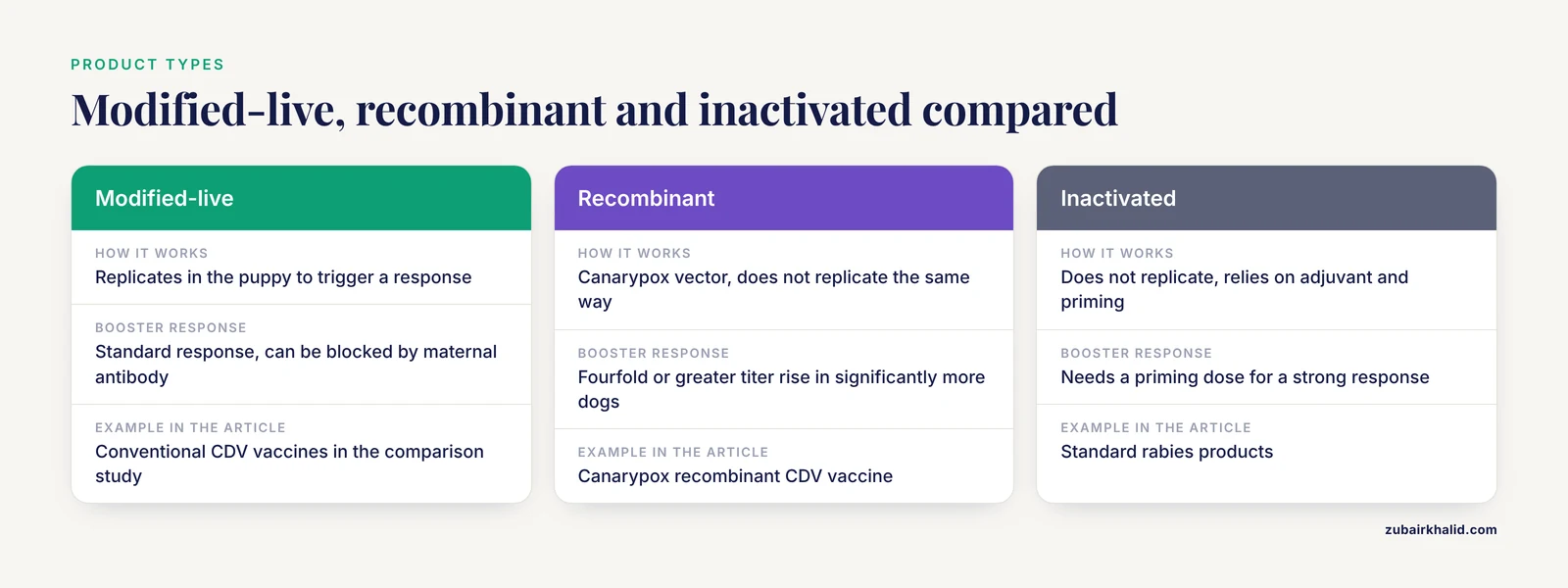
Vaccine technology does change the response. A study comparing a canarypox recombinant CDV vaccine with conventional modified-live CDV vaccines found that a fourfold or greater rise in titer occurred in significantly more dogs revaccinated with the recombinant product [7]. The recombinant vaccine boosted antibody responses in dogs that had previously received a modified-live vaccine [7]. That finding matters for dogs whose distemper titers have drifted down: switching product type is sometimes the difference between a flat response and a real boost.
Inactivated vaccines, including standard rabies products, work differently. They do not replicate, so they rely on adjuvant and on a priming dose to generate a strong response. A study of 10-month-old vaccine-naive dogs that received modified-live multivalent vaccine on day 28 showed that all dogs reached threshold titers. When those same dogs received a modified-live booster and a primary inactivated rabies vaccine on day 88, the response to rabies was reduced in dogs treated with a JAK inhibitor, with 2 of 6 treated dogs responding compared with all controls [8]. The study was confounded by an outbreak of coccidiosis and a confirmed case of infectious canine hepatitis, so the result is not a clean measure of drug effect. It still carries a clear clinical message about timing and immune suppression.
How Veterinarians Adjust the Schedule
Puppies with unknown or incomplete history
A puppy rescued from a shelter, transferred from a breeder with vague records, or purchased without documentation is treated as unvaccinated. The series is started from the beginning. Age matters here: a puppy that is already 20 weeks old and has never been vaccinated still needs multiple doses, because the immune system needs repeated exposure to build durable protection, and the old maternal antibody clock is no longer relevant.
Puppies on immunosuppressive medication
Drugs that suppress the immune system can blunt vaccine responses. The ilunocitinib study described above is the clearest recent example: treated dogs reached threshold titers after the priming modified-live vaccine, but their response to a later booster and to primary rabies vaccination was reduced [8]. A veterinarian managing a puppy on any immunosuppressive drug has to weigh the risk of infection against the risk of a weak vaccine response, and the timing of vaccination relative to the drug is part of that decision.
Puppies with individual variation in response
Two littermates given identical vaccines on identical dates can end up with different titers. Genetic factors explain part of that gap. In a study of 60 Beagles immunized on a standard schedule, heritability estimates for antibody response ranged from about 0.18 to 0.63 depending on the antigen, with distinct genetic associations identified for viral and bacterial components [5]. Breed and family background therefore influence how a puppy responds, though no owner can predict an individual puppy's titer from its breed alone.
Antibody Titer Testing and the Puppy Series
Titer testing measures circulating antibody against a specific antigen. It answers a narrow question: does this dog have antibody levels historically associated with protection right now? It does not measure cell-mediated immunity and it does not predict the future.
What point-of-care titer tests can and cannot do
In-clinic tests are attractive because they give a same-day answer. Their performance is not uniform across antigens. A 2025 evaluation of three commercial point-of-care tests against virus neutralization found high sensitivity (79.0 to 100%) and high specificity (97.8 to 100%) for CPV-2 across the products tested. Specificity for CDV and CAV was much lower for two of the three tests, at 43.5% and 55.3% for CDV and CAV with the first product and 42.4% and 79.2% with the second, despite high sensitivity. The third product had high specificity (94.1% for CDV, 84.4% for CAV) but very low sensitivity (17.4% for CDV, 33.1% for CAV). Only one of the three tests reliably detected maternal antibody against CPV-2 [9]. Agreement with virus neutralization on the vaccination recommendation reached 82% for two of the products and 62% for the third [9].
That last point is the critical one for puppy care. A positive parvovirus titer in a 9-week-old puppy may reflect maternal antibody, not vaccine-induced immunity, and the puppy can lose that protection within weeks. Titer testing is therefore most useful in adult dogs with a completed vaccination history, where the goal is to decide whether a booster is needed rather than to certify that a puppy is finished with its series.
Sampling practicalities
Traditional venipuncture can be difficult in small or fractious puppies. A study of paired samples from 55 healthy dogs compared standard venipuncture with a minimally invasive ear-prick capillary technique using a portable lancet. With a 21G lancet, full match rates between the two sampling methods reached 81.4% for CPV-2, 76.8% for CDV, and 74.4% for CAdV-1. Clinical concordance was 95.3%, 90.7%, and 100% respectively, with perfect statistical agreement for CPV-2 and CAdV-1 and moderate agreement for CDV [10]. For owners of tiny puppies, that means the ear-prick route is a realistic alternative to a jugular or cephalic stick.
What titers show in special populations
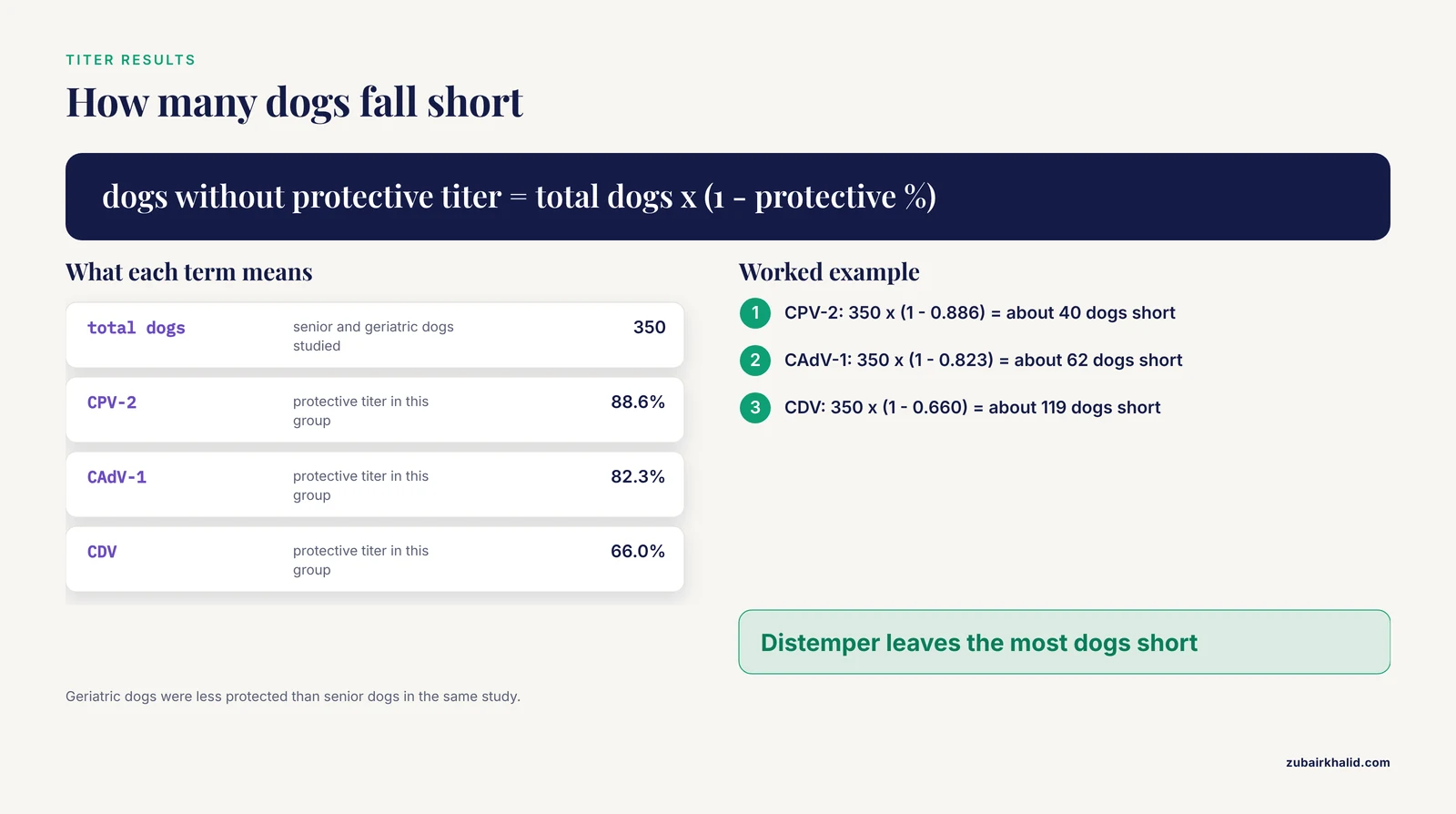
Titer data in sick dogs help put the puppy results in context. In 120 core-vaccinated dogs with malignant neoplasia evaluated before any anticancer therapy, protective antibody titers were present in 93.3% for CPV-2, 86.6% for CAdV-1, and 79.2% for CDV [11]. In 350 senior and geriatric dogs, protective titers were found in 88.6% for CPV-2, 82.3% for CAdV-1, and 66.0% for CDV, with geriatric dogs less protected than senior dogs [12]. Distemper is consistently the antigen most likely to fall short.
When a Dose Is Delayed or Missed
Life interrupts schedules. A puppy gets kennel cough, the family travels, the car breaks down, and the 12-week appointment becomes the 16-week appointment.
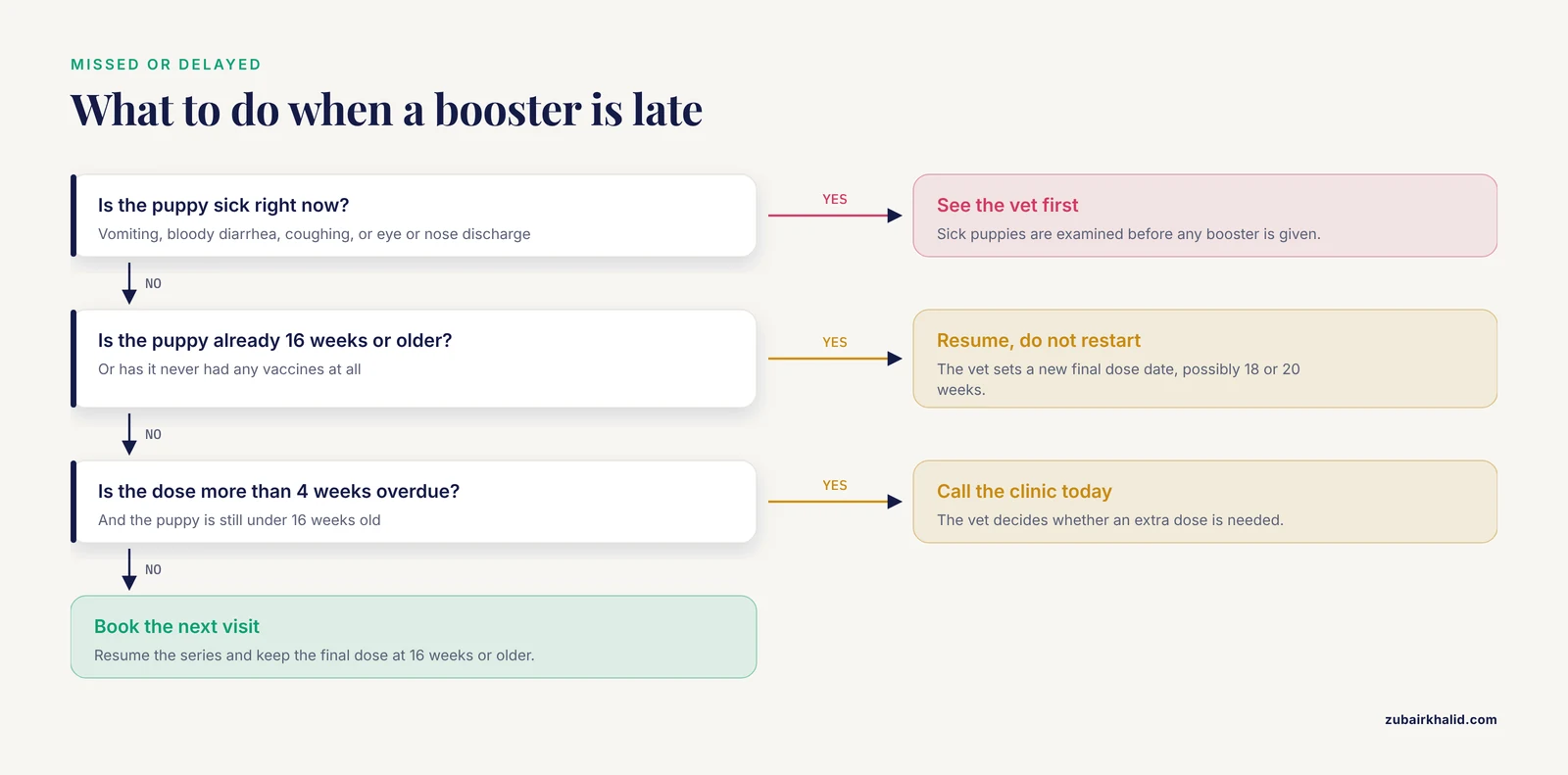
The general approach in practice is to resume the series rather than restart it, because the goal is to reach a final dose at 16 weeks or older. What changes is the new target date. A puppy that missed its 12-week dose and is now 15 weeks old may need an additional dose after the 16-week visit if the interval since the previous dose exceeds 6 weeks., or the veterinarian may add a dose at 18 or 20 weeks if risk is high. A puppy that missed everything and is now 6 months old needs a full series.
Delayed vaccination carries real risk. Parvovirus circulates in environments where unvaccinated puppies go, and the disease is severe in young dogs. A case report from Australia described CPV-2c infection in an 8-week-old puppy that died of acute hemorrhagic enteritis, alongside two older vaccinated dogs that developed only mild signs [13]. The older dogs had completed their schedules and survived with vomiting or mild diarrhea. The unvaccinated puppy did not.
Vaccine Failure: Why a Vaccinated Puppy Can Still Get Sick
No vaccine produces sterilizing immunity in every dog. Parvovirus is the clearest example. A 2026 review of canine parvovirus across Africa described the persistent paradox of disease in vaccinated populations and examined the major explanations: antigenic variation, maternal antibody interference, host factors, and gaps in protocol compliance. The same review concluded that current modified-live vaccines provide substantial cross-protection against circulating variants, including CPV-2c [14].
That conclusion is reassuring but not absolute. The Australian CPV-2c cases included two young adults that had completed vaccination schedules and still developed disease, though mild [13]. A completed series reduces the probability of severe illness. It does not eliminate infection.
Maternal antibody interference is the leading cause of true vaccine failure in puppies. A puppy whose final dose arrived while MDA were still high can leave the clinic "fully vaccinated" on paper and unprotected in reality [14]. That is the single strongest argument for honoring the 16-week floor rather than compressing the series for convenience.
What to Watch After a Booster
Most puppies tolerate vaccines without incident. The veterinarian who gives the vaccine sets the monitoring instructions for that puppy, and owners should follow them.
Call the clinic immediately if any of the following occur in the hours or days after a vaccine:
- Collapse, weakness, or difficulty standing
- Swelling of the face, muzzle, or eyelids
- Vomiting or diarrhea that starts within a day of vaccination
- Difficulty breathing or noisy breathing
- Hives or a widespread rash
- Persistent crying, refusal to eat, or marked lethargy that does not improve
These signs can indicate a hypersensitivity reaction or an unrelated illness that happened to start at the same time. Either way, they warrant same-day evaluation.
Mistakes That Undo a Good Schedule
Treating one shot as a completed series. A puppy that received a single vaccine at 8 weeks from a breeder is not vaccinated. The series continues through 16 weeks.
Skipping a dose because the puppy seems healthy. Health is a reason to vaccinate, not a reason to skip. A mild illness may justify a short delay, but that decision belongs to the veterinarian performing the examination.
Using titer results to end the puppy series early. A positive titer in a young puppy can reflect maternal antibody, and point-of-care tests vary substantially in how well they detect it [9]. Titer testing is a tool for adult dogs with known vaccination histories, not a shortcut through the puppy series.
Buying and administering vaccine at home. Veterinary vaccines are prescription biologicals. Storage, handling, and administration all affect whether the product works, and a home-administered dose leaves no verified record for boarding, travel, or licensing.
Relying on supplements or "immune boosters" instead of vaccination. No supplement substitutes for a completed core series.
Building a Schedule That Actually Holds
The most common reason a puppy ends up under-vaccinated is not a medical problem. It is a scheduling problem. Three appointments in eight weeks is a lot for a new household.
Practical steps that help:
- Book all puppy visits at the first appointment, before leaving the clinic.
- Ask for written records after every visit and keep them in one place. Boarding facilities, trainers, groomers, and animal control all want them.
- Set phone reminders for the exact date the next dose is due, not a general note.
- Tell the veterinarian about upcoming travel, boarding, daycare, or puppy class so the non-core vaccine timing can be built around it.
- Keep the puppy away from unknown dogs and contaminated ground until the series is complete, and ask the veterinarian which public spaces are safe in the meantime.
What Protection Looks Like After the Puppy Series
The 1-year booster is not a formality. It is the dose that consolidates the puppy series into durable immunity. After that, the core vaccines have a minimum duration of immunity of 3 years for CDV, CPV-2, and CAV-2, based on studies involving roughly 1,000 dogs vaccinated with products from major US manufacturers, with antibody titers measured in all dogs and challenge studies performed in selected groups [1].
Immunity does not stop at exactly 3 years. In a study of 188 healthy dogs with known vaccination histories, 62% of the dogs available for 5-year follow-up still had positive CDV titers 5 years after their last vaccination [15]. Titers against CAV-2 and CPV declined with increasing time since vaccination, and CDV showed a decreasing trend [15]. Distemper is consistently the antigen that drops first, which is why it appears lowest in the senior and geriatric data as well [12].
This is the scientific basis for the current recommendation structure: a final puppy dose at 16 weeks or older, a booster at 1 year, then revaccination no more often than every 3 years [1]. Titer testing fits into that adult phase, where the question is whether a booster is needed now. The tests perform best for parvovirus and less reliably for distemper and adenovirus, and the choice of product changes the answer [9]. An owner considering titer-based decisions for an adult dog should ask which test the clinic uses and how it performed in comparative studies.
Limitations and When to Contact a Veterinarian
This article describes the standard schedule and the evidence behind it. It cannot account for an individual puppy's maternal antibody levels, immune status, medication history, or local disease pressure. Those variables change the plan, and only the veterinarian examining the puppy can set the dates.
Contact a veterinarian promptly if:
- The puppy has never been vaccinated and is older than 16 weeks
- A dose is more than 4 weeks overdue and the puppy is still under 16 weeks
- The puppy is scheduled for boarding, daycare, or travel and the series is incomplete
- The puppy is receiving prednisone, cyclosporine, a JAK inhibitor such as ilunocitinib, or any other immunosuppressive drug
- The puppy has a chronic illness, is failing to gain weight, or has recurring infections
- The puppy shows vomiting, bloody diarrhea, coughing, nasal discharge, or eye discharge
- The puppy has a reaction after any vaccine
- The puppy has been exposed to a dog with confirmed parvovirus, distemper, or rabies
Related Guides
- Dog Vaccination Schedule: What Shots Does Your Dog Really Need?: Broader dog vaccine schedule beyond puppy booster timing
- Puppy Vaccination Schedule by Age: Age-by-age chart for timing each puppy vaccine dose
- Outline A General Puppy Vaccination Schedule For The First Year: Step-by-step first-year outline for a general puppy schedule
- Puppy Preventive Care Schedule: Vaccinations, Deworming, and Wellness Exams: Combines vaccines with deworming and routine wellness exams
- Puppy Vaccination Schedule Aaha: AAHA guideline context for final core vaccine timing
- AVMA Puppy Vaccination Schedule Explained: AVMA-based explanation of core puppy vaccine timing
- Puppy Veterinarian Schedule for Vaccines and Care: Maps vaccine appointments to broader puppy veterinary care
- Puppy Vaccine Schedule: A Veterinary Partner Guide: Veterinary partner guide for planning puppy vaccine visits
Frequently Asked Questions
When does a puppy get its first booster shot?
Most puppies receive their first core vaccine at 6 to 8 weeks of age. That dose starts the series but does not complete it, because maternal antibodies block many puppies at that age.
How many booster shots does a puppy need?
A standard series is three core doses between 6 and 16 weeks, with the final dose at 16 weeks or older. Puppies that start late or miss doses may need additional visits to reach that endpoint.
Can my puppy go outside before all boosters are finished?
Ask your veterinarian which areas are safe for your puppy. Ground shared with unknown dogs carries parvovirus risk, and unvaccinated puppies are the most vulnerable group.
What happens if my puppy misses a booster?
Resume the series rather than restarting it, and let your veterinarian set the new final dose date. A delay lengthens the period during which the puppy is not fully protected.
Is a titer test enough instead of puppy boosters?
No. A titer in a young puppy may reflect maternal antibody rather than vaccine-induced immunity, and point-of-care tests differ in how well they detect it. Titer testing is most useful in adult dogs with a completed history.
Does the 16-week rule apply to every vaccine?
No. It applies to the core viral puppy series, where maternal antibody interference is the central problem. Rabies timing follows state law and the product label, and non-core vaccines such as Bordetella are timed around lifestyle risk.
When is the rabies shot given?
In the United States, the first rabies vaccine is typically given at 12 weeks of age or older, with the exact timing and revaccination interval set by state law and the product label.
How long do puppy vaccines last after the series?
Core vaccines against distemper, parvovirus, and adenovirus have a minimum duration of immunity of 3 years after the 1-year booster. Many dogs retain antibodies longer, and distemper titers tend to decline first.
Sources
- Duration of immunity for canine and feline vaccines: a review.
- The first evaluation of the effectiveness of canine vaccination schedule by two commercial vaccines in Iran.
- A Novel Vitamin E Adjuvanted Injectable Bordetella bronchiseptica Vaccine Is Safe and Efficacious in Dogs.
- Evaluation of the humoral immune response induced by vaccination for canine distemper and parvovirus: a pilot study.
- Heritability and genome-wide association study of vaccine-induced immune response in Beagles: A pilot study.
- RABIES IN A SET OF EIGHT-WEEK OLD PUPPIES IN NIGERIA: THE NEED FOR REVIEW OF CURRENT DOG ANTIRABIES VACCINATION SCHEDULE.
- Effect of recombinant canine distemper vaccine on antibody titers in previously vaccinated dogs.
- Response to primary canine core vaccination in 10-month-old seronegative dogs treated with three times the recommended therapeutic dose of Ilunocitinib tablets (Zenrelia™).
- Antibody Titer Testing in Dogs: Evaluation of Three Point-of-Care Tests for Canine Core Vaccine Antigens Compared to Virus Neutralization.
- Comparison Between a Minimally Invasive Capillary Blood Sampling Technique and Venipuncture for Core Vaccine Antibody Titration in Dogs.
- Does Neoplastic Disease Negatively Affect Serum Antibody Titers Against Core Vaccines in Dogs?
- Effect of Aging on the Immune Response to Core Vaccines in Senior and Geriatric Dogs.
- Detection of the Canine Parvovirus 2c Subtype in Australian Dogs.
- Canine parvovirus in Africa: Explaining persistent disease despite vaccination.
- Influence of age and vaccination interval on canine parvovirus, distemper virus, and adenovirus serum antibody titers.