Boerboel Dog Breed Guide: Temperament, Health and Care
By Dr. Zubair Khalid, DVM, MS, PhD ·
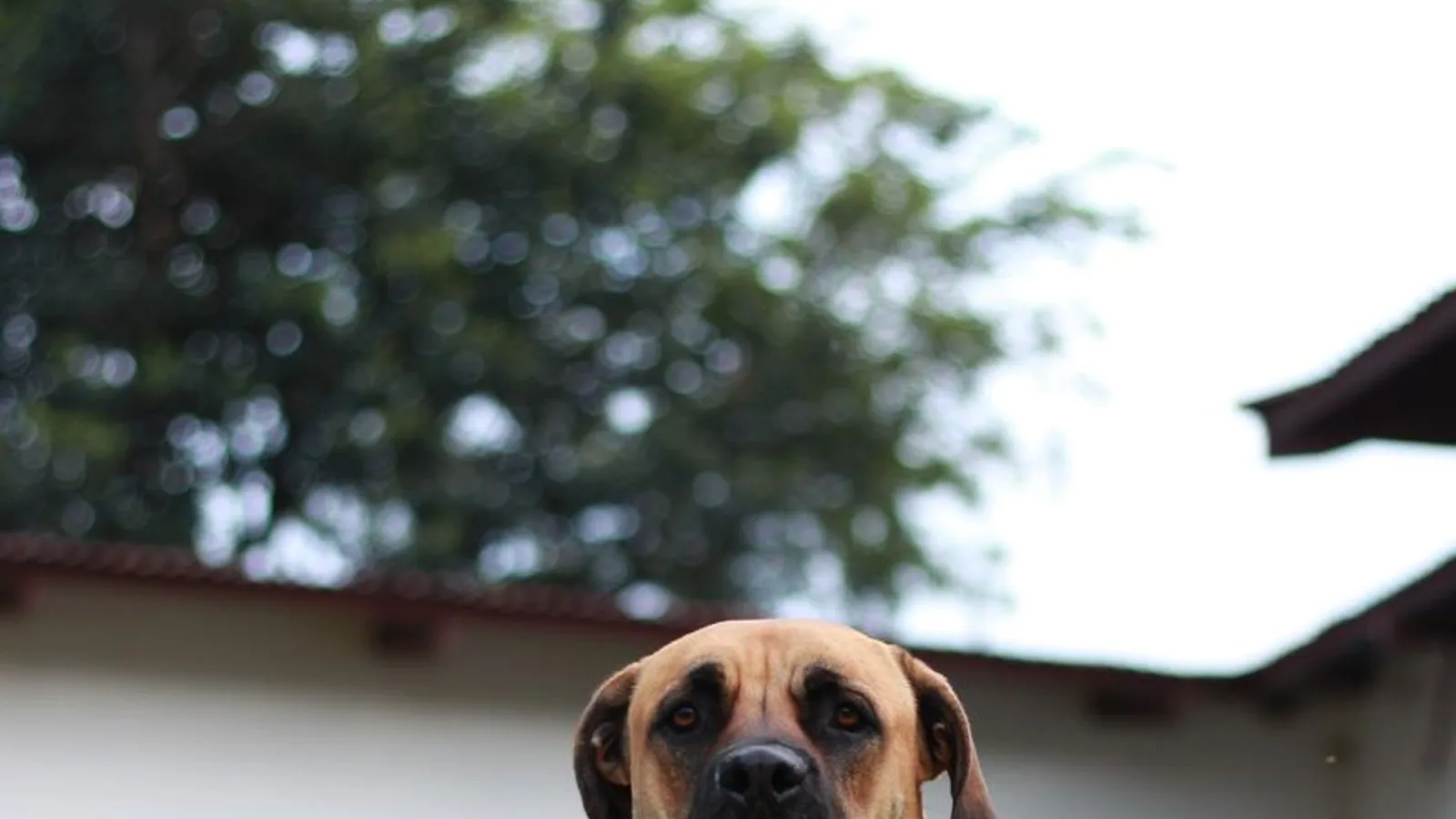
The Boerboel, also called the South African Mastiff, is a large, powerful guardian breed with a calm but protective temperament. For anyone who owns or is considering this breed, the single most important health topic is gastric dilatation-volvulus (GDV), commonly known as bloat or stomach torsion. GDV is an acute, life-threatening emergency that occurs mainly in large and giant, deep-chested breeds [1]. This guide explains what the veterinary research shows about Boerboel temperament, size, health problems, and the preventive care steps that can save a dog's life. The advice here is grounded in published studies on GDV in large and giant breeds, the population to which the Boerboel belongs. Owners who understand the risk factors, recognize the emergency signs, and act early give their dogs the best chance at a long and healthy life. The sections below cover breed background, temperament, size, the full GDV risk picture, feeding and surgical prevention, and what to do in an emergency.
At a Glance: Boerboel Preventive Care Checklist
| Topic | What to know |
|---|---|
| Breed type | Large to giant guardian breed, also called the South African Mastiff |
| Primary health threat | Gastric dilatation-volvulus (GDV), or bloat |
| Feeding rule | Feed smaller meals, slow the eating speed, do not use a raised bowl [3] |
| Key surgical option | Prophylactic gastropexy for at-risk dogs [5][6] |
| Emergency sign | Non-productive retching, abdominal distension, restlessness [2] |
| Action plan | Any suspected GDV is an emergency, transport to a veterinary hospital immediately |
Boerboel Breed Background
The Boerboel is a mastiff-type guardian breed from South Africa, and the name South African Mastiff is used interchangeably. The breed was developed as a working farm guardian, and it carries the size, bone, and guarding instinct of the mastiff family.
That deep-chested conformation matters for health. Thoracic depth and the ratio of chest depth to width appear to predispose dogs to GDV [2]. The Boerboel's body type places it squarely in the population that GDV research targets: large and giant breeds with a deep thoracic cavity [1][2].
In prospective studies of GDV, large breeds are defined as 23 to 45 kg (50 to 99 lb) and giant breeds as over 45 kg (99 lb) [7]. Boerboels fall in the large to giant range, which means owners should take the breed-specific health risks described below seriously from puppyhood onward.
Boerboel Temperament and Behavior
The Boerboel temperament is that of a confident guardian. The breed is known for loyalty and protectiveness, which makes early socialization and consistent training essential. Temperament also has a health dimension.
Research on GDV in large and giant breeds found that an owner-perceived personality trait of happiness was associated with a decreased incidence of GDV [7]. In contrast, a fearful temperament and stressful events may predispose dogs to GDV [2]. These findings do not mean that a happy dog is immune to bloat. They do suggest that chronic stress and anxiety can be part of the risk picture for deep-chested breeds.
For a Boerboel owner, the practical takeaway is that a stable, predictable home environment, positive training methods, and routine are part of preventive care. A dog that is fearful, anxious, or frequently stressed may carry a higher risk for the very condition that most threatens the breed [2]. If a Boerboel shows persistent fear or anxiety, a veterinarian or qualified behavior professional should be part of the care team.
Boerboels are powerful dogs, and training should focus on impulse control and calm behavior around people and other animals. A well-adjusted Boerboel is easier to manage in daily life and less likely to experience the chronic stress that research links to GDV risk [2].
Boerboel Size and Conformation
Size is one of the defining features of the Boerboel. As a large to giant breed, the Boerboel carries a heavy frame and a deep chest. That conformation is directly relevant to GDV risk. The disease primarily affects large and giant, deep-chested breeds [1][2], and thoracic depth relative to width appears to be a predisposing factor [2].
Body condition matters as much as height and weight. Large-breed dogs that carry excess weight face a higher burden of orthopedic disease and osteoarthritis, and obesity can lead to early death [8]. Keeping a Boerboel lean, with a visible waist and easily felt ribs, is one of the most effective preventive measures an owner can take. Weight control, proper nutrition, and regular exercise provide the best opportunity for healthy aging in large and giant breeds [8].
Boerboel Health Problems: The GDV Risk
What Is GDV?
Gastric dilatation-volvulus is a disease in which the stomach becomes grossly distended with fluid or gas and then rotates out of its normal position [2]. The distension and rotation cause pathology in multiple organ systems, and the condition is rapidly fatal without treatment [2]. Dogs with GDV classically meet the criteria for systemic inflammatory response syndrome (SIRS) and can progress to multiple organ dysfunction syndrome (MODS) [9].
The cardiovascular effects are severe. Dogs with GDV can develop shock, cardiac arrhythmias, and myocardial dysfunction [9]. Respiratory dysfunction follows from decreased respiratory excursion due to the dilated stomach, decreased pulmonary perfusion, and possible aspiration pneumonia [9]. Gastrointestinal effects include gastric necrosis and postoperative problems such as regurgitation, vomiting, and ileus [9]. Coagulation dysfunction, including disseminated intravascular coagulation, can occur, along with acute kidney injury and acid-base and electrolyte disturbances [9]. The combination of distension and rotation compromises blood flow and triggers shock, arrhythmias, and tissue damage across multiple organs [9][2].
Why Boerboels Are at Risk
The Boerboel has the two features that define the highest-risk population for GDV: large to giant size and a deep chest [1][2]. The lifetime risk of GDV in large and giant breeds has been estimated at 3.9% to 36.7% depending on breed and other factors [10]. In one prospective cohort, the cumulative incidence of GDV was 6% for large and giant breed dogs [3]. In another, the incidence was 23 cases per 1,000 dog-years for large breeds and 26 per 1,000 dog-years for giant breeds, with a cumulative incidence of 5.7% across all breeds studied [7].
Mortality is substantial. In one cohort, 28.6% of dogs that developed GDV died [7]. In a UK survey of pedigree dogs, GDV was the cause of death for 2.5% of all deaths reported, and the median age at death was 7.92 years [11]. The median age at first diagnosis in that survey was 5 years [11]. Incidence of GDV increases with age [7], so the risk does not disappear as a Boerboel matures. Owners of senior Boerboels should remain vigilant.
GDV also appears to run in families. The disease has a familial predisposition [1][2], and having a first-degree relative with a history of GDV significantly increases risk [3]. Recent genetic research has identified specific single-nucleotide polymorphisms associated with GDV, including genes involved in gastric tone and motility such as VHL, NALCN, and PRKCZ [10]. This means that a Boerboel from a line with a history of bloat may carry a higher inherited risk.
Abnormal gastric motility and delayed gastric emptying have also been described in dogs after GDV, although the role of motility problems in causing the first episode remains unclear [12]. Researchers are using newer noninvasive tools, including wireless motility devices, to study this question in large and giant breeds [12].
Non-Dietary Risk Factors
The most influential study on non-dietary risk factors for GDV followed 1,637 large and giant breed dogs and identified several factors that significantly increase risk [3]:
- Increasing age [3]
- Having a first-degree relative with a history of GDV [3]
- A faster speed of eating [3]
- Eating from a raised feeding bowl [3]
The raised bowl finding is striking. Approximately 20% of GDV cases among large breed dogs and 52% of cases among giant breed dogs were attributed to having a raised feed bowl [3]. Many owners raise bowls to reduce neck strain or mess, but the research does not support that practice for deep-chested breeds. The standard advice is to feed from a bowl placed on the floor.
Diet-Related Risk Factors
Diet and feeding patterns also matter. A nested case-control study within a 5-year prospective cohort of 1,634 dogs found that dogs fed a larger volume of food per meal were at significantly increased risk of GDV, regardless of the number of meals fed daily [4]. The highest risk was for dogs fed a larger volume of food once daily [4].
The same study found that the risk was highest for both large and giant breed dogs fed one large meal per day [4]. For Boerboel owners, this supports splitting the daily ration into two or more smaller meals rather than one large bowl.
Gastric Foreign Bodies
A gastric foreign body is another significant, and often overlooked, risk factor. In a case-control study of 118 large and giant breed dogs treated surgically for GDV and 342 controls, the presence of a gastric foreign body was significantly more common in the GDV group [13]. A large or giant breed dog with a gastric foreign body was approximately 5 times as likely to develop GDV as a similar dog without one (odds ratio 4.92) [13].
This finding has a practical edge for Boerboels. Powerful chewers can swallow pieces of toys, bones, rawhide, or other objects that lodge in the stomach. Owners should supervise chewing, choose appropriately sized and durable chews, and remove objects that can be swallowed whole.
The Gut Microbiome and GDV
Emerging research links the gut microbiome to GDV risk. In a study comparing fecal samples from healthy Great Danes and dogs with at least one GDV episode, dogs with GDV had significantly more diverse fecal microbiomes than healthy controls [14]. Dogs with GDV showed a significant expansion of Actinobacteria, a greater abundance of Firmicutes, and a lower abundance of Bacteroidetes [14]. The study authors proposed that variation in immune system genes may act through the gut microbiome to predispose dogs to GDV [14].
This research is early stage, and no dietary supplement or probiotic has been proven to prevent GDV. The takeaway for owners is that gut health is an active area of GDV research, and any dietary changes for a Boerboel should be discussed with a veterinarian.
Recognizing the Emergency
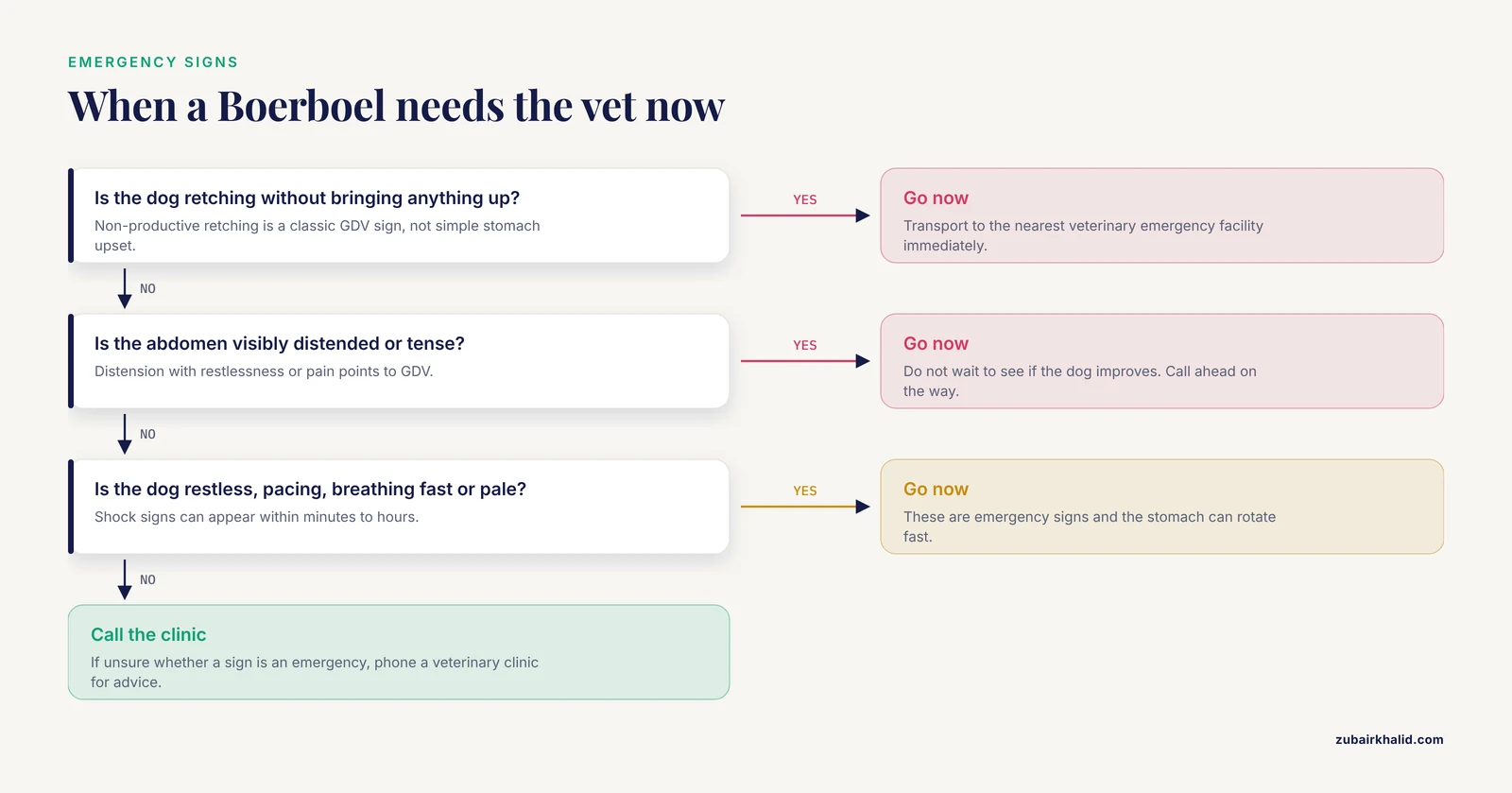
Every Boerboel owner should memorize the signs of GDV. The classic presentation includes:
- Abdominal distension
- Non-productive retching, or attempting to vomit without bringing anything up
- Restlessness
- Signs of shock
- Rapid breathing (tachypnea) and difficulty breathing (dyspnea)
Any combination of these signs in a Boerboel is an emergency. The stomach can rotate and compromise blood flow within minutes to hours, and the condition is rapidly fatal without intervention [2]. Rapid diagnosis is important for prompt initiation of stabilization therapy and surgical correction [6]. Do not wait to see if the dog improves. Transport to the nearest veterinary emergency facility immediately.
Preventive Care and Feeding Strategies
Feeding Practices That Reduce Risk
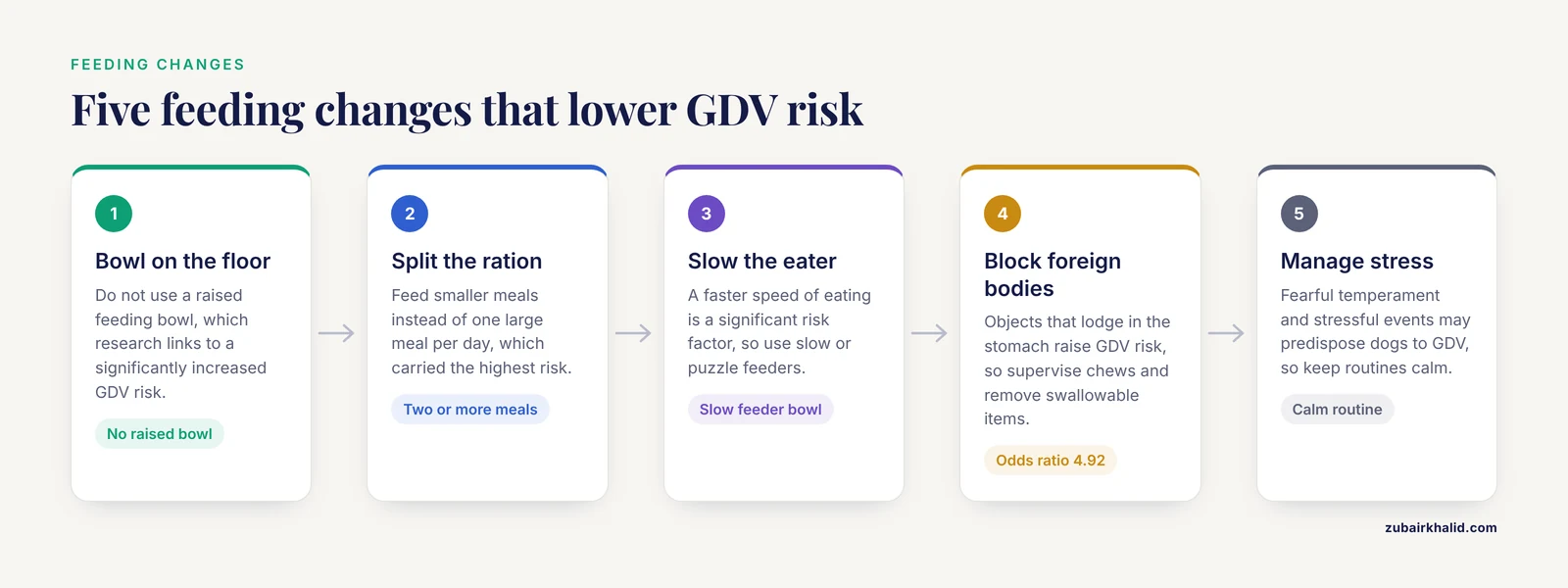
The GDV research supports several concrete feeding changes for Boerboel owners:
- Do not use a raised feeding bowl. The research links raised bowls to a significantly increased risk of GDV [3].
- Feed smaller meals. Dogs fed a larger volume of food per meal are at higher risk, and the highest risk is for one large meal per day [4].
- Slow down fast eaters. A faster speed of eating is a significant risk factor [3]. Slow feeder bowls, puzzle feeders, or spreading food on a flat tray can help.
- Prevent access to foreign bodies. Objects that lodge in the stomach increase GDV risk [13].
- Manage stress. Fearful temperament and stressful events may predispose dogs to GDV [2].
Prophylactic Gastropexy
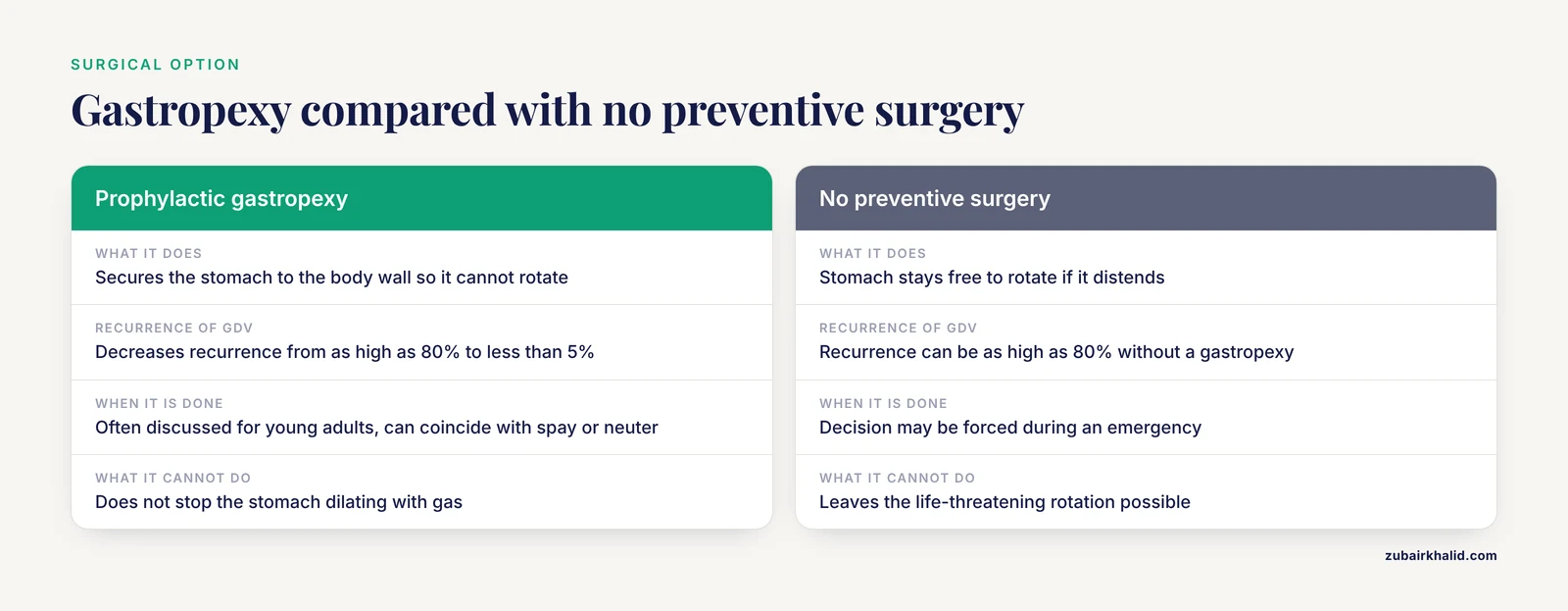
Gastropexy is a surgical procedure that secures the stomach to the body wall so it cannot rotate [5]. It is the most effective preventive procedure for GDV. Effective gastropexy decreases the recurrence of GDV from as high as 80% to less than 5% [5].
Gastropexy has a long history in veterinary medicine. It was first reported in 1971 for the management of gastric reflux, and later in 1979 for treating and preventing the recurrence of GDV [5].
Gastropexy is indicated in all dogs that undergo surgical correction of GDV [5]. It should also be strongly considered as a prophylactic procedure in at-risk breeds, including large and giant, deep-chested dogs, especially when they are already undergoing abdominal surgery for another reason, such as splenic disease [5]. Updated guidance confirms that prophylactic gastropexy for at-risk breeds can be performed via minimally invasive laparoscopic surgery [6].
For a Boerboel owner, the decision about prophylactic gastropexy should be made with a veterinarian who knows the individual dog. The procedure is often discussed for young adult dogs, and it can be performed at the same time as spay or neuter surgery. It does not prevent the stomach from dilating with gas, but it prevents the life-threatening rotation [5]. The discussion is best held before an emergency happens, so the decision is not made under pressure.
Weight and Nutrition
Nutrition is a lifelong preventive care issue for large and giant breeds. From weaning to maturity, improper nutrition is linked to developmental skeletal diseases in large-breed dogs [8]. As large dogs mature, skeletal disease and obesity can lead to osteoarthritis, which is difficult to manage and can increase the risk of early death [8].
The same source notes that GDV is a leading cause of death in large and giant breed dogs, and that management of health, including proper nutrition, exercise, and weight control, provides the best opportunity for successful aging [8]. For Boerboels, this means feeding a balanced diet appropriate for large-breed life stages, keeping the dog lean, and providing regular, appropriate exercise. Obesity is a particular concern in mastiff-type breeds because excess weight loads the joints and makes arthritis harder to manage [8].
Common Mistakes to Avoid
- Raising the food bowl to reduce mess or neck strain. The research links raised bowls to higher GDV risk [3].
- Feeding one large meal per day. Large volumes of food per meal increase risk [4].
- Ignoring non-productive retching. This is a classic GDV sign, not a simple stomach upset [2].
- Allowing unsupervised access to destructible chews. Gastric foreign bodies raise GDV risk about 5-fold [13].
- Skipping the gastropexy discussion until an emergency happens. The decision is best made with a veterinarian in advance.
Surgical Treatment and Recovery From GDV
If a Boerboel is diagnosed with GDV, treatment begins with medical stabilization and gastric decompression, followed by prompt surgical repositioning of the stomach [2]. Surgery involves decompression, correction of the gastric malpositioning, debridement of any necrotic tissue, and gastropexy [2][5].
Numerous gastropexy techniques are described, but the procedure is always performed on the right side of the abdomen, near the last rib [5]. An anatomically correct gastropexy location is vital to prevent postoperative complications such as partial pyloric outflow obstruction [5].
Negative prognostic factors include hyperlactatemia that does not respond to fluid therapy, gastric perforation, and the need for splenectomy or gastric resection [6]. These factors are determined by the emergency team, not by the owner, but they explain why speed of presentation matters.
Recovery from GDV surgery can be complicated. Abnormal gastric motility patterns and delayed gastric emptying have been described in dogs after GDV [12]. Postoperative gastrointestinal upset such as regurgitation, vomiting, and ileus can occur [9]. Dogs that required gastric resection or splenectomy face a longer and more guarded recovery [6].
There is also a rare but documented complication specific to giant breed dogs. A case report described sciatic neuropraxia in three giant breed dogs following successful surgical management of GDV [15]. The authors emphasized proper intraoperative positioning, frequent walks or position changes during hospitalization, deep kennel bedding, and physical therapy [15]. Two of the three dogs died of unrelated causes within a year, while the third recovered nerve function with minimal deficits [15]. Owners of giant breeds recovering from abdominal surgery should ask the veterinary team about positioning and rehabilitation.
Limitations and When to Contact a Veterinarian
This article is educational and is not a substitute for veterinary diagnosis or treatment. Breed-level information cannot predict what will happen in an individual dog. Every Boerboel is different, and the best preventive care plan is built with a veterinarian who examines the dog in person.
Contact a veterinarian immediately if a Boerboel shows any of the following:
- Non-productive retching or repeated attempts to vomit [2]
- A visibly distended or tense abdomen
- Restlessness, pacing, or signs of pain [2]
- Rapid breathing, difficulty breathing, or pale gums
- Collapse or weakness
These are emergency signs, not wait-and-see signs. Also schedule a veterinary visit for any of the following: lameness or difficulty rising, unexplained weight gain or loss, changes in appetite or thirst, behavior changes such as new fearfulness, and any concern about chewing or swallowing foreign material. If you are unsure whether a sign is an emergency, call a veterinary clinic for advice. Know the closest 24-hour emergency facility before you need it.
Boerboel Exercise and Mental Stimulation Needs
Adult Boerboels do best with moderate, consistent exercise rather than occasional intense bursts. A practical target is 45 to 60 minutes of purposeful activity daily, split into two or three sessions. Brisk walks, leash manners practice, and supervised time in a secure yard are enough for most adults. Avoid forced roadwork, long runs in heat, and repetitive jumping in a heavy dog. On hot days, walk early or late and watch for heavy panting. Keep the dog lean; regular exercise and weight control support healthy aging in large breeds [8].
Puppies and Forced Exercise
Puppies should not be exercised like small adults. Growth plates are open, and forced exercise such as long runs, stair repetitions, jumping, or treadmill work adds load to developing joints. Let a Boerboel puppy play and explore at its own pace, use short walks for socialization, and avoid endurance exercise until growth is complete. Free play on non-slip surfaces is safer than structured mileage. A puppy that limps or is reluctant to move should be seen by a veterinarian.
Mental Stimulation
Mental work is part of exercise. Short training sessions, puzzle toys, scent games, and controlled sniff walks give a Boerboel a job and reduce restless, pushy behavior. A dog that has used its nose and brain is often calmer indoors than one that has only been walked. End training before the dog becomes frustrated, and keep enrichment supervised. Choose toys that cannot be swallowed whole.
Signs of Joint Pain
Schedule a veterinary visit for stiffness after rest, reluctance to climb stairs or jump into a car, lagging behind on walks, a shortened stride, swelling or heat around a joint, difficulty rising, or yelping when touched. These signs can have several causes, and early assessment is better than waiting. Large breeds carry more load on their joints, so a limp that persists beyond a few days, or any sudden inability to bear weight, warrants prompt examination.
Boerboel Grooming, Skin and Ear Care
The Boerboel has a short, dense coat that is easy to maintain. Brush it once or twice a week with a rubber curry brush or hound glove to remove dead hair. Seasonal shedding is heavier in spring and autumn, so brush daily during those periods. Regular brushing reduces loose hair on furniture. Bathe only when needed with a mild dog shampoo, and rinse thoroughly.
Nail Care
Trim nails every three to four weeks, or when you hear them clicking on hard floors. Overgrown nails can split and alter the dog's gait. Use a clipper or grinder and avoid the quick, the pink tissue inside the nail. If you are unsure where the quick ends, ask a veterinarian or groomer to demonstrate. Regular nail care prevents discomfort.
Ear Care
Check ears weekly for redness, swelling, discharge, or odor. Boerboels have drop ears, which reduce airflow and trap moisture. Clean the outer ear with a cotton ball and a veterinary-approved cleaner. Do not use cotton swabs in the canal. Dry ears thoroughly after swimming or bathing. Ear cleaning should be gentle.
Skin Fold Hygiene
Clean facial and neck folds with a damp cloth or pet-safe wipe, then dry completely. Trapped moisture and debris can cause intertrigo, a superficial dermatitis. Check folds regularly, especially in warm weather. Keeping folds dry is the main preventive step.
Common Skin and Ear Problems
Common problems include allergic dermatitis, pyoderma, and skin fold dermatitis. Signs include itching, redness, hair loss, pustules, and a musty odor. Ear infections, usually otitis externa, cause head shaking, scratching, discharge, and pain when the ear is touched. Allergies often affect the ears and skin together.
When to Seek Veterinary Treatment
Contact a veterinarian if itching, hair loss, crusting, pustules, or odor persists, or if ear redness, discharge, or pain lasts more than a day or two. Also seek help for head tilt, balance problems, or signs of pain around the ears. Skin and ear conditions need an accurate diagnosis and specific treatment. Do not use over-the-counter products without veterinary guidance. Prompt treatment prevents chronic changes.
Boerboel Lifespan and Common Orthopedic Conditions
A typical Boerboel lifespan is about 9 to 11 years. As with other large and giant breeds, the orthopedic conditions that most often affect quality of life are hip dysplasia, elbow dysplasia, and the osteoarthritis that develops as a result of abnormal joint conformation and cumulative wear.
Hip and Elbow Dysplasia
Hip dysplasia is a developmental condition in which the hip joint fails to fit together properly, leading to laxity, abnormal cartilage wear, and eventually osteoarthritis. Elbow dysplasia is a similar developmental problem involving the elbow joint, often caused by fragmented coronoid process, osteochondritis dissecans, or ununited anconeal process. Both conditions are common in large-breed dogs and can appear as early as puppyhood or remain silent until later in life. Improper nutrition during growth is linked to developmental skeletal disease in large-breed dogs [8], so feeding a balanced large-breed puppy diet and avoiding excess calcium and calories is part of prevention.
Osteoarthritis and Weight Control
Osteoarthritis is the progressive, irreversible degeneration of joint cartilage. In Boerboels, it is usually secondary to hip or elbow dysplasia, but it can also follow joint trauma. Skeletal disease and obesity can lead to osteoarthritis, which is difficult to manage and can increase the risk of early death [8]. Keeping a Boerboel at a lean body weight is the single most effective way to reduce joint stress and slow the progression of arthritis. Excess weight loads the joints directly and increases inflammation, so weight control is a cornerstone of orthopedic care in this breed [8].
Warning Signs Requiring Veterinary Evaluation
Owners should have a Boerboel evaluated by a veterinarian if any of the following appear:
- Lameness or a shifting limp
- Difficulty rising from lying down
- Stiffness, especially after rest or exercise
- Reluctance to climb stairs, jump, or play
- Decreased hindlimb muscle mass
- Pain, swelling, or grating sensation in a joint
- Changes in gait, such as bunny-hopping
Early diagnosis allows earlier management with weight control, controlled exercise, and appropriate pain relief. Any persistent lameness or stiffness in a Boerboel warrants a veterinary examination rather than waiting to see if it resolves.
Frequently Asked Questions
What is a Boerboel dog?
A Boerboel is a large to giant guardian breed from South Africa, also called the South African Mastiff. It is a deep-chested mastiff-type dog, and that conformation places it in the population at risk for gastric dilatation-volvulus [1][2].
Is the Boerboel the same as the South African Mastiff?
Yes, the terms Boerboel and South African Mastiff refer to the same breed. The Boerboel is a mastiff-type guardian breed from South Africa.
How big do Boerboels get?
Boerboels are a large to giant breed. Research on GDV classifies large breeds as 23 to 45 kg (50 to 99 lb) and giant breeds as over 45 kg (99 lb) [7]. Boerboels fall in that range, with a deep chest and heavy bone.
What is the Boerboel temperament?
The Boerboel temperament is confident and protective, typical of a guardian mastiff. A stable, low-stress home environment supports both behavior and health in this breed.
What health problems are common in Boerboels?
The most serious health problem for the Boerboel is gastric dilatation-volvulus, or bloat [1][2]. Large and giant breed dogs also face developmental skeletal disease, obesity, and osteoarthritis across their life stages [8].
What is GDV or bloat in Boerboels?
GDV is a condition in which the stomach distends with gas or fluid and rotates out of position, causing multiple organ failure and rapid death without treatment [2]. It is the leading emergency threat for deep-chested large and giant breeds [1].
Should my Boerboel have prophylactic gastropexy?
Prophylactic gastropexy should be strongly considered for at-risk breeds such as deep-chested large and giant dogs [5][6]. Discuss timing, technique, and the risks and benefits with your veterinarian.
How can I reduce my Boerboel's risk of GDV?
Feed smaller meals rather than one large meal, do not use a raised bowl, slow down fast eating, prevent access to foreign bodies, manage stress, keep the dog lean, and discuss prophylactic gastropexy with your veterinarian [3][13][4][5].
Sources
- Inherited and predisposing factors in the development of gastric dilatation volvulus in dogs.
- Gastric dilatation-volvulus in dogs.
- Non-dietary risk factors for gastric dilatation-volvulus in large and giant breed dogs.
- Diet-related risk factors for gastric dilatation-volvulus in dogs of high-risk breeds.
- Gastropexy for prevention of gastric dilatation-volvulus in dogs: history and techniques.
- Updated Information on Gastric Dilatation and Volvulus and Gastropexy in Dogs.
- Incidence of and breed-related risk factors for gastric dilatation-volvulus in dogs.
- Nutritional risks to large-breed dogs: from weaning to the geriatric years.
- Cardiovascular and systemic effects of gastric dilatation and volvulus in dogs.
- Identification of Genetic Susceptibility Factors Associated with Canine Gastric Dilatation-Volvulus.
- Mortality and morbidity due to gastric dilatation-volvulus syndrome in pedigree dogs in the UK.
- The relationship between gastrointestinal motility and gastric dilatation-volvulus in dogs.
- Gastric foreign body as a risk factor for gastric dilatation and volvulus in dogs.
- The canine gut microbiome is associated with higher risk of gastric dilatation-volvulus and high risk genetic variants of the immune system.
- Development of Sciatic Neuropraxia following Abdominal Surgery in 3 Giant Breed Dogs.