When to Call the Vet About Your Cat's Behavior: A Decision Guide
By Dr. Zubair Khalid, DVM, MS, PhD ·

The one-sentence difference between a quirk and a warning sign is direction of change. A quirk sits inside your cat's long-standing baseline, while a warning sign is a departure from that baseline, above all when it starts suddenly or arrives with physical symptoms. The rule of thumb for choosing a response follows directly. Call the same day when a change is sudden, when it comes with appetite, thirst, litter box, breathing, or movement changes, or when anyone in the home could get hurt. Start a log and book an appointment within days to a few weeks when a change is mild, gradual, and stable in a cat who otherwise seems well.
That rule sounds simple, and cats make it hard to apply. The Cornell Feline Health Center reminds owners that cats are accomplished at hiding illness, so a behavior change is sometimes the only outward signal a developing problem produces. The AVMA's guidance for pet owners treats changes in behavior, appetite, or elimination as standard reasons to contact a veterinarian rather than as quirks to wait out. This guide turns that principle into a working decision system. It lays out four response options in a side-by-side table, explains each option on its own terms, compares them on the criteria that decide real choices, works through real scenarios, and closes with a preventive care checklist that makes every future decision faster.
This article is educational and is not a substitute for veterinary diagnosis or treatment.
When to Call the Vet About Your Cat's Behavior: The Four Options
Every behavior question has four possible responses, and the skill is matching the response to the urgency rather than to the annoyance level.
| Option | Best fit | Speed | What you actually do | Core trade-off |
|---|---|---|---|---|
| 1. Home monitoring with a behavior log | Mild, gradual, stable change, no physical symptoms, no safety risk | Days to weeks | Record what happens, when, how often, and on video | Costs nothing but risks delay if a medical problem is developing |
| 2. Scheduled wellness or behavior appointment | Persistent change, household conflict, preventive questions | Days to a few weeks | Bring the log, videos, and questions to a full exam | Costs a visit for a problem that may turn out benign |
| 3. Same-day call or telehealth triage | New or worsening sign, sudden change without collapse-level danger | Same day | Describe the signs and answer triage questions by phone | Fast expert sorting, but no physical exam |
| 4. Emergency clinic now | Red flag signs or active safety risk | Minutes | Call ahead, transport safely | Highest cost and stress, sometimes for a benign cause |
The sections below explain when each option fits, what it involves, and where owners most often go wrong.
Why Behavior Changes Deserve a Medical Look First
Behavior works as a vital sign in cats. A cat in pain may stop jumping, groom less, or growl when touched. A cat with urinary tract disease may visit the litter box again and again. An overactive thyroid gland, which veterinarians screen for in older cats, can surface as restlessness, increased appetite, and weight loss. Sensory decline and age-related cognitive change can produce nighttime vocalizing and confusion. None of these labels is something an owner should assign from a distance. Each is a question to put to your veterinarian: could pain be involved, could the urinary tract be involved, could a hormonal condition common in aging cats be involved?
The point is not that every odd day is disease. The point is that a behavioral label should follow a medical screen, not replace it. A published case of territorial urine marking shows how much screening sits behind that kind of diagnosis, and the appointment section below walks through exactly what was tested. When a behavior change arrives with any physical companion, weight loss, new thirst, a limp, a changed litter box pattern, the medical question comes first, always.
Option 1: Monitor at Home With a Behavior Log
Monitoring is an active choice, not a shrug. It fits when a change is mild, gradual, and stable, when appetite, thirst, litter box output, movement, and breathing all look normal, and when nobody in the home is at risk. Examples that commonly land here include a new preference for a high shelf, mild grumbling between cats that never escalates, or a slightly changed play style in an otherwise bright, eating, drinking cat.
A useful log captures five things. Record the date and time of each event, what happened in one plain sentence, how long it lasted, what preceded it, and, when possible, a short phone video. Once a week, add a line on appetite, water intake, litter box stool and urine, and weight if you own a scale the cat tolerates. Review the log at the two-week mark. A behavior that is fading needs nothing more than a mention at the next preventive visit. A behavior that is holding steady or intensifying has just earned an appointment.
The pros are real. Monitoring costs nothing, keeps anxious cats out of the carrier, and hands your veterinarian better data than memory ever could. The cons center on delay. Some emergencies begin with deceptively mild signs, and owners under-report changes they have slowly normalized. Escalate out of monitoring the moment appetite, thirst, litter box habits, breathing, or mobility shift, or if the behavior jumps in frequency or intensity.
Option 2: Schedule a Wellness or Behavior Appointment
A scheduled visit fits changes that persist beyond a couple of weeks, recurring conflict between cats, litter box dissatisfaction without straining, new aggression, overgrooming, and any new behavior in a kitten or senior cat. It also fits the questions owners postpone, such as noise sensitivity or a changed response to handling.
Book it as a wellness or behavior appointment and bring three things: the log, the videos, and a written timeline of home changes, new pets, moved furniture, changed food, new cleaning products, a new baby, construction noise. The veterinary team will take a history, perform a physical exam, and screen for medical drivers before discussing behavior. AAHA's preventive care framework puts regular wellness exams at the center of lifelong care, at least yearly for healthy adults and more often for kittens and seniors, and behavior belongs on that agenda rather than waiting for a crisis.
The pros are thoroughness and baseline building. An exam can catch medical drivers that look behavioral from the outside, and a documented baseline makes every future decision faster. The cons are lag and cost. Appointments take days to arrange, they cost money for a problem that may prove benign, and complex behavior cases often need follow-up visits. If the change worsens while you wait for the date, move up to a same-day call.
Option 3: Call the Clinic the Same Day
The same-day call fits a sudden change that has not reached collapse-level danger, a new symptom stacked on a change you were already monitoring, a steady worsening trend, or plain uncertainty about whether what you are seeing matters. Calling is the cheapest, fastest way to convert worry into a plan.
Expect triage questions: when did it start, how often does it happen, is the cat eating and drinking, how are urine output and effort, any vomiting or diarrhea, any breathing change, any sign of pain such as a hunched posture or flinching, any possible access to toxins, medications, or string. Three outcomes are possible. The team may set a monitored plan with a firm recheck time, they may ask you to come in today, or they may direct you to an emergency hospital.
The pros are speed and expert sorting without an owner guessing. The cons are that phone advice is provisional without an exam, and after hours your call may route to an emergency line. If the triage team says come in, go. If they say monitor, get the recheck time in writing.
Option 4: Go Straight to Emergency Care
Emergency care fits red flag signs and active danger. The Merck Veterinary Manual treats obstruction of the urethra, which owners usually see as straining with little or no urine, as an emergency situation, and it is most typical in male cats. The broader red flag list includes crying in the litter box, difficulty breathing or open-mouth breathing, collapse, a seizure, repeated vomiting, suspected ingestion of toxins, medications, or foreign objects such as string, and a cat who is suddenly unable to stand.
Call the clinic or emergency hospital while someone drives. Keep the cat in a carrier, bring the packaging for any suspected toxin, and expect triage at the door. The pros are simple. In obstruction and toxin cases, minutes change outcomes, and no scheduled appointment can help a cat who cannot breathe. The cons are cost, stress for the cat, and the possibility of a benign explanation at the end of an expensive night. That trade still favors going. When you are torn between a same-day call and the emergency clinic, call, describe exactly what you see, and let the team decide.
What Happens at the Behavior Appointment
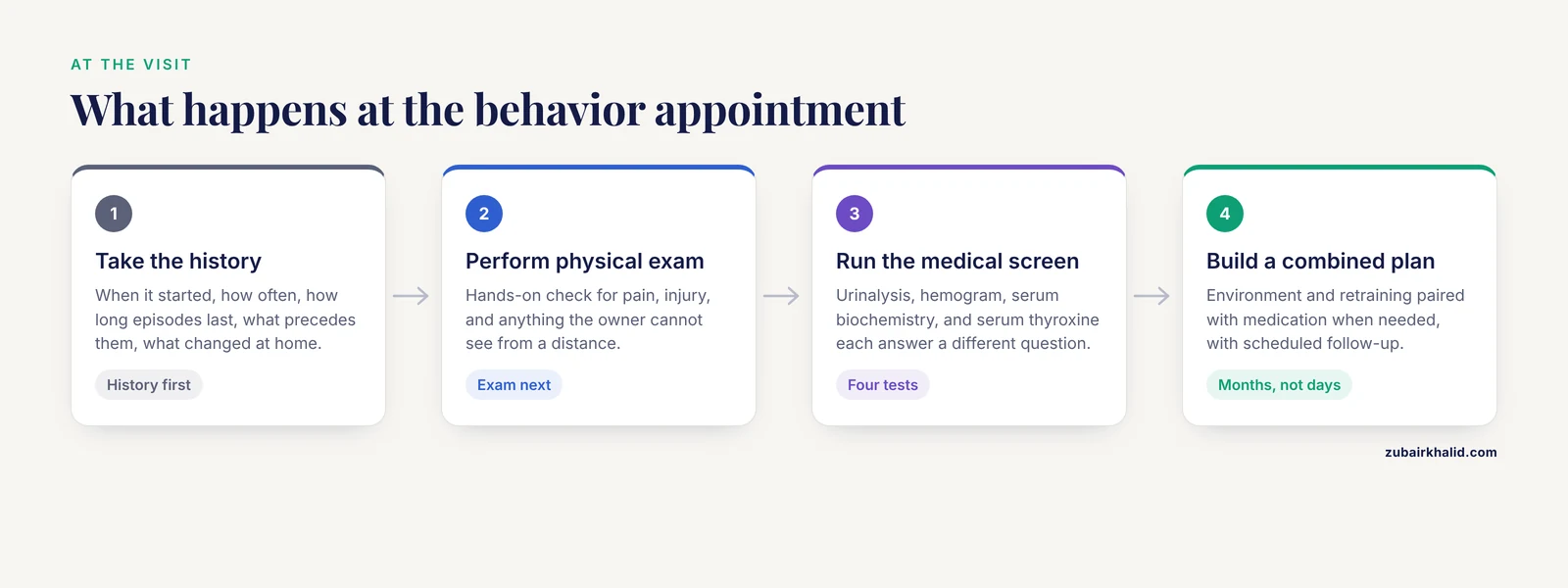
A behavior appointment runs on history first. Expect questions about when the change started, how often it happens, how long episodes last, what precedes them, what has changed in the home, how the cats in the household divide litter boxes, food stations, water, resting spots, and scratching surfaces, and how the cat responds to being touched.
Then comes the physical exam, and then the medical screen. In the published case of territorial urine marking, the workup included urinalysis, a hemogram (complete blood count), serum biochemistry, and serum thyroxine, and every result fell within the reference range [1]. Each test answers a different question. Urinalysis looks for urinary tract disease that can drive litter box changes. The blood count looks for infection, inflammation, and anemia. The chemistry panel assesses organ function. Thyroxine screens thyroid hormone status, a standard concern in middle-aged and older cats. The case cat's testosterone concentration was also measured and matched the expected range for a castrated male [1].
Only after results like these come back clean does a behavioral diagnosis carry its full weight. Even then, the medical and behavioral tracks usually run together, because pain, illness, and stress feed each other. Ask your veterinarian which parts of this screen apply to your cat, since age, history, and the specific behavior shape the workup.
A Worked Example: Urine Spraying With a Long History
A published case report shows the full arc from complaint to outcome. A 10-year-old castrated male domestic cat was admitted because of lifelong urine spraying on vertical surfaces, and the diagnosis was territorial urine marking. The report notes that treatment controlled the spraying even in this castrated cat, a useful corrective to the belief that only intact males mark [1]. With the medical screen clear, the team moved to a combined plan.
Treatment paired behavior modification with cyproheptadine, and the unwanted marking stopped immediately. The dose was then adjusted to find the lowest level that maintained consistent litter box use [1]. The plan called for continuing the medication for at least 1 year before any attempt to withdraw it, a timeline that surprises owners who expect behavior medication to last a few weeks [1].
Two details about the drug matter to owners. Cyproheptadine is an antihistamine that is also prescribed in cats for its appetite-stimulating effects, and it has antiandrogenic effects in other species [1]. A follow-up call 8 months after treatment began found the cat still in remission from inappropriate urination [1]. In the United States, cyproheptadine is a prescription medication, and giving it to a cat is an extralabel use that only a veterinarian within a valid client-patient relationship can authorize, so leftover tablets and online purchases have no place in a behavior plan.
The takeaways reach past this one case. Long-standing behaviors can respond to treatment. Combined plans that pair environmental work and retraining with medication outperform any single fix. Timelines run in months and years rather than days, and scheduled follow-up is part of the treatment rather than an afterthought. Ask your veterinarian whether a combined plan fits your cat, and expect the medication decision, the dose, and the duration to be tailored, not copied.
The Criteria That Decide the Call
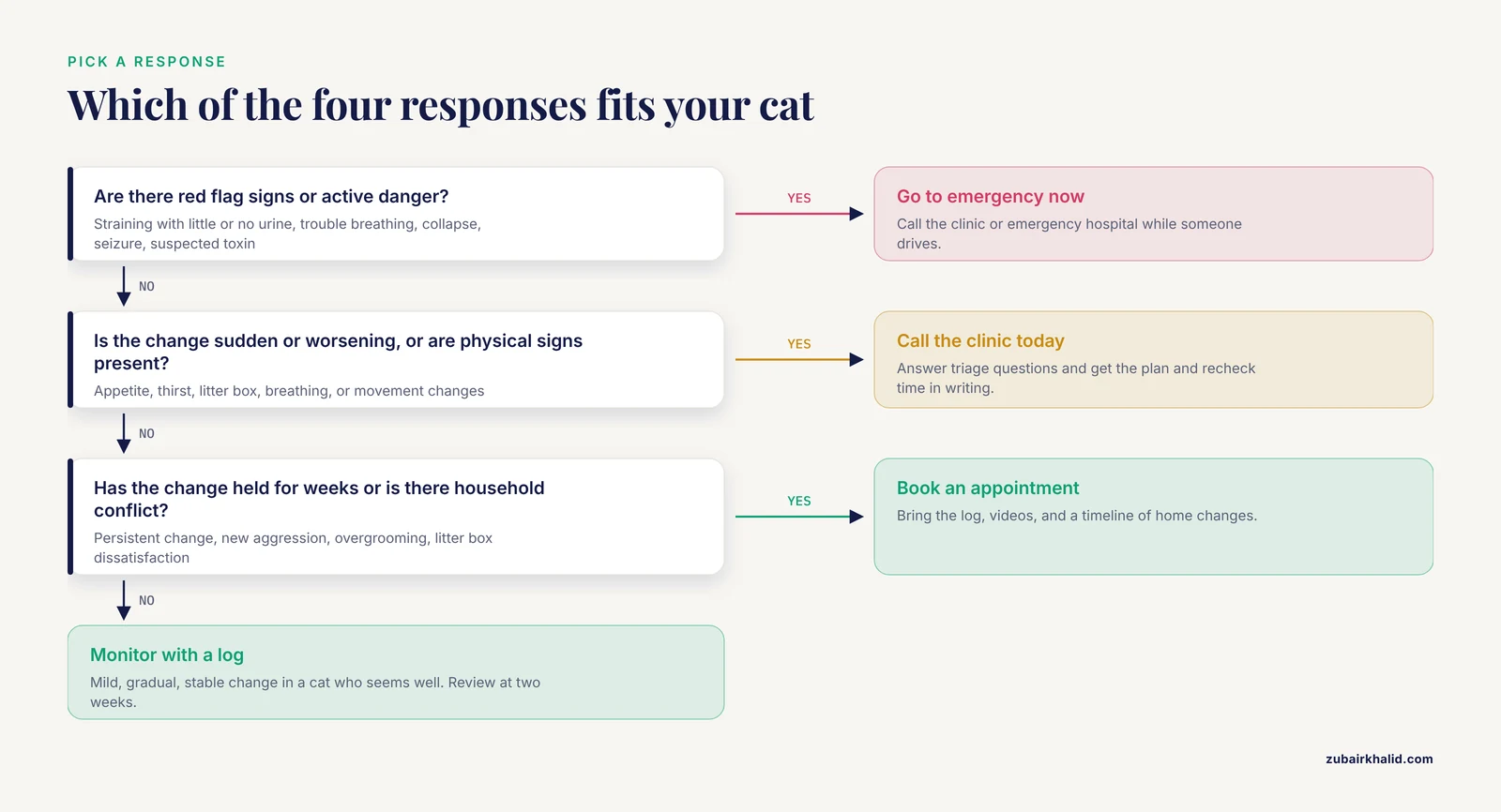
Six criteria separate the four options in real decisions. Speed of onset separates emergency and same-day responses from scheduled visits and monitoring. Physical symptoms do the same work, and any physical companion, appetite, thirst, litter box output, breathing, movement, pushes the decision toward faster care. Safety to people or other animals overrides everything else and favors immediate contact. Persistence moves monitoring toward a scheduled visit once a change has held for weeks. Household impact, destroyed furniture, sleepless nights, a fearful cat, justifies a visit even when urgency is low. Finally, confidence in your baseline, which preventive care builds, determines whether you can trust your read of mild at all.
Weighing the pros and cons of each option becomes straightforward once urgency is separated from irritation. Monitoring buys data at the price of delay. A scheduled visit buys thoroughness at the price of waiting days. A same-day call buys expert sorting at the price of provisional advice. Emergency care buys speed at the price of cost and stress. The best answer to when to call the vet about cat behavior comes from applying these criteria to your own cat, not from how frustrated the behavior makes you feel.
Three Scenarios, Three Decisions
Scenario 1. A 9-year-old cat spent the morning under the bed and skipped breakfast, after a normal yesterday. Sudden onset plus an appetite change fails the monitoring test on two counts. Call the clinic the same day and expect a recommendation for an exam, because hiding with a complete loss of appetite in a middle-aged cat needs medical sorting, not observation.
Scenario 2. A young male cat spends long minutes squatting in the litter box, produces small puddles, and returns again and again. This is the red flag pattern described in the emergency section. Go now, call on the way. Waiting overnight to see whether it resolves is the most common and most costly mix-up with this sign.
Scenario 3. A neutered 4-year-old cat starts spraying a hallway wall after a new roommate moves in and the litter box is relocated. He eats, drinks, and plays normally. This fits a scheduled appointment. Start the log, capture a video, and list the household changes. Expect the medical screen first, then a combined plan, and ask whether medication has a place in it, as it did in the worked example above.
Scenario 4. A 6-month-old kitten sprints the hallway at midnight and pounces the curtain. This is normal developmental behavior, and it belongs in the monitoring column at most, with a mention at the next wellness visit. The concern would be a change, a kitten who suddenly stops playing and hides has crossed into the same-day column.
Common Mix-Ups
Waiting out straining tops the list. Urinary blockage in male cats is a same-hour problem, and owners who watch overnight to see whether it resolves create the worst outcomes in feline practice. Blaming age comes next. Senior cats do get set in their ways, but new aggression, new vocalizing, and new house soiling in an older cat each deserve a medical screen before an age explanation. Punishing marking adds stress to a stress-driven behavior and usually makes it worse, so ask your veterinarian about behavior-safe approaches instead.
Confusing the two elimination presentations also derails decisions. Spraying small amounts on vertical surfaces and squatting to produce puddles on horizontal ones are different patterns that point to different plans, and the appointment sorts them. Skipping preventive visits for indoor-only cats removes the baseline that makes behavior decisions possible. Home dosing with human leftovers or online purchases risks toxicity and masks the signs your veterinarian needs. Changing everything at once, new litter, new food, moved boxes, right before an appointment scrambles the history, so keep the environment stable until your cat has been seen.
Preventive Care and Your Cat Health Checklist
Preventive care makes every decision in this guide easier, because a documented baseline turns "is this new?" into a checkable fact. AAHA's wellness framework centers on regular preventive exams, at least yearly for healthy adults and more often for kittens and seniors. The Companion Animal Parasite Council recommends parasite prevention tailored to your cat's lifestyle and local risk, and your veterinarian can fold dental checks and weight trends into the same visits. Ask your veterinarian how often your own cat should be seen, since life stage changes the answer.
Between visits, a monthly cat health checklist keeps the baseline current. Run through these ten points and call the clinic when any of them shifts suddenly:
- Appetite, including new pickiness or ravenous hunger
- Water intake, up or down
- Litter box output, effort, and habits
- Weight trend, using the same scale each time
- Coat condition and grooming effort
- Mobility, including jumping to favorite perches
- Sleep pattern and resting spots
- Vocalization pattern
- Breathing at rest
- Social behavior with people and other pets
Weekly checks are worth adding during any monitoring period, and a one-line note per week is enough. The checklist takes five minutes and converts vague worry into specific, reportable facts.
Limitations and When to Contact a Veterinarian
Every cat is an individual, and only a hands-on examination can separate a harmless quirk from early disease, so treat this guide as a way to organize the call rather than a way to avoid it. Individual cases need a veterinarian, and the four options above are entry points, not verdicts.
Contact your veterinarian the same day, or an emergency hospital immediately, for any of the following:
- Straining to urinate, passing little or no urine, or crying in the litter box
- Difficulty breathing, open-mouth breathing, or collapse
- Seizure, staggering, or sudden disorientation
- Repeated vomiting or complete refusal of food
- Suspected ingestion of toxins, medications, or foreign objects
- Sudden severe hiding paired with no appetite
- New aggression that risks a bite, or any aggression with a physical component
- Self-trauma, such as licking an area raw
- Any monitored change that crosses into this list
When a call ends with a watch-and-recheck plan, put the recheck time in writing and honor it. If signs worsen before that time, escalate rather than waiting for the date.
Frequently Asked Questions
How do I know if my cat's behavior change is an emergency?
Treat straining to urinate, difficulty breathing, collapse, seizures, repeated vomiting, or suspected poisoning as emergencies and seek care immediately. If you are unsure, call a clinic or emergency hospital and let their triage team sort the urgency.
Can a behavior change really come from a medical problem?
Yes, and it happens often. Pain, urinary disease, and hormonal conditions can all change how a cat acts, which is why veterinarians screen for medical causes before treating a behavior problem as behavioral.
What should I tell the clinic when I call?
Lead with what changed, when it started, and how often it happens. Then cover appetite, thirst, litter box output and effort, vomiting, breathing, mobility, and any video you captured.
Is urine spraying a medical problem or a behavior problem?
It can be either, so expect your veterinarian to check urine and blood first. If the medical screen is clear, the plan usually combines environmental changes, retraining, and, when needed, medication.
How long can I watch a mild change before calling?
A mild, stable change in a cat who eats, drinks, and uses the litter box normally can be logged for a few days while you arrange an appointment. Escalate the same day if anything physical appears.
Are some behavior changes just normal cat behavior?
Yes. Playfulness, scratching, kneading, and evening energy bursts are normal, and the concern is a shift away from your own cat's baseline rather than any single behavior.