The Ultimate Litter Box Cleaning Schedule: A Printable Template
By Dr. Zubair Khalid, DVM, MS, PhD ·

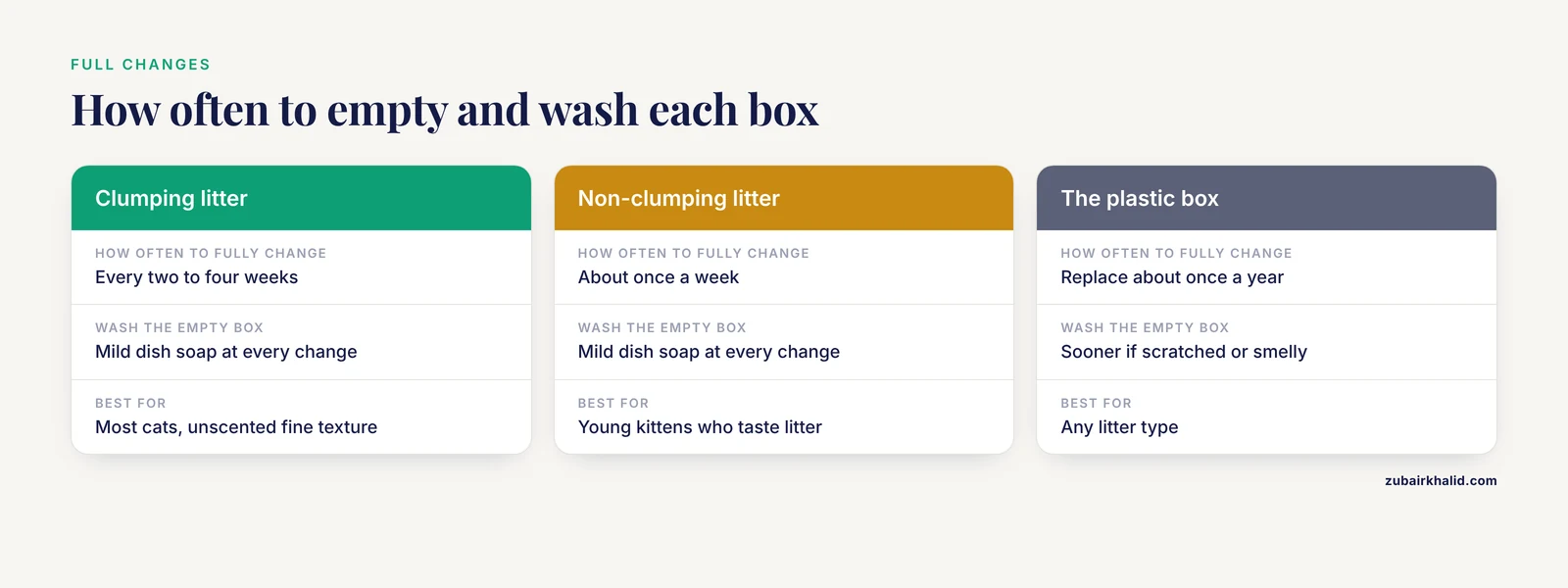
Scoop every box at least once a day, wash the scoop and the box rim once a week, and give each box a full emptying, scrub, and refill every two to four weeks for clumping litter, or about once a week for non-clumping litter. That three-part rhythm is the core of the ultimate litter box cleaning schedule. The printable litter box cleaning schedule template in this article turns that rhythm into a one-page checklist you can tape beside the litter station and tick off in under a minute a day.
A written schedule matters because litter box care fails quietly. Nobody decides to stop scooping. The task gets skipped on a busy morning, then skipped again, and within a week the box is dirty enough that a fastidious cat starts looking for alternatives, such as a laundry pile or a quiet corner of carpet. A printed checklist removes the guesswork, breaks the work into small daily and weekly pieces, and doubles as a health log that can catch disease early.
This article is educational and is not a substitute for veterinary diagnosis or treatment. Always discuss your cat's specific needs with your veterinarian.
At a Glance: The Whole Schedule in Five Lines
| Task | How often | Time | Key detail |
|---|---|---|---|
| Scoop feces and urine clumps | Twice daily is ideal, once daily is the minimum | 2 minutes | Bag and seal waste, trash it |
| Top up litter to 2 to 3 inches | Weekly, or whenever depth drops | 1 minute | Depth matters more than amount |
| Wash scoop, mat, and box rim | Weekly | 5 minutes | Hot water and mild dish soap |
| Full litter change and deep wash | Every 2 to 4 weeks for clumping litter, weekly for non-clumping | 15 minutes per box | Rinse well, dry fully, refill |
| Replace the plastic box | Yearly, or when odor or scratches persist | 5 minutes | Scratched plastic holds odor |
Print the tables in the template section, tape them next to the litter station, and you have a working system today.
Why a Fixed Cleaning Schedule Matters
Cats are among the cleanest animals people keep. A cat's instinct is to eliminate away from its core territory and cover waste so its presence is not advertised to other animals. A litter box concentrates each day's waste in one small space, so the box can go from acceptable to offensive for a cat within a day or two of neglect, long before it smells bad to a human nose. Cats read scent at concentrations people barely notice, and a box that has soaked for days carries an ammonia load strong enough to genuinely repel them.
Consistent cleaning prevents the most common and frustrating consequence of a dirty box, which is house soiling. Once a cat starts urinating outside the box, the habit can persist even after the box is cleaned, because the cat has learned a new preferred spot or developed a negative association with the box itself. Prevention through routine is far easier than reversal.
The second reason is medical. The litter box is the best daily window you have into your cat's health. The size and number of urine clumps track how much your cat is drinking and urinating. Stool texture reflects gut function. Blood, mucus, visible worms, straining, or a sudden change in clump size often show up in the box days before you would notice anything else. A daily scoop is a daily exam, and the template in this article includes a log built for exactly that purpose.
The third reason is household hygiene. Cat feces can carry parasites, including the organism that causes toxoplasmosis and common roundworms. Toxoplasma oocysts passed in feces are not immediately infectious, they need time in the environment to mature, so waste that is removed promptly and daily presents far less risk than waste that sits for days. Regular cleaning, sealed disposal, and handwashing close the loop.
Finally, in multi-cat homes, box cleanliness shapes social peace. A soiled box can trigger avoidance or guarding, and cats that feel they lack a clean, safe place to eliminate may redirect that stress into marking or conflict with housemates.
The Ultimate Litter Box Cleaning Schedule
The schedule runs on four frequencies, daily, weekly, monthly, and quarterly. Adjust the details to your cat, your litter type, and your household, but keep the daily scoop non-negotiable.
Daily Tasks
- Scoop every box, removing all feces and urine clumps. Once a day is the minimum. Twice a day, morning and evening, is the standard for good reason, it keeps odor nearly invisible and doubles your health monitoring.
- Top up litter if the depth has dropped below about two to three inches.
- Do a ten-second visual check. Count urine clumps, look at the stool, and note anything unusual in the health log.
- Bag the waste, tie the bag, and place it in a covered trash container. Avoid flushing litter or scoopings unless your litter is specifically sold as flushable and your local water authority approves, because clumping litter can clog plumbing and cat waste can carry parasites that standard water treatment is not designed to target.
- Sweep or vacuum tracked litter so the area stays inviting.
Weekly Tasks
- Wash the scoop with hot water and mild dish soap.
- Rinse and hang the litter mat, or vacuum and wipe it.
- Wipe the box rim, lid, and exterior with a damp cloth and mild soap.
- Check each box for deep scratches or lingering odor, both signs that replacement is approaching.
- Sweep the floor around the station.
- Restore litter to the proper depth.
Monthly Tasks
Every two to four weeks for clumping litter, or about weekly for non-clumping litter, give each box a full change:
- Empty all litter into a bag, seal it, and trash it.
- Scrub the empty box with warm water, mild dish soap, and a dedicated sponge or brush. Wear gloves.
- Rinse thoroughly until no soap film remains.
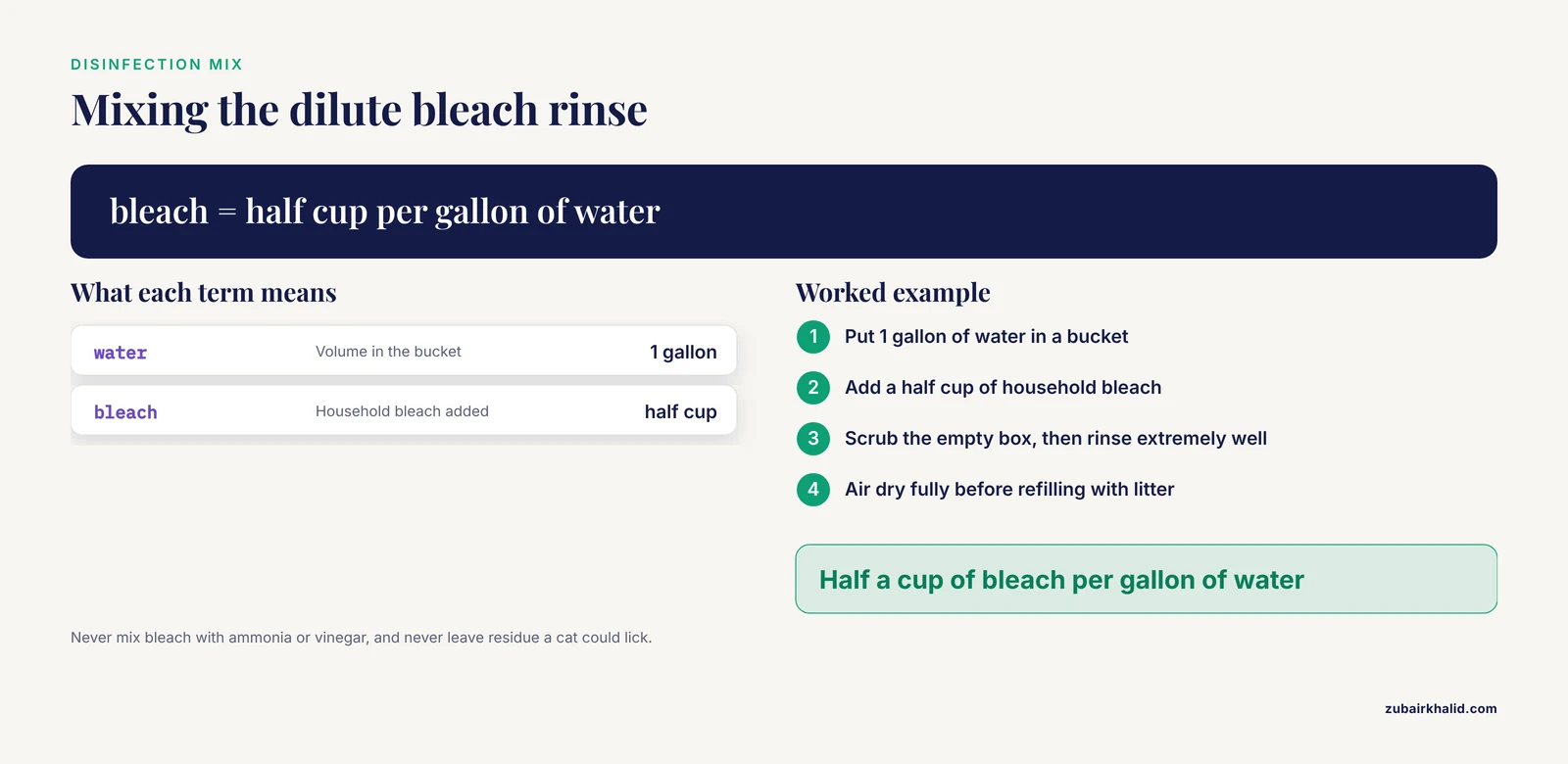
- For odor that persists, disinfect with a dilute bleach solution, about a half cup of household bleach per gallon of water, then rinse extremely well. Never mix bleach with ammonia-containing products. The combination releases toxic gases.
- Air dry completely, because damp plastic holds odor.
- Refill with fresh litter to a depth of two to three inches.
- Wash the scoop and mat while the box dries.
Stagger the washes so you never clean every box on the same day. In a two-box home, wash Box 1 on the first Saturday of the month and Box 2 two weeks later, so a clean option always exists.
Quarterly Tasks
- Replace plastic boxes that stay smelly after washing or that are heavily scratched inside. A common rule of thumb is replacement about once a year, sooner for scratched boxes.
- Replace worn mats.
- Reassess the setup. Kittens grow, cats age, and households change, so a box that worked last year may now need a larger size, a lower entry, or a new location.
- Deep clean the floor around the station, and treat any accident spots with an enzyme cleaner rather than an ammonia-based product.
The Printable Litter Box Cleaning Schedule Template
This free litter box cleaning schedule template prints on a single page. The template format is deliberately simple, three blocks, a weekly tick grid, a monthly deep-clean log, and a health watch log. Copy the tables into any document, print, and tape them beside the litter station. Laminating the page and using a dry-erase marker lets you wipe it clean each week.
Block 1, Weekly Grid
| Daily task | Mon | Tue | Wed | Thu | Fri | Sat | Sun |
|---|---|---|---|---|---|---|---|
| AM scoop, all boxes | |||||||
| PM scoop, all boxes | |||||||
| Litter topped to 2 to 3 in | |||||||
| Waste bagged and sealed |
| Weekly task | Done, date |
|---|---|
| Wash scoop in hot soapy water | |
| Rinse or wash mat | |
| Wipe box rim, lid, and exterior | |
| Sweep around the station | |
| Check each box for scratches and odor |
Block 2, Monthly Deep-Clean Log
| Box | Full change and wash date | Cleaner used | Fresh depth | Notes |
|---|---|---|---|---|
| Box 1 | ||||
| Box 2 | ||||
| Box 3 |
Block 3, Health Watch Log
| Date | Urine clumps, number and size | Stool, formed or soft | Anything unusual | Action taken |
|---|---|---|---|---|
The health watch log is the block most owners skip and the one that helps most. Bring it to veterinary appointments.
A Filled-In Litter Box Cleaning Schedule Template Example
Here is a litter box cleaning schedule template example for a two-cat, two-box home over three days:
| Day | Completed | Noticed |
|---|---|---|
| Monday | AM and PM scoop, both boxes, grid ticked | One large urine clump in Box 2, bigger than this cat's usual |
| Tuesday | AM scoop done, PM scoop late | Clump size back to normal |
| Wednesday | AM scoop, topped up Box 1 | Two formed stools, nothing unusual |
The example shows the habit the template builds. Because clump size was logged on Monday, the return to normal on Tuesday became a confirmed observation rather than a vague memory. If the large clumps had continued for several days, the log would hand your veterinarian a precise, dated record of increased urine output, which is exactly the information that speeds up diagnosis.
Adjusting the Template for Multi-Cat Homes
- Follow the one box per cat plus one extra rule, so two cats get three boxes and three cats get four.
- Spread boxes across separate rooms rather than lining them up in one spot, because a single bank of boxes functions as one location to a territorial cat.
- Scoop twice daily at minimum, since shared boxes fill faster.
- Stagger monthly washes as described above.
- Track which cat favors which box where you can. In most homes each cat has preferences, which helps you interpret the health log.
How to Wash the Box Without Making Your Cat Avoid It
Technique matters as much as frequency. Use gloves and a sponge or brush reserved only for litter boxes, never shared with dishes. Mild dish soap and warm water are enough for routine washes. Rinse more than feels necessary, because soap residue carries a scent cats notice. Let the box air dry fully before refilling.
Know which products to keep away from the litter station:
- Ammonia-based cleaners. Ammonia smells like urine to a cat, so cleaning with it can invite re-marking in or near the box.
- Phenol-based disinfectants and pine or citrus heavy products. Cats are unusually sensitive to certain compounds in these, and treated surfaces can put off a cat or expose it through licking paws.
- Strong perfumes of any kind. The finished box should smell like nothing at all.
If you disinfect with bleach, dilute it, rinse until no odor remains, and air dry. Store all cleaning chemicals away from pets and children, and never mix bleach with ammonia or vinegar. For accidents on the floor around the box, blot the spot and treat it with an enzyme cleaner designed for pet stains, which breaks down odor molecules rather than masking them.
Supplies and Setup That Make the Schedule Easy
Choosing the Box
- Go roomy. Your cat should be able to turn around and dig without touching the sides, and bigger is generally better.
- Pick a low entry for kittens, seniors, or cats with arthritis, who may avoid boxes with high sides they have to climb.
- Consider leaving boxes uncovered. Many cats prefer open boxes, covered designs trap odor inside where the cat sits, and a covered entrance can become an ambush point in multi-cat homes. Watch your own cat's preference.
- Plan one box per cat plus one extra, spread across rooms and, in multi-story homes, across floors.
Choosing the Litter
- Unscented, fine-textured clumping litter is the type most cats accept readily. Perfumes are added for people, not cats.
- For young kittens who tend to taste litter, many veterinarians suggest non-clumping or paper litter until kittens outgrow that phase, often around three to four months, because clumping material can form a mass if swallowed.
- Silica gel and plant-based litters work well for some cats. Change intervals differ between types, so follow the product directions and watch whether your cat actually uses them.
- Fill to two to three inches. Deeper fills waste litter and can discourage digging, shallower fills soak through to the bottom.
- Change brands gradually over a week or more by mixing increasing amounts of the new litter, because abrupt switches cause avoidance in some cats.
Tools Worth Having
- A slotted scoop, metal or stiff plastic, with slots sized to let clean litter fall through.
- A lidded waste pail or a supply of small bags.
- A washable mat large enough to catch tracked litter.
- Gloves, a dedicated sponge or brush, and mild dish soap.
- An enzyme cleaner for floor accidents.
- A small covered trash can near the station.
Common Mistakes That Undo a Good Schedule
- Too few boxes. This is the single most common setup error, and no cleaning schedule can compensate for it.
- Scented everything. Perfumed litter plus a perfumed cleaner plus a plug-in air freshener beside the box creates a scent wall many cats refuse to cross.
- Scooping only when the box looks dirty. By the time a box looks dirty to you, it has smelled bad to your cat for days.
- Washing all boxes the same day. Cats then face a wet, soap-scented box or no box at all. Stagger the washes.
- Wrong depth. A shallow fill soaks to the plastic and sticks, while a very deep fill frustrates cats who like to dig down.
- Harsh chemicals. Ammonia cleaners, phenol disinfectants, and undiluted bleach residue all push cats away from a box that is, ironically, freshly cleaned.
- Abrupt litter switches. Change brands or textures gradually over a week or more.
- Liners that catch claws. Some cats dislike plastic liners enough to avoid the box, so watch for scratching hesitation at the entrance.
- Poor locations. Boxes beside roaring washing machines, in dark dead-end corners, or next to food bowls get avoided.
- Punishing accidents. Scolding or rubbing a cat's nose in waste raises stress and reliably makes house soiling worse, never better.
Troubleshooting When the Schedule Is Not Enough
If the boxes are clean on schedule and your cat still eliminates elsewhere, work through the possibilities in this order.
Medical first. House soiling is one of the most common visible signs of urinary tract disease, gastrointestinal disease, and other painful or urgent conditions. Any sudden change in box behavior deserves a veterinary exam before you treat it as a behavior problem, and the red flags in the section below need same-day attention.
Litter preference. Offer a side-by-side test, two identical boxes in the same room with different litters, and see which one your cat chooses. Preference tests work best when everything else is held constant.
Box style and location. Try a larger box, remove a cover, move a box away from appliance noise or heavy foot traffic, or add a box on another floor. A cat that hesitates at the box entrance may be telling you the entry is too high or the approach feels exposed.
Cleaning products. If you recently changed soaps or disinfectants, switch back to mild dish soap. A new scent can be enough to trigger avoidance.
Stress and multi-cat conflict. New pets, moves, schedule changes, and tension between cats all show up in the litter box. Add boxes in open areas with clear escape routes so no cat can be cornered, and ask your veterinarian about stress-reduction strategies tailored to your home.
Accident cleanup. Treat soiled spots with an enzyme cleaner and avoid ammonia-based products on those areas, because the ammonia smell resembles urine and can invite repeat marking in the same spot.
Welfare, Safety, and Human Health Around the Litter Box
Clean box care protects people as well as cats. Cat feces can carry Toxoplasma gondii, the parasite that causes toxoplasmosis. Infected cats shed the organism in feces for only a short window, and the oocysts are not immediately infectious, they need a day or more in the environment to mature. That biology is the reason prompt daily scooping sharply reduces human exposure risk. Anyone who is pregnant or immunocompromised should have someone else handle scooping, or wear disposable gloves and wash hands thoroughly afterward. Keep boxes out of kitchens and away from areas where children play, cover outdoor sandboxes, and wash hands after every box contact.
Handle cleaning chemicals with the same care. Ventilate the room, never mix bleach with ammonia or vinegar, rinse disinfectants away completely, and store products where pets and children cannot reach them. When pouring litter, pour slowly and close to the box to limit dust, choose a low-dust formula if pouring clouds bother you or your cat, and avoid sweeping dry litter into the air.
Remember the cat's side of welfare too. A cat without an acceptable clean box may delay elimination, and holding urine is uncomfortable and risky, particularly for male cats. Enough boxes, in enough places, cleaned on schedule, is a basic welfare provision, not a luxury.
Litter Box Care as Part of Cat Preventive Care
Treat the daily scoop as the first item on your cat preventive care list, because it is the one health check you perform 365 times a year. Watch for:
- Urine clumps. A clear increase in clump number or size can accompany kidney disease, diabetes, hormonal conditions, and urinary problems. A decrease, or trips to the box that produce nothing, is urgent.
- Stool. Formed, easy-to-scoop stool is normal. Persistent soft stool, mucus, blood, or visible worms that look like rice or spaghetti need a veterinary visit.
- Behavior at the box. Crying, straining, excessive licking of the genitals, or standing instead of squatting all warrant attention, and standing to urinate in an older cat can signal joint pain.
Keep the health watch log from the template and bring it to appointments, because dated observations shorten the road to a diagnosis. Pair the log with the rest of your cat health checklist, wellness exams on the schedule your veterinarian recommends, often yearly for healthy adults and more often for kittens and seniors, vaccinations and parasite prevention tailored to your cat's lifestyle, dental checks, and routine weight monitoring.
Age changes the schedule. Kittens need shallow boxes, gentle litter, and frequent checks, because their digestive systems turn on a dime. Seniors benefit from more boxes, lower entries, and closer locations, because arthritis makes long trips to a basement box genuinely painful. If your cat has kidney disease, diabetes, or arthritis, ask your veterinarian before changing litter brands or moving boxes, since abrupt changes can backfire in cats who rely on routine.
Limitations and When to Contact a Veterinarian
Every cat is an individual, and this schedule is general guidance rather than a prescription, so your veterinarian is the right partner for tailoring it to your cat's age, health, and household. Contact your veterinarian promptly, or seek emergency care, if you see any of the following:
- Straining to urinate with little or no urine produced, especially in a male cat, which can indicate a blocked urethra and is an emergency.
- Repeated trips to the box producing nothing, crying in the box, or constant licking of the genitals.
- Blood in the urine or on the litter.
- No bowel movement for 48 to 72 hours, hard dry stools, or straining to defecate.
- Diarrhea lasting more than 24 to 48 hours, or any diarrhea with vomiting, lethargy, or appetite loss.
- A sudden jump in urine clump size or number, or a new pattern of drinking heavily.
- Sudden house soiling in a previously reliable cat, which can signal pain or illness rather than misbehavior.
- Vomiting more than occasionally, weight loss, hiding, or a dull, unkempt coat.
- Any kitten under four months with diarrhea or abnormal box habits, because young kittens dehydrate quickly.
If house soiling continues for two to three weeks after you have corrected the schedule, the setup, and the cleaning products, and your veterinarian has found no medical cause, ask about a referral to a veterinarian with behavior expertise.
Frequently Asked Questions
How often should I scoop the litter box?
At least once a day, and twice a day is better for most cats. Morning and evening scooping keeps odor down, cuts parasite risk, and gives you two chances a day to spot changes in urine and stool.
How often should I completely change the litter?
Every two to four weeks for clumping litter and about weekly for non-clumping litter. Wash the empty box with mild soap at every change, and stagger boxes so one clean option is always available.
What cleaner is safe for a litter box?
Mild dish soap and warm water handle routine washing. For lingering odor, a dilute bleach rinse works if you rinse it away completely. Skip ammonia-based cleaners, phenol disinfectants, and strongly scented or essential-oil products, which cats may avoid or react to.
How many litter boxes do I need?
One box per cat, plus one extra. Two cats need three boxes in separate locations, because a single bank of boxes reads as one spot to a territorial cat.
Can I use bleach to clean a litter box?
Yes, if it is dilute, rinsed completely, and the box air dries before refilling. About a half cup of household bleach per gallon of water is a typical mix. Never combine bleach with ammonia products, and never leave residue a cat could lick.
Why is my cat suddenly avoiding the litter box?
Rule out a medical cause first, then check the litter, box style, location, and household stress. Sudden avoidance with straining, blood in the urine, or frequent unproductive trips needs a same-day veterinary visit.
Is a dirty litter box dangerous to people?
It can be. Cat waste can carry parasites such as the organism that causes toxoplasmosis and common roundworms, along with bacteria. Daily scooping, sealed disposal, and handwashing cut the risk sharply, and pregnant or immunocompromised people should have someone else scoop or wear gloves.
How much litter should go in the box?
About two to three inches for clumping litter. That depth gives cats room to dig and cover while letting clumps release cleanly, and it avoids both the soak-through of shallow fills and the waste of very deep ones.