How to Transition Your Cat to a New Litter
By Dr. Zubair Khalid, DVM, MS, PhD ·

If you want to know how to switch cat litter without triggering a household rebellion, the answer is a gradual blend over 7 to 10 days. Start with roughly three parts old litter to one part new, shift the ratio every two to three days, and finish with a box that contains only the new product. Keep the box location, the cleaning routine, and everything else in the cat's daily life unchanged while you do it. Cats form firm preferences about the texture and smell of their toilet area, and an abrupt swap is one of the fastest ways to cause house soiling, which is among the most common behavior problems reported by cat owners and is far easier to prevent than to reverse.
This article is educational and is not a substitute for veterinary diagnosis or treatment.
At a Glance: Your 10-Day Litter Transition Plan
| Days | Litter mix | What you do | What you watch for |
|---|---|---|---|
| 1 to 3 | About 75% old, 25% new | Wash and dry the box, refill with the blend, scoop twice daily | Hesitation at the entrance, paw shaking, digging that stops abruptly |
| 4 to 6 | 50% old, 50% new | Keep the ratio, keep the location and routine identical | Perching on the rim, shallow digging, deposits beside the box |
| 7 to 9 | About 25% old, 75% new | Continue as before, or set out a parallel box with only new litter for a cautious cat | Crying in the box, small or frequent urinations, visits without producing anything |
| 10 and beyond | 100% new | Retire the old litter, keep one familiar backup box for another week if your cat is cautious | Accidents, or avoidance lasting more than about two days |
Why Cats Resist a New Litter
Cats learn the feel of their litter early in life, during kittenhood, and many carry that first accepted texture into adulthood. Surveys of feline preference consistently point the same direction. Most cats favor fine, unscented, clumping litter, and a large share dislike added perfume. From the cat's point of view, the box is a carefully selected toilet site that must feel and smell safe every single time.
Three forces drive most litter refusals:
- Substrate preference. Granule size, texture, scent, and depth all matter. A litter that feels wrong under paw, or smells wrong to a nose far more sensitive than yours, can be rejected outright.
- Aversion learning. If something unpleasant happens in the box, such as pain while urinating, a startling noise, or a soiled floor, the cat can attach that bad experience to the litter itself. The Merck Veterinary Manual lists urinary tract disease, constipation, and other medical problems among the reasons a cat may stop using the box, which is why any sudden refusal should raise the question of pain before it raises the question of attitude.
- Social pressure. In multi-cat homes, a preferred box can be guarded or blocked by another cat. A litter change layered onto limited box access compounds the stress and speeds up failure.
Because an aversion can outlast whatever triggered it, the goal of every transition is to keep the experience inside the box predictable while only one variable, the litter itself, changes.
Choosing a New Litter Your Cat Will Accept
Match texture and scent before anything else
Read your cat's current preference as your starting brief. If the cat uses a fine clumping product happily, the safest new litter is one with a similar granule size and no added fragrance. Perfumes and deodorizers are designed for human noses, and they are a frequent reason a cat backs away from a fresh box. Low dust matters too, both for the cat and for the person scooping, and it is a reasonable question to raise with your veterinary team if your cat coughs, sneezes, or has a diagnosed respiratory condition.
Know the main litter types
- Clumping clay. Easy daily scooping and a texture most adult cats already accept. Heavier, and some formulas are dusty.
- Non-clumping clay. Absorbent and inexpensive, but it needs more frequent full changes to stay inoffensive.
- Silica gel crystals. Light, low dust, and long lasting, though the coarse texture puts some cats off.
- Recycled paper. Soft, low dust, and gentle on tender paws, with weaker odor control.
- Wood or pine pellets. A natural scent and a very different texture, so expect a longer adjustment period.
- Plant-based options such as corn, wheat, or grass. Often lighter in texture, with clumping varieties available. Keep them dry, since moisture ruins performance.
Selection criteria in order of importance for the cat are texture the cat already tolerates, no added scent, low dust, and clumping action if the cat has used clumping happily. Weight, tracking, and odor control are owner-level criteria that come after the cat's requirements are met.
Special situations
- Kittens. Very young kittens explore with their mouths and may swallow litter, so many veterinarians start them on a non-clumping option such as paper and introduce clumping later. Ask your veterinary team when to make that change.
- Seniors. Arthritis is common in older cats and turns high-sided boxes into barriers. Choose a low entry, keep the box easy to reach, and place it where the cat actually spends time.
- Cats recovering from surgery or with sore paws. Softer substrates such as paper are usually better tolerated. Follow your veterinarian's direction here, because some surgical aftercare calls for a specific litter.
- Multi-cat homes. The texture accepted by the most cats in the group usually wins. Plan a slower timeline and more boxes than the minimum.
How to Switch Cat Litter Step by Step
Step 1: Stabilize the setup before day one
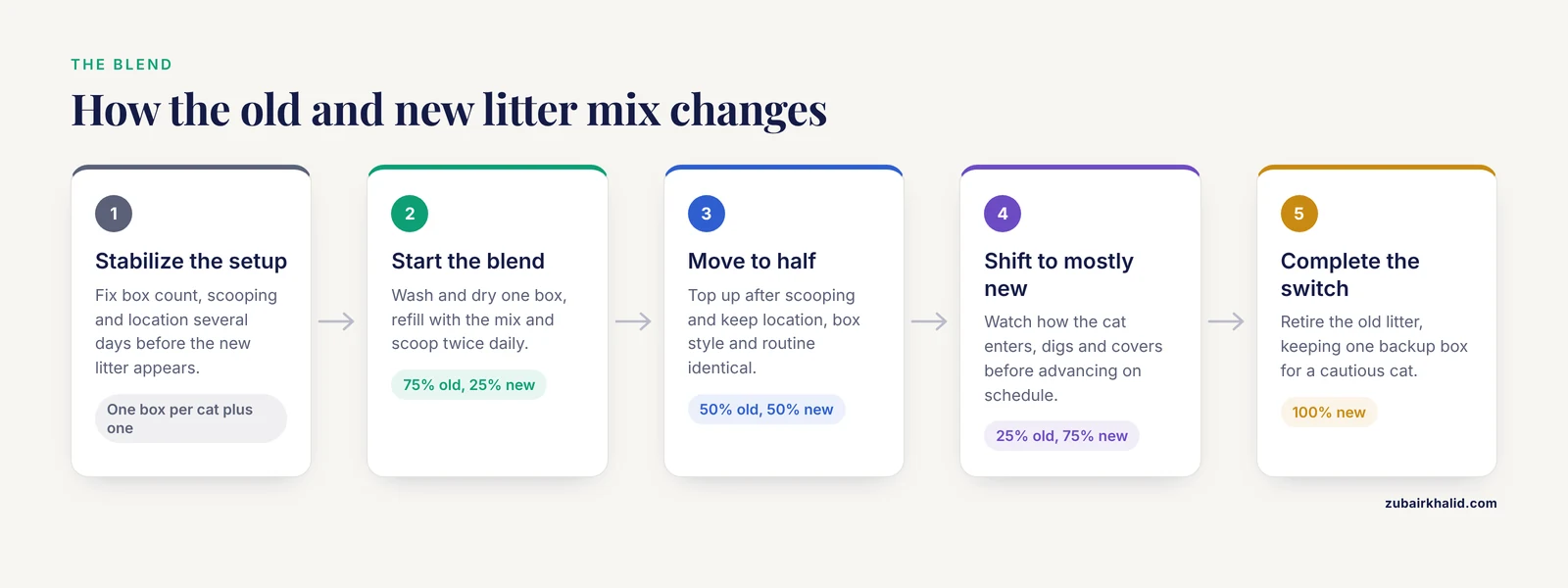
Confirm the basics first, because a litter transition layered onto a flawed setup fails far more often. Provide one litter box per cat plus one extra. Scoop at least once daily. Place each box in a quiet, accessible spot away from food and water and away from noisy appliances. If any of these need fixing, fix them several days before the new litter appears so the cat has settled into the improved setup.
Step 2: Start the blend (days 1 to 3)
Empty and wash one box, dry it, and refill with a mix of about 75 percent old litter and 25 percent new litter. Blend thoroughly so the texture feels consistent under paw. Scoop twice daily during the transition, since cleanliness is the strongest stabilizing force you control.
Step 3: Move to half and half (days 4 to 6)
After scooping, top up with a 50/50 mix. Keep the location, the box style, and the surrounding routine exactly the same.
Step 4: Shift to mostly new (days 7 to 9)
Move to roughly 25 percent old and 75 percent new. Watch how the cat enters, digs, and covers. Confident entry and normal digging mean you can advance on schedule.
Step 5: Complete the switch (day 10 onward)
Fill the box with only the new litter. For cautious cats, keep one small box with the old litter available for another week, then retire it once the new litter has been used reliably for several days.
The parallel box method for cautious or senior cats
Some cats accept a new product faster when they can choose rather than being blended into it. Place a second box containing only the new litter beside the established box. Once the cat uses the new box consistently for several days, retire the old one. This method avoids mixed textures, which fastidious cats sometimes reject as neither one thing nor the other.
Tips that raise your odds
- Change one variable at a time. Litter only, not location, box style, or cleaning products.
- Scoop twice daily during the transition.
- Never carry the cat to the box or move its paws in the litter. Forced exposure builds aversion.
- Reward calm box visits with quiet praise, and never punish accidents. Punishment teaches a cat to hide its eliminations, not to prefer the box.
- If the cat hesitates at any ratio, hold that ratio for two extra days before advancing.
A typical transition runs 7 to 10 days. Sensitive, senior, or multi-cat households often need two to four weeks, and the slower pace still counts as success.
Litter Box Setup Fundamentals
How many boxes. One per cat plus one extra, spread through the home so no single cat can control access to all of them.
Size and depth. Bigger than most retail boxes, ideally about one and a half times the cat's nose-to-tail-base length so it can turn and dig comfortably. Fill to a shallow depth of roughly two inches, since deep fill frustrates some cats.
Location. Quiet, easy to reach, with a visible escape route, away from food and water, away from furnaces and washing machines, and with at least one box on every floor of a multi-story home.
Covered or open. Many cats prefer open boxes. Covers trap odor inside and can create a blind corner where another cat can stage an ambush.
Cleaning routine. Scoop at least once daily, wash the box with mild unscented soap and water rather than strongly scented chemicals, and retire worn plastic boxes that hold odor even after washing.
Common Mistakes When Changing Cat Litter
- Switching every box on the same day. If the cat rejects the new product, it has nowhere acceptable to go. Blend in one box or run the parallel method so a familiar option always remains.
- Buying scented litter for your own nose. Perfume that smells clean to you can read as contamination to a cat. Unscented wins most feline votes.
- Changing litter, location, and box style at once. Stack changes and you cannot tell which one caused a refusal.
- Letting cleanliness slip mid-transition. A soiled box during a change invites accidents and cements an aversion.
- Too few boxes in multi-cat homes. Underprovisioning turns a texture preference problem into a territorial one.
- Overfilling the box. Deep litter is uncomfortable for many cats and invites digging the contents onto the floor.
- Punishing accidents. Scolding increases fear and avoidance, and the cat simply relocates its toilet habits out of your sight.
- Ignoring early aversion signals. Paw shaking, hesitating at the rim, shallow digging, or perching on the edge are your cue to slow down, not to push forward.
- Cleaning with harsh or heavily scented chemicals. Residual fragrance can repel a sensitive nose. Mild soap and water are enough.
- Rushing the schedule. The calendar is a guide. The cat's behavior is the deadline.
Troubleshooting: What to Do If Your Cat Refuses the New Litter
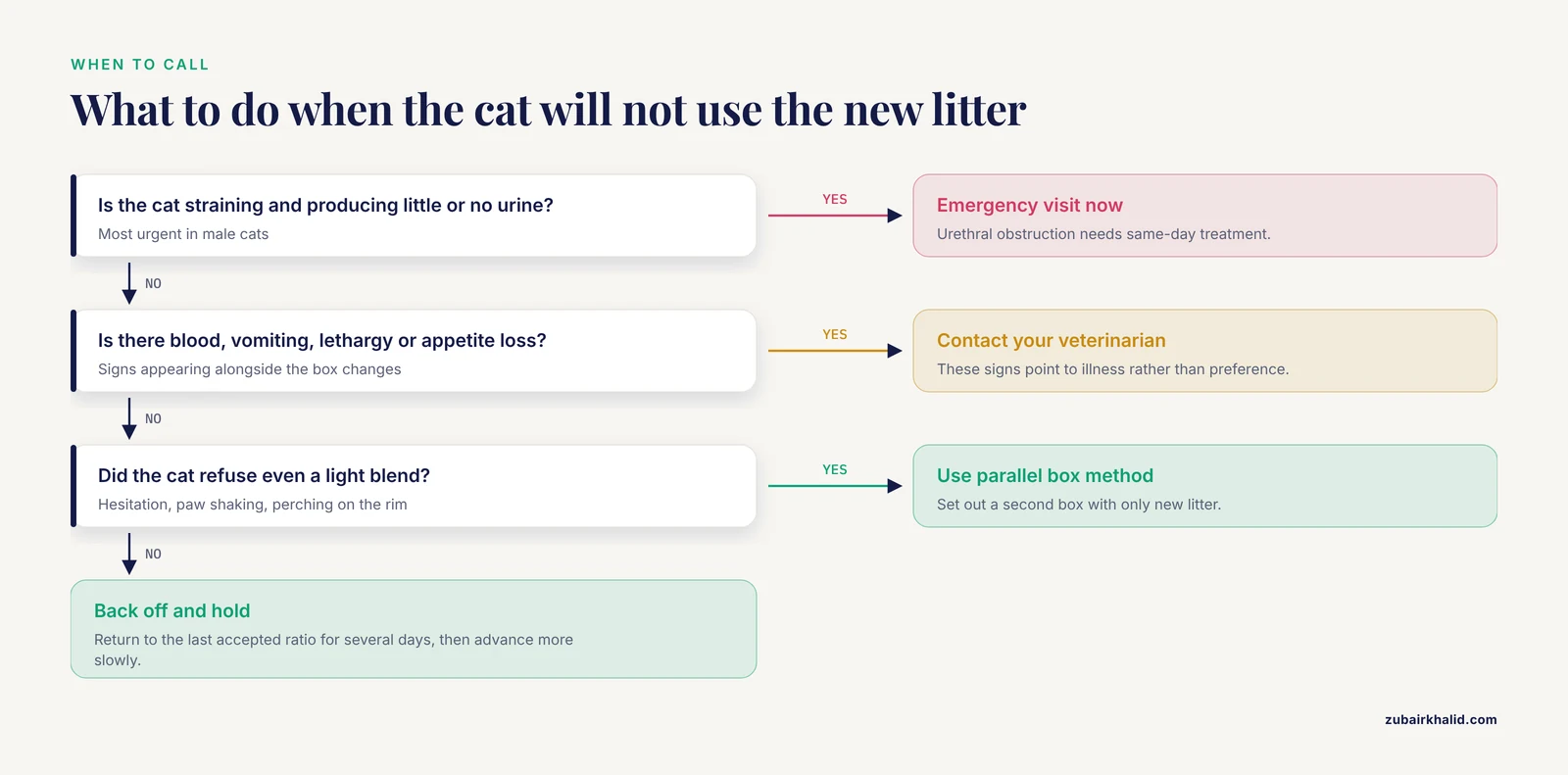
Read the early warning signs. Hesitation at the entrance, shaking or flicking paws after stepping in, digging that stops abruptly, perching on the rim, or small deposits beside the box all signal discomfort. Slow the plan at the first sign rather than waiting for a full accident.
Rule out medicine before blaming behavior. Any cat that stops using the box needs a veterinary examination before the problem is treated as purely behavioral, because urinary disease, constipation, and pain commonly present as litter refusal. This matters most in male cats, where straining with little or no urine is an emergency.
Back off and restart. If accidents happen, return to the last ratio the cat accepted and hold it for several days, then advance more slowly. If the cat refused even a light blend, restart with the parallel box method instead of mixing.
Consider the multi-cat picture. Make sure one cat is not guarding the box being transitioned. Extra boxes in separate rooms remove the opportunity for ambush and often solve the problem on their own.
When the preference wins. If a slow, well-run transition still fails after two to three weeks, the cat may simply prefer the old product. Try a different texture category rather than forcing the same one again. Persistent house soiling despite a correct setup warrants a veterinary exam and possibly a referral to a veterinary behavior professional.
Litter Box Habits and Cat Preventive Care
The litter box is the most sensitive daily health monitor in your home. Cats hide illness, and changes in urine clump size, visit frequency, stool consistency, or box behavior are often the first visible signs that something is wrong. Building a simple cat health checklist around the box turns a daily chore into genuine cat preventive care.
The preventive side is straightforward. The American Animal Hospital Association and the American Veterinary Medical Association recommend at least one wellness examination every year for healthy adult pets, with more frequent visits for seniors and pets with health conditions. The Companion Animal Parasite Council recommends fecal testing at least once a year for healthy adult cats, more often for kittens, and notes that Toxoplasma gondii oocysts shed in feces need time in the environment before they become infectious, so scooping daily also protects the people in the house.
Hygiene matters for owners as well as cats. The AVMA advises people who are pregnant or immunocompromised to have someone else change the litter box when possible, and otherwise to wear gloves and wash their hands thoroughly afterward.
| Frequency | Checklist task |
|---|---|
| Daily | Scoop all boxes, glance at urine and stool volume and consistency, note any hesitancy, crying, or extra visits |
| Weekly | Top up litter to the right depth, wipe the rim, count your boxes against the one-per-cat-plus-one rule |
| Monthly | Full litter change on the schedule the product and your veterinarian recommend, wash the box with mild unscented soap |
| Every 6 to 12 months | Wellness exam, weight and dental check, fecal test per your veterinarian's schedule, vaccine review |
| Ongoing | Watch for straining, blood, constipation, or accidents, and call your veterinarian when any of them appear |
Safety and Welfare Points During the Switch
- Choose low dust options, and ask your veterinary team before switching litters for a cat that coughs, sneezes, or has diagnosed respiratory disease.
- Keep litter bags and cleaning products stored away from curious paws, since kittens in particular investigate with their mouths.
- Give seniors a low entry box in an easy location, because reduced mobility is a common hidden reason for box avoidance.
- Never trap a cat in a box or force its paws into the litter. This reliably worsens aversion.
- Wash your hands after box chores, and follow the pregnancy and immunocompromise precautions above.
Limitations and When to Contact a Veterinarian
Every cat is an individual, and a transition that looks textbook on paper can stall in a particular home. Use this plan as a framework and involve your veterinary team whenever the picture is unclear.
Contact your veterinarian promptly, or seek emergency care, in these situations:
- A cat, especially a male, that repeatedly enters the box, strains, cries, and produces little or no urine. Urethral obstruction is a life-threatening emergency that needs same-day treatment.
- Blood in the urine or stool, or urine marked by frequent small visits.
- No bowel movement for more than 48 to 72 hours, or repeated unproductive straining to defecate.
- Vomiting, lethargy, or appetite loss appearing alongside the box changes.
- Accidents that continue more than about 48 hours after you fully revert to the previous litter.
- Box avoidance that persists beyond two to three weeks despite a slow restart and a correct setup.
- New reluctance to step into the box, limping, or stiffness, which can reflect arthritis rather than litter preference.
- Any cat with known urinary, kidney, gastrointestinal, or mobility disease, or a cat on a prescribed litter, should have litter changes approved by the treating veterinarian first.
Frequently Asked Questions
How long does it take to transition a cat to a new litter?
Most cats accept a new litter within 7 to 10 days of gradual blending, while cautious, senior, or multi-cat households may need two to four weeks. Let your cat's behavior set the pace.
Can I switch cat litter all at once?
You can, and some cats tolerate it, but an abrupt swap is the most common trigger for litter refusal. A gradual blend is the safer default unless your veterinarian directs an immediate change for medical reasons.
What is the best way to introduce a new litter step by step?
Blend old and new litter in stages over about a week, starting mostly old and ending all new, while keeping the box location and daily routine unchanged. Scoop twice daily and pause at any stage where your cat hesitates.
Why did my cat stop using the litter box after I changed the litter?
The most likely cause is an aversion to the new texture or scent, but medical problems such as urinary disease or constipation can also show up as box refusal. Revert to the old litter and have your veterinarian examine any cat that keeps avoiding the box.
What type of litter do most cats prefer?
Most cats prefer unscented, fine-textured litter, and many adults like clumping formulas. Individual preference varies, so watch how your cat responds rather than assuming any single type is universal.
How many litter boxes should I have during a transition?
Keep one box per cat plus one extra. During a switch, an additional box containing only the new litter gives your cat a choice and reduces pressure in multi-cat homes.
Is it safe to change the litter box while pregnant?
Pregnant people should have someone else change the litter when possible. If that is not an option, wear gloves, scoop daily, and wash your hands thoroughly afterward, because cat feces can carry Toxoplasma gondii.
When should a litter box problem become a veterinary visit?
Call your veterinarian if your cat strains with little or no urine, which is an emergency, or if you see blood, repeated vomiting, constipation, or accidents that continue more than about two days after you return to the old litter.