How to Transition Your Cat to a New Food
By Dr. Zubair Khalid, DVM, MS, PhD ·
The safest way to switch a cat to a new food is gradually, over roughly 7 to 10 days, by mixing an increasing proportion of the new food with the old food while watching stool quality, appetite, and behavior every day. A slow transition gives the digestive tract and the gut bacteria time to adapt, and it gives a picky cat time to accept a new smell and texture before the old food disappears entirely.
Some cats need more time. A slow transition is not just about the food itself. Research in domestic cats shows that changing the diet changes the population of bacteria living in the intestines, and that these bacterial communities settle into diet-specific patterns over a period of weeks rather than days [1]. That is one reason a rushed switch often ends in loose stool, refusal to eat, or both.
This article walks through how to switch cat food step by step, offers practical tips, lists the mistakes owners make most often, and explains when a food change needs veterinary supervision.
This article is educational and is not a substitute for veterinary diagnosis or treatment.
At a Glance: A 10-Day Transition Plan
Use this schedule as a starting point. If your cat develops soft stool, vomits, or refuses meals at any stage, hold at the current ratio for an extra two to three days or drop back one step before moving forward again.
| Days | Old Food | New Food | What to Watch |
|---|---|---|---|
| 1 to 3 | 75% | 25% | Appetite, stool quality, energy level |
| 4 to 6 | 50% | 50% | Stool quality, any vomiting or gas |
| 7 to 9 | 25% | 75% | Consistent eating of both portions |
| 10 onward | 0% | 100% | Weight, coat, stool over the following weeks |
Before day 1, confirm three things: the new food is complete and balanced for your cat's life stage, your veterinarian agrees the change is appropriate for your cat's health status, and you have enough of the old food on hand to extend the transition if needed.
Why a Gradual Transition Matters
Cats are creatures of habit, and their digestive systems are too. Two separate processes need to adjust when the food changes.
The first is the gut microbiome. In a controlled feeding study, cats moved from a wet diet to a dry diet showed distinct, diet-specific shifts in their fecal bacterial populations, with the two dietary periods producing clearly different bacterial profiles [1]. A sudden change forces these communities to reorganize overnight, which commonly shows up as diarrhea or soft stool. A gradual mix lets the shift happen incrementally.
The second is acceptance. Cats learn what "food" smells and feels like early in life, and many respond to an unfamiliar diet with suspicion rather than curiosity. Studies of new diets in cats routinely build in adaptation periods of a week or more before measuring whether the animals will eat and digest the food properly [2]. Household cats deserve the same runway.
There is also a diagnostic benefit to going slowly. If you change everything at once and your cat becomes ill, you will not know whether the new food caused the problem. A gradual switch makes cause and effect much easier to read.
How to Switch Cat Food Step by Step
Step 1: Talk With Your Veterinarian First
For a healthy adult cat moving between two complete maintenance diets, a phone call or a brief mention at a routine visit is usually enough. For cats with existing medical conditions, the conversation comes first and the food choice comes second.
Diet is a genuine medical tool in cats. Therapeutic diets have been shown to improve chronic diarrhea in cats, with both of the gastrointestinal prescription diets tested in one trial producing significant improvement in fecal scores over a four-week period [3]. A psyllium-enriched gastrointestinal diet was studied over six months for chronic constipation, and that trial allowed cats to switch diets if signs did not improve or the food was not tolerated [4]. In cats with idiopathic hypercalcemia, switching to specific high-moisture prescription diets was used as the first treatment step, with a six-week trial period before escalating to other therapies [5].
What this means for you: if the new food is being chosen to manage a condition, your veterinarian should select or approve it, set the trial length, and define what improvement looks like. Cats with chronic diseases such as diabetes deserve particular caution, because illness and metabolic instability change what and how a cat should eat, and a cat that stops eating while unwell can deteriorate quickly [6].
This step is also a natural fit for your broader cat preventive care routine. Diet reviews belong on the same cat health checklist as annual examinations, dental assessments, and parasite prevention, and the transition itself is easier when your cat is otherwise healthy.
Step 2: Choose the Right New Food
Look for a diet that is complete and balanced for your cat's life stage, made by a manufacturer with quality control you can verify, and appropriate for any medical needs your cat has. Your veterinarian can help you compare options.
A few points from the veterinary literature worth knowing as you evaluate choices:
- Wet versus dry. Both formats can be nutritionally complete. They differ in moisture content and in their effects on the gut, as the fecal bacterial study above demonstrated [1]. Hydration matters for cats, and research has shown that increasing water intake in cats lowers urine specific gravity and urine calcium concentration, changes associated with better urinary tract health [7]. Many veterinarians favor including wet food for this reason, though the right mix depends on your cat.
- Home-prepared diets. Some owners choose to cook for their cats, often motivated by memories of pet food recalls or a desire for more control. Veterinary reviews of home-prepared diets emphasize that they carry real risks, including nutrient imbalances, unless they are formulated and monitored properly [8]. If this is your direction, do it with a veterinary nutritionist, not from an internet recipe.
- Raw diets. Raw meat-based diets are popular, but veterinary reviews highlight the potential for nutrient imbalance, the need for precise calcium to phosphorus ratios in growing animals, careful taurine monitoring in cats, the risk of thyroid tissue contamination in neck cuts, and the possibility of bacterial or parasitic contamination [9]. If you are considering raw feeding, involve your veterinarian and, ideally, a board-certified nutritionist before you transition.
- Novel proteins and new formats. Emerging ingredients are being studied for acceptance and digestibility in cats, and early research uses careful cross-over designs with adaptation periods to confirm that cats will eat and digest a novel diet well [2]. This is a reminder that any truly new protein source deserves the same measured transition as any other new food.
Step 3: Gather Your Supplies
You need very little, but a few choices make the process smoother:
- Enough of the old food to extend the transition beyond 10 days if your cat needs a slower pace.
- A dedicated measuring cup or kitchen scale so your ratios are real rather than estimated.
- Separate bowls or one adequately sized bowl if you plan to mix foods, so the mixture is not crowded.
- A food diary or notes app for tracking what was eaten and what the stool looked like each day.
On bowls specifically, you may have heard that deep dishes cause whisker stress and that wide "whisker-friendly" dishes help. A study of forty indoor cats compared a commercially advertised whisker-friendly dish with each cat's normal dish and found no difference in time spent eating, amount of food dropped, or amount eaten, although about three quarters of the cats showed a preference for the new dish when both were offered [10]. The practical takeaway: bowl shape matters far less than consistency and cleanliness, but there is no harm in offering a shallow dish if your cat seems reluctant at the bowl.
Step 4: Start the Mixing Schedule
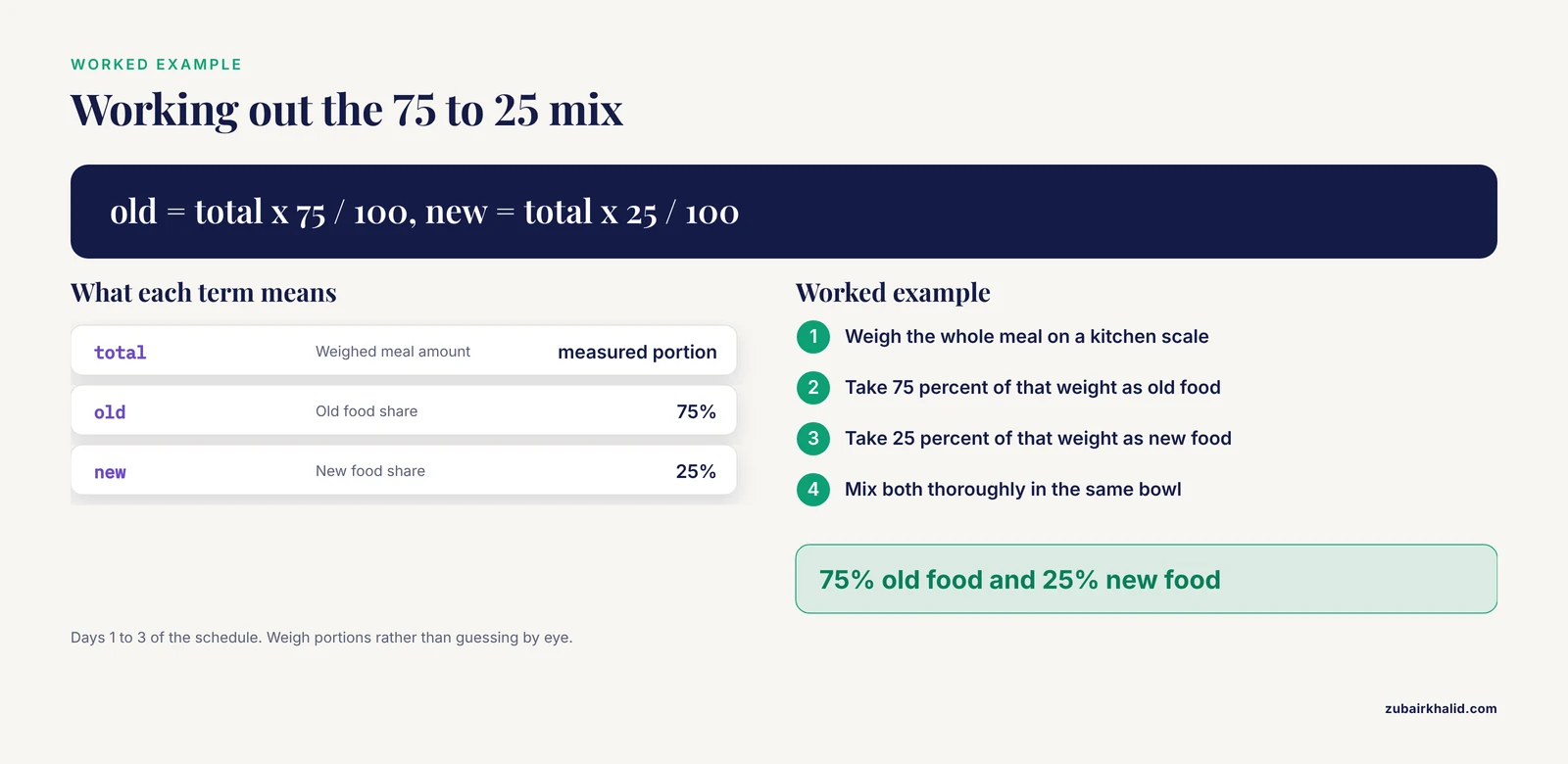
Follow the table above. Mix the two foods thoroughly in the same bowl so your cat cannot simply eat around the new portion. For wet foods, mixing works best when both components are at a similar temperature. For dry foods, combine them in the storage container over a day or two so the scents blend.
Weigh or measure each portion. Guessing by eye is unreliable, and this is a known problem in feline feeding more broadly. In a survey of cat caregivers, 66 percent said they monitored their pet's treat intake, but the most common method, used by 41 percent of respondents, was an eyeball estimate rather than any actual measurement [11]. The same habit undermines food transitions. Measured portions are how you know the ratios in your plan are the ratios in the bowl.
Step 5: Use Positive Associations
Food transitions go better when the new food arrives in a good mood rather than a confrontation. Cats learn quickly when food rewards are involved, and research using food-based rewards has documented strong motivation and fast, consistent learning in cats [12]. Practical ways to use this:
- Offer the first taste of the new food as a small separate portion when your cat is calm and hungry, before it ever appears mixed in the main meal.
- Pair mealtime with calm attention, a familiar routine, and the same feeding location.
- Never force the issue by holding the bowl or pushing the cat's face toward the food. That creates avoidance, not acceptance.
Step 6: Keep Treats Under Control During the Transition
Treats are where many transitions quietly fail. If a cat fills up on treats, it has less appetite for the meal that contains the new food, and the transition stalls.
The treat research is worth knowing here. In the caregiver survey cited above, respondents interpreted the word "treat" in very different ways, and those interpretations influenced how many treats they gave. The human-animal bond, the feeling that treats express love, was a major driver of treat-giving behavior [11]. That impulse is understandable, but during a transition, treats compete directly with the new diet.
Set a rule before day 1: treats come from the new food itself, in small pieces, or they are paused until the transition is complete. If you use treats for medication or training, account for them in the daily portion.
Step 7: Monitor Daily and Adjust the Pace
Each day, record three things:
- Appetite. Did your cat eat the mixed meal within a normal timeframe?
- Stool. Firm and formed is the goal. Soft stool means slow down.
- Behavior. Lethargy, hiding, vocalizing at the bowl, or vomiting all warrant attention.
Some cats sail through in ten days. Others need three to four weeks. Both are fine. The schedule serves the cat, not the other way around.
How to Switch Cat Food: Tips That Make It Easier
- Warm wet food slightly. Room temperature food smells stronger than refrigerator-cold food, and scent drives feline appetite. A few seconds in the microwave or a brief soak of the sealed pouch in warm water helps.
- Top-dress, then mix. If your cat refuses a full mix, sprinkle a small amount of the new food on top of the familiar food for a day or two so it becomes a known smell before it becomes a known meal.
- Feed to appetite, not to the plan. If your cat eats only the old portion out of a mixed meal on day 4, that is information. Hold the ratio steady rather than progressing.
- Keep mealtimes consistent. Same time, same place, same bowl. Novelty in the food is enough change for one transition.
- Do not leave new food sitting out all day. Wet food should be picked up after a reasonable period for food safety, and scheduled meals make appetite easy to read.
- Transition one thing at a time. If you are also changing bowls, feeding locations, or adding supplements, stagger the changes so you can tell what is bothering your cat.
Common Mistakes When Switching Cat Food
Switching cold turkey. The single most common error. Some cats tolerate an abrupt change, but many develop diarrhea or refuse the unfamiliar food outright, and a cat that is already hesitant about the new diet has now also learned that mealtime is unpredictable.
Progressing on schedule despite soft stool. The calendar in the At a Glance table is a template, not a contract. Loose stool is a signal to pause or step back, not to push through.
Free-feeding through the transition. If dry food sits out all day, you cannot tell how much of each diet your cat actually ate, and a picky cat can simply avoid the new kibble indefinitely. Scheduled meals make a transition measurable.
Letting treats and table food fill the gap. As the treat survey showed, many caregivers give treats generously and estimate the amounts by eye [11]. During a transition this undermines the whole plan.
Changing the food to fix a problem without a diagnosis. Vomiting, diarrhea, weight loss, or poor coat can have many causes. Diet trials are legitimate tools, as the therapeutic diet studies show [3][4], but they work best with a diagnosis or at least an examination first, and with defined endpoints.
Choosing a home-prepared or raw diet without professional formulation. Both approaches carry documented risks of nutrient imbalance and, for raw diets, microbial contamination [8][9]. Enthusiasm is not a substitute for a formulated recipe and veterinary oversight.
Giving up after one refusal. Cats often need repeated, low-pressure exposure to accept a new food. One refusal at one meal is not a verdict. Repeated total refusal is.
Troubleshooting a Difficult Transition
My cat picks out the old food. Mix more thoroughly, moisten the mixture so the pieces stick together, or drop back to a smaller proportion of new food and progress more slowly.
My cat skips a meal entirely. Skip one meal, then offer the same mixture again. A healthy adult cat missing a single meal is not an emergency, but do not get into a standoff. If refusal continues, step back to a ratio your cat accepted and progress from there.
My cat develops soft stool. Hold the current ratio for two to three extra days. If stool does not firm up, return to the previous ratio that produced normal stool. Persistent diarrhea beyond a few days, or diarrhea with blood, lethargy, or vomiting, needs a veterinary visit. Remember that chronic diarrhea itself can be managed with dietary therapy, and that controlled studies have documented significant improvement in cats with chronic diarrhea switched to gastrointestinal diets [3], so a diet change under veterinary guidance may be part of the solution rather than the cause.
My cat refuses everything for more than a day. Call your veterinarian. Food refusal in cats is never something to wait out indefinitely, and it matters more in overweight cats, in cats with known medical conditions, and in kittens.
My cat begs for the old food but eats the new food when it is the only option. This is common and usually behavioral rather than digestive. Hold firm with measured portions, provided your cat is eating and acting normally.
Special Situations
Kittens. Growing kittens have specific nutritional requirements, including precise calcium to phosphorus balance, which is one reason unbalanced diets are singled out as risky for young animals [9]. Any diet change in a kitten should use a complete kitten formulation and should be discussed with your veterinarian.
Cats with chronic constipation. Fiber content matters, and a controlled six-month trial of a psyllium-enriched gastrointestinal diet documented its use for chronic constipation, with defined criteria for when a diet was considered to have failed and a switch was warranted [4]. If you are transitioning to or from a therapeutic fiber diet, follow your veterinarian's plan rather than a generic schedule.
Cats with urinary or metabolic concerns. Hydration influences urinary health, and research has shown that increasing water intake in cats lowers urine specific gravity and urine calcium concentration [7]. If the reason for your switch involves urinary health, ask your veterinarian how wet food, water access, and the new diet should fit together.
Cats on medication or with chronic disease. Diet interacts with disease management, and cats with conditions such as diabetes need coordinated veterinary oversight of what they eat and when [6]. Never transition a cat with a chronic illness to a new diet without telling your veterinarian.
Monitoring After the Transition
The transition does not end on the day the bowl contains only new food. Gut bacterial communities continue to shift over weeks after a diet change [1], so the first two to four weeks on the completed diet are your real evaluation window.
Watch for:
- Consistent, well-formed stool
- Stable body weight
- Good appetite without begging or refusal
- Normal energy and grooming
- Healthy coat quality
For therapeutic diets, follow the recheck schedule your veterinarian sets. Published diet trials in cats used defined evaluation points, with constipation scored at intervals through a six-month study [4] and hypercalcemia rechecked after roughly six weeks of dietary therapy before treatment was escalated [5]. Your recheck plan should be just as concrete.
Limitations and When to Contact a Veterinarian
Every cat is an individual, and the schedules in this article are starting points rather than prescriptions. Your veterinarian, who knows your cat's history, body condition, and diagnoses, is the right person to tailor them.
Contact your veterinarian promptly, and do not simply continue the transition, if any of the following occur:
- Complete refusal of all food for more than 24 hours
- Vomiting more than once, or vomiting with lethargy
- Diarrhea lasting more than two to three days, or any diarrhea with blood
- Signs of pain, hunching, hiding, or vocalization at the litter box
- Weight loss or a noticeable drop in water intake
- Any worsening of a known chronic condition during the switch
Seek urgent care if your cat is lethargic, unresponsive, repeatedly vomiting, or showing signs of distress.
Frequently Asked Questions
How long does it take to switch a cat to a new food?
Most cats transition successfully in 7 to 10 days using a gradual mixing schedule. Sensitive cats, senior cats, and cats with gastrointestinal history may need three to four weeks. Let stool quality and appetite set the pace.
Can I just switch my cat's food all at once?
You can, but it is the approach most likely to cause diarrhea or total refusal. Some cats handle an abrupt change, and an abrupt switch may be unavoidable in a true shortage, but a gradual mix is the safer default for nearly every cat.
My cat refuses the new food. What should I do?
Drop back to the last ratio your cat ate reliably, warm the wet food slightly, mix more thoroughly, and progress more slowly. Persistent refusal of all food for more than a day is a reason to call your veterinarian rather than wait it out.
Is it safe to mix old and new food in the same bowl?
Yes, and mixing thoroughly is exactly how the gradual transition works. Some picky cats sort around the new food, in which case moistening the mixture or using a smaller proportion of new food helps.
Do I need a slow transition between flavors of the same brand?
Usually a shorter transition is fine when the formula base is similar, but treat any change in protein source or formula as a real switch and use at least a few days of mixing, especially for cats with sensitive stomachs.
Should I add water or broth to help my cat accept the new food?
Warming wet food and adding a small amount of warm water to release aroma often helps acceptance. Ask your veterinarian before adding anything with sodium, onion, or garlic, and skip any additive that is not intended for cats.
How does switching food fit into my cat's preventive care routine?
Diet belongs on your cat health checklist alongside regular examinations, dental care, and parasite prevention. Review the diet at each wellness visit, weigh your cat at least a few times a year, and make major diet changes with your veterinarian's input.
When should I call my veterinarian during a food transition?
Call if your cat refuses all food for more than 24 hours, vomits repeatedly, has diarrhea lasting beyond two to three days or containing blood, or seems painful or lethargic. Cats with chronic conditions should have their transitions planned with the veterinarian from the start.
This article is educational and is not a substitute for veterinary diagnosis or treatment. Always consult your veterinarian about your individual cat's diet and health.
Sources
- Five-week dietary exposure to dry diets alters the faecal bacterial populations in the domestic cat (Felis catus).
- Can cultivated hamster cells compete with chicken meat? Insights on acceptance and digestibility in domestic cats.
- Evaluation of canned therapeutic diets for the management of cats with naturally occurring chronic diarrhea.
- A psyllium-supplemented gastrointestinal diet is effective for the management of chronic constipation in cats: a 6-month controlled clinical trial.
- Managing Feline Idiopathic Hypercalcemia With Chia Seeds (Salvia hispanica L.): A Case Series.
- Remission of diabetes mellitus induced by prednisolone in combination with cyclosporine toxicity in a cat.
- Increased Water Viscosity Enhances Water Intake and Reduces Risk of Calcium Oxalate Stone Formation in Cats.
- Focus on nutrition: Home-prepared diets for dogs and cats.
- Raw diets for dogs and cats: Potential health benefits and threats.
- Evaluation of whisker stress in cats.
- Cat caregivers' perceptions, motivations, and behaviours for feeding treats: A cross sectional study.
- The use of a T-maze to measure cognitive-motor function in cats (Felis catus).