How to Read a Cat Food Label
By Dr. Zubair Khalid, DVM, MS, PhD ·

Reading a cat food label means working through six fixed panels in order: the product name, the nutritional adequacy statement, the guaranteed analysis, the ingredient list, the calorie statement and feeding guide, and the manufacturer's identification. Each panel answers a different question about what you are buying, and together they tell you whether a food is complete for your cat's life stage, how many calories it actually delivers, and who is responsible for making it. This guide walks you through cat food label interpretation panel by panel, explains the numbers in plain language, and shows how the label fits into a broader cat preventive care routine.
How to Read a Cat Food Label: The Six Panels
In the United States, pet food labeling follows a standardized format. State feed regulators adopt model rules developed by the Association of American Feed Control Officials (AAFCO), and the US Food and Drug Administration enforces federal labeling requirements for pet food. Because the format is standardized, once you learn where each piece of information lives, you can compare any two products side by side in a few minutes.
The Product Name and What It Actually Promises
The front of the bag or can is the least regulated-feeling part of the label, but even the product name follows rules. Under the model rules most states adopt, how an ingredient appears in the name tells you something about how much of it the food contains.
- A name like "Chicken Cat Food" generally means the named ingredient makes up a very large share of the product by weight.
- A name like "Chicken Dinner," "Chicken Formula," or "Chicken Recipe" signals a lower minimum of the named ingredient than the first example.
- A phrase like "With Chicken" indicates an even smaller amount.
- A word like "Flavor" means the food only needs to be detectable as tasting like that ingredient, not contain a meaningful quantity of it.
The practical takeaway is that a can labeled "Tuna Dinner" is not a can of tuna. The product name is a marketing surface governed by minimum thresholds, not a description of the full recipe. The ingredient list and the guaranteed analysis on the back tell you far more.
The Nutritional Adequacy Statement
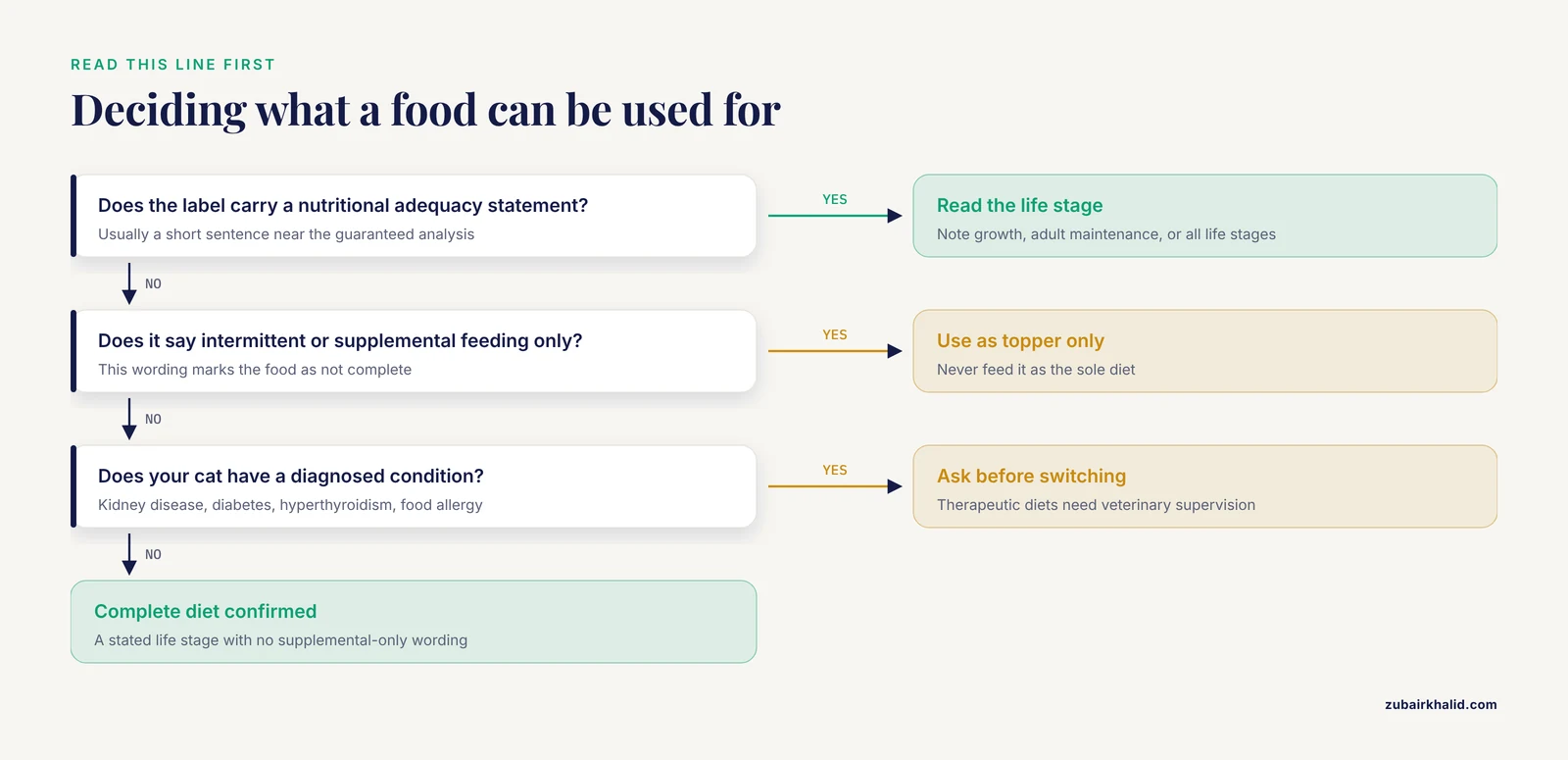
This short sentence, usually tucked near the guaranteed analysis, is the single most important line on the label. It states which life stage the food is designed to support, for example:
- "Formulated to meet the nutritional levels established for growth," meaning kittens.
- "For adult maintenance," meaning healthy adult cats.
- "For all life stages," meaning the food meets the requirements for both growth and maintenance.
- "For intermittent or supplemental feeding only," meaning the food is not nutritionally complete and should not be the sole diet.
A statement of "complete and balanced" means the food either was formulated to meet established nutrient profiles or passed a feeding trial protocol that fed the formula to animals and measured outcomes. The distinction matters. A formulation-based claim is a paper exercise against a nutrient profile. A feeding trial claim involves actual feeding. Both are legitimate paths to the claim, and your veterinarian can help you weigh them for a cat with specific health needs.
If the adequacy statement is missing, or if it says the product is for intermittent or supplemental feeding only, treat the product as a topper, treat, or supplement rather than a main diet.
The Guaranteed Analysis
The guaranteed analysis lists minimum percentages of crude protein and crude fat, and maximum percentages of crude fiber and moisture. The word "crude" refers to the laboratory method used to measure the nutrient, not to the quality of the nutrient. A crude protein number says nothing about how digestible that protein is for a cat.
Four numbers deserve your attention:
- Crude protein. Cats are obligate carnivores with a high dietary protein requirement, so this number is a useful first screen.
- Crude fat. Fat supplies concentrated calories and essential fatty acids.
- Crude fiber. Relevant to hairball management and stool quality in some cats.
- Moisture. This is the number most owners overlook, and it is the key to comparing wet and dry foods, which the next section covers.
Some labels also list taurine, an essential amino acid for cats, along with other nutrients such as omega fatty acids, glucosamine, or minerals. Taurine listing is worth looking for because cats cannot synthesize enough of it from precursors and depend on dietary sources.
The Ingredient List
Ingredients appear in descending order by weight before cooking. Two quirks of this system trip up nearly everyone learning how to read a cat food label.
First, weight includes water. A fresh chicken ingredient that is 70 percent water by weight can outrank a dry ingredient that contributes far more actual nutrients. This is why a wet food can legitimately list a meat first and still not be overwhelmingly meat on a dry matter basis, and why comparing raw ingredient order across a wet food and a dry food is misleading.
Second, manufacturers can split a family of related ingredients, such as different forms of corn or rice, into separate entries. Split ingredients each rank lower on the list individually, but their combined weight can rival or exceed the first named ingredient. If you see peas, pea protein, pea fiber, and pea starch listed separately, adding their positions mentally gives a more honest picture of the recipe.
The ingredient list tells you what is in the food. It does not tell you the quality of the ingredients, the digestibility of the finished product, or whether the formula was verified in actual feeding. Two diets can have nearly identical ingredient statements and nutrient profiles yet perform differently in the body. A controlled feline trial comparing a diet built on cultivated hamster cell biomass against an identical formula built on chicken breast meat found that, despite matching nutritional profiles on paper, the researchers still had to run a dedicated digestibility trial with fecal collection to confirm the new protein source performed comparably, and acceptance was optimal in 9 of 10 cats [1]. That study is a useful reminder that the ingredient list is a starting point, not a verdict.
The Calorie Statement and Feeding Guide
Somewhere on the package, usually near the guaranteed analysis, you will find the calorie content expressed as kilocalories of metabolizable energy per kilogram of food, and in a familiar unit such as per cup for dry food or per can for wet food. This is the number that should drive portion decisions. Two foods with similar guaranteed analyses can differ substantially in calorie density, and a "cup" of one food can deliver far more energy than a cup of another.
The feeding guide below the calorie statement gives a starting amount by body weight. Use it as exactly that, a starting point. Individual cats vary in metabolism, activity, and body condition, and the guide on the bag cannot account for your specific animal. Weigh your cat regularly, evaluate body condition with your veterinary team, and adjust the amount in small steps.
Manufacturer Identification, Dates, and Lot Codes
The last panel most owners skip is the one worth knowing in an emergency. Look for:
- The name and address of the manufacturer or the responsible party. A label that says "manufactured for" or "distributed by" names a marketer, not the facility that made the food. If you ever need to trace a problem, knowing the actual manufacturer matters.
- A best-by or best-before date.
- A lot code, which is the identifier used in recalls.
Keep the bag or can after opening until the food is finished. If a recall is announced, the lot code on the package is how you determine whether your specific batch is affected. The FDA maintains searchable recall notices on its website, and checking there is more reliable than relying on social media posts.
Label Panels at a Glance
| Panel | The question it answers | What to look for |
|---|---|---|
| Product name | How much of the featured ingredient is present | "Chicken" versus "chicken dinner" versus "chicken flavor" |
| Nutritional adequacy statement | Is this a complete diet, and for whom | A life stage claim, and no "supplemental feeding only" wording |
| Guaranteed analysis | What nutrient levels does it guarantee | Protein, fat, fiber, and especially moisture |
| Ingredient list | What went into the food, by pre-cooking weight | Named protein sources early, awareness of ingredient splitting |
| Calorie statement | How energy-dense is the food | kcal per cup or per can, not just per kilogram |
| Feeding guide | Where do I start with portions | A starting point to adjust against your cat's body condition |
| Manufacturer and dates | Who made it and when does it expire | Actual manufacturer name, best-by date, lot code |
Comparing Wet and Dry Food on the Same Scale
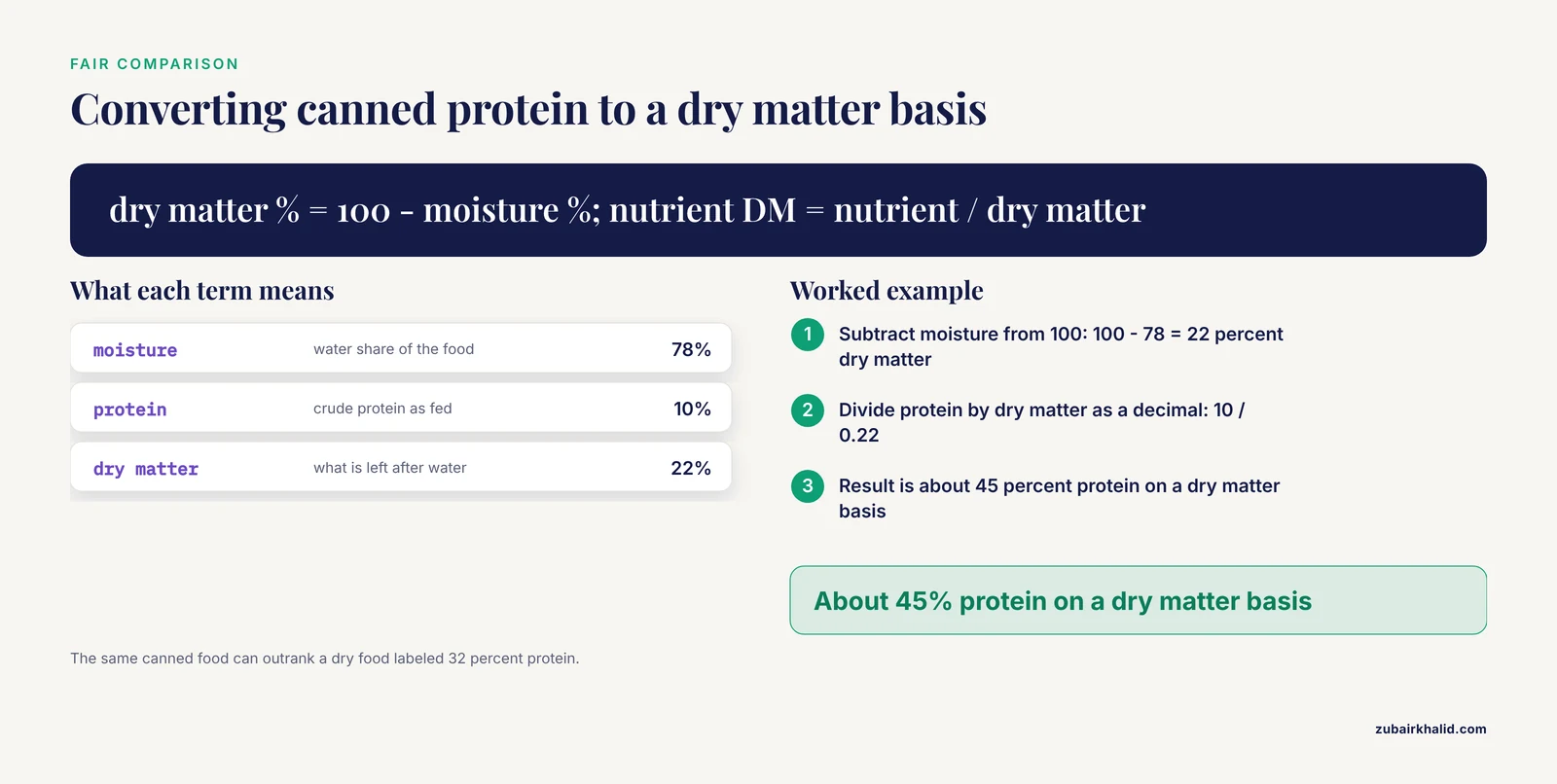
Cat food label interpretation gets genuinely useful when you learn one piece of arithmetic. Guaranteed analysis numbers are expressed on an as-fed basis, meaning they include the water in the food. Canned foods typically run 70 to 80 percent moisture, while dry foods run around 10 percent. A canned food showing 10 percent crude protein is not lower in protein than a dry food showing 32 percent, because the canned figure is diluted by all that water.
To compare fairly, convert to a dry matter basis. Subtract the moisture percentage from 100 to get the dry matter percentage, then divide each nutrient by that figure. A canned food with 78 percent moisture and 10 percent crude protein has 22 percent dry matter, so its protein on a dry matter basis is 10 divided by 0.22, roughly 45 percent. Once both foods are on the same basis, the comparison becomes meaningful.
This single calculation resolves the most common confusion in cat food label reading. It also explains why a wet food and a dry food from the same product line can look wildly different on the bag yet be formulated to similar nutritional targets.
Treats, Toppers, and How Perception Shapes the Bowl
The main label tells you about the main diet, but what lands in the bowl also includes everything else. Treat feeding deserves explicit attention because research shows that how owners think about treats strongly influences how many they give. In a survey of 337 cat caregivers, mostly from Canada and the United States, respondents held varying interpretations of the word "treat" and of how treats relate to the primary diet, and those perceptions appeared to influence the quantities they fed [2]. Aspects of the human-animal bond, such as using treats as an expression of affection, emerged as an important driver of treat-giving behavior [2].
Two findings from that study are directly relevant to label reading. First, while 66 percent of respondents said they monitored their cat's treat intake, the most common method by far, used by 41 percent, was an eyeball estimate rather than any measurement [2]. Eyeballing is precisely the habit that lets treat calories accumulate invisibly. Second, the study's authors note that feeding practices surrounding treats have the potential to cause nutrient imbalances and adverse health outcomes, including obesity [2].
The label connection is this. Treat packages carry their own guaranteed analysis and calorie statements, and most owners never read them. Reading the treat label the way you read the food label, and measuring treats instead of estimating them, converts an untracked variable into a controlled one. Ask your veterinary team what share of daily calories treats should occupy for your cat, since the right figure depends on the cat's weight, body condition, and any medical diet in use.
When the Label Ends: Homemade Diets and Mistrust of the Industry
Some owners respond to pet food recalls or distrust of commercial pet food by leaving labeled products altogether and preparing food at home, whether raw or cooked. This decision has understandable motivations and real consequences that the label cannot manage, because a homemade bowl has no adequacy statement, no guaranteed analysis, and no feeding trial behind it.
Veterinary nutrition literature frames this plainly. Over the past decade, highly publicized pet food recalls and growing owner awareness of diet's role in health have changed how some owners approach feeding, and many now advocate home-prepared foods as the sole source of nutrition, citing perceived health benefits or mistrust of the pet food industry [3]. Practitioners are urged to understand both the risks and benefits of home-prepared diets and the motivation behind the owner's choice, because a diet formulated without professional input can be chronically unbalanced in ways that take months or years to surface clinically [3].
For owners considering this route, the label lesson is instructive rather than discouraging. Everything a commercial label guarantees, amino acid levels, mineral ratios, vitamin content, caloric density, is a promise you would have to recreate yourself, ideally with a formulation reviewed by a veterinarian or a board-certified nutritionist. If you already feed homemade food, bring the recipe to your veterinarian for review as part of routine preventive care.
Novel Ingredients on the Label: What the Front Cannot Tell You
Sustainability pressures are bringing new protein sources to market, and those ingredients will increasingly appear on cat food labels with names unfamiliar to most owners. Cultivated meat, grown from cell cultures rather than raised animals, is one example. In the feline trial described above, the cultivated hamster cell diet and the chicken-based control diet were identical in ingredient composition except for the protein source, and were formulated to comparable nutritional profiles [1]. The researchers measured apparent total tract digestibility using a cross-over design with a 7 to 12 day adaptation period followed by 5 days of fecal collection, and used an indigestible marker to calculate nutrient absorption [1].
For the average owner scanning a shelf, the relevant lesson is not about cultivated meat specifically. It is that a novel-sounding ingredient name on a label carries no inherent information about digestibility, acceptance, or nutritional adequacy. Those properties are established by formulation and testing, not by the ingredient's origin or its position in the marketing copy. When a food built on an unfamiliar protein interests you, look past the front panel to the adequacy statement, and discuss the choice with your veterinarian, especially for a cat with a sensitive digestive tract or existing disease.
Where Labels Fit in a Cat Preventive Care Checklist
Label reading is one habit inside a larger preventive framework. Veterinary wellness guidelines, including the AAHA wellness guidelines, emphasize regular preventive care visits and individualized health planning for cats. A practical cat health checklist that puts label reading in context includes:
- Choose a complete and balanced diet appropriate to your cat's life stage, confirmed by reading the adequacy statement rather than the front of the package.
- Know the calories. Record the kcal per cup or per can, and use the feeding guide as a starting point, not a rule.
- Measure everything, including treats. Eyeball estimation is the most common method owners use and the least accurate [2].
- Monitor body condition and weight between veterinary visits, using a consistent method at home.
- Schedule regular wellness examinations so your veterinarian can assess weight, body condition, dental health, and organ function over time.
- Review the diet at each visit, especially as your cat ages, since nutritional needs shift across life stages and with chronic disease.
- Keep packaging until the food is finished so lot codes and dates are available if a safety issue arises.
This checklist turns label information into action, which is the entire point of learning how to read a cat food label.
Common Myths and Misreadings
Myth: The first ingredient is what matters most. Ingredient order reflects pre-cooking weight, which includes water and is vulnerable to ingredient splitting. The adequacy statement and the dry matter comparison tell you more than the first line of the ingredient list.
Myth: By-products are low quality. By-products are the nutrient-dense organ and tissue fractions of an animal, such as liver and kidney, and many are excellent protein sources for an obligate carnivore. The word sounds unappetizing to human ears, but it describes ingredients cats consume readily in whole prey.
Myth: Grain-free is automatically healthier. Grains are uncommon feline allergens, and removing them does not make a formula more biologically appropriate for a cat. What matters is the total nutrient profile, not the absence of a fashionable ingredient. If you suspect a food allergy in your cat, the diagnostic path runs through your veterinarian, not through the front of a bag.
Myth: Front-of-package terms indicate quality. Words like "premium," "holistic," and "ancestral" are marketing language without standardized nutritional meaning in most contexts. The regulated panels on the back are where enforceable claims live.
Myth: More protein is always better. High protein suits healthy cats, but cats with kidney disease and several other conditions may need modified protein levels on a prescription basis. Never escalate protein based on label numbers alone if your cat has a diagnosed condition.
Limitations and When to Contact a Veterinarian
This article explains the standardized structure of cat food labels and the habits that make label reading useful. It cannot tell you which specific product is right for your individual cat, because that decision depends on age, body condition, medical history, and concurrent medications or diseases. Individual cases need a veterinarian.
Contact your veterinarian promptly, rather than at the next routine visit, if any of the following occur:
- Persistent vomiting or diarrhea, especially after a diet change.
- A sudden or sustained drop in appetite, or complete refusal of a newly opened food.
- Unexplained weight loss, or a kitten that is not gaining weight appropriately.
- Itching, skin lesions, or chronic gastrointestinal signs that you suspect are food related.
- Any confirmed or suspected exposure to a recalled food, identified by the lot code on your packaging.
- A cat with an existing diagnosis, such as kidney disease, diabetes, or hyperthyroidism, before you change diets, since therapeutic diets are formulated for disease management and require veterinary supervision.
This article is educational and is not a substitute for veterinary diagnosis or treatment.
Frequently Asked Questions
What does "complete and balanced" mean on a cat food label?
It means the food meets established nutrient profiles for a stated life stage or passed a recognized feeding trial, making it suitable as a cat's sole diet. If the label instead says "for intermittent or supplemental feeding only," the food is incomplete and should only accompany a complete diet.
How do I compare protein between wet food and dry food?
Convert both to a dry matter basis by subtracting moisture from 100 percent and dividing each nutrient by the result. A canned food at 78 percent moisture and 10 percent protein delivers roughly 45 percent protein on a dry matter basis, which can exceed a dry food's labeled number.
What is the difference between chicken, chicken meal, and chicken by-product meal?
Chicken is the fresh ingredient, whose weight includes water. Chicken meal is rendered with most moisture removed, concentrating protein. Chicken by-product meal includes organ and tissue fractions alongside muscle, and can be a nutritionally sound protein concentrate for cats.
How much should I feed based on the label?
Use the feeding guide as a starting amount for your cat's weight, then adjust based on body condition and regular weigh-ins with your veterinary team. The bag's guide cannot account for your cat's individual metabolism, activity, or medical needs.
Can treats make up a large part of my cat's diet?
No. Treats can contribute to nutrient imbalance and obesity, and surveys show most owners monitor treat intake by eyeball estimate, which is inaccurate. Measure treats, read their calorie labels, and ask your veterinarian what fraction of daily calories they should represent for your cat.
What does "intermittent or supplemental feeding only" mean?
It means the food is not nutritionally complete and is intended for occasional use alongside a complete diet. Feeding such a product as the sole diet risks deficiencies over time.
Are fillers or grains bad in cat food?
Grains provide energy and are uncommon feline allergens, so their presence does not make a food inferior. Judge a food by its complete nutrient profile and adequacy statement rather than by whether it contains grains.
How do I know if my cat's food has been recalled?
Check the FDA's recall notices online and match the lot code and date printed on your package or can. Keep packaging until the food is finished so you can verify a specific batch if a recall is announced.