The Right Cat Grooming Brush for Your Cat's Coat Type
By Dr. Zubair Khalid, DVM, MS, PhD ·

Cat grooming brushes differ in one fundamental way: the layer of the coat they touch and the material they pull out with each stroke. Some lift floating hair off the surface, some rake dead undercoat out by the handful, some break up early tangles, and some only polish and spread skin oil.
The rule of thumb is simple. Choose by coat density and length first, by your cat's tolerance second, and by brand, price, or handle last. A Persian and a Siamese cannot share a grooming plan, and a tool that is perfect for one can be useless or harsh on the other.
Cats arrive with professional equipment of their own. The tongue is covered in sharp, rear-facing spines called papillae, and these spines are hollow at the tip, wicking saliva deep into the coat with every lick [1]. Grooming is so fundamental to feline biology that neuroscientists can evoke it directly by stimulating deep brain structures in cats [2]. But the tongue has fixed limits. It cannot extract the volume of dead undercoat a shedding double coat produces, it cannot separate a forming mat, and it swallows what it collects, because cats ingest material from their own fur through oral grooming [3]. This guide walks through how to choose a cat grooming brush by coat type, compares the main options with their pros and cons, and folds the routine into a practical preventive care habit.
This article is educational and is not a substitute for veterinary diagnosis or treatment.
Why Brushing Matters, Even for a Fastidious Self-Groomer
The cat tongue is a genuine grooming organ, and its design tells you exactly where a brush fits in. Each papilla has a flexible base that lets collected hair release from the tongue rather than being swallowed, and the same spine design holds across six felid species, from house cats to lions [1]. The tongue cleans surfaces and deposits saliva through the coat, but it was never built to rake out the loose undercoat a seasonal shed produces or to untangle hair that has already felted together.
Grooming is also the cat's own parasite defense. Research on host grooming shows that a cat's licking and scratching activity helps regulate cat flea populations [4]. A flea comb extends that defense and shows you what is happening at skin level, which no amount of self-grooming can report.
Grooming is a behavioral need, not a cosmetic chore, and livestock research makes the point clearly because it is easier to measure in a barn than in a living room. Group-housed calves given a rotating brush used it readily, about 20 minutes per 12-hour observation window [5], and calves new to a group pen found an automated brush within roughly two and a half days [6]. Socially isolated dairy cows showed calmer heart rates and less restless behavior when a grooming brush was available [7]. Grazing cattle that lost brush access developed dirtier coats, slower weight gain, and higher fecal cortisol metabolites, a stress marker [8]. The principle transfers across species: animals will work for the chance to groom, and losing that chance shows up in their bodies.
There is a flip side, and it matters for how you brush. When grooming turns excessive, it stops being a virtue and becomes a signal, a topic with its own section below.
How to Choose a Cat Grooming Brush: A Five-Minute Method
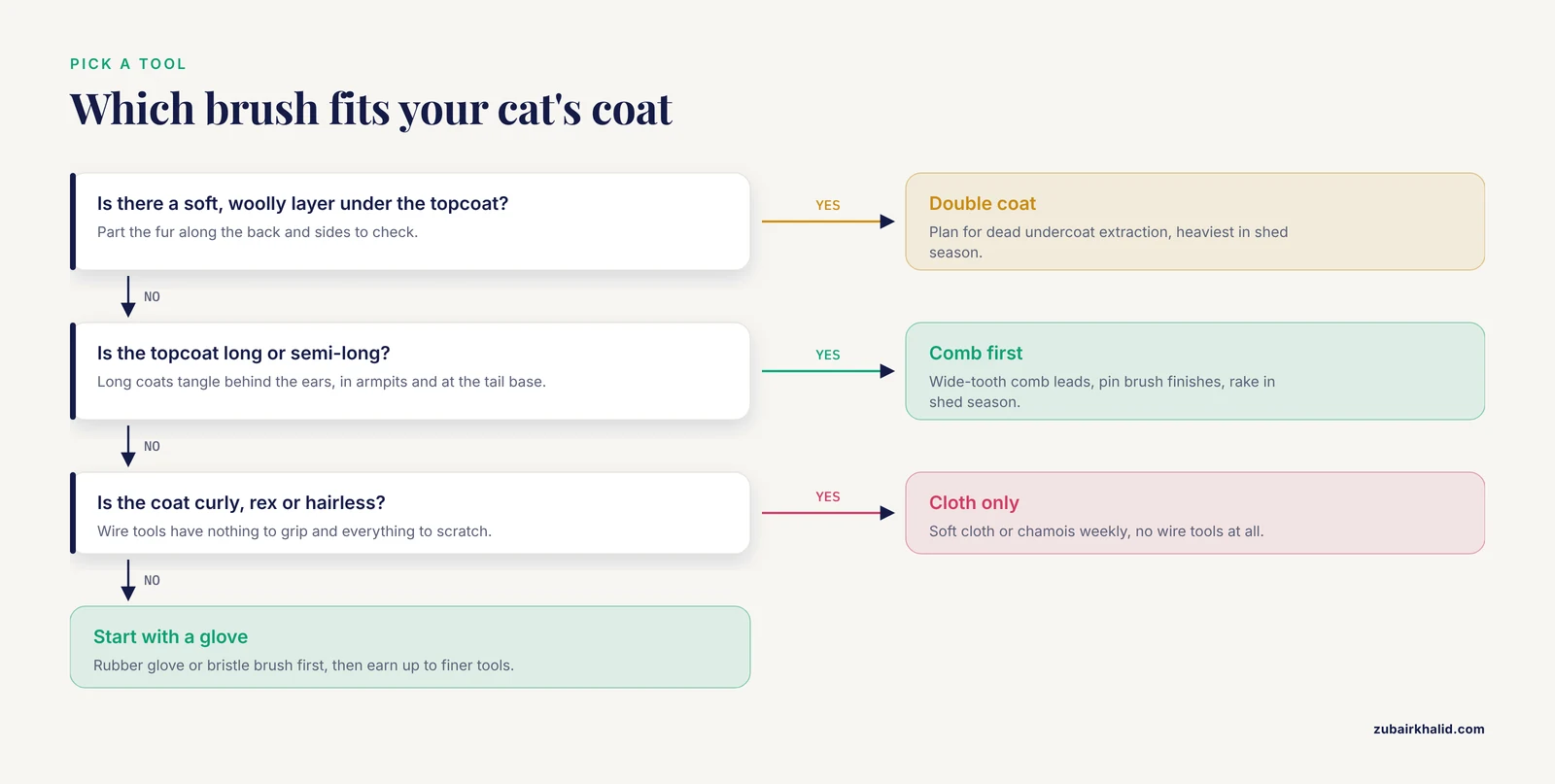
Most lists of the best cat grooming brushes sort products by price and star rating. Coat type is the better starting point, because the tool has to match the job. Answer three questions in order and the choice usually makes itself.
Question 1: How dense is the undercoat? Part the fur along your cat's back and sides. A soft, woolly layer under longer guard hairs means a double coat that sheds heavily and mats at friction points. Hair that lies flat, with skin showing easily through a single layer, means your cat needs polish and monitoring rather than deep extraction.
Question 2: How long is the topcoat? Short hair tangles rarely. Semi-long and long hair tangles at predictable addresses, behind the ears, under any collar, in the armpits, along the hind legs, and at the base of the tail. The longer the coat, the more the plan depends on combs rather than brushes.
Question 3: What will your cat actually tolerate? The best brush on paper is worthless if it lives in a drawer because your cat flees from it. A cat that rejects wire tools may accept a rubber glove. A cat that loves the glove may still need a rake during shed season. Tolerance decides whether the plan happens, so start where your cat is and earn up to more effective tools through short, calm sessions.
Once you reach the shelf, four criteria decide real choices: shedding volume, tangle risk, skin sensitivity, and your cat's patience. The two tables that follow map those criteria first to coat types and then to tools.
Cat Coat Types and the Tools That Fit Them
| Coat type | Typical examples | What the coat needs | Primary tool | Supporting tools |
|---|---|---|---|---|
| Short, smooth, close-lying | Siamese, Burmese, Ocicat | Oil distribution, loose hair removal, monitoring | Soft bristle brush | Rubber curry or grooming glove, fine-tooth comb |
| Short, dense double coat | British Shorthair, Russian Blue, Scottish Fold, many domestic shorthairs | Dead undercoat extraction, heaviest in shed season | Undercoat rake or deshedding tool | Slicker during heavy shed, bristle brush for finish, flea comb |
| Semi-long, variable undercoat | Maine Coon, Ragdoll, Birman, Norwegian Forest Cat | Tangle prevention at friction points, undercoat control | Wide-tooth comb plus pin brush | Undercoat rake in shed season, slicker for armpits and hind legs |
| Long, heavy undercoat | Persian, Himalayan | Daily tangle control and mat prevention | Wide-tooth comb, then fine-tooth comb | Pin brush, rake in shed season, professional help for established mats |
| Curly or rex | Cornish Rex, Devon Rex, LaPerm | Gentle oil removal, curl preservation | Soft cloth or chamois | Soft bristle brush, gentle rubber glove, no wire tools |
| Hairless | Sphynx, Donskoy | Skin oil management, no coat to brush | Soft cloth weekly | Nail and skin checks folded into the same routine |
Brush Options Compared: Pros and Cons
| Tool | Best coat match | What it does | Pros | Cons |
|---|---|---|---|---|
| Soft bristle brush | Short smooth coats | Lifts loose hair and dander, spreads skin oils | Gentle, quiet, ideal for beginners and brush-averse cats | No effect on undercoat, cannot detangle |
| Pin brush | Long and semi-long silky coats | Light detangling, smooths the topcoat | Comfortable, rounded tips protect skin | Does not reach undercoat, slow on real tangles |
| Slicker brush | Medium to long coats, friction zones | Removes loose hair and small tangles efficiently | Fast, reaches through the topcoat | Harsh on thin or rex coats, irritates skin under pressure, often disliked |
| Undercoat rake | Double coats, short or long | Pulls dead undercoat out in clumps | Large shedding reduction, mat prevention | Pointless on single coats, can break guard hairs if overused |
| Deshedding tool (bladed edge) | Dense double coats | Strips loose undercoat with each stroke | Very efficient at peak shed | Not for rex or single coats, thins the coat with overuse |
| Wide-tooth comb | Long and semi-long coats | Detangles, locates hidden mats | Finds mats before they tighten, gentle | Slow, removes little loose undercoat |
| Fine-tooth comb and flea comb | All coats, face and small zones | Precision work, parasite and debris checks | Doubles as a flea and skin check, safe near the face | Drags in dense coats, impractical for full-body work |
| Rubber curry or grooming glove | All coat types as a first step | Collects loose hair while petting | Highest cat acceptance, doubles as bonding | Limited depth, no detangling |
| Soft cloth or chamois | Rex and hairless coats | Wipes skin oils, adds shine | Gentlest option, well tolerated | Cosmetic only, removes almost no hair |
Read that table against the four criteria. If shedding volume is your problem, only the rake and the bladed deshedding tool address it, and only on coats that have undercoat to spare. If tangle risk is the problem, combs lead and brushes support. If skin sensitivity or a thin coat is the constraint, wire tools drop off the list entirely. If tolerance is the constraint, the glove buys you entry before anything else.
The Options Explained
Soft Bristle Brushes
A bristle brush has a flat, padded head with dense, short bristles, natural or synthetic. It lifts loose surface hair and dander, spreads skin oils along the hair shaft, and leaves a smooth coat with visible shine. On a Siamese-type coat it can be the only brush you need, used weekly. The pros are gentleness, quiet operation, and near-universal acceptance. The cons are hard limits: it moves almost nothing from the undercoat, it cannot detangle, and it barely dents a heavy shed.
Pin Brushes
Pin brushes carry long, flexible pins with rounded tips on a cushioned pad. They glide through long, silky topcoats, easing light tangles without dragging, and most cats find the sensation pleasant, which keeps them on the table. They suit semi-long and long coats as a comfort and finishing tool alongside a comb. The cons: pins do not reach the undercoat, they are slow on established tangles, and a pin that loses its tip turns the tool from comfort to hazard, so check the head regularly.
Slicker Brushes
A slicker packs fine, slightly bent wire pins into a flat or curved head. It is the workhorse for medium and long coats because it pulls loose hair and small tangles through the topcoat efficiently, and it earns its keep in friction zones such as the armpits and the hind legs. Use light pressure and straight strokes, lifting hair rather than scrubbing skin. The cons: it is harsh on thin or rex coats, it can redden skin when pressed, and many cats tolerate it less well than a glove, so keep sessions short and check the skin afterward.
Undercoat Rakes and Deshedding Tools
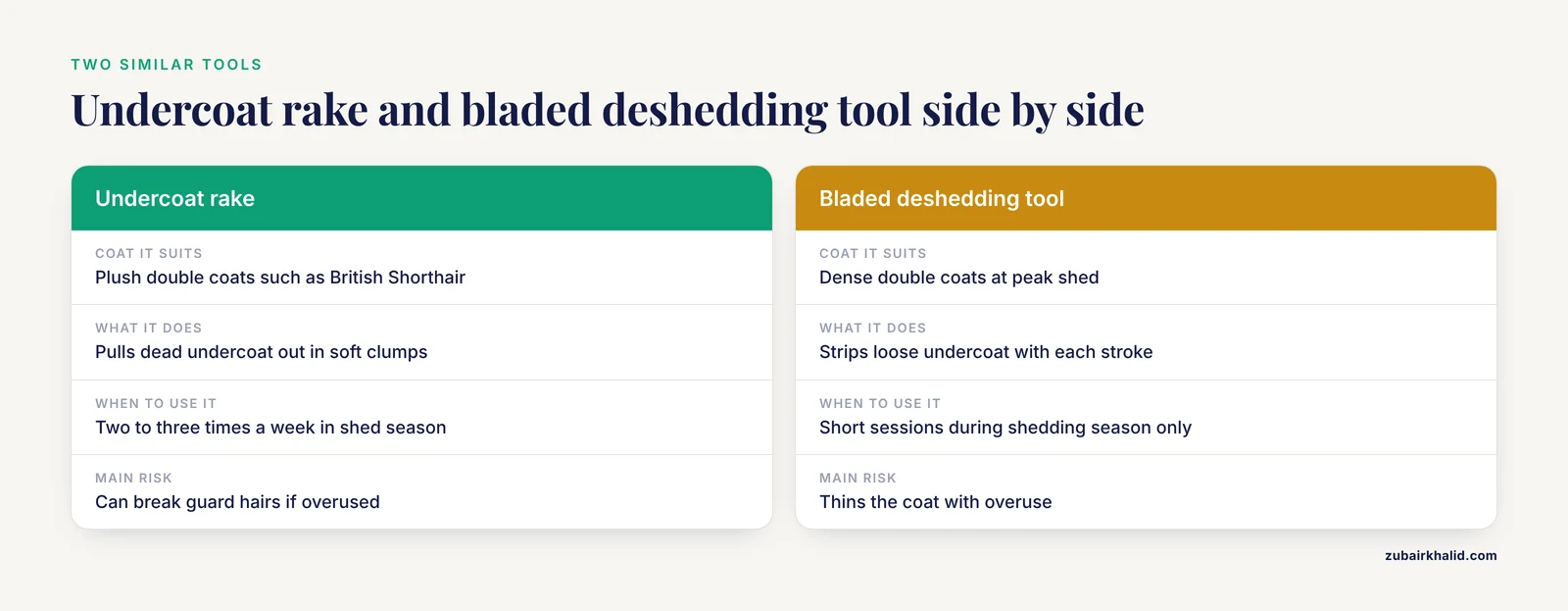
These two are often confused, and the difference matters. A rake has rows of longer teeth that reach through the topcoat and pull dead undercoat out in soft clumps, which suits plush double coats such as a British Shorthair's. A bladed deshedding tool has a fine edge that strips loose undercoat with each stroke, which suits dense coats at peak shed. Both can transform shedding volume in a genuinely double-coated cat. Both have hard limits: they are pointless on single coats, they can break guard hairs or thin a coat when overused, and they must never be dragged across a mat, where they tighten the tangle instead of fixing it. Restrict bladed tools to short sessions during shedding season and give single-coated and rex cats a pass entirely.
Combs, From Wide to Flea
Combs are the diagnostic tools of grooming. A wide-tooth comb travels through long and semi-long coats, locates mats you cannot see under the surface, and tells you how far a tangle has progressed. A fine-tooth comb finishes the face, the ears, and small zones with precision. A flea comb, the finest of all, catches adult fleas and flea dirt along the lower back and the base of the tail. The pros are gentleness and information. The cons are speed, since a comb alone will not clear a heavy shed.
Rubber Curries and Grooming Gloves
A rubber curry or a nubby grooming glove turns brushing into petting. Hair sticks to the surface, the cat experiences a massage, and the session builds tolerance for finer tools later. These are the best entry point for kittens, for newly adopted cats with unknown histories, and for any cat that has learned to fear wire tools. The cons are depth and detangling, since they collect surface hair and nothing more.
Cloths and Chamois for Rex and Hairless Coats
Cornish Rex, Devon Rex, and Sphynx cats break the standard rules. Rex coats are sparse and curly, and hairless cats have no coat at all but oily skin instead. Wire tools have nothing to grip and everything to scratch, so the right tool is a soft cloth or chamois, run over the body weekly to lift oils and leave shine. A very soft bristle brush or gentle glove can supplement on rex coats. Sudden bald patches in a rex coat are not a styling issue, so mention any change at your next veterinary visit.
Worked Scenarios: Matching the Brush to a Real Cat
A Domestic Shorthair That Coats the Couch
The coat is short but the undercoat is real. Start with a rubber glove twice a week, which the cat accepts as petting. Add a bladed deshedding tool once a week during spring and fall shed peaks, keeping sessions under ten minutes. Finish with a bristle brush to collect what the glove missed. Run a flea comb along the back monthly so the parasite check rides along for free.
A Maine Coon in Spring Shed
Semi-long coats shed in volume and tangle at friction points. Open each session with a wide-tooth comb through the armpits, the hind legs, and behind the ears, where mats start. Follow with an undercoat rake two to three times a week, daily at the peak. A pin brush finishes and feels good, which keeps the cat in the chair. Expect the rake to fill fast in spring, because that is the dead undercoat leaving the coat instead of the couch.
A Persian With Mats Behind the Ears
Stop raking. Mats are felted hair, and a rake or blade tightens them. Map every mat with a wide-tooth comb, then work the small, loose ones with fingers and a comb over several short sessions, holding the coat at its base so the skin does not pull. A mat that sits tight against the skin, or a cat that hurts when you touch the area, needs a professional groomer or your veterinarian, not scissors at home. Cutting a mat off thin, mobile skin with household scissors is a common way cats get injured.
A Devon Rex With a Greasy Coat
Skip wire tools entirely. A soft cloth weekly handles the oil, and a gentle glove adds light hair collection. Watch the skin rather than the coat, because a rex coat shows problems quickly. Thinning beyond the breed's normal sparse look goes on the list for your veterinarian.
An Older Cat That Stopped Grooming
A cat that stops grooming is a medical question before it is a grooming question. Painful joints, dental disease, weight gain, and illness all take the energy out of self-grooming, so book an examination first. Once your veterinarian has evaluated or treated the cause, stand in with a rubber glove for short daily sessions, since the glove feels like touch rather than equipment. Senior cats often settle into the routine quickly once grooming feels like affection instead of restraint.
Common Mix-Ups When Choosing a Cat Grooming Brush
- Choosing for your hand instead of the coat. A comfortable handle on the wrong tool still does the wrong job.
- Raking a single coat or a rex coat. Bladed tools need undercoat to spare, and these coats have none.
- Dragging a rake across a mat. The tool tightens felted hair, it never separates it.
- Brushing only the top layer. Surface strokes leave the dead undercoat in place and the shedding unchanged.
- Pressing hard with a slicker. Pressure scrapes skin, and one painful session can spoil the whole routine.
- Ignoring consent signals. Tail flicking, skin rippling, flattened ears, and walking away mean stop. Forcing sessions builds a cat that runs at the sight of the brush.
- Skipping friction zones. The armpits, the hind legs, behind the ears, and the base of the tail are where mats start, and they are the zones owners miss most often.
- Never cleaning the tools. Hair, dander, and parasites ride on dirty equipment, so pull collected hair out and wash the heads regularly.
Introducing a Brush to a Brush-Averse Cat
Some cats treat any tool past the cheek as an attack, and the fix is sequencing, not force.
- Start with the tool in the room. Leave the brush near the food bowl or a favorite perch for a few days so it stops being news.
- Pair it with good things. Touch the brush to the cat's cheek, then offer a treat. Scent transfer makes the tool smell like the cat.
- Begin where petting is welcome. One or two strokes along the cheek or shoulder, then stop while the cat is still happy.
- Grow the session, not the pressure. Add strokes and zones over days. Work the chest and back first and save the hindquarters for last, since the rear is the zone most cats guard.
- End on success. Finish each session before the tail flicks or the skin ripples, then reward. A record of short, safe sessions is what earns you the right to use a rake or slicker later.
Brushing as Part of Cat Preventive Care
The minutes with the brush are the cheapest preventive medicine in feline care. Routine cat preventive care combines what you observe at home with what your veterinarian finds on scheduled examinations, a framing used by groups such as the AVMA and the Cornell Feline Health Center, and the brushing session is the most reliable place to do the home half. Every stroke parts the coat, so skin, fleas, mats, and body condition pass in review week after week.
Flea surveillance is the clearest example. Normal grooming keeps flea numbers down, and a flea comb tells you whether that defense is holding. Run the comb along the lower back and the base of the tail. Adult fleas, or black specks that turn reddish brown on a damp paper towel, mean it is time to talk with your veterinarian about parasite control. Year-round protection is the standard in feline medicine under guidance such as the Companion Animal Parasite Council's, and the comb is how you check that it is working.
A Cat Health Checklist Built Around the Brush
Use the session as the anchor for a simple cat health checklist.
- Weekly: brush to the coat type, run a flea comb along the back and tail base, part the fur in two or three spots and look at the skin, glance at the eyes and ears for discharge.
- Monthly: check the nails, feel along the body for new lumps, inspect the friction zones for early mats, and weigh your cat if you can, since a cat in a carrier on a bathroom scale works fine.
- Seasonally: step up frequency during spring and fall, when double coats shed most of their dead undercoat.
- Every 6 to 12 months: a wellness examination, a parasite prevention review, and a dental assessment on the schedule your veterinarian recommends.
The brush handles the coat. Your veterinarian handles the medicine, and the checklist is where the two meet.
When Grooming Becomes a Warning Sign
Self-grooming sits on a spectrum. Normal maintenance sits at one end. At the other end sit repetitive licking that thins the coat and self-induced wounds, which veterinary medicine classifies as abnormal repetitive behaviors and indicators of poor welfare in cats [9]. The severe end of that spectrum includes a crusted, non-healing ulcer, most often on the neck or between the shoulder blades, diagnosed only after other causes of itch have been ruled out [9]. In a study of 13 cats with such self-induced wounds, the median welfare score was 16 on a 21-point scale, against 7 in 35 healthy cats, and major changes to the cats' home environment helped the wounds heal [9].
The practical message for brush shopping is this: if your cat licks one spot raw, scratches the neck constantly, or loses hair in patches, the answer is rarely a different tool. Those signs point to itch, pain, or stress, and they need a veterinarian. Brushing still helps, because sessions are when you catch thinning coats, guarded spots, and early wounds, especially in places cats hide them, such as the neck and between the shoulder blades.
Limitations and When to Contact a Veterinarian
Coat-type advice is general, individual cats vary widely, and any decision that touches skin, pain, or behavior needs a veterinarian who has examined your cat. Contact your clinic when any of the following shows up:
- Hair loss, scabs, or open sores, especially on the neck, head, or between the shoulder blades.
- Grooming that looks compulsive, or a cat that stops grooming suddenly.
- Mats that sit tight against the skin, or any mat you cannot separate with your fingers.
- New pain reactions during brushing, flinching, growling, or biting where none existed before.
- Red, flaky, greasy, or ulcerated skin anywhere you part the coat.
- Live fleas or flea dirt despite prevention, or a heavy flea load in a kitten.
- A sudden change in coat texture or shine, which can track diet, illness, or hormonal disease.
- Anything you find during a brushing session that you cannot explain or that is getting worse.
Book the follow-up your veterinarian recommends and keep the checklist going between visits.
Frequently Asked Questions
How often should I brush my cat?
Short smooth coats do well with one gentle session a week. Dense double coats need two to three sessions weekly, daily at shed peaks. Long or heavy coats need daily attention to stay mat-free. Frequency matters more than session length, five calm minutes beat a monthly struggle.
What is the best cat grooming brush for a shorthaired cat?
For a smooth-coated shorthair, a soft bristle brush or rubber glove is usually enough. For a plush double-coated shorthair, add an undercoat rake or bladed deshedding tool during shedding season. Match the tool to the density you feel when you part the fur.
Can the wrong brush hurt my cat?
Yes. Wire tools can scratch thin or rex coats, bladed deshedding tools can thin a coat that has no undercoat to spare, and a slicker used with pressure can irritate skin. Pain during brushing also teaches the cat to fear the brush.
Why is my cat still shedding if I brush regularly?
Brushing removes hair that is already loose, it does not stop the growth and shedding cycle. Shedding peaks seasonally, so expect more loose hair in spring and fall even with a good routine, and step up frequency during those windows.
Do cats need brushing if they groom themselves well?
Most do. The tongue handles surface cleaning well, but it cannot extract the volume of dead undercoat a double coat sheds, and it cannot break down forming tangles. Brushing also gives you a weekly look at skin, fleas, and mats you would otherwise miss.
When does a grooming problem become a veterinary problem?
When you see hair loss, wounds, compulsive licking, mats tight to the skin, pain, or a sudden coat change. Those are medical findings, not grooming failures, and they need an examination rather than a new tool.
Sources
- Cats use hollow papillae to wick saliva into fur
- Predatory Attack, Grooming, and Consummatory Behaviors Evoked by Electrical Stimulation of Cat Cerebellar Nuclei
- Can fastidiousness kill the cat? The potential for target-specific poisoning of feral cats through oral grooming.
- Host grooming efficiency for regulation of cat flea (Siphonaptera: Pulicidae) populations.
- Characterizing grooming behavior patterns and the influence of brush access on the behavior of group-housed dairy calves.
- Effect of a mechanical grooming brush on the behavior and health of recently weaned heifer calves
- Can access to an automated grooming brush and/or a mirror reduce stress of dairy cows kept in social isolation?
- Loss of a grooming enrichment impacts physical, behavioural, and physiological measures of welfare in grazing beef cattle.
- From Feline Idiopathic Ulcerative Dermatitis to Feline Behavioral Ulcerative Dermatitis: Grooming Repetitive Behaviors Indicators of Poor Welfare in Cats