How to Read a Cat Supplement Label
By Dr. Zubair Khalid, DVM, MS, PhD ·
Reading a cat supplement label comes down to four checks: what the active ingredients actually are, how much of each is in a serving, what the label claims the product does, and whether the dosing and cautions fit your specific cat. Everything else on the package, from illustrations of playful kittens to phrases like "immune support," is communication from the manufacturer, and some of it is marketing rather than medicine.
This guide walks through each part of a typical cat supplement label, explains the biology behind the ingredients you are most likely to see, and shows how to fold supplement decisions into a broader routine of cat preventive care. Supplement use should always start with a veterinarian, because a label can tell you what is in a jar but it cannot tell you whether your cat needs what is in the jar.
What Cat Supplement Label Reading Means
Cat supplement label reading interpretation is the skill of translating the printed panel on a supplement package into a clear answer to three questions. Is this product intended for cats specifically? Does it contain a meaningful, listed amount of the ingredient it is sold for? And does its claim match something your veterinarian has actually identified in your cat?
The term "supplement" itself carries legal weight in the United States. Products sold as supplements sit in a different regulatory category than prescription or over-the-counter drugs. A supplement manufacturer does not need to prove, before sale, that the product treats a disease the way a drug manufacturer does. Because of that, the label is often the only detailed information an owner has about what the product contains and what the manufacturer says it does. Reading it carefully is the owner's main quality-control step.
This also explains what cat supplement label reading means in practice. It is not memorizing chemistry. It is a consistent habit of checking five or six specific pieces of information before you buy, and knowing which phrases signal substance and which ones signal marketing.
Why Cats Are Not Small Dogs: The Biology Behind the Label
A label that looks fine for a dog product can be wrong for a cat, and the reason lies in feline physiology. Cats are obligate carnivores. Their ancestors ate prey, and over evolutionary time cats lost the ability to make several nutrients from scratch. They need preformed vitamin A in the diet because they convert plant beta-carotene poorly. They require dietary taurine, and deficiency causes serious heart and eye disease. They also need arginine and have high requirements for certain B vitamins. These feline-specific nutritional requirements are well described in veterinary references such as the Merck Veterinary Manual.
Two consequences follow for label reading.
First, a cat's base diet already delivers a calibrated set of nutrients. Complete commercial cat foods, whether dry, canned, or fresh, are formulated to meet recognized nutrient profiles. Adding a supplement with meaningful amounts of vitamins or minerals on top of a complete diet can push total intake of certain nutrients into an excessive range. Fat-soluble vitamins in particular (vitamins A, D, E, and K) are stored in body fat and the liver rather than excreted quickly in urine, so chronic oversupplementation can accumulate to toxic levels. Water-soluble vitamins are excreted more readily, but that does not make megadoses harmless.
Second, a cat's small body size magnifies dosing errors. A milligram dose designed for a large dog or an adult human can represent a large per-kilogram exposure for a four-kilogram cat. This is why the serving directions and any "for animal use only" statement on the label deserve as much attention as the ingredient list.
The Sections of a Cat Supplement Label
Most labels, regardless of brand or format (chew, paste, powder, liquid, capsule), contain the same structural elements. The table below summarizes them, what to verify in each, and the red flags that should slow you down.
| Label section | What to check | Red flags |
|---|---|---|
| Product name and species statement | The words "for cats" and, ideally, a life-stage statement | "For dogs and cats" with no cat-specific dosing, or no species statement at all |
| Intended use / claim statement | A vague wellness claim ("supports," "helps maintain") rather than a disease claim ("treats arthritis," "cures kidney disease") | Disease claims, which supplements are not permitted to make in the US |
| Active ingredients | Each active listed with an exact amount per serving (mg, IU, or CFU for probiotics) | A "proprietary blend" with no individual amounts |
| Inactive ingredients | Flavorings, carriers, preservatives, and anything your cat has reacted to before | Sweeteners or flavorings that seem designed for dogs rather than cats |
| Serving directions | Dose by body weight, frequency, and route | A single dose "for all cats" regardless of size or age |
| Warnings and cautions | Statements about pregnancy, kittens, medical conditions, or interactions with medications | No cautions at all, which suggests the label is incomplete rather than that the product is risk-free |
| Manufacturer identity and contact | A real company name, address, and way to ask questions | No manufacturer contact information |
| Lot number and expiration date | A legible lot code and a "best by" date far enough out for the package size to be used | Missing or smudged lot and date information |
Product Name and the Intended-Use Statement
Start at the front of the package. The product name should identify the species and the category of support. "Feline joint support soft chews" tells you the target species and the intended category. What it does not tell you is whether the ingredients inside actually do anything for joints, which is why the front panel is a starting point and never a conclusion.
Below or near the name, most labels carry an intended-use statement. In the United States, a supplement is supposed to stay in the territory of supporting normal structure or function ("supports healthy skin," "helps maintain a calm demeanor"). Statements that a product treats, cures, or prevents a named disease cross into drug territory, and regulators treat products that make such claims differently. If a cat supplement claims to cure kidney disease, resolve urinary blockages, or eliminate parasites, treat that claim as a serious warning sign about the manufacturer rather than as evidence of potency.
Active Ingredients and the Guaranteed Analysis
This is the heart of cat supplement label reading explained in plain terms. The active ingredient section lists the substances the product is actually being sold for, each with an amount per serving. A joint product might list glucosamine hydrochloride at a specific milligram amount per chew. An omega-3 product might list EPA and DHA separately in milligrams. A probiotic should list the organisms by genus and species, such as Enterococcus faecium, with a colony-forming unit (CFU) count guaranteed at the time of manufacture, and ideally a guarantee through the end of shelf life.
Several details matter here.
Look for exact amounts, not just ingredient names. An ingredient listed with no amount tells you nothing about whether a serving delivers a meaningful quantity. Some manufacturers hide behind the phrase "proprietary blend," which bundles several ingredients under one total weight. Proprietary blends make it impossible to know whether an active ingredient is present at a useful level or as window dressing.
Look at units and context. Milligrams per serving is only meaningful relative to your cat's body weight and to what the directions recommend. Some labels also express amounts per kilogram of body weight. A product designed for a ten-kilogram dog that is being off-label dosed to a four-kilogram cat will deliver very different relative amounts.
Look at the form of the nutrient. Mineral supplements often appear as chelates (minerals bound to amino acids, such as zinc methionine), and the chemical form can affect how well the mineral is absorbed. The label naming a specific, defined chemical form is generally a better signal than a vague term like "mineral complex."
Inactive Ingredients
The inactive list contains everything else: flavors, binders, preservatives, and carriers. Two reasons to read it. First, if your cat has a known food sensitivity, scan for the trigger. Second, some cats refuse supplements for palatability reasons, and the inactive ingredients explain a lot about whether a product will actually be accepted. A supplement your cat will not eat has a value of zero regardless of what the actives promise.
Serving Directions
Good serving directions specify three things: how much, how often, and for which body weight range. They may also specify starting doses for kittens or sensitive cats, and a note about giving with food or on an empty stomach, which matters for absorption of some ingredients. Compare the recommended serving against your cat's weight and against any similar product your cat already receives. Two joint supplements given together can double an ingredient you never intended to double.
Warnings, Cautions, Lot Number, and Expiration
Cautions on a well-made label address the populations where a product has not been established as safe, commonly pregnant or lactating queens, kittens under a stated age, and cats with specific medical conditions. The label should also carry a lot number and an expiration or best-by date. The lot number matters if a recall or quality problem ever affects the product, because it identifies exactly which batch your package came from.
Marketing Terms, Decoded
Many phrases on supplement labels have no standardized definition in pet supplement labeling, which means they function as advertising rather than as verifiable specifications. A few deserve specific attention.
"Natural" generally means little more than a claim about ingredient sourcing, and natural does not imply safe. Arsenic and lead are natural. Therapeutic benefit and safety come from evidence, not from the word natural.
"Veterinarian formulated" or "veterinarian recommended" means that some veterinarian, somewhere, had a role in the formula or endorses it. It does not mean the product was tested in clinical trials, and it does not mean that veterinarian has ever seen your cat.
"Human grade" is a phrase with an official meaning in pet food labeling rules, tied to ingredients handled under standards applicable to human food, but it describes the ingredient supply chain, not the safety or efficacy of the finished supplement in cats.
"Premium," "science-based," "clinically proven," and similar phrases, when unaccompanied by a specific citation to actual research on the finished product, carry no verifiable meaning. Some reputable manufacturers do publish studies on their own products, and when they do, the label or website should name the study in a way you can ask your veterinarian to review.
The most reliable signals on a label are boring ones: exact amounts, named chemical forms, specific species dosing, complete contact information, and quality-certification seals from industry programs that audit manufacturing. The Cornell Feline Health Center advises cat owners to discuss any supplement with a veterinarian before starting it, precisely because the label alone rarely settles the question of whether a product is needed or appropriate.
A Practical Checklist: How to Read a Cat Supplement Label in Under Two Minutes
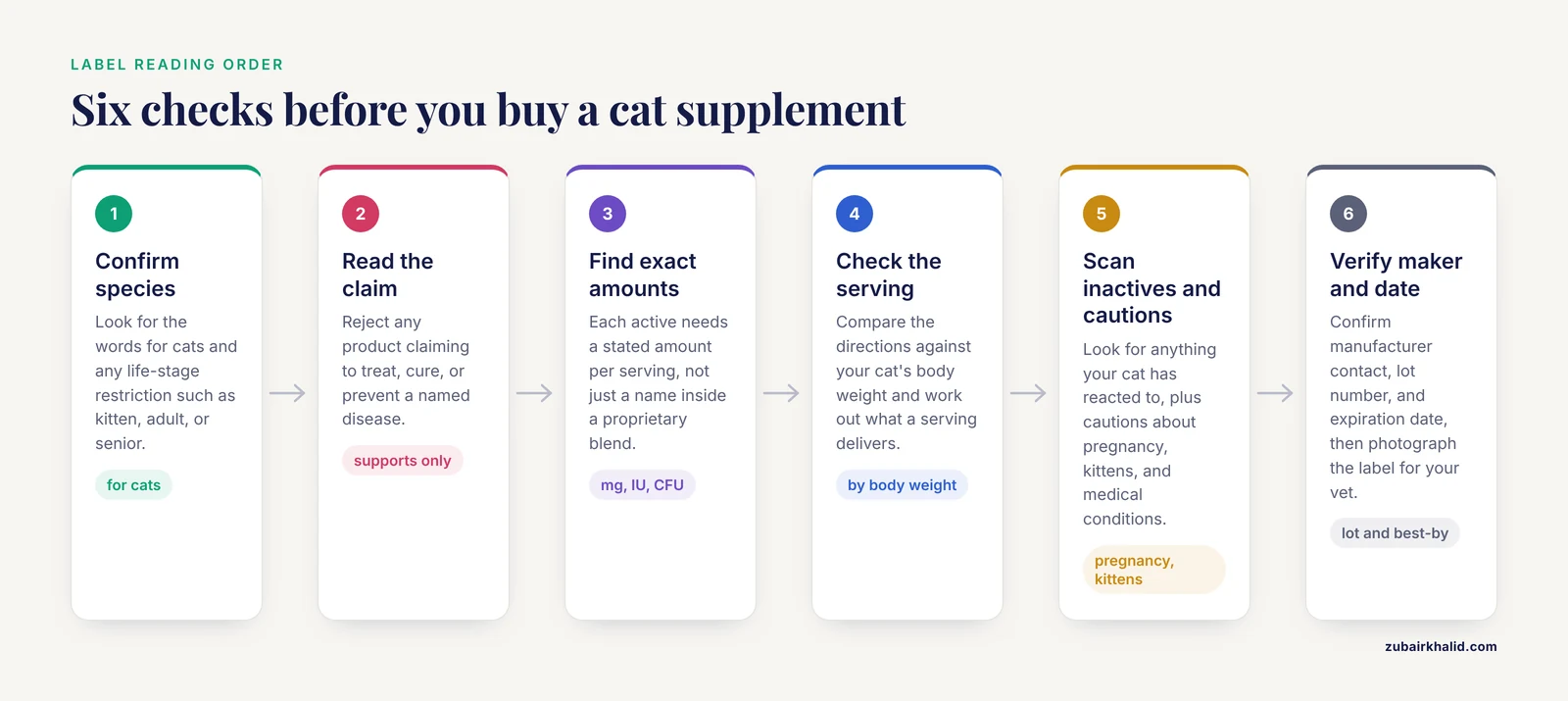
Work through the label in this order every time.
- Confirm the product is labeled for cats and note any life-stage restriction (kitten, adult, senior).
- Read the intended-use statement and reject any product claiming to treat, cure, or prevent a named disease.
- Find the active ingredients and confirm each one has a stated amount per serving, not just a name inside a proprietary blend.
- Check the serving directions against your cat's body weight and calculate what a serving actually delivers.
- Scan inactive ingredients for anything your cat has reacted to or refuses.
- Read every caution, especially those about pregnancy, kittens, and medical conditions.
- Verify the manufacturer name, contact information, lot number, and expiration date.
- Photograph the label or keep the package, then bring it to your veterinarian and ask whether the product is appropriate for your cat, whether it overlaps with anything your cat already receives, and what outcome you should expect and by when.
That last step is the one most owners skip and the one that matters most. Your veterinarian can compare the supplement against your cat's full diet, medications, and lab work, which no label can do.
Where Supplements Fit in Cat Preventive Care
Supplements are one small entry on a much longer cat health checklist. A sound preventive care routine, as promoted by organizations such as the American Veterinary Medical Association in its owner-facing guidance, centers on regular wellness examinations, vaccination appropriate to your cat's lifestyle, year-round parasite prevention as recommended by your veterinarian, dental care, weight management, and environmental enrichment. The American Animal Hospital Association's wellness guidance similarly emphasizes scheduled preventive visits as the framework within which decisions about diet and supplements should be made.
The practical ordering matters. Diagnostics come before supplements. If your cat is acting "old," bloodwork might reveal chronic kidney disease, hyperthyroidism, or painful joints, and each of those calls for a specific veterinary plan rather than a generic "senior support" supplement. Chronic kidney disease, for example, is common in aging cats, and management is built around veterinary monitoring, prescription diets when indicated, and treatment of complications, not around over-the-counter kidney supplements chosen from a shelf. If your veterinarian diagnoses a condition with an evidence-based first-line treatment, a supplement is at best an adjunct to that treatment and never a substitute for it.
Supplements earn a place in the plan when a veterinarian identifies a specific gap or goal: a probiotic alongside treatment of digestive upset as directed by your veterinarian, an omega-3 product as part of a joint or skin plan, or a targeted nutrient when bloodwork or diet history shows an actual deficiency. In each case the label reading skills above determine whether the product you bring home matches the plan.
Common Myths and Owner Mistakes
Myth: natural means safe. Safety depends on the ingredient, the dose, and the individual cat, not the marketing category. Overdosing even familiar nutrients causes harm, and cats are unforgiving about certain compounds that other species tolerate.
Myth: if some is good, more is better. Nutrients follow a dose-response curve with a beneficial range and a toxic range. Fat-soluble vitamins accumulate in the body, and chronic excess of vitamins A and D is a recognized toxicity concern in veterinary medicine. Doubling a supplement because progress feels slow is a mistake to avoid.
Myth: human supplements work fine if I cut the dose. Human products are formulated for human bodies and human palates. Some contain flavorings, sweeteners, or inactive ingredients unsuitable for animals, and the delivery forms (large capsules, xylitol-containing chewables) create real risks. The xylitol hazard is best documented in dogs, but the broader point stands: human products are not labeled for feline dosing, and guessing the dose on a small cat is genuinely dangerous.
Myth: a label claim is proof of efficacy. A supplement sold without pre-market proof of effectiveness can still print confident language on its packaging. The claim tells you what the manufacturer wants you to believe. Independent evidence, reviewed with your veterinarian, tells you what is actually supported.
Myth: supplements can replace prescription diets or medications. Prescription therapeutic diets and prescription drugs exist because they have documented effects at documented doses. A sprinkle-on supplement does not substitute for either, and stopping prescribed treatment in favor of a supplement can allow a manageable disease to progress.
Mistake: stacking products with overlapping actives. Owners often give a multivitamin, a joint chew, and a skin coat product without realizing all three contain vitamin E, or all three contain fish oil. Add up the actives across every product, including treats marketed with functional claims, and review the total with your veterinarian.
Mistake: ignoring the cat's own veto. A cat that hides, drools, gags, or fights the pilling process is telling you the cost of administration is too high. Chronic stress around dosing has its own welfare price. Ask your veterinarian about alternative formats or whether the supplement is worth continuing at all.
Red Flags on and Around the Label
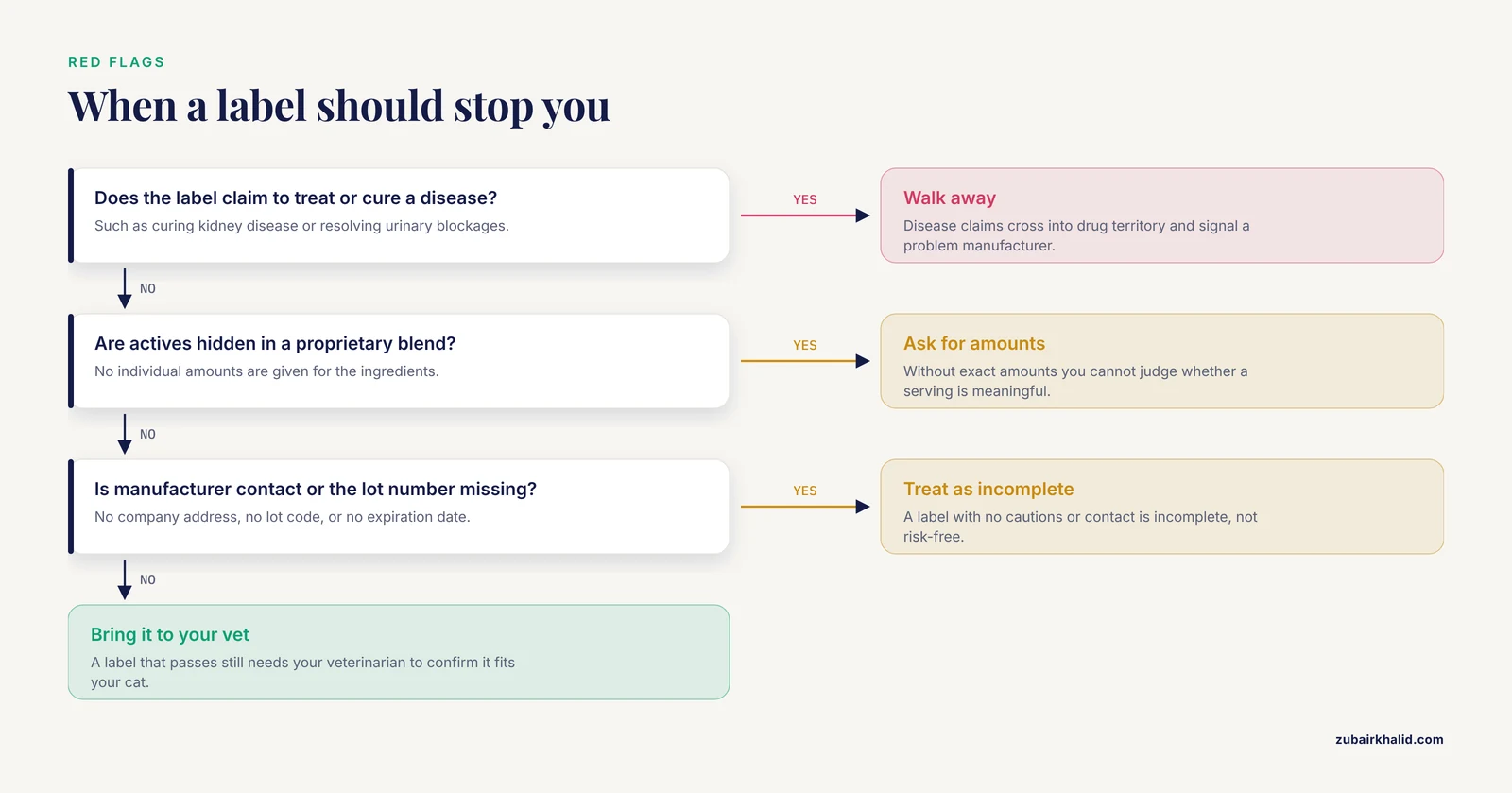
Some warning signs justify walking away from a product regardless of how attractive the claims are.
Disease claims on a supplement label, as covered above. A proprietary blend where individual amounts should be. No manufacturer contact information. Dosing described only as "as directed" with no body weight guidance. Testimonials in place of any reference to actual research. A manufacturer that cannot or will not answer direct questions about ingredient sourcing, manufacturing practices, or third-party testing. Packaging that lacks a lot number or expiration date. A product sold primarily through dramatic before-and-after stories, especially for serious diseases such as cancer or kidney failure, where delay of proper veterinary care causes the real harm.
What Is Still Uncertain
Honesty about uncertainty is part of competent label reading. For many supplement categories in cats, the published evidence base is thin, variable in quality, or based on studies in other species. Ingredient forms differ in bioavailability, and manufacturing quality varies across the industry, meaning the amount on the label may not always match the amount in the product. Labels can also change without much fanfare when suppliers change, so a product your cat tolerated for years can shift its inactive ingredients. These uncertainties do not make all supplements useless. They mean the case for any particular supplement rests on your veterinarian's judgment, your cat's measurable response, and periodic reevaluation, not on the confidence of the packaging.
Limitations and When to Contact a Veterinarian
This article is educational and is not a substitute for veterinary diagnosis or treatment. Individual cases need a veterinarian, and no label-reading routine can replace an examination and appropriate testing.
Contact your veterinarian promptly, and stop the supplement in the meantime, if any of the following occur after starting a new product:
- Vomiting, diarrhea, or constipation that begins within days of starting the supplement
- Reduced appetite, drooling, lip smacking, or refusal of food
- Lethargy, hiding, or behavior change that coincides with starting the product
- Any suspicion that your cat consumed a large quantity, such as chewing through a container, which is an urgent situation
- New or worsening signs in a cat with known kidney, liver, thyroid, or heart disease who is given any new supplement, because these cats have narrow margins for additions to their regimen
- Any planned surgery or anesthesia, since some supplements affect bleeding or interact with anesthetic and pain medications, and your veterinary team needs a complete list of everything your cat receives
- Pregnancy or lactation, where supplement decisions should be made with your veterinarian before anything new is added
- A supplement that seems to stop working, or a cat whose underlying condition worsens while on a supplement, which calls for reevaluation of the whole plan rather than a dose increase
Bring every supplement, including treats with functional claims, to your cat's wellness visits so your veterinarian can see the complete picture. Annual or semiannual examinations, with more frequent monitoring for seniors and cats with chronic disease, are the schedule recommended in mainstream preventive care guidance from groups such as the AAHA and the AVMA.
Frequently Asked Questions
What does cat supplement label reading mean?
It means systematically checking a supplement package for the species it is intended for, the exact active ingredients and their amounts per serving, the dosing directions, the cautions, and the manufacturer's identity before buying or giving the product. The goal is to confirm the product matches a real, veterinarian-identified need for your specific cat.
Can I give my cat a supplement made for humans or dogs if I reduce the dose?
No, not without your veterinarian's approval. Human and dog products are formulated with different species in mind, and their inactive ingredients and dose concentrations may be unsafe for a small cat. A reduced dose of a human product is still a guess, and guessing doses on a cat weighing four or five kilograms carries real risk.
What is a guaranteed analysis on a cat supplement?
It is the section listing the minimum or maximum amounts of key nutrients or actives that the product is guaranteed to contain. For a supplement, look for each active ingredient listed with a specific amount per serving, such as milligrams, international units, or colony-forming units for probiotics. Vague blends without individual amounts make the analysis meaningless.
Does "veterinarian formulated" mean the product is proven to work?
No. It means a veterinarian participated in creating or endorsing the formula. It does not mean the finished product was tested in controlled studies or that it is appropriate for your cat. Ask your veterinarian to evaluate the ingredient list and the evidence behind it.
Do cat probiotics need to list CFU counts?
Yes, a quality probiotic label should identify the bacterial or yeast species included and state a guaranteed CFU count per serving. Without a count, you cannot know whether a serving delivers a potentially meaningful amount of the organisms listed.
How do I know if a supplement will interact with my cat's medication?
You usually cannot know from the label alone, so bring the label to your veterinarian or pharmacist-vet team before starting the product. This matters especially for cats on long-term medications, and for any cat scheduled for surgery or anesthesia, where the veterinary team needs a full list of everything the cat receives.
Is it harmful to give a cat an expired supplement?
Potency generally declines after the expiration date, so an expired product may deliver less of the active ingredient than the label promises, and in some products degradation can change the ingredient profile. The safe practice is to replace expired supplements rather than finish them.
How long should I give a supplement before deciding whether it works?
Ask your veterinarian to define a trial period and a measurable outcome when the supplement is first prescribed, because reasonable timelines differ by product type and goal. If no agreed outcome appears within the defined window, the productive next step is a recheck visit rather than continuing indefinitely or increasing the dose on your own.