Cat Lethargy vs Normal Sleep: Template and Examples
By Dr. Zubair Khalid, DVM, MS, PhD ·
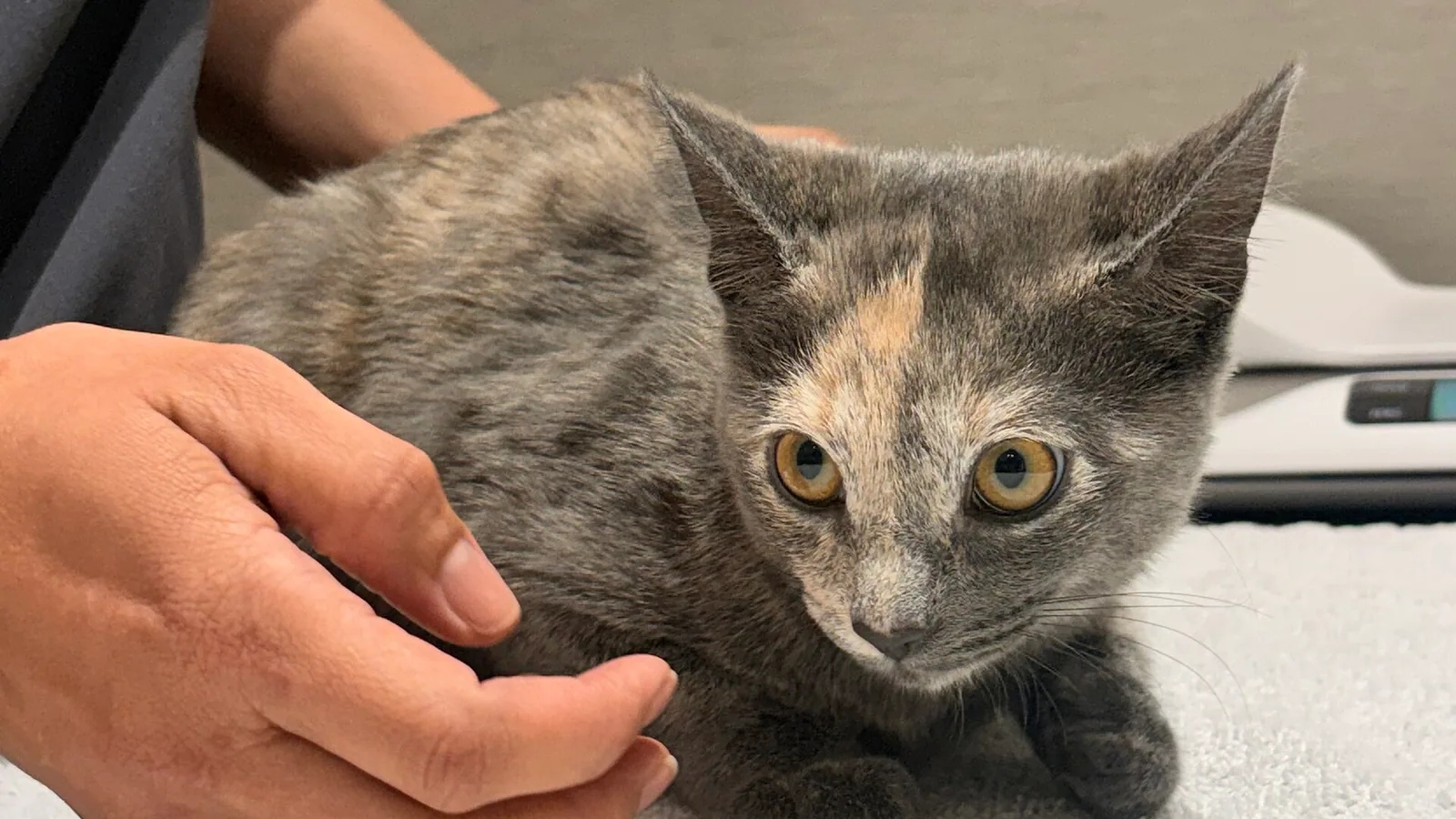
A sleeping cat wakes up, stretches, eats, grooms, and reacts to sound and touch. A lethargic cat does none of those things with normal energy. Lethargy is a drop in activity and responsiveness that goes beyond long naps, and it is one of the most common nonspecific signs of illness in cats, which is why the Merck Veterinary Manual lists it as a reason for a prompt veterinary exam rather than watchful waiting at home. This article gives you a practical framework for telling the two apart, a fill-in template you can use starting today, and worked examples that show what the difference looks like in a real home.
This article is educational and is not a substitute for veterinary diagnosis or treatment.
At a Glance: Quick Triage Checklist
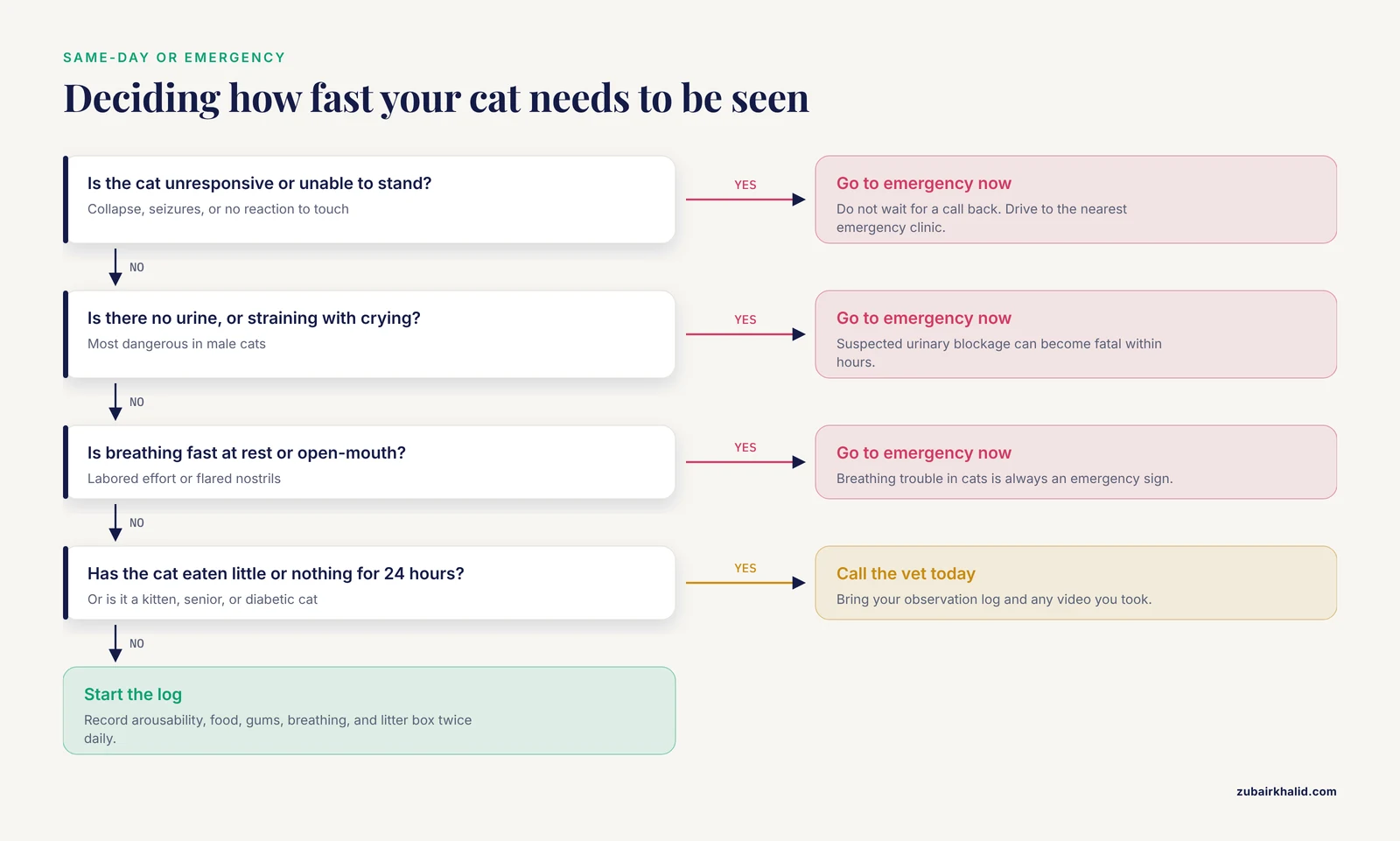
Use this checklist the moment you wonder whether your cat is sick or just sleepy. If any single box in the "Call now" column applies, contact your veterinarian or an emergency clinic the same day.
| Check | Normal sleep looks like | Call your veterinarian today | Go to emergency care now |
|---|---|---|---|
| Arousability | Wakes for food, noise, or touch, then resettles | Wakes slowly, seems "flat" for more than a day | Unresponsive or cannot stand |
| Appetite | Eats normal meals after naps | Reduced appetite for 24 hours or more | Not eaten for 48 hours or more, or completely refuses food |
| Gums | Pink and moist | Pale, muddy, or tacky gums | White, blue, or brick-red gums |
| Breathing | Slow and quiet while asleep | Faster than normal when resting | Open-mouth breathing, labored effort, or flared nostrils |
| Posture | Curled, loaf, or side-lying with relaxed limbs | Hunched, hiding, reluctant to move | Collapsed, seizing, or limping badly |
| Litter box | Normal urination and stool | Straining, no urine for 12 to 24 hours, diarrhea | Straining with crying or no urine plus distress |
A cat that produces no urine at all is a medical emergency. Urinary obstruction is most common in male cats and can become fatal within hours, so treat any suspected blockage as a same-hour crisis.
What Normal Sleep Looks Like in Cats
Cats are champion sleepers, and this is the first fact owners need to accept before worrying. Healthy adult cats commonly sleep between 12 and 16 hours per day, and some sleep even more. Sleep is spread across many short naps rather than one long block, which reflects the species' crepuscular nature. Domestic cats are most active at dawn and dusk, a pattern inherited from their hunting ancestors, and they routinely doze lightly between those activity peaks.
Normal sleep has recognizable features:
- Arousal is easy. A healthy sleeping cat reacts to the sound of a can opener, a bag rustling, or your voice. It may open one eye, twitch an ear, or get up to investigate.
- Sleep follows a rhythm. Cats sleep heavily after their evening and early-morning activity bursts, then rejoin household routines.
- Life stage changes the total. Kittens sleep more because they are growing, and senior cats sleep more because their energy reserves and joints change with age.
- Sleep is interruptible by interest. A favorite toy, a treat bag, or a bird at the window will usually rouse even a drowsy cat.
Depth of sleep also varies. Cats cycle between light dozing, where whiskers twitch and ears pivot, and deeper sleep. A cat in deep sleep may be briefly hard to wake, and that alone is not a problem if the cat then gets up, stretches fully, grooms, and behaves normally.
What Lethargy Actually Is
Lethargy is not sleep. It is a measurable decrease in energy, responsiveness, and willingness to do normal cat things. The Merck Veterinary Manual describes lethargy as a nonspecific sign that can accompany nearly any illness in cats, including infections, pain, fever, anemia, toxin exposure, kidney disease, and metabolic disease. That breadth is the reason lethargy deserves respect. It is the body's shared signal that something is wrong, and it does not tell you which system is failing.
A lethargic cat typically shows some combination of the following:
- Sleeps in unusual places, such as the closet floor or behind the washer, instead of favorite perches
- Wakes slowly or seems disinterested in food, play, or people
- Sits hunched with a tucked or flattened posture rather than loafing comfortably
- Stops grooming, so the coat looks dull, greasy, or matted
- Moves stiffly, jumps less, or hesitates at stairs
- Purrs less, vocalizes differently, or hides from family members it usually seeks out
- Eats less, drinks more or less than usual, or changes litter box habits
The key distinction in the cat lethargy vs normal sleep question is arousability plus engagement. A tired cat that sleeps 18 hours but wakes eagerly for dinner and plays for five minutes is probably fine. A cat that sleeps the same 18 hours, ignores dinner, and does not groom is not.
Side-by-Side Comparison
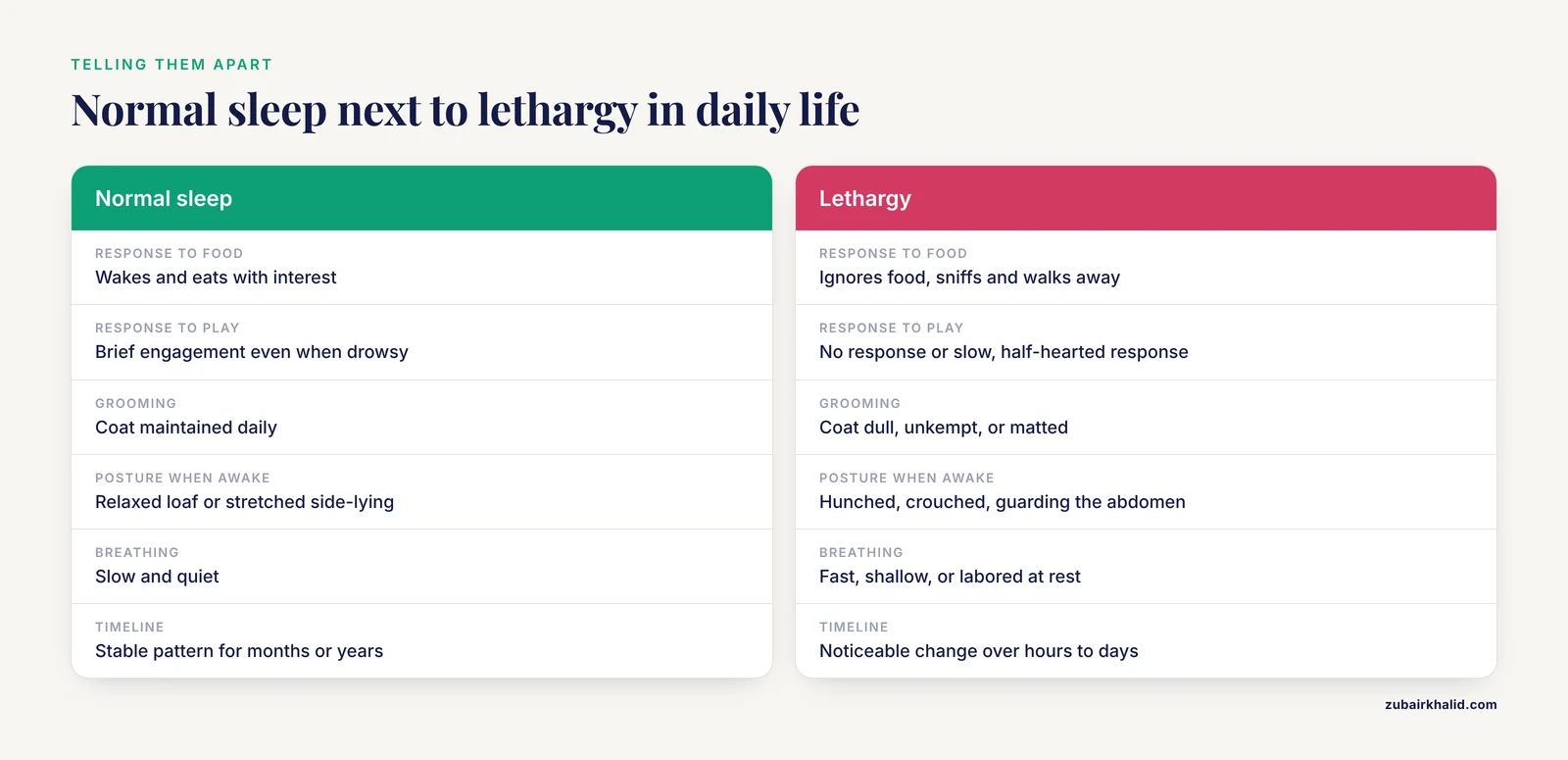
| Feature | Normal sleep | Lethargy |
|---|---|---|
| Response to food | Wakes and eats with interest | Ignores food, sniffs and walks away |
| Response to play or favorite stimuli | Brief engagement even when drowsy | No response or slow, half-hearted response |
| Grooming | Coat maintained daily | Coat dull, unkempt, or matted |
| Posture when awake | Relaxed loaf, stretched side-lying | Hunched, crouched, guarding the abdomen |
| Breathing | Slow, quiet | Fast, shallow, or labored at rest |
| Temperature feel | Warm nose and ears vary normally | Feels unusually hot (possible fever) or cold (possible poor circulation) |
| Litter box | Consistent habits | Straining, accidents, reduced output |
| Timeline | Stable pattern for months or years | Noticeable change over hours to days |
Why the Difference Matters
Cats evolved to hide weakness, and modern house cats preserve that instinct. Sick cats often mask discomfort until disease is advanced, which means the first visible clue is frequently nothing more than "he seems quieter." A cat that appears merely sleepy can be running a fever, fighting an infection, or cushioning a painful abdomen. The Cornell Feline Health Center emphasizes that subtle behavior changes, including reduced activity and appetite, are among the earliest signs owners can detect, and that early veterinary attention improves outcomes for many feline illnesses.
There is also a time-sensitive reason to act. When a cat stops eating or eats far less for more than a day or two, the risk of hepatic lipidosis, a serious liver condition triggered by prolonged anorexia, rises, particularly in overweight cats. Cornell's Feline Health Center identifies hepatic lipidosis as one of the most common severe liver diseases in cats in North America and links it directly to periods of not eating. This is why "she is just sleeping more and skipping breakfast" is never a sentence to sit on for a week.
Step-by-Step Home Assessment
Work through these steps in order. Each one takes less than two minutes and produces information your veterinarian will actually want.
Step 1: Test arousability
Approach quietly. Say your cat's name. Touch a paw or the shoulder. A normally sleeping cat rouses within seconds, stretches, and shows interest in its surroundings. A lethargic cat may lift its head weakly, stare blankly, or put its head back down. Note how long full recovery of normal behavior takes after waking. A healthy cat is fully "online" within a minute or two.
Step 2: Offer a food test
Present a small amount of something genuinely appealing, such as a favorite wet food warmed slightly. Do not force feed. Record what happens: eager eating, slow nibbling, sniffing then refusing, or total disinterest. Appetite is one of the strongest practical signals separating normal sleep from illness, and appetite data from home is extremely useful during the veterinary exam.
Step 3: Check gum color and moisture
Gently lift the lip. Healthy gums are pink and slick. Pale, white, bluish, muddy, or brick-red gums, or gums that feel dry and tacky, warrant an immediate call. If your cat resists this step, do not wrestle. A struggling cat can bite, and cat bites frequently require medical treatment for people, so stop and note that the check could not be completed.
Step 4: Observe breathing at rest
Count breaths while your cat is asleep or calmly resting. Normal resting breathing is slow and quiet. Fast breathing at rest, open-mouth breathing, or visible effort with the belly pushing on each breath is an emergency sign in cats. Cats almost never pant from exertion the way dogs do.
Step 5: Assess hydration
Lightly tent the skin over the shoulders and release it. In a well-hydrated cat, the skin snaps back immediately. Skin that stays tented or returns slowly suggests dehydration, which accompanies many illnesses and always justifies a call. Also note water bowl activity. A sudden increase in drinking can signal kidney disease, diabetes, or other conditions, while a decrease pairs dangerously with vomiting.
Step 6: Review the litter box
Scoop and count. Note urine clump size, any blood, stool consistency, and whether your cat cried out, groomed excessively after leaving the box, or made repeated trips with nothing produced. Straining to urinate with little or no urine is a same-hour emergency, especially in male cats.
Step 7: Look for fever signs indirectly
You cannot reliably assess fever by nose or ear feel. Healthy adult cats run a body temperature of roughly 100 to 102.5 degrees Fahrenheit, and only a thermometer or a veterinary exam confirms fever. What you can note at home are the companions of fever: shivering, a hunched posture, warm ears, seeking cool surfaces, and complete disinterest in food. Report these observations rather than guessing a number.
Step 8: Photograph or video
Take a short video of your cat's posture and movement, and a photo of the litter box contents if abnormal. Owners frequently report "he seemed fine at the clinic," and footage helps the veterinarian see the change you noticed at home.
The Cat Lethargy vs Normal Sleep Template
This is the template portion of the cat lethargy vs normal sleep format. Copy it into a notes app or print it. Fill one row per observation period, ideally twice daily. Three days of completed rows give your veterinarian a timeline no single exam can replace.
Observation Log Template
| Field | What to record |
|---|---|
| Date and time | Hour and AM or PM |
| Estimated hours slept since last entry | Rough count or "mostly sleeping" |
| Arousability (1 to 5) | 1 = instantly alert, 5 = barely responds |
| Food offered and response | What food, percent eaten, seconds to interest |
| Water intake | Normal, increased, decreased, none observed |
| Gums | Pink and moist, pale, tacky, could not check |
| Resting breaths per minute | Count while asleep or calm |
| Litter box | Urine clumps, stool, straining, accidents |
| Grooming | Normal, reduced, none, matted area |
| Hiding or posture | Favorite spots vs new hiding, hunched or relaxed |
| Distinctive behaviors | Purring change, vocalizing, flinching when touched, head pressing, pacing |
| Other signs | Vomiting, diarrhea, sneezing, eye discharge, weight of any vomitus |
Score arousability the same way every time, and score it at the same points in the day. Consistency is what turns these rows into a trend.
Example 1: Normal Sleep Pattern
Mango, a 6-year-old domestic shorthair, sleeps about 14 hours daily. Here is a completed log over one day.
| Time | Entry |
|---|---|
| 7:00 AM | Slept roughly 9 hours overnight. Arousability 1. Ate all breakfast wet food within 3 minutes. Water normal. |
| 12:30 PM | Napped about 3 hours since breakfast. Arousability 1, came to window when treat bag opened. Gums pink and moist. |
| 6:00 PM | Napped 2 hours since noon. Arousability 2, stretched fully, groomed, played 4 minutes with wand toy. Urine clump normal. |
| 10:00 PM | Active evening zoomies 8:30 to 9:00. Slept 45 minutes since. Arousability 1. Stool normal in box. |
Reading: long sleep totals, easy arousal, full meals, normal grooming, normal litter output. This is normal sleep. No action needed beyond routine preventive care.
Example 2: Lethargy Pattern
Oscar, a 9-year-old domestic shorthair, normally sleeps 13 hours daily and greets every meal loudly. His family noticed he was "quiet" and started logging.
| Time | Entry |
|---|---|
| Day 1, 7:00 AM | Slept through breakfast time, unusual. Arousability 3. Ate half of breakfast slowly. |
| Day 1, 6:00 PM | Slept nearly all day. Arousability 4. Ate 3 bites of dinner. Hiding under bed instead of couch. |
| Day 2, 7:00 AM | Arousability 4. Sniffed food, walked away. Gums pink but tacky. Skin over shoulders returned slowly. No urine clump found in box from overnight. |
| Day 2, 8:00 AM | Called veterinarian with log in hand. Same-day appointment booked. |
Reading: two distinct red flags. Total sleep rose while arousal, appetite, grooming, hydration, and urine output all fell. The pattern moved across multiple body systems, which is the signature of lethargy rather than tiredness. The completed log let the clinic triage Oscar as urgent rather than routine.
How to Describe Lethargy to Your Veterinarian (Format)
Use this short format when you call or arrive. It takes under a minute and it prevents the most common communication failure, which is vague words like "lethargic" with no anchor points.
- Signalment: age, breed or type, sex, spay or neuter status, approximate weight trend.
- Baseline: "His normal is 13 hours of sleep and he meets me at the bowl."
- Change and timeline: "Starting Tuesday morning, he sleeps most of the day, ate half of Tuesday's meals, and has eaten nothing today."
- Home findings: gum color, skin tent result, resting breathing, litter box events, hiding, any vomiting or diarrhea.
- Exposures: new plants, lilies in a bouquet, human medications, cleaning products, possible access to garage or outdoors, new foods, other sick pets in the home.
- Your questions: what tests are planned, what the monitoring plan is at home if illness is ruled out, and when to recheck.
Mentioning lilies matters enough to say plainly. True lilies and daylilies are severely toxic to cats, and kidney injury can begin within hours of chewing even a small amount, so any known or suspected exposure combined with lethargy is an emergency, not a watch-and-wait situation.
Common Mistakes Owners Make
Mistake 1: Chalking it up to age. Senior cats sleep more than young adults, but a sudden increase in sleep is not a normal aging event. Aging changes are gradual over months and years. A change over days is a symptom. Senior cats benefit from wellness exams twice yearly rather than annually, precisely because subtle decline is easy to miss between visits.
Mistake 2: Waiting out appetite loss. Cats that go without adequate food for more than a couple of days risk hepatic lipidosis, and overweight cats are at particular risk. If a cat eats poorly for 24 to 48 hours, call. Do not wait for a full weekend.
Mistake 3: Comparing to other cats or to dogs. Dogs wake eagerly and show sickness obviously. Cats do neither reliably. Judge your cat against its own baseline, which is what the template captures.
Mistake 4: Force feeding or giving human medications. Never give acetaminophen, ibuprofen, aspirin, or any human drug to a cat. These drugs can be fatal to cats at small doses, and masking symptoms before an exam removes the very clues your veterinarian needs.
Mistake 5: Treating a single data point as the whole story. One slow afternoon after a busy day of visitors is not disease. The pattern across 24 to 48 hours is what matters, which is why the log template asks for repeated entries.
Mistake 6: Missing the litter box clues. Owners watch the cat and forget the box. Urine output is one of the most informative signals available at home, and the absence of urine clumps overnight is a finding to report, not to assume away.
Cat Preventive Care: Reducing the Chance of Hidden Lethargy
Most causes of lethargy cannot be prevented entirely, but a structured cat preventive care routine shortens the list and catches problems early. Preventive care is also the cheapest medicine your cat will ever receive.
Cat Health Checklist
Use this cat health checklist as your annual framework, and adjust intervals with your own veterinarian.
- Wellness examination. Healthy adult cats should see a veterinarian at least annually, and senior cats, generally considered mature from around 7 years of age and senior from around 10, benefit from examinations twice a year according to AAHA guidance.
- Vaccinations. Core vaccines follow the schedules in the AAHA and AAFP feline vaccination guidance, with boosters tailored to your cat's lifestyle after a risk assessment with your veterinarian.
- Parasite prevention. The Companion Animal Parasite Council recommends year-round protection against fleas, heartworm, and intestinal parasites for cats, including indoor cats, because exposure occurs inside homes as well as outside.
- Weight and body condition. Ask your veterinary team to assign a body condition score at every visit and record it. Gradual weight gain hides in long fur, and both obesity and unexplained weight loss raise disease risk.
- Dental health. Dental disease is painful, and pain produces exactly the quiet withdrawal owners read as sleepiness. Ask for an oral assessment at each exam.
- Baseline bloodwork. For senior cats, periodic bloodwork and urinalysis establish baselines that make later abnormalities obvious early. Discuss an appropriate schedule with your veterinarian.
- Indoor environment. Provide vertical space, scratching surfaces, daily play, and separate resources in multi-cat homes. Behavioral stress can suppress appetite and activity, and enrichment is genuine preventive medicine for cats.
- Microchip and ID. The AVMA recommends microchipping as a permanent form of identification, paired with a collar and tag where appropriate.
- Toxin audit. Walk your home once a year. Remove lilies and other toxic plants, secure medications, and store automotive and household chemicals behind closed doors.
Limitations and When to Contact a Veterinarian
Every individual case is different, and only a veterinarian examining your cat can determine whether lethargy reflects minor self-limiting illness or serious disease. Home observation supports but never replaces that exam.
Contact your veterinarian promptly, the same day, when any of the following is true:
- Lethargy has lasted more than 24 hours with no clear cause such as a busy household event
- Appetite is reduced for 24 hours or more, or any meal is skipped entirely by a cat that normally eats well
- Your cat is hiding in new places, has stopped grooming, or resists being touched where it was previously comfortable
- Water intake has clearly increased or decreased
- Vomiting or diarrhea occurs more than once in 24 hours
- Your cat is a senior or has a known chronic condition such as kidney disease, diabetes, or hyperthyroidism, and behavior has shifted
Go to emergency care immediately, without waiting for a call back, when any of these applies:
- Open-mouth breathing, labored breathing, or rapid breathing at rest
- Pale, white, blue, or brick-red gums
- Collapse, seizures, or unresponsiveness
- No urine produced, or repeated straining with crying, particularly in a male cat
- Known or suspected ingestion of lilies, human medication, antifreeze, rodenticide, or toxic plants
- A body temperature you cannot bring down alongside profound listlessness, shivering, or a hunched posture
- Any cat that will not eat at all for 48 hours or more, or 24 hours or more in a kitten, a senior, or a diabetic cat
Kittens deserve a lower threshold than adults. A kitten under 6 months of age that is lethargic and eating poorly can deteriorate within hours because it has small energy and fluid reserves, so treat kitten lethargy as a same-day problem, every time.
Frequently Asked Questions
How many hours a day do cats normally sleep?
Healthy adult cats commonly sleep 12 to 16 hours per day, often more, spread across many short naps with activity peaks at dawn and dusk. Kittens and senior cats sleep even more. The number alone tells you little. What matters is whether your cat's sleep pattern has changed from its own baseline.
My cat is sleeping more than usual but still eats. Is that lethargy?
Possibly, but not necessarily. If your cat wakes readily, eats full meals, grooms normally, and uses the litter box normally, increased sleep is often benign, especially after an active day. If sleep is increasing alongside smaller meals, new hiding spots, or reduced grooming, start the observation log and call your veterinarian.
How long can a cat go without eating before it becomes an emergency?
Call your veterinarian when a cat has eaten little or nothing for 24 hours, and treat 48 hours of no food as urgent regardless of how the cat seems. Prolonged anorexia can lead to hepatic lipidosis, a serious liver disease, and overweight cats are at particular risk. Kittens, seniors, and diabetic cats need even faster action.
Can a lethargic cat just be tired from a busy day?
Yes, occasionally. A cat that hosted visiting children or had an unusually stimulating day may sleep longer the next day. The test is recovery. If energy, appetite, grooming, and behavior return to normal within 24 hours, tiredness is the likely explanation. If they do not, log your observations and call.
What should I tell the vet when I call about lethargy?
Give your cat's age and baseline, when the change started, what you have observed using the template fields, including appetite, gums, breathing, hydration, and litter box findings, and any possible toxin exposure. Offer to send your log and any video. This format lets the clinic triage accurately on the first call.
Do older cats naturally become lethargic?
Senior cats do sleep more and move more slowly, but natural aging is gradual. A sudden drop in activity, appetite, or engagement in an older cat is a symptom until proven otherwise, and senior cats should be examined twice yearly so that conditions like kidney disease, hyperthyroidism, arthritis, and dental pain are caught early.
What home checks can I do right now?
Check arousability, offer a small favorite food, look at gum color, count resting breaths, test skin elasticity over the shoulders, and inspect the litter box. Record what you find in the template above. These five minutes of observation are the same information your veterinarian will ask about first.
Can stress or boredom cause lethargy?
Stress and under-stimulation can reduce activity and appetite in cats, and hiding after a move, a new pet, or construction noise is common. However, stress and illness look alike, and illness is the more dangerous explanation to miss. If reduced activity lasts more than about 24 hours or pairs with appetite loss, have your veterinarian rule out medical causes before treating it as behavioral.