When to Euthanize a Finich: Quality of Life Signs
By Dr. Zubair Khalid, DVM, MS, PhD ·
Euthanasia becomes the right choice for a finch when illness or age has caused suffering that treatment cannot relieve, when the bird can no longer perform basic functions such as eating, perching, and moving normally, and when your avian veterinarian agrees that the outlook for a comfortable life is poor. Because finches are small prey animals that hide illness until they are very sick, this decision often arrives quickly, and owners frequently feel unprepared for it. This guide walks you through a practical finch quality of life scale, the signs a finch is dying, concrete steps for how to comfort a dying finch, and how to handle grieving the loss of a finch afterward.
This article is educational and is not a substitute for veterinary diagnosis or treatment. Any decision to euthanize a pet finch should be made with an avian veterinarian who can examine the bird, identify treatable conditions, and confirm when the suffering is beyond relief.
At a Glance: Your Decision Checklist
Use this checklist today if you are worried about your finch. Any single item in the urgent column means you should contact an avian veterinarian the same day.
| Domain | What is normal | Cause for concern | Urgent, same-day veterinary contact |
|---|---|---|---|
| Posture and position | Upright on the perch, alert, quick movements | Fluffed feathers for most of the day, hunched posture | Sitting on the cage floor, unable to perch |
| Breathing | Quiet, effortless, beak closed | Tail bobbing with each breath, labored effort | Open-mouth breathing or gasping |
| Appetite and drinking | Eats millet seed and other foods throughout the day, drinks regularly | Eating noticeably less, ignoring favorite foods | No eating or drinking for many hours in a small bird |
| Plumage and body condition | Smooth, sleek, well-groomed feathers | Ruffled, dull, unkempt feathers, a prominent breastbone | Soiled vent area, feathers matted around the vent |
| Activity and social behavior | Sings, calls to flock mates, interacts, moves between perches | Sitting still for long periods, withdrawn from the flock | Falls from perches, cannot stay upright, seizures |
| Droppings | Small, formed droppings with a dark center and white cap | Changes in volume, color, or consistency that persist more than a day | Diarrhea, no droppings, blood in droppings |
The overall rule of thumb: when several domains are in the concern or urgent column at the same time, when the bird has stopped improving despite care, and when its good moments no longer outnumber the bad ones, it is time to have an honest quality of life conversation with your veterinarian about euthanasia.
Why This Decision Is Different for Finches
Two realities shape end-of-life decisions in finches, and both work against waiting too long.
The first is the prey-animal paradox. Finches are small songbirds, and like most small prey species they mask weakness. A bird that shows visible illness to a predator in the wild would be singled out, so pet finches carry the same instinct and look almost normal until their reserves are nearly gone. By the time a finch is sitting fluffed on the cage floor, it is usually much sicker than it appears. This is why avian veterinarians, including guidance published by the Association of Avian Veterinarians, urge owners to treat even subtle changes in a small bird as potentially serious rather than waiting to see whether the bird bounces back.
The second is speed. Small bodies have small reserves. A canary or zebra finch that stops eating can decline in hours to days, not weeks. This compresses the timeline you have for observation, diagnosis, and decision making. It also means the question of when to euthanize a finch is rarely a slow, months-long deliberation the way it can be with a dog or cat. More often, owners face a compressed window of a few days in which the bird is clearly failing and the choice must be made.
Neither reality means you should rush to euthanize. Many finch illnesses, caught early, respond well to treatment. The goal of the sections below is to help you recognize the difference between a bird that is sick but treatable and a bird whose suffering has reached the point where humane euthanasia is the kindest remaining option.
Start With a Baseline: What a Healthy Finch Looks Like
You cannot judge decline without knowing what normal looks like for your individual bird. Spend time watching your finch when it is well and you will be far better positioned to notice decline early.
A healthy zebra finch or other pet finch shows these markers:
- Sleek plumage. Researchers studying zebra finch welfare have developed and validated a simple plumage scoring system in which healthy, well-cared-for birds carry smooth, complete, well-maintained feathers, while declining well-being shows up as ruffled, damaged, or unkempt plumage that observers can score reliably and non-invasively [1]. In plain terms, feather condition is one of the most trustworthy everyday windows into your finch's well-being.
- Good body condition. The same research program examined fat scores, a body condition measure used in small passerines, and found plumage scoring was easier for untrained observers to apply consistently than fat scoring, which required more training [1]. For owners, the practical takeaway is that the feather condition you can see daily is your most reliable at-home indicator.
- Normal social behavior. Finches are flock birds. A healthy finch engages with cage mates, sings or calls, and reacts to activity in the room. In zebra finches, normal social and mate-choice behavior is a core part of the species' behavioral repertoire, with female zebra finches actively assessing and choosing among males based on appearance and environment in controlled studies [2]. A finch that has stopped participating in the social life of the cage, including pair bonding, courtship, and mutual preening, has lost something meaningful, and that loss is itself a welfare signal.
- Constant small meals. Finches are high-metabolism birds that eat many small meals through the day rather than one or two large ones. Normal finches are frequently at the seed cup.
- Quick, purposeful movement. Hopping between perches, fluttering to the food dish, and orienting instantly toward sounds are all normal.
Build your baseline by photographing your bird in good condition, noting its typical weight if you use a small gram scale, and recording how it spends its day. When decline begins, this record turns a vague worry into an objective comparison.
A Finch Quality of Life Scale You Can Actually Use
Formal quality of life scales exist for dogs and cats, and the concept transfers to birds with adjustments. The scale below is adapted for finches using the indicators that researchers and avian practitioners have found meaningful: plumage condition as a validated welfare marker in zebra finches [1], distress-related behaviors documented in finch handling contexts [3], and the everyday functions an owner can observe without handling the bird.
Score each of the six domains below on a simple three-point scale: 2 points for good days, 1 point for declining, and 0 points for poor. Total the score out of 12. This is an observation and communication tool, not a mathematical verdict. Its real value is that it forces you to look at each domain separately and gives you concrete language to use when you call your veterinarian.
Domain 1: Posture and Perching (0-2)
- 2: Sits upright on the perch, shifts positions freely, sleeps with feathers slightly loose only at night.
- 1: Fluffed for much of the day, favors one perch, less upright posture.
- 0: Sits on the cage floor, cannot perch, hunched with feathers tightly fluffed.
A fluffed-up finch is the single most common early sign of illness that owners describe. Persistent daytime fluffing means the bird is trying to conserve heat, which happens when it feels unwell or is running a temperature.
Domain 2: Breathing (0-2)
- 2: Breathing is invisible or nearly so, beak closed.
- 1: Visible effort, slight tail bob, more breathing movement than usual.
- 0: Open-mouth breathing, obvious tail bobbing with each breath, clicking or wheezing sounds audible across the room.
Open-mouth breathing deserves special weight. In a controlled study comparing euthanasia methods in zebra finches, open-mouth breathing was one of the behaviors the researchers specifically scored as potentially indicating discomfort or distress, precisely because it is recognized as a meaningful welfare signal in these small birds [3]. In a pet finch, open-mouth breathing at rest is an emergency sign, not a wait-and-see sign.
Domain 3: Appetite and Weight (0-2)
- 2: Eats throughout the day, cracks seeds normally, shows interest in greens or treat foods.
- 1: Eats less, drops favorite foods, needs foods presented close by.
- 0: Not eating, or only nibbling when you place food directly in front of the bird.
Because finches eat constantly when healthy, reduced appetite shows up quickly and matters enormously. Discuss with your avian veterinarian how to monitor weight at home and what drop would be significant for your bird's size.
Domain 4: Plumage and Cleanliness (0-2)
- 2: Smooth, sleek, self-maintained feathers, clean vent area.
- 1: Duller, ruffled, less grooming, some droppings staining around the vent.
- 0: Matted, soiled, unkempt feathers, heavily stained vent, lost feather condition over days.
This domain is grounded directly in the validated plumage scoring work in zebra finches, which demonstrated that feather condition can be scored reliably by different observers and tracks well-being in this species [1]. Check the vent area daily in a declining bird, since droppings that stick to the vent feathers signal both illness and a hygiene problem that adds to the bird's discomfort.
Domain 5: Activity and Social Participation (0-2)
- 2: Sings, calls, interacts with cage mates, moves between perches normally.
- 1: Quiet, less interaction, watches the flock instead of joining it.
- 0: Withdrawn completely, sleeps during the day, does not react to cage mates or to you, falls from perches.
Social withdrawal is particularly meaningful in finches because flock participation is central to the species. Normal zebra finch behavior includes active mate choice and pair interaction, and researchers use participation in these behaviors as a marker of normal functioning [2]. A finch that no longer engages with its pair or flock has declined in a way that pure physical measures can miss.
Domain 6: Comfort and Freedom From Pain (0-2)
- 2: Relaxed, normal resting positions, responds normally to handling or cage activity.
- 1: Restless, shivering, guarding a body part, limping or favoring a leg.
- 0: Trembling, rigid or hunched, crying out when moving, unable to settle anywhere.
Using the Score
Add the six numbers for a total between 0 and 12. Two patterns matter more than any single number:
- A total trending downward over several days, even slowly, means the trajectory is wrong and a veterinary visit is needed to look for treatable causes.
- A low total that persists after treatment has been attempted, with several domains at 0, indicates that the bird's suffering is ongoing. This is the situation in which euthanasia discussion becomes appropriate.
Review the scale at the same time each day, ideally in the morning after the bird has had its first hours of light, and keep brief written notes. Small birds hide illness, so trends over days reveal what any single observation hides.
Signs a Finch Is Dying
The signs a finch is dying tend to arrive in a recognizable sequence, though not every bird shows every sign and some birds move through them very quickly.
Early warning signs, days to weeks before the end in chronic illness:
- Fluffed feathers during the day when the bird is not sleeping
- Reduced singing and vocalizing
- Eating noticeably less or picking at only favorite seeds
- Less movement around the cage, longer stationary periods
- Plumage losing its sleek condition, mild vent staining
- Subtle changes in droppings that persist beyond a day
Later-stage signs:
- Sitting on the cage floor, which in a normally perching bird is a serious sign
- Profound lethargy, eyes partly or fully closed during the day
- Tail bobbing with each breath, labored or open-mouth breathing
- Weight loss you can feel as a sharp, prominent keel (breastbone)
- Inability to fly or flutter up to perches, falling from perches
- No interest in food or water, even favorite treats
- Soiled, matted feathers around the vent or body
- Cold feet and generalized coldness of the body
Final-stage signs:
- Lying on the cage floor, unable to right itself
- Seizures, twisting of the head or neck, or rolling movements
- Very shallow, slow, or open-mouthed breathing
- Unresponsive to touch, sound, or the approach of cage mates
- Head drooping or wedged into a cage corner
When you observe late-stage or final-stage signs, your immediate task shifts from diagnosis to comfort, and your immediate call is to an avian veterinarian to discuss whether anything is still treatable and whether euthanasia is the humane choice. The Merck Veterinary Manual's pet bird resources emphasize that critically ill birds are fragile patients and that supportive care and euthanasia decisions for them belong in a veterinary setting.
When to Euthanize a Finch: Making the Decision
The question of when to euthanize a finch comes down to a balance you can state in one sentence: is the bird having more bad moments than good ones, and is there a reasonable chance that treatment will restore a comfortable life?
The American Veterinary Medical Association frames euthanasia as the induction of a painless, stress-free death and recognizes that, for animals whose suffering cannot be relieved, euthanasia is an act of humane care rather than a failure of it. Applied to a finch, the decision generally meets the humane threshold when these conditions hold together:
- A veterinarian has examined the bird, or at minimum evaluated it remotely, and treatable causes have been ruled out or treated without success.
- Basic functions are failing. The bird cannot perch, cannot reach food and water, is not eating despite supportive feeding measures, or cannot maintain normal posture.
- Distress is visible and continuous. Fluffed posture around the clock, open-mouth breathing, constant trembling, or pain responses that no intervention relieves.
- The trend is one-directional. Days of scores on your quality of life scale are moving downward with no plateau or recovery.
- Good moments no longer outnumber bad ones. On a good day the bird still eats, sings, and interacts. When those moments have disappeared entirely, or when the bird's bad hours dominate every day, the balance has tipped.
Give the decision one full, honest review before proceeding. Ask your veterinarian three questions directly: Is anything treatable? What would treatment look like for a bird this size and this sick? If we treat, what is a realistic picture of the bird's life afterward? Finches can recover from surprisingly severe episodes when the underlying problem is treatable, so euthanasia is appropriate when comfort cannot be restored, not simply because the bird is old or has a chronic condition.
One practical note on decision timing: because small birds decline fast, waiting through a weekend to "see how it goes" is often not a neutral choice. If your finch is showing urgent signs from the checklist above, Friday afternoon is not too early to call.
What Euthanasia for a Finch Actually Involves
Understanding the mechanics of finch euthanasia can reduce fear of the unknown for owners.
Euthanasia of a pet finch is performed by a veterinarian, almost always with the bird under anesthesia first so it is unconscious and unaware. The research literature on zebra finch euthanasia gives a window into the methods that have been formally studied in this species. In a comparison of five euthanasia methods in zebra finches, the fastest route to respiratory arrest came from administering sodium pentobarbital, and the study concluded that intracoelomic administration of pentobarbital in the bird was a rapid and effective euthanasia method, while carbon dioxide, when used, required a high chamber displacement rate to limit distress behaviors such as open-mouth breathing and head retroflexion [3]. Research settings and clinical practice differ, and the specific protocol your veterinarian uses will reflect the AVMA Guidelines for the Euthanasia of Animals, current drugs available in clinical avian practice, and the bird's condition. The essential point for you as an owner is that a properly performed avian euthanasia is fast, and that the behaviors researchers watch for as signs of distress, especially open-mouth breathing, are precisely what a well-executed protocol is designed to avoid [3].
Never attempt to euthanize a finch at home. No home method, including freezing, CO2 exposure from household sources, or any substance, is humane, and attempting one causes suffering and can constitute animal cruelty under state law in the United States. If cost or access to an avian veterinarian is the barrier, call regular small-animal clinics in your area, veterinary schools, and local exotics practices, since many clinics will perform euthanasia on small birds even when they do not provide full avian medical care. Some owners choose to have the euthanasia performed during a scheduled appointment so they can be present, and most veterinarians will accommodate this for a small bird if asked in advance.
Afterward, ask the clinic about body handling options. Most offer either communal cremation or, for a fee, individual cremation with return of ashes. There is no wrong choice, and deciding in advance, before the appointment, removes one decision from the hardest hour.
How to Comfort a Dying Finch
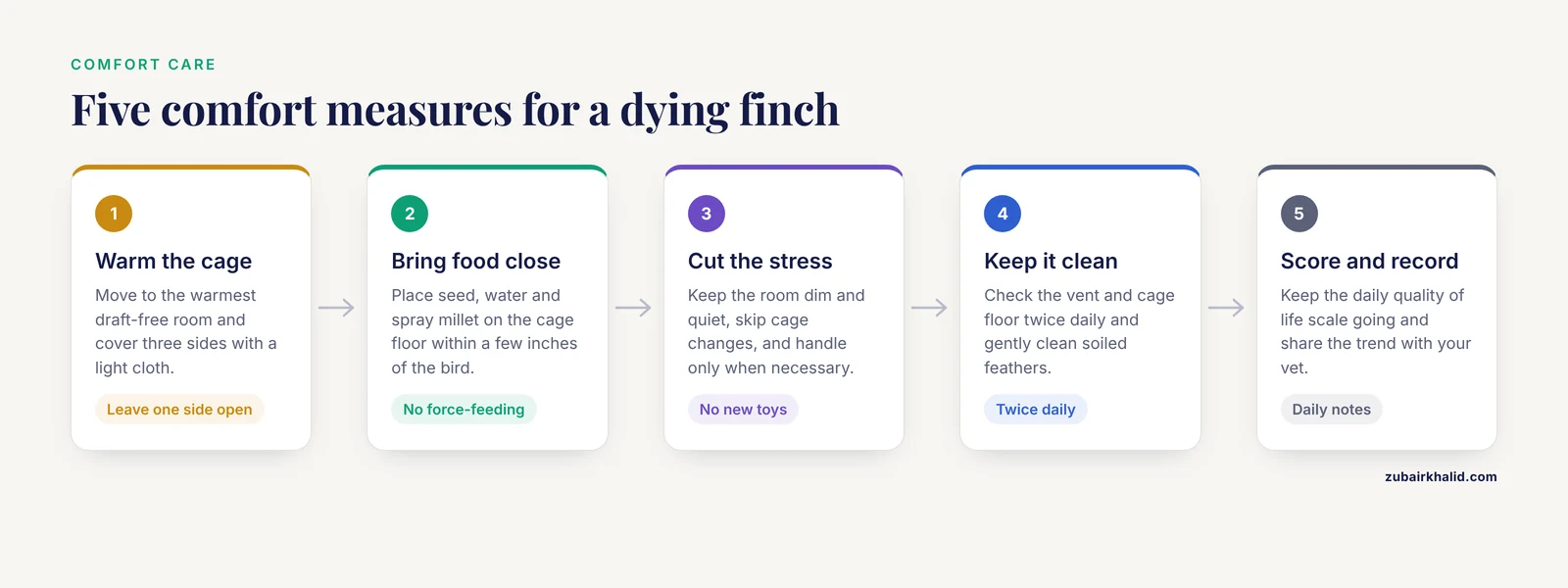
Comfort care, sometimes called supportive or palliative care, is what you do for a finch whose condition cannot be fixed, whether the bird is awaiting a veterinary appointment, recovering from an acute crisis, or in its final days at home under veterinary guidance. The goals are warmth, easy access to essentials, low stress, and cleanliness.
Warmth First
A sick finch loses the ability to regulate its body temperature, and warmth is the single most valuable comfort measure you can provide. Move the cage to the warmest draft-free room in the house. Cover three sides of the cage with a light cloth to hold heat and reduce visual stress, leaving one side open for airflow and observation. Many avian practitioners recommend providing supplemental heat so part of the cage stays comfortably warm, and products such as a ceramic heat emitter or a bird-safe heated perch can accomplish this. Discuss the exact temperature target with your avian veterinarian, since overheating a critically ill bird is also harmful. Avoid heat lamps with exposed bulbs, hot water bottles that can leak, and anything the bird can chew.
Make Food and Water Effortless
A declining finch cannot make long trips to the food dish. Place seed, water, and any approved soft foods directly on the floor of the cage within a few inches of where the bird sits. Offer favorite foods, including spray millet, which many finches will nibble even when they refuse everything else. Do not force-feed and do not administer any homemade formulas, oils, or remedies by mouth, since aspiration into the lungs is a real risk in a weak bird and can be fatal. If your veterinarian recommends assisted feeding, ask for a demonstration of the exact product and technique rather than improvising.
Reduce Stress and Disturbance
- Move the bird away from household traffic, other pets, loud televisions, and children.
- Keep lighting on a normal day-night rhythm but dim in the room.
- Do not rearrange the cage, and do not introduce new perches, toys, or cage mates.
- Keep other finches with the bird if the flock is calm and the sick bird is not being picked on. Separating a finch from its flock can add stress, but a cage mate that harasses a weak bird should be removed.
- Handle the bird only when necessary, and then gently, with warm hands, low to a soft surface in case it flutter-falls.
Keep the Bird Clean
Check the vent area and cage floor at least twice daily. Remove soiled paper, replace with fresh lining, and if the vent feathers are soiled, gently clean the area with a warm, damp cloth or cotton pad. A bird that sits in its own droppings develops skin irritation and infection, and the discomfort is entirely preventable.
Watch and Record
During comfort care, continue your daily quality of life scale. Comfort care is not a holding pattern forever. It is appropriate while there is a treatment plan in motion or while the bird remains comfortable in its basics. The moment the scores show ongoing suffering with no plan that can change the trajectory, comfort care has done its job and the euthanasia conversation should happen.
A Step-by-Step Path Through the Decision
If you are facing this situation now, here is the sequence in practical order.
- Observe and score. Start the quality of life scale today. Write down scores for all six domains once or twice daily.
- Document what you see. Take a short video of the bird breathing, eating, and moving. Birds often look normal in the veterinary clinic because adrenaline masks illness, and video gives the veterinarian information the appointment cannot.
- Call an avian veterinarian. Describe the signs, share your scores and video, and ask whether the bird should be seen and when. If no avian vet is nearby, ask general practices whether they see birds and be honest that it is an end-of-life evaluation.
- Pursue the indicated workup and treatment if appropriate. For a bird with a treatable condition, follow the treatment plan exactly, including medication timing and follow-up rechecks, and re-score daily during treatment.
- Set a review point. Agree with your veterinarian on a specific date to reassess, for example one to two weeks into treatment for a stable chronic condition, or 48 hours for an acute episode. On that date, review the scores together and decide whether to continue, change course, or plan euthanasia.
- Plan the euthanasia appointment when the decision is made. Schedule it at a calm time of day, decide who will attend, decide on aftercare (communal or individual cremation), and ask the clinic in advance whether you can be present.
- Prepare the household. If other finches remain, plan how you will manage the cage and flock afterward, which is covered in the grieving section below.
Common Mistakes Owners Make
- Waiting too long because the bird still looks "okay." Finches mask illness. Waiting until a bird is on the cage floor often means waiting until it is in its final hours, which removes the option of a calm, planned euthanasia.
- Waiting too little, without a veterinary opinion. The opposite error is real too. Lethargy and fluffing have many causes, some very treatable, and euthanasia should not be decided from living-room observation alone.
- Internet remedies. Home treatments for sick birds, from apple cider vinegar in the water to over-the-counter "bird antibiotics," delay real care, can interact with prescribed drugs, and have no evidence base in finches. Nothing belongs in your finch's water or on its food without veterinary direction.
- Handling a critically ill bird roughly. A struggling bird with respiratory disease can deteriorate from the stress of restraint. When you must move a very sick finch, cup it gently in both hands rather than gripping it, and keep the session short.
- Assuming cold is the disease. Owners often blame a draft for a fluffed bird. Cold stress can contribute, but fluffing is a symptom of illness, and treating only the temperature misses the underlying problem.
- Not preparing for the appointment. Arriving at the clinic without your notes, videos, or a decision about aftercare makes an already hard day harder.
Welfare and Safety Points
- Zoonosis and hygiene. Some bird illnesses can affect people. Wash your hands after handling a sick finch, cleaning the cage, or handling droppings, and keep the bird's supplies out of the kitchen. Immunocompromised household members should discuss bird care duties with their physician.
- Protect the rest of the flock. A sick bird should be evaluated partly because infectious disease can spread through a finch flight or aviary. Ask your veterinarian whether the sick bird should be separated and whether any quarantine, cleaning, or monitoring protocol is needed for the other birds. Quarantine procedures for new and ill birds are a standard recommendation in avian practice, and your veterinarian can tailor one to your setup.
- Humane handling at the end. A finch in its final hours should not be moved, weighed, photographed repeatedly, or passed among family members. Every unnecessary stressor costs a dying bird energy it does not have.
- Disposal and legality. In the United States, the bodies of pets that died of illness are typically handled through veterinary cremation services, and some municipalities regulate home burial or disposal of animal remains. If you are considering home burial, check your local rules first.
Limitations and When to Contact a Veterinarian
Every finch is an individual, and the patterns in this article describe tendencies, not certainties. Individual cases require examination by a veterinarian, and no article can substitute for hands-on evaluation of a sick bird. The scale in this guide is an owner observation framework built on indicators validated in research settings, not a diagnostic instrument.
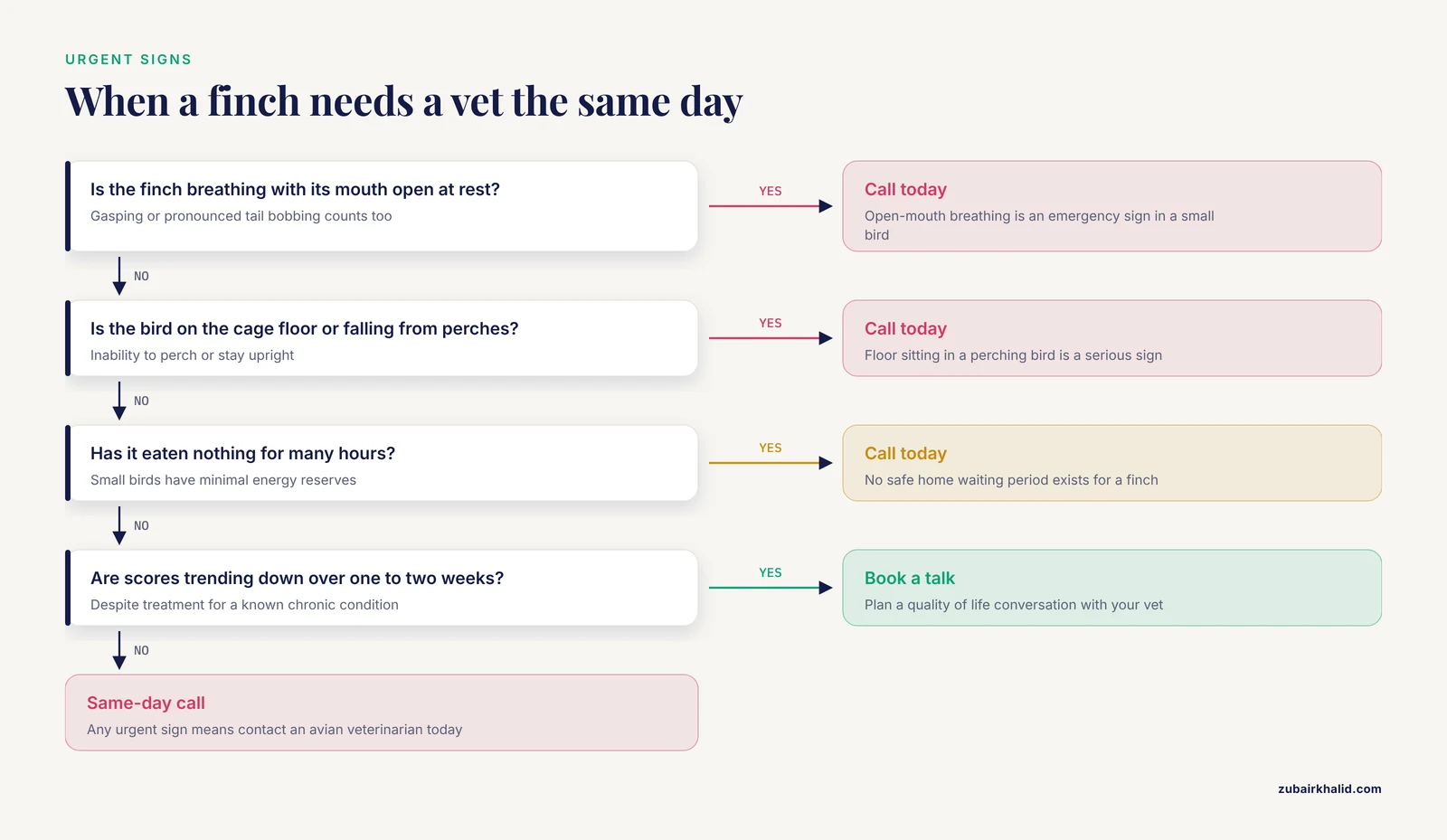
Contact an avian veterinarian the same day if your finch shows any of the following:
- Open-mouth breathing, gasping, or pronounced tail bobbing at rest
- Sitting on the cage floor, inability to perch, or falling from perches
- No food intake for many hours, given how fast small birds decompensate
- Blood in or on the droppings, no droppings at all, or severe diarrhea
- A closed or half-closed eye, discharge from the eyes or nostrils, or a visible growth or swelling
- A broken blood feather, bleeding of any kind, or an apparent fracture
- Sudden fluffing with lethargy in a bird that was normal the day before
- Seizures, loss of balance, head tilt, or abnormal neck posture
Contact a veterinarian for a planned, non-urgent conversation about quality of life and euthanasia when your finch has a known chronic condition, when daily scores have been trending down over one to two weeks despite treatment, or when you find yourself dreading each morning's check because you expect the bird to be worse. That dread is itself data, and a veterinarian experienced with birds can help you turn it into a plan.
Grieving the Loss of a Finch
Grieving the loss of a finch is real grief, and it is often harder than outsiders expect. People who have never kept birds sometimes dismiss the loss of a small animal, which can leave owners grieving alone. The bond with a finch is built out of daily small attentiveness, years of morning song, and the quiet responsibility of caring for a fragile life. Losing it matters.
A few things help many owners:
- Acknowledge the loss out loud. Tell someone who will not minimize it, whether a friend, a family member, or an online community of bird keepers. Many avian veterinarians' offices also have staff who understand pet bird loss.
- Do the aftercare ritual deliberately. Whether you choose cremation, keep a feather, or plant something in the bird's memory, a deliberate act of marking the loss helps the grief find its shape.
- Expect the empty-cage effect. The silence in a room where a finch sang every morning can be startling for weeks. Some owners need to remove or cover the cage promptly. Others leave it in place for a while. There is no correct timeline.
- Watch the remaining finches. Finches are flock animals, and the loss of a cage mate or pair partner affects them. A remaining finch may call for the lost bird, search the cage, or go quiet itself. Give the remaining bird extra attention, and if you later add new birds, introduce them gradually and with the quarantine protocol your veterinarian recommends.
- Consider a grief support resource. Veterinary organizations, including the AVMA, provide pet owner resources on pet loss and grief, and some veterinary schools operate pet loss hotlines staffed by trained volunteers.
- Do not rush a replacement. Getting a new finch the same week sometimes helps a lonely remaining bird, and sometimes it prevents the owner from finishing their own grieving. Decide based on your household, not on the expectation that a new bird erases the loss.
If grief remains overwhelming after many weeks, or if it is interfering with sleep, work, or relationships, talking with a counselor is a reasonable and ordinary step. Pet loss grief is a recognized form of bereavement.
Frequently Asked Questions
How do I know when it is time to euthanize my finch?
It is time when your veterinarian has confirmed that the bird's suffering cannot be relieved by treatment and the bird can no longer manage basic functions such as perching, eating, and staying warm and comfortable. Use the six-domain quality of life scale in this article, look for a persistent downward trend with several domains at zero, and make the final call together with an avian veterinarian.
What is a finch quality of life scale?
A finch quality of life scale is a simple daily scoring tool covering six domains: posture and perching, breathing, appetite and weight, plumage and cleanliness, activity and social participation, and comfort free of pain, each scored from 0 to 2 for a total of 12. Scores that trend downward over days, or that stay low after treatment, signal that a euthanasia discussion is warranted.
What are the signs a finch is dying?
Late-stage signs include sitting on the cage floor, fluffed feathers around the clock, eyes closed during the day, open-mouth or tail-bobbing breathing, refusal of all food, a prominent keel bone, soiled vent feathers, inability to perch or right itself, and unresponsiveness to its surroundings. Any of these warrants a same-day call to an avian veterinarian.
How do I comfort a dying finch?
Keep the bird warm in a draft-free space with the cage partially covered, place seed, spray millet, and water directly within reach on the cage floor, keep lighting dim and household noise low, clean the vent area and cage floor twice daily, and handle the bird as little as possible. Never force-feed or give any home remedy by mouth, and confirm all comfort measures with your veterinarian.
Can I euthanize my finch at home?
No. Home euthanasia methods for birds are not humane, cause suffering, and may violate animal cruelty laws in your state. Humane euthanasia must be performed by a veterinarian, and most clinics, including general practices that do not treat birds routinely, will euthanize a small bird. If cost is the barrier, call local clinics, veterinary schools, and exotics practices to ask.
How long can a finch go without eating?
A finch should never be allowed to go without eating for an extended period, because small birds have minimal energy reserves and can decline rapidly. There is no safe home waiting period, so if your finch has stopped eating, contact an avian veterinarian the same day rather than watching through the night.
Should my other finches be present at the euthanasia or see the body?
This is a personal choice, and there is no evidence-based requirement either way. What matters more is monitoring the remaining birds afterward, since finches are flock animals and a cage mate may call for or search for the lost bird. Give survivors extra attention, keep their routine stable, and consult your veterinarian before making flock changes.
How do I cope with grieving the loss of a finch?
Acknowledge the loss openly with people who take it seriously, perform a deliberate aftercare ritual such as cremation or keeping a feather, expect the silence of an empty cage to take weeks to adjust to, and use pet loss resources from organizations such as the AVMA if support would help. If grief remains disabling after many weeks, speaking with a counselor is a normal, healthy step.
Sources
- Plumage and Fat Condition Scores as Well-Being Assessment Indicators in a Small Passerine Bird, the Zebra Finch (Taeniopygia guttata).
- Colour Cues That Are Not Directly Attached to the Body of Males Do Not Influence the Mate Choice of Zebra Finches.
- Evaluation of Best Practices for the Euthanasia of Zebra Finches (Taeniopygia guttata).