What to Bring to Your Bird's First Vet Visit: Checklist
By Dr. Zubair Khalid, DVM, MS, PhD ·
Bring your bird in a secure travel carrier, your bird's purchase or adoption records, a written list of what and how much you feed, photos or videos of the bird's normal behavior and droppings, photographs of your cage setup from several angles, and any supplements or medications in their original packaging. A fresh sample of droppings, a signed note about recent changes in behavior, and a short list of questions round out the visit. This article gives you a complete, copyable checklist for your first avian vet appointment, explains why each item matters, and shows you how to prepare your bird for the trip.
This article is educational and is not a substitute for veterinary diagnosis or treatment.
At a Glance: First Avian Vet Visit Checklist
| Item | Why It Matters | Practical Tip |
|---|---|---|
| Secure travel carrier or small travel cage | Prevents escape and injury in the car and waiting room | Cover partially with a light towel to reduce visual stress |
| Cage liner or paper towel with fresh droppings | Droppings tell the veterinarian a great deal about digestive health | Collect the morning droppings on clean paper |
| Purchase, adoption, or breeding records | Establishes age, source, and any prior medical history | Bring the original documents or clear photos of them |
| Complete diet list with brands and amounts | Diet errors are among the most common problems in pet birds | Photograph the labels of everything you feed |
| Photos of the full cage setup | Shows bar spacing, perches, toys, and layout the vet cannot see at the clinic | Take one wide shot and several close ups |
| Short video of normal behavior and breathing | Birds hide illness, so baseline footage is valuable | Record 30 to 60 seconds while the bird is calm |
| All medications and supplements in original packaging | Lets the vet confirm products, strengths, and dosing | Do not repack or combine containers |
| Written list of your questions | First visits are busy, and questions are easy to forget | Number your questions and bring the list in writing |
| Towel for restraint and cleanup | Useful for safe handling and minor messes | Bring a clean, dedicated towel |
| Payment and your calendar | The exam may include follow up testing or a recheck booking | Ask before the visit what a first exam typically includes |
Why the First Visit Matters
Birds are prey animals. They instinctively hide weakness, so by the time a pet bird looks sick at home, the problem is often advanced. This single fact drives almost everything about avian preventive care, and it explains why the Association of Avian Veterinarians recommends that new birds receive an initial health examination and that all pet birds have regular wellness exams with a qualified avian veterinarian. The Merck Veterinary Manual makes the same practical point in its guidance on pet birds, noting that birds are adept at masking signs of disease and that regular veterinary evaluation is central to keeping them healthy.
Your first appointment is not just a sick bird visit. It is a baseline visit. The veterinarian weighs your bird, listens to its heart and lungs, examines the beak, feathers, eyes, nares, feet, and vent, and records normal values that become the reference point for every future visit. A baseline weight in particular is one of the most useful numbers in avian medicine, because unexplained weight loss in a bird is often an early warning sign.
The first visit is also where you and the veterinarian align on diet, housing, and daily care. Most of the common health problems seen in pet birds, including nutritional disease and husbandry related injuries, are shaped by decisions you make at home every day. The quality of the information you bring to this first appointment directly affects the quality of the advice you get back.
What to Bring to Your Bird's Vet Visit
This section is the core checklist. Work through it the night before the appointment.
The Travel Carrier
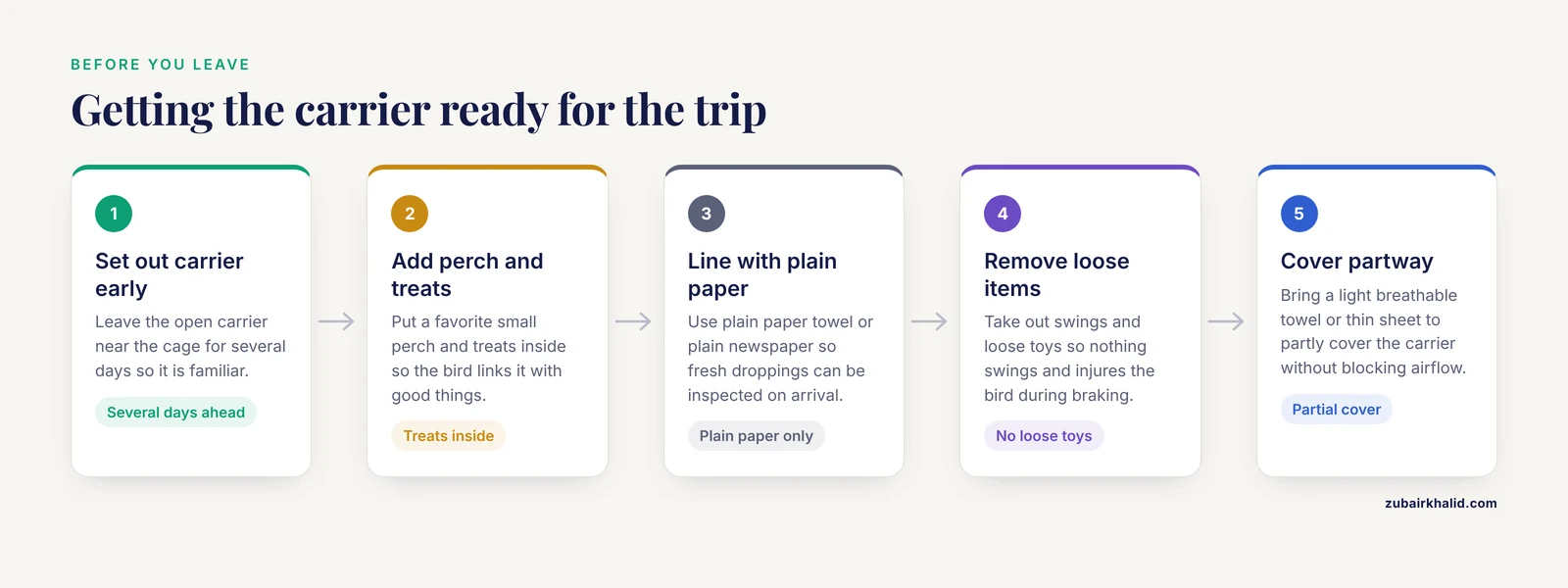
The carrier is the single most important item on the list. VCA Animal Hospitals' avian care guidance emphasizes that birds should be transported in a secure carrier or travel cage rather than carried loose, on a shoulder, or in a cardboard box with loose openings.
When choosing and preparing the carrier:
- Use a hard sided small animal carrier or a dedicated travel cage with a secure door.
- Choose a carrier large enough for the bird to stand upright, but small enough that the bird will not be thrown around during braking.
- Remove swings and loose toys from a travel cage so nothing moves abruptly and injures the bird during transport.
- Line the bottom with plain paper towel or plain newspaper so the veterinarian can inspect fresh droppings on arrival.
- Bring a light, breathable cover such as a thin sheet or towel to partly cover the carrier. Partial covering reduces visual stimulation without blocking airflow.
- In cool weather, warm the car before the bird goes in. In hot weather, never leave the bird in a parked car.
If your bird has never used the carrier, let it explore the carrier at home for several days before the visit. Feed a favorite treat near, and then inside, the carrier so the experience is not entirely new on exam day.
Records and Written History
Gather every document you have about the bird. If you adopted the bird, request records from the previous owner, breeder, shelter, or rescue before the appointment. Useful records include:
- Purchase or adoption paperwork with species, age or hatch date if known, and sex if known.
- Any prior veterinary records, including previous test results and vaccination or screening history where applicable.
- Band or microchip information if the bird has a leg band or was microchipped.
- A short written history covering how long you have had the bird, any recent changes in appetite, droppings, vocalization, feather condition, or activity, and any known contact with other birds.
Write this history in a numbered list on one page. A single clear page is more useful in the exam room than a folder of scattered notes.
Photos, Videos, and Samples
Birds often behave differently in a clinic than at home, so your phone becomes a diagnostic tool. Bring the following:
- Photos of the cage setup. Take one wide photo of the whole cage, then close ups of the perches, food and water stations, toys, substrate or liner, and the cage's location in your home. Cage design, perch variety, and placement all matter to an avian veterinarian assessing your bird's environment. Photos let the vet see the real setup instead of relying on your description.
- A short video of normal behavior. Thirty to sixty seconds of the bird moving, perching, eating, and vocalizing while calm gives the veterinarian a baseline. If the bird has any specific sign you are worried about, such as a tail bob, sneeze, or odd posture, capture that on video too.
- Fresh droppings. Line the carrier with clean paper and bring the morning droppings on the paper. Do not add water or preservative. Droppings have three visible components, the dark fecal portion, the white urate portion, and the liquid urine, and changes in color, volume, or consistency can signal problems in the digestive, liver, or kidney systems.
- Photos of droppings over recent days. If your bird's droppings have changed, photograph a few days of them so the veterinarian can see the trend.
Food, Supplements, and Medications
Diet is a central topic at every first avian visit, and the Association of Avian Veterinarians identifies nutrition as a foundation of bird health that owners should discuss directly with their avian veterinarian. Lafeber Company's avian nutrition resources likewise stress that a bird's diet is one of the most important factors an owner controls, and that switching a bird from a seed based diet to a balanced formulation requires patience and a structured plan.
Bring the following:
- Every food you offer, photographed. Photograph the front and the guaranteed analysis panel of pellets, seed mixes, and treats.
- A list of fresh foods you offer, with rough amounts and how often.
- All supplements and medications in their original containers. Do not decant pills or powders into unlabeled bags.
- A note about anything the bird eats that is not food, such as table scraps, foraging items, chewable household objects, or plants it has access to.
If the bird is a parrot and you are unsure how to describe your feeding routine, a simple parrot care checklist format works well. Write the species, the main diet, the treats, the supplements, and the schedule in four short lines. The veterinarian will expand from there.
What to Leave at Home
Do not bring these items:
- Other pets. Even a friendly dog adds stress to a bird in a carrier.
- Cage attachments you plan to show in person. Photos are safer and easier.
- The entire cage, unless the clinic specifically asks you to bring it for a small bird that will be examined in its own cage. Most clinics prefer the bird in a carrier.
- Unlabeled supplement bags, homemade mixes, or guesswork about doses. If you cannot name the product, write down what you remember instead of bringing an unidentified substance.
Preparing Your Bird for the Trip
A first visit goes better when the bird itself is prepared. Start several days ahead.
Acclimate the carrier. Leave the open carrier in or near the cage for a few days. Put treats and a favorite small perch inside so the bird associates it with good things.
Practice short trips. If time allows, take one or two short drives with the carrier secured in the back seat with a seat belt. Keep these practice trips brief and calm.
Plan the timing around droppings. Do not clean the cage the night before. You want fresh, undisturbed droppings in the morning that you can transfer on clean paper to the carrier.
Protect against temperature swings. Birds are sensitive to drafts and heat. Warm or cool the car before loading the bird, cover the carrier partway for the drive, and keep air vents from blowing directly on the carrier.
Do not withhold food. Unlike some mammals, healthy pet birds should not be fasted before a routine visit. Birds have high metabolic rates, and prolonged fasting can be dangerous. Confirm the clinic's instructions when you book, and unless your veterinarian specifically instructs otherwise, feed your bird normally on the day of the visit.
A Simple Format and Template for Your Visit Notes
If you want a ready made example of what to bring to a bird vet visit in written form, use this one page template. Copy it, fill it in, and hand it to the veterinary team at the start of the appointment.
Bird visit information sheet
- Bird's name:
- Species and, if known, subspecies:
- Approximate age or hatch date:
- Sex, if known or DNA determined:
- How long you have owned the bird:
- Where the bird came (breeder, rescue, pet store, private rehome):
- Leg band or microchip number, if any:
- Other birds in the home, and whether they have contact:
- Main diet, including brand names and rough daily amounts:
- Treats and table foods offered, and how often:
- Supplements or medications, with product names:
- Cage type and size, bar spacing, and where the cage is located:
- Hours of light exposure and sleep schedule:
- Any bathing or showering routine:
- Recent changes in appetite, droppings, weight, voice, feathers, or activity:
- Any past illness, injury, or prior veterinary visits:
- Your top three questions for the veterinarian:
Bring two copies, one for the front desk and one for the veterinarian. This format takes about twenty minutes to complete and saves significant time in the exam room.
The Conversation: A Parrot Care Checklist for the Appointment
The physical exam is only half of a first avian visit. The other half is the discussion of daily care, and this is where a simple parrot care checklist keeps you on track. Ask about each of these five areas before you leave.
Diet. Ask what the veterinarian recommends for your specific species, how to transition from a seed heavy diet if needed, and which fresh foods are appropriate. Lafeber Company's owner resources emphasize that dietary change in birds should be gradual and monitored, and your veterinarian can tailor that transition to your bird.
Housing. Ask whether your cage size, bar spacing, perch variety, and cage location are appropriate. Bring up your bird cage setup photos here and ask about perch diameter variety, placement of food and water, and safe toy rotation.
Environment. Ask about household hazards such as nonstick cookware fumes, aerosols, smoke, ceiling fans, open windows, and toxic plants, all of which are standard safety topics for pet birds.
Behavior and enrichment. Ask about normal social behavior for your species, how much out of cage time is appropriate, and how to read early signs of stress or boredom, such as feather damaging behavior.
Follow up. Ask when the veterinarian wants to see the bird again, whether baseline lab work is recommended at this stage, and how the clinic prefers to handle after hours concerns. The Association of Avian Veterinarians encourages establishing a relationship with an avian veterinarian before an emergency occurs, precisely so that follow up care is already in place when you need it.
Common Mistakes Owners Make at the First Visit
Avoid these predictable errors:
- Waiting for visible illness to book the first visit. Because birds hide disease, a symptom free bird still benefits enormously from a baseline exam. A bird that arrives already showing fluffed feathers, sitting low on the perch, or refusing food is an urgent case, not a routine one.
- Transporting the bird loose or on the shoulder. A startled bird can fly even with clipped wings, and a loose bird in a car is a serious safety risk.
- Cleaning the cage the night before. You lose the fresh dropping sample that the vet would otherwise examine.
- Guessing about the diet. Vague answers such as "mostly seeds and some fruit" produce vague advice. Brands and amounts get you specific recommendations.
- Bringing the bird on a hot or freezing day without climate control. Temperature stress before the exam can distort findings.
- Stacking the appointment right after a big home change. If possible, avoid booking the first visit the same week as a move, a new pet, or a major diet change, so the baseline picture is as normal as possible.
- Forgetting the questions list. Write your questions down. A busy first appointment moves quickly.
Troubleshooting Travel and Exam Day Stress
If your bird panics in the carrier, slow the acclimation process. Feed meals near the open carrier for several days, then inside it, and only close the door and lift the carrier on the last day before the appointment. If panic persists, call the clinic and ask whether they have experience with carrier anxious birds and whether they recommend any specific preparation for your bird's next attempt.
If your bird Screams or flaps continuously in the car, keep the carrier partly covered, keep your voice calm and low, avoid sudden music changes, and drive smoothly. Most birds settle once the car is moving steadily.
If your bird has never been handled much and you expect difficulty with restraint, tell the front desk when you arrive. Avian veterinarians and their technicians are experienced with low handling birds and can plan a calmer exam approach. You can also ask whether the clinic prefers that you do not handle the bird at all before the appointment, since a stressed, recently chased bird is harder to examine.
If the droppings in the carrier look abnormal to you on the drive, do not discard them. Bring them anyway and point them out.
Welfare and Safety Points
A few principles protect your bird throughout the visit:
- Never transport a bird loose in a vehicle. This is the leading preventable risk of the entire outing.
- Secure the carrier. A seat belt or a footwell placement away from airbags keeps the carrier stable in a sudden stop.
- Respect the bird's signs of stress. Rapid breathing, tail bobbing at rest, holding feathers tight to the body, and wide eyes are signs the bird is overwhelmed. Ask for a moment, partly cover the carrier, and let the bird settle.
- Ask before you handle. In the exam room, let the veterinary team direct restraint. Improper restraint, particularly tight compression around the chest, can harm a bird, which is why avian handling technique is a trained skill.
- Keep the visit short where possible. Birds do better with efficient exams. A prepared owner with organized records shortens the visit and reduces stress for everyone, especially the bird.
Limitations and When to Contact a Veterinarian
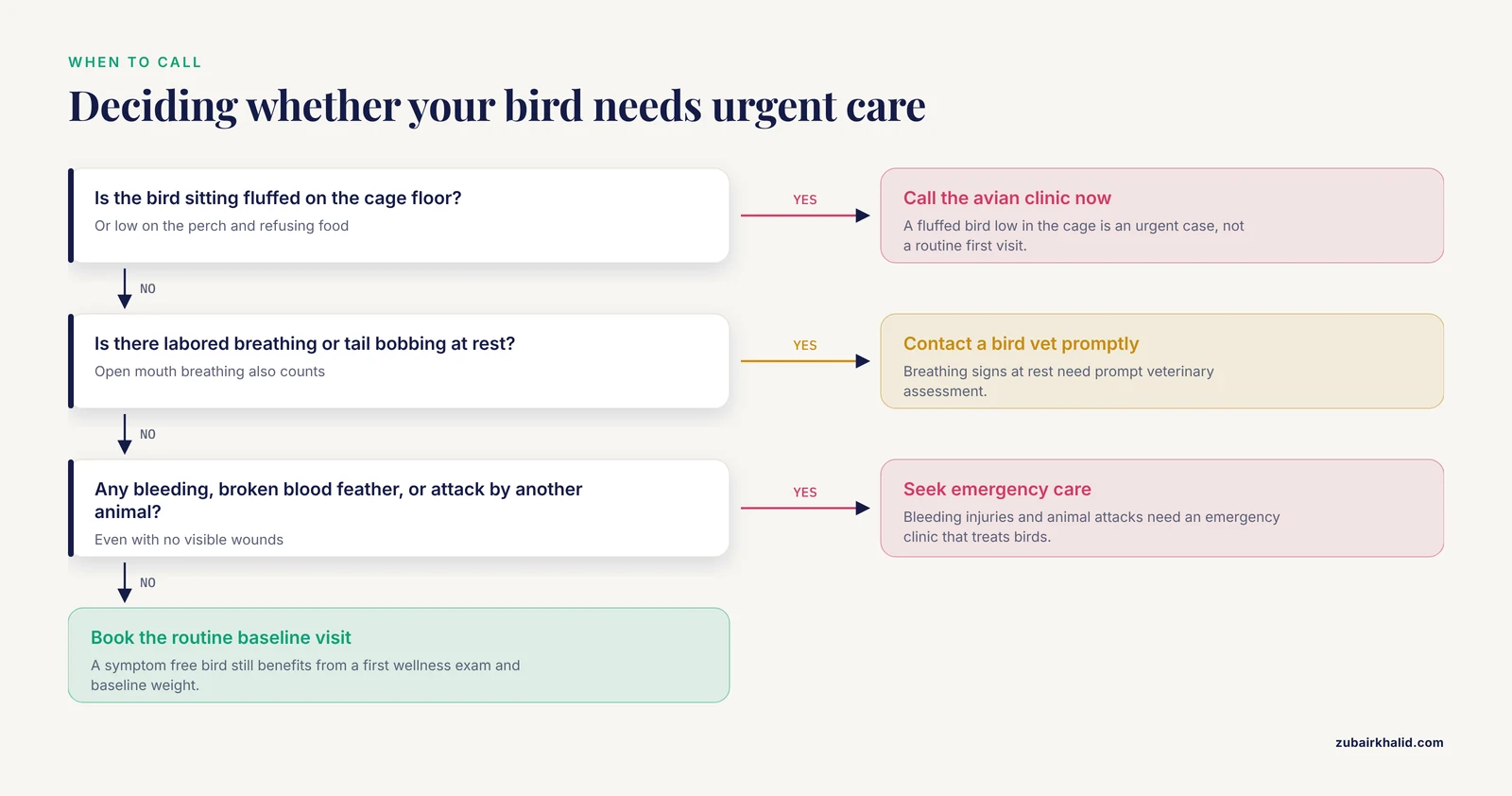
Every bird is an individual, and the preparation described here supports a routine first wellness visit. It does not replace veterinary judgment for a specific bird. If your bird is already sick, preparation changes. Contact an avian veterinarian, or an emergency clinic that treats birds, promptly if you observe any of the following:
- Sitting fluffed on the cage floor or bottom of the cage
- Open mouth breathing, tail bobbing while at rest, or labored breathing
- Not eating or dramatically reduced appetite for more than a few hours
- No droppings, or droppings that are dramatically changed in color or volume
- Regurgitation outside of normal courtship behavior, vomiting, or diarrhea
- A bleeding injury, a broken blood feather, or visible trauma
- Sudden inability to perch, flying into objects, or head tilt
- Discharge from the eyes or nostrils
- Any bird that has been attacked by another animal, even without visible wounds
These are escalation criteria, not a complete list. When in doubt about whether a sign is urgent, call the avian clinic and describe what you are seeing. The Association of Avian Veterinarians maintains resources to help owners locate qualified avian veterinary practices.
Frequently Asked Questions
What should I bring to my bird's first vet visit?
Bring a secure travel carrier lined with clean paper, fresh droppings on that paper, all purchase or adoption records, photos of your complete cage setup, a short video of normal behavior, every food and medication in its original packaging, a towel, and a written list of questions. The one page information sheet template in this article covers the history details in a format the veterinary team can use immediately.
Should I bring my bird's actual cage to the appointment?
Usually no. Most clinics prefer the bird in a carrier, and photos of the cage are a safer and more practical way to show the setup. Bring wide angle and close up photos of the cage, perches, food stations, and liner instead, and ask the clinic when booking if they want anything unusual brought along.
What kind of carrier is best for a bird vet visit?
A hard sided small animal carrier or a small secure travel cage with a working door latch works best. It should be large enough for the bird to stand, lined with paper towel, and covered partway with a light towel to reduce visual stress. VCA Animal Hospitals advises against transporting birds loose or in flimsy containers because of escape and injury risk.
Should I feed my bird before the appointment?
Yes, in most cases. Healthy pet birds should eat normally before a routine visit, because birds have high metabolic demands and fasting can harm them. Confirm the clinic's instructions when you book, since the clinic may give specific directions for certain procedures.
How do I find a vet qualified to treat birds?
Look for a veterinarian with specific avian experience, and ask directly how much of the practice is devoted to birds. The Association of Avian Veterinarians provides resources for locating avian veterinarians and encourages owners to establish this relationship before an emergency happens.
Why does the vet need photos of my bird's cage setup?
Cage size, bar spacing, perch types and placement, toy condition, liner material, and the cage's location in your home all influence health and behavior, and the veterinarian can only see your bird, not your home. Photos let the vet evaluate the real environment and give specific, actionable housing advice.
What should I do if my bird gets stressed on the way to the vet?
Partly cover the carrier, keep the car at a comfortable temperature, drive smoothly, and keep your voice calm. Practice short trips before the real appointment so the experience is familiar. If stress is severe, call the clinic before traveling and ask for their guidance on preparing a highly anxious bird.
What happens at a bird's first vet visit?
The veterinarian takes a history, weighs the bird, and performs a nose to tail physical exam covering the feathers, beak, eyes, nares, chest, wings, legs, feet, and vent, often with the bird perched on a scale first. The visit also covers diet, housing, and preventive care planning. Regular wellness examinations are recommended for pet birds so that problems are caught early, before a bird's natural tendency to hide illness makes them hard to treat.