Signs of Stress in Finches and How to Help
By Dr. Zubair Khalid, DVM, MS, PhD ·
This article is educational and is not a substitute for veterinary diagnosis or treatment.
A stressed finch mostly stops doing what a content finch does. Singing fades, bathing stops, foraging slows, and the bird spends more time motionless and watchful on its perch. Finches are small prey animals, and they mask fear and illness until a problem is well advanced, so owners who wait for obvious distress usually wait too long. The most dependable early warning is a drop in everyday positive behaviors, above all undirected singing, which research in zebra finches has validated as a sensitive, non-invasive welfare indicator [1]. Across studies, a wide range of stressors reliably suppresses singing in this species, and a bird that keeps singing steadily through daily life is showing one of the strongest available signs that it is coping well [2].
Use this triage summary to decide your next move.
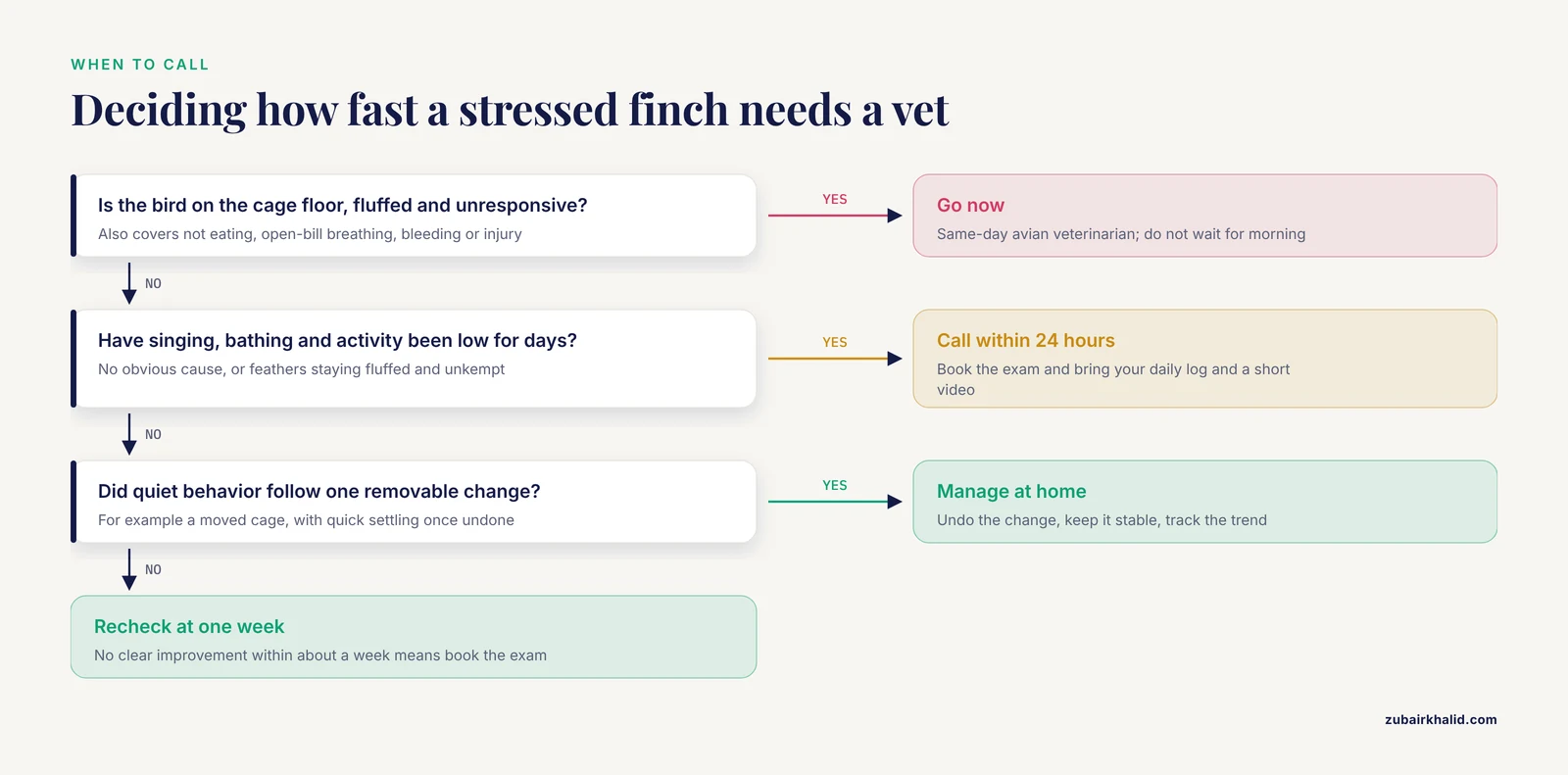
- Go to an avian veterinarian now. Your finch is on the cage floor, fluffed and unresponsive, has stopped eating, is breathing with an open bill or visible effort, or is injured or bleeding.
- Call within 24 hours. Singing, bathing, and activity have been low for more than a few days without an obvious cause, feathers stay fluffed or unkempt, or appetite has clearly dropped.
- Reasonable to manage at home first. A single day of quiet behavior after an obvious, removable change, such as a moved cage, with quick recovery once the bird settles.
The rest of this guide explains the signs of stress in finches in detail, covers what causes stress in finches, walks through evidence-based ways to calm a stressed finch, and spells out when to see a vet for a stressed finch instead of continuing home care.
Signs of Stress in Finches at a Glance
| What you observe | What it often means | First step at home | Call the vet when |
|---|---|---|---|
| Singing drops sharply or stops | An acute stressor, most often environmental change [1][3] | Undo recent changes and restore the familiar setup | No recovery after several days, or other signs appear |
| Feathers fluffed, clumped, or unkempt | Reduced well-being, sometimes illness [4][5] | Check warmth, food, and bath access | Plumage worsens, or lethargy joins in |
| Freezing, constant vigilance, little foraging | Fear or a perceived threat [6] | Remove the trigger, add distance and quiet | Freezing persists beyond a day or two |
| Long settling time after you approach | Poor habituation to disturbance [7] | Predictable, reward-based routines | Panic flights that risk injury |
| No bathing despite clean water offered | Stress or a husbandry gap [8] | Offer fresh bath water at a consistent time | Refusal continues alongside other signs |
| Keel bone prominent, bird visibly thinner | Chronic stress or disease [9] | Book a veterinary exam | Any confirmed weight loss |
| Oddly docile with abnormal clumped feathers | Rare inherited stress-response disorder [4] | Veterinary exam needed | Any abnormal feather development in a young bird |
Why Finches Hide Stress, and What It Does Inside the Body
Finches sit near the bottom of the food chain, and their survival strategy depends on not looking sick, slow, or frightened. A bird that advertises weakness attracts predators, so natural selection has favored animals that conceal problems until they can no longer function. Owners see the end result, a bird that seems fine on Monday and is critically ill by Friday, when the underlying process may have run for days or weeks.
The hormonal engine of that process is corticosterone, the primary stress hormone in birds. In zebra finches, corticosterone does double duty. It rises when a bird perceives a threat, and it also rises whenever the body needs to mobilize energy. Researchers who measured both hormones and metabolic rate in the same individual birds found that both climbed together in cold conditions, with birds held at 12 degrees Celsius showing higher corticosterone and higher energy expenditure than the same birds tested at 22 degrees Celsius [10]. The practical lesson is broad. Anything that forces a finch to burn more energy, including a cold room or a draft, travels the same physiological pathway as fear, and chronic activation of that pathway wears the body down.
Stress also leaves physical records. Feathers and beak color are built from pigments, including carotenoids that come from the diet, and their quality depends on how well the bird was doing while those structures grew [11][12]. That is why a finch's plumage and coloration act as a running log of its condition over previous weeks and months.
Individuals differ, too. Work in a related pet songbird, the chestnut-bellied seed-finch, showed that temperament shapes how a bird expresses stress during novelty challenges, with measurable shifts in time spent alert, freezing, and foraging [6]. In zebra finches, rare families carry an inherited tendency toward an extreme, even fatal stress response, a reminder that two birds from the same nest can have very different stress biology [4].
Stressed Finch Symptoms: What to Watch For
Stressed finch symptoms fall into four groups, vocal, behavioral, physical, and appetite-related. No single sign proves stress, but clusters of them, especially a simultaneous drop in singing, bathing, and foraging, paint a consistent picture.
A collapse in singing is the clearest signal
Undirected singing is the casual, solo song a male zebra finch produces when nothing in particular demands his attention, distinct from courtship singing aimed at a mate. It is the version of song that tracks welfare most closely. In long-term monitoring spanning more than 300 days of song data, male zebra finches subjected to aversive manipulations such as surgery or tethering showed transient but reliable drops in undirected singing, and a sustained rate above several hundred song motifs per day indicated the absence of an acute stressor or successful coping with one [1]. A companion review of research manipulations concluded that a diverse set of known stressors reliably suppresses singing rate, and that increased singing is therefore a useful positive welfare indicator [2].
For owners, the translation is simple. Learn what your male finch's normal daily soundscape sounds like. A zebra finch male in good condition fills the day with running commentary, and when that commentary fades to silence for more than a day or two, treat it as data rather than a quiet phase. Two cautions apply. This evidence comes from male zebra finches, and females of the species do not sing, so for hens and for finch species in which females are silent you will need the other markers below. And a bird that sings constantly is not automatically stress-free, because singing is one indicator among several.
Behavioral symptoms
Watch for these changes in how your finch uses its day:
- Freezing and heightened alertness. The bird perches tight and upright, head up, tracking movement in the room instead of eating, preening, or hopping. In songbird stress research, increased time spent alert and freezing, with less time foraging, accompanies elevated stress hormones.
- Slow settling after disturbance. A well-habituated finch resumes normal activity within moments of a person entering the room. Birds that take a long time to settle, or that never settle, have not adapted to routine disturbance [7].
- Panic responses. Wild flight around the cage, collisions with bars, or clinging to the farthest corner whenever you approach.
- Loss of comfort behaviors. Preening, bathing, stretching, and quiet exploration all fade when a bird is stressed.
Feather and body changes
Plumage condition is one of the most practical stress markers available to an owner, and science backs it up. Researchers developed a simple plumage scoring system for zebra finches and found that it could be applied reliably even by observers of different experience levels, making it a simple, non-invasive way to estimate well-being [5]. In practical terms, run your eyes over the bird daily. Feathers should lie smooth and neat. Clumped, ragged, stained, or fluffed plumage, or feather growth that seems slow or abnormal in a young bird, deserves attention [4][5].
Body condition follows a similar logic. Developmental stress in zebra finches reduces body mass, and its effects on body size and composition persist into adulthood, with stressed nestlings growing into lighter adults carrying less lean mass [9]. An adult finch that is visibly thinner, or whose keel bone is becoming prominent, is showing you a problem that has been building for a while.
Color changes in beak and plumage
Color is a subtler marker, but it is real. In zebra finches, beak redness reflects carotenoid deposition into the beak tissue, and females prefer males with bright red beaks [11]. Repeated handling causes short-term changes in beak color [11], the nutrition a young male receives during the month when his adult plumage develops shapes the size of his orange cheek patches and his attractiveness as an adult [12], and food restriction can interfere with a bird's ability to use dietary carotenoids [13]. A pet finch whose beak or cheek patches fade without an obvious explanation, especially a young bird, may be reporting stress or diet problems from the weeks when those colors were built.
When calm behavior is not calm
One surprising finding deserves its own warning. A case report described zebra finch siblings that were strikingly tame, showing no escape response and no rapid breathing when handled, alongside abnormal clumped feathers and slow feather growth. Those same birds later died after exposure to nonhuman stressors, and the pattern appeared in more than one brood from the same nest box, pointing to an inherited disorder of the stress response [4]. This is rare, and it does not describe the typical pet finch. But it carries two lessons. A bird that never startles is not automatically a relaxed bird, and an extreme stress response can be lethal, which is why persistent, unexplained changes in behavior or feathers warrant a veterinary exam rather than watchful waiting.
What Causes Stress in Finches
Understanding what causes stress in finches makes the symptoms easier to interpret and the fixes more obvious. The best-documented causes fall into seven categories.
Unfamiliar environments and change
Novelty is the most potent stressor identified in pet-relevant finch research. When zebra finches were isolated in an unfamiliar environment, their singing rate dropped for several days, a clear marker of an acute stressor. Remarkably, the same study found no such drop when birds were isolated by the removal of a companion, or when isolation happened in a familiar environment. During repeated brief separations, singing stayed high when the bird stayed in a known place but failed to recover when each isolation involved recurrent transfer to an unknown one. The authors concluded that stress from environmental change outweighed stress from social isolation in their data, and that frequent short visits to unfamiliar environments are detrimental rather than beneficial [3].
For a pet owner, this inverts a common instinct. Moving the cage to a new room for variety, carrying the bird around the house for company, or rearranging the cage frequently can each register as a fresh stressor. Finches do not want novelty. They want a territory they know completely.
Cold and temperature swings
Because corticosterone and metabolic rate rise together in cold conditions [10], a finch kept in a cool room, near a drafty window, or in a house where temperatures drop sharply at night is under physiological stress even if it looks calm. Small birds burn energy fast, and cold multiplies the cost of simply staying alive. Keep finches in a room with a stable, comfortable temperature, away from windows, exterior doors, fireplaces, and air conditioning vents.
No bathing water
Bathing is not a luxury for a finch. Captive zebra finches deprived of bathing water showed increased plasma corticosterone concentrations compared with birds that had access to it [8]. A finch without a bath loses more than a pleasure. It loses a core comfort behavior, and its body registers the loss.
Housing, cover, and disturbance
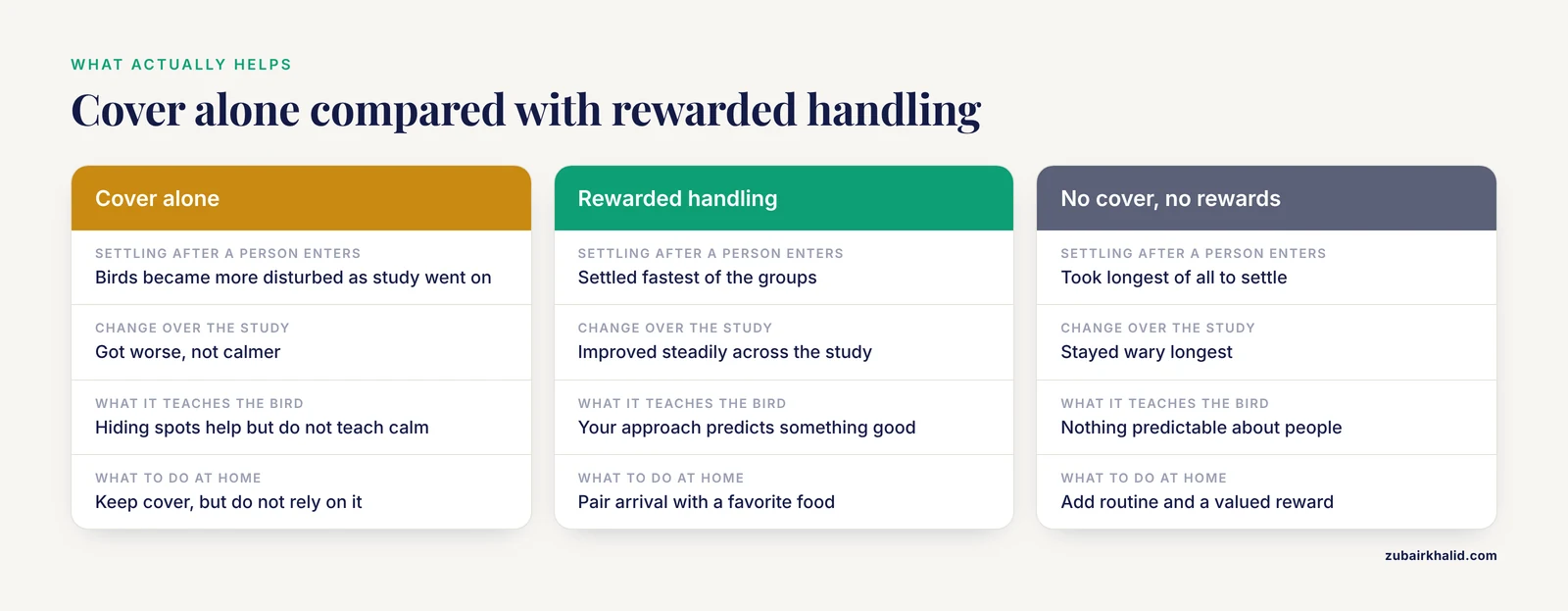
Where the cage sits and what happens around it shape stress levels every day. In a study of zebra finch housing, birds that received a small reward during handling settled fastest after a person entered the room, and their settling times improved steadily across the study. Birds given cover alone, by contrast, became more disturbed by disturbance as the study progressed, and birds with neither cover nor rewards took longest of all to settle [7]. The takeaway is nuanced. Physical cover in the form of hiding spots can be part of a good setup, but it does not teach calm by itself. Predictable, positive interaction does.
Handling and restraint
Handling is a genuine stressor for finches, not a neutral event. Researchers use repeated handling and restraint as experimental stressors in zebra finches, and it produces measurable short-term effects, including changes in beak color [11]. Birds can learn to tolerate handling well when it is paired with rewards and delivered predictably [7], but grabbing, chasing with hands, and frequent catch-ups for casual checks all tax the stress system.
Nutritional stress
Food that is poor in quality, restricted in amount, or inconsistent is a recognized environmental stressor in finches [13]. Its effects run deepest during development. Male zebra finches that ate high quality food during the second month of life, the window when adult plumage, song learning, and reproductive organs develop, grew larger orange cheek patches and were preferred as mates in adult choice tests compared with their siblings on standard food [12]. Developmental stress also leaves lasting marks on adult body mass and composition [9]. For owners, the practical rules are consistency and quality. Feed a complete diet at reliable times, avoid crash diets and skipped meals, and be extra careful with nutrition for young birds and for pairs raising chicks [13].
Stress before hatching and during development
Some of the most striking finch research shows that stress reaches back before birth. Zebra finch eggs incubated at suboptimal temperatures produced birds whose beak color development and adult responses to a handling stressor differed from controls, with effects that differed between the sexes [11]. Developmental stress also selectively affects HVC, a brain nucleus essential for song production [14], and song itself acts as an honest record of the developmental stress a male experienced while growing up [15]. An adult finch's stress reactivity is partly written by its early history, which is one reason two birds raised under different conditions can respond very differently to the same household event.
Risk factors to keep in mind
Young birds going through plumage and song development are especially vulnerable to lasting effects [12][9]. Birds with a family history of abnormal stress responses or feather abnormalities need closer monitoring [4]. Individual temperament modulates how strongly any given stressor lands [6]. Birds kept in unpredictable environments, with frequent changes and no positive routines, accumulate stressors faster than their physiology can absorb [7][3].
How to Calm a Stressed Finch
The evidence points to a short list of interventions that work, and an equally short list of well-meant moves that backfire.
Step 1: Identify and remove the trigger
Walk backward through the last two weeks. Did the cage move, even a few feet? Did a new pet, a new baby, a renovation, a changed work schedule, or a louder television enter the picture? Did the diet change, did a cagemate die or get rehomed, did bathing water disappear, did the room get colder? In finch research, unfamiliar surroundings alone are enough to suppress a bird's song for days [3], so even changes that look trivial from a human perspective can be the whole story.
Step 2: Restore familiarity and keep it stable
Put the cage back where it was, or, if the new location must stay, give the bird time and stop moving things. Keep cage furniture, perches, dishes, and routines in a consistent arrangement. A familiar environment prevents the song suppression that unfamiliar settings cause [3]. If the cage must be relocated, do it once, cleanly, and then leave it alone, because repeated relocations prevent recovery rather than promoting adaptation [3].
Step 3: Offer bathing water every day
Provide a clean, shallow bath at a consistent time each day and let the bird choose whether and when to use it. Given that its absence measurably raises stress hormones in zebra finches [8], reliable bath access is one of the cheapest and best-supported calming measures available. In a cool room, a wet bird burns extra energy, and cold is a documented physiological stressor in finches [10], so many keepers offer baths earlier in the day. Discuss timing with your avian veterinarian if your room runs cool.
Step 4: Build predictable, reward-based routines
Approach the cage the same way every time, at roughly the same times, moving slowly and speaking softly. Pair your approach with something the bird values, such as a favorite food item dropped into the dish as you arrive. This is the design that worked in research, where rewarded handling produced the fastest settling times and steady improvement over weeks, while birds without any positive routine stayed wary longest [7]. Never grab a finch for casual handling. Catch-ups should be reserved for genuine need, such as a veterinary visit or a health check you have discussed with your veterinarian, because restraint itself is a documented stressor [11].
Step 5: Keep the bird warm and draft-free
Move the cage away from windows, doors, and vents, and hold the room temperature steady. The link between cold, metabolic rate, and stress hormones in finches is direct and well measured [10]. A bird spending its energy budget on thermoregulation has less left for singing, bathing, and play.
Step 6: Feed consistently and completely
Stick to a schedule, keep the diet complete and varied as your avian veterinarian recommends, and never use food restriction as a behavior tool. Nutritional stress is a recognized stressor in finches [13], and its developmental effects on plumage, coloration, and body condition can persist for life [12][9]. If you need to transition a bird to a better diet, do it gradually and confirm with your veterinarian that the bird keeps eating throughout the switch.
Step 7: Give it time, and track the trend
Acute stress signs ease over several days once the stressor is gone, with singing returning gradually [1][3]. Keep a simple daily log for two weeks, noting roughly how much your finch sings, whether it bathes, how it eats, and how fast it settles when you enter the room. The trend matters more than any single day. A bird that is a little better each day is recovering. A bird that stays flat for a week needs a veterinary exam.
What not to do: mistakes and unsafe home remedies
Well-meaning owners make several predictable mistakes.
- Moving the bird for variety. Frequent transfers to new surroundings are documented as detrimental, not enriching [3].
- Handling the bird to reassure it. Restraint is a stressor [11], and extra handling teaches the bird that your approach means capture.
- Restricting food to reset behavior or weight. Food restriction is itself a stressor [13].
- Relying on cover alone. Hiding spots can help a shy bird feel secure, but research found that cover by itself did not produce calm and did not improve over time, while rewarded, predictable interaction did [7].
- Reaching for unproven calming products. There is no good evidence that supplements, herbal preparations, or commercial calming products lower stress in finches, so treat any such product as unproven and discuss it with an avian veterinarian before use.
Monitoring Your Finch at Home
Three simple habits turn you into an accurate observer.
First, keep a singing log. Note each day roughly how much your male finch sings when left alone. You do not need laboratory precision, and a one-to-five subjective score works as long as you apply it consistently. A downward trend across several days is the signal.
Second, learn a plumage check. The feather scoring system validated in zebra finches was designed to be simple enough that different observers reached the same verdict [5]. Pick a consistent time, look at the same areas, including the head, back, chest, and vent, and judge whether feathers look smooth and groomed or clumped and rough. Record the result in your log alongside singing.
Third, watch the comfort behaviors. Bathing, foraging, preening, and relaxed hopping are the positive side of the welfare ledger. A bird that keeps doing these things through a stressful week is coping. A bird that drops all of them at once is not. Ask your avian veterinarian whether home weight tracking makes sense for your bird and how to interpret the numbers, since declining body condition is a late sign that should never be the first one you notice [9].
When to See a Vet for a Stressed Finch
Stress and illness overlap heavily in finches, and only an examination can separate them. A quiet, fluffed bird with poor plumage could be reacting to a new dog in the house, or it could be fighting a respiratory infection, and the management of those two problems could not be more different.
Emergency red flags
Avian veterinarians, and owner guidance from organizations such as the Association of Avian Veterinarians and the Merck Veterinary Manual, consistently urge same-day care for birds showing these signs:
- Not eating, or eating dramatically less, for more than 24 hours
- Sitting fluffed on the cage floor, unresponsive or slow to react
- Labored breathing, open-bill breathing, tail bobbing, or audible breathing sounds
- Discharge from the eyes or nostrils
- Bleeding, a seizure, or sudden inability to perch or fly
- A bird found on the cage floor that cannot rise
Any of these is an emergency in a bird this small. Do not wait to see whether the bird improves by morning.
Stress or illness? Why the exam matters
Plan a non-emergency visit when stress signs persist. Expect your veterinarian to take a detailed history of the environment and recent changes, weigh the bird, examine the feathers and body condition, and look for underlying disease that can mimic stress. Feather condition is a validated well-being indicator in zebra finches [5], so a structured plumage assessment is a reasonable thing to request. If stress persists without an obvious environmental cause, ask whether fecal stress hormone testing is available. Measurement of glucocorticoid metabolites in droppings has been validated against a hormonal challenge in a pet songbird, and while availability varies by practice, it can sometimes help distinguish a stressed bird from a sick one.
A practical recheck rhythm follows from the research timeline. Acute stress signs should ease over several days once the cause is removed [1][3]. If your finch has not clearly turned the corner within about a week of your changes, or if any sign worsens at any point, book the exam rather than extending the home trial. Bring your daily log, a list of recent changes, and, if possible, a short video of the behavior that worries you.
Limitations and When to Contact a Veterinarian
Every finch is an individual, and the decision points above are guidelines, not diagnoses. Individual cases need a veterinarian, especially because small birds deteriorate quickly and because stress signs overlap with serious disease.
A few boundaries on the evidence are useful to know. Most controlled research on finch stress comes from zebra finches, particularly males, so findings about singing transfer most directly to male zebra finches and less directly to hens or to other commonly kept species such as society finches or Gouldian finches. Much of the work was done in research colonies, and while the core findings, that unfamiliar environments, cold, bathing deprivation, and handling raise stress, are biologically consistent, your bird's threshold for each stressor is its own.
Contact your veterinarian when any of the following is true:
- Stress signs have persisted more than a few days despite removing obvious causes
- Singing and bathing have both stopped for more than two or three days
- Feathers are deteriorating, or a young bird's feather development looks abnormal
- The bird is visibly thinner, or its keel bone feels prominent
- The bird's response to handling changed suddenly, in either direction, including a previously wary bird that becomes oddly docile, which can signal an abnormal stress response rather than contentment [4]
- You are considering any calming product, supplement, or diet change and want it vetted first
Preventing Stress Before It Starts
Prevention in finches is mostly about stability.
- Anchor the cage. Choose the right location once, then leave it there. Every move is a fresh stressor with days of recovery attached [3].
- Guarantee bath access. Daily bathing water is a physiological need, not optional enrichment [8].
- Make yourself predictable. Feed, clean, and interact on a schedule, and pair your presence with rewards so the bird learns your approach means good things [7].
- Hold the temperature steady. Avoid drafts, cold rooms, and sharp day-night drops, which raise both energy expenditure and stress hormones [10].
- Feed for development, not just survival. Young finches building adult plumage and song are especially sensitive to nutrition, and deficits during that window show up in adult coloration and condition [12][9].
- Protect the early environment if you breed finches. Incubation and rearing conditions echo through the rest of a bird's life, influencing adult stress reactivity and ornamentation [11][9].
- Schedule routine avian wellness visits. A baseline weight, plumage assessment, and relationship with an avian veterinarian are far easier to establish before an emergency than during one.
Prognosis: What Recovery Looks Like
For the typical pet finch whose stress traces to an environmental cause, the prognosis is good. Once the stressor is removed, singing and other behaviors recover over several days [1][3], and birds habituate further with each calm, rewarded interaction [7].
The picture is more guarded for stress that struck during development. Nestlings exposed to stress grow into adults with lower body mass and altered body composition [9], males nutritionally stressed during plumage development carry smaller cheek patches into adulthood [12], and developmental stress leaves marks on the song system and on song itself [14][15]. Those birds can still be wonderful companions, but some effects do not fully reverse.
Finally, a small number of birds carry an inherited, extreme stress response that proved fatal in the documented cases [4]. That outcome is rare, but it underlines the central message of this article. Chronic stress in a finch is a medical issue, not a personality quirk, and it deserves the same prompt attention you would give any other illness.
Frequently Asked Questions
What are the most common signs of stress in finches?
A stressed finch sings less, bathes less, forages less, and spends more time frozen and alert. Feathers may look fluffed, clumped, or unkempt, the bird may take longer to settle after you enter the room, and chronic cases drift toward weight loss. A simultaneous drop in singing, bathing, and foraging is the pattern that should get your attention.
Why has my finch suddenly stopped singing?
The most common trigger is a change in the environment, such as a moved cage, a new room, new pets, construction noise, or a changed routine. Unfamiliar surroundings can quiet a male zebra finch for several days even when his social situation has not changed. If no cause is obvious, or the silence lasts beyond a few days, arrange a veterinary exam to rule out illness.
How do I calm a stressed finch quickly?
Undo recent changes first, restore the familiar cage location and layout, offer fresh bathing water, keep the room warm and draft-free, and switch to calm, predictable, reward-based interactions. Resist the urge to handle the bird for reassurance, because restraint is itself a stressor.
How long does it take a stressed finch to recover?
Most acute stress signs ease over several days once the stressor is gone, with singing returning gradually. Track a daily trend rather than judging single days. If signs have not clearly improved within about a week, or any sign worsens, book a veterinary exam.
Can a finch die from stress?
Rarely, yes. A documented inherited disorder in zebra finches produced an extreme stress response that was fatal, and severe chronic stress is never harmless in an animal this small. The encouraging news is that most stress in pet finches traces to fixable environmental causes.
What causes stress in pet finches?
The best documented causes are unfamiliar environments and frequent changes, cold conditions and drafts, lack of bathing water, unpredictable handling and restraint, nutritional stress from poor or restricted diets, and repeated disturbance near the cage. Early-life stress, even before hatching, can also shape how reactive an adult bird is.
When should I see a vet for a stressed finch?
Go the same day if your finch is not eating, sits fluffed on the cage floor, breathes with effort or an open bill, or is injured. Call within a few days if stress signs persist after you remove obvious causes, if feathers are deteriorating, or if the bird is visibly thinner.
Do cage covers and baths help finch stress?
Baths help and should be available daily. Covers alone did not reliably calm birds in controlled research, where predictable, reward-based handling worked best. A cover can still be part of a stable setup, but it is not the fix. Treat interaction quality, warmth, bath access, and environmental stability as the main levers.
Sources
- Undirected singing rate as a non-invasive tool for welfare monitoring in isolated male zebra finches
- Welfare of zebra finches used in research
- Familiarity of an environment prevents song suppression in isolated zebra finches
- Abnormal Feather Phenotype Associated with a Fatal Stress Response and Unusual Tolerance to Human Contact in the Zebra Finch (Taeniopygia castanotis).
- Plumage and Fat Condition Scores as Well-Being Assessment Indicators in a Small Passerine Bird, the Zebra Finch (Taeniopygia guttata).
- Non-invasive stress monitoring and temperament of chestnut-bellied seed-finch (Passeriformes, Thraupidae)
- Welfare and mate choice in zebra finches: effect of handling regime and presence of cover
- Captive domesticated zebra finches (Taeniopygia guttata) have increased plasma corticosterone concentrations in the absence of bathing water
- Developmental stress reduces body condition across avian life-history stages: A comparison of quantitative magnetic resonance data and condition indices.
- Strong association between corticosterone levels and temperature-dependent metabolic rate in individual zebra finches
- Suboptimal Embryonic Incubation Temperature Has Long-Term, Sex-Specific Consequences on Beak Coloration and the Behavioral Stress Response in Zebra Finches
- Living with the Past: Nutritional Stress in Juvenile Males Has Immediate Effects on their Plumage Ornaments and on Adult Attractiveness in Zebra Finches
- Maintenance of Physiological and Molecular Processes Through Food Restriction During Offspring Provisioning in the Adult Zebra Finch.
- Developmental stress selectively affects the song control nucleus HVC in the zebra finch
- Song as an honest signal of developmental stress in the zebra finch (Taeniopygia guttata).