Safe Toys and Equipment for Finches: What to Avoid
By Dr. Zubair Khalid, DVM, MS, PhD ·
The safest toys for finches are simple, natural, appropriately sized items with no small removable parts, no fraying fibers, no galvanized or painted metal, and no soft plastics that can be chewed and swallowed. The most dangerous toys for finches are those designed for larger parrots, anything with loose strings or clasps, items coated in zinc or lead based paint, and accessories that cramp a small cage or press against flight paths. Finches are among the smallest birds kept as pets, usually weighing only a few grams to a few dozen grams, so the margin for error with equipment is small. A toy that would be a harmless chew item for a budgerigar can trap a zebra finch's foot or toe within minutes.
This guide explains how to choose safe toys for finches, which toxic materials for finches you need to recognize, how to audit your cage setup for finch cage accessories safety issues, and how to monitor your birds so you catch problems early. The advice draws on published welfare research in zebra finches and on general principles of avian husbandry used by avian veterinarians.
This article is educational and is not a substitute for veterinary diagnosis or treatment.
At a Glance: Safe and Unsafe Choices for Finch Toys and Equipment
| Safer choices | Avoid |
|---|---|
| Natural wood perches of varied diameter, sized for tiny finch feet | Sandpaper perch covers and abrasive concrete perches as the only perching option |
| Untreated, pesticide free branches from bird safe species | Galvanized (zinc coated) wire, chain, and hardware |
| Simple stainless steel or stainless hardware attachments | C links and key rings that can trap a toe or beak |
| Short natural fiber or paper based shredding items supervised at first | Long cotton rope, frayed fabric, and loose threads |
| Bells with a single solid piece and no clapper gap | Jingle bells with open clappers that trap toes |
| Foraging cups, millet holders, and shallow dishes | Small hinged parts, beads, buttons, and plastic eyes |
| Swings and ladders with adequate clearance | Mirrors and crowded cages in breeding or stressed birds |
| Firm, clean, appropriately sized cage furnishings | Soft, porous, or chewable plastics and foam |
Use this table as a starting checklist today, then read the sections below to understand why each item appears where it does.
Why Toy and Equipment Safety Matters So Much in Finches
Adequate housing is described in the scientific literature as a prerequisite for the wellbeing of animals kept by humans, whether in laboratories, on farms, or as pets [1]. For finches, the cage environment is not decoration. It is the entire world your birds occupy for most of their lives, and every perch, toy, and accessory inside it either supports or undermines their health.
Finches differ from parrots in ways that change the risk profile of every accessory. They are not powerful chewers, so they rarely destroy a toy the way a conure or an African grey would. That sounds safer, but it creates a hidden danger. Small beaks can still pry at joints, nibble at glued parts, and work loose threads free. Finches also move fast and fly in bursts rather than climbing, so they collide with and snag on objects more often than owners expect. A loop, a gap, or a hanging strand that a parrot would simply ignore can catch a finch mid-flight.
There is also a behavioral dimension. Captive finches respond to their visual environment in measurable ways. In a series of experiments with 220 zebra finches, environmental color cues in the birds' surroundings influenced female choice behavior, with red cues in the background preferred over green cues in the first experiment, even though later follow up experiments found the effect was not consistent across contexts [2]. The practical lesson for owners is that what you place in and around the cage is not visually neutral to a finch. Bright, saturated colors and constant visual novelty can be stimulating, and stimulation is useful in moderation but stressful in excess. Equipment choices should enrich the environment without overwhelming it.
Finally, welfare in small passerines can be tracked with simple, non-invasive tools. Researchers have validated a plumage scoring system for zebra finches that shows substantial agreement between observers of different experience levels, and they found that the plumage score was more reliably applied than the commonly used fat score [1]. In plain language, the condition of your finch's feathers is one of the most reliable windows you have into whether the environment, including the toys and perches inside it, is working.
What Makes a Toy Safe for Finches
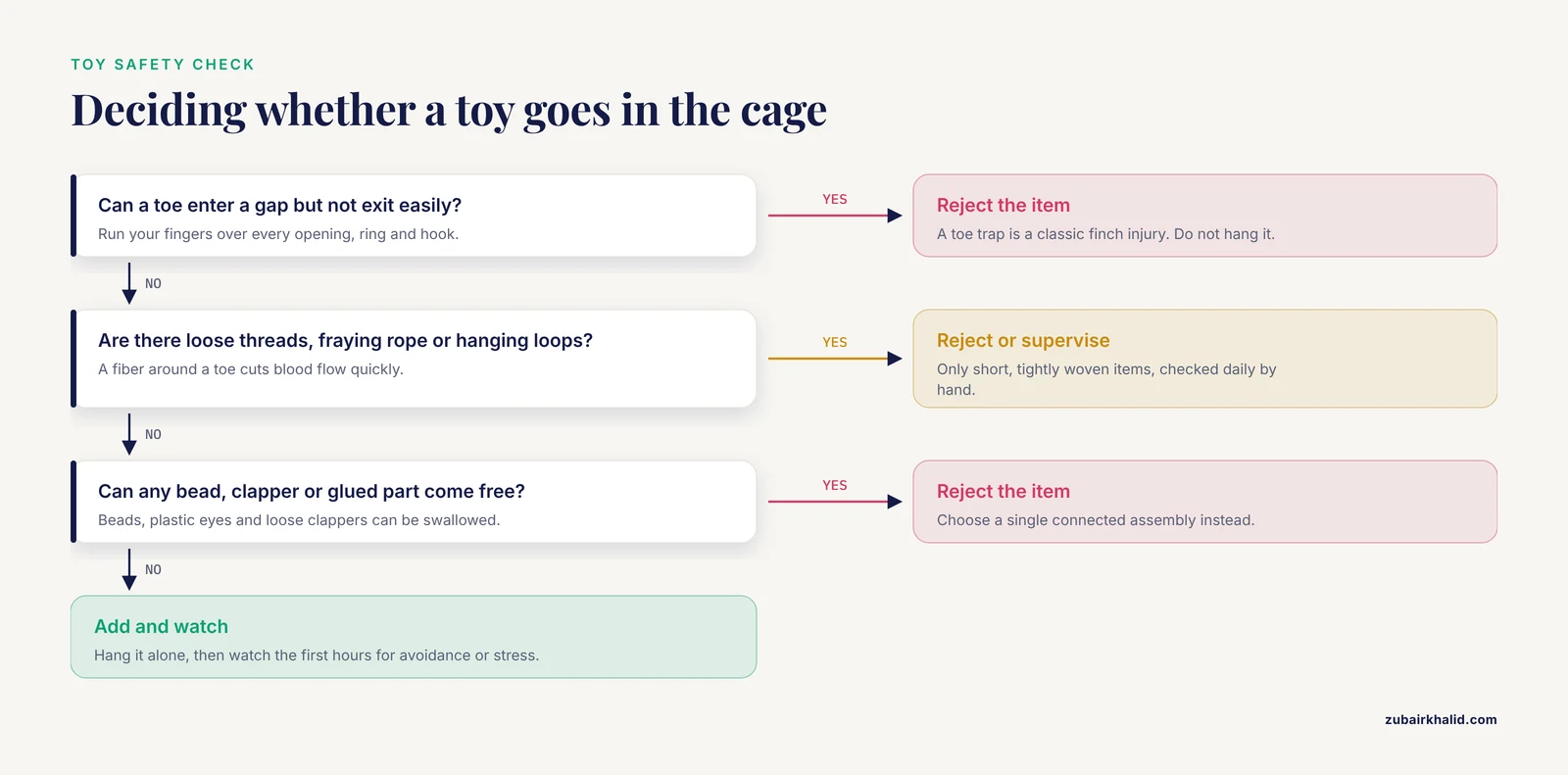
Safe toys for finches share four characteristics. Evaluate every item in the cage, including items the birds use as perches, against all four.
1. Right scale for a tiny bird. Finches need components small enough to use and gaps small enough that feet and toes cannot slip through and wedge. Run your fingers over every opening, ring, and hook. If a toe can enter but not easily exit, the item fails this test. When you are unsure whether a gap is too wide or a component is too small, photograph the item and ask your avian veterinarian at the next visit. Manufacturers market many toys for "small birds," but that label usually targets budgerigars and cockatiels, which are far larger than society finches, owl finches, or zebra finches. Treat "small bird" labeling as a starting point, not a guarantee.
2. Materials that will not poison a small bird. Birds are sensitive to heavy metals and certain other compounds, and a finch's body mass gives toxins very little dilution. The section below on toxic materials for finches lists the specific materials to screen for. The general rule is simple: plain, untreated, unpainted natural materials are the safest default, and anything with unknown coating, glue, or dye stays out of the cage.
3. Nothing that can snag, tangle, or entangle. Loose threads, fraying rope, layered fabric, and hanging loops are among the most dangerous toys for finches. A fiber wrapped around a toe restricts blood flow quickly in a bird whose leg is only a few millimeters thick. Inspect toys daily with your hands, not just your eyes, because a fraying edge is easier to feel than to see.
4. Nothing that can be dismantled into swallowable pieces. Beads, bells with loose clappers, plastic eyes, rubber grommets, and glued components can all end up in a finch's digestive tract. Choose toys that are a single connected assembly or made of pieces too large and too firmly attached to come free.
A fifth, softer criterion is behavioral fit. A toy is only safe if your birds use it calmly. Watch the first hour after any new item goes in. Birds that flee the item, stop eating, or crowd to the far side of the cage are telling you the addition is a stressor, not an enrichment.
Toxic Materials for Finches
Owners often ask about toxic materials for finches because the hazards are invisible until a bird is already sick. Screen every toy and accessory for the following.
Zinc and galvanized metal. Zinc coating is applied to many cheap wires, chains, eye screws, and cage hardware to prevent rust. Zinc toxicosis in birds is a well recognized clinical problem, and parrots are the species most often described in case reports, but the exposure route, chewing or licking metal, applies to any bird. For finches, exposure can also occur when birds pick at hardware out of curiosity rather than hunger. Prefer stainless steel hardware, and replace any galvanized component you find in the cage.
Lead. Lead appears in old paint, some solder, some weighted items, some stained glass style decorations, and some inexpensive toy components, including some fishing and craft weights that owners bring into bird rooms by accident. Lead toxicosis in birds can be serious and is a documented clinical entity in avian practice. Never place an item of unknown origin in a finch cage, and keep craft supplies, fishing tackle, and hardware out of the bird room entirely.
Paints, dyes, and adhesives. Colored coatings on cheap toys may not be food safe or bird safe. Finches may not chew heavily, but they do peck, and they preen anything their feathers touch. Avoid painted wood, dyed softwood chips of unknown origin, and any toy held together with visible glue.
Soft plastics and foam. Soft plastic, vinyl, and foam items can be punctured and swallowed. In a bird the size of a finch, even a small fragment is a meaningful gastrointestinal foreign body risk. Choose firm plastics only if the piece is large, integral, and intended for small birds, and prefer natural materials when you have the choice.
Household and air hazards near the cage. Toxic exposure is not limited to what the bird touches. Fumes from overheated nonstick cookware have long been recognized in avian medicine as an acute hazard to pet birds, and aerosols, scented products, and smoke in the bird room pose inhalation risks. The Association of Avian Veterinarians and the Merck Veterinary Manual both emphasize, in their pet bird owner resources, that the respiratory system of birds makes them unusually sensitive to airborne irritants. Place the cage in a well ventilated area away from the kitchen and away from aerosol use, and discuss any specific product concerns with your avian veterinarian.
Wood and plant material. Fresh branches are excellent enrichment, but species matter. Avoid woods and plants you cannot positively identify as bird safe, and never use branches from trees treated with pesticides or collected near roadsides. Wash and dry natural branches, and inspect them for insects and mold before offering them. If you are unsure about a species in your yard, bring a sample or a photo to your veterinarian before it goes in the cage.
Dangerous Toys for Finches: A Specific Hit List
The following items account for many of the preventable injuries and exposures avian veterinarians see. Audit your cage against this list.
- Jingle bells with open clappers. The gap between the clapper and the bell wall is a classic toe trap. If you want sound enrichment, use a bell designed with a single solid internal piece or none at all.
- Key rings and split rings. A finch's toenail or beak tip can slip under the split and tear or wedge. Use quick links and hangers sized and shaped for small birds, and check that no gap remains once closed.
- Rope toys and fabric hammocks. Long cotton rope, sisal, and fabric loops can fray into strands that wrap around toes, legs, or the tongue. Short, tightly woven, supervised items are the limit. Replace anything that shows the first sign of fuzzing.
- Mirrors. Mirrors are controversial even for social parrots, and for finches the picture is simpler. Finches are flock animals, and a mirror can redirect social behavior toward a reflection instead of toward cagemates. In breeding or territorial birds, mirror driven behavior can become compulsive or aggressive. There are gentler ways to enrich a finch, so most avian veterinarians suggest skipping mirrors in favor of foraging and natural perching options.
- Toys built for larger parrots. Chain links, hard plastic rings, leather knots, and metal clips designed for medium parrots are oversized, heavy, and full of gaps at finch scale. Weight matters too. A heavy toy swinging above a light cage can injure a bird that flies into it.
- Brittle plastic and acrylic toys. Cracked acrylic develops sharp edges. Inspect firm plastic items regularly and retire them at the first crack.
- Anything with paint flaking, rust, or corrosion. Rust on steel is unsightly but generally not the primary toxin. The concern is what rust tells you, which is that the coating has failed and the underlying metal, possibly zinc plated, is now exposed. Retire corroded items.
- Sandpaper perch covers. These are marketed as nail conditioning tools but abrade the bottom of the foot and contribute to pressure sores, especially when they are the only perch texture offered. They belong on the avoid list rather than the shopping list.
- Human household objects repurposed as toys. Buttons, dice, thread spools, and small children's toys were never manufactured for bird contact. Their dyes, glues, and small parts make them dangerous toys for finches even when they look harmless.
The Best Finch Toys: What Actually Works
The best finch toys are the ones that encourage natural behaviors, foraging, hopping, short flights, and exploration, without physical risk. Zebra finches and related species are active, social, and curious, and enrichment that invites species-typical movement gets used rather than ignored.
Foraging opportunities. Scatter feeding, millet sprigs hung safely away from food dishes, and small foraging cups turn feeding time into activity. Foraging is one of the most practical forms of enrichment because it works with a behavior the bird already has. Keep the foraging setup simple at first, and make sure food cannot become trapped behind or under the device where it will spoil.
Varied perching. Perches are technically cage accessories, but for a finch they function as constant enrichment. Offer several perches of varied natural diameter so the feet change position throughout the day. Vary height and location, but keep flight paths clear between perches, food, and water. Avoid a cage where the only straight, uniform dowels force the feet into the same grip all day.
Swings and ladders. A small swing with solid construction and no entrapment gaps gets regular use in many finch cages. Ladders can work, provided the rung spacing matches finch feet and the ladder does not swing into a wall or another perch.
Shredding and chewing items in moderation. Finches nibble, and small amounts of bird safe shredding material, such as plain paper based products or untreated balsa style wood, give them an outlet. Supervise first use and remove the item when it is shredded down, both for cleanliness and to prevent ingestion of accumulated fragments.
Visual variety, used thoughtfully. The zebra finch color cue experiments show that the visual environment can influence behavior, at least under some conditions [2]. That does not mean you need to color coordinate the cage. It means you should introduce visual changes gradually and observe. A cage that looks identical every day offers little enrichment, and a cage that changes dramatically every day can keep birds in a low level state of alarm. Small, steady changes are the goal.
Flocking and social enrichment. The single best "toy" for most finches is another compatible finch. Many finch species, including zebra finches, are highly social, and a companion reduces reliance on objects for stimulation. Compatibility varies by species and individuals, so discuss pairing and introductions with an avian veterinarian or an experienced breeder before adding birds.
When you shop, apply the selection criteria from the earlier sections rather than buying by label. A plain natural wood swing with stainless hardware is often a better purchase than an elaborate multicolored plastic toy, and it is usually easier to inspect and clean.
Finch Cage Accessories Safety: Auditing the Whole Setup
Toys get the blame in most conversations, but finch cage accessories safety depends on the entire setup. Work through the cage in this order.
Perches. Check diameter variety, surface condition, and placement. Remove perch covers, smooth the ends of natural branches, and make sure no perch sits directly over food or water dishes where droppings can contaminate them. Rotate and wash perches on a regular schedule.
Dishes and feeders. Use dishes that attach securely to the cage wall and cannot tip or trap a bird behind them. Check that no feeder has a gap between the dish and the bars where a bird can enter and become stuck.
Cage bar spacing and construction. Bar spacing must be narrow enough that a finch cannot force its head through, and welds, joints, and door latches must be free of gaps and burrs. New cages sometimes ship with protective coatings or residue, so clean and dry the cage fully before use. If you are choosing a cage, ask the seller for exact bar spacing and material details, and confirm the choices with your avian veterinarian.
Placement of accessories. Overcrowding is a safety problem in itself. A cage packed with toys leaves no clear flight lanes and increases collision injuries, feather damage from brushing objects, and territorial disputes. In small passerines, crowding also complicates the health monitoring you should be doing. A bird with ruffled or damaged plumage is harder to assess when objects crowd every corner. Leave visible air space and keep sightlines open.
Cleaning compatibility. Every accessory should be cleanable. Porous materials absorb droppings, moisture, and bacteria. The Merck Veterinary Manual's pet bird resources stress routine sanitation of the cage environment as part of preventive care, so choose items you can scrub, rinse, and fully dry. Retire any toy or accessory that cannot be cleaned adequately.
Cage covers and room environment. Covers should be breathable fabric, free of loose threads and hardware, and large enough that they cannot snag on the cage. Keep the cage away from drafts, direct cooking fumes, and aerosols.
How to Introduce, Rotate, and Retire Toys
A step by step routine keeps enrichment safe over time.
- Inspect before it enters the cage. Check for gaps, loose parts, coatings, odors, and sharp edges. Tug on every attachment point.
- Introduce one item at a time. Adding several objects at once makes it impossible to tell which one is causing a reaction.
- Observe the first hours. Note whether the birds approach, avoid, or ignore the item. Avoidance that persists beyond the first day, or any bird that stops eating normally, is a signal to remove the item.
- Establish a cleaning and inspection schedule. Wash cleanable items regularly, and physically inspect each toy weekly for fraying, cracks, and loosened hardware.
- Rotate rather than accumulate. Keep a small set of inspected items and rotate them, so novelty is provided without crowding the cage.
- Retire on schedule and on evidence. Retire any item at the first sign of structural failure, and retire durable items when wear makes inspection unreliable. When in doubt about whether an item is still safe, replace it. A finch toy costs far less than an emergency veterinary visit.
Common Mistakes Owners Make With Finch Toys and Equipment
- Buying for a larger species. The most common error is purchasing toys labeled for parakeets or cockatiels without checking gap sizes and part dimensions at finch scale.
- Leaving a damaged toy in place. Owners often notice fraying or a loosened part and plan to deal with it later. In a finch, later can be too late.
- Assuming finches will not chew. They nibble, they pick, and they pry at anything loose. Assume every component can be worked on.
- Overcrowding the cage. Enrichment excess looks like a full cage but functions like a hazard course.
- Using mirrors or single toys as substitutes for companionship. Objects cannot replace appropriate social housing for a flock species.
- Skipping the hands-on inspection. Visual checks miss fraying fibers and small gaps that fingers find instantly.
- Introducing scented or dyed items. Perfumed woods, scented ropes, and brightly dyed materials add exposure risk without adding enrichment value.
Monitoring Your Finches After Any Equipment Change
Because you cannot ask a finch how it feels, you watch its body and behavior. Published work gives you a concrete framework. The validated plumage scoring system for zebra finches is non-invasive, shows substantial agreement between different observers, and can be taught reliably, which is why researchers propose it, alone or combined with the fat score, as a practical wellbeing indicator for this species [1]. For an owner, the practical translation is this. Learn what a healthy finch looks like in your own birds, smooth, sleek, evenly aligned feathers, and check each bird's plumage regularly. A decline in feather condition after a change in the cage is a signal worth investigating.
Behavior offers a second channel. In research on zebra finches, observers scored behaviors such as open-mouth breathing as potential indicators of discomfort or distress [3]. At home, open-mouth breathing, tail bobbing, fluffed and inactive posture, reduced feeding, and birds that press themselves into a corner are all reasons to look for a cause, and a newly added toy or accessory is one of the first things to remove while you observe.
Establish a simple weekly routine. Check each bird's plumage, watch it eat and move, and physically inspect every item in the cage. Keep changes to one item at a time so cause and effect stay clear.
Limitations and When to Contact a Veterinarian
Published safety research specific to finch toys is limited, and much of the guidance above reflects general avian husbandry principles applied to very small passerines. Individual birds vary in temperament, species, age, and health status, so an accessory that suits one finch may not suit another. Every specific decision about your birds' cage, including whether a particular product is appropriate, is best confirmed with an avian veterinarian who can see your setup.
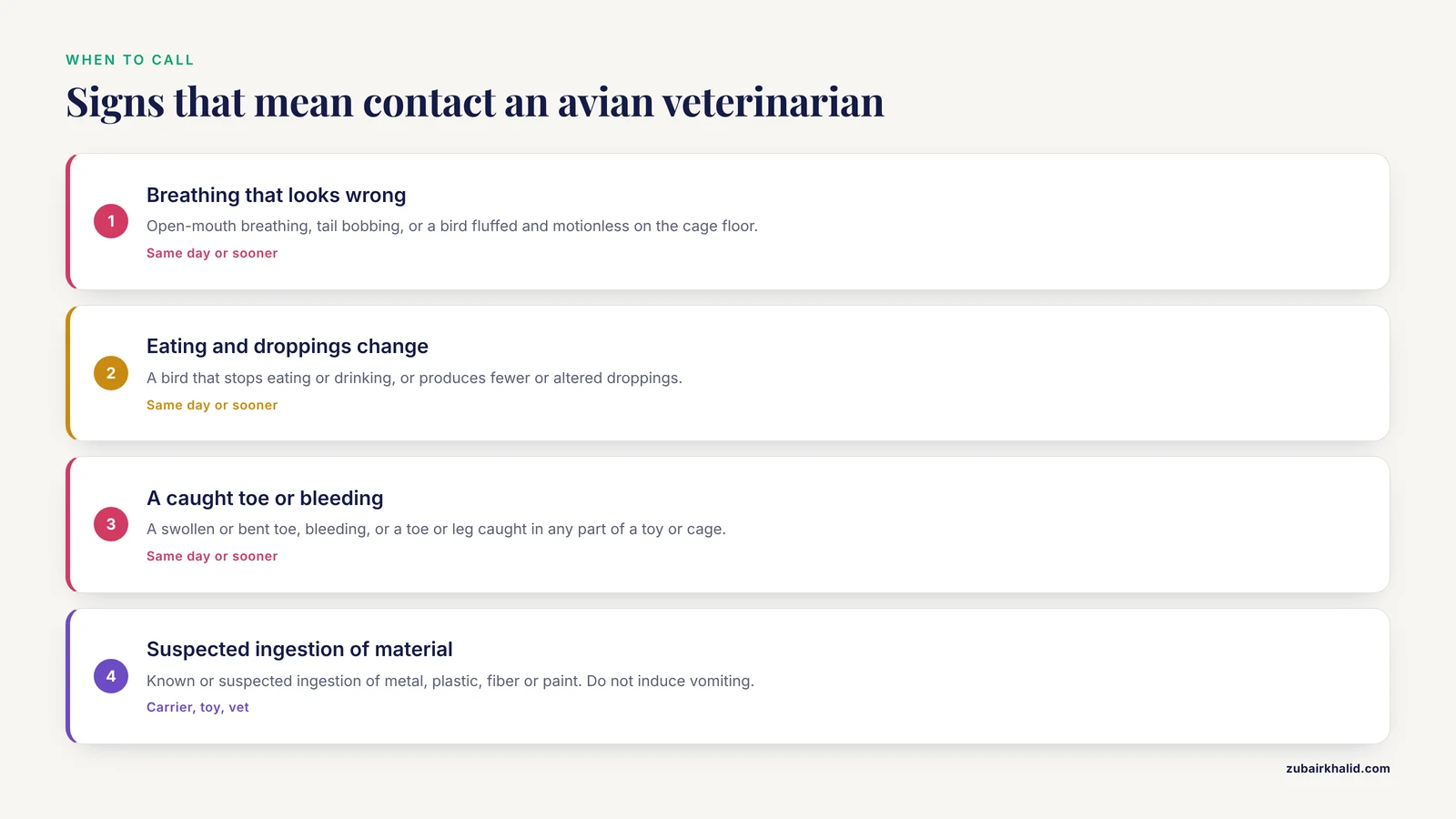
Contact an avian veterinarian promptly, the same day or sooner, if you observe any of the following:
- Open-mouth breathing, tail bobbing, labored breathing, or any bird sitting fluffed and motionless on the cage floor
- A bird that has stopped eating or drinking, or that is producing fewer or altered droppings
- A bleeding injury, a swollen or bent toe, or a toe or leg caught in any part of a toy or cage
- A known or suspected ingestion of metal, plastic, fiber, paint, or any other foreign material
- Sudden feather destructive behavior, persistent ruffled plumage, or a drop in activity and vocalization
- Any bird acting abnormally after a new accessory was introduced, especially if more than one bird is affected at once
- Signs consistent with fume exposure, such as several birds breathing abnormally at the same time, which is an emergency
If a bird has ingested part of a toy, do not induce vomiting or attempt home remedies. Secure the bird in a quiet, warm, covered carrier with clear flight paths removed, bring the toy or a photo of it, and seek veterinary care immediately.
Frequently Asked Questions
What are the safest toys for finches?
Simple natural items with no gaps, no fraying fibers, no small removable parts, and no suspect coatings are the safest. Varied natural perches, small swings with solid hardware, foraging cups, and short supervised shredding items are dependable choices.
What materials are toxic to finches?
Screen for zinc on galvanized hardware, lead in old paint and weighted items, unknown paints and adhesives, soft plastics and foam, and unidentifiable woods. Also protect finches from airborne hazards, including fumes from overheated nonstick cookware and aerosols, by keeping the cage well away from the kitchen and sprays.
Are mirrors good or bad for finches?
For most pet finches, mirrors are better avoided. Finches are flock animals, and a mirror can redirect social and territorial behavior toward a reflection, which can create compulsive or aggressive behavior. Foraging items and natural perches provide healthier enrichment.
How many toys should a finch cage have?
Fewer than most new owners expect. Aim for a small number of inspected, rotated items that leave clear flight paths and open sightlines. Overcrowding increases collision, snag, and stress risks.
Can finches use parakeet or cockatiel toys?
Some can, but do not assume it. Budgerigars and cockatiels are substantially larger than most finches, so their toys often have gaps, weights, and parts that are hazardous at finch scale. Judge each item by its actual dimensions and construction, not its label.
How often should I replace or rotate finch toys?
Inspect physically every week, clean on a regular schedule, and retire any item at the first sign of fraying, cracking, rust, or loosening. Rotate a small set of safe items to provide novelty without crowding the cage.
What cage accessories should finches never have?
Avoid sandpaper perch covers, jingle bells with open clappers, key rings and split rings, rope and fabric items that fray, galvanized or painted hardware, and anything designed for larger parrots. These are among the most common sources of finch injuries and toxic exposures.
How can I tell if a toy is stressing my finch?
Watch the first hours after introduction. Persistent avoidance, reduced feeding, crowding to the far side of the cage, increased conflict between birds, or a decline in feather condition after the change are all signals. Remove the item, observe for a day or two, and contact your avian veterinarian if abnormal behavior or any breathing changes persist.
Sources
- Plumage and Fat Condition Scores as Well-Being Assessment Indicators in a Small Passerine Bird, the Zebra Finch (Taeniopygia guttata).
- Colour Cues That Are Not Directly Attached to the Body of Males Do Not Influence the Mate Choice of Zebra Finches.
- Evaluation of Best Practices for the Euthanasia of Zebra Finches (Taeniopygia guttata).