Comparing the Social Needs of Pet Birds
By Dr. Zubair Khalid, DVM, MS, PhD ·

The biggest difference between popular pet birds is not size or color but who they need company from. Flock species such as budgerigars and cockatiels are wired for a busy group around them for most of the day. Pair-bonded species such as lovebirds organize their whole social life around one trusted partner. Hands-off species such as canaries and finches mostly want company of their own kind and are content to be watched rather than held.
The rule of thumb for choosing is simple. Match the bird's natural social schedule to the companionship your household can genuinely deliver every day for the animal's entire life. The best pet bird social needs comparison therefore weighs three things together, your real daily availability, your noise ceiling, and the number of years you can commit, rather than ranking species by beauty or talking ability.
This article is educational and is not a substitute for veterinary diagnosis or treatment.
Why Species Differ So Much in Social Needs
Two birds of similar size can need completely different social lives, and comparative biology explains why. In a study of two seabird species with nearly identical body size and overlapping diets, black-tailed gulls showed higher oxidative stress than streaked shearwaters, and the researchers tied that gap to differences in life history, habitat, and physiological function rather than to size or menu [1]. Lifestyle leaves measurable marks on the body even when two species look interchangeable in a pet store.
Anatomy tells the same story. Among five accipitriform raptors, the architecture of the grasping muscles separated the carrion-feeding cinereous vulture from four live-prey hawk species, with muscle mass and fiber design tracking diet and foraging style [2]. Brain organization follows lifestyle too. Reconstruction of the brain endocast of the extinct giant bird Argentavis magnificens showed an overall vulture-like shape, yet its visual-processing structures resembled active hawks and falcons more than smell-driven scavengers, pointing to a vision-led way of life [3].
Pet birds fit the same pattern. A budgerigar's ancestors moved across open Australian grasslands in large flocks, while a canary's ancestors held scattered island territories as songbirds. Their brains, bodies, and behavior were shaped by those different social worlds, which is why a care plan that delights one species can starve another. VCA Animal Hospitals' avian care guides describe parrots as flock animals that stay in touch with companions through contact calls, and the Merck Veterinary Manual's pet bird resources treat the social environment as a core part of parrot husbandry rather than an optional extra.
Side-by-Side Comparison Table
The table below is the core of this comparison. Read your own row honestly first, then read the rows of any bird you were considering on impulse.
| Bird | Natural social pattern | Companionship demand at home | Enjoys handling | Typical sound | Living alone |
|---|---|---|---|---|---|
| Budgerigar | Large flocks | High, from people or other budgies | Yes, with patient training | Steady chatter | Possible with heavy human time, better with a budgie friend |
| Cockatiel | Flocks | High, mostly from people | Yes, generally gentle | Whistles and calls | Possible with daily interaction |
| Lovebird | Tight pair bond | High, from a mate or one person | Yes if single and well handled, less so in pairs | Sharp, loud calls | Hard unless a person fully substitutes for a mate |
| Small conure | Flocks | Very high | Yes, playful | Loud at times | Behavior problems are frequently reported when isolated |
| African grey | Flocks with deep pair bonds | Very high, plus mental work | Selectively | Variable, excellent mimicry | Poor match for absent households |
| Canary | Loosely social outside breeding | Low to moderate | Little, prefers observation | Male song | Usually fine |
| Finch | Stable small flocks | Low from humans, essential from other finches | Minimal | Soft twitters | Should not live alone |
Species Profiles, Each on Its Own Terms
Budgerigars (Budgies)
Budgerigars are small Australian parrots built for flock life. A pet budgie reads constant companionship as normal and silence as danger. In a home, that translates into a bird that wants to be where the action is, chatters back when you talk, and often learns to mimic words and household sounds.
Pros: quick to tame with patient handling, happy in pairs, and one of the best entry points into bird ownership. Cons: the need for company is easy to underestimate because the bird is small, and a budgie left alone in a quiet room all day often becomes withdrawn or excessively noisy.
For bird cage setup, place a budgie cage in the family's main living space rather than a spare room, with room for short flights between perches. A single budgie needs a person who is home much of the day. A pair keeps each other company but may tame down more slowly.
Cockatiels
Cockatiels are another Australian flock species and the classic first parrot for good reason. They bond readily to people, communicate with crest positions and whistles, and generally accept gentle handling. Males often become enthusiastic whistlers, while females tend to be quieter.
Pros: even-tempered, adaptable to family routines, and responsive to training without the intensity of larger parrots. Cons: they are quieter than many parrots but not silent, and their social needs are real despite the gentle reputation. A cockatiel kept alone in an ignored corner can develop screaming or feather-plucking habits that are difficult to reverse.
Give the cage horizontal space for flight and position it in family traffic, with a quiet dark area for sleeping.
Lovebirds
Lovebirds are African parrots named for the way bonded pairs sit pressed together. Their social template is a single intense partnership rather than a loose flock. A single lovebird can transfer that bond to a person and become a devoted, sometimes possessive pet, while a paired lovebird often directs its loyalty to its mate and drifts away from human handling.
Pros: bold personality in a small body, entertaining and affectionate when bonded to you. Cons: sharp voices, a nippy streak, and a real risk that an owner buys two birds expecting easy pets and ends up with a pair that wants little to do with people.
If you want a handleable lovebird, plan on one bird and daily hands-on time. If you want birds to watch, start with an established pair and enjoy them as a unit.
Small Conures
Small conures such as green-cheeked conures are South American flock parrots with outsized social appetites. They want to be involved in everything, they play hard, and they communicate with contact calls that can be surprisingly loud for their size.
Pros: playful, cuddly by parrot standards, and deeply bonded to engaged owners. Cons: the social demand is among the highest of any small pet, and behavior problems rooted in isolation are frequently reported in avian practice.
Conures suit households where someone is home most of the day, or where the cage sits in the middle of family activity and out-of-cage time is a routine rather than an event.
African Grey Parrots
African greys sit at the demanding end of this comparison. They are long-lived parrots from Central and West African forests that form deep pair bonds and depend on flock companionship. Their intelligence means social interaction must include problem solving and novelty, not just proximity.
Pros: unmatched communicative ability, subtle and rewarding relationships, and the potential for a companionship measured in decades. Cons: greys are sensitive to change and to isolation, and stress-related problems such as feather destructive behavior are well recognized in under-stimulated or anxious birds. Rehoming a grey is hard on the bird.
Greys fit experienced keepers with stable routines. Discuss the species' behavioral needs with an avian veterinarian before acquiring one, not after problems appear.
Canaries
Canaries are domesticated finch relatives, and their social needs run opposite to parrots. A male canary sings to declare himself, and housing males side by side can suppress song or trigger fighting, especially in breeding condition. Most canaries prefer to be admired rather than handled.
Pros: the classic bird for people who want sound and color without daily handling, and one of the few pet birds genuinely comfortable as a single animal. Cons: little hands-on appeal, and a pair is not automatically harmonious.
A canary cage should offer flight room along its length and sit in a bright, draft-free spot where the bird can hear household life without sitting in the roughest traffic.
Finches
Zebra finches and society finches are true flock birds that should not be kept alone. Their social needs are met by their own kind, and a single finch in a cage is one of the clearer welfare mismatches in pet keeping. Handling matters little to them, and most finches never become tame in the parrot sense.
Pros: lively to watch, gentle sounds, and a pair or small group largely entertains itself. Cons: minimal interactive appeal, and breeding can surprise owners who house mixed sexes together.
Finch cages prioritize flight length over ornamentation, with perches spaced so birds can hop and fly without crowding.
Running a Pet Bird Social Needs Comparison on Your Own Household
A comparison only helps when it is run against your real life. Score any species you are considering against these seven questions.
- Who is home, and when? A bird that needs flock company all day is a poor match for an empty house, no matter how lovely the evenings are.
- What can your household tolerate in sound? Contact calls at dawn and dusk are normal bird behavior, and thin apartment walls turn a cheerful species into a lease problem.
- How many years are you signing up for? Small parrots live for many years and larger parrots for decades, so the honest question is who will care for this animal far in the future.
- Do you want to hold the bird or watch it? Handling-oriented homes match with budgies, cockatiels, lovebirds, and conures. Observation-oriented homes match with canaries and finches.
- Is a second bird realistic? Space, cleaning, and future veterinary care all scale up, and introductions between birds need patience.
- What else lives in the house? Children, cats, dogs, and other predators change cage placement and supervision.
- What happens when you travel? A hands-off pair manages a pet sitter easily. A bonded single parrot needs a sitter who will actually interact.
Answer those seven honestly and usually one or two species remain standing. That shortlist, not a store display, is where the decision should happen.
Housing Models and Their Pros and Cons
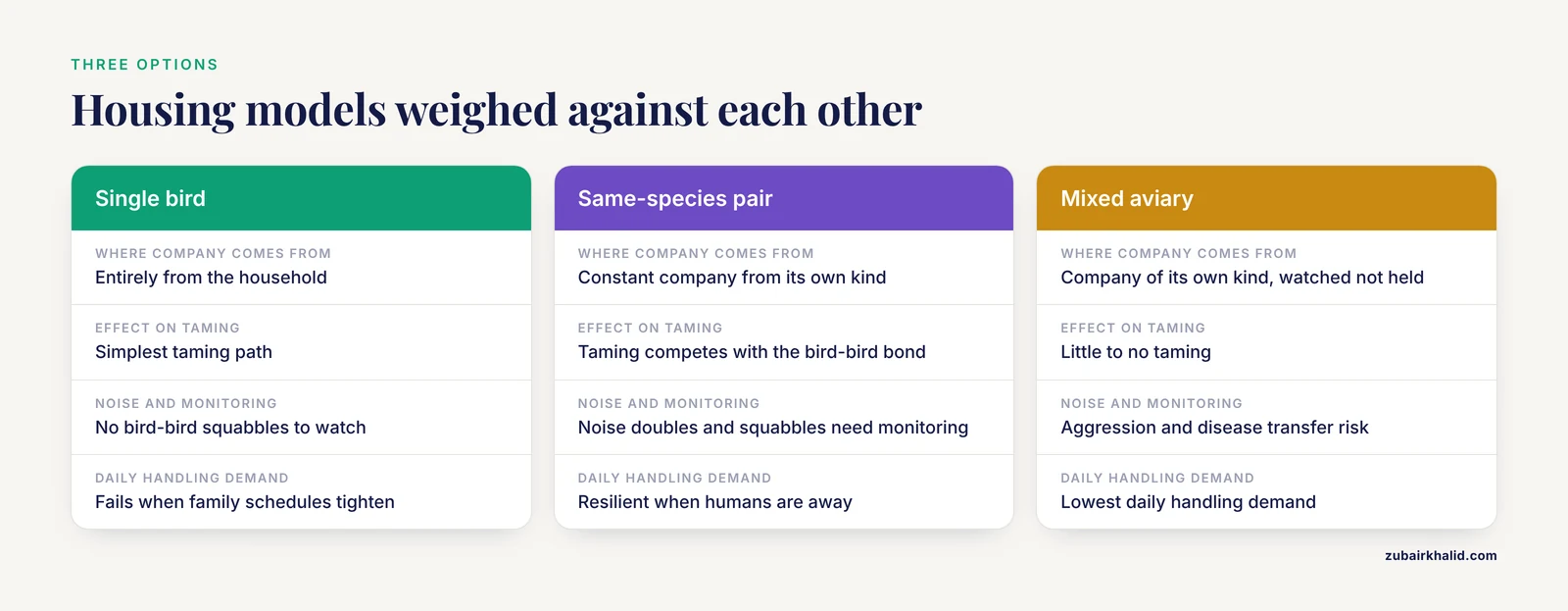
The main pet bird social needs comparison options are housing models rather than product choices, and each carries a distinct set of pros and cons.
A single bird with people as its flock
Pros: the deepest potential bond with humans, the simplest taming path, and no conflict between bird-bird and bird-human attachment. Cons: the entire social burden falls on the household, the bird may form a mating bond with one favored person, and the arrangement fails quietly whenever family schedules tighten. This model works only when someone is genuinely present most of the day.
A same-species pair or small group
Pros: constant company, natural preening and calling, and resilience when humans are away. Cons: taming competes with the bird-bird bond, breeding becomes a question to manage with an avian veterinarian, noise doubles, and squabbles need monitoring. Introductions should be gradual, and quarantine and health screening for a new bird are conversations to have with an avian veterinarian beforehand.
A mixed, hands-off aviary
Pros: rich natural behavior to observe and the lowest daily handling demand. Cons: mixing species invites aggression and disease transfer, requires real expertise, and offers nothing to owners who want a hands-on pet. Casual mixing of species in one cage is a common source of injury and is best attempted only with experienced guidance.
Worked Scenarios
A couple in an apartment, both working full time
Both are out for long weekdays and the building has thin walls. A conure or African grey fails on availability and noise. A pair of finches or a single canary fits the actual schedule, with a budgie pair possible if the couple commits to substantial evening interaction. The honest comparison here is between a bird that keeps itself company and a bird that waits all day.
A remote worker who wants a talking companion
Someone home all day with control over their schedule can meet the demands of a single cockatiel or budgie, and an experienced keeper might consider a small conure. The trap in this scenario is assuming permanent home working. If a return to office work is plausible, plan the bird's social life for the busier future rather than the current one.
A family with children wanting one memorable pet
School-age children bring noise and unpredictable handling, which favors sturdy, gentle species. A hand-fed cockatiel or budgie with clear handling rules usually outperforms a more fragile or more demanding species. An African grey is a poor fit for a chaotic household regardless of how much the family wants a talking bird, because greys are sensitive to upheaval. Agree in advance on who handles care when enthusiasm fades, and ask an avian veterinarian to help set expectations before the purchase rather than after.
Bird Cage Setup for Social Species
Bird cage setup either supports or undermines the social plan. Three principles carry most of the weight.
Placement comes first. Social species want to live where the flock lives, which for a household means the family room rather than an unused bedroom. Position the cage away from kitchens and away from fumes of any kind, since airborne contaminants that a mammal tolerates can injure avian lungs, a warning avian veterinarians repeat routinely. The bird also needs a quiet, dark option for sleeping, whether that is a cover or a separate sleep cage.
Space follows social structure. Flight-oriented species such as finches and canaries need length. Climbing, playing parrots need room for multiple perches, toys, and food stations without crowding. For pairs, provide two feeding stations so one bird cannot monopolize food, and avoid round cages with tight centers that can trap feathers.
Furnishing completes the setup. Offer varied perch textures and diameters, rotate toys rather than crowding the cage, and build in foraging opportunities so that eating takes time and thought. Lafeber's avian resources promote foraging as a daily activity rather than a gimmick, a framing that suits social species especially well because parrots in the wild devote a large share of their day to finding food.
A Parrot Care Checklist for Social Well-Being
A parrot care checklist turns social needs into repeatable habits. The items below apply to budgies and cockatiels as much as to large parrots, scaled to the bird.
- Morning flock check-in. Greet the bird and respond to contact calls, which VCA's avian guidance identifies as the glue of flock communication.
- Fresh food and water, presented with some foraging challenge rather than in a bare dish.
- One dedicated training or handling session, short and positive.
- Supervised out-of-cage time in a bird-safe room.
- Toy rotation to keep novelty flowing.
- Evening wind-down with a consistent, quiet sleep period.
- Daily observation of droppings, appetite, posture, and feather condition.
- A yearly wellness examination with an avian veterinarian, the baseline the Association of Avian Veterinarians recommends for pet birds.
- Home weighing if your avian veterinarian recommends it, since gradual weight change is often the first visible sign of trouble.
A checklist does not replace judgment. It exists so that busy weeks degrade gracefully instead of collapsing.
Common Mix-Ups
- Buying a second bird to fix a screaming problem. Sometimes it helps, and sometimes the new bird simply joins the noise while the underlying training and enrichment gaps remain. Understand why the bird is vocalizing before adding a bird.
- Treating a mirror as a friend. Mirrors occupy some birds briefly, but they are not companions and can trigger hormonal or defensive responses in others.
- Assuming small means easy. Budgies and lovebirds have full-sized social needs in small packages.
- Expecting a pair to stay hand-tame. Many pairs redirect their bond toward each other and away from people.
- Assuming a quiet bird is a content bird. Sudden silence in a normally vocal bird can signal illness, and the Merck Veterinary Manual notes that birds tend to hide sickness until it is advanced.
- Housing male canaries together as if they were finches. Songbirds differ from each other, and canary males in breeding condition may fight.
- Substituting background noise for company. Radio and television fill silence for humans, not social needs for birds.
Limitations and When to Contact a Veterinarian
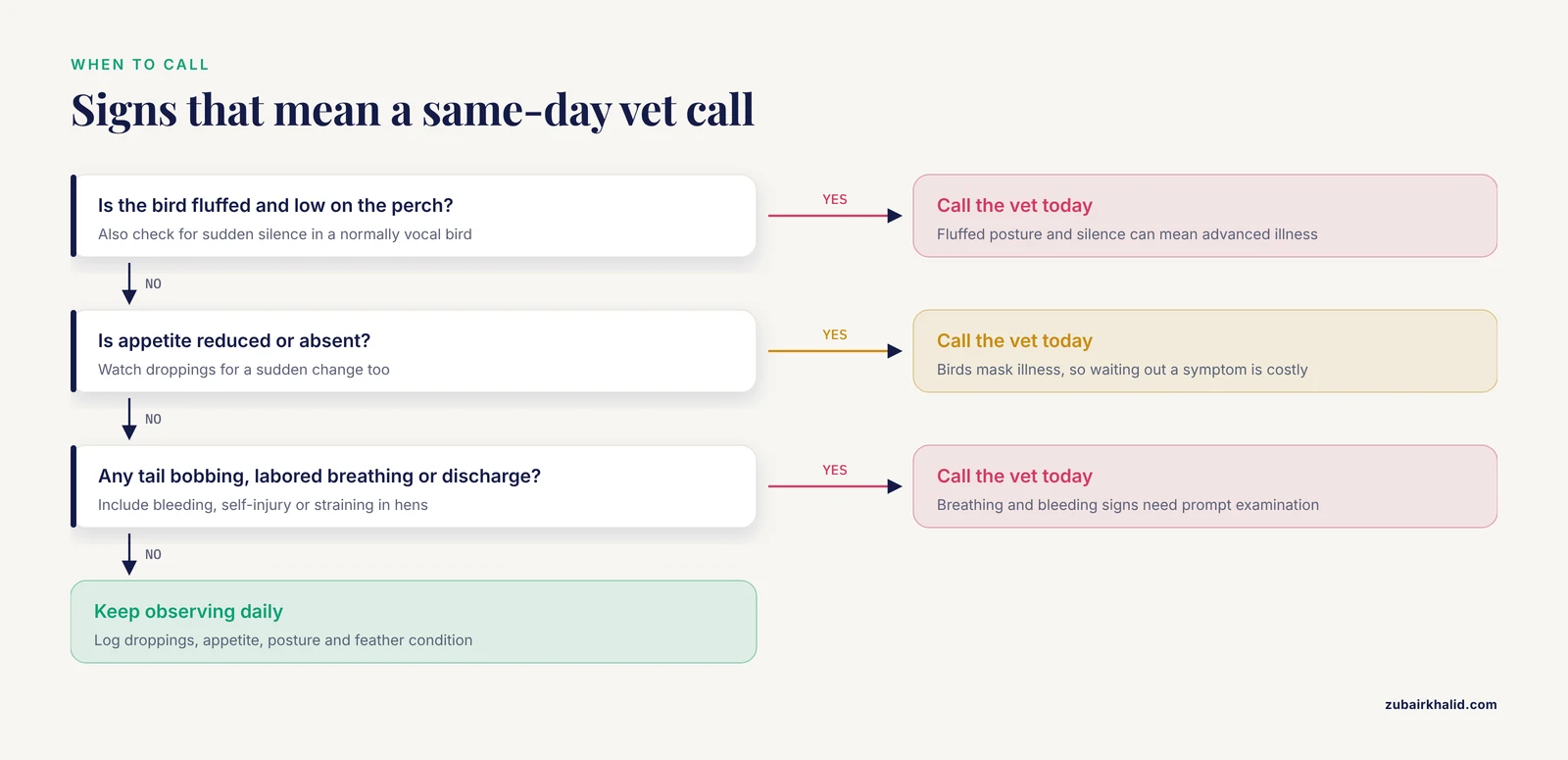
Individual birds vary around every species pattern described here, and an avian veterinarian who can examine your specific bird should guide the final care plan. This article is educational and is not a substitute for veterinary diagnosis or treatment.
Contact an avian veterinarian promptly, the same day when possible, for any of the following: a bird sitting fluffed and low on the perch, reduced or absent appetite, tail bobbing at rest, labored breathing, discharge from the eyes or nostrils, a sudden change in droppings, bleeding of any kind, sudden silence in a normally vocal bird, new feather chewing or plucking, self-injury, straining or persistent egg laying in hens, or a major unexplained change in behavior. Because birds mask illness until disease is advanced, waiting out a symptom is the most costly mistake in bird keeping.
Behavioral concerns deserve professional input too. Chronic screaming, feather destructive behavior, aggression that makes handling unsafe, and hormonal behaviors such as chronic egg laying all benefit from an avian examination first, since many behavior problems have medical components.
Frequently Asked Questions
Which pet birds do best living alone?
Canaries top the list of pet birds that cope well as single animals. Budgies and cockatiels can live alone only when people provide genuine flock time daily. Finches should not live alone at all.
Do budgerigars need a second budgie?
Not if a person supplies real companionship through most of the day. When the household is empty on weekdays, a second budgie usually serves the bird better than any toy or background broadcast.
Is it cruel to keep a single parrot?
No, provided the bird receives reliable daily interaction and enrichment. It becomes a welfare problem when the household's available time was overestimated at purchase.
Can different bird species share one cage?
Generally no. Mixing species in one cage risks injury and disease spread and should only be attempted with experienced guidance.
How much daily attention does a pet parrot need?
Think in terms of being included in the household's day plus dedicated interaction time, rather than a fixed hour count. Your avian veterinarian can help you calibrate this to your specific bird.
Do mirrors ease loneliness in pet birds?
They can briefly occupy a bird but do not replace a living companion, and in some birds they trigger hormonal or defensive behavior. Ask an avian veterinarian whether a mirror suits your bird.
Further Reading
- Mapping bird and bat assemblage vulnerability for predicting wind energy impact.
- Anthropogenic debris as nest material in three swift species: New insights into the interactions of atmospheric pollution with wildlife.
- Pollen diet diversity across bee lineages varies with lifestyle rather than colony size.