Pet Bird Lifespan Chart: Options Compared
By Dr. Zubair Khalid, DVM, MS, PhD ·

Choosing a pet bird is mostly choosing a time horizon. A canary may share your home for about a decade, while a macaw can outlive your mortgage and possibly you. The rule of thumb for choosing: match the top of a species' lifespan range, not the bottom, to the number of years you can realistically guarantee stable care.
A pet bird lifespan chart puts those years side by side so you can compare options before you fall for a bird in a store aisle. This guide compares the most common pet birds by typical lifespan, sorts the options into three commitment tiers, weighs the pros and cons of each, and then covers the husbandry that turns those numbers into reality, including bird cage setup and a parrot care checklist.
This article is educational and is not a substitute for veterinary diagnosis or treatment.
What the Best Pet Bird Lifespan Chart Should Include
Lifespan numbers are ranges with assumptions attached, and the best pet bird lifespan chart makes those assumptions visible. A single figure such as "parrot, 50 years" hides more than it reveals.
Four features separate a useful chart from a misleading one:
- Ranges instead of single numbers. A budgerigar listed at "8 years" tells you almost nothing. A range of 5 to 10 years, with a note that well-kept birds often reach their teens, lets you plan for the realistic top end.
- Species-level precision. "Small parrot" is not a species. Cockatiels, lovebirds, and green-cheeked conures differ in lifespan, noise, and handling needs, and they deserve their own rows.
- Wild versus captive context. Captive birds protected from predators and famine often outlive wild relatives, but only when diet, housing, and veterinary care are adequate.
- Stated care assumptions. Any honest range presumes decent food, clean housing, safe air, and access to an avian veterinarian.
Publisher transparency matters as well. VCA Animal Hospitals and Lafeber Company publish species care sheets that list lifespan ranges beside diet and housing guidance, and the Merck Veterinary Manual connects husbandry failures, such as all-seed diets, to preventable disease. A chart built on that kind of material gives you ranges you can actually plan around.
Pet Bird Lifespan Chart: Side-by-Side Comparison
The table below compares the options most people actually choose from. Ranges reflect commonly reported captive lifespans under reasonable care, drawn from species-level avian husbandry references, including care sheets published by VCA Animal Hospitals and Lafeber Company. Individual birds vary, and exceptional animals sit outside every range listed.
| Bird | Typical lifespan | Size | Noise | Daily interaction | Best fit |
|---|---|---|---|---|---|
| Zebra or society finch | 5-10 years | Very small | Soft chirping | Low | Song and motion, no handling |
| Canary | 10-15 years | Very small | Male song, otherwise quiet | Low | Song in a small space |
| Budgerigar (budgie) | 5-10 years, often into the teens with excellent care | Small | Chatty, moderate | Low to moderate | First bird, supervised kids |
| Lovebird | 10-15 years, some to 20 | Small | Shrill calls | Moderate to high | Hands-on owners who accept noise |
| Ringneck dove | 10-20 years | Small | Gentle cooing | Low to moderate | Calm homes, soft sound |
| Cockatiel | 15-20 years, some past 25 | Small to medium | Whistles, moderate | Moderate to high | Classic first parrot |
| Green-cheeked conure | 15-25 years | Small | Quiet for a conure, loud in bursts | High | Interactive owners in smaller homes |
| Sun conure | 20-30 years | Small to medium | Extremely loud | High | Detached homes with tolerant neighbors |
| Quaker parakeet | 15-25 years, some longer | Small to medium | Loud | High | Talkers and builders, where legal |
| Indian ringneck | 20-30 years | Medium | Loud contact calls | Moderate to high | Would-be talkers |
| Pionus parrot | 20-30 years | Medium | Relatively quiet for a parrot | Moderate | Medium parrot without maximum noise |
| Caique | 20-30 years | Small to medium | Loud play calls | Very high | High-energy households |
| Eclectus | 30-40 years or more | Medium to large | Moderate | High | Patient, diet-focused owners |
| African grey | 40-60 years | Medium to large | Loud but intermittent | Very high | Dedicated, engaged owners |
| Amazon parrot | 40-60 years, some longer | Large | Very loud mornings and evenings | High | Experienced owners with space |
| Cockatoo | 40-60 years, some longer | Large | Extremely loud | Extremely high | Only highly available households |
| Macaw | 50-70 years, some reported longer | Very large | Extremely loud | High | Experienced owners with a succession plan |
The options in a pet bird lifespan chart cluster into three tiers, and the rest of this article treats each on its own terms, because a ten-year bird and a sixty-year bird are not the same kind of decision.
Tier 1 Options (About 15 Years or Less): Pros and Cons
Finches (zebra, society). Finches are the watch-and-listen option. They thrive in pairs or small flights, entertain themselves for hours, and rarely want hands on them. Most live well under a decade, which suits owners who want living color and sound without a handling relationship. The trade-off is that nearly all of the joy comes through the eyes and ears.
Canaries. Canaries are celebrated for the male's song and are content to live solo. Most ignore hands, so plan for flight space rather than lap time. Commonly reported spans run a decade or a bit more, longer than many buyers expect from a bird this small.
Budgerigars (budgies). Budgies are the world's most commonly kept parrot and the most underestimated. Cheap and small does not mean simple. With daily taming, a budgie learns tricks and often dozens of words. Many live under a decade, and well-managed birds commonly reach their teens. Their low price invites impulse purchases, which is where most budgie welfare problems begin.
Lovebirds. Lovebirds are pocket-sized opinions. Bold, beaky, and intensely bonded, they need daily interaction whether kept singly or in pairs. The old warning that a single lovebird will pine away is overstated, but a single bird does need you to fill the partner role. Most live into their teens.
Ringneck doves. Ringneck doves are the gentlest row on the chart. They coo rather than scream, tolerate calm handling, and ask for simple routines. Many live into their second decade. The trade-off is an understated look and a repetitive coo that some households adore and others grow tired of.
Where this tier shines
- Lower total cost across the bird's life
- A commitment most households can honestly promise
- Quieter homes overall, with finches and doves at the gentle end
- Easier to plan around moves, kids, and career changes
Where this tier falls short
- A shorter relationship than many owners end up wanting
- Several species are look-don't-touch, which disappoints people who wanted a handler
- Small size invites underinvestment in cage space and diet
- Budgies in particular are often treated as disposable starter pets
Tier 2 Options (Roughly 15 to 30 Years): Pros and Cons
Cockatiels. Cockatiels are the classic first parrot, and their two-decade range is exactly why the decision deserves respect. They whistle, ride shoulders, telegraph their mood with that crest, and handle gently. Males can be loud at dawn and dusk, and their powder down dusts nearby furniture.
Green-cheeked conures. Green-cheeked conures are the introvert's conure, quieter than most of their cousins though still capable of piercing bursts. Clownish and affectionate, they bond hard and chew harder. Expect a bird in your life for roughly two decades.
Sun conures. Sun conures wear the sunset and sound like it too. Affectionate, playful, and commonly reported to live into their third decade, they are wonderful birds with a voice that ends apartment leases. House one only where screaming is survivable.
Quaker parakeets. Quakers talk well, build elaborate nest structures, and behave like birds three times their size. Many live into their twenties. Legal fine print matters here, because several US states restrict or ban Quakers over concerns about feral colonies and crop damage, so confirm your state's rules before you buy.
Indian ringnecks. Indian ringnecks are elegant, surprisingly clear talkers that commonly live into their third decade. They need steady, friendly handling through adolescence, or they can turn hand-shy and distant.
Pionus parrots. Pionus parrots are the quiet, understated medium parrot. Less flashy than Amazons and far easier on the ears, they suit owners who want parrot substance without parrot volume. Commonly reported lifespans reach the third decade.
Caiques. Caiques are the class clowns, hopping, wrestling, and demanding play. Many live into their twenties. The trade-off is near-constant energy and a beaky play style that needs redirecting onto toys rather than fingers.
Where this tier shines
- Real parrot interaction, including speech potential in several species
- A cage footprint most homes can absorb
- Long enough to bond deeply, short enough to plan honestly
Where this tier falls short
- Decades of daily noise and mess, not years
- Hormonal seasons test unprepared owners
- Rehoming a twenty-year bird mid-life is hard on everyone involved
Tier 3 Options (30 Years and Beyond): Pros and Cons
Eclectus parrots. Eclectus parrots show dramatic color differences between the sexes, brilliant green males and crimson females. Commonly reported lifespans run three decades and beyond. Talk feeding over with an avian veterinarian before you commit, because this species does best with a carefully managed, produce-heavy diet.
African greys. African greys set the benchmark for avian intelligence and speech, with commonly reported lifespans of four to six decades. They need novelty, foraging puzzles, and genuine engagement. Ask an avian veterinarian about enrichment early, because greys are among the species where boredom-linked feather damage shows up in practice.
Amazon parrots. Amazons are big, bold, and vocal at dawn and dusk, with commonly reported lifespans of four to six decades and some birds reported longer. They stay playful into old age when kept trim and busy.
Cockatoos. Cockatoos bond intensely and demand contact to match. Reported lifespans commonly reach four to six decades, some longer. Avian rescue organizations routinely describe cockatoos as frequent rehoming cases, because daily needs exceeded what owners pictured at the pet store.
Macaws. Macaws are the long game, with commonly reported lifespans of five to seven decades and credible reports beyond. They need serious space, steel, and an owner comfortable managing a large, loud, brilliant bird. Everything scales up, including the commitment.
Where this tier shines
- A companion measured in generations, not years
- The deepest cognition and communication on the chart
- Old birds stay engaging when their bodies are kept healthy
Where this tier falls short
- Outliving their owners is a real possibility that demands paperwork
- Noise, space, and destruction at full parrot scale
- A succession plan is mandatory, not optional
Why Bird Lifespans Vary So Much
Lifespan is baked into a species' biology. Across birds, life-history traits travel together. In a 2023 study of sympatric bird species breeding at high altitude, clutch size correlated with parental care, predation rate, and adult lifespan, and species with smaller clutches tended toward longer adult lives, while egg mass tracked development period [1]. Egg and clutch mass also rose with body mass across those species [1], the kind of scaling that separates a finch from a macaw. Small, fast-maturing birds that reproduce quickly sit at the short end of the chart. Large, slow-maturing parrots sit at the long end.
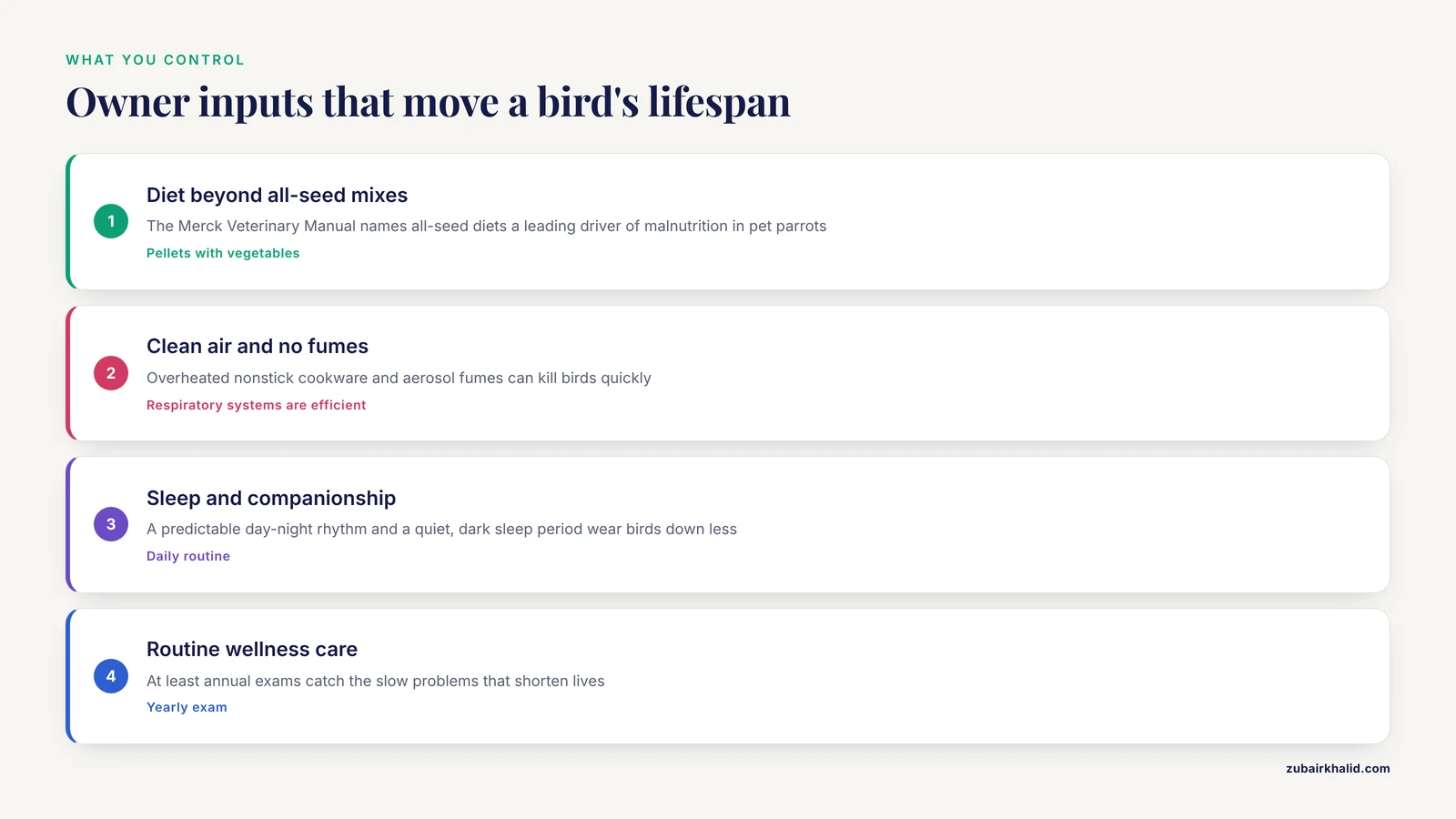
Care writes the rest of the story. The Merck Veterinary Manual identifies all-seed diets as a leading driver of malnutrition in pet parrots, and poor diet compounds with inactivity, chronic stress, and airborne hazards. Avian veterinarians also warn that overheated nonstick cookware and aerosol fumes can kill birds quickly, a risk most owners never connect to the lifespan conversation. Birds' respiratory systems are unusually efficient, which is why avian veterinarians treat airborne toxins as emergencies. Sleep, companionship, and routine wellness care round out the variables an owner controls. Two budgies from the same clutch can age years apart depending on these inputs.
The Association of Avian Veterinarians recommends at least annual wellness examinations for pet birds, precisely because the slow problems that shorten lives rarely announce themselves at home.
Comparing Options on the Criteria That Decide Real Choices
The numbers in a pet bird lifespan chart only matter next to your actual life. Six criteria decide most real choices:
- Time horizon. Match the top of the range to the years you can guarantee stable housing and care. A bird that fits your lease but not your decade is the wrong bird.
- Daily minutes. Finches need minutes of your day. Cockatiels need a solid hour of attention. Cockatoos need most of your evening and still want more.
- Noise budget. Walls, neighbors, remote work calls, and sleeping children all vote on this criterion. Vote honestly.
- Household trajectory. Babies, moves, deployments, divorces, and new pets are the events that actually end bird ownership, more than any lifespan number.
- Succession plan. For any Tier 2 or Tier 3 bird, name the person who takes the bird if you cannot. Put it in writing.
- Lifetime logistics. Cages wear out, diets evolve, and veterinary needs change across decades. Plan for the whole arc, not the first year.
Three Worked Scenarios
Scenario 1: The Apartment First-Timer
A 28-year-old renter wants birdsong, not a neighbor dispute. Finches or a single canary fit perfectly, and a hand-tamed budgie works if she commits to daily handling. Skip conures, ringnecks, and anything with "cockatoo" in the name, because their voices defeat leases. Cage setup note: choose a wide flight-style cage placed away from the kitchen, since even small birds need horizontal room and clean air.
Scenario 2: The Family With School-Age Children
Parents want a bird the kids can interact with. A cockatiel or green-cheeked conure fits, with adult supervision and adults who accept that the daily work lands on them. The catch is arithmetic: a bird that lives into its twenties outlasts childhood by a decade or more, so the household, not the child, owns the commitment. Buy the cage for the adult bird, not the baby.
Scenario 3: The Empty-Nesters Building a Legacy
A couple in their fifties, home most of the day, wants a decades-long companion. An African grey or Amazon fits, with eyes open about noise and hormones. Their real work is administrative: a named successor in their estate documents, funded care, early introductions between bird and successor, and a cage setup built for a forty-year resident from day one.
Bird Cage Setup Basics That Support a Long Life
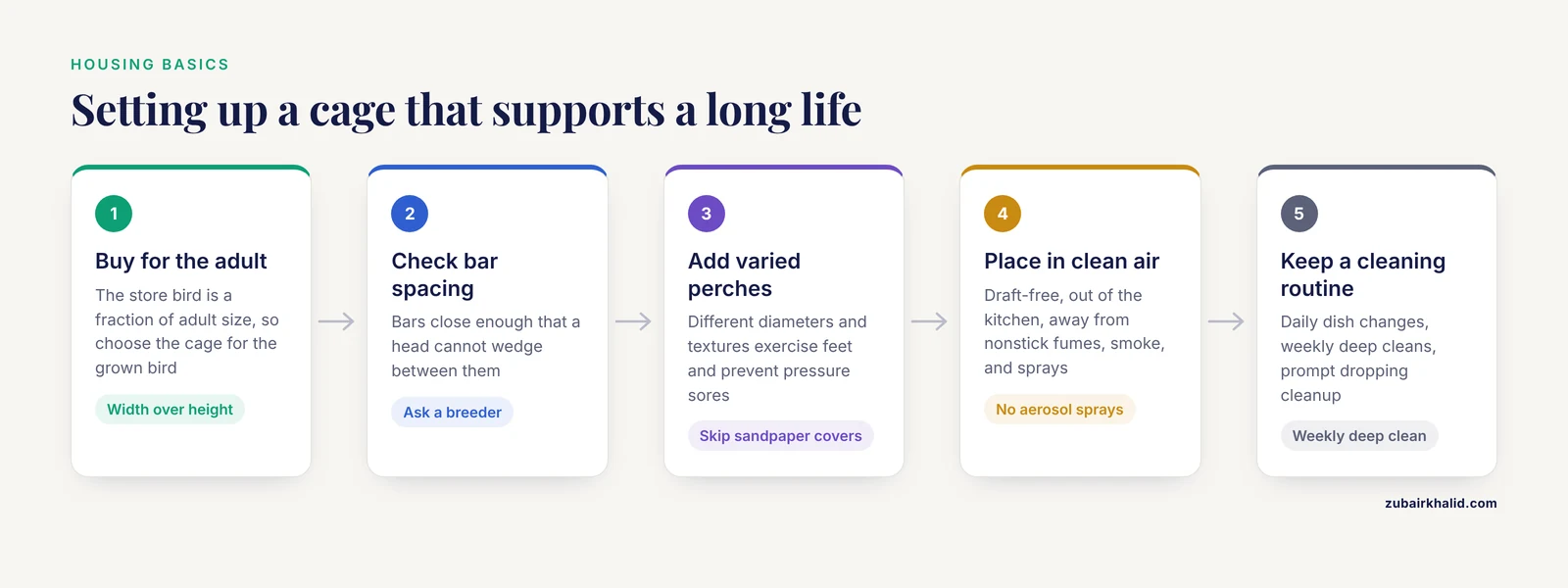
Cage setup is lifespan maintenance, not decoration. Get these fundamentals right:
- Buy for the adult bird. That tiny lovebird in the store is a fraction of its adult size. Width matters more than height, because birds fly horizontally.
- Bar spacing that fits the species. Bars must be close enough that a head cannot wedge between them. Ask an avian veterinarian or a reputable breeder for species-appropriate spacing before you buy.
- Varied perches. Different diameters and textures exercise feet and prevent pressure sores. Natural branches beat plastic dowels. Skip sandpaper sleeve covers.
- Location with clean air. Draft-free, out of the kitchen, away from nonstick cookware fumes, smoke, and aerosol sprays.
- Light and sleep. Birds need a predictable day-night rhythm and a quiet, dark sleep period. A cage in the middle of household light and noise around the clock wears a bird down.
- Enrichment rotation. Foraging opportunities and rotated toys prevent the boredom that drives screaming, plucking, and aggression.
- A cleaning routine you will actually keep. Daily dish changes, weekly deep cleans, and prompt dropping cleanup protect the respiratory and digestive health that lifespans depend on.
VCA Animal Hospitals' avian guides and Lafeber Company's care sheets cover species-specific setup details, and a first wellness visit is a good moment to have an avian veterinarian review your arrangement.
Parrot Care Checklist
Long lifespans are earned in boring routines. Scale this parrot care checklist to your species, and shrink the handling items for finches and canaries while keeping the hygiene and exam items.
Daily
- Fresh water and a measured meal of pellets with vegetables or fruit appropriate to the species
- A quick dropping check, since droppings are an early warning system
- Out-of-cage time and interaction for parrots, or flight and foraging setups for hands-off species
- A quiet, dark, uninterrupted sleep period
Weekly
- Deep clean of the cage, bowls, and perches
- Toy rotation to keep novelty high
- A gentle weight check on a gram scale if the bird tolerates handling
- A look at nails, beak, and feather condition
Monthly
- Full cage disinfection and perch rotation
- A hazard sweep for new risks, such as new cookware, candles, scented products, or a loose ceiling fan
- Restock foraging materials and chew toys
Yearly
- A wellness examination with an avian veterinarian, as the Association of Avian Veterinarians recommends
- A diet review and weight trend discussion with the clinic
- An update to your succession plan and written care instructions
Common Mix-Ups When Reading a Lifespan Chart
- Planning around the low end. Buyers who assume a cockatoo lives "about 20 years" discover the truth around year 25.
- Assuming small means short. Budgies regularly reach their teens, which surprises owners who budgeted for five.
- Treating a child's bird as the child's. The bird outlasts childhood, so the adults own the commitment from day one.
- Confusing records with typical outcomes. A century-old macaw anecdote is not a plan, and neither is a five-year budgie tragedy.
- Believing lifespan is fixed regardless of care. Diet, air quality, sleep, and veterinary access move individual outcomes substantially.
- Sizing the cage for the baby bird. Juvenile-sized cages crowd adults and clip flight lives short.
- Ignoring noise until after move-in. Noise is a leading reason parrots lose their homes.
- Skipping the succession plan. Tier 3 birds need a named successor the day they come home.
Limitations and When to Contact a Veterinarian
Charts describe populations, and your bird is an individual whose health, diet, and risk factors deserve assessment by an avian veterinarian. Use the chart to plan and the vet to personalize.
Contact an avian veterinarian promptly, the same day when you can, for any of the following:
- Sitting fluffed on the cage floor or unusually still
- Not eating, or eating far less than usual
- Tail bobbing, open-beak breathing, or any labored breathing
- A change in voice, song, or speech
- Discharge from the eyes or nostrils
- Rapid weight loss or a suddenly prominent keel bone
- Droppings that change sharply in color, volume, or consistency
- Bleeding, a fall, or an encounter with a cat or dog, even without visible wounds
- A hen that strains, swells, or sits low in the cage, which can signal egg trouble
Birds mask illness until they cannot mask it anymore, so subtle changes count as urgent ones. The Association of Avian Veterinarians recommends at least annual wellness examinations, and any newly acquired bird should meet an avian veterinarian soon after arrival.
Frequently Asked Questions
What pet bird lives the longest?
Large macaws top the chart, commonly living five decades or more with good care, and credible reports describe longer lives. Cockatoos, African greys, and Amazons follow close behind.
Which pet birds have the shortest lifespans?
Finches usually anchor the short end at under a decade, with canaries and budgies close behind. Even these species can surprise you, since well-kept budgies commonly reach their teens.
Are lifespan chart numbers averages or maximums?
They are typical ranges for reasonably well-cared-for pet birds, neither averages nor records. Plan around the top of the range, because good care pushes birds toward the high end.
Does cage setup really affect how long a bird lives?
Yes, indirectly but powerfully. Flight space, safe placement away from fumes and drafts, varied perches, and steady enrichment protect against obesity, respiratory injury, and stress-related disease.
How do I plan for a parrot that may outlive me?
Name a successor in writing, fund the bird's future care, introduce the successor while you can, and revisit the plan as life changes. An estate planning attorney can formalize the arrangements.
Are conures too loud for apartments?
Sun conures and most of their cousins are a poor apartment fit because their calls carry through walls. Cockatiels, budgies, canaries, and finches are the safer acoustic choices.
Further Reading
- Managing livelihood in displacement: the politics of land ownership and embodied health and well-being by senior women in Kenya.
- The Realization of Nurses in Managing a Day Care Program for Senior Citizens
- Understanding and Managing Fragmented Transitions in Care: Learning from and Guided by Patient, Family, Health Care Provider and System-Level Experiences Before, During and Follow-up to COVID-19
- Understanding and managing anxiety sensitivity during critical illness and long-term recovery
- Managing ADHD across the Lifespan in the Primary Care Setting