Pet Bird Food Pyramid: Complete Guide
By Dr. Zubair Khalid, DVM, MS, PhD ·
The pet bird food pyramid is a simple feeding model that ranks foods by how much of the daily diet they should provide, with formulated pellets and vegetables forming the broad base and seeds, nuts, and treats forming a narrow top. It exists because the single most common dietary error seen in avian medicine is a bird fed almost nothing but seed, a pattern linked to vitamin A deficiency, calcium problems, and other preventable disease [1].
This guide explains the pet bird food pyramid tier by tier, the biology behind why the structure matters, worked examples for common species, and how the pyramid fits into a practical parrot care checklist and bird cage setup.
What Is the Pet Bird Food Pyramid?
A pet bird food pyramid is a visual and practical framework for building a daily ration. Instead of asking "what can my bird eat," it asks "what should make up the largest share of the bowl, and what should be rare." Foods sit on the pyramid according to their nutrient density, their moisture content, and the diseases they promote when overfed.
The model resembles the food pyramids once used in human nutrition. The base contains foods a bird should eat in volume every day. The middle contains foods that add variety and micronutrients in moderate amounts. The peak contains energy-dense foods that birds relish but that cause harm in excess. A food pyramid for a bird is not a strict prescription, and different avian veterinarians express the tiers with slightly different emphasis, but the core logic is consistent across avian nutrition resources such as those published by the Association of Avian Veterinarians and Lafeber Company.
Two facts explain why the pyramid approach took hold in avian practice. First, nutritional disease is deeply embedded in pet bird medicine. A review of nutrition-related problems in pet birds documents hypovitaminosis A in parrots, hypocalcemia in African grey parrots, goitre in budgerigars, iron storage disease in mynahs and toucans, and nutritional secondary hyperparathyroidism, most of them traceable to seed-heavy rations [1]. Second, birds are enthusiastic food selectors. Given a bowl of mixed seed, a parrot will excavate its favorite high-fat items and leave the rest, so the nutrients that leave the bowl are not the nutrients that enter the bird. The pyramid counters that behavior by restructuring what goes into the bowl in the first place.
The Biology Behind the Pyramid
To understand why tiering food matters, it helps to look at what goes wrong when the tiers are inverted.
Vitamin A and mucous membrane health
Seed mixtures are the classic staple of pet bird feeding, and they are chronically low in preformed vitamin A. Vitamin A deficiency produces metaplasia of the mucous membranes, meaning the moist linings of the respiratory and digestive tracts change structure and lose their normal protective function. That change predisposes birds to chronic rhinitis and to respiratory fungal infections, and the deficiency syndrome in parrots is directly attributed to seed-based feeding [1]. The base of the pyramid, built from formulated pellets and fresh vegetables, exists precisely to correct this gap.
Calcium, phosphorus, and the African grey problem
Seed mixtures are often deficient in calcium. If a bird receives no additional calcium source, such as ground shells, nutritional secondary hyperparathyroidism can develop, in which the body pulls calcium from bone to maintain blood levels [1]. Hypocalcemia has a particularly dramatic presentation in two species. Tetanic symptoms from low blood calcium are reported specifically in the African grey parrot and the timneh parrot, which is why avian veterinarians pay close attention to calcium status in these birds [1].
Iodine and the budgerigar
Goitre, an enlargement of the thyroid gland, develops in budgerigars fed a millet-based seed mixture combined with iodine-deficient drinking water [1]. This is a reminder that the pyramid is not only about what is abundant in the bowl but also about trace nutrients that seeds simply do not deliver.
Fat, iron, and species sensitivity
Energy-dense oilseeds dominate the top of the pyramid for a reason. Sunflower is a major global ingredient for confectionery, bird food, and pet food, valued precisely because it is calorie-rich and highly palatable [2]. That same palatability is the problem when sunflower and similar seeds form the bulk of a ration. Birds select them first, overeat fat, and reject the balanced base.
Iron adds a species-specific warning. Iron storage disease occurs in mynahs and toucans, and although the exact cause is not known, a diet low in iron and vitamin C is advised as therapy [1]. For softbills, the pyramid leans further away from iron-rich items than it does for parrots.
Protein, and why more is not better
Protein needs a middle position on the pyramid. Researchers estimated the maintenance protein requirement of adult Amazon parrots by measuring the nitrogen the birds inevitably lost in their excreta, which came to 87.2 mg per bird per day under the study conditions. The authors note that unnecessary protein overconsumption should be avoided in older pet birds in particular, given the potential decline in liver and kidney efficiency with age [3]. This is why legumes and cooked pulses sit in the middle tiers rather than the base, and why high-protein items are not something to pile on generously.
The cost of an unbalanced ration
When the overall diet is unbalanced or multideficient, the consequences are not limited to one organ. Documented outcomes include reproductive disorders, abnormal feathers, and infections caused by diminished immune resistance [1]. Owners often notice the feather and beak changes first, because they are visible, but the internal effects usually come first.
Pet Bird Food Pyramid Explained, Tier by Tier
The tiers below reflect the consensus logic used in avian practice. Exact proportions vary by species, life stage, and health status, so treat the table as a structural map rather than a measuring chart, and confirm targets with your avian veterinarian.
| Tier | Position in the pyramid | Typical foods | Role in the diet | Practical owner note |
|---|---|---|---|---|
| , - | , - | , - | , - | , - |
| Base | Largest share of the daily bowl | Formulated pellets, chopped dark leafy and orange vegetables | Delivers balanced vitamins, minerals, and fiber, corrects the vitamin A and calcium gaps of seed diets [1] | Present fresh each morning, remove perishables before they spoil |
| Middle | Moderate, rotating share | Cooked pulses and legumes, whole grains, chopped fruit, sprouted seed | Adds variety, micronutrients, and foraging interest without excess fat or protein | Rotate colors and textures across the week, keep fruit modest because of sugar |
| Upper | Small, deliberate share | Dry seed mixes, millet spray, nuts | Energy, essential fatty acids, and powerful training rewards | Size the share to the species, a budgerigar needs far less seed energy than a macaw |
| Peak | Occasional and minimal | Human snack foods, fatty or salted items, sweetened anything | None nutritionally, purely recreational | Reserve for rare moments or exclude entirely |
A few details make the tiers work in real kitchens.
Formulated diet at the base. Pellets are engineered so that every bite carries a similar nutrient profile, which defeats a bird's ability to selectively sort its food. This matters because selective feeding is exactly how a seemingly generous seed mix produces deficiency [1].
Vegetables alongside pellets. Dark leafy greens and orange vegetables contribute carotenoids and other nutrients that help protect mucous membranes, the tissue type damaged by hypovitaminosis A [1]. Chop them finely for small species and offer them in a separate dish so moisture does not degrade the pellets.
Seed demoted, not banned. Seed retains value as training reinforcement, enrichment, and a component for species that genuinely need it. The pyramid asks only that seed stop being the foundation. For conversions, seed becomes a tool rather than a meal.
Calcium access. Because seed mixtures are calcium deficient and secondary hyperparathyroidism follows when no calcium source is provided [1], many avian veterinarians discuss mineral sources such as ground shells or cuttlebone as part of the plan. Your veterinarian can advise whether your bird needs a specific supplement, because oversupplementation carries its own risks described below.
Pet Bird Food Pyramid Examples for Common Species
The pyramid flexes by species. These examples show how the same structure produces different bowls.
Amazon parrots and similar medium parrots
Amazons are frugivore-granivores, and their pyramid leans on a formulated base with generous vegetables and measured fruit. The maintenance protein work in Amazons shows their baseline protein needs are modest, and the authors caution against protein overconsumption in older birds because of the liver and kidneys [3]. In practice this keeps pulses, eggs, and meat in the middle or upper tiers, never the base.
African grey parrots and timneh parrots
The pyramid structure is the same, but calcium draws special attention because hypocalcemia with tetanic symptoms is documented specifically in African greys and timnehs [1]. Owners of these species should discuss blood calcium monitoring and dietary calcium strategy with an avian veterinarian rather than guessing with supplements, because vitamin D oversupplementation causes poisoning with polyuria and polydipsia as early signs [1].
Budgerigars and cockatiels
Budgerigars developed goitre on millet-based seed mixtures with iodine-deficient water [1], so the pyramid for these small parrots emphasizes formulated diet and corrects the trace mineral gap. Small birds also burn energy quickly, so the upper seed tier is small in absolute terms but still psychologically valuable.
Mynahs, toucans, and other softbills
Softbills shift the pyramid away from seed almost entirely. Fruit and low-iron formulated softbill diets form the base, and the iron storage disease literature advises keeping iron low with vitamin C in the diet for susceptible species [1]. Insects and other protein sources occupy the middle tiers.
Red-whiskered bulbuls, a worked softbill example
A survey of caretakers feeding red-whiskered bulbuls in Thailand documented rations built from plant foods across 18 families and 24 species, including bananas, papaya, watermelon, tomato, cucumber, chinese squash, and ivy gourd, plus insects such as mealworms, crickets, grasshoppers, and ant eggs, with some caretakers adding vitamins [4]. Translate that into pyramid language and you see the base as fruit and soft food, the middle as live insect protein, and the peak as anything extra. It is a living demonstration that a food pyramid is a framework, not a fixed shopping list.
Nectar and softbill specialists
Lories and lorikeets sit at the far end of the spectrum, with liquid or powder nectar diets forming the base and fruit and vegetables in the middle tiers. Seed plays almost no role. If you keep a specialist feeder, ask your avian veterinarian to sketch the pyramid for your exact species before you buy food.
Why Seed-Only Feeding Persists, and the Myths Around It
Myth, birds naturally eat seed, so seed must be complete. Wild parrots travel, forage for hours, and eat a rotating array of plant parts, fruits, bark, and insects depending on season. A bag of static seed mix reproduces almost none of that variation. The diseases tied to seed feeding in the veterinary literature, from hypovitaminosis A to goitre to secondary hyperparathyroidism, exist precisely because a seed ration is narrow, not because seed is toxic [1].
Myth, my bird looks fine on seed. Nutritional disease in birds tends to develop slowly and silently. Deficiency states such as hypovitaminosis A damage mucous membranes before owners see obvious signs, and that damage then opens the door to chronic rhinitis and respiratory fungal infections [1]. By the time a bird looks sick, the deficit is often long standing.
Myth, more protein means more muscle and better feathers. The Amazon study suggests otherwise. Beyond maintenance needs, extra protein offers no clear benefit and raises theoretical concern for aging liver and kidneys [3]. Feathers reflect overall diet quality, including vitamins and minerals, not protein loading.
Myth, expensive feed means clean feed. A pilot study of 22 popular parrot feeds on the Polish market found mold in nearly three out of four samples, with Aspergillus species most common, including the pathogen Aspergillus fumigatus. Mold also appeared in some more expensive feeds, and no clear safety limits currently exist for mold in parrot feed [5]. Price is not a substitute for sourcing and storage discipline.
Practical Implications, from Bowl to Bird Cage Setup
Building the daily bowl
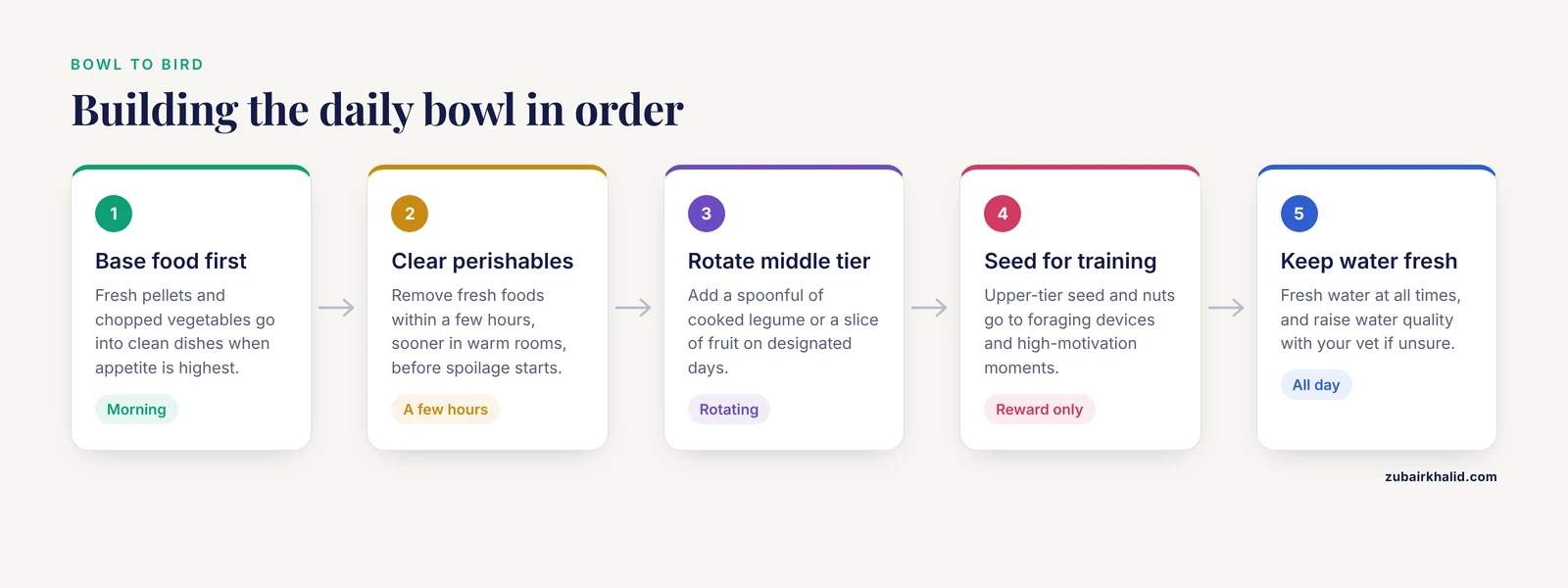
- Offer the base first thing in the morning, when appetite is highest. Fresh pellets and chopped vegetables go in clean dishes.
- Remove perishable foods within a few hours, or sooner in warm rooms, so spoilage and mold never become part of the meal.
- Add middle-tier items as rotation, a spoonful of cooked legume or a slice of fruit on designated days.
- Reserve upper-tier seed and nuts for training sessions, foraging devices, and moments that need high motivation.
- Keep fresh water available at all times, and remember the budgerigar goitre findings [1] if your municipal water quality is in question, a topic your veterinarian can help you evaluate.
Food storage and mold prevention
Mold contamination in commercial parrot feed is common enough to warrant real vigilance. In the Polish market study, Aspergillus species dominated the fungal isolates, and Aspergillus fumigatus was identified, a species whose spores can reach the deep areas of a bird's lungs [5]. Buy feed in quantities you will finish quickly, store it in sealed containers in a cool dry place, discard bags that smell musty or show clumping, and clean storage containers between refills. The study's authors call for better production controls, which means the burden of vigilance currently sits with the buyer.
A broader commercial feed note comes from radiological monitoring in Brazil, which measured natural radionuclides in the most sold bird, dog, cat, and rabbit foods and concluded that consumption of the commercial foods tested was radiologically safe for pets [6]. That finding addresses one narrow contaminant class and does not speak to mold, oxidation, or nutrient degradation, which remain the practical storage concerns.
Where the pyramid meets a parrot care checklist
A parrot care checklist usually covers diet, housing, enrichment, grooming, and veterinary care. The food pyramid anchors the diet line, and it also shapes the enrichment lines. Foraging is how parrots spend much of their wild day, and the pyramid gives you the currency for it, since upper-tier seed and nuts become meaningful rewards placed inside foraging toys rather than free-feed in a dish.
Bird cage setup that supports the pyramid
Cage layout either helps or undermines the feeding plan.
- Place the pellet and vegetable dishes at an accessible height, away from droppings contamination and away from the water dish so moisture does not splash into dry food.
- Position foraging toys at perch level so working for seed rewards feels natural rather than frustrating.
- Keep at least one perch clear of all dishes so a bird can eat without another bird, or a mirror, looming over it.
- Avoid siting food directly under favorite sleeping perches, where droppings will land in the bowl overnight.
- For damp fresh foods, choose a dish location you can reach quickly for removal, because spoilage speed matters.
Owners who restructure cage layout around feeding consistently find the diet conversion easier, because the bird's attention moves from the old seed dish to the new sources of interest.
Converting a seed-eating bird
Conversion is the hardest step for most owners, and it is also the step with the biggest health payoff. Common approaches include mixing increasing amounts of pellets into the seed, offering pellets fresh in the morning when hunger is highest, eating a portion of the food yourself in front of the bird, since parrots learn by social modeling, and using the bird's weight as a safety net during the transition. Any bird that is dropping weight, producing fewer droppings, or acting lethargic during conversion needs immediate veterinary attention. An avian veterinarian can run a baseline examination before the switch and confirm progress afterward, which is the safest path for small birds with limited energy reserves.
What Is Still Uncertain
Several areas lack definitive answers. The exact cause of iron storage disease in toucans and mynahs is not known, and the low-iron, vitamin C approach is a therapy rather than a proven prevention strategy [1]. Safety limits for mold contamination in commercial parrot feed do not currently exist, and the fungal contamination data come from a pilot study of one national market, so the full picture in other markets is not established [5]. Feed additive safety is evaluated by bodies such as the European Food Safety Authority, and its assessments sometimes stop short of ornamental birds. In the vermiculite opinion, the panel concluded the additive was safe for poultry at specified inclusion limits but stated that no conclusion could be drawn for ornamental birds and other non-food-producing animals because of a lack of data, while noting the product is a potential skin and respiratory sensitiser during handling [7]. Species-specific optimal proportions inside the pyramid, especially for less common species, rest more on clinical experience than on feeding trials, and individual birds with existing disease may need modified pyramids designed by their veterinarian.
Limitations and When to Contact a Veterinarian
This article is educational and is not a substitute for veterinary diagnosis or treatment. The pyramid is a general framework, and individual cases need an avian veterinarian who can examine your bird, its droppings, and its weight history.
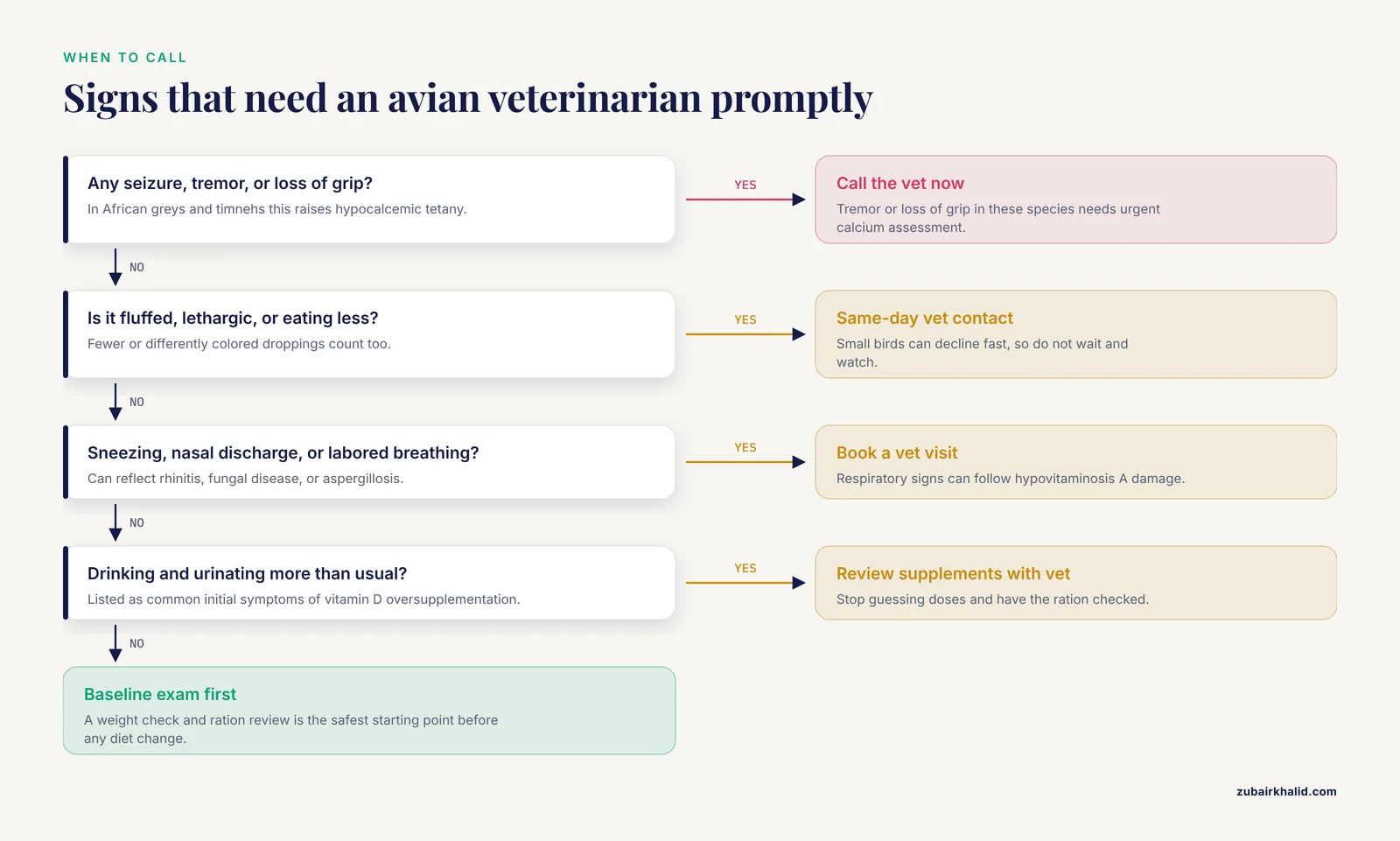
Contact an avian veterinarian promptly if you see any of the following.
- A bird that is eating less, producing fewer or differently colored droppings, or fluffed and lethargic, since these can escalate fast in small species.
- Any seizure, tremor, or loss of grip, which in African grey and timneh parrots raises the documented concern of hypocalcemic tetany [1].
- Increased drinking and increased urination, listed as common initial symptoms of vitamin D oversupplementation poisoning [1], and also possible signs of other disease.
- Sneezing, nasal discharge, voice change, or labored breathing, which can reflect the rhinitis and respiratory infections associated with hypovitaminosis A [1] as well as fungal disease such as aspergillosis [5].
- Abnormal feathers, beak changes, or reproductive problems, all documented consequences of unbalanced or multideficient diets [1].
- Visible mold in any feed bag, or feed that smells musty, given the high mold detection rate in sampled commercial parrot feeds [5].
A baseline avian wellness examination, including a weight check and discussion of your bird's current ration, is the ideal starting point before you restructure the diet, especially for older birds or birds with known liver, kidney, or calcium concerns.
Frequently Asked Questions
What is a pet bird food pyramid?
It is a tiered feeding model that ranks foods by the share of the daily diet they should provide, with pellets and vegetables as the base, grains, legumes, and fruit in the middle, and seed, nuts, and treats at the narrow top. The structure exists to prevent the deficiency diseases tied to seed-based rations [1].
Why is a seed-only diet harmful for pet birds?
Seed mixtures are deficient in vitamin A and calcium and have been linked to hypovitaminosis A with mucous membrane damage, nutritional secondary hyperparathyroidism, goitre in budgerigars, and reduced immune resistance [1]. Birds also sort seed mixes and eat only their favorite high-fat items, which worsens the imbalance.
What proportion of the diet should be pellets and vegetables?
Veterinarians generally recommend formulated diet and vegetables as the largest share of the bowl, with seed reduced to a small role, but exact proportions depend on species, age, and health. Ask your avian veterinarian to set specific targets for your bird, since published sources describe the structure rather than one universal percentage.
How do I switch my bird from seed to pellets?
Transition gradually by mixing increasing amounts of pellets into the seed, offering pellets fresh in the morning when appetite is strongest, and modeling the food yourself if your bird learns socially. Monitor weight and droppings during the switch, and stop for a veterinary check if intake drops.
Can parrots eat fruit every day?
Fruit belongs in the middle tier as a rotating addition rather than the main dish, because it adds vitamins and foraging value along with sugar. Surveys of caretakers of fruit-feeding species such as red-whiskered bulbuls document fruit as a core ration component for those species [4], while parrot pyramids typically keep fruit more modest and lean harder on vegetables.
Do African grey parrots need extra calcium?
African greys and timnehs are the species in which hypocalcemia with tetanic symptoms is documented [1], so calcium status deserves attention, but supplementation should follow veterinary testing and advice. Oversupplementation of vitamin D, often paired with calcium products, causes poisoning with polyuria and polydipsia as early signs [1].
How should I store bird food to prevent mold contamination?
Buy feed in small quantities you will use quickly, store it sealed in a cool dry place, discard any bag that smells musty or clumps, and clean containers between refills. Mold was detected in nearly three of four sampled commercial parrot feeds, including harmful Aspergillus species, regardless of price [5], so storage discipline matters as much as brand choice.
How does the food pyramid fit into a parrot care checklist and bird cage setup?
The pyramid supplies the diet line of your parrot care checklist, and it also shapes the cage, since foraging toys, dish placement, and perch layout determine how your bird experiences the plan. Put fresh base-tier foods in accessible clean dishes, reserve seed and nuts for foraging devices, and keep perishables in spots you can clear quickly during your daily bird cage setup routine.
Sources
- [[Nutrition-related problems in pet birds].](https://pubmed.ncbi.nlm.nih.gov/9929897/)
- Sunflower for Confectionery Food, Bird Food, and Pet Food
- Estimation of protein requirement for maintenance in adult parrots (Amazona spp.) by determining inevitable N losses in excreta.
- Food for Feeding Red-Whiskered Bulbul (Pycnonotus jocosus Pattani)
- Occurrence of Aspergillus spp. in Parrot Feeds on the Polish Market: The Potential Health Threat of Aspergillosis and Mycotoxicosis for Exotic Pet Birds, a Pilot Study
- Concentration of 40K, 226Ra, 228Ra and 228Th in the main brands of pet food sold in Brazil.
- Safety and efficacy of a feed additive consisting of vermiculite for all poultry and ornamental birds, all porcine species, equines, leporids, camelids, pets and other non-food-producing animals (Regal B.V.)